© 2017, IRJET | Impact Factor value: 6.171 | ISO 9001:2008 Certified Journal | Page 1
DYNAMIC RESPONSE AND FAILURE ANALYSIS OF INTZE STORAGE
TANKS UNDER EXTERNAL BLAST LOADING
Sujit Paija
1, Farhan Vahora
21
P.G. Student, Department of Structural Engineering, L.J.I.E.T., Ahmedabad, Gujarat, India
2Associate Professor, Department of Structural Engineering, L.J.I.E.T., Ahmedabad, Gujarat, India
---***---Abstract -
In the present work, an attempt has been madeto carry out the parametric study for analysis of blast load on an Elevated INTZE Type Water Tank with frame and shaft staging structure and Study about what effects occurs on tank with full and empty condition and tank with different height changes and compare the results. The Water Tank will be analysed using the software SAP2000. The parameters like displacement and reactions and stresses will be studied for applied blast loads. This will be analysed for Different blast charge in Tones at ground zero distance of Different Levels. Blast load will be applied to the front face of the structure considering it as a triangular load.
Key Words: INTZE TANK, BLAST LOAD ANALYSIS,
FAILURE ANALYSIS, SAP2000
1. INTRODUCTION
A bomb explosion within or around a Structure can have catastrophic effects, damaging and Destroying internal or external portions of the Structure. The impact from the blast causes debris, fire and smoke and hence can result in injury and Deal to occupants. Bomb damage to Structure depends on the type and layout of the structure, material used, Range
of the located explosive device and the charge weight.If a
Structure is not designed for a “blast”, a steel frame might be better under reasonably small bomb scenarios since steel has equal capacity in tension and compression and concrete has capacity only in compression in at one face and tension is taken by the reinforcement at the other face. One doesn’t know in which direction the blast effects will occur. If a Structure is designed for a blast, the concrete components do better. They have more mass and more damping and energy-absorbing capacity. In the United States, the state department allows only reinforced-concrete Structure in high-risk areas. The objective of this work is to study the dynamic response and failure analysis of the storage tank
due to blast loading with different geometry. Preparing
software based structure model, performing linear dynamic analysis and identifying the key load carrying elements by applying blast load. Subsequently storage tank is subjected to a specified blast, at specified distance and altitude. Conclusions and recommendations derived from comparative study.
1.1 Failure Analysis
When the blast load apply on structure, sometimes some elements can damage or fail and sometimes whole structure can collapse due to blast load. When the shock wave reaches the surface of the storage tank, the pillars located at the front surface of the explosion are subjected to a large stress with plastic deformation So, there is need to analyse the failure part in structures and carry out what are the preventing
measures to resist this type of failure.The failure modes of
these types of tanks classified as following:
Shear failure modes in beams
Bending-shear failure in beams
Axial failure in columns
Cracks in connections
Torsion failure
Since significant stress concentration under blast loading is generated at the connections between the pillars and Tank dome. The supporting system plays an important role in controlling the structural damages to the storage tank. So, Failure analysis in terms of blast loading on storage tank, the shock waves through which components fail and amount of failure can be analyse and study out what are the remedial measures is to be select for preventing the structure against blast charge.
2. BLAST LOAD CALCULATION
Based on the specifications conforming to IS 4991; 1963, blast load pressure on the building in form of a triangular load is calculated as follows:
Characteristics of the Blast
Scaled Distance, X = D / W
Where, D = Distance of the Building from Ground Zero W = Explosive Charge in Tonne
Here, assuming Pa = 1.00 kg/cm2 (Ambient Air Pressure)
Blast Parameters
For the value of scaled distance, various blast parameters are selected from the Table 1 of IS 4991: 1968
© 2017, IRJET | Impact Factor value: 6.171 | ISO 9001:2008 Certified Journal | Page 2
In the present task, a 27m height of water tank has beenused. Software SAP2000 has been used for performing interactive as well as non- interactive analyses of this structure. The details for generating the structural model in the software are as given below:
Capacity of tank is 1,000,000 liters, Type of staging is Frame and Shaft Footed, Heights of staging is 18m,
Container thickness 300mm, Column 750mmX1050mm Bracings 500mmX500mm Loading: DL, LL, EQ, BL, WL
Load Combinations for Blast Load:
1) DL+0.35LL+BL
2) 1.2DL+LL+BL
Same as for other models with height change and shaft footed tank is consider.
Fig-1: Elevation of Selected Water Tanks
4. EXPERIMENT RESULTS
Compare the results for different geometries with different loading condition for base reactions and maximum displacements.
Chart-1: Frame-1 Base Reaction Force
Chart-2: Frame-2 Base Reaction Force
Chart-3: Shaft-1 Base Reaction Force
© 2017, IRJET | Impact Factor value: 6.171 | ISO 9001:2008 Certified Journal | Page 3
Chart-5: Frame-1 & Frame-2 Base Reaction ForceChart-6: Shaft-1 & Shaft-2 Base Reaction Force
4.2 Displacement
Chart-7: Frame-1 Maximum Displacement
Chart-8: Shaft-1 Maximum Displacement
Chart-9: Frame-2 Maximum Displacement
Chart-10: Shaft-2 Maximum Displacement
Chart-11: 0.3T Frame-1 & Frame-2 Maximum Disp.
© 2017, IRJET | Impact Factor value: 6.171 | ISO 9001:2008 Certified Journal | Page 4
At the initial stage of the failure process, the maximumeffective stress was observed at the connection of the pillar and the shell due to the effects of the stress concentration at step-1.
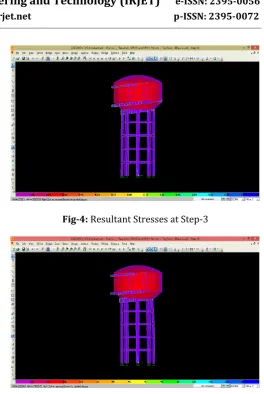
Then significant deformation occurred at the first row of the pillars facing the explosion at step-2. During the shock wave propagation, significant bending deformation and shear breakage were observed in the pillars facing the explosion, and concaved buckling of the shell was also found at step-3.
[image:4.595.298.563.55.450.2]The final failure mode shows that global damage of the structure occurs. At the step-4, some of the pillars lost the support for the shell under the blast loads. A significant amount of concaved deformation was observed at the surface of the shell.
Fig-2: Resultant Stresses at Step-1
Fig-3: Resultant Stresses at Step-2
[image:4.595.30.562.421.789.2]Fig-4: Resultant Stresses at Step-3
Fig-5: Resultant Stresses at Step-4
5.2 Compare Results
Compare the results which is related to maximum stresses occurs on tank with time intervals for different blast load with different geometries for failure analysis.
[image:4.595.305.561.556.681.2]© 2017, IRJET | Impact Factor value: 6.171 | ISO 9001:2008 Certified Journal | Page 5
Chart-14: Shaft-1 Maximum StressesChart-15: Frame-2 Maximum Stresses
Chart-16: Shaft-2 Maximum Stresses
Chart-17: Frame-1 & Frame-2 Maximum Stresses
Chart-18: Shaft-1 & Shaft-2 Maximum Stresses
6. CONCLUSIONS
According to results we can conclude that the highest charge 10m with 0.3 tonne can deform whole structure of tank, with comparison the shaft footed tank have more strength as compare to frame footed tank because of mass concrete.
For the displacement part frame footed tank have more value of displacement as compare to shaft footed tank because of shaft footed tank have more mass concrete. For inner comparison displacement value is increase with height increase in frame footed tank and decrease in shaft footed tank.
According to results, in stresses part the stresses should be increase with increasing height of tank staging in both the cases. Frame footed tank have more stresses as compare to shaft footed tank. So, shaft footed tank can resist more blast charge as compare to frame footed tank.
According to all the comparison and results we can conclude that the shaft footed tank with maximum heights can resist more blast load as compare with all other cases. So, the shaft footed water tank is best solution in blast prone zone.
It is recommended that proper take care of explosion should be taken for the important structures, or proper security should be managed so that explosion should be away as far as possible from the structures and tree plantation and any other obstacles are should be placed in front of structure to resist blast load and protect the structure.
REFERENCES
[1] B.Y. Zhang, H.H. Li, W. Wang, “Numerical study of
© 2017, IRJET | Impact Factor value: 6.171 | ISO 9001:2008 Certified Journal | Page 6
Pattern”, Procedia Engineering 14 (2011) 3076–3087, doi:10.1016/j.proeng.2011.07.387, Elsevier.
[4] Halil Sezen, Ramazan Livaoglu, Adem Dogangun,”
Dynamic analysis and seismic performance
evaluation of above-ground liquid-containing
tanks”, Engineering Structures 30 (2008) 794–803, doi:10.1016/j.engstruct.2007.05.002, Elsevier.
[5] M. Moslemi, M.R. Kianoush, W. Pogorzelski,” Seismic
response of liquid-filled elevated tanks”,
Engineering Structures 33 (2011) 2074–
2084, doi:10.1016/j.engstruct.2011.02.048,
Elsevier.
[6] Yousef Alostaz, PhD, PE, “Blast Loads behind Blast
Walls: are they low enough?” Structures Congress
2014 © ASCE 2014.
[7] ZHANG Li, CHEN Li, FANG Qin, ZHANG Ya-dong,
“Mitigation of blast loadings on structures by an anti-blast plastic water wall”, J. Cent. South Univ. (2016) 23: 461−469, springer.
[8] Graham Atkinson, “Blast damage to storage tanks
and steel clad buildings”, Process Safety and
Environmental Protection 8 9 (2 0 1 1) 382–390,
ELSEVIER.
[9] IS: 456:2000, Plain and reinforced concrete code of
practice, Bureau of Indian Standards, New Delhi.
[10] IS: 1893:2002, Criteria for earthquake resistant
design of structures, Bureau of Indian Standards, New Delhi.
[11] IS: 4991 (1968): Criteria for blast resistant design of
structures for explosions above ground [CED 39:
Earthquake Engineering]
[12] IS: 875 (Part-1, 2, 3): Code of Practice for design
Loads (Other than Earthquake) for buildings and Structures.
[13] Handbook for Blast Resistant Design of Buildings