© 2017, IRJET | Impact Factor value: 5.181 | ISO 9001:2008 Certified Journal
| Page 452
A Study of Construction Chemical Used for Testing in Building
Construction
Anil Gupta, Rahul Satbhaiya
M.Tech Scholar Dept. Of Civil Engineering, Infinity Management & Engineering College Sagar, M.P. India
Asst. Prof. Dept. Of Civil Engineering, Infinity Management & Engineering College, Sagar, M.P. India
---***---Abstract -
-
Performance assessment of RCC buildingstructures can be done while accessing the chemicals which are being used by the engineers for building the complete.
Testing the chemical used in the building constructing. We have considered three main parameters to test & these are as follows:
1. Water Reducers
2. Water Proofers
3. Strengtheners
Tests are as follows:
a) 28 Day cube compressive strength
b) Split tensile strength test
c) Jacketed column test
d) Double shear test
1. INTRODUCTION
WR Series I
i) It is seen that the addition of water reducers increases workability. The slump values and compaction factor values of the mixes containing water reducers are more than that of the reference mix.
ii) From the test results, it is observed that the workability values in terms of slump and compaction factor, of the mixes with 1% dosage of water reducers are greater than with 0.5% dosage.
iii) Mixes with water reducers having chemical bases refined lignosulphonates, naphthalene base and m0elamine base performed well in producing very high workability. This was observed from the results of slump test and compaction factor test.
iv) One of the objectives of adding water reducers is to increase the workability with unchanged strength. On seeing and comparing the results of 28-day strengths of various mixes, it is concluded that melamine based superplasticiser performed best in achieving higher strength in addition to increased workability.
WR Series 2
i) In these mixes, the slump value is found to be less than the slump value of the reference mix.
ii) In the mixes with reduced water content and having water reducers, the slump value is found to be more in the mixes containing 1% dosage than in the mixes having 0.5% dosage.
iii) It is seen that mixes containing refined lignosuiphonates and processed lignosulphonates have very low slump value for 15% water reduction and 20% water reduction. It is concluded that they are plasticisers and able to maintain workability up to 15% water reduction even though they enhance strength.
iv) While reducing water content and adding water reducers, the 28- day compressive strength increased for 10%, 15% and 20% water reduction than the value of reference mix. This increase is less than that with 1% dosage of processed lignosuiphonates based plasticisers.
v) The value of 28-day compressive strength of the mix containing 20% less water than reference mix with 0.5% water reducer was found to be 42.96 N/mm2 which is 55% greater than the strength of reference mix. The water reducer used was naphthalene based one. The corresponding slump value was 11 mm, which is slightly less than that of reference mix.
vi) The advantage of adding water reducer to concrete is to lower the water content thereby increasing strength without affecting workability. On comparing the results, it has been seen that melamine based superplasticiser performed best in achieving good strength on reducing water content while maintaining workability.
WR Series 3
The purpose of this series is to prove that the addition of water reducer helps in the reduction of cement without loss of workability and strength and comparing the performance of mixes containing different water reducers. The following are the observations:
i) The slump is found to be more in the mixes containing 1% dosage than in the mixes with 0.5 % dose.
ii) From the test values, it has been found that the mixes with naphthalene based superplasticiser performed well while reducing cement content without affecting workability and 28 –day compressive strength.
© 2017, IRJET | Impact Factor value: 5.181 | ISO 9001:2008 Certified Journal
| Page 453
by 7.5% and 15% and water reducers were added in 0.5%and 1% dosage by weight of cement. On comparing the costs of reduced cement and added water reducer, it is clear that added water reducer at the dosage of 1% costs more than the cost of reduced cement at 7.5% or 15%.
2. DESCRIPTION OF VARIOUS TESTING
28-day cube compressive strength test
(i) It is seen that the values of compressive strength of specimens jointed with bonding agent are more than those of without bonding agent.
(ii) Among the cube specimens coated with four types of bonding agents, specimens coated with PVA based bonding agent produced a high 28- day compressive strength. The value is 24% greater than that of reference one
(iii) Specimens jointed with epoxy resin based bonding agent also produced good compressive strengths next to PVA based ones.
(iv) The 28-day compressive strength of a normal cube (set of 3 samples) was 27.85 N/mm2. From the test results, it is found that the compressive strength values of jointed cube specimens with bonding agents are less than that of a normal cube.
(v) On seeing the tested cube specimens, it was observed that the failure occurred outside the joints.
Split tensile strength test
(i) Surprisingly the values of split tension of the specimens using SBR based and AR based bonding admixtures were lesser than those of specimen without bonding agent
(ii) Cylinder specimens jointed with PVA based bonding agent produced a high tensile strength value. Its value was nearly 24% more than the specimen without bonding agent.
(iii) Epoxy resin based bonding agent produced high tensile strength next to PVA based one.
(iv) The split tensile strength value of a normal cylinder was found as 1.55 N/mm2. From the test results, it has been seen that the split tensile strength values of cylindrical specimens jointed with bonding agents are less than that of a normal cylinder.
(v) It has been found that, failure occurred at the joints while conducting split tension tests.
Jacketed column test
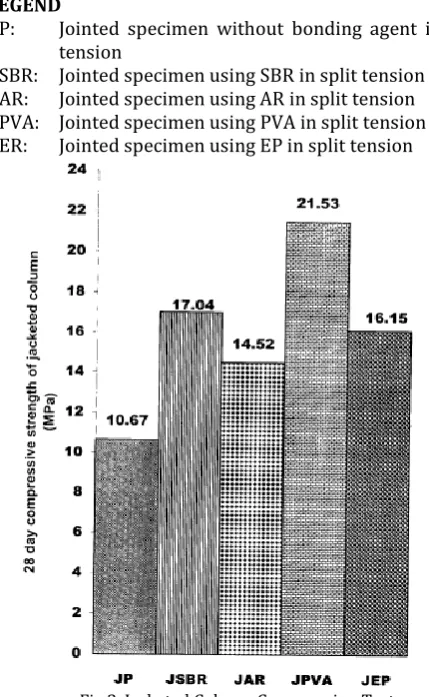
(i) From the test results, it has been seen that the compressive strength values of jacketed specimens with bonding agents are greater than that of specimen without bonding agent.
(ii) The 28-day compressive strength value of jacketed column jointed with PVA based bonding agent is nearly double than that without bonding agent.
(iii) Next to PVA based bonding agent, specimens with SBR based bonding agent produced good compressive strengths.
(iv) Failure occurred at the joints while testing in Compression Testing Machine.
Double shear test
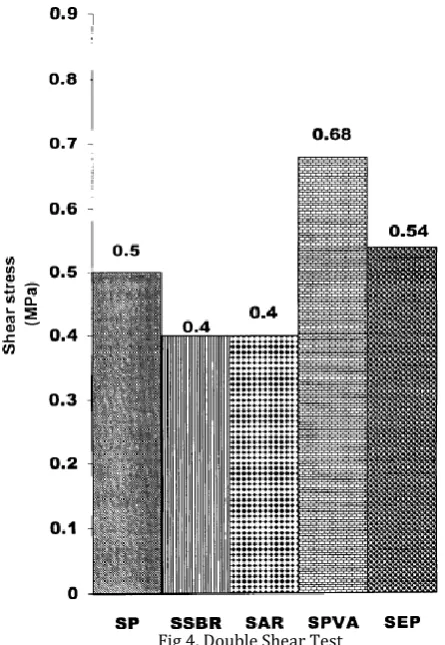
(i) Shear specimens jointed with SBR based and AR based bonding agents produced lesser shear strength values than that without bonding agents.
(ii) Specimens jointed with PVA based bonding agent produced good shear strength, nearly 32% greater than that without bonding agent.
(iii) Epoxy resin based bonding admixture performed well in producing good shear strength, next to PVA based ones
© 2017, IRJET | Impact Factor value: 5.181 | ISO 9001:2008 Certified Journal
| Page 454
[image:3.595.315.530.103.452.2]3. GRAPHICAL REPRESENTATION OF TEST RESULTS
[image:3.595.50.459.127.764.2]Fig.1 cube compression test
Fig 2. Split Tension Test Legend
LEGEND
TP: Jointed specimen without bonding agent in split tension
TSBR: Jointed specimen using SBR in split tension TAR: Jointed specimen using AR in split tension TPVA: Jointed specimen using PVA in split tension TER: Jointed specimen using EP in split tension
Fig 3. Jacketed Column Compression Test
LEGEND
JP: Jointed specimen without bonding agent JSBR: Jointed specimen using SBR
[image:3.595.53.276.146.457.2]© 2017, IRJET | Impact Factor value: 5.181 | ISO 9001:2008 Certified Journal
| Page 455
Fig 4. Double Shear Test
LEGEND
SP: Jointed specimen without bonding agent in shear SBR: Jointed specimen using SBR in shear
SAB: Jointed specimen using AR in shear SPVA: Jointed specimen using PVA in shear SER: Jointed specimen using EP in shear
4.
WATER PROOFERS
Integral waterproofers
i) It is seen that the value of coefficient of permeability is considerably reduced while using integral water proofers with concrete.
ii) From the test results, it is found that the mixes containing integral powder waterproofer performed very well in producing very low permeability concrete. In these cases, the value of coefficient of permeability was in the order of 10-' m/s. Hence they are highly suitable for structural concrete.
iii) Among the two types of liquid integral waterproofers, lignosuiphonates based waterproofer performed better.
iv) Mixes containing both types of integral waterproofers produced higher slump values than the reference mix. Their
28 day compressive strength values also were in line with that of the reference mix. Hence we can conclude that integral water proofers can act as water reducers cum waterproofers. Since they are functioning as water reducers also it is possible to reduce the water content in the mix upto 20% to 30%. Therefore there are chances for further reduction in the value of co-efficient of permeability.
Surface coatings
i) The value of coefficient of permeability of surface coated concrete specimens is found to be less than that value of reference mix.
ii) From the test results it is found that silicone based surface coating performed very well in producing concrete with low permeability.
iii) Coating of rubber based bitumen emulsion was found to perform next to silicone based coating.
iv) The specimens with bitumen based coat and elastomeric cernentitious coating at the top (waterside) produced more or less similar results.
v) Elastomeric cementitious coating is a two component package system, one in the form of powder and the another in the form of liquid. By mixing these two in proper proportion, a slurry is obtained which is applied as the coat over the top of specimen. This procedure seemed to be cumbersome. The mix did not have enough shelf life.
5. WATER REDUCING AGENT NAMES
ADVA® 140M
ADVA® 140M water reducer is a high-range water-reducing admixture that may also be used as a mid-range water reducer.
ADVA® Cast 600
ADVA® Cast 600 admixture is a polycarboxylate based high-range water reducer designed for the production of conventional and Self Consolidating Concrete.
6. CONCRETE GRID
© 2017, IRJET | Impact Factor value: 5.181 | ISO 9001:2008 Certified Journal
| Page 456
concrete needs to cover the steel by more than the minimumthickness, not have large cracks and not have its chemistry altered by environmental factors like chloride attack from deicing salts, carbonation, etc.
[image:5.595.64.260.308.458.2]ACI and PCI (American Concrete Institute, Precast/ Prestressed Concrete Institute) codes specify minimum cover thicknesses depending on the application of the structure. In practice, steel often corrodes due to improper placement of steel reinforcement, moisture drive through cracks, poor workmanship, environmental effects such as deicing salts or coastal environments and a myriad of other causes. Due to the inherent properties of steel reinforced concrete, many structures are expensive, heavy and costly to maintain. The repair of these structures is a multibillion-dollar business worldwide according to industry sources (ICRI International Concrete Repair Institute).
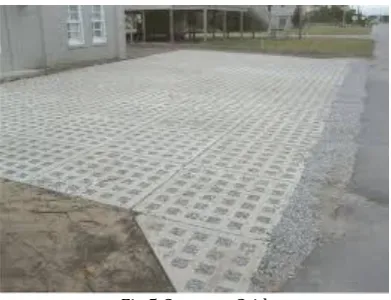
Fig 5 Concrete Grid
7. CONCLUSION
Testing process resulted in great help for the engineers involved in the construction RCC structures that these chemicals are very helpful.
An Engineer must consider these chemicals & codal advice to build a good and bearable building.
REFERENCES
[1]. Kaushal kishore, "High strength concrete", ICI bulletin No.5 1, April-June 1995, p 25 to 31.
[2]. T.B. Viswanath, "Evaluation, selection and uses of Water reducing admixtures at Chamera Hydro Electric project", Institution of Engineers (India) Journal - cv, Feb 1994, p 202 to 207.
[3]. Dr. N.C. Rawal and M.K.Rawal, "Performance of chemical admixtures developed in India" Civil Engineering and Construction Review, May 91, p28 to 31.
[4].K.B. Prakash and Dr.K.T. Krishnaswamy, "Effect of repeated dosages of superplasticisers on the properties of concrete produced from high grade cements", Civil Engineering and Construction Review, May 1996, p 29 to 37.
[5]. T.Manjrekar, "Use of superplasticisers : Myths and reality", The Indian Concrete Journal, June 1994, p 317 to 320.
[6]. A.M. Chalibal, "Superplasticisers in concrete", Civil Engineering and Construction Review, Aug 1991, p 33 to 37.
[7]. Irshad Masood and S.K.Aggarwal, "Use of superplasticisers in cement concrete-Present status and future prospects in India", Civil Engineering and Construction Review, Aug 1993, p 12 to 17.
[8]. M.K. Rawal, "Role of superplasticiser in concrete", Civil Engineering and Construction Review, April 1998, p 57 to 59.
[9]. D.Ghanti, "Construction chemicals and their utilities", Civil Engineering and Construction Review, Aug 1993, p 25 to 28.
[10]. V.Das Gupta, "Concrete admixtures: Facts & fiction", Civil Engineering and Construction Review, Aug 1993, p 21 to 22.