International Research Journal of Engineering and Technology (IRJET)
e-ISSN: 2395 -0056 p-ISSN: 2395-0072 Volume: 04 Issue: 06 | June -2017 www.irjet.netA Survey on Image Retrieval by Different Features and
Techniques
Parul Shrivas
1, Dr. Umesh K. Lilhore
2, Prof. Nitin Agarwal
3 1m.Tech Scholar, Cse Dept. Nri Institute of Information Science &Technology2dr, Cse Dept. Nri Institute of Information Science &Technology 3prof.., Cse Dept. Nri Institute of Information Science &Technology
---***---
Abstract -
As the advanced world is developing with changed sensibly data like archive, picture, video. Out of these picture assumes a fundamental part in a few field like remote detecting, online networking, and so on. currently this increase of information has attract several researchers for looking the relevant pictures from the gathering. This paper gives a brief survey of image retrieval strategies for shifted ecological scenes. Here paper has demonstrate various features of the images with their requirements. Evaluation parameters for the image retrieval algorithm comparison was also discussed in this work.Key Words: CBIR, Digital Image Processing, Image retrieval, Information extraction.
1.INTRODUCTION
Content based generally picture recovery (CBIR) has been a lively investigation space since 1970. It applications has enhanced a few overlap with handiness of low worth plate stockpiles and high speeds processors. Picture databases containing a few pictures zone unit as of now value compelling to shape and keep up. Picture databases have important utilizes as a part of a few fields and in addition meds, biometric security and satellite picture handle. adjust picture recovery might be a key interest for these spaces. Analysts have created numerous procedures for process of pictures databases [1]. These grasp strategies for; sorting, seeking, perusing and recovery of pictures. Ancient picture recovery approach translates picture by content then utilize matter data to recover pictures from text based management framework appeared in fig. 1. This method has numerous disadvantages; it utilizes catchphrases identified with pictures to recover visual data. it's horribly dreary and time taken. it's depleting to clarify the content of different sorts of pictures with matter representation. Catchphrases because of their subjective natures neglect to connect the phonetics hole between the recovery framework and
furthermore the client requests; thus the precision of the recovery framework is low. The watchword for portraying pictures winds up noticeably deficient in monster databases. it's not versatile .
Fig.1 Image retrival by text query.
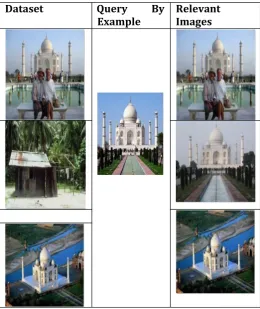
Dataset Query By Example
Relevant Images
calculation and an unearthly chart installing procedure, is connected to coordinate relating charts and to recover pictures in the request of diagram closeness.
[image:2.596.31.292.97.407.2]In [3], the shading highlight is separated from the joint histogram in view of the blend of the tint and immersion and the surface element is extricated utilizing the GCLM include. The k-implies bunching is utilized to group the component of the picture. The ROC bend is attracted request to assess the execution of the element extraction. The chi-square is utilized to discover the comparability between the two pictures. The assessment comes about exhibit the exactness of the recovery in light of the accuracy and review false positive and negative proportion. The ROC bend is utilized to think about the proficiency of the shading, surface and the blend of both the shading and the surface.
Fig. 2 Image retrival by visual query. measuring the
similarity amid the queried image and
images in the database using different statistical methods. In content-based retrieval systems different features of an image query are exploited to search for analogous images features in the database [8]–[10]. So general process of retrieval is explained in fig. 2.
2. RELATED WORK
Bindita Chaudhuri et. al. [2] letter presents a novel unsupervised graph theoretic approach in the structure of district based recovery of remote detecting (RS) pictures. The proposed approach is portrayed by two primary strides: 1) demonstrating each picture by a chart, which gives district based picture portrayal joining both neighborhood data and related spatial association, and 2) recovering the pictures in the chronicle that are most like the inquiry picture by assessing diagram based similitudes. In the initial step, each picture is at first portioned into particular areas and afterward displayed by a credited social diagram, where hubs and edges speak to area qualities and their spatial connections, separately. In the second step, a novel inaccurate diagram coordinating methodology, which mutually abuses a sub graph isomorphism
Iyad Aldasouqi and Mahmoud Hassan [4], proposed a quick calculation for distinguishing human faces in shading pictures utilizing HSV shading model without trading off the speed of identification. The calculation is quick and can be utilized as a part of some ongoing applications.
Vadivel, An et. al., [5], did a point by point investigation of the properties of the HSV (Hue, Saturation and Intensity Value) shading space, laid accentuation on the visual impression of the shade of a picture pixel with the variety in tint, immersion and power estimations of the pixel. Utilizing the aftereffects of this examination, they decided the relative significance of tone and force in light of the immersion of a pixel and connected this idea in histogram era for substance based picture recovery (CBIR) from expansive databases. In customary histograms, every pixel contributes just to one part of the histogram. In any case, they proposed a strategy utilizing delicate choice that adds to two parts of a histogram for every pixel.
International Research Journal of Engineering and Technology (IRJET)
e-ISSN: 2395 -0056 p-ISSN: 2395-0072 Volume: 04 Issue: 06 | June -2017 www.irjet.netnetwork. UBLH takes the grid articulation of neighborhood.
Problem Formulation
Here image cluster was done by K-Means which need to be replaced by some accurate algorithm. Use of shift feature for image clustering was quit time taken. As shift feature have high time complexity. Only visual content of the images were utilize, while textual feature can also be used. Relevancy score of the user query need to be improved. Arrangement of features in the hash table was quit time consuming which should be replaced by other structure as well.
Solutions
Here image cluster was done Teacher Learning Based Optimization genetic algorithm. Use of CCM for image clustering takes less time. As shift feature have high time complexity. Both visual content of the images and textual feature are utilize. Relevancy score of the user query need to be improved by prior clustering of the images. So it was expected that solution will reduce the retrieval time of the work. Here it is desired that image set obtained by the proposed solution is more relevant than existing methods.
3. FEATURES FOR IMAGE IDENTIFICATION
As Image is collection or sequence of pixel and each pixel is treat as single value which is a kind of cell in a matrices. In order to identify an object in that image some features need to be maintained as different object have different feature to identify them which are explain as follows:
Color feature:
Image is a matrix of light intensity values, these intensity values represent different kind of color. so to identify an object colure is an important feature, one important property of this feature is low computation cost .
Different Image files available in different color formats like images have different colure format ranging from RGB which stand for red, green, and blue. This is a three dimensional representation of a single image in which two dimensional matrix represent single color and collection of those matrix tends to third dimension. In order to make intensity calculation for each pixel gray format is use, which is a two dimension values range from 0 to 255. In case of binary format which is a
[image:3.596.325.569.148.387.2]black and white color matrix whose values are only 0 or 1. With the help of this color feature face has been detected efficiently in [8].
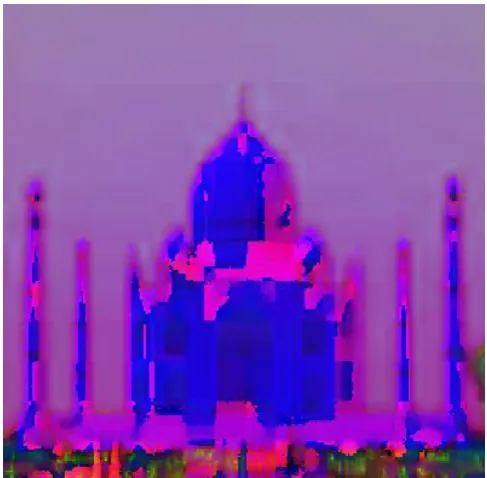
Fig. 3 Represent the HSV (Hue Saturation value) format of an image.
Edge Feature:
Fig. 4 Represent Edge feature of an image.
Corner Feature:
In order to stabilize the video frames in case of moving camera it require the difference between the two frames which are point out by the corner feature in the image or frame. So by finding the corner position of the two frames one can detect resize the window in original view. This feature is also use to find the angles as well as the distance between the object of the two different frames. As they represent point in the image so it is use to track the target object.
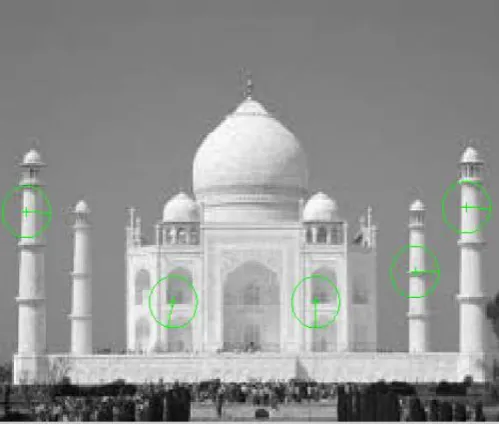
Fig 5 Represent the corner feature of an image with green point.
Texture Feature:
Texture is a degree of intensity difference of a surface which enumerates properties such as regularity and smoothness [1]. Compared to color space model, texture requires a processing step. The texture features on the basis of color are less sensitive to illumination changes as same as to edge features.
CCM:
The statistical approach for image analysis based on the matrix of co-occurrence (CCM Co-occurrence Matrix) is widespread in many fields, alone or synergistically with other analysis, to evaluate the images morphology. This one, better known as “texture” (an innate property of all the virtual surfaces), gives information on the disposition of the structures and their relations with the environment.
4. Techniques of Image Retreival
Image retrieval has been attractive analysis space for many decades. There square measure varied techniques are projected to retrieve the image effectively and with efficiency from the massive set of image knowledge during which a number of the ways square measure represented below:
A. Relevance Feedback
The thought of Relevance feedback could be a powerful technique to reinforce the system search effectively, developed throughout the Nineteen Sixties to enhance document retrieval processes, consists of victimisation user feedback to judge the connection of search results and so improve their quality through unvaried steps. Relevance feedback improves the retrieval accuracy of content-based image retrieval by modifying the query supported the user's feedback during which the user will choose the foremost relevant pictures and supply a weight of preference for every relevant image. The interaction between the system and therefore the user allows the retrieval to approach the user‟s expectation, and eventually achieves the requests [7,10].
B. Support Vector Machine
[image:4.596.55.305.503.715.2]International Research Journal of Engineering and Technology (IRJET)
e-ISSN: 2395 -0056 p-ISSN: 2395-0072 Volume: 04 Issue: 06 | June -2017 www.irjet.netis made, such style of strategy is thought as characterization, once if yield is nonstop than relapse performed. For developing most isolating hyper planes SVM maps input vector to a superior measurement highlight space. Highlight space alludes to partner include space that is held for estimation comparability with the help of bit capacity. It‟s high measurement space wherever straight detachment turns out to be horrendously less demanding than information space. In this, information is revised into a set length test vectors. Here are a unit two terms that area unit utilized in feature space i.e. known as feature values and feature vectors. The features of image is named feature values and these feature values conferred the machine in a very vectors is understood as feature vectors. Kernel function utilized in the kernel methodology activity some operation like classification, clustering upon completely different classes of knowledge like content record, movement, vectors, group of focuses, picture and charts and so on. It maps the info information into a superior measurement highlight space subsequently of amid this information can be essentially isolated or better organized. There are a unit a few focuses inside the element house that territory unit isolated by a long shot is named bolster vectors. It is the reason between beginning which point and shows the circumstance of the extractor. The separation from the decision surface to the storeroom datum closes the edge the classifier [11].
C. Square Truncation coding (BTC)
BTC could be a lossy pressure system that utilizations minute saving division strategy for press advanced pictures. In piece truncation coding (BTC), the main picture is part into settled size non covering squares of size M×N. The square size picked is normally little to maintain a strategic distance from the sting obscuring and piece result. Each piece is severally coded utilizing a two level (1-bit) quantizer. At that point, the technique registers the normal and furthermore the change for each square. Next, they generate a two-level bitmap to record whether or not the picture element is larger than the average of the block or not. If the picture element is smaller than the average of the block, the theme used „„0‟‟ to represent the picture element. Otherwise, the theme used „„1‟‟ to represent the picture element. The two values preserve the primary and also the moment characteristic of the first block [8-9]. The block truncation coding methodology uses the bitmap, the average and also the variance to represent and recover the image. It‟s evident that the
average and also the variance properties will be wont to state the first color and also the condition of picture element color variation in a picture, severally. Moreover, the bitmap describes the local variation of pixels. These properties depict the characteristics of a picture that may be treated as image features.
D. Image Clustering
Image Clustering will be a broadly advantage for dipping the sharp time of images in the database. Fuzzy C-Mean clustering (FCM) is a technique for get- together which lets one a player in information to go to at least two groups. In fuzzy grouping information nuts and bolts can have a place with more than one bunch, and with each section an arrangement of participation levels is connected. These assign the quality of the association between that information component and a specific bunch. fuzzy bunching is a strategy for passing on these participation levels, and after that devouring levels to dispense information components to at least one groups.
III. Evaluation Parameters
As various techniques evolve different steps of working for retrieving images from appropriate dataset. So it is highly required that techniques or existing work need to be compare on same dataset. So following are some of the evaluation formula shown in equation which help to judge the image ranking techniques.
NDCG [6] as the performance evaluation measure. The NDCG measure is computed as
where P is the considered depth, l(i ) is the relevance
level of the i -th image and ZP is a normalization constant that is chosen to let the optimal ranking’s NDCG score to be 1.
Actual System
True False
Positive TP FP
Negative TN FN
Recall = true positives / (true positives +false negatives)
F-score = 2 * Precision * Recall / (Precision + Recall)
In order to evaluate results there are many parameter such as accuracy, precision, recall, F-score, etc. Obtaining values can be put in the mention parameter formula to get better results.
6. Conclusions
With the popularity of picture in different fields specialists get pulled in for investigation. This paper have evaluated diverse properties of the picture that are utilized to depict the substance of a picture and different strategies for ordering in light of highlight vector. It is demonstrating that most content based picture retrieval framework manages low level elements. The conventional content based retrieval frameworks are ignorant concerning the genuine content of the pictures. So to enhance the accuracy of the recovery framework content based picture recovery framework was presented. CBIR recover pictures in view of the visual elements like shading, surface and shape. In future an impeccable calculation is required with great component mix which can retrieve pictures of various scenes.
REFERENCES
[1]. S. Kaur and Dr. V. K. Banga, “Content Based Image Retrieval:Survey and Comparison between RGB and HSV”, model AMRITSAR COLLEGE OF ENGG & TECHNOLOGY, Amritsar, India, 2013.
[2]. Bindita Chaudhuri, Begüm Demir, Lorenzo Bruzzone, and Subhasis Chaudhuri. “Region-Based Retrieval of Remote Sensing Images Using an Unsupervised Graph-Theoretic Approach”. IEEE GEOSCIENCE AND REMOTE SENSING LETTERS, VOL. 13, NO. 7, JULY 2016 987
[3]. Sridhar, G., “Color and Texture Based Image Retrieval, (2009).
[4]. I. Aldasouqi and M. Hassan, “Human face detection system using HSV”, Proc. Of 9th WSEAS Int. Conf. on Circuits, Systems, Electronics, Control & Signal Processing (CSECS’10), Atenas, Grecia, (2010). [5]. A. Vadivel, A. K. Majumdar and S. Sural,
“Perceptually smooth histogram generation from the HSV color space for content based image retrieval”, International Conference on Advances in Pattern Recognition, (2003).
[6]. Li Liu, Mengyang Yu, Student Member, IEEE, and Ling Shao .”Unsupervised Local Feature Hashing for Image Similarity Search”. IEEE TRANSACTIONS ON CYBERNETICS, VOL. 46, NO. 11, NOVEMBER 2016.
[7]. Shanmugapriya, N. and R. Nallusamy, “a new content based image retrieval system using gmm and relevance feedback”, Journal of Computer Science 10 (2): 330-340, 2014 ISSN: 1549-3636. [8]. E. J. Delp and O. R. Mitchell, “Image compression
using block truncation coding,” IEEE Trans. Commun., vol. 27, no. 9, pp. 1335–1342, Sep. 1979. [9]. Guoping Qiu “Color Image Indexing Using BTC” IEEE
Transaction on image processing, VOL. 12, NO. 1, January 2003.
[10]. Patil, P.B. and M.B. Kokare, “Relevance feedback in content based image retrieval: A review” J. Appli. Comp.Sci. Math., 10: 41-47.