© 2017, IRJET | Impact Factor value: 5.181 | ISO 9001:2008 Certified Journal | Page 695
Decisive Taxi Booking Model Using Big Data
Apoorva D, Rajesh Kumar Pathak, Kanmani S.P
Department Of Computer Science and Engineering,
SRM University.
---***---ABSTRACT:
Taxis play a vital theatrical role in urban transformation in terms of local and regional approachability to and from the city. Taxi number one wood s’ conclusion to make misstep are one of the most important factors that maintain taxicab demand and supplying sense of balance in the city. The fashion model provides an important tool which can be used to suggest and assess insurance policy recommendations for improving taxi trading operations in cities. Considering the increasing handiness of taxi trip book in the worldly concern, the suggested methodology can also be applied universally. These are often caused due to the driver’s disinterest in pick up certain rider. We therefore aim at building a model that analyses traffic patterns and passenger and driver behaviour to increase upper limit profitability, avoid empty rides and also reduces the waiting time of passengers rendering the stallion organization more efficient. The polynomial time algorithm can be used to create graphs and the probabilities of idle times of drivers can be plotted on a graph based of the time of day of the day. This will better help a centralized organization to create dynamic path for any driver. The efficiency of this proposed system is assumed to be LX -90%. To overcome the hitch Big Data was under the limelight to analyse such a colossal Dataset. Big Data can effortlessly analyse the thousands of GB within a fractions second and expedite the procedure. This information can be analysed for several purposes like avoiding traffics, lower rate where services are not functioning more frequency than a cab on jacket crown location and many more. This information can be used by numerous authorities and industries for their own purpose. Government official can use this data to deliver supplementary public transport service.
Keywords—Big data; Map Reduce, Hive, Base, Spark, Logistic regression, Decision model
1. INTRODUCTION
The Global Positioning System (GPS) is an orbiteer positioning technology developed by the U.S. Department of Defence team (United States Department of Defence). This technology can be used in military and for the public for marine and ground fomite positioning.2 Commercial products using GPS telephone receiver
© 2017, IRJET | Impact Factor value: 5.181 | ISO 9001:2008 Certified Journal | Page 696 arrangement being introduced to speed up the radio set -
hack service. Those who register as regular users must provide their particular proposition and a list of their usual filling -up distributor compass level. The information will be keyed into the data processor sized arrangement of rules. When regular rider s dial their PIN and follow a set of recorded messages to “tell” the system of rules where they are, the computer will identify them and their cream -up points. If regular customer are at locations other than those listed as usual pick-up points, they will have to use the operator-assisted system—like other nonregistered passenger s. Registered regular customer use the system by following these whole tone : single . When regular rider earphone yells for a hack cab by phone, an automated representative system guides them to key their PIN and pick-up point. Two. The call goes to the exchange computer system and is sent to taxis via a Mobile Data Meshing. 3. Using General practitioner, the system can track and locate the most suitable taxi (based on a number of operator-defined criteria) that is the nearest to the passenger’s pick-up point and can reach the passenger fastest. 4. The system dispatches the call, and the booking details are sent to the assigned number one wood via the Mobile Data Network, which is said to greatly reduce the communicating time required. Then, the passenger’s pick-up point will appear on a display depot next to the fascia in the number one wood’s car. 5. As soon as the taxi number one wood receives details of pick-up points and destinations on the display pole and accepts the call, the driver will be dispatched and a computerized voice message will tell the passenger the number of the vehicle on its way. If the cabman does not accept the call, the next nearest taxi will be dispatched. Nonregistered client will still use an operator-assisted system to call for a cab.
2. BIG DATA
The grandness of big information doesn’t revolve around how much data you have, but what you do with it. You can take data from any source and analyse it to find reply that enable
1) Price reductions, 2) fourth dimension reductions, 3 )new intersection exploitation and optimized offerings, and 4) smart decision fashioning . When you combine big data with high-powered analytics, you can accomplish business-related tasks such as:
•Decondition inning root causes of failures, matter and defects in near-real number time.
•Generating coupons at the point of sale based on the customer’s buying use.
•Recalculating entire risk portfolios in minutes. •Detection fraudulent behaviour before it affects your organization.
While the term “big data” is relatively new, the act of gathering and storing large amounts of information for eventual analytic thinking is ages old. The concept gained momentum in the early 2000s when manufacture analyst Doug Laney articulated the now-mainstream definition of big data as the three vs.: Volume: Brass collect information from a variety of origin , including business transactions, sociable media and information from sensor or machine -to-machine information . In the past, storing it would’ve been a problem – but new technologies (such as Hadoop) have eased the burden. Velocity: Data streams in at an unprecedented speeding and must be dealt with in a timely style. RFID ticket, sensors and smart metering are drive the need to deal with torrents of information in near-real time.
Diversity: Data comes in all eccentric of formats – from structured, numeric data in traditional databases to unstructured text documents, email, TV, sound, stock ticker data and financial transactions. At SAS, we consider two additional proportion when it comes to big data:
Variability: In addition to the increasing velocities and variety of data, data catamenia can be highly inconsistent with periodic peaks. Is something trending in social media? Daily, seasonal worker and event-triggered peak data loads can be challenging to manage. Even more so with unstructured data.
Complexity: Today's data comes from multiple sources, which makes it difficult to inter-group communication, match, cleanse and transform data across systems. However, it’s necessary to connect and correlate relationship, pecking order and multiple data linkage or your data can quickly spiral out of control.
© 2017, IRJET | Impact Factor value: 5.181 | ISO 9001:2008 Certified Journal | Page 697 and still icon data, which is the format most useful for
most big data applications. This also shows the voltage of yet unused data (i.e. in the form of video and audio content). While many vendors offer off-the-ledge solutions for big data, expert recommend the evolution of in-theatre solutions usage -tailored to solve the society’s problem at deal if the company has sufficient technical capabilities.
3. URBAN TAXI SYSTEM
The cab help systems in big cities are immensely complex due to the interaction and self-organization between taxicab number one wood and passengers. An inefficient taxi inspection and repair system leads to more empty trips for drivers and longer waiting metre for passengers, and introduces unnecessary congestion to road network. Although understanding the performance of urban taxi service system is important, the performance of the urban taxi service is rarely examined.
In this experimental newspaper, we investigate the efficiency story of the cab service dodging using real world large -scale taxi trip data. By assuming a hypothetical system -wide good word system, two approaches are proposed to find the theoretical optimal scheme that minimizes the cost of vacant trips, and solvent in minimum number of taxis required to satisfy all observed trips. The optimization problems are transformed into equivalent graph problems and solved using polynomial time algorithms. The taxi trip data in New York Metropolis is used to quantitatively examine the gap between the current system performance and the theoretically optimal system. The numerical solvent indicate that if a centralized system-wide recommendation scheme applied, it is possible to reduce 20% to 90% aggregate vacant trip monetary value
depending on different objectives, and 1 /3 of all taxi s that required to serve all observed trips. The huge performance gap obtained suggests an urgent need for the system of rules reconsideration in taxi recommendation system design.
© 2017, IRJET | Impact Factor value: 5.181 | ISO 9001:2008 Certified Journal | Page 698 Several works on ridesharing systems have been
developed with the consideration of time, capacity and monetary constraints. Despite the technological advance in ridesharing services, non-technical problem remain, such as the credit of a passenger and taxi driver as well as security payoff. The geo-location data is seen as the remedy for the asymmetric info between drivers and passengers and is appearance to be helpful for more efficiently taxi and passenger matching. While some drivers or passenger are benefited from the aforementioned taxi dispatching and recommendation scheme, whether the efficiency of the stallion system is improved stiff questionable. Prerequisite and first harmonic research questions to be answered are how efficient is the current taxi service system, and how to quantitatively evaluate the performance level of the current system
4. PROPOSED ARCHITECTURE
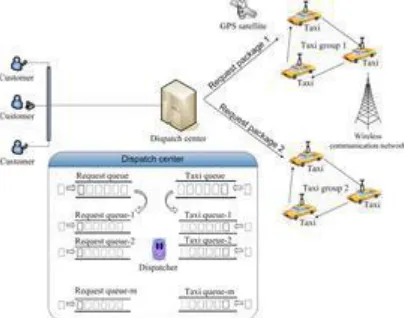
The basic architecture of a current taxi dispatch system in use by a taxicab operator in Singapore and elsewhere. Incoming taxi service requests are queued on a first-come, first-served basis at the expedition centre. For each client (online reservation) request, available taxis in the neck of the woods of the customer pick-up fix are considered, and a taxi among them is dispatched to service it, upon the homo driver acknowledging acceptance of the booking job. It is empirically confirmed that an efficient way of dispatch is to assign a nearby taxi that can crossbeam the shortest-time route to the customer pick-up localisation, computed using real-time traffic information over a road network. In general, it is not feasible to compute the (locally) shortest-time path for each of a possibly large issue of available taxis nearby a customer location, since determining such a path requires a considerably significant amount of figuring time. Thus, it has been assumed that a taxi with the shortest-time path is discovery among a limited identification number in the vicinity that are the nearest in terms of their shortest straight-line of reasoning length to the customer placement. As a remark , besides and a related but different effort that empirically examines the performance improvement of using
General practitioner in taxi dispatch operations, there is apparently little work in the published literature on automated taxi dispatch. This is despite its grandness and commercial interest.2 Henceforth, for comparison purposes, we shall assume that the existing (state-of-the-artwork ) taxi dispatch organization available employ the centralized architecture of Fig. 2 and applies the dispatch method proposed in. In our opinion, this scheme should equivalence favourably with the centralized dispatch system provided by a marketplace leader. According to the website (WWW .cordic.com), the commercial system comrade every taxi service request with a taxi waiting line according to its customer weft -up location, and then offers it to the first taxi in that queue
In this section, we propose an architecture to integrate the cover -close system that produces rich hack cab data selective information with a smartphone practical application front-end to enable historic cab data information to be offered to drug user as a Mobile River Service. Taxicab cabs are already equipped with GPS devices that can upload acquired samples to the back-end via a cellular data network. Each cab is a mobile unit that records information regarding its surroundings. Next we propose a mobile application to armed service drug user utilizing the results we obtained from the taxi dataset via big data technologies. The proposed architecture is shown in Al-Jama'a al-Islamiyyah al-Muqatilah bi-Libya
© 2017, IRJET | Impact Factor value: 5.181 | ISO 9001:2008 Certified Journal | Page 699
Fig. 2. Architecture to combine taxi data
Through big data analysis described in Section Seven , we provide function and heat map s of placement where taxicab pick-ups occur most frequently according to different time of day for both yellow and greens taxis in NYC. Our app collects the 1 sense of gap coordinates and current time from the exploiter ’s sound . Using the map of frequent pick-up fix , our help directs the drug user to the location having the highest probability of quick pick up. This Service allows users who can’t find taxis to be directed to position where there is a high level of pick-up activities. Similar to pick-up locations, the drop-off -off locations map Tell us where there is the greatest issue of taxi drop-offs. In the font where a user is far from all pick-up location hotspot s, he/she is directed to a hotspot for drop-offs.
5. METHODOLOGY
This department presents the contingent of the two attack used to evaluate the efficiency of the taxi religious service scheme , namely the optimal matching and the tripper integration. Consider following two facet of the efficiency in the taxi service system: • If the information for both the taxis and rider are known within a prison term interval, how to match the given set of vacant taxis and the passengers so that the total time/length or revenue loss are minimized
If a given circle of cab head slip are known beforehand, how to combine a chronological succession of head trip s served by individual cab s to achieve the minimum utilization of the number of taxis and lower the total trip cost? The first inquiry question associates with the issue
that taxi driver tend to spend too much time or travel extra knot than actually needed to find the next passenger. The second enquiry question is particularly meaningful if there is a high demand for taxis while the supply is very limited, such as during peak hours. Apparently, the system efficiency will be improved by addressing either of the two troubles. The optimal matching provides an optimal answer for the first scenario while the second one is addressed by the trip integration.
6. EXPERIMENTAL RESULTS AND
EVALUATION
In this section, we have evaluated public presentation between Map Reduce and Hive of all the Job definition of defined in Problem Definition 1 and Problem Definition 2. The result was as expected Map Reduce discharge faster than hive . But when it comes to complex query like in Problem Definition thereto and
[image:5.595.37.239.575.734.2]Problem Definition 4 than hive is preferred as it is easy to write and understand.
Fig. 7. The urban road network model used
© 2017, IRJET | Impact Factor value: 5.181 | ISO 9001:2008 Certified Journal | Page 700 The first analysis i.e. Analysis on Individual Person can
helpful for determining the ability of the individual driver.
We can determine the ability like efficient, quick , truth etc. which can be helpful in evaluating the individual and reward the individual who is doing great study or railroad train the individual who is struggling to do the goodness work. In second analytic thinking we determine which region has highest cartridge and fall -off location, it helper vendor to provide more cab s where there is more pickup and lessen the bit of taxi where there is more drop-off. In this way system will work more efficiently.
7 CONCLUSION
In conclusion, leveraging on the shortest-prison term paths computed using real number -clip traffic information , the proposed NTuCab dispatch arrangement can potentially achieve high efficiency , particularly in limiting customer waiting time provided the demand for hack service is manageable for a fleet size. Explicated in this paper are, in our opinion, important theoretical and empirical insights about our proposed multivalent approach. These fundamental insights would serve as a radical reference in further research and development on automating distributed taxicab dispatch, including the preparation and investigating of new A-QoS rule to incorporate human being drivers’ preferences. The issues of non-functioning
satellites, heavy rain and other environmental conditions also need to be bailiwick and tested by long-term practical use. The taxi companies conclude that in spite of the limit of the current sense of gap -based organization , based on the result of actual use for several calendar month , the new arrangement is more efficient than the previous radio-voice engagement system. At the same time, further improvements of the system of rules are under circumstance . We proposed an efficient dispatch and decision model for taxi-booking service and used evolutionary secret plan theory to optimize the behaviour of taxi drivers and passengers. GPS trajectory data from Transport Committal of Shenzhen Municipality was used to evaluate the performance of the proposed system.
8. REFERENCE
[1] S. Osswald, N. Brueckel, C. Brickwedde, M. Lienkamp, and M. Schoell. Taxi Checker: A Mobile Application for Real-Time Taxi Fare Analysis. Adjunct Proceedings of the 6th International Conference on Automotive User Interfaces and Interactive Vehicular Applications, Sep 17-19, Seattle, WA, USA, 2014.
[2]S. Ma, Y. Zheng, and O. Wolfson. Real-Time City-Scale Taxi Ridesharing. IEEE Transactions on Knowledge And Data Engineering, VOL. 27, NO. 7, JULY 2015.
[3] J. Aslam, S. Lim, X. Pan. City-Scale Traffic Estimation from a Roving
Sensor Network. SenSys’12, Nov. 6–9, Toronto, ON, Canada, 2012.
[4]J. A. Deri, J. M. F. Moura. Taxi data in New York City: a network perspective. 2015 49th Asilomar Conference on Signals, Systems and Computers, Nov. 2015.
[5]L. Zhang, J. Liu, H. Jiang, Y. Guan. SensTrack: Energy-Efficient Location Tracking With Smartphone Sensors. IEEE Sensors Journal, July 2013.
[6]R. Ganti, I. Mohomed, R. Raghavendra, and A. Ranganathan. Analysis of Data from a Taxi Cab Participatory Sensor Network. MobiQuitous 2011, LNICST 104, pp. 197–208, 2012.
[7]J. Freire, C. Silva, H. Vo, H. Doraiswamy, N. Ferreira, J.e Poco. Riding from Urban Data to Insight Using New York City Taxis. IEEE Computer Society Technical Committee on Data Engineering, 2014.
[8] V. Salnikov, R. Lambiotte, A. Noulas, and C. Mascolo. OpenStreetCab: Exploiting Taxi Mobility Patterns in New York City to Reduce Commuter Costs. NetMob, MIT, April 8-10, 2015.
[9]J. W. Y. Chan, V. L. N. Chang, W. K. Lau, Lawrence K. T. Law, and C. J. Lei. Taxi App Market Analysis in Hong Kong. Journal of Economics, Business and Management, Vol. 4, No. 3, March 2016.
© 2017, IRJET | Impact Factor value: 5.181 | ISO 9001:2008 Certified Journal | Page 701 Transportation Research Part A: Policy and Practice,
45(6):476–484, 2011.
[11]Charles F Manski and J David Wright. Nature of equilibrium in the market for taxi services. Technical report, 1967.
[12]George W Douglas. Price regulation and optimal service standards: The taxicab industry. Journal of Transport Economics and Policy, pages 116–127, 1972. [13] Carlos F Daganzo. An approximate analytic model of many-to-many demand responsive transportation systems. Transportation Research, 12(5):325–333, 1978.
[14] Hai Yang and SC Wong. A network model of urban taxi services. Transportation Research Part B: Methodological, 32(4):235–246, 1998.