Performance Evaluation of MPLS TE Signal Protocols
with Different Audio Codecs for Voice Application
Sarmad K. Ibrahim
Computer Engineering Department, Nahrain University
Baghdad, Iraq
Mahmoud M. AL-Quzwini
Computer Engineering Department, Nahrain University
Baghdad, Iraq
ABSTRACT
This paper studies the performance of MPLS networks with TE signal protocols in relation with voice codecs. Simulation were performed and compared for a multisite network with PCM and GSM based VoIP. Simulation results show that the MPLS network with CR-LDP TE signal protocol outperforms the MPLS network with RSVP TE signal protocol in terms of both the total amount of received voice packets and the number of maintained calls for both voice codecs.
General Terms
Computer network and communication
Keywords
MPLS; VOIP; CODECS, MPLS, LSP, Traffic Engineering, LSR, LER, LDP, FEC, QOS.
1.
INTRODUCTION
In the last years there have been an enormous growth in the use of Internet, and new real-time connection-oriented services like streaming technologies and mission-critical transaction-oriented services are in use and new ones are currently emerging. The increased number of Internet users made the popular services Television and Telephone to use the Internet as a medium to reach their customers [1]. Voice over IP is also known as IP telephony or broadband telephony. It routes voice conversations over IP-based networks including the Internet. VoIP has made it possible for businesses to realize cost savings by utilizing their existing IP network to carry voice, video and data; especially where businesses have underutilized network capacity that can carry .VoIP at no additional cost on their Local Area Networks Reyadh Shaker Naoum ,Mohanand Maswady [2]. However providing the Real-time applications on Internet is a challenging task for the conventional IP networks as it uses best-effort services which doesn’t provides guarantee quality of services and Traffic Engineering(TE).MPLS technology works to solve those shortcomings of IP. MPLS merges the flexibility of the IP routing protocols with speed that ATM switches provide to introduce fast packet switching in frame-based IP networks [3].MPLS is not designed to replace IP; it is designed to add a set of rules to IP so that traffic can be classified, marked, and policed. MPLS as a traffic-engineering tool has emerged as an elegant solution to meet the bandwidth management and service requirements for next generation Internet Protocol (IP) based backbone networks [4]. WAN bandwidth is probably the most expensive and important component of an enterprise network, Network administrators
utilization, a description in detail for coder-decoders (Codecs), codec complexity and the bandwidth requirements for VoIP calls. Codecs are especially important on low-speed serial links where every bit of bandwidth is needed and utilized to ensure network reliability. Analyzing and optimizing voice traffic over data networks have been a major challenge to researchers and developers, many techniques have been proposed based on analyses from real word and simulated traffic. Mahesh Kr. Porwal, Anjulata Yadav & S. V. Charhate. in [5] have made a comparative analysis of MPLS over Non-MPLS networks and showed that MPLS have a better performance over IP networks, through this paper a comparison study has been made on MPLS signaling protocols (CR-LDP, RSVP and RSVP-TE) with Traffic Engineering by explaining their functionality and classification. The Simulation of MPLS and Non-MPLS network is done; performance is compared by with consideration of the constraints such as packet loss, throughput and end-to-end delay on the network traffic. Ravi Shankar Ramakrishnan & P. Vinod kumar. in [6] analyzed three commonly used codecs using peer-to-peer network scenario. The paper presents OPNET simulator and they were considered only in Latency, Jitter and Packet loss. They were able to present from the results that G.711 is an ideal solution for PSTN networks with PCM scheme. G.723 is used for voice and video conferencing however provides lower voice quality. Music or tones such as DTMF cannot be transmitted reliably with G.723 codec. G.729 is mostly used in VoIP applications for its low bandwidth requirement that’s why this type is mostly common on the WAN connections and to transport voice calls between multisite branches. Md. Arifur Rahman, Ahmedul Haque Kabir. in [7] they calculated the minimum number of VoIP calls that can be created in an enterprise IP network. The paper presents OPNET simulator designing of the real-world network model. The model is designed with respect to the engineering factors needed to be reflected when implementing VoIP application in the IP network. Simulation is done based on IP network model to calculate the number of calls that can be conserved. Umber Iqbal ,Younas Javed, Saad Rehman in [8] , their Simulation experiments, they observed that SIP module provides and reduced congestion over access networks. Reyadh Shaker Naoum et al.in paper [2] a simulation were performed and compared for a multisite office network for G.723 VOIP communication traffic applied on two network infrastructure models: one for IP and the other for MPLS.
VoIP equipment. Furthermore, this study will help to predict the number of VoIP calls that can be maintained by the network while satisfying VoIP requirements.
2.
MPLS Concepts
MPLS is a technology to forward the packets in IP unaware networks. Entire MPLS network can be divided into two parts namely MPLS edge and MPLS core [4]. MPLS edge is the boundary of the MPLS network consisting of ingress and egress routers (see Figure 1). MPLS core encompasses intermediate Label Switching Routers (LSRs), through which Label Switched Paths (LSPs) are formed. General terms associated with MPLS network and their meaning is specified below:
1) Label Switching Router (LSR): LSR is a type of MPLS router which operates at the boundary and core of the MPLS network. Ingress and egress router are the two types of edge LSR. The ingress router attaches a new label to every incoming packet and forwards it into MPLS core.
2) Label Switched Path (LSP): It is a route established between two edge LSRs which act as a path for forwarding labeled packets over LSPs.
[image:2.595.59.277.373.456.2]3) Label Distribution Protocol (LDP): It is a protocol used by the routers to create a label database. RSVP (Resource Reservation Protocol) and CR-LDP (Constraint-based Routed Label Distribution Protocol) are some type of LDPs.
Fig 1: MPLS Domain network.
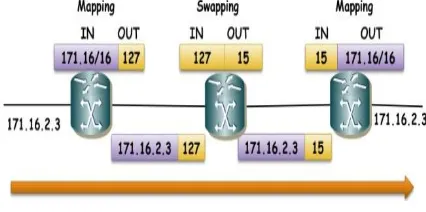
The MPLS operation is clearly shown in Figure 2. Initially each of the MPLS routers creates a table. LDP uses the routing table information to establish label values among neighboring LSRs and created LSPs. As soon as a packet arrives at ingress router, it assesses the QoS and bandwidth requirement demands of the packet and assigns a suitable label to the packet and forwards into MPLS core. The labeled packet is transmitted over several LSRs inside the MPLS core till it reaches the egress router. Egress router takes off the label and reads the packet header and forwards it to appropriate destination node.
Fig 2: MPLS Domain network.
3.
Traffic Engineering Signal Protocols
Traffic Engineering is the process of selecting network paths so the traffic patterns can be balanced across the various route choices. The use of LSPs in MPLS can help balance the traffic on network link event [9]. It allows a network administrator to make the path deterministic and bypass the normal routed hop-by-hop paths. An administrator may elect to explicitly define the path between stations to ensure QoS or have the traffic follow a specified path to reduce traffic loading across certain hops. In other words, the network administrator can reduce congestion by forcing the frame to travel around the overloaded segments. Traffic engineering, then, enables an administrator to define a policy for forwarding frames rather than depending upon dynamic routing protocols ,Traffic engineering is similar to source-routing in that an explicit path is defined for the frame to travel, However, unlike source-routing, the hop-by-hop definition is not carried with every frame [10].
Signaling is a way in which routers exchange relevant information. In an MPLS network, the type of information exchanged between routers depends on the signaling protocol being used. At a base level, labels must be distributed to all MPLS enabled routers that are expected to forward data for a specific FEC (Forwarding Equivalent Class) and LSPs created. The MPLS architecture does not assume any single signaling protocol [11]. The power of MPLS depends on its TE capabilities and the efficiency of control plane i.e. routing and signaling. The routing protocols are basically re-used from the IP system. Consequently, the design of signaling protocols is something that brings new functionalities and thus is very important for general operation as well as for TE. In this way Constraint based routed Label Switched Path CR-LSPs are used for TE in MPLS [10]. Two protocols are used to set CR-LSPs in MPLS that are:
Constraint based routed LDP (CR-LDP)
Resource Reservation Protocol (RSVP-TE)
3.1
Constraint Based Routed Label
Distribution Protocol (CR-LDP)
[image:2.595.61.274.625.731.2]Fig 3: CR-LDP signal protocol.
3.2
Resource Reservation Protocol
(RSVP-TE)
RSVP-TE is an extension of RSVP that utilizes the RSVP mechanisms to establish LSPs, distribute labels and perform other label-related duties that satisfies the requirements of TE [13]. The revised RSVP protocol has been proposed to support both strict and loose explicit routed LSPs (ERLSP). For the loose segment in the ER-LSP, the hop-by hop routing can be employed to determine where to send the PATH message [14].RSVP is the soft state protocol. It uses Path and RSVP commands to establish path. The CR-LSPs established by RSVP signaling protocol in MPLS network is described by the following steps:
1. The Ingress router in the MPLS network selects a LSP and sends the Path message to every LSR along that LSP, describing that this is the desired LSP used to establish as CR-LSP.
2. In this process the Path and RSVP messages are send periodically to refresh the state maintained in all LSRs along the CR-LSP [7]shown in Figure 4. 3. The LSRs along the selected LSP reserve the
resources and that information is send to Ingress router using the RSVP message.
Fig 4: RSVP signal protocol.
List of difference between CR-LDP and RSVP mentioned in table (1).
Table 1 . Compared network between signal protocols
CR-LDP RSVP
LSP State Hard Soft
LSP Architecture Sink Tree Source Tree
LSP Failure Detection
Reliable Unreliable
Scalability Good Marginal
4.
Simulation
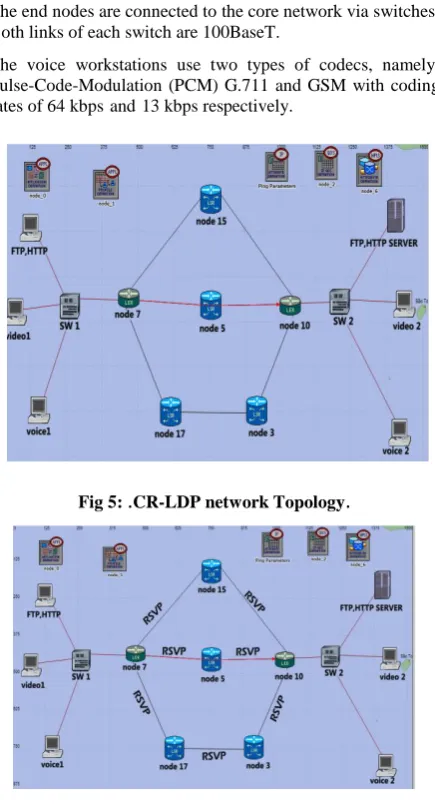
The simulation environment employed in this paper is based on OPNET 14.5 simulator which is extensive and powerful simulation software. Figures 5 and 6 show an MPLS network with CR-LDP and RSVP TE signal protocols respectively. The VoIP traffic is sent from source (voice 1) to destination (voice 2), the video traffic is sent from source (video 1) to destination (video 2), FTP and HTTP traffic is sent from source (FTP, HTTP) to destination (server). Internet Core consists of six routers and two switches. These routers are connected with DS3 cable with data rate of 44.736 Mbit/s. The end nodes are connected to the core network via switches. Both links of each switch are 100BaseT.
[image:3.595.321.539.195.599.2]The voice workstations use two types of codecs, namely, Pulse-Code-Modulation (PCM) G.711 and GSM with coding rates of 64 kbpsand13 kbps respectively.
[image:3.595.324.536.265.430.2]Fig 5: .CR-LDP network Topology.
Fig 6:
.
RSVP network Topology.
The voice delay can be divided into three contributing components which are described as follows [2], [15]:
The delay introduced by the G.711 codec for encoding and packetization are 1 ms and 20 ms respectively. The delay at the sender considering above two delays along with compression is approximated to a fixed delay of 25ms.
[image:3.595.99.253.505.573.2] [image:3.595.63.273.637.742.2] The overall network delay can be calculated from the above sender and receiver delays to be 80 ms approximately (150-25-45) ms .
[image:4.595.331.532.80.232.2] In GSM codec, the overall network delay will be 150 ms approximately [2], [15].
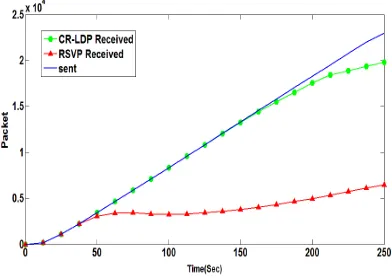
Figure 7 shows the results of voice traffic transmitted over MPLS network with CR-LDP and RSVP TE signal protocols using PCM codec. As shown in the figure, RSVP starts dropping packets at time 40 second of the simulation while CR-LDP starts dropping voice packets at 170 second of the simulation. It has to be noted that in both scenarios voice traffic starts at 10 second, this will be the case for all the following simulations.
Fig 7: Average number of voice PCM codec packet between two signals protocols
Figure 8 presents the results when a GSM voice codec is used to encode the voice traffic at the transmitter. MPLS network with RSVP TE signal protocol starts dropping packets at time 40 seconds of the simulation while the MPLS network with CR-LDP TE signal protocol starts dropping voice packets at 350 seconds.
Fig 8: Average number of voice GSM codec packet between two signals protocols
Figures 9 and 10 show the end-to end delay of the two signal protocols with PCM and GSM codecs respectively. These figures validate the results obtained in Figures 7 and 8 respectively.
Fig 9: end-to-end voice delay with PCM codec
Fig 10: end-to-end voice delay with GSM codec
The number of maintained calls for each scenario can be calculated as follow
Number of calls = (drop time - start time)/2…. (1) Table 2 lists the simulations results
Table 2. Simulations results
Parameter CR-LDP RSVP
Average sum of received voice packets with PCM
1981026 648172.4
Average sum of received voice packets with GSM
2514124 1388482
Number of calls with
PCM 80 15
Number of calls with
[image:4.595.73.269.229.368.2] [image:4.595.330.523.277.428.2] [image:4.595.72.264.487.633.2]5.
CONCLUSIONS
This paper has showed that the MPLS network with CR-LDP TE signal protocol has a noticeable performance advantage compared to the MPLS network with RSVP TE signal protocol in terms of the number of received voice packets and the number of maintained calls with both GSM and PCM codecs. Furthermore, it has been noted that the number of calls maintained by the MPLS network with RSVP TE signal protocol were the same in both GSM and PCM codecs. This is mainly due to the poor scalability of RSVP protocol resulted from the extra traffic requirements for periodic refreshment of traffic, high LSP failure recovery traffic and RSVP messages to maintain the states in all LSR.
6.
REFERENCES
[1] John Wiley & Sons Ltd, The Atrium, Southern Gate, Chichester, “SERVICE AUTOMATION AND DYNAMIC PROVISIONING TECHNIQUES IN IP/MPLS ENVIRONMENTS” ISBN 978-0-470-01829-3, 2008.
[2] Reyadh Shaker Naoum ,Mohanand Maswady" Performance Evaluation for VOIP over IP and MPLS", World of Computer Science and Information Technology Journal (WCSIT) ISSN: 2221-0741 Vol. 2, No. 3, 110-114, 2012
[3] Eric Osborne,Ajay Simha “Traffic Engineering with MPLS“,CCIE #4122, CCIE #2970,Cisco Press,ISBN: 1-58705-031-5, July 17, 2002.
[4] UYLESS BLACK ’’MPLS and Label Switching Network, 2nd Edition, 2002
[5] Mahesh Kr. Porwal, Anjulata Yadav & S. V. Charhate, 2008,”Traffic Analysis of MPLS and Non MPLS Network including MPLS Signaling Protocols and Traffic distribution in OSPF and MPLS”, International Conference on Emerging Trends in Engineering and Technology.
[6] Ravi Shankar Ramakrishnan & P. Vinod kumar, 2008,”Performance Analysis of Different Codecs in VoIP Using SIP”, National Conference on Mobile and Pervasive Computing (CoMPC-2008).India.
[7] Md. Arifur Rahman, Ahmedul Haque Kabir, K. A. M. Lutfullah,M. Zahedul Hassan & M. R. Amin, 2008 ,”Performance Analysis and the Study of the behavior of MPLS Protocols”, Proceedings of the International Conference on Computer and Communication Engineering 2008, Kuala Lumpur, Malaysia.
[8] Umber Iqbal ,Younas Javed, Saad Rehman & Asia Khanum 2010 .”SIP-Based QoS Management Framework for IMS Multimedia Services”. IJCSNS International Journal of Computer Science and Network Security, VOL.10 No.5.
[9] SumitKasera ’’ATM Networks Concepts And Protocols’’, Sumit Kasera , 1st Edition, 2006.
[10] A. Ghanwani, “Traffic Engineering Standards in IP Networks Using MPLS”, in IEEE Communications Magazine, vol. 37, no. 12, 1999, pp. 49- 53.
[11] Regis J. (Bud) Bates, “Broadband Telecommunications Handbook”, 2nd Edition, 2002
[12] B. Jamoussi et al, “Constraint-Based LSP Setup using LDP”IETF RFC 3212, Jan. 2002.
[13] Mahesh Kr. Porwal., AnjulataYadav., S. V. Charhate, “Traffic Analysis of MPLS and Non MPLS Network including MPLS Signaling Protocols and Traffic distribution in OSPF and MPLS,” International Conference on Emerging Trends in Engineering and Technology, ICETET, July 2008.
[14] Nader F.Mir.,Albert Chien, “Simulation of Voice over MPLS communications Networks,” IEEE ICSS 02, conference ,2002