Urdu Text Summarizer using Sentence Weight Algorithm
for Word Processors
Aqil Burney, Badar Sami, Nadeem Mahmood, Zain
Abbas
Department of Computer Science, University of Karachi, Karachi, Pakistan
Kashif Rizwan
Department of Computer Science & IT, Federal Urdu University, Karachi, Pakistan
ABSTRACT
For the past few years, a lot of work has been done in Urdu text processing. However, many areas are still open for research in Urdu text processing. Microsoft® has done a lot of work in text processing in its product MS Word®. It also supports Urdu Language but the major drawback is that many of these features do not support Urdu text. One such feature is “Auto Summarize Tool”. In this paper, we present an Add-in “Auto Summarizer for Urdu language” for MS Word. The Add-in has been specially designed to summarize of news, informative articles such as scientific writings, economical items, and sports commentary.
Keywords
Text summarizer, Urdu language processing, sentence weight algorithm, Urdu summary, Urdu Stop words.
1.
INTRODUCTION
A variety of word processors are available in the market to carry out desktop publishing tasks. Due to user friendliness, features and simplicity, MS Word® [1] has emerged as the
leading tool used for desktop publishing and document processing. It is due to the extensive usage of MS Word that we have chosen it to carry out this research.
MS Word was first released in 1983 under the name Multi-Tool Word [2] for Xenix systems. Consequent versions were later written for many other platforms including IBM PCs running DOS in 1983, for Apple Macintosh in 1984, for AT&T Unix PC in 1985, for Atari ST in 1986, and for MS Windows® in 1989. MS Word is a vital part of the Microsoft Office® suite [3] along with several other applications. MS Word has a built in “Auto-summarize” feature. This feature highlights phrases that it considers valuable in any document. The length of the summary generated by this feature can be specified by the user as a percentage of the amount of text present in the original document.
Urdu is spoken by around 100 million people around the world, predominantly in Pakistan and India [7] [8] [15]. It is the state language of Pakistan. It belongs to the Indo-Aryan branch of the family of Indo-European languages. Urdu is closely related to Hindi and number of Hindi-Urdu speakers in world is over 500 million. It has borrowed a great deal of vocabulary from Persian, Arabic and Sanskrit languages. Urdu language contains 38 alphabets, 25 consonants and 12 vowels.
A summary, synopsis, or recap is a shorter version of the original. It highlights the major points from a longer text, speech, or event. The purpose of summarization is to facilitate the audience or reader in comprehending the essence of the document in a short period of time. Summaries are supposed
to be written in a balanced and objective way, mirroring the genre‟s aim by portraying original from the author‟s point of view. Nonfiction summaries generally do not offer analysis or assessment. Summarizers generate these condensed versions by arranging the text distillations in a syntactic manner. They exclude unessential examples, descriptions and digressions. The opening sentence introduce the topic, whereas the final sentence sum up the theme, taking into account and building upon the knowledge gained from the body of the text.
In recent years, a summarizing industry has sprung up. Leading firms are working on building summarization software mainly concentrating on business literature. Although they adhere to the nonfiction guidelines mentioned above, but they also provide numerical ratings and evaluations of the titles covered. Shorter, more concise nonfiction summaries are often referred as abstracts. Abstracts may also be generated through the summarization software.
Auto summarizing applications are generally developed in the form of plug-in that can be readily associated with word processors. Programmers typically implement plug-in using libraries installed in an area prescribed by the host application. Generally all word processing applications support plug-in functionality. There are many advantages of plug-in; some of them are listed below [1]:
Enable third party designers to develop feature for desktop publishing applications through extension.
Facilitate addition of new features. Reduce the size of the parent application.
Separate source code from application because of incompatible software licenses.
According to Microsoft Word 97 team [4], Auto-summarize feature works by counting words and ranking sentences in any document. It does so by identifying the most frequent words in the document (excluding “a”, “the” and such words). It then assigns a “score” to each word in a way that the most common word receives the highest score and so on. It then “averages” sentences by adding scores of the constituent words and dividing sum by the number of words in that sentence.
In this paper, we present an Add-in that does auto-summarization work for document in Urdu language. The
Section 6 concludes the discussion which is followed by acknowledgment and references.
2.
RELATED WORK
Different techniques have been proposed for auto-summarization of text [7] [11] [13] [14]. Each technique uses a different approach for text distillation. Some of these techniques are discussed below:
2.1
Luhn’s method
Luhn‟s method [7] [8] [9] focus technical literature for summarization. It takes into consideration the frequency and relative position of the significant words. However, it doesn‟t account for the semantics of those words [8]. It is based on the assumption that frequency of occurrence of a word is a useful measurement of its significance in an article. The method was originally proposed to work with limited capability machines so semantic information pertaining to the words wasn‟t taken into account. It is a simple and straightforward algorithm that is economical to implement but has high time complexity. Luhn‟s method is useful in situations where insignificant words have low frequency or high (e.g. “the”, “and”). In such situations it becomes easy to remove such words. Similarly, minimum and maximum frequency threshold can be set and finally comparison with common word list may be done.
2.2
Weighting methods:
Edmundson [12] developed four methods for computing weights for technical literature. These methods are
Cue Method Key Method Title Method Location Method
Four weights are computed using these algorithms. The weight of each sentence is calculated through linear combination of these weights. The sentences with highest weights are included in the summary or abstract.
2.3
Naive-Bayes Method
Kupiec [11] described a method that was derived from [10]. The method was able to learn from data. The classification function used by the method categorized each sentence as worthy of extraction or not, using a Naive-Bayes classifier. The features provided by the method were compliant with the weighting methods with the additional capability of handling sentence length and uppercase letters.
3.
SENTENCE WEIGHT ALGORITHM
Sentence weight algorithm is a statistical method, in which each sentence in the text is given a specific weight or rank to decide its inclusion in the summary. This algorithm is used by MS Word in “Auto Summarize” feature to generate summary of English text. The listing of the algorithm is provided is section 3.3.
3.1
Stop words
A stop word [13] is generally a token in any language that does not have any linguistic meaning. For example, in English “of”, “is”, “an”, and “the” etc. are stop words. Stop words are
small, simple words that make a sentence grammatically correct. They give a correct form or “structure” to any sentence. If the stop words are removed from a sentence, the meaning of the sentence is still understandable.
3.2
Content words
Content words in any text are the words that have meaning. Rather than indicating a syntactic function, these words have a state able lexical meaning. These include words such as nouns, verbs, or adjectives. Content words are the keywords of any sentence. Without the content words any sentence will lose its connotation and sense. An example of content and stop words is provided in Fig. 1.
3.3
Algorithm
The algorithm of calculating weight of sentences is listed below:
i. Calculate the total words.
ii. Find all the stop words.
iii. Calculate the content words by subtract stop words from the total words using Eq. (1).
iv. Calculate weight percentage using Eq. (2).
v. Sort the sentences with respect to percentages in descending order.
vi. Pick the required number of sentences after sorting
vii. Again sort the sentences selected in order of occurrence in original document to get the summarized document.
The Content words in step (iii) are of the algorithm are computed using the formula
Content Words = Total word – Stop words (1) where Content words, Total Words and Stop words are the respective count of the words for a sentence.
The sentence weight in the step (iv) of the algorithm is calculated using the following formula
100 * S words Total words Content Weight
entence (2)
Where, Sentence Weight is the weight of a single sentence, Content words is the number of content words in that sentence and Total Words is number of words in the sentence.
4.
URDU STOP WORDS
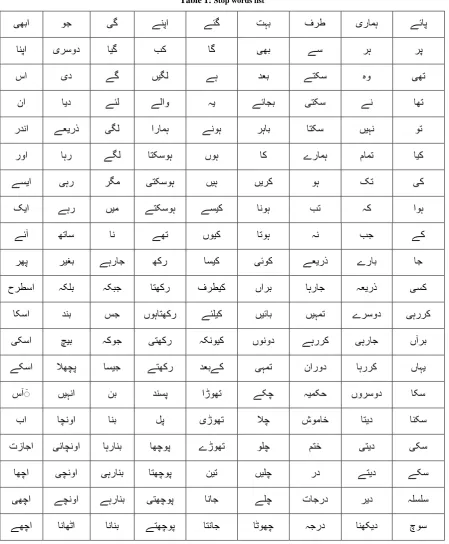
As discussed previously, stop words are functional words of a language and meaningless in context of text classification. They are eliminated from the lexicon in order to reduce its size by using a list of most frequent words known as Stop Word list. A lot of research work has been carried out in English language to find stop words and more than 400 stop words have been identified.
Content Words
Will you SELL my CAR because I've GONE to FRANCE.
[image:2.595.65.541.711.775.2]Like English, Urdu language has stop words as well, for example “بک”, “ےہ”, “کیا”, “بگ” etc. However, no considerable work has been carried out to find the stop words in Urdu language. In order to overcome this problem, we have
[image:3.595.60.536.72.131.2]collected English stop words and translate them into Urdu. An example of content and stop words in Urdu in provided in Fig. 2 and detailed list of the translated stop words is presented in Table 1.
Table 1: Stop words list
یھثا
وخ
یگ
ےٌپا
ےئگ
تہث
فرط
یربوہ
ےئبپ
بٌپا
یرضود
بیگ
تک
بگ
یھث
ےض
رہ
رپ
شا
ید
ےگ
ںیگل
ےہ
ذعث
ےتکض
ٍو
یھت
ىا
بید
ےئل
ےلاو
ہی
ےئبدث
یتکض
ےً
بھت
رذًا
ےعیرر
یگل
اربوہ
ےًوہ
رہبث
بتکض
ںیہً
وت
روا
بہر
ےگل
بتکضوہ
ںوہ
بک
ےربوہ
مبوت
بیک
ےطیا
یہر
رگه
یتکضوہ
ںیہ
ںیرک
وہ
کت
یک
کیا
ےہر
ںیه
ےتکضوہ
ےطیک
بًوہ
تت
ہک
اوہ
ےئآ
ھتبض
بً
ےھت
ںویک
بتوہ
ہً
تخ
ےک
رھپ
ریغث
ےہربخ
ھکر
بطیک
یئوک
ےعیرر
ےربث
بخ
ذرطضا
ہکلث
ہکجخ
بتھکر
فرطیک
ںارث
بہربخ
ہعیرر
یطک
بکضا
ذٌث
صخ
ںوہبتھکر
ےئلیک
ںیئبث
ںیہوت
ےرضود
یہررک
یکضا
چیث
ہکوخ
یتھکر
ہکًویک
ںوًود
ےہررک
یہربخ
ںآرث
ےکضا
لاھچپ
بطیخ
ےتھکر
ذعثےک
یہوت
ىارود
بہررک
ںبہی
شآ ٓ
ںیہًا
يث
ذٌطپ
اڑوھت
ےکچ
ہیوکز
ںورضود
بکض
ةا
بچًوا
بٌث
لپ
یڑوھت
لاچ
ظوهبخ
بتید
بٌکض
تزبخا
یئبچًوا
بہربٌث
بھچوپ
ےڑوھت
ولچ
نتخ
یتید
یکض
بھچا
یچًوا
یہربٌث
بتھچوپ
يیت
ںیلچ
رد
ےتید
ےکض
یھچا
ےچًوا
ےہربٌث
یتھچوپ
بًبخ
ےلچ
تبخرد
رید
ہلطلض
ےھچا
بًبھٹا
بًبٌث
ےتھچوپ
بتًبخ
بٹوھچ
ہخرد
بٌھکید
چوض
Content Words
ےہ
لبهلابه
ےض
لئبضو
یترذق
روا
ےہ
کله
یهلاضا
کیا
ىبتطکبپ
[image:3.595.75.525.225.770.2]Stop Words
Table 2: Stop words list (continued)
مبتتخا
نہا
ذٌث
بٌھچوپ
یتًبخ
ںوٹوھچ
ےخرد
وھکید
بچوض
رھدا
یئآ
بًرکذٌث
وھچوپ
ےتًبخ
یٹوھچ
تقیقزرد
یھکید
بتچوض
درا
ےئآ
ورکذٌث
ںوھچوپ
بًٌبخ
ےٹوھچ
تضرد
ںیھکید
یتچوض
درگدرا
جآ
یذٌث
ںیھچوپ
ذرططخ
ہھچ
شد
بٌید
ےتچوض
ىبکرا
رخآ
اڑث
اروپ
ہگخ
ںیسیچ
ہعفد
ےد
بٌچوض
لبوعتضا
ربکرخآ
ںوڑث
لاہپ
ںوہگخ
لصبز
ںیئبھکد
ںوتضار
وچوض
تلابوعتضا
یهدآ
یڑث
یلہپ
ںیہگخ
رضبز
بتبھکد
ہتضار
یچوض
بیغا
بًآ
ےڑث
یضےلہپ
یذلخ
لبز
یتبھکد
ےتضار
ںیچوض
فارطا
ھٹآ
رھث
ےضےلہپ
ةبٌخ
لبز
ےتبھکد
يکر
بھذیض
دارفا
بیآ
ارھث
یہےضےلہپ
ىاوخ
تلابز
بًبھکد
بھکر
یھذیض
رثکا
بث
اوہارھث
عیپ
یہًوخ
ہیلبز
وبھکد
یھکر
ےھذیض
بھٹکا
تیترتبث
روپرھث
ٍزبت
ہکبطیخ
ںوصز
بیبھکد
ےھکر
ڈٌکیض
یھٹکا
یربث
رتہث
رت
ربچ
ہصز
پطچلد
ٍدبیز
ذیبغ
ےھٹکا
لابث
یرتہث
تیترت
بہبچ
ےصز
یپطچلد
تبض
صخغ
لایکا
تیترتلبث
يیرتہث
يیرت
بٌہبچ
قئبقز
ںبیپطچلد
ٍدبض
ذغ
یلیکا
شرث
شبپ
داذعت
ےہبچ
ںیتیقز
تضبٌه
اربض
عورغ
ےلیکا
ریغث
بًبپ
اًبجیرقت
بکچ
تقیقز
ود
ےربض
تبعورغ
ہچرگا
ذٌلث
چًبپ
نت
یکچ
نکز
رود
لبض
ےغ
گلا
لابثوذٌلث
بًارپ
بہٌت
ںیکچ
اًبوکز
ارضود
ںولبض
فبص
ریسص
ہلیجق
ےطًوک
یهزلا
ےلئطه
بیً
قیرط
یترک
ےتہک
رفص
نطق
لاوھک
بتگل
لئبطه
راو
ںوقیرط
ےترک
بٌہک
تروص
یئک
بٌلوھک
یتگل
لوعتطه
راو
ہقیرط
وہےترک
بٌہک
لبستروص
ےئک
ولوھک
ےتگل
لوتػه
کیھٹ
ےقیرط
بًرک
وہک
ںوتروص
یفبک
یلوھک
بٌگل
قلطه
اڈًوھڈ
روط
ورک
ںوہک
ںیتروص
مبک
ںیلوھک
یگل
مولعه
بیلڈًوھڈ
رپروط
ںیرک
یہک
رورض
یھجک
ےلوھک
ےگل
لوکه
بًڈًوھڈ
رہبظ
ےرک
ںیہک
ترورض
ارک
بہک
بجول
لاه
وڈًوھڈ
دذع
لک
ںیہک
اًبترورض
بترک
بتہک
یجول
يکوه
یڈًوھڈ
نیظع
نک
ےہک
Table 3: Stop words list (continued)
تبسول
ہٌکوه
نہ
ےل
ذٌطپبً
ےہروہ
ہقلاع
اروک
ےعیررےک
ہسول
اڑه
یئوہ
قلعته
ریسگبً
یئگوہ
ےقلاع
ںوروک
یئگ
ول
بًڑه
ےئوہ
مرتسه
تجطً
ےئگوہ
ٍولاع
ٍروک
درگ
گول
ےڑه
یتوہ
ہهرتسه
ہطقً
بیگوہ
اًبهووع
ےروک
پورگ
ںوگول
ىبثرہه
ےتوہ
شوطسه
بٌلبکً
یًوہ
یهووع
يطوک
ٍورگ
يپکڑل
اریه
بکچوہ
فلتخه
ہتکً
یہ
درف
ىوک
ںوہورگ
یل
یریه
یکچوہ
ذیسه
وً
اًبٌیقی
یف
بطًوک
یتٌگ
بیل
ےریه
ےکچوہ
ہلئطه
ىاوخوً
یٌیقی
لجق
یطًوک
اًبهزلا
بٌیل
یئً
بہروہ
ںیل
ےئً
یہروہ
ثعبث
تض
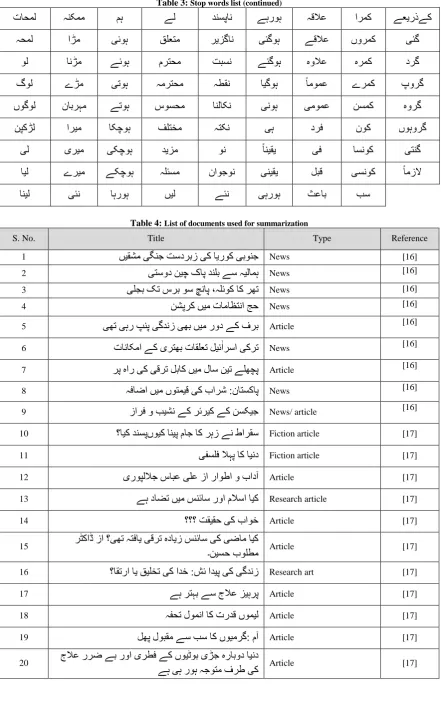
Table 4: List of documents used for summarization
S. No. Title Type Reference
1
ںیقػه یگٌخ تضدرثز یک بیروک یثوٌخ
News [16]2
یتضود يیچ کبپ ذٌلث ےض ہیلبوہ
News [16]3
یلدث کت شرث وض چًبپ ،ہلئوک بک رھت
News [16]4
يػپرک ںیه تبهبظتًا حز
News [16]5
یھت یہر پٌپ یگذًز یھث ںیه رود ےک فرث
Article [16]6
تبًبکها ےک یرتھث تبقلعت لیئٰارضا یکرت
News [16]7
رپ ٍار یک یقرت لثبک ںیه لبض يیت ےلھچپ
Article [16]8
ہفبضا ںیه ںوتویق یک ةارغ
:
ىبتطکبپ
News [16]9
زارف و تیػً ےک رئریک ےک يطکیخ
News/ article [16]10
؟بیک ذٌطپ ںویک بٌیپ مبخ بک رہز ےً طارقض
Fiction article [17]11
یفطلف لاہپ بک بیًد
Fiction article [17]12
یروپللاخ شبجع یلع زا راوطا و ةادآ
Article [17]13
ےہ دبضت ںیه صٌئبض روا ملاضا بیک
Research article [17]14
؟؟؟ تقیقز یک ةاوخ
Article [17]15
رٹکاڈ زا ؟یھت ہتفبی یقرت ٍدبیز صٌئبض یک یضبه بیک
۔يیطز ةولطه
Article [17]16
؟بقترا بی قیلخت یک اذخ
:
عئ اذیپ یک یگذًز
Research art [17]
17
ےہ رتہث ےض جلاع سیہرپ
Article [17]18
ہفست لووًا بک ترذق ںوویل
Article [17]19
لھپ لوجقه ےض تض بک ںویهرگ
:
مآ
Article [17]20
جلاع ررض ےث روا یرطف ےک ںویٹوث یڑخ ٍربثود بیًد
5.
RESULTS
Once the Auto-Summarizer was complete, we integrated it as Add-in to the MS Word main menu as shown in fig. 3. To verify the accuracy of the add-in twenty different types of documents were selected. The documents include News, articles, informative Articles, and fiction Articles that were collected as random from [15] [16]. List of the documents collected is provided in Table 4.
It was observed that the summary generated by the summarizer is well formed and easy to understand. More importantly, the summary generated especially very close to the original in case of News articles. The result was cross checked by human verification. Five human verifiers were used for this purpose. The process clearly indicated that the sentences selected in the summary by the summarizer, also selected by at least one of the human verifiers generally. To be precise, if one verifier was selected the result was about 80% accurate. If two verifiers out of five were selected, the accuracy was over 50%.
The decreasing value of accuracy in case of increasing the number of verifiers is due to the fact that all the verifiers have their own perception regarding each document and all of the generate a different summary. The human verification facts pertaining to one document are provided below:
The original document contained 718 words, 3415 characters in 47 lines.
The summary generated by Add-in was about 25% of original document. It contained 139 words, 698 characters in 10 lines.
Summary generated by the verifiers contained about 12 lines.
There were 7 common lines between the human and auto summaries.
The similarity result stood around 64%.
6.
CONCLUSION AND FUTURE WORK
The work presented here is an initial step towards building a true Urdu summarizer. In the technique presented here, our main focus remained in the elimination of stop words as we had used the Sentence Weight algorithm.
Many advanced algorithms for summarization of text have been developed and are waiting to be implemented. Some algorithms also eliminate the words that are rarely used in the text. Others propose to enhance the overall accuracy by calculating the frequency of content words that exist in the document title, and rating the sentences containing these words higher. In future, we plan to implement such advanced algorithms to improve the efficiency of the Auto-Summarizer.
7.
ACKNOWLEDGEMENTS
We appreciate the efforts of Basharat ullah, Saima Asghar and Waseem of Department of Computer Science, University of Karachi, Pakistan in research and development of the Add-in.
8.
REFERENCES
[1] Edwards, B. 2008. Microsoft Word Turns 25. PC World.
[2] Allen, A. R. 2001. Microsoft in the 1980‟s. In A History of the Personal Computer: The People and the Technology (pp. 12/25–12/26). Allan Publishing. [3] Office 2010 Availability. Microsoft Office 2010
Engineering. Microsoft. 2010.
[4] Gore, Karenna. 1997. Cognito Auto Sum. Retrieved from http://www.slate.com/id/2419
[5] Urdu language - Britannica Online Encyclopedia. Retrieved from http://www.britannica.com/EBchecked/ topic/619612/Urdu-language.
[6] Durrani, N., and Hussain, S. 2010. Urdu Word Segmentation, Human Language Technologies: The 2010 Annual Conference of the North American Chapter of the ACL, pp. 528–536.
[7] Luhn, H. P. 1958. The Automatic Creation of Literature Abstracts, IBM Journal, pp. 159-165.
[8] Wieling, M., and Groningen, R. 2004. Automatic Text Summarization: A Solid Base, Presented paper.
[9] Das, D., and Martins, F.T. 2007. A Survey on Automatic Text Summarization. Literature Survey for the Language and Statistics II course at CMU.
[10]Edmundson, H.P. 1968. New methods in automatic extracting. Journal of the Association for Computing Machinery, 16(2), pp. 264-285.
[11]Kupiec, J., Pedersen, J., and Chen, F. 1995. A trainable document summarizer. In Proc. SIGIR '95, pp. 68-73. NY. USA.
[12]Russell, S. J., and Norvig, P. 1995. Artificial intelligence: a Modern Approach, Englewood Cliffs, NJ: Prentice-Hall International Inc.
[13]Hussain, S. 2008. Resources for Urdu Language Processing. The 6th Workshop on Asian Language Resources.
[14]Patel, A., Siddiqui, T., and Tiwary, U.S. 2007. A language independent approach to multilingual text summarization. Conference RIAO2007, Pittsburgh PA, U.S.A.
[15]„A Guide to Urdu‟, Retrieved from http://www.bbc.co.uk/languages/other/urdu/guide/
[16]News and research articles retrieved from http://www.bbc.co.uk/urdu
[image:6.595.119.505.71.146.2]