http://dx.doi.org/10.4236/as.2015.68078
How to cite this paper: Wen, K.J., Liu, C., Wu, L.P., Ma, C. and Zhang, Y.Y. (2015) Self-Assembly Effects of Seafood Waste and Cow Dung to Remediate Saline Soil. Agricultural Sciences, 6, 807-816. http://dx.doi.org/10.4236/as.2015.68078
Self-Assembly Effects of Seafood Waste and
Cow Dung to Remediate Saline Soil
Kejun Wen
1,2, Cong Liu
1,2*, Liping Wu
1,2, Chao Ma
1,2, Yuyao Zhang
1,21Tianjin Chengjian University, School of Environmental and Municipal Engineering, Tianjin, China 2Tianjin Key Laboratory of Aquatic Science and Technology, Tianjin, China
Email: *[email protected], *[email protected]
Received 2 June 2015; accepted 15 August 2015; published 18 August 2015
Copyright © 2015 by authors and Scientific Research Publishing Inc.
This work is licensed under the Creative Commons Attribution International License (CC BY). http://creativecommons.org/licenses/by/4.0/
Abstract
This research is based on the U8 (43) uniform table to conduct uniform experiments for improving saline soil. Different proportions of saline soil and silt, with a composted residue of marine fish and seashells that was mixed with sawdust and cow dung, were chosen as the assembly factors. The improvement coefficients for available nitrogen phosphorus of the mixed salt mud and for the production of tall fescue hay were adopted as the characterization values. According to the causal relations that were previously established by 64 types of permutations and combinations, the op-timal assembly scheme with maximum characterization values was determined. The results indi-cate that the artificial soil that consisted of saline soil and silts in a ratio of 8:2; sea fish waste, shellfish trash and sawdust in a ratio of 5:4:1; and 8 kg of cow dung (10 wt%) is the best among the 64 types of composting treatments. Under the improved conditions, the predictive values of the increasing coefficients of valid nitrogen and valid phosphorus in the soil are 1.99 and 1.93, respec-tively; the predictive value of the tall fescue in a unit area production is 238.83 g·m−2. Its error ac-curacy is more than 99.82%. All of the above results indicate that utilizing the saline soil im-provement media, which is composed of Haihe river silts, fish and shellfish slag, cow dung, and other wastes, provides a new option for saline soil improvement.
Keywords
Haihe Estuary Sediments, Seafood Residue, Coastal Saline Soil Improvement, Regression Analysis
1. Introduction
Soil is one of the key elements of environmental systems [1] [2]. Thus, soil pollution protection is fundamental
for most productive activities [3]. The salinization of soils, which has become a widespread nature hazard be-cause of serious land degradation, has become a major barrier to local agriculture production and a major con-cern worldwide that researchers have sought to improve [4]-[7]. The salinization of soils is a natural phenome-non, particularly in coastal areas due to seawater intrusion or high-salt groundwater discharge [8] [9]. The low productivity of saline soils may be ascribed not only to their salt toxicity or to damage caused by excess amounts of soluble salts but also to the lack of organic matter and available mineral nutrients, particularly N, P, and K [10]. Concerns regarding salinization risks, environmental quality and agro-ecosystem productivity have em-phasized the requirement of developing management practices that maintain soil resources [11]. Many previous studies have involved analyses and made some effective attempts to solve this problem, which is greatly affect-ing agricultural areas. To enhance soil productivity in agricultural lands and to rebuild fertility, composted mu-nicipal solid waste has commonly been used [12] [13]. In 2006, two organic wastes (cotton gin-crushed compost and poultry manure) were added into saline soil in dry land conditions and their effects on the soil were studied over a period of 5 years [14]. To study the methane emission effects of the addition of a locally available organic and fresh green manure to saline soil, a field experiment was conducted using morning glory as a potential green manure to increase the grain yield of coastal saline ecosystems [15].
Much sediment under the estuary of the Haihe River needs to be cleared annually [16] [17]. This sludge con-tains many proteases, fatty acids, amino acids, chitosan, and many minerals; many dominant species that live in this region have the ability to alternately survive in seawater and in freshwater environments [18] [19]. The ma-rine fish and shellfish residue that is generated by the seafood market, to which many microorganisms attach, has not been effectively utilized for coastal saline soil. This residue not only pressures the environment but also wastes resources. In this paper, the authors present the effects of the application of a composted residue of ma-rine fish and seashells, which was mixed with sawdust, Haihe estuary sediments and cow dung, on the fertility characteristics of coastal saline soil. Different proportions of saline soil and silt with composted residue of ma-rine fish and seashells that were mixed with sawdust, amounts of cow dung and the structural component of Festuca arundinacea were tested using a uniform experiment to examine whether this mixture can rebuild the ecological structure of saline soil via self-assembly and self-repair by the biological structure (containing indi-genous organisms in saline soil), which is specific for improving saline soil and its trophic structure. To provide the foundation and theory for the improvement of saline soil by this method, the improvement coefficients of available nitrogen and available phosphorus in the saline soil after the implementation of this method and the shoot dry weight of the harvest of Festuca arundinacea were used as representations of the achievement and inquiry into the correlation between these assembly factors and their characterization values. As one of the most important conclusions, the optimal proportion scheme was found at last.
2. Methods
2.1. Test Conditions
Table 1.Content of nutrients and salt ions in saline soil.
Nutrient content/(g∙kg−1) Salt ions content/(g∙kg−1)
Organic matter Valid-N Valid-P Na+ Mg2+ Ca2+ K+ Cl− 2
4
SO− HCO3
−
30.298 16.213 3.785 4.136 0.533 1.288 0.451 3.994 2.520 5.078
Table 2. Ground water salinity component.
Salinity Molar ratio/% Content/(g∙L−1)
MgCl2 13 1.49
Na2SO4 14 1.95
CaCl2 18 2.25
[image:3.595.88.538.116.579.2]NaCl 55 3.31
Table 3.Nutrient and chemical composition of sediment in sea estuary area.
Nutrient composition/% Chemical composition mg/kg
Organic matter TN TP Mn Ni Cr Cu Zn Cd
[image:3.595.89.538.360.582.2]1.68 0.147 0.099 678.7 169.9 620.8 269.5 1936.5 12.2
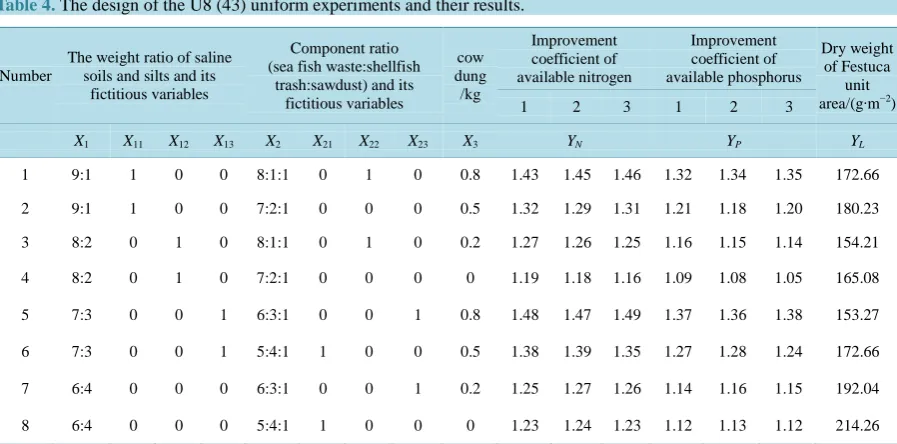
Table 4. The design of the U8 (43) uniform experiments and their results.
Number
The weight ratio of saline soils and silts and its
fictitious variables
Component ratio (sea fish waste:shellfish
trash:sawdust) and its fictitious variables
cow dung
/kg
Improvement coefficient of available nitrogen
Improvement coefficient of available phosphorus
Dry weight of Festuca
unit area/(g∙m−2)
1 2 3 1 2 3
X1 X11 X12 X13 X2 X21 X22 X23 X3 YN YP YL
1 9:1 1 0 0 8:1:1 0 1 0 0.8 1.43 1.45 1.46 1.32 1.34 1.35 172.66
2 9:1 1 0 0 7:2:1 0 0 0 0.5 1.32 1.29 1.31 1.21 1.18 1.20 180.23
3 8:2 0 1 0 8:1:1 0 1 0 0.2 1.27 1.26 1.25 1.16 1.15 1.14 154.21
4 8:2 0 1 0 7:2:1 0 0 0 0 1.19 1.18 1.16 1.09 1.08 1.05 165.08
5 7:3 0 0 1 6:3:1 0 0 1 0.8 1.48 1.47 1.49 1.37 1.36 1.38 153.27
6 7:3 0 0 1 5:4:1 1 0 0 0.5 1.38 1.39 1.35 1.27 1.28 1.24 172.66
7 6:4 0 0 0 6:3:1 0 0 1 0.2 1.25 1.27 1.26 1.14 1.16 1.15 192.04
8 6:4 0 0 0 5:4:1 1 0 0 0 1.23 1.24 1.23 1.12 1.13 1.12 214.26
consumption and water permeability.
2.2. Ratio of Trial Soil
(10%), 1.5 kg (6.25%), 0.6 kg (2.5%) and 0 kg cow dung were added based on test numbers, and the corres-ponding 24 flowerpots were filled with the matrix after thorough blending to complete the eight assembly types and the preparation of triplicates of each type for a uniform experiment.
2.3. Sowing and Data Acquisition
At the beginning of April 2001, the flowerpots were filled with the test soil and the plants were sown. Festuca arundinacea, which has strong vitality, stress resistance against saline-alkaline and more than 85% germination for planting, was selected. Its seeding rate is 1.32 g/basin (20 g∙m−2). The detection period was from the begin-ning of May to the end of September. To reduce the hysteretic nature of soil nutrients, the hysteretic value was determined by examining the effects of the perturbation of the test matrix and soil adsorption, employing the sa-turated water content of the experimental substrate as a reference, and by directly determining the soil available nitrogen and phosphorus in water samples as an index of this test. Indophenol blue colorimetry was used to measure the ammonium nitrogen in the test soil, and ultraviolet spectrophotometry was used to measure the ni-trate nitrogen in the test soil. The molybdenum blue colorimetric method was used to determine the phosphorus content in the improved saline soil. The first measurement was at seven days and measurements were taken again after thirty days. To reduce artificial errors, sample measurements were repeated three to five times for each sample, and the average of three similar values was considered the measured value of the sample. Tall Festuca arundinacea was produced at the end of September, by the end of the experiment. The aerial part of Festuca arundinacea was harvested from every experimental plot, dried and weighed. Finally, the average of three replicates for Festuca arundinacea production in each processing unit was determined.
3. Treatment and Analysis of Test Data
3.1. Data Processing
For the determination of the soil available nitrogen and available phosphorus values, the time series data of dy-namic change over time were used, with the chronological average as a representation of the entire process for the dependent variable. The available nitrogen and available phosphorus chronological averages of each test group of three replicates of each time series, were first calculated, and then the ratio of the chronological aver-age of time series, which is the ratio of the available nitrogen and phosphorus of a test group compared with that of 2 control groups, was calculated and used as the target (Y) of regression analysis. Because the survival rate of Festuca arundinacea in the control group is zero, the average of the measured Festuca arundinacea dry weight, which is the average value of triplicate trials with dimension g∙m−2, as the characterization value of modified achievement to saline soil were calculated by this method.
The qualitative variables on the U8 (43) uniform table were converted to dummy variables for regression analysis. The transformed test data are shown in Table 4.
3.2. Model and Inspection
3.2.1. Regression Model
According to Table 4, using the PASW Statistics 18 software, the saline soil and sediment ratio (X1), compost composition ratio (X2) and the addition of cow dung (X3) as the independent variables of the assembly control factor, with the improvement coefficient of soil available nitrogen (YN), the improvement coefficient of soil
available phosphorus (Yp) and the production of Festuca arundinacea (YL) as the dependent variables, a multiple
linear regression model was produced as follows:
The regression forecasting model of the improvement coefficient of soil available nitrogen:
(
2)
12 13 21 22 23 3
0.962 0.217 0.196 0.268 0.059 0.164 0.683 0.987
N
Y = + X − X + X − X + X + X R = (1)
The regression forecasting model of the improvement coefficient of soil available phosphorus:
(
2)
12 13 21 22 23 3
0.836 0.239 0.214 0.285 0.071 0.172 0.717 0.986
p
Y = + X − X + X − X + X + X R = (2)
(
2)
12 13 21 22 23 3
164.964 0.057 57.042 49.355 16.882 20.887 30.65 0.996
L
Y = + X − X + X − X + X + X R = (3)
The R2 value of each regression model indicated that each of the dependent variables and each assembly fac-tor have an extremely high degree of linear fitting, with an extremely high R2 value for assembly factors; thus, their correlation is extremely significant.
3.2.2. Partial Regression Coefficient Test
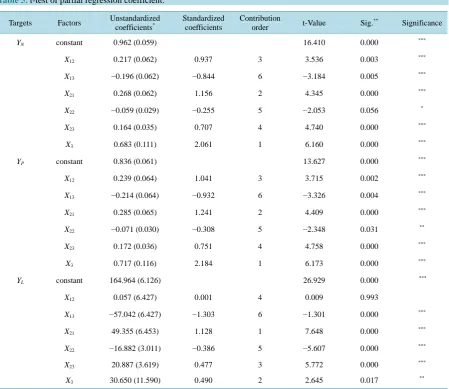
Using the R2 test, t detection and sig detection of the partial regression of each assembly factor were counted. The contribution degree and significant values are shown inTable 5.
3.2.3. The Inspection of Prediction Accuracy
1) The predictive values and measured values were examined as follows: Calculate the predictive value of the improvement coefficient of available nitrogen. Use the improvement coefficient of available nitrogen of the ma-trix of the sixth group in Table 4 as an example. In the regression model (1), treat the virtual variable (Xij) that
has not been selected as zero, and treat the virtual variable (Xij) that has been selected as one. Take the
corres-ponding assembly factor in the regression model. The predicted value is as follows:
(
)
6 0.962 0.217 0 0.196 1 0.268 1 0.059 0 0.164 0 0.683 0.5 1.3755
N
[image:5.595.89.539.313.702.2]Y = + × − × + × − × + × + × =
Table 5. t-test of partial regression coefficient.
Targets Factors Unstandardized coefficients*
Standardized coefficients
Contribution
order t-Value Sig.
** Significance
YN constant 0.962 (0.059) 16.410 0.000 ***
X12 0.217 (0.062) 0.937 3 3.536 0.003 ***
X13 −0.196 (0.062) −0.844 6 −3.184 0.005 ***
X21 0.268 (0.062) 1.156 2 4.345 0.000 ***
X22 −0.059 (0.029) −0.255 5 −2.053 0.056 *
X23 0.164 (0.035) 0.707 4 4.740 0.000 ***
X3 0.683 (0.111) 2.061 1 6.160 0.000 ***
YP constant 0.836 (0.061) 13.627 0.000 ***
X12 0.239 (0.064) 1.041 3 3.715 0.002 ***
X13 −0.214 (0.064) −0.932 6 −3.326 0.004 ***
X21 0.285 (0.065) 1.241 2 4.409 0.000 ***
X22 −0.071 (0.030) −0.308 5 −2.348 0.031 **
X23 0.172 (0.036) 0.751 4 4.758 0.000 ***
X3 0.717 (0.116) 2.184 1 6.173 0.000 ***
YL constant 164.964 (6.126) 26.929 0.000 ***
X12 0.057 (6.427) 0.001 4 0.009 0.993
X13 −57.042 (6.427) −1.303 6 −1.301 0.000 ***
X21 49.355 (6.453) 1.128 1 7.648 0.000 ***
X22 −16.882 (3.011) −0.386 5 −5.607 0.000 ***
X23 20.887 (3.619) 0.477 3 5.772 0.000 ***
X3 30.650 (11.590) 0.490 2 2.645 0.017 **
Similarly, using regression models (2) and (3), the predictive value of the improvement coefficient of availa-ble nitrogen, whose prediction value is 1.2655, and dry weight of Festuca arundinacea, whose prediction value is 172.597 g∙m−2, can also be obtained. Their measured values are 1.3733, 1.2633 and 172.66 g∙m−2, respectively, and their regression accuracies are all above 99.82%. Thus, the three types of characterization values can be fo-recasted using the regression model. By this method, the prediction values of the three characterization values can be obtained for the other 63 arrangements of the assemble factors.
2) The regression accuracy of the predictive values and detection values of the optimum assembly were cal-culated as follows: Based on the unstandardized coefficients inTable 5, choose the assembly parameter of the target value, whose contribution to improvement coefficient of available nitrogen, improvement coefficient of available phosphorus and dry weight of Festuca arundinacea is the best of the 64 arrangements of the assembly factors. For instance, X12 (the weight ratio of saline soils and silts of 8:2) + X21 (component ratio; sea fish waste, 5: shellfish trash, 4: sawdust, 1) + X3 (cow dung, 0.8 kg). Therefore, we obtain the predictive value as follows: the improvement coefficient of available nitrogen (YN) is 1.9934; the improvement coefficient of available
phosphorus (YP) is 1.9936 and the dry weight of Festuca arundinacea (YN) is 238.8296 g∙m−2.
Because the best assembly did not appear in Table 4, a repeatability verification test was simultaneously per-formed in 2012 to study the reliability of the optimum parameters of the assembly. By the verification results in Table 6, the author found that the improvement coefficients of the soil available nitrogen and soil available phosphorus have a higher goodness of fit with the predictive value than with the dry weight of Festuca arundi-nacea. Uncontrollable meteorological factors led to the lower dry weight of Festuca arundinacea compared with its predictive value.
4. Results and Discussions
The correlation coefficients (R2) of each regression model are all above 0.986. This result indicates that there were statistically significant linear relations between the dependent variables and all the assembly factors. The regression analysis results of three models are as follows.
4.1. Scheduling Problems and the Analysis of the Contribution of Each Factor to the
Target Value
1) The contribution of each factor to the improvement coefficients of available nitrogen and available phos-phorous has a high degree of homoplasy. The contribution schedule of each assembly factor for improvement coefficients of available nitrogen and available phosphorous is as follows: X3 (cow dung) > X2 (component ra-tio) > X1 (weight ratio of saline soils and silts). The contribution schedule of the level of each assembly factor is as follows: X3 (cow dung, 0.8) > X21 (component ratio, 5:4:1) > X12 (weight ratio of saline soils and silts, 8:2) > X23 (component ratio, 6:3:1) > X22 (component ratio, 8:1:1) > X13 (weight ratio of saline soils and silts, 7:3). The influence of X22 and X13 on nitrogen and phosphorus is a negative correlation, and the influence of X22 on the improvement coefficients of available nitrogen and available phosphorus are significant and more significant, respectively. Beyond that, the influence of other assembly factors on the improvement coefficients of available nitrogen and available phosphorus are all positively correlated and very significant.
[image:6.595.98.540.642.722.2]2) The contribution of each factor to the dry weight of Festuca arundinacea is different from that to the im-provement coefficients of available nitrogen and available phosphorous. The contribution schedule of each as-sembly factor is as follows: X2 (component ratio) > X3 (cow dung) > X1 (weight ratio of saline soils and silts). The contribution schedule of the level of each assembly factor is as follows: X21 (component ratio, 5:4:1) > X3 (cow dung, 0.8) > X23 (component ratio, 6:3:1) > X12 (weight ratio of saline soils and silts, 8:2) > X22 (component ratio, 8:1:1) > X13 (weight ratio of saline soils and silts, 7:3). The influences of X22 and X13 on the dry weight of
Table 6. Targets of optimum disposing.
Target 1 2 3
Improvement coefficient of available nitrogen 1.98 1.96 1.99
Improvement coefficient of available phosphorus 1.92 1.90 1.93
Festuca arundinacea are negatively correlated, and the influence of X12 on the dry weight of Festuca arundina-cea is not significant. Beyond that, the influences of other assembly factors on the dry weight of Festuca arun-dinacea are all positively correlated and more significant. This result indicates that the dry weight of Festuca arundinacea is not only correlated with organic fertilizer but also significantly negatively correlated with the content of silts in the test soil.
4.2. Analysis of Contributions of Each Factor to the Dependent Variable
1) The contribution of cow dung to the improvement coefficients of available nitrogen and available phos-phorous rank first, and its contribution to the dry weight of Festuca arundinacea ranks second. Not only does fermented cow dung contain 60.9% organic matter, in which there is 30.36% crude protein and 5.06% crude fat, but the dung is also rich in vitamins and amino acids. Thus, cow dung contributes to the biosynthesis of humus colloids, and its large granular structure cause the sodium salt of the test soil to obtain a bond bridge to improve the performance of its anions and cations for the synthesis and metabolism of sodium ions so that the cation ab-sorption capacity increases 6 - 10 times compared with that of the original soil. In addition, humic acid and folic acid play a key role of in the mechanism to reduce the activity of soil salinity, to increase the released amounts of nitrogen and phosphorus, which are absorbed and fixed for improving the effectiveness of nitrogen and phosphorus, and to promote the accumulation of photosynthate. According to the three models, the improvement coefficients of available nitrogen and available phosphorous and the dry weight of Festuca arundinacea achieve the highest value when cow dung is 0.8 kg, which is the maximum amount of cow dung.
achieve-ment has a close positive correlation with the content of shellfish trash and that the contents of the shellfish re-sidue play a key role in the composting achievement.
3) The contribution of saline soil or silts to the improvement coefficient of available nitrogen and available phosphorous and to the dry weight of Festuca arundinacea remain third. From the coefficient of the regression model of nitrogen and phosphorus, the author draws the conclusion that the contribution of X12 (the weight ratio of saline soils and silts) to the improvement coefficients of nitrogen and phosphorus accounts for 31.77% and 33.33% of cow dung, respectively. This result explains the significant correlation between the flora of sediment and the nitrogen or phosphorous in the soil release test. In contrast, the contribution to the dry weight of Festuca arundinacea is indistinctive. With the increase of the amount of sediment, both the increments of nitrogen and phosphorus and the dry weight of Festuca arundinacea are highly significantly or have significant negative growth, respectively. This result indicates that the Haihe River sediment can only be used as a halophilic bacte-rium agent and that the utilization of sediment must be limited. The sediment of the Haihe River is rich in some simple organisms, such as active proteases, bone phosphates, chitin, organic acids, carbon and so on, as well as some inorganic substances, such as carbonate, nitrogen, phosphorous and so on. Specific biological communities have adapted to the recorded alternating environment; however, this environment also contains much exchan-geable sodium and heavy metals (Table 3), whose concentrations are beyond “soil environmental quality stan-dards” (GB15618-1995). According to the research of Wu Qing et al., the enrichment effect and the transfer ef-fect of Festuca arundinacea on Cr, Cd and Zn is obvious; however, the rejection of Ni and Mn by Festuca arundinacea is significant. Because the activity of its dehydrogenase is particularly sensitive to heavy metals, the activity of Festuca arundinacea is negatively correlated with concentrations of heavy metals. Clearly, this type of toxicology rejection mechanism affects the effectiveness of the biological activity and nutrients. Thus, in the form of a vaccination, we use its extreme and numerous sexual reproduction to avoid reducing the dry weight of Festuca arundinacea. According to the three regression models, the contribution coefficients of X12 (weight ratio of saline soils and silts, 8:2) to the available nitrogen, available phosphorous and the dry weight of Festuca arundinacea are all the maximum in all weight ratios of saline soil and silts. The other ratios that were examined have a negative impact on the target value; thus, the author determined that the X12 proportion is the optimum selection.
4.3. The Characterization of Microorganisms
Through the preliminary identification of the bacteria genera in the test soil, we found that the microorganisms in the test soil are primarily composed of lactobacillus and bacillus genera, as well as successfully isolated ha-lophilic species, such as halobacterium, acinetobacter, microbacterium Orla-Jensen and so on. Moreover, we isolate three types of actinomyces, whose dominant bacteria are streptomyces, and a small amount of fungi and penicillium genera. This result shows clearly that as long as the growing medium precisely assembles what the microorganisms and plants require for survival and selects for suitable species, the key issues of saline soil pro-duction medium conditions and the lack of biological species can be resolved. These requirements are measured by examining the available nutrients, the dry weight of test plants and the vitality of the biodiversity. These flora and fauna, whose cells have electrostatic attraction, and the metabolites of microorganisms (polysaccharides, polyamino acids and so on, which are recognized extracellular polymer substances that are abbreviated EPS) can cause soil particle cohesion, accelerate the formation of soil aggregates and the release of nutrients, and change the ionization balance of the toxic ions, such as Na+, Cl−, 2
4
SO − and so on in the saline soil environment [20]. Finally, this ability is reflected in the improvement of available nitrogen and phosphorus, whose values are 1.99 and 1.93, respectively, and the dry weight of Festuca arundinacea is 236.83 g∙m−2.
5. Conclusions
2) After analyzing the contribution value of every assembly factor and target, the author concludes the fol-lowing: (a) The rank of the contribution of each assembly factor to nitrogen and phosphorous is as shown below: X3 (cow dung) > X2 (component ratio) > X1 (weight ratio of saline soil and silts). (b) The rank of the contribution of each assembly factor to the dry weight of Festuca arundinacea is as shown below: X2 > X3 > X1. The contri-bution of cow dung to the improvement of available nitrogen and available phosphorous and to the dry weight of Festuca arundinacea is first and second, respectively. The contribution of cow dung is proportional to its dosage. (c) In the four types of component ratios, the contribution of X22 (sea fish waste, 8:shellfish trash, 1:sawdust, 1) to all targets is the lowest. Because the correlation between the target and the amount of shellfish trash is signif-icantly positive, increasing the dosage of shellfish trash has a significant positive correlation with the compost-ing achievement. (d) The contribution of the weight ratio of saline soil and silts to all the target value ranks third, and the contribution of X12 (weight ratio of saline and silts, 8:2) is the best in all the levels of the weight ratios. If the contents are relatively low, then the contribution of sediment is not significant; if the contents are relatively high, then the contribution of sediment is negative. Thus, the Haihe River sediment can only be used as a halo-philic bacterium agent, and the utilization of sediment must be limited.
3) The assembly that has the best contribution to nitrogen, phosphorous and the dry weight of Festuca arun-dinacea in the 64 types of permutations and combinations is as follows: X12 (weight ratio of saline and silts, 8:2) + X21 (component ratio, sea fish waste, 5:shellfish trash, 4:sawdust, 1) + X3 (cow dung, 0.8 kg, accounting for 10% of the total weight of X1 + X2). In this composition, the improvement coefficient of available nitrogen is 1.99, the improvement coefficient of available phosphorous is 1.93, and the dry weight of Festuca arundinacea in the unit area is 238.83 g∙m−2. This conclusion has been thoroughly and repeatedly verified and can provide a basis for the demonstration of coastal saline soil improvement.
Acknowledgements
This work was supported by Tianjin Science and Technology Support Program Key Projects [08ZCJYSF02500] and Tianjin Science and Technology Commission of Science and Technology Support Program [12ZCZDSF- 01900]. The authors appreciate them for providing the financial support for our research.
References
[1] Martens, D.A. and Suarez, D.L. (1997) Selenium Speciation of Soil/Sediment Determined with Sequential Extractions and Hydride Generation Atomic Absorption Spectrophotometry. Environmental Science and Technology, 31, 133-139. http://dx.doi.org/10.1021/es960214+
[2] Citterio, S., Aina, R., Labra, M., Ghiani, A., Fumagalli, P., Sgorbati, S. and Santagostino, A. (2002) Soil Genotoxicity Assessment: A New Strategy Based on Biomolecular Tools and Plant Bioindicators. Environmental Science and Technology, 36, 2748-2753. http://dx.doi.org/10.1021/es0157550
[3] Gao, Y.-C., Wang, J.-N., Xu, J.-B., Kong, X., Zhao, L. and Zeng, D.-H. (2013) Assessing the Quality of Oil-Contaminated Saline Soil Using Two Composite Indices. Ecological Indicators, 24, 105-112.
http://dx.doi.org/10.1016/j.ecolind.2012.06.005
[4] Wong, V.N.L., Dalal, R.C. and Greene, R.S.B. (2008) Salinity and Sodicity Effects on Respiration and Microbial Bio-mass of Soil. Biology and Fertility of Soils, 44, 943-953. http://dx.doi.org/10.1007/s00374-008-0279-1
[5] Pisinaras, V., Tsihrintzis, V.A., Petalas, C. and Ouzounis, K. (2010) Soil Salinization in the Agricultural Lands of Rhodope District, Northeastern Greece. Environmental Monitoring and Assessment, 166, 79-94.
http://dx.doi.org/10.1007/s10661-009-0986-6
[6] Yao, L.-X., Li, G.-L., Tu, S.-H., Gavin, S. and He, Z.-H. (2007) Salinity of Animal Manure and Potential Risk of Sec-ondary Soil Salinization through Successive Manure Application. Science of the Total Environment, 383, 106-114. http://dx.doi.org/10.1016/j.scitotenv.2007.05.027
[7] Zalidis, G. (1998) Management of River Water for Irrigation to Mitigate Soil Salinization on a Coastal Wetland. Jour-nal of Environmental Management, 54, 161-167. http://dx.doi.org/10.1006/jema.1998.0226
[8] Russak, A. and Sivan, O. (2010) Hydrogeochemical Tool to Identify Salinization or Freshening of Coastal Aquifers Determined from Combined Field Work, Experiments, and Modeling. Environmental Science & Technology, 44, 4096- 4102. http://dx.doi.org/10.1021/es1003439
[9] Carol, E., Kruse, E. and Mas-Pla, J. (2009) Hydrochemical and Isotopical Evidence of Ground Water Salinization Processes on the Coastal Plain of Samborombon Bay, Argentina. Journal of Hydrology, 365, 335-345.
[10] Lakhdar, A., Rabhi, M., Ghnaya, T., Montemurro, F., Jedidi, N. and Abdelly, C. (2009) Effectiveness of Compost Use in Salt-Affected Soil. Journal of Hazardous Materials, 171, 29-37. http://dx.doi.org/10.1016/j.jhazmat.2009.05.132 [11] de Paz, J.M., Visconti, F., Zapata, R. and Sanchez, J. (2004) Integration of Two Simple Models in a Geographical
In-formation System to Evaluate Salinization Risk in Irrigated Land of the Valencian Community, Spain. Soil Use and Management, 20, 333-342. http://dx.doi.org/10.1079/SUM2004265
[12] Lakhdar, A., Hafsi, C., Rabhi, M., Debez, A., Montemurro, F., Abdelly, C., Jedidi, N. and Ouerghi, Z. (2008) Applica-tion of Municipal Solid Waste Compost Reduces the Negative Effects of Saline Water in Hordeum maritimum L. Bio-resource Technology, 99, 7160-7167. http://dx.doi.org/10.1016/j.biortech.2007.12.071
[13] Lakhdar, A., Falleh, H., Ouni, Y., Oueslati, S., Debez, A., Ksouri, R. and Abdelly, C. (2011) Municipal Solid Waste compost Application Improves Productivity, Polyphenol Content, and Antioxidant Capacity of Mesembryanthemum edule. Journal of Hazardous Materials, 191, 373-379. http://dx.doi.org/10.1016/j.jhazmat.2011.04.092
[14] Tejada, M., Garcia, C., Gonzalez, J.L. and Hernandez, M.T. (2006) Use of Organic Amendment as a Strategy for Sa-line Soil Remediation: Influence on the Physical, Chemical and Biological Properties of Soil. Soil Biology & Bioche-mistry, 38, 1413-1421. http://dx.doi.org/10.1016/j.soilbio.2005.10.017
[15] Datta, A., Yeluripati, J.B., Nayak, D.R., Mahata, K.R., Santra, S.C. and Adhya, T.K. (2013) Seasonal Variation of Methane Flux from Coastal Saline Rice Field with the Application of Different Organic Manures. Atmospheric Envi-ronment, 66, 114-122. http://dx.doi.org/10.1016/j.atmosenv.2012.06.008
[16] Chi, J. (2009) Vertical Fluxes and Accumulation of Organochlorine Pesticides in Sediments of Haihe River, Tianjin, China. Bulletin of Environmental Contamination and Toxicology, 82, 510-515.
http://dx.doi.org/10.1007/s00128-008-9630-3
[17] Sun, S.J., Huang, S.L., Sun, X.M. and Wen, W. (2009) Phosphorus Fractions and Its Release in the Sediments of Haihe River, China. Journal of Environmental Sciences-China, 21, 291-295.
http://dx.doi.org/10.1016/S1001-0742(08)62266-4
[18] Bossuyt, H., Denef, K., Six, J., Frey, S.D., Merckx, R. and Paustian, K. (2001) Influence of Microbial Populations and Residue Quality on Aggregate Stability. Applied Soil Ecology, 16, 195-208.
http://dx.doi.org/10.1016/S0929-1393(00)00116-5
[19] Claus, H., Akca, E., Debaerdemaeker, T., Evrard, C., Declercq, J.P. and Konig, H. (2002) Primary Structure of Se-lected Archaeal Mesophilic and Extremely Thermophilic Outer Surface Layer Proteins. Systematic and Applied Micro-biology, 25, 3-12. http://dx.doi.org/10.1078/0723-2020-00100