ABSTRACT
In this paper a new programming methodology for optimizing rocket trajectories using steepest descent technique is presented. The programming is done in Matlab platform. At first the dynamical equations of rocket is derived and for the proper derivation and analysis of the equations ,Eulers integration method is used. A new programming approach is designed and the equations are optimized using steepest descent technique, assuming certain boundary conditions. The results obtained are verified and it is seen that the optimal trajectory is attained with all objectives satisfied. This project is done at Vikram Sarabhai Space Centre(VSSC),a constituent of Indian Space Research Organization(ISRO).
General Terms
Rocket dynamics,Euler‟smethod,Simulator program.
Keywords
Rocket trajectory,Matlab,Optimization,Steepest descent
1.
INTRODUCTION
The optimality of rocket trajectories may be defined according to several objectivesliketransfer time is minimal for a given propellant and payload mass (i.e. for a given launch mass),the required propellant mass is minimal for a given transfer time and launch mass, the required propellant mass is minimal for a given transfer time and payload mass.In practice, the methods of solving deterministic optimal control problems are divided into two categories: direct and indirect methods[9]. Indirect methods proceed by formulating the optimality conditions according to the Pontryagin maximum principle and then numerically solving the resulting two point boundary value problem. Direct methods discretize the original problem in time and solve the resulting parameter optimization problem and thus generate an approximate solution of the original problem. Both methods solve the necessary conditions of optimality and both discretize the problem. The most common objective is to minimize the propellant required or equivalently to maximize the fraction of the rocket that is not devoted to propellant. Of course, as is common in the optimization of continuous dynamical systems, it is usually necessary to provide some practical upper bound for the final time or the optimizer will trade time for propellant. There are also rocket trajectory problems where minimizing flight time is an important, or, for example those using continuous thrust, where minimizing flight time and minimizing propellant use are synonymous.
2.
MATHEMATICAL
REPRESENTATION OF
ROCKETDYNAMICS
Point-mass equations of motion with non-rotating
sphericalearth are considered in this paper, which is given by
𝑟 = 𝑉𝑠𝑖𝑛𝛾 (1)
𝑉 = 1
𝑚𝑉 𝑇 𝑐𝑜𝑠𝛼 − − 𝑚𝑔 𝑠𝑖𝑛𝛾 (2)
𝛾 = 1
𝑚𝑉 𝑇 𝑠𝑖𝑛𝛼 + 𝑉 𝑟−
𝑔
𝑉 𝑐𝑜𝑠𝛾 (3)
For a problem without path constraints, with terminal equality constraints, and with an initial state vector whose components are either fixed or optimizable, the first order necessary conditions can be formulated as shown in equations from 4 to(11).
Hamiltonian:
𝐻 = 𝐿 + 𝜆𝑇𝑓 (4)
Dynamics:
𝑋 = 𝑓 𝑥, 𝑢, 𝑡 = (𝜕𝐻
𝜕𝜆)𝑇 (5)
Adjoint differential equations:
𝜆 = (𝜕𝐿 𝜕𝑥)𝑇− (
𝜕𝑓 𝜕𝑥)𝑇𝜆 = (
𝜕𝐻
𝜕𝑥)𝑇 (6)
Optimality condition:
(𝜕𝐻
𝜕𝑢)𝑇 = 0 = ( 𝜕𝑓 𝜕𝑢)𝑇𝜆 + (
𝜕𝐿
𝜕𝑥)𝑇 (7)
Initial conditions:
𝑥𝑘(𝑡0)given or 𝜆𝑘 𝑡0 = 0 (8)
Terminal constraints:
𝛹𝑓 𝑥𝑓, 𝑡𝑓 = 0 (9)
New Programming Approach for Steepest Descent
Optimization of Rocket Trajectories
Vishnu G Nair
Department of Aeronautical & Automobile Engineering, Manipal Institute of Technology
Manipal, India-576104
Dileep M V
Department of Instrumentation & Control Engineering, Manipal Institute of Technology
Manipal, India-576104
Prahalad K R
Department of Instrumentation & Control Engineering, Manipal Institute of Technology
Transversality conditions:
𝜆𝑓 = (𝜕∅𝜕𝑥+ 𝑣𝑇
𝜕𝛹𝑓
𝜕𝑥)𝑡=𝑡𝑓 (10)
Transversality condition for optimizable𝑡𝑓:
Ω= [(𝜕∅ 𝜕𝑡+ 𝑣𝑇
𝜕𝛹𝑓
𝜕𝑡 + 𝐻)]𝑡=𝑡𝑓 (11)
Where L = Lagrangefunction
H = Hamilton function
𝜆 = costate variable
Euler-Lagrange [22] equations were extended by the introduction of further necessary conditions, such as the Legendre- Clebsch condition, The Jacobi condition[4] and the Weierstrass condition[4].
𝜕2𝐻
𝜕𝑢2 ≥ 0 (12)
A detailed discussion on these conditions can be found in Ref. [22].In this part optimization of the three variables take place, they are radial distance from the center of earth 𝑟, rocket velocity 𝑣 and the flight path angle 𝛾.The equations 1 − (3) can be described in generic form as,
𝑋 = 𝑓 𝑋, 𝑈 (13)
𝑟 𝑣 𝛾 =
𝑉𝑠𝑖𝑛𝛾 1
𝑚𝑉(𝑇𝑐𝑜𝑠𝛼 − 𝑚𝑔𝑠𝑖𝑛𝛾 ) 1
𝑚𝑉 (𝑇𝑠𝑖𝑛𝛼 ) + ( 𝑉 𝑟−
𝑔 𝑉) 𝑐𝑜𝑠𝛾
(14)
Where the state and control vectors are defined as
𝑋 = 𝑥1𝑥2𝑥3𝑇 (15)
That is
𝑋 = 𝑟𝑣𝛾 𝑇 (16)
𝑈 = 𝛼 (17)
In this a trajectory optimization problem of a single stage launch vehicle is considered. The objective here is to generate the guidance command history 𝛼 𝑡 , 𝑡 ∈ 𝑡0, 𝑡𝑓 such that the
following concerns are taken care of,
(a) At the final time 𝑡𝑓, the specified terminal constraints must
meet as accurately. The terminal constraints include constraints on altitude, velocity and flight path angle (which is the angle made by the velocity vector with respect to the local horizontal).
(b) The system should demand minimum guidance command, which can be ensured by formulating a „minimum time‟ problem.
To achieve the above objectives, the following cost function is selected, which consists of terminal penalty terms and a dynamic control minimization term.
𝐽 = (𝑟 𝑡𝑓 − 𝑟𝑓)2𝑠𝑟+ (𝑣 𝑡𝑓 − 𝑣𝑓)2𝑠𝑣
+ (𝑟𝑜𝑤 𝑡𝑓 − 𝑟𝑜𝑤𝑓)2𝑠𝛾 (18)
Where 𝑠𝑟,𝑠𝑣,𝑎𝑛𝑑𝑠𝛾 weighing factors. The Hamiltonian (Ref equation (4)) is defined as ,
𝐻 = 𝐽 + 𝜆𝑇 (19)
Where 𝜆𝑇= [𝜆1𝜆2𝜆3], costate variables.
𝐻 = 𝐽 − 𝜆1 𝑉𝑠𝑖𝑛𝛾 − 𝜆2 𝑚𝑉1 𝑇𝑐𝑜𝑠𝛼 − 𝑚𝑔𝑠𝑖𝑛𝛾
− 𝜆3 𝑚𝑉1 𝑇𝑠𝑖𝑛𝛼 𝑉𝑟
−𝑔
𝑉 𝑐𝑜𝑠𝛾 (20)
From equation (18) we get
𝐻 = (𝑟 𝑡𝑓 − 𝑟𝑓)2𝑠𝑟+ (𝑣 𝑡𝑓 − 𝑣𝑓)2𝑠𝑣
+ (𝑟𝑜𝑤 𝑡𝑓 − 𝑟𝑜𝑤𝑓)2𝑠𝛾− 𝜆1 𝑉𝑠𝑖𝑛𝛾
− 𝜆2 𝑚𝑉1 𝑇𝑐𝑜𝑠𝛼 − 𝑚𝑔𝑠𝑖𝑛𝛾
− 𝜆3 𝑚𝑉1 𝑇𝑠𝑖𝑛𝛼
+ 𝑉 𝑟−
𝑟
𝑉 𝑐𝑜𝑠𝛾 (21)
Equation (21) gives the final Hamiltonian function. This function has solve to get the optimum solution .Therefore
𝜕𝐻 𝜕𝑟= 𝜆3
𝑣
𝑟2𝑐𝑜𝑠𝛾 = −𝜆1 (22)
𝜕𝐻
𝜕𝑣= −𝜆1𝑠𝑖𝑛𝛾 + 𝜆3− 1
𝑚𝑣2 𝑇𝑠𝑖𝑛𝛼 −
1 𝑟−
𝑔 𝑣2 𝑐𝑜𝑠𝛾
= −𝜆2 (23)
𝜕𝐻
𝜕𝛾= −𝜆1𝑐𝑜𝑠𝛾 − 𝜆2𝑔𝑐𝑜𝑠𝛾+ 𝜆3 𝑣 𝑟−
𝑔 𝑣 𝑠𝑖𝑛𝛾
= −𝜆3 (24)
𝜕𝐻 𝜕𝛼= 𝜆2
𝑇
𝑚𝑠𝑖𝑛𝛼 − 𝜆3 𝑇
𝑚𝑣𝑐𝑜𝑠𝛼 (25)
The above equations 22 − 25 to be solved to get the solutions of costate variables, that is 𝜆1, 𝜆2𝑎𝑛𝑑𝜆3. In an
conditions. The equations 1 2 & 3 in the simulator program is developed initial steering profile for steepest descent optimization is obtained.For finding the accurate steering profile taking an assumption that is acceleration is a linearly increasing quantity. So rate of change of velocity is approximating as linear function. This linear function is selected by polynomial approximation[17] that is by changing the functions randomly to fit the curve properly.
𝛼 = 𝑐𝑜𝑠−1 𝑐1𝑡 + 𝑐2+ 𝑔 𝑠𝑖𝑛𝛾
𝑇 𝑚 (26)
Now knowing the values of 𝜆1 , 𝜆 𝑎𝑛𝑑𝜆2 3 , so to get
𝜆1, 𝜆2𝑎𝑛𝑑𝜆3 have to integrate. Therefore the final values of
𝜆𝑇is 𝜆
1𝑓, 𝜆2𝑓𝑎𝑛𝑑𝜆3𝑓. To find the final values of 𝜆.
𝜆1𝑓=𝜕𝐽𝜕𝑟= 2 × 𝑠𝑟× 𝑟 𝑡𝑓 − 𝑟𝑓 (27)
𝜆2𝑓=𝜕𝑣𝜕𝐽= 2 × 𝑠𝑣× 𝑣 𝑡𝑓 − 𝑣𝑓 (28)
𝜆3𝑓=𝜕𝛾𝜕𝐽= 2 × 𝑠𝛾× 𝛾 𝑡𝑓 − 𝛾𝑓 (29)
The integration method used in the optimal control problem is Eulers method. It is the usual basic method.
2.1Implementation of Euler’s method
Euler‟s method can be implemented both in simulator program and the optimal control problem. In simulator program the integration of 𝑟, 𝑣 𝑎𝑛𝑑 𝛾 happens. That is given as follows.
𝑟 = 𝑟0+ 𝑟 𝑑𝑡 (30)
𝑣 = 𝑣0+ 𝑣 𝑑𝑡 (31)
𝛾 = 𝛾0+ 𝛾 𝑑𝑡 (32)
In optimal control the 𝜆𝑇 is integrating to get final 𝜆 values.
𝜆1= 𝜆10+ 𝜆1 𝑑𝑡 (33)
𝜆2= 𝜆20+ 𝜆2 𝑑𝑡 (34)
𝜆3= 𝜆30+ 𝜆3 𝑑𝑡 (35)
Where 𝑑𝑡 is the integration step size.𝑟0, 𝑣0&𝛾0are the initial
values of 𝑟, 𝑣 𝑎𝑛𝑑 𝛾. Similarly 𝜆10, 𝜆20&𝜆30are the initial values of 𝜆1, 𝜆2&𝜆3 .Thus gets the solution of equation
(21)For optimal solutions, The optimality condition (Ref equation (26)) is given by
𝜕𝐻
𝜕𝛼= 0 (36)
The weighting factor tow (𝜏) should select according to the steepest descent method . That is
𝑡𝑜𝑤𝑤 =𝜕𝐻 𝜕𝛼×
𝜕𝐻 𝜕𝛼
𝑇
(37)
tow 𝜏 = 1 𝑡𝑜𝑤𝑤
2 (38)
Thus weighting factor tow (𝜏) is obtained. Then it is applied to the control variable alpha (𝛼) ,toget the new alphaprofile.
𝛼 = 𝛼0−
𝜕𝐻
𝜕𝛼× tow 𝜏 (39)
Where 𝛼0= privious computed 𝛼
Equation 21 is the gradiant function, optimizes the objective function. An optimal control problem needs accurate initial conditions. From the equations 1 − (3) the simulator program is developedand initial steering profile for steepest descent optimization is obtained.For finding the accurate steering profile acceleration is assumed to be a linearly increasing quantity. So rate of change of velocity is approximated as linear function. This linear function is selected by polynomial approximation that is by changing the functions randomly to fit the curve properly. The vehicle acceleration is a linear function of time as given in the equation. The constants are obtained by varying initial and final steering angle value. Thus tuning of constants𝑐1 𝑎𝑛𝑑 𝑐2are done. The initial and final 𝛼 is thus obtained to be3.5 𝑑𝑒𝑔and 14 𝑑𝑒𝑔 respectively.Therefore by solving the equation 21 using the initial and final values the appropriates values for 𝑐1 𝑎𝑛𝑑 𝑐2 can be find out;
𝑐1= 6.4217 × 10⁻³
𝑐2= 1.918235
3
.SIMULATOR PROGRAM STEPS AND
RESULTS
The simulator program is mainly used for generating the initial steering angle. This steering is given as the input thrust angle for trajectory optimization problem. Table (1)shows travelling time and the initial steering angle profile. The main programming steps are given below:-
a)-Develop rocket dynamics equations.
b)-To get initial alpha profile develop a simulator program that has minimum objective function values.
c)-Put this alpha profile in the trajectory optimization problem.
e)Alpha profile is updated by using steepest descent technique.
f) Alpha profile update is done by tuning of multiplication factor.
g) The optimized result will be obtained after 82 iterations.
[image:4.595.324.568.87.280.2]The results obtained are shown below:-
Table 1 Travelling time and the initial steering angle profile
Time in seconds
initial thrust angle
𝛼 values in radian
1 0.275101
50 0.279912
100 0.271316
150 0.255160
200 0.235788
250 0.217232
300 0.203625
350 0.198925
400 0.206037
450 0.226118
500 0.258920
510 0.266945
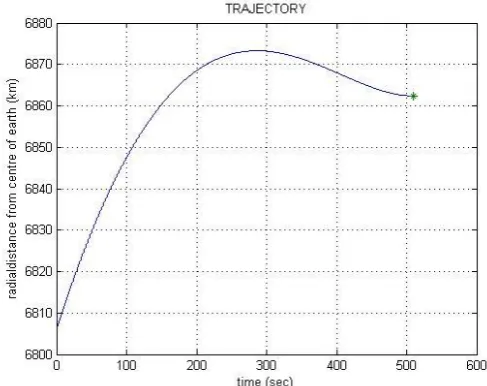
Figure 1 shows the graph obtained for the simulation program.The figure indicates the radial distance from earth centre.The symbol,„ * ‟ indicates the target, 𝑟𝑓 = 6862.41573 𝑘𝑚. By this method, the rocket achieved the desired position, but not the desired velocity. Therefore the above method is not an optimized one. So has to be optimized.
Fig 𝟏 Radial distance from earth centreVs time
Fig 𝟐 Velocity Vs time
Fig 𝟑: Flight path angle Vs time
Figure 3 & (2) indicates the flight path angle and velocity variation with respect to time.1n figure (4.8), the symbol‘ ∗ ’
[image:4.595.95.241.229.535.2] [image:4.595.324.556.308.697.2]and in figure 3 , it indicates the value of final gamma, 𝛾 =
0 𝑑𝑒𝑔. In figure (2) the desired target-velocity is not achieved. The simulation program provides the basic model trajectory and the initial steering angle. The trajectory optimization problem is explained in the following sections. Euler‟s method of integration can be used for optimization. In Euler‟s method of integration the integration step size is same. Iteration results are shown below. Total iteration number =
[image:5.595.366.494.81.156.2]82
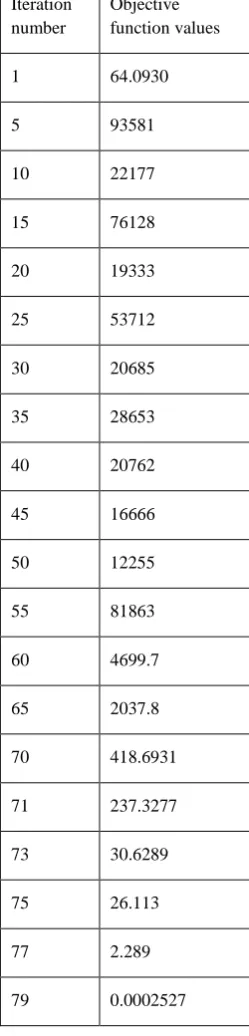
Table 2 Itration number and the objective function value
Iteration number
Objective function values
1 64.0930
5 93581
10 22177
15 76128
20 19333
25 53712
30 20685
35 28653
40 20762
45 16666
50 12255
55 81863
60 4699.7
65 2037.8
70 418.6931
71 237.3277
73 30.6289
75 26.113
77 2.289
79 0.0002527
80 8.3802× 10⁻⁶
81 0.0002527
82 8.3802× 10⁻⁶
Table (2) shows the objective function values for each iteration. By analyzing the objective function values, it seems to be decreasing and tends to a minimum value. Table (3) shows final radial distance from center of earth, final velocity of rocket and final flight path angle in each iteration.
Table 3 Iterationnumber, final radial distance, final velocity and final flight path angle
Iteration number
final radial distance from centre of earth
(𝑘𝑚)
final velocity of rocket
(𝑚/𝑠)
Final flight path angle (𝑟𝑎𝑑)
1 6862.4 7703.6 0.0002116
5 68655 7696.6 0.0015444
10 6863.9 7700.7 -0.0002827
15 6865.2 7697.5 -0.0004971
20 6863.8 7700.2 -0.0024106
25 6864.7 7696.5 -0.0030378
30 6863.9 7696.0 -0.0049032
35 6864.1 7691.4 -0.0061224
40 6863.9 7686.7 -0.0076483
45 6863.7 7680.5 -0.0090698
50 6863.5 7673.3 -0.010482
55 6863.3 7664.9 -0.011885
60 6863.1 7655.5 -0.013288
65 6862.9 7645.0 -0.014698
70 6862.6 7633.5 -0.016121
71 6862.6 7631.0 -0.016407
73 6862.5 7626.1 -0.016981
[image:5.595.104.229.233.753.2] [image:5.595.316.541.252.765.2]77 6862.4 7623.6 -0.017293
79 6862.4 7623.5 -0.017286
80 6862.4 7623.5 -0.017286
81 6862.4 7623.5 -0.017286
[image:6.595.53.280.81.208.2]82 6862.4 7623.5 -0.017286
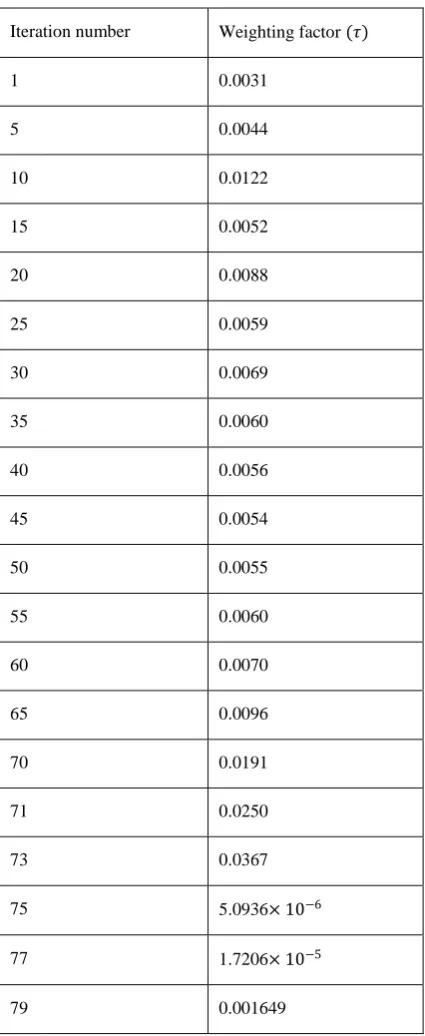
Table 4 Itration number and weighting factor (𝝉)
Iteration number Weighting factor (𝜏)
1 0.0031
5 0.0044
10 0.0122
15 0.0052
20 0.0088
25 0.0059
30 0.0069
35 0.0060
40 0.0056
45 0.0054
50 0.0055
55 0.0060
60 0.0070
65 0.0096
70 0.0191
71 0.0250
73 0.0367
75 5.0936× 10⁻⁶
77 1.7206× 10⁻⁵
79 0.001649
80 0.011844
81 0.001649
82 0.011843
Table (4) shows weighting factor (𝜏) variation in each iteration. Weighting factor has a significant major role in optimizing the trajectory. Figure 4 , (5) & (6) shows the graphs obtained for Steepest Descent method with Euler‟s integration. The figure (4)indicates the radial distance from
earth center. The symbol, „ * ‟ indicates the target,𝑟𝑓 =
6862415.73 𝑚 . The above method is optimized with minimum objective function value. From the graph it can be
seen that the rocket achieved the target-position .A higher altitude is considered in this method, sothat it can achieve the
target-velocity.
Fig.𝟒 Radial distance from the centre of earth Vs time
Figure 5 &(6)indicates the flight path angle and velocity variation with respect to time.1n figure 5 the symbal‘ ∗ ’ indicate the final velocity, 𝑉𝑓 = 7623.5321 𝑚/𝑠 and in figure 6 the symbal‘ ∗ ′ indicates final gamma , 𝛾 =
[image:6.595.323.537.82.156.2] [image:6.595.61.274.246.765.2] [image:6.595.322.545.299.493.2]Fig 5 VelocityVstime
Fig .6 Flight path angle Vs time
5 .CONCLUSIONS
A new programming approach for steepest descent optimization of rocket trajectories is presented in this paper. From the results it is clear that the final objectives are achieved with optimum resources and time. All the constraints are satisfied and the trajectory is a optimal one. This methodology can be implemented in future missions and the results ]can be verified and compared with the real time outputs. Comparison of the results with real time results and formulation of more efficient algorithms will be the future work.
6 .ACKNOWLEDGMENTS
The authors would like to express their appreciation to Dinesh Kumar, Scientist grade D ,of Indian Space Research Organization (ISRO) for his sensible help and honourable support.
7 .REFERENCE
[1]John T. Betts “Survey of Numerical Methods for Trajectory Optimization”, AIAA Journal of Guidance, Control and Dynamics, Vol. 21, No. 2, March-April 1998, pp. 193-207.
[2] Betts, J. T., and Frank, P. D., “A Sparse Nonlinear Optimization Algorithm,” Journal of Optimization Theory and Applications, Vol. 82, 1994, pp. 519–541. [3]Peter F. Gath, Klaus H. Well “Trajectory Optimization
Using A Combination of Direct Multiple Shooting”AIAA Guidance, Navigation, and Control Conference and Exhibit 6-9 August 2001 Montreal, Canada.
[4]Peter Friedrich Gath “CAMTOS - A Software Suite Combining Direct and Indirect Trajectory Optimization Methods” Institute of Flugmechanik und Flugregelung University Stuttgart 2002.
[5]LukkanaVaraprasad and RadhakantPadhi “Ascent Phase Trajectory Optimization Of a Genetic Launch Vehicle ” XXXII NATIONAL SYSTEMS CONFERENCE, NSC 2008, December 17-19, 2008
[6]JukkaRanta“optimal control and flight trajectory optimization applied to evasion analysis”Espoo, March 2004
[7]Siddal, J.N.,“ Optimal Engineering Design: Principles and Applications”, Mercell Dekker Inc., New York, NY, 1982.
[8]Bryson, A. E. and Denham, W. F., “A Steepest-Ascent Method for Solving Optimum Programming Programs,” Journal of Applied Mechanics, Vol. 29, pp. 247-257, June 1962.
[9]Fletcher, R., “Practical Methods of Optimization,” Vol. 2, ConstrainedOptimization,Wiley, New York, 1985. [10]Gilberto E. Urroz, “Solution of non-linear equations”
September 2004
[11]Bruce A. Conway “Spacecraft Trajectory Optimization”Cambridge University Press, © Cambridge University Press 2010ISBN-13 978-0-521-51850-5
[12]Donald Greenspan “ Numerical Solution of Ordinary Differential Equations for Classical, Relativistic and Nano Systems. ” Copyright © 2006 WILEY-VCH Verlag GmbH & Co. KGaA, Weinheim, ISBN: 3-527-40610-7
[13]Ulrich Walter“Astronautics” © 2008 WILEY-VCH Verlag GmbH & Co. KgaA,Weinheim ISBN:978-3-527-40685-2 [14]Mischa Kim“Continuous Low-Thrust Trajectory
Optimization: Techniques And Application” © 2005 by Mischa Kim
[15]Desineni Rama Naidu “Optimal control Systems”Boca Raton London New York Washington, D.C. © 2003 by CRC Press LLC ISBN 0-8493-0892-5
[16]Bryson, A.E., Jr., Ho, Y.-C., “Applied Optimal Control”, Revised Printing, Hemisphere Publishing Corporation, 1975
[17]Gordon K. Smyth “Polynomial Approximation”John Wiley & Sons, Ltd, Chichester, 1998 ,ISBN 0471 975761 [18]John H. Mathews and Kurtis K. Fink “Numerical Methods
Using Matlab ”, 4th Edition, 2004ISBN: 0-13-065248-2 [19]“THE ART OF SCIENTIFIC COMPUTING ”Copyright