Computer Aided Touchless Palmprint Recognition Using SIFT
Neha Shukla
1, Abhishek Saxena
21
Research Scholar, Dept of CSE, BIET, Lko, India
2Associate Professor, Dept of CSE, BIET, Lko, India
---***---
Abstract : Palmprint identification has established to be
one of the in style and promising biometric modalities for rhetorical and business applications. In recent years the Touchless system emerged as a viable choice to address healthful problems and improve the user
acceptance. The presence of important variations in
scale, rotation, occlusion and translation in the Touchless palpitation images requires the extraction of characteristics that are tolerant of such changes. Therefore, the use of traditional handheld extraction methods in Touchless image schemes remains a hot topic of research and therefore, all the most popular methods for extracting the handheld function may not be useful in Touchless frames. In this document, we systematically perform the feature extraction method using SIFT related to the recognition of palpable Touchless impressions and present the performance evaluation of images in real time. Our experimental results in more than 15 real-time handheld images. It suggests that the transformation characteristics of scaling invariant features (SIFT) have significantly better performance for Touchless handheld imaging compared to other approaches previously employed in conventional handheld imaging. The accuracy achieved shows a good performance of these characteristics.
Keywords : Biometrics,Palmpriimaging,SIFT,Matlab basics,Feature extraction.
I.
INTRODUCTIONHand-based biometric authentication systems have gained a lot of attention since the last decade. Identity authentication based on hand geometry such as DNA, fingerprints, venous patterns and knuckles are among other biometric data apart from the handheld impression, however square measure later thought of higher and a lot of economists. It required sensors and did not require much in security applications such as home security systems, IT systems, restricted access control, etc. Hand-based systems
II.
OUR WORKIn this document, we investigate the method of extracting characteristics using the characteristics of SIFT. We have implemented the SIFT algorithm, which aims to have a series of images and find the best match with a single image that remains as a "template image". SIFT offers matches and exchange scores, where the "matches" represent the same descriptors found within the 2 images and the "scores" determined by the surveyor's methodology, tend to evaluate the best correspondence between all the images with the image of the model, when there is an exact correspondence between two images, the "score" seems to be zero, since the position of the descriptors in the two images is the same, we find the best match or the second best match with the model that uses the "scores". This approach has been adopted to address the wide variety within the contactless image class.
III.
SYSTEM DESIGNA manual fingerprint recognition system usually consists of four parts: manual scanner, preprocessing, feature extraction and association. The Palmprint scanner is for collecting portable print images. Pre-processing consists in configuring a coordinate system to align the images of the palm of the hand and segment a part of the palm image to extract the characteristics. The extraction of the characteristics is to obtain effective characteristics of the pre-treated palms. Finally, a matchmaker compares two characteristics of the palm of the hand.
Preprocessing
Preprocessing is used to adjust the different images on the handheld and to divide the vocal parts to include extraction. Most preprocessing calculations use the key between the fingers that make up an organization's framework. The preprocessing includes in principle five basic improvements,
Read a photo
Feature extraction
Extract the shape of a hand and, in addition, the fingers
Detect the main keys
Establish a coordination framework
Matching current work image with database image to separate the separation between two key points.
IV. FEATURE EXTRACTION USING (SIFT)
ALGORITHM:
1.
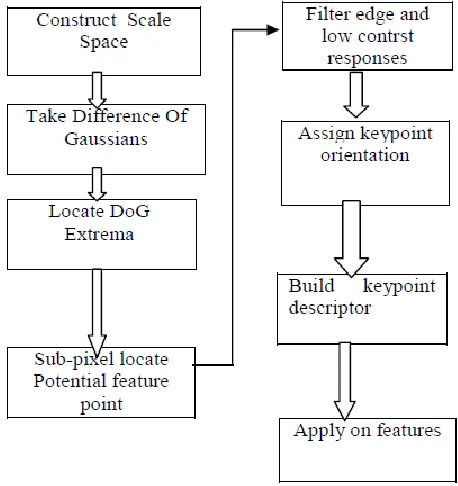
Detection of scale extrema points: In this first phase, the key points were found in SIFT. The key points are such that they are invariant to change scale and several views of the same object. In order to achieve said scale space of an image, the image and the defocusing of the Gaussian defocusare convolved at different scales and, therefore, the difference is taken in consequence of the blurred Gaussian image for the efficient detection of stable key points. The convolution of the input image with the Gaussian blur on the scale, that is, the Gaussian difference (DoG) at multiple scales is calculated by subtracting two adjacent image scales separated by a constant multiplicative factor k?
of the Taylor series of the spatial scale function DoG, with the candidate key point as the origin. This expansion of Taylor is given by:
Where D and its derivatives are evaluated at the candidate key point and represent the displacement from this point.
3.
The key point of low contrast is discarded: In the previous method, there are key points of low contrast, which are eliminated in this stage. To discard low-contrast key points, the value of Taylor's second-order expansion D (x) is calculated in the displacement. If this value is less than 0.03, the candidate key point is discarded. Otherwise, it is maintained, with the final position y + x and the scale, where y is the original position of the key point on the scale.4.
Eliminate edge responses: Even if the candidate key point is not robust enough for small amounts of noise, the DOG function has strong responses along the edges. Therefore, to improve stability, key points with ill-defined positions but with high-level responses are eliminated.5.
Assignment of orientation: In this step, each key point is assigned with one or more orientations according to the gradient directions of the local image. With this step, the rotational invariance is achieved when the key point descriptor is represented in relation to this orientation and then the invariance to the rotation image is achieved. The magnitude and direction calculations for the gradient are made for each pixel in a neighboring region around the key point in the Gaussian image L. blurred. [image:3.612.339.568.92.335.2]6.
Descriptor of key points: the previous steps have identified positions of key points in specific scales and assigned orientations. This ensured the invariance of the position, scale and rotation of the image. Now we want to calculate a descriptor vector for each key point so that the descriptor is highly distinctive and partially invariant with respect to the remaining changeFig.6:Steps of SIFT Algorithm
Matlab Simulation:
Our simulation required:
a) Resize image captured by mobile phone
b) SIFT algorithm
c) Databse with real palm images
TABLE 1-Related work on touchless palmprint recognition
Accuracy:
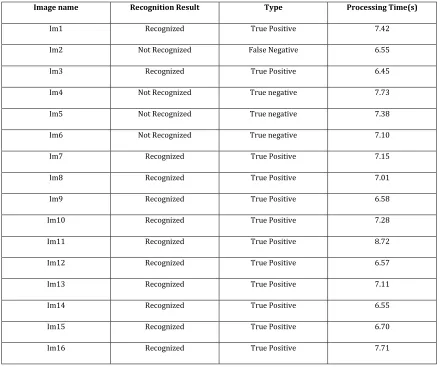
TP= 12
TN= 3
FP=0
FN=1
Accuracy= TP+TN/(TP+TN+FP+FN)*100%
=(15/16)*100
= 93.75
Image name Recognition Result Type Processing Time(s)
Im1 Recognized True Positive 7.42
Im2 Not Recognized False Negative 6.55
Im3 Recognized True Positive 6.45
Im4 Not Recognized True negative 7.73
Im5 Not Recognized True negative 7.38
Im6 Not Recognized True negative 7.10
Im7 Recognized True Positive 7.15
Im8 Recognized True Positive 7.01
Im9 Recognized True Positive 6.58
Im10 Recognized True Positive 7.28
Im11 Recognized True Positive 8.72
Im12 Recognized True Positive 6.57
Im13 Recognized True Positive 7.11
Im14 Recognized True Positive 6.55
Im15 Recognized True Positive 6.70
Simulation Result
Analysis:
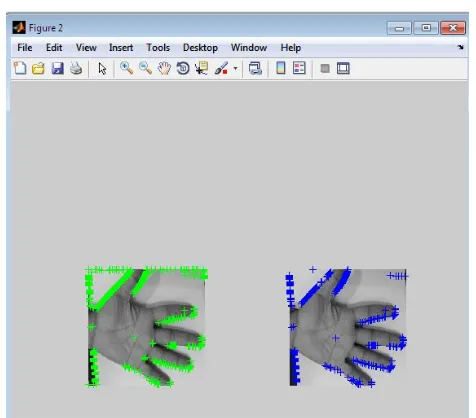
[image:5.612.46.284.104.313.2]In this experiment using SIFT,about 16real palmimages were stored in database and current image are matchedwith database images.This figure shows the maximum matching and occurance of highPerformance.
Fig.9:Performance graph using SIFT method
Fig: shows the following parameters
TP:true positive
TN:true negative
FP:false positive
V.CONCLUTION:
In this research work, realtime palmprint bases recognition system has been envisaged. The Palmprint are classified and features are extracted. Scale Invariant feature transform method has been used to extract regions from the palmprint images taken from camera images. It is advancement from the the previous work in the sense that previous reserach work researches have used existing databases of palmprint images rather than realtime images to implement and evaluate their algorithm while in this research work actual images of palmprint are taken.16 different palmprint images are taken of 16 subjects and algorithm is evaluated for accuracy and sensitivity of the algorithm which shows good results.
VI. FUTURE WORK:
Need to perform additional experiments to use the color information available in your handheld images, to dynamically take advantage of a larger footprint area or to develop algorithms that can detect (even correct) cosmetics, injuries or palm text to enable Greater precision.
Additional work is needed to evaluate the accuracy of correspondence in a more demanding way correspondence protocols, i.e,combination of left and right palm.
REFERENCES:
[1] J. Chen, Y.S. Moon, M. F. Wong, G. Su, “Palmprint authentication using a symbolic representation of images”Image Vis. Comput., vol. 28, no. 3, pp. 343-351, 2010.
[2] L. Fang, M. K. H. Leung, T. Shikhare, V. Chan, K. F. Choon“Palmprint classification”, in Conf. Proc. IEEE Int. Conf. Syst. Man Cybern., 2007, vol. 4, pp. 2965-2969.
[3] S. H. Kahleel, “Palm-print patterns in population of Diwaniyah City”Journal of Al-Qadisiya for Pure Sciences, vol. 17, no. 2, pp. 1-8, 2012.
[image:5.612.62.277.421.593.2][5] T. Cook, R. Sutton, K. Buckley, “Automated flexion crease identification using internal image seams”, Pattern Recognit., vol. 43,no. 3, pp. 630-635, 2010.
[6] T. Connie, A. T. B. Jin, M. G. K. Ong, D. N. C. Ling, “An automated palmprint recognition system”, Image, Vis. Comput., vol. 23, no. 5, pp.501-515, 2005.
[7] M. O. Adetona, O. O. Oladapo, J. O. Akinyemi, “Palmar flexion creases variants among Nigerians”, Africal Journal of Biomedical Research,vol. 15, no. 2, pp. 93-96, 2012.
[8] M. Hays, “An identification based on palmar flexion creases”, J.Forensic Idenf., vol. 63, no. 6, pp. 633, 2013.
[9] L. Fei, Y. Xu, W. Tang, D. Zhang, “Double-orientation code and nonlinear matching scheme for palmprint recognition”, PatternRecognition, vol. 49, pp. 89-101, 2016.