SEAMLESS HORIZONTAL HANDOVER ALGORITHM FOR HOMOGENEOUS WIRELESS MOBILE NETWORKS USING FUZZY
LOGIC
MOHAMMED KHALEEL IBRAHIM
A thesis submitted in partial
fulfillment of the requirement for the award of the Degree of Master of Electrical Engineering
Faculty of Elecrical and Electronic Engineering Universiti Tun Hussein Onn Malaysia
ABSTRACT
The wireless networks of the near future will be capable of successfully handling various kinds of communication systems. Worldwide Interoperability for Microwave Access (referred to as WiMAX) is a physical layer wireless communications technology for outdoor broadband wireless coverage. The most important and society application of WiMAX is the mobile communication. When a mobile station changes its geographical position, it may also need to change its attachment point in the network in order to retain the quality of the connection. Currently, the mobility of a terminal is a requirement of great importance, supported by a procedure known as handover. One of the main challenges for robust mobility is the availability of simple and seamless handover algorithms, which allow a mobile node to connect among
homogeneous or heterogeneous wireless networks. Two types of handover could take
place: horizontal handover between wireless Access Points at the same wireless network, and vertical handover between different wireless networks. During the handover procedure the mobile node can neither send nor receive any data packets.
v
ABSTRAK
Rangkaian tanpa wayar masa terdekat mampu mengendalikan pelbagai jenis sistem
komunikasi. Interoperability Seluruh Dunia bagi Akses Gelombang Mikro (dirujuk
sebagai WiMAX) adalah lapisan teknologi tanpa wayar komunikasi fizikal untuk
liputan jalur lebar tanpa wayar. Yang paling penting dan aplikasi pengunaan
WiMAX adalah komunikasi mudah alih. Apabila stesen mudah alih mengubah
kedudukan geografinya, ia juga mungkin perlu menukar titik lampiran dalam
rangkaian untuk mengekalkan kualiti sambungan. Pada masa ini, mobiliti terminal
adalah satu keperluan yang amat penting, yang disokong oleh prosedur yang dikenali
sebagai pemindahan. Salah satu cabaran utama untuk mobiliti yang mantap adalah
adanya mudah dan lancar pemindahan algoritma, yang membolehkan nod mudah alih
untuk menyambung antara rangkaian tanpa wayar homogen atau heterogen. Dua
jenis pemindahan boleh berlaku: pemindahan mendatar antara Access Points tanpa
wayar pada rangkaian wayarles yang sama, dan pemindahan menegak antara
rangkaian tanpa wayar yang berbeza. Semasa prosedur pemindahan nod bimbit tidak
boleh menghantar atau menerima apa-apa paket data. Ini menyebabkan kelewatan
paket dan dalam beberapa kes kehilangan paket. Projek ini mencadangkan
pemindahan mendatar yang cekap berdasarkan prinsip logik kabur untuk
mengurangkan pemindahan yang tidak diperlukan. Tiga sistem digunakan dalam
pengajian ini untuk mengetahui yang mana satu boleh mendapatkan keputusan
sistem yang terbaik system A, system B dan sistem C serta menggunakan lapan
langkah pemindahan senario mendatar pada setiap sistem. Sistem A merrlunakan tiga
parameter: Diterima Kekuatan Isyarat (RSS), jalur lebar Disediakan (ABW) dan
Kadar Ralat Bit (BER), Sistem B menggunakan dua parameter: RSS, ABW
manakala sistem C menggunakan kaedah konvensional. Selepas perbandingan antara
ketiga-tiga sistem, ia menunjukkan sistem A adalah senario terbaik di antara tiga
sistem tersebut. Hasil kajian menunjukkan bahawa dengan menggunakan kaedah ini,
pemindahan bilangan dan masa lengah berkurangan beserta penurunan jumlah
CONTENTS
TITLE i
DECLARATION ii
ACKNOWLEDGEMENT iii
ABSTRACT iv
ABSTRAK v
CONTENTS vi
LIST OF TABLES ix
LIST OF FUGURES x
LIST OF SYMBOLS xii
LIST OF APPENDICES xiv
CHAPTER 1 INTRODUCTION 1
1.1 Introduction 1
1.2 Problem Statement 2
1.3 Aim of Study 3
1.4 Objectives of Study 3
1.5 Scope of Study 3
1.6 Significance of Study 4
1.7 Thesis Outline 4
CHAPTER 2 LITERATURE REVIEW 6
2.1 Introduction 6
2.2 Worldwide Interoperability for Microwave Access (WiMAX) 7
2.2.1 Mobile system 8
vii
2.3 Handovers 10
2.3.1 Types of Handover 10
2.3.1.1 Hard Handover 11
2.3.1.2 Soft Handover 12
2.4 Fuzzy Logic 13
2.4.1 Fuzzification 14
2.4.2 Fuzzy Inference System 17
2.4.3 Fussy Rule 17
2.4.4 Defuzzification 18
2.5 Horizontal Handover In Homogenous Network 18
2.6 Chapter Summary 23
CHAPTER 3 RESEARCH METHODOLOGY 24
3.1 Introduction 24
3.2 Proposed Simulation Model 25
3.2.1 Horizontal Handover Scenario 25
3.2.2 Parameters of Fuzzy Logic 26
3.2.3 Horizontal Handover Procedure 29
3.3 Chapter Summary 32
CHAPTER 4 RESULTS AND DISCUSION 33
4.1 Introduction 33
4.2 System Architecture 33
4.3 Fuzzy Logic Controller Development Process 34
4.4 Horizontal Handover Decision 35
4.4.1 Three input parameters (RSS,ABW,BER)(System A) 36 4.4.1.1 Fuzzy Inference System (FIS) Editor 36 4.4.1.2 Fuzzy Sets (System A) 39
4.4.1.3 The membership function(System A) 40 4.4.1.4 The rule editor(System A) 41 4.4.1.5 The rule viewer(System A) 42 4.4.1.6 Surface viewer(System A) 43 4.4.2 Two Input Parameters (RSS,ABW) (System B) 46
4.4.3 One Parameter (RSS)(System C) 48
4.6 Chapter Summery 49
CHAPTER 5 CONCLUSIONS AND FUTURE WORK 50
5.1 Introduction 50
5.2 Research Contribution 50
5.2.1 Objective One: Seamless and Robust Horizontal Handover
51
5.2.2 Objective Two: Construct a Mobile Communication System using Fuzzy Logic
51
5.2.3 Object Three: High Quality and Fast System 51
5.3 Recommendation and Future Works 52
REFERENCES 53
APPENDICES 56
ix
LIST OF TABLES
2.1 Trapezoidal and triangular of Membership Function Calculation 16
2.2 Fuzzy Set 17 2.3 Related work for horizontal and vertical handover 19 3.1 Membership Function Variables 29 3.2 FAM Table if BER is LOW 31
3.3 FAM Table if BER is HIGH 31
4.1 Parameters for FIS editor 38
4.2 When BER Low 44
4.3 When BER High 45
LIST OF FIGURES
2.1 WiMAX 7
2.2 The Mobility Process 10
2.3 Vertical and horizontal handover 11
2.4 Hard Handover 12
2.5 Soft Handover 12
2.6 The application of Fuzzy logic 13
2.7 Fuzzy Logic 14
2.8 Trapezoidal membership function 14
2.9 Triangular membership function 15
2.10 Trapezoidal and Triangular membership function 16
2.11 Multi-Level Threshold Handover Concept 21
2.12 Proposed fuzzy logic based handoff architecture 21
3.1 Scenario of proposed model 26
3.2 Membership function for RSS 27
3.3 Membership function for ABW 27
3.4 Membership function for BER 28
3.5 Membership function for O/P 29
3.6 Procedure of Scenario 30
4.1 Five primaries GUI tools for FIS 35
4.2 Basic Structure of a Fuzzy Inference System 37
4.3 FIS editor for adaptive HHO (system A) 38
4.4 Membership function editor for “RSS”,“ABW” and "BER" 40
4.5 Membership function editor for LEVELS 41
xi
4.7 Rule viewer for 3 inputs 43
4.8 Surface viewer (system A) 44
4.9 Block diagram for RSS and ABW to Output level (System B) 46
4.10 Rule viewer (System B) 47
LIST OF SYMBOLS
IEEE - Institute of Electrical and Electronics Engineers WLAN - Wireless Local Area Network
WiMAX - Worldwide Interoperability for Microwave Access
GPRS - General Packet Radio Service LTE - Long Term Evolution
3G - 3rd Generation 4G - 4th Generation
WAN - Wide Area Network RSS - Received Signal Strength
MN - Mobile Node
HHO - Horizontal Handover
AP - Access Point
ABW - Available Bandwidth
BER - Bit Error Rate QoS - Quality of service
WMAN - Wireless
MSC - Mobile Switching Centre
MTSO - Mobile Telephone Switching Office
SNREQ - Source Node Request Packet
NDREP - Neighbor Discovery Request Packet
NPER - Neighbor Reply Packets
LPER - List Replay Packet MLREP - MH List Reply Packet
MLREQ - MH List Request Packet
SNREP - Source Node Replay Packet RREQ - Route Request Packet
RREP - Route Replay Packet
xiii
MF - Membership Function
IS - Information Server
VoIP - Voice over Internet Protocol GUI - Graphical User Interface
FIS - Fuzzy Inference System
OW - Optical Wireless
MSCTP - Mobile Stream Control Transmission Protocol
SIP - Session Initiation Protocol
NGWS - Next Generation Wireless system
CHMP - Cross Layer Handover Management Protocol
COG - Centre Of Gravity
LIST OF APPENDICES
APPENDIX TITLE PAGE
A1 First case of system A when BER is low 56
A2 Second Case of system A when BER is high 57
A3 When BER is constant 58
CHAPTER 1
INTRODUCTION
1.1 Introduction
Communication is one of the integral parts of science that has always been a focus point for exchanging information among parties at physically apart locations. After its discovery, wireless communications has replaced the telegraphs and letters.
Wireless networking is becoming increasingly important and a popular way of providing global information access to users on the move. Various popular protocols such as IEEE 802.11/16/21 (Sharif & Maeda, 2011; Wong et al., 2009), and technologies such as; WLAN, WiMAX, GPRS, Long Term Evolution (LTE) and 3G/4G Cellular wireless networks providing mobile users universal and seamless mobility for all kinds of traffic. Worldwide Interoperability for Microwave Access (WiMAX) is a recent wireless broadband standard that has promised high bandwidth overlong-range transmission (Mohammed et al., 2010). WiMax is one of the technologies that is being used for 4G networks and can be used in both point to point and the typical WAN type configurations that are also used by 2G and 3G mobile network carriers. Its formal name is IEEE standard 802.16 (Rogers & Edwards, 2003). Mobile devices are able to configure multiple wireless network interfaces which simply give them the ability to access resources in heterogeneous wireless networks (Niyato&Hossain, 2008).
Today, mobile communication has become the backbone of society. All the mobile system technologies have improved the way of living. It’s main plus point is
when the phone gets outside the range of the first cell. Many have proposed newer approaches to solve this problem and one of them is the incorporation of fuzzy logic
into the decision making process (Edward & Shankar, 1998).
Fuzzy logic has long been used successfully in applications’ controls and
predictions. Its nature of using language based approach, i.e. employing if-then rules, will allow less dependence on the precise quantitative analysis. This makes fuzzy logic suitable for analysis in an environment of uncertainty (Foong& Maeda, 2011).
1.2 Problem Statement
With rapid development and deployment of wireless technologies, Mobile Telephone
Systems tend to be smaller in order, the size of cells used in cellular phones is to increase traffic channels for more users in that area, especially in the city area because, the small size handovers occur more frequently (Loiaet al., 2004). Moreover, there are many buildings built in various shapes and various location arrangements in the city area that affect the received signal strength’s (RSS) level in
the mobile stations (MS), by increasing fading which causes more number of handovers. One of the most challenging issues in homogeneous wireless network is the considerable amount of packet loss due to performing handover procedures (Moravejoshariehet al., 2011).
3
phenomenon known as the Manhattan effect, where the sudden signals drop due to the high rise of buildings in the urban area (Foonget al., 2009).
There are many applications and techniques on horizontal handover that were developed in the past. However, limitations such as QoS and the efficiency of the model need to enhance the performance of the system. Therefore, continuous efforts are carried out to improve HHO in many fields, including fuzzy logic. Several related methods had been investigated and carried out. Thus, to overcome the drawbacks, this project focuses on enhancing the performance of the communication system by using a computing intelligence
1.3 Aim of Study
A seamless Horizontal Handover Decision Algorithm for homogeneous Wireless Mobile Network using fuzzy logic is studied. Horizontal Handover technique will enhance the QoS and then obtaining high efficiency in mobile communication.
1.4 Objectives of Study
At the end of this project the following objectives will be achieved:- i. To develop a seamless and robust horizontal handover.
ii. To construct a mobile communication system based on horizontal handover using fuzzy logic.
iii. To obtain a high quality and faster system of better efficiency for mobile communication system.
1.5 Scope of Study
and then choose which one will make the best and seamless horizontal handover decision as a new station.
1.6 Significance of Study
The importance of this project to increase the performance of the mobile communication system by using fuzzy logic into the communication field. In the conventional method, many handovers need to be change always before one is chosen, which causes a delay and fails some calls while, Fuzzy logic will decrease the number of handovers by choosing the best value, which decreases the fail call and requires a shorter time to obtain high efficiency.
1.7 Thesis Outline
This thesis is a documentary to deliver the generated idea, the concepts applied, the activities perform, and finally, the output project produced. The thesis consists of five chapters.
Chapter 1 discusses the background of the research. In addition, the objectives of project, problems statement, scopes of work and thesis structure outline are presented.
Chapter 2 contains literature review discussing the applications of wireless communication (WiMAX) and explain the mobility. In this chapter, the handover and their types and the advantage of each type are explained. Furthermore, a review of fuzzy logic and the reason of using fuzzy logic will be discusses in this chapter. On the others hand, this chapter also includes preview recent research of modulation schemes from the year 2006 until 2012 and the author's view on these research.
Chapter 3 provides the detailed properties of the proposed seamless horizontal handover decision in homogenous network using fuzzy logic, and briefly describe the simulation for HHO event. The methodology that being used in this study involved eight steps starting from choosing the parameters until decision of handover.
5
covered MATLAB Fuzzy Inference System (FIS) result and analysis. The Fuzzy logic control module was developed to assist the adaptation process.
CHAPTER 2
LITERATURE REVIEW
2.1 Introduction
The key objective of most “robust and seamless communication system” research
projects is to ensure good mobility in homogeneous wireless network, and to allow a user to communicate with fast and high quality of service (Hua & Brieu, 2006). The most important parameter to measure the QoS is the efficiency of the system within depend on several parameters (Foongs et al., 2009; Agrawal & Zeng, 2011).
Handover decision is the ability to decide when to perform the horizontal handover. Handover metrics are the qualities that are measured to indicate whether or not a handover is required. Traditional handover decision metrics based on the received signal strength (RSS) and other parameters used for horizontal handover in
7
This chapter also discussed the related works that will in line with the problem under study, seamless horizontal handover using fuzzy logic.
2.2 Worldwide Interoperability for Microwave Access (WiMAX)
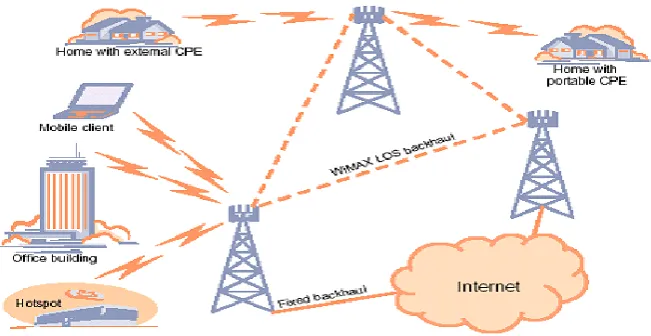
Worldwide Interoperability for Microwave Access (WiMAX) is a MAC and physical layer wireless communications technology. WiMAX was designed to provide outdoor broadband wireless access at a municipal, state-wide, or regional level. The set of standards that define WiMAX are developed and maintained by the IEEE 802.16 Working Group (Martin et al., 2009). WiMAX is central to a number of new market and technology opportunities. The standard offers a range of broadband wireless technologies that are capable of delivering differentiated and optimized service models. WiMAX promises to combine high capacity services with wide area coverage (Martin et al., 2009; Hua & Brien, 2006; Singh & Ahuja, 2011). Provides up to 70 Mb/sec symmetric broadband speed without the need for cables. The technology is based on the IEEE 802.16 standard (also called Wireless MAN) (Mitra, 2009). 802.16 networks operating at licensed 2.5 GHz spectrum are being deployed by broadband wireless Internet Service Providers such as Sprint and Clearwire at specific locations around the country. States and cities are deploying
[image:19.595.150.476.555.723.2]WiMAX for Internet access in licensed 3.65 GHz spectrum ( Martin et al., 2009; Bian et al., 2007), as shown in Figure 2.1.
IEEE 802.16 is a set of standards on broadband wireless access (BWA), which was established by the IEEE standards board in 1999 and aims for global
deployment of broadband wireless metropolitan area networks (WMAN). As currently defined through IEEE standard 802.16, a wireless MAN provides network access to buildings through exterior antennas communicating with central radio- based stations (BSs) (Rogers & Edwards, 2003).
2.2.1 Mobile System
The definition of mobile radio terminal means any radio terminal that could be moved during its operation. In general, however, a Mobile Station (MS) or subscriber unit communicates to a fixed Base Station (BS) which in turn communicates to the desired user at the other end. The MS consists of transceiver, control circuitry, duplexer and an antenna while the BS consists of transceiver and channel multiplexer along with antennas mounted on the tower. The BS is also linked to a power source for the transmission of the radio signals for communication and connected to a fixed backbone network. Figure 2.2 shows a basic mobile communication with low power transmitters/receivers at the BS, the MS and also the Mobile Switching Center (MSC) (Mitra, 2009).
The MSC is sometimes called Mobile Telephone Switching Office (MTSO).
9
2.2.2 The Mobility
When a mobile station transfers a user's session from one network to another, the IP address will change. In order to allow the Corresponding Node that the MN is communicating with to find it correctly and allow the session to continue, Mobility Management is used. The Mobility Management problem can be solved in different layers, such as the Application Layer, Transport Layer, IP Layer, etc. The most common method is to use SIP (Session Initiation Protocol) and Mobile IP.
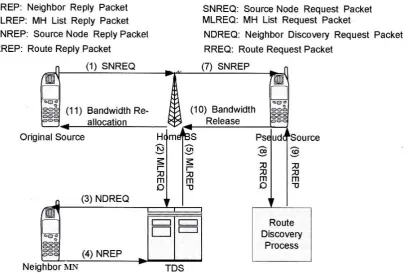
If the Mobile Node (MN) in a congested cell is trying to make a call, it sends a source node request packet (snreq) to the home BS (see step 1 in Fig 2.2). After receiving a SNREQ, the home BS broadcast a MN list request packet (MLREQ) to al TDSs within the home cell (see step 2 in Fig 2.2). Once the TDS received the MLREQ, it broadcasts a Neighbor Discovery Request Packet (NDREP) to all MNs within it coverage (see step 3 in Fig 2.2), which respond neighbor Replay Packets (NREP) to the TDS (see step 4 in Fig 2.2). Then the TDS return a list of MNs to the home BS by sending a MN List Replay Packet (LREP) (see step 5 in Fig 2.2), which also contains the bandwidth status of the TDSs. After receiving the MLREPs from all the TDSs upper bounded to a timeout, the home BS applies a rational SSP algorithm to analyze the information included in MLREPs so as to choose a proper source node (see step 6 in Fig 2.2). Following this, the home BS sends a Source Node Replay
Figure 2.2: The Mobility Process (Hossain, 2008).
2.3 Handovers
The ability to maintain voice calls or packet sessions when moving from the coverage area of one call to another has been one of the most fundamental enabling features of mobile communication networks. This feature generally known as handover (HO) (handover is also written as handoff or handover, and as handover outside North America) (Agrawal & Zeng, 2011; Ramiro & Hamied, 2012).
2.3.1 Types of Handovers
11
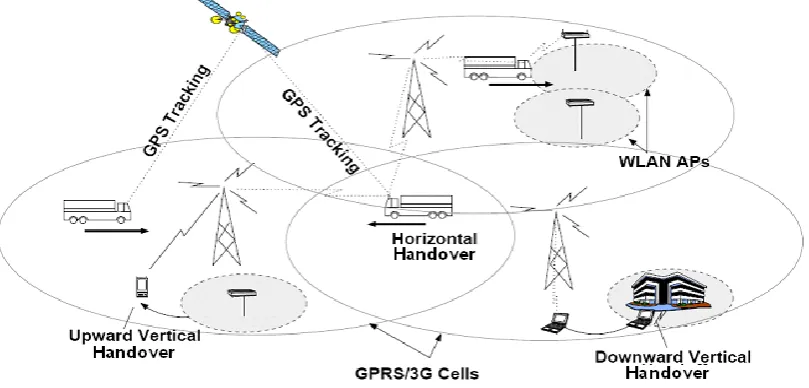
Figure 2.3: Vertical and horizontal handover (Wong et al, 2009).
There are two types of handover (vertical handover) and (horizontal
handover). Vertical handovers refer to the automatic fall over from one technology to another in order to maintain communication. This is different from a horizontal
handover between different wireless access points that use the same technology in that a vertical handover involves changing the data link layer technology used to access the network. Vertical handover happen when a mobile station transfers a user's session from one network to another, the IP address will change. In order to allow the corresponding node that the MS is communicating that is to find it correctly and allow the session to continue. The Mobility Management problem can be solved in different layers, such as the Application Layer, Transport Layer, IP Layer, etc. In horizontal handovers, there are two types, hard handover (break before make) and soft handovers (make before break).
2.3.1.1 Hard Handover
Figure 2.4: Hard handover (Wong et al, 2009).
2.3.1.2 Soft Handover
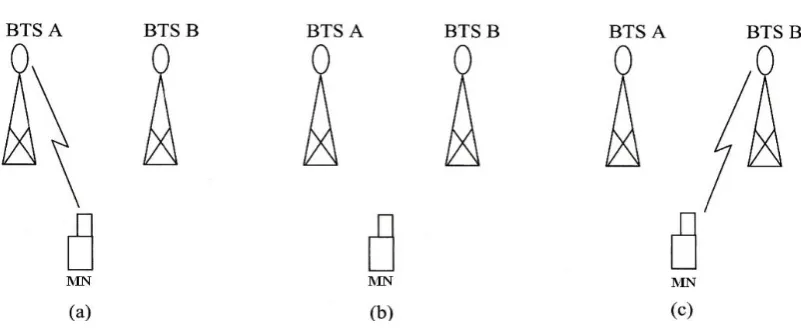
Figure 2.5 shows a soft handover process, with Figure 2.5(a) showing the MN connected to BTS A initially. Figure 2.5(b) shows that the MN in connected with
[image:24.595.114.525.537.705.2]BTS A and B. Finally, the MN is disconnected from BTS A but still connected to BTS B in Figure 2.5(c). This is also known as make before breaking (Wong et al, 2009). The MSC evaluates the signal strengths received from different BS for a single user and then shifts the user from one BS to the other without actually changing the channel. These types of handovers are called as soft handover as there is no change in the channel.
13
2.4 Fuzzy Logic
Fuzzy logic was invented by Dr. Lotfi Zadeh at the University of California at Berkeley in 1965. In very simple terms, fuzzy logic allows situations or problems to be described and processed in linguistic terms such as “hot” or “heavy” instead of precise numeric values such as “140 degrees” or “180 kg”.
[image:25.595.102.553.290.494.2]Fuzzy logic is much more than a logical system. It has many facets. The principal facets are: logical, fuzzy-set-theoretic, epistemic and relational. Most of the practical applications of fuzzy logic are associated with its relational facet (Zadeh, 2008).
Figure 2.6: The application of Fuzzy logic.
The application of fuzzy logic techniques has been increasing rapidly. Its implementation can be seen in many branches of engineering such as linguistic system, the areas of application for fuzzy logic have spread from consumer electronics to industrial control, information processing, financial analysis, communication, network and others as shown in Figure 2.6. In Communications and networking field, the fuzzy logic is used for ATM network traffic modeling, management, and rate control as well as nonlinear channel equalization, telecommunication ranking and network admission control. Besides that, Fuzzy Logic has been successfully applied in various areas pertaining to wireless communication systems. Robotic Industrial Application Civil Engineering Electronic Engineering Communicatio
n & Network Aerospace Engineering Power System Vehicular Technology Biomedical Engineering Chemical Engineering The design of
Observers& Controller
Sensor Technology
Figure 2.7: Fuzzy logic (Zadeh, 2008).
Fuzzy logic incorporates a simple, rule-based IF X AND Y THEN Z approach for solving control problem rather than attempting to model a system mathematically (Nguyen & Walker, 2000).
2.4.1 Fuzzification
The fuzzification comprises the process of transforming crisp values into grades of membership for linguistic terms of fuzzy sets. The membership function (MF) is used to associate a grade to each linguistic term (Salih et al., 2012).
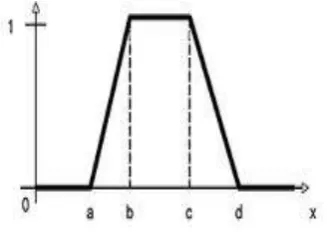
[image:26.595.238.402.609.725.2]Reznik (1997) reported that, Trapezoidal or Triangular functions as shown in Figure 2.8 & 2.9 have proved to be more popular with fuzzy logic theoretic and practitioners rather than higher order based functions such as Gaussian, etc. However, the problem of the membership function has not yet been solved theoretically. Different researchers choose numerous shapes in various application problems. Membership function need to be assigned (m=z….. [0,1]) to each fuzzy subset, its can have many different shapes, depending on definition.
15
The trapezoidal curve is a function of a vector, x, and depends on four scalar parameters a, b, c, and d, as given equation 2.1. The parameters a and d locate the "feet" of the trapezoid and the parameters b and c locate the "shoulders."
The simplified equation 2.1 for trapezoidal is as follows:
[image:27.595.119.307.87.204.2]Trapezoid(x;a,b,c,d)= max (min (𝑥−𝑎𝑏−𝑎, 1,𝑑−𝑥𝑑−𝑐), 0) (2.2)
Figure 2.9: Triangular Membership Function
The triangular curve is a function of a vector, x, and depends on three scalar parameters a, b, and c, as given equation 2.3. The parameters a and c locate the "feet" of the triangle and the parameter b locates the peak.
The simplified equation 2.1 for triangular is as follows:
Triangle (x;a,b,c) = max (min (𝑥−𝑎𝑏−𝑎,𝑐−𝑥𝑐−𝑏), 0) (2.4)
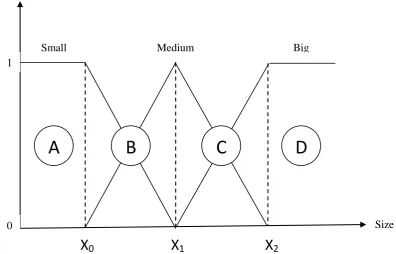
The following example demonstrate how trapezoidal and triangular for the above equations is used in horizontal handover.
Degree of Membership
[image:28.595.130.527.206.460.2]
X0
X1
X2
Figure 2.10: Trapezoidal & Triangular Membership Function [image:28.595.116.523.593.725.2]Table 2.1 explain each section in detail of Figure 2.10
Table 2.1: Trapezoidal and Triangular of Membership Function Calculation
Section Rule Calculation
A X≤X0
Small = 1 Medium = 0 Big = 0
B X0<X≤X1
Small = ( x1 – x ) / ( x1 – x0 ) Medium = ( x – x0 ) / (x1 – x0 ) Big = 0
A
B
C
D
Size Big
Medium Small
1
17
C X1<X≤X2
Small = 0
Medium = ( x2 – x ) / ( x2 – x1 ) Big = ( x – x1 ) / ( x2 – x1 )
D X2<X
Small = 0 Medium = 0 Big = 1
2.4.2 Fuzzy Inference System
Inference is known as the process that draws conclusions from a set of facts using a collection of rules. The fuzzy inference system is a computing framework based on the concepts of fuzzy set theory, fuzzy if-then rules, and fuzzy reasoning. Two types of fuzzy inference systems that can be implemented are the Mamdani-type and the Sugeno-type (Hua & Brieu, 2006). The differences between these fuzzy inference
[image:29.595.115.525.69.171.2]systems lie in the consequents of their fuzzy rules, and therefore their aggregation and defuzzification processes differ accordingly.
Table 2.2: Fuzzy Set
parameters Fuzzy set
RSS LOW, MEDIUM , HIGH
ABW LOW , MEDIUM , HIGH
BER LOW , HIGH
HHO LOW , MEDIUM , HIGH , VERY HIGH
2.4.3 Fuzzy Rule
This step involves with the definition by using “if-then’’ rules to be relevant to human sense and proper handover. Number of fuzzy rules generated increases
significantly with the number of parameters used in a decision engine. This leads to an increased computational complexity of the decision algorithm (Thumthawatwarn
1- If ( RSS = low and BW = low and BER = low ) then HHO_ decision = low 2- If ( RSS = medium and BW = medium and BER = low ) then HHO_
decision = medium.
3- If ( RSS = high and BW = high and BER = high ) then HHO_ decision = high.
Assignment of conditions in fuzzy logic can be changed in any case depending on the designer, so that the number of handover is reduce automatically because many conditions can be defined for this method.
2.4.4 Defuzzification
As a result of applying the previous steps, one obtains a fuzzy set from the reasoning process that describes, for each possible value how reasonable it is to use this particular value. In other words, for every possible value one gets a grade of membership that describes to what extent this value is reasonable to use. Using a fuzzy system as a controller, one wants to transform this fuzzy information into a single value that will actually be applied. This transformation from a fuzzy set to a crisp number is called a defuzzification. The fuzzy results generated cannot be used as such to the applications, hence it is necessary to convert the fuzzy quantities into crisp quantities for further processing.
There are five methods of defuzzifying a fuzzy set of a universe of discourse, Centre of gravity, Mean of maximum, weighted average, Smallest of maximum, Largest of maximum and Bisector of area, but probably the most popular one is the centroid technique. It finds the point where a vertical line would slice the aggregate set into equal masses. Mathematically this centre of gravity (COG) can be expressed as equation (2.5).
COG = µ 𝑨 𝒙 𝒅𝒙 𝒃
𝒂
µ 𝑨 𝒙 𝒅𝒙𝒂𝒃 (2.5)
2.5 Horizontal Handover in Homogenous Network
19
wireless access point to another in a homogeneous network environment, it has to perform horizontal handover. This results in packet delay and in some cases packet
loss. These two factors severely affect the Quality of Service (QoS). A few researchers tried to find the best method for handover with the best QoS (Ortiz et al., 2009).
Table 2.3: Related work for horizontal and vertical handover
No. Author & Year Title HHO VHO FL Others 1. Hua & Brien
(2006)
Vertical handover-decision-making algorithm using fuzzy logic for the integrated Radio-and-OW system
2. Nkansah,Y. & Agbinya,J. (2007)
Vertical Handoff Decision Algorithms Using Fuzzy Logic
3. Thumthawatuarn & Preues (2009)
Multi-level Threshold Handover for
Homogeneous Wireless Mobile Networks
4. Foong, K. C. , Chee, C. T. & Wei, L. S. (2009)
Adaptive Network Fuzzy Inference System(ANFIS) Handoff Algorithm
5. Thumthawatwarn
et al.(2011)
Modular Handover Decision System based on Fuzzy Logic for Wireless Networks
6. Salih et al. (2012)
A Fuzzy Predictive Handover Mechanism based on MIH Links Triggering in
Heterogeneous Wireless Networks
7. Israt, P. ;Chakma, N. &Hashem, M, M, A.(2008)
A Fuzzy Logic-Based Adaptive Handoff Management Protocol for Next-Generation Wireless Systems
8. Bhosale, S. & Daruwala. D. (2011).
Evaluating the Reliability of Network Simulator during Wi-Fi toWi-Fi Horizontal Handover Simulation
Hua & Brien (2006) used fuzzy logic to enhance the performance of the communication system, he used the received signal strength, bandwidth, network coverage and preferred network parameters in his method. Due to the complementary nature of radio and optical wireless (OW) both in capacity and coverage, the
combined use of both for data transmission could have advantages over a single media. Since excessive transfer delay results in disrupted connection and corrupted service, the proposed FL-based VHO decision-making algorithm has the potential to provide a better quality of service (QoS) to users in future wireless broadband communications.
Nkansah,Y. & Agbinya,J. (2007) used fuzzy logic in heterogeneous vertical handoff by installing and test the Stream Control Transmission Protocol (SCTP) throughput performance of the OpenSS7 Linux kernel SCTP implementation on two Pentium 4 machines in our network laboratory as part of a scheme to implement vertical handoff using mobile SCTP (mSCTP) and the Session Initiation Protocol (SIP). The mSCTP is targeted for the client-server model, where a mobile node (MN) initiates an SCTP session with a fixed correspondent node (CN). For supporting vertical handoff where the fixed CN initiates an SCTP session with the MN, the mSCTP must be used with a location management scheme such as SIP. A major drawback of using SCTP is that almost all of the current Linux kernel implementations of SCTP do not provide the DAR extension features of SCTP and almost all open source SIP servers and user agents do not support SCTP.
Thumthawatuarn & Preues (2009) divided the received signal strength RSS to
21
Figure 2.11: Multi-Level Threshold Handover Concept
Israt, P. ;Chakma, N. & Hashem, M, M, A.(2008) He try to develop a seamless handoff management protocol for next-generation wireless systems(NGWS). In this paper, a fuzzy logic-based adaptive handoff (FLAH) management protocol is developed which is then integrated with an existing cross layer handoff protocol used fuzzy logic as a based handover management protocol is introduced which is integrated with an existing Cross-Layer Handover Management Protocol (CHMP). The existing link-layer-assisted HMIP protocols propose to initiate the initiate Hierarchical Mobile IP (HMIP) registration when the RSS from the serving BS, as shown in Figure 2.12.
Figure 2.12: Proposed fuzzy logic based handoff architecture.
[image:33.595.181.495.480.624.2]function to be constructed based on the historical data of the metrics. It also included the adaptive nature for automatic tuning purposes. The training algorithm for ANFIS
is based on the hybrid learning algorithm where premise and consequent parameters are to be updated after each data presented into the algorithm, known as pattern learning. The training algorithm consists of forward pass and backward pass.
Thumthawatwarn et al.(2011) proposed a new modular fuzzy rule-based (MFRB) handover decision system algorithm, which aims to address the issues of multiple QoS parameters and at the same time reduces the computational complexity significantly by reducing the total number of fuzzy rules, and hence minimizing the execution time (T). The proposed modular fuzzy rule-based (MFRB) decision system is introduced in the handover decision stage. The handover parameters are categorized into groups, and a different fuzzy engine deals with each group. There are three fuzzy engines, namely Network QoS (NQ), Efficiency (Eft) and Degree of Satisfaction (OS). The final score for each candidate network is jointly determined by the three fuzzy engines. The network with the highest final score is selected for handover.
While Salih et al. (2012) used fuzzy logic in heterogeneous network to enhance the vertical handover mechanism based on the Media Independent Handover (MIH) Links Triggering. He proposes a fuzzy based prediction algorithm with dynamic of links triggering for vertical handover by applying the Information Server
(IS) of IEEE 802.21. Under the IEEE 802.21 [2] media independent handover function (MIHF), current network connecting with the terminal can easily collect the useful information of its neighboring networks (WiFi, WiMAX, and UMTS) by registering for MIH services. Most of the information is dynamic, changing with time such as RSS and ABW. Current network sends the dynamic information request to neighboring networks. The current network can collect them as soon as it senses the new neighboring network or any other time, and store them in its own database.
Bhosale, S. & Daruwala. D. (2011) used the same technology between different Wi-Fi cells. His proposal is an attempt to evaluate the reliability and scalability of the network simulator-2 (ns-2) tool in simulating multiple horizontal handovers between different Wi-Fi Access Points (APs).
23
hand, they also suffer long time training times and often reach local minima. Furthermore, some researchers favioure to use many parameters to improve the
performance of the communication system.
2.6 Chapter Summary
CHAPTER 3
RESEARCH METHODOLOGY
3.1 Introduction
This section provides detailed properties of the proposed seamless Horizontal Handover (HHO) decision in homogenous network using fuzzy logic, and briefly describe the simulation for HHO event. The methodology that being used in the present study involved the following steps as shown in Figure 3.6: step (1) the variable selection for considerating Received Signal Strength (RSS), Available BandWidth (ABW) and Bit Error Rate (BER) to be used in the simulation. Step (2) the variable selection that enter the used fuzzy system. The process start by fuzzification,where in fuzzification, is converting the crisp values into variables and then defining Membership Function (MF) for each parameter. Step (3) is to define
53
REFERENCES
Agrawal, D. P. & Zeng, Q. A. (2011). Introduction to Wireless & Mobile System.3 rd addition.USA: Globel Engineering: Christopher M. Short.
Bhosale, S. & Daruwala, R. D. (2011). Experimental Analysis of Horizontal and Vertical Handovers in Wireless Access Networks using NS2. World Congress on_Information and Communication Technologies, pp. 294-599.
Bian,Y,Q. ; Nix,A,R. ; Sun,Y. &Strauch, P. (2007). Performance Evaluation of Mobile WiMAX with MIMO and Relay Extensions . This full text paper was peer_reviewed at the direction of IEEE Communications Society subject matter experts_for publication in the WCNC 2007 proceedings, pp. 1816-1821.
Ciubotaru, B. & Muntean, G. M. (2009). SASHA—A Quality-Oriented Handover Algorithm for Multimedia Content Delivery to Mobile Users. IEEE TRANSACTIONS ON BROADCASTING, VOL. 55, NO. 2, pp. 437-450. Edwards, G. & Shankar, R. (1998). Microcellular Handoff using Fuzzy Logic
Techniques. Wireless Networks, vol. 4, pp. 401-409.
Foong, K. C. , Chee, C. T. & Wei, L. S. (2009). Adaptive Network Fuzzy Inference System (ANFIS) Handoff Algorithm . IEEE, Future Computer and Communication, 2009. ICFCC 2009. International Conference on Communication, Networking & Broadcasting ;Computing & Processing (Hardware/Software), pp. 195 – 198.
He, D. ;Chi, C. ;Chan, S. ; Chen, C. ;Bu, J . & Yin, M. (2010). A Simple and Robust Vertical Handoff Algorithm for Heterogeneous Wireless Mobile Networks.
Wireless Pers Commun, pp. 361–373.
Devices &Systems ; Engineered Materials, Dielectrics & Plasmas. pp. 503 – 506.
Hossain, E. (2008). Heterogeneous Wireless Access Network Architecture and Protocols.USA : Springer Science + Business Media, LLC.
Hua, j. & Brien, D. C. (2006). Vertical handover-decision-making algorithm using fuzzy logic for the integrated Radio-and-OW system. IEEE Transactions on Wireless_Communication, pp. 176-185.
Israt, P. ;Chakma, N. &Hashem, M, M, A.(2008). A Fuzzy Logic-Based Adaptive Handoff Management Protocol for Next-Generation Wireless Systems.
Proceedings of 11_th International Conference on Computer and Information Technology (ICCIT 2008), pp. 288-293.
Loia, V. ;Nikravesh, M. & Zadeh, L, A.(2004). Fuzzy Logic and the Internet .New York.
Martin, J. ; Li, B. ; Pressly, W. & Westall, J. (2009).WiMAX Performance at 4.9 GHz. IEEE, pp. 1-8.
Mitra, A. (2009) . Lecture Notes on Mobile Communication. India : Indian Institute of Technology Guwahati.
Molina-Garcia, M.; Duran, A.F.; Leal, R.P.; Alonso, J.I. (2008). Method to Assess the Effect of the Horizontal Handover Decision on Voice Quality in Wireless Convergent Networks. Communication, Networking & Broadcasting ;Computing & Processing (Hardware/Software), pp. 226 – 229.
Moravejosharieh, A., Salleh, R.& Modares, H. (2011). Overview of Latest Approaches in Heterogeneous and Mobile IPv6 Homogeneous Wireless Networks Based on Location-Assisted Information. IEEE Communication, Networking &_Broadcasting ;Components, Circuits, Devices & Systems ; Computing & Processing (Hardware/Software), pp: 343 - 347.>
Md, A. I. ; Md, a.k. ; & Md, J.C. (2010). BER Performance Analysis of a Real Data Communication through WiMAX-PHY Layer over an AWGN and Fading_Channels. International Journal of Electrical & Computer Sciences IJECS-IJENS, Vol: 10 No 04, pp. 13-16.
55
Ortiz, J. H. ;López, J. C. & Lucero, C. (2009). Mechanisms of Quality of service and mobility in 4G Networks . Sch. of Comput. Eng., Univ. of Castillay la Mancha, Ciudad Real, Spain, pp. 1-4.
Ramiro, J. & Hamied, K. (2012). Self-Organizing Network.UK : John Wiley & Sons, Inc.
Rogers, G. S. & Edwards, J. (2003). An introduction to wireless technology. New Jersey.Prantice Hall.
Salih, Y.K. ;See, O. H. and Yussf, S. (2012). A Fuzzy Predictive Handover Mechanism based on MIH Links Triggering in Heterogeneous Wireless Networks. The 2012 International Conference on Software and Computer Applications (ICSCA 2012 ), pp. 225-229.
Sherif, M.H.& Maeda, Y. (2011). Some recent IEEE standards for wireless data communications. Communication, Networking & Broadcasting, pp. 112 – 113.
Singh, M. & Ahuja, K.(2011). Performance Evaluation Of Adaptive Modulation Techniques Of Wimax network with cyclic_Prefix._(Ijaest) International Journal Of Advanced Engineering SCIENCES AND TECHNOLOGIES Vol No. 3, Issue No. 1,_034 – 038, pp. 34-38.
Singal, T. L. (2011). Wireless Communication .New Dellhi : Tha Tata McGraw Hill Education Private Limited.20- Martin, J. ; Li,B. ; Pressly, W. & Westall,J.
(2010). WiMAX Performance at 4.9 GHz. IEEE ,Aerospace Conference, pp. 1-8.
Thumthawatwarn, T. ;Pervez, A. & Santiprabhob, P. (2011). Modular Handover Decision System based on Fuzzy Logic for Wireless Networks. IEEE 8th Int, Conf. Computer, Telecommunications and Information Technology (ECTI-CON), pp. 385-388.
Thumthawatworn, T. & Preves, A. (2009). Multi-level Threshold Handover for Homogeneous Wireless Mobile Networks.
Wong, D.T.C. Peng, Y.K. ,Ying, C.L. ,CHUA, K.C. & Mark, J.W. (2009). Wireless Broadband Network. Hoboken ,New Jersey : John Wiley & Sons, Inc.
Zadeh, L, A. (2008). Is There a Need for Fuzzy Logic?*. IEEE Computing & Processing (Hardware/Software), pp. 1-3.