Transferable lessons: ‘the policy making
process and the introduction of elected
regional assemblies'
May, T and Marvin, S
Title Transferable lessons: ‘the policy making process and the introduction of elected regional assemblies'
Authors May, T and Marvin, S
Type Monograph
URL This version is available at: http://usir.salford.ac.uk/17106/ Published Date 2005
USIR is a digital collection of the research output of the University of Salford. Where copyright permits, full text material held in the repository is made freely available online and can be read, downloaded and copied for noncommercial private study or research purposes. Please check the manuscript for any further copyright restrictions.
Output 7
Transferable Lessons: ‘The Policy
Making Process and
2
SURF Centre
August, 2005
Contents
Acknowledgements 3
Abbreviations 3
Executive Summary 4
Section 1: Introduction
1.1. Introduction 7
1.2. Purpose and Scope of Report 7
1.3. Study Approach 7
1.4. Structure of Report 7
Section 2: The Policy Context: Frameworks for Action
2.1. Introduction 9
2.2. Frameworks for Action: Improving the Policy Making Process 9
2.3. Summary 11
Section 3: The Practice Context: Frameworks in Action
3.1. Introduction 13
3.2. Frameworks in Action: Perspectives on Implementation 13
3.4. Summary 17
Section 4: Transferable Lessons from Process and Practice
4.1. Introduction 18
4.2. The Opportunities for ERAs 18
4.3. Fusing Frameworks for Effective Policy Making 18
4.4. Summary 23
Section 5: Recommendations and Ways Forward for Effective Policy Making
5.1. Introduction 24
5.2. Improving Effectiveness through Enhanced Legitimacy 24
Acknowledgements
We would like to record our thanks to those personnel across Government Departments
and the nine English regions who agreed to be interviewed for this project. Particular
thanks are due to Ian Scotter and his colleagues in RAD and to Sarah Morgan for
providing support during the research process. Both the Advisory Group and Professor
Charlie Jeffrey gave constructive advice during the research, as did our colleagues in
SURF.
Tim May and Simon Marvin
Abbreviations
DCMS Department for Culture, Media and Sports
DEFRA Department for Environment, Food and Rural Affairs
DfES Department for Education and Science
DTI Department of Trade and Industry
DTp Department for Transport
ERA Elected Regional Assembly
GO Government Office
ODPM Office of the Deputy Prime Minister
OGDs Other Government Departments
RA Regional Assembly
RAD Regional Assemblies Division, ODPM
RCU Regional Coordination Unit
4
Executive Summary
1. The key finding from this review of the Whitehall policy making process for ERAs are the different sets of expectations and experiences of the central and regional officials involved. Central officials were focused on internal processual issues within Whitehall in order to meet the tight timetable outlined in the White Paper. The critical issue was to provide the framework for action that would lead to the establishment of ERAs. Regional officials were attempting to anticipate what this framework for action might mean in practice in particular regional contexts. Yet all officials agreed that the central policy making processes did not attempt to bring together the relevant departmental and regional interest to anticipate how the framework would be translated into effective action.
2. The work raises issues that are central for understanding the development of more effective policy making and making more successful use of regions in national policy making. Whilst ERAs are stalled, the role of regions and how central policy in general can be improved is still very much a live issue for Whitehall. Successful policy making links context and interpretations to organisational cultures and proposed environmental solutions embedded in policy itself. Key to this is generating a greater understanding of expectations, degrees of ambition, drive and resistance.
3. The key transferable lessons from this work for the Better Policy Making agenda are:
Improving Understanding of Context
• More effective strategic fit in policy making involves examining regional needs in relation to emerging policy priorities from the centre. This requires analysis of the tensions between vertical alignment and horizontal integration in terms of the cross-cutting impact of policy and the effect of variable commitment between OGDs on the development of regional policies.
• Improved forms of communication within and between OGDs concerning policy development that has regional implications. This requires the identification of officials who would be responsible for particular substantive areas of activity within and between departments.
• Government Offices have a key role to play in co-ordinating regional responses to policy. This requires greater sharing of knowledge and understanding in the development of shared strategic directions and partnerships between Whitehall and with officials in the regions.
Whitehall and regions that are able to build an honest and shared understanding of what is feasible and what is desirable in policy formulation.
• Government Offices can take more active responsibilities for managing strategic fit at a regional level. This requires the co-ordination of input from different regional agencies, including the private and voluntary sectors, as well as negotiating between different perspectives and managing the resulting intelligence.
• Regions cannot respond to every new policy concern with equal capacity and commitment. This requires Whitehall and the regions to jointly make informed choices about which policies they are actively intended to respond to through a sustained process of mutual understanding.
Coherence, Consistency and Communication
• Close linkage between policy and evaluation needs a more in-depth understanding the capacity of different institutions to deliver outcomes according to over-arching purposes This requires an evaluation process that not only asks how it will be known that a policy is working, but also what is the appropriate methodology for communicating that to different audiences.
• Turnover of key personnel leaves important tacit knowledge that makes policy work in particular contexts, diminished. This requires consistency and continuity in roles and responsibilities by selecting key personnel in terms of the knowledge and capacity they possess, as well as consideration given to the time and space to occupy these roles effectively.
• The evaluation function should not be developed at the end of the policy process. This requires designing evaluation into the planning phase in cooperation with key personnel at different levels to ensure that it is linked with the strategic purpose of policy.
• Restrictive time deadlines exist in uneasy tension with effective enrolment to make policy work. This requires a more systematic approach to developing networks for policy engagement and learning is needed that gives consideration to who is included and why, but also who is excluded, why and with what effect?
• Policy making is often characterised by misalignments and duplication rather than identifying overlaps and interrelationships. This requires the development of a shared ethos in partnership with identified stakeholders with a clear set of aims that are internally coherent and externally communicated in a consistent manner.
6 will be faced in the process of design and implementation and anticipation of how they might be overcome.
Section 1:
Introduction
1.1 Introduction
This section of the report outlines the wider purpose and scope of the project, the
research aims and objectives and provides an outline of the report.
1.2 Purpose and Scope of the Project
The core purpose of the work was to review the process informing the Regional
Assemblies (Preparations) Bill in order to generate knowledge and intelligence that
would improve the quality and effectiveness of central government policy making. With
this in mind, the project focused on:
• tracking the delivery of policy relating to ERAs;
• examining the regional responses to policy and
• identifying ‘good practice’ from both central and regional perspectives.
1.3 Study Approach
The research sought to examine how ERAs were viewed in different Government
Departments. In particular, how did these central viewpoints compare to regional
perspectives and with what implications for the policy making process? Central to this
was building an understanding of how practice related to the prescriptions for
improving policy making for regions in terms of the following three documents:
• Your Region, Your Choice (2002), which outlined the Government’s plans for
the regions in England.
• Modernising Government White Paper (1999), which stated that policy making
should be characterised by more joined-up working between Departments.
• Incorporating Regional Perspectives into Policy Making (2002), which noted that a lack of joined up working acted as a barrier to regional engagement with
central policy making.
1.4 Structure of Report
The remainder of the report is divided into four sections:
8
• Section 3 examines the practice contexts.
• Section 4 focuses upon transferable lessons.
Section 2: The Policy Context: Frameworks for Action
2.1 Introduction
This section of the report sets out the wider policy context for ERA policy making and
implementation.
2.2 Frameworks for Action: Improving the Policy Making Process
The White Paper Your Region, Your Choice (2002) is the only official, detailed source
of guidance on the purposes, powers and functions of the proposed elected regional
assemblies (ERAs) in England. Policy implementation was in a two stage legislative
process. First, the Preparations Bill was a relatively straight forward set of changes
based on the Political Parties Elections and Referendums Act (2000), as well as
building on previous devolution experience in Scotland, Wales, Northern Ireland and
the establishment of the GLA. It was also based on existing legislation to deal with local
government reviews. Second, the primary legislation was designed to create the
framework outlining the powers and responsibilities of ERAs. This was much more
complex as it involved negotiation with a wide range of central government
departments.
In order to understand the enlarged scope of the second Bill it is important to understand
how Government viewed the potential of ERAs. The White Paper argued that ERAs
‘will make regional governance more effective and more accountable to the regional
electorate’ and that ‘greater accountability will itself lead to a more effective
decision-making process’ (3.4). ERAs were expected to make a difference because they will be
controlling or influencing resources that are not already being used within the regions
and because they will be able to bring a stronger regional perspective to bear on
decisions that are either taken nationally, or by regional agencies that are not answerable
to the electorate.
In this context, The Modernising Government White Paper (1999) defined policy
making as 'the process by which governments translate their political vision into
10 order to improve the quality of policy and implementation, Government made a
commitment to policy makers that they should have available to them the widest and
latest information on research and best practice. The reports, Better Policy-Making
(2001) and Professional Policy-Makingfor the 21st Century (2000), provide examples
of some of the difficulties faced in taking new approaches to policy-making. Two
themes came out strongly: a lack of confidence in different ways of doing things unless
they have been shown to work and the need to ground the implementation of policy in
practical experience. According to Better Policy Making (p.14), modern policy making
should incorporate forward looking, outward looking, innovative, flexible and creative,
evidence-based, inclusive, and joined up methods of working. These should then be
reviewed and evaluated in order to learn lessons for subsequent practice.
The role of regions in national policy became the focus of a stream of work within the
wider modernising government and the better policy making initiative. A report
-Incorporating Regional Perspectives into the Policy Making Process (2002) - was
commissioned by the Government to examine how regional perspectives could be
effectively incorporated into the policy making process. Focusing specifically on the
publication of the Your Region, Your Choice it stated that the White Paper: ‘Expresses
the Government’s belief that successful solutions to regional problems need to be rooted
in the regions themselves, through improved co-ordination of Government policy and
regional strategies, to provide for more efficient and effective delivery’ (3). In addition:
‘The impact of different departmental cultures remained crucial in determining how
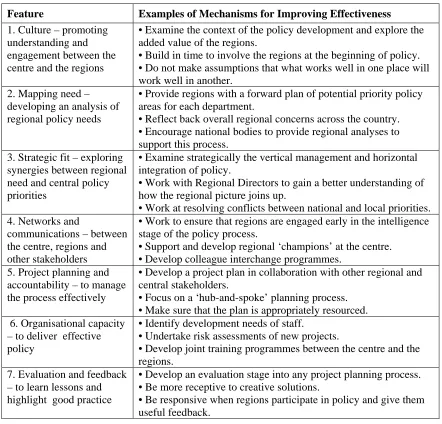
effectively they engaged with regions’ (9). Table 1, below, provides a summary of the
seven building blocks that were developed as the foundation for sound policy
Table 1: Model of Effective Regional Involvement in Policy-Making
Feature Examples of Mechanisms for Improving Effectiveness
1. Culture – promoting understanding and engagement between the centre and the regions
• Examine the context of the policy development and explore the added value of the regions.
• Build in time to involve the regions at the beginning of policy. • Do not make assumptions that what works well in one place will work well in another.
2. Mapping need – developing an analysis of regional policy needs
• Provide regions with a forward plan of potential priority policy areas for each department.
• Reflect back overall regional concerns across the country. • Encourage national bodies to provide regional analyses to support this process.
3. Strategic fit – exploring synergies between regional need and central policy priorities
• Examine strategically the vertical management and horizontal integration of policy.
• Work with Regional Directors to gain a better understanding of how the regional picture joins up.
• Work at resolving conflicts between national and local priorities. 4. Networks and
communications – between the centre, regions and other stakeholders
• Work to ensure that regions are engaged early in the intelligence stage of the policy process.
• Support and develop regional ‘champions’ at the centre. • Develop colleague interchange programmes.
5. Project planning and accountability – to manage the process effectively
• Develop a project plan in collaboration with other regional and central stakeholders.
• Focus on a ‘hub-and-spoke’ planning process. • Make sure that the plan is appropriately resourced. 6. Organisational capacity
– to deliver effective policy
• Identify development needs of staff.
• Undertake risk assessments of new projects.
• Develop joint training programmes between the centre and the regions.
7. Evaluation and feedback – to learn lessons and highlight good practice
• Develop an evaluation stage into any project planning process. • Be more receptive to creative solutions.
• Be responsive when regions participate in policy and give them useful feedback.
2.3 Summary
There were two sets of expectations shaping the policy making framework for ERAs.
The first perspective views the policy making process as comprising:
• the translation of the White Paper into a legislative programme to create the
formal framework for enabling action in the regions;
12
• and a focus on efficiency and speed in establishing framework that effectively
delivers the White Paper within the proposed timetable.
Second, the expectations set out in the better policy making agenda concerned regions
involved in shaping the development of the policy making process. This regards the
policy making process as comprising:
• the translation of a general framework into effective action in specific regional
and central contexts;
• regional involvement and anticipation of how the general framework will work
effectively in practice
• and finally, a focus on developing a joint and shared understanding of how the
framework will formally and informally facilitate new and effective action and
practices in regions and with the centre.
With these issues in mind, the next section examines the affinities between these
Section 3: The Practice Context: Frameworks in Action
3.1 Introduction
This section of the report synthesises the results of the central and regional interviews to
provide an understanding of the level of affinity between experiences within the centre
and between the centre and regions over the policy implementation for ERAs.
3.2 Frameworks in Action: Perspectives on the Policy Making Process
The purpose of the ERA policy was intended to bring about a set of circumstances that
may end up having an effect on subsequent policy-making processes themselves within
Whitehall. Yet whilst this was recognised by officials, it became a processual matter of
meeting deadlines and timetables which required a considerable effort in terms of
coordination between the policy and legal sections, with 8 Departments involved around
38 functional areas. At one stage it was necessary to provide a complete draft of
instructions to Parliamentary Counsel within a 13 week time period.
In OGDs the region was frequently seen as a convenient scale of implementation, but
not an active contributor to the conception of policy, only its execution. As one official
expressed it: “It is an old fashioned way of doing things but a good way that is built up
entirely in government and we managed to build a consensus”. Consequently the
process had a very strong internal focus where matters of coordination and ensuring
coherence and fit in terms of the relations between general and specific legislation,
meant that draft policy instruments were required according to tight timetables.
The strategic fit between the intentions of the legislation and potential effect upon the
work of OGDs was illustrated by the sustainable development agenda. In the case of
DEFRA, they translated this into a principle purpose for ERAs that officials in ODPM
could easily support as it provided a joint approach that would not require separate
strategies. At the same time, those in the DTI and it was suggested, amongst Treasury
and key ministers in ODPM, saw the prime role of ERAs as dealing with wider
economic disparities. This led to a concern about not seeing this objective as being
14 by loss of control, did not want to see principal purposes amended to create what they
interpreted as less regional commitment to the economic agenda.
What this and other examples illustrate is a set of complex environments through which
the policy making process had to navigate. It was dealing with differing cultures of
regionalism within Departments that, in turn, constituted a particular way of seeing
regions: “You can talk to colleagues in another government department and they are
incredibly plugged in, very much on the ball…You can talk to other colleagues in
another government department and although they think it’s probably important, it’s a
tiny peripheral thing compared to what they’re doing”
The need for consistency, in terms of having the same personnel from OGDs turn up to
meeting, was central to obtaining clarity. A cross-departmental meeting began by one
official stating: “I am just looking around the room to see if there are the usual
suspects”. Without the appropriate commitment at a particular level within OGDs, the
policy process was inevitably problematic leaving the onus upon RAD to attempt to
continually enrol others within tight policy making timetables. In the face of such
forces, balance and a concern with due process became the justifications for practice.
Policy making was therefore strongly focused on internal processes as if this could be
separated from the wider purposes of ERAs.
Overall, the central interviews exhibited a high degree of consistency in accounts
concerning the policy making process, despite the diversity of regions, personnel and
agencies interviewed. Critically, such views were also reflected in acknowledgements of
the absence of regional input into the implementation process itself, which was
described as ‘the involvement of external stakeholders’.
What became evident during the research was the importance of the informal ways of
working that were not generally acknowledged in organisational cultures, nor
recognised by performance management systems. These provided for ways of making
sense of particular communications in context and also worked to derive benefits for
the both the strengths and weaknesses of the consultation process. Its strengths are the
informality and drawing upon local knowledge in order to make contacts. Its
weaknesses are that it is not systematic and who is excluded is just as, if not more,
important that who is included and why? Overall, therefore, it is perhaps not surprising
that there was a clearly expressed view among regional stakeholders that there had been
few opportunities to make a considered or strategic input into the policy making
process.
Officials from the three northern GOs worked together to produce a proposal for more
effective engagement with RAD over the policy making process. A number of meetings
were held in the Northern regions and London to discuss improvements in the
relationship. Consequently officials felt that more effective forms of communication
and dissemination were built between the GOs and Whitehall. These were primarily
focused on informing GOs of progress in Whitehall rather than seeking a strategic
regional input into the policy making process. However, officials at the centre also felt a
much higher degree of engagement with the private, public and voluntary sectors in the
ERA regions was needed.
A clear wish for a comparative understanding was required that would address issues
concerned with the absence of a learning culture in the policy making process. At both
the centre and within the referenda regions pressure of time, due to the nature of the
performance management systems in place, led to such comments as: “We have not had
a chance to have a sensible dialogue”. Whilst there was also evidence, that because of
the normal ways of working, some did not “understand how to engage and have a
partnership”. Consultation processes were often informal and unsystematic. Officials,
both regionally and centrally, agreed that relevant expertise and knowledge could have
been of value in shaping the policy making process. Regional officials felt that despite
central uncertainties, a more strategic approach could have been taken to incorporate
local knowledge and expertise into the policy making process. Critical to this were the
potential development of joint processes involving regional interests and institutions
16 effectiveness might mean in practice by drawing on existing experiences with devolved
institutions and developing scenarios.
All the regions expressed support for the chapter 2 agenda. Specifically, it was seen to
offer non-referendum regions a wider flexibility because, in contrast to interpretations
of chapter 4, it was not seen to have a prescriptive central framework. Instead, it created
a context for innovation in the development of regional working by providing policy
agenda that enabled engagement with other regional partners and contributed to the
development of regional capacity. Officials consistently provided examples of regional
innovations in joint working and arrangement that had been made possible by the
regional work led by GOs on the Chapter 2 agenda. At the same time, different views
were offered about the further development of the Chapter 2 agenda.
Officials were concerned that the space for innovation created by the chapter 2 agenda
was already filled and that the limitations, particularly the ability of regions to national
policies and priorities, were evident to officials in the GOs, RDAs and RAs. Officials
were already starting to anticipate what other options might be available for
strengthening democratic regionalism ranging from rolling out the recent changes in
spatial and housing policy to other functions to the appointment of a regional minister
but without moving to an ERA. However, it was felt that the ERA agenda was driving
national imperatives with the result that: “To us it seems very distant…the perception is
that there is a particular timescale and a sense of waiting to see what happens and with a
general election on the horizon, the region is not paying much attention”.
What about the messages that were being received from the centre about
implementation and how understandings were gained in terms of experiences from other
regions? One person, who had worked in a variety of settings, including at the centre,
focused upon the consistency of messages: “The real problem for Whitehall is dealing
with this issue as it is harder to deal with 9 regions than one nation…so systems,
processes and skills have to deal with diversity…the ODPM is split – half pushing
3.3 Summary
Overall what emerges from this review of the policy making process are quite different
sets of experiences from the central and regional officials involved.
• Centrally officials were strongly internally focused on processual issues within Whitehall in order to meet the tight timetable outlined in the White Paper. The
critical issue was to provide the framework for action that would lead to the
establishment of ERAs.
• At the same time regional officials were attempting to anticipate what this
framework for action might mean in practice. The critical issue was what would
happen when the framework for action was put into action in particular
contexts?
• Yet as all officials interviewed agreed the central policy making processes did not attempt to bring together the relevant departmental and regional interest to
anticipate how the framework would be translated into effective action.
• It was also evident that in non-ERA regions a policy vacuum was opening up
18
Section 4:
Transferable Lessons from Process and Practice
"...effective policy making must be a learning process which involves finding out from experience what works and what does not and making sure that others can learn from it too. This means that new policies must have evaluation of their effectiveness built into them from the start ..." Professional Policy Making in the 21st Century, Cabinet Office, 2000
4.1 Introduction
This section of the report examines those lessons that arise from the research for
subsequent policy making. We do this according to the aspirations and prescriptions
contained within the documents as outlined in section 2.
4.2 The Opportunity for ERAs
The opportunities presented for ERAs came with a shift in emphasis that took matters of
scale and context-sensitivity more seriously thereby providing for more effective
governance in terms of connections to the characteristics of regions. Taking regional
contexts seriously, in other words, were not envisaged as impediments to the delivery of
policy, but necessary preconditions for its success. ERAs would become co-participants
in implementation, as well as having an enhanced potential for co-producing policy in
the first instance. We can explore this further through an examination of the relationship
between official goals and those that emerge from the particular circumstances in which
staff actually work. As a result the research highlighted the fact that staff drew upon
different forms of intelligence to make sense of emerging regional contexts. Whilst
some Whitehall officials felt far removed from the implications of ERAs, others in GOs
felt positioned by those in their regions to be knowledgeable, but were unable to convey
a clear sense of progress and purpose.
4.3 Fusing Frameworks for Effective Policy Making
Frameworks for action refer to those understandings that can be read off from formal
policy prescriptions and the intentions of policy-makers in terms of how they anticipate
they will transform actions at a distance in different locations. ‘Frameworks in action’,
on the other hand, are concerned with the practicalities of making policy work in
these two frameworks leads to a significant reduction in the effectiveness and efficiency
of both policy conception and execution.
RAD officials examined the procedural lessons that could be learnt from the
establishment of the WDA and GLA. The key lesson was the need to reduce the number
of clauses in order to smooth the legislative path through parliament. RAD was
consistently viewed by OGD as an effective unit working with a shared ethos that was
strongly committed to implementing the White Paper within the key deadlines. At the
same time, there was a high degree of consistency amongst officials across central
departments, particularly over the shared requirement and joint responsibility to
translate a political commitment into workable proposals and furthermore into draft
instructions. But there were a number of competing viewpoints within Whitehall.
Officials in OGDs also consistently raised concerns at the extended delays in specifying
the principal purposes and identifying the general powers of ERAs. These elements of
the Bill instructions were more complex and contentious than anticipated and were only
clarified towards the later part of the drafting process. OGDs (a view shared by RAD)
felt that the early production of these instructions could have provided greater clarity
and simplified production of the Bill instructions. Thus, both RAD and OGDs found
that the departmental commitments produced in the White Paper could be subject to a
high degree of interpretative flexibility during the drafting of the Bill instructions. A
number of policy commitments that had appeared to be closed were subsequently
revisited and tensions resolved by negotiation between officials and on occasion,
ministerial intervention. The Bill instructions drafting process thereby re-opened and
made visible OGDs competing understanding and levels of commitment to, the
regionalisation agenda.
Past experiences of regions being seen as sites of implementation, rather than
co-participants in the construction of policy, as well as its delivery, meant that the
consultation process between the referenda regions and the centre was variable and so
overall quality was diminished as a result. Within the three referendum regions a high
20 the diversity of regions and the agencies interviewed. It was clear that regional inputs
were limited and there was a general concern regarding the few opportunities that had
been available to inform the policy making process.
As with central perspectives, regional officials offered the view that relevant regional
expertise, knowledge and intelligence could have been of significant practical value in
shaping the implementation of the White Paper. But this was resource that was not
exploited in any systematic or effective way. Most officials centrally and regionally had
little knowledge of the Incorporating Regional Perspectives into Policy Making report
and the potential implications of the tool-kit for providing a framework that could
enlarge regional input into the policy making process. There were clear and competing
central and regional perspectives on the quality and effectiveness of the policy making
process. In referendum regions RDAs and RAs often assumed that there was a high
degree of interaction between GO and RAD on the practical issues involved in
preparing for ERAs. GO officials were acutely aware of these expectations and often
found themselves embarrassed by a lack of intelligence concerning progress on policy
implementation.
A number of ways in which regional officials could have added value to the policy
making process were identified.
• An understanding of specific regional contexts, challenges and opportunities for
a national White Paper may have been identified that would have resulted in the
anticipation of potential problems in the future.
• A capacity could have been developed to see how policies would work in
practice and identify options which would have resulted in more positive
outcomes.
• Through highlighting those areas in which specific national policy
recommendations would have had differential regional implications. This, in
turn, could have fed back into a more sensitive analysis of differences and
similarities that would have improved overall effectiveness.
• In the policy making process regional officials could have more systematically
mediated the policy with stakeholders enabling not only a greater understanding
of the purpose and powers contained within the legislation, but also in providing
an understanding of the claims of other regional actors.
• GO’s could have promoted even better linkages between policies across OGDs
given continual contacts with different official at the centre.
In the non-referendum regions there were important differences, but also evidence of
common themes. Interviewees were generally unable to offer specific advice via their
experiences of the policy making process, but were more interested in the wider
implications of ERAs for the development of regionalism. To this extent there was wide
support for the Chapter 2 agenda as it was not prescriptive, but instead created a context
for innovation in the development of regional working through providing an agenda that
could engage with other regional partners, as well as contribute to the development of
regional capacity. During the research questions were raised about whether the
boundaries of voluntary working were already being reached. Furthermore, officials
were already anticipating what other options might be available for strengthening
democratic regionalism, but without moving to an ERA. Yet in terms of seeking clarity
about potential ways forward, a vacuum was believed to exist at the centre in terms of
the future role of regions.
While there is no consensus that an alternative pathway of a particular type was needed,
the work found support for a review of the potential options. In both ERA and non-ERA
regions different degrees of preparedness were evident and there was a differential
anticipation of what the legislation might have delivered according to the context in
which officials work. It is for this reason that cultures of regionalism range from
‘active’ to ‘latent’ to capture their variable manifestations.
The findings on relations between perspectives lead to a number of points that have a
22 First, there were widespread perceptions that there was no single, clear agenda of
regionalisation at the centre. RCU were primarily seen as having an administrative role,
with ODPM having a ‘voice-giving’ agenda for the northern regions. The Treasury and
Cabinet Office, in turn, were seen as having a delivery and value-for-money focused
agenda that was more about more effective central government policy and spending,
rather than giving voice to the regions to reach their potential in the development and
delivery of policy.
Second, there were strong perceptions, centrally and in referendum regions, that
developments in Chapter 2 were not fully integrated into Chapter 4 thinking. This was
problematic given that Chapter 2 developments inevitably changed the terrain of that
which was intended to be democratised through Chapter 4. OGDs did not understand
the Chapter 2 agenda and had very little direct contact with regions about its
implications. The regions, in turn, felt that it was not being centrally coordinated or
managed.
Third, all central and regional officials consistently stated that the regional agenda has
moved forward more rapidly and on a broader front than anticipated in the White Paper.
Officials at both levels referred to the Treasury Regional Emphasis Review and the
Devolved Decision-Making Review (and a number of senior regional officials also
referred to the Modern Regional Policy document). While each of these agendas had
implications for central and regional officials it was not clear how these developments
linked to the Chapter 4 agenda. A number of senior regional officials noted that in
meetings with Treasury and Cabinet Office, officials had distanced themselves from
Chapter 4 because it was not seen as being ‘relevant’ to their regional agendas.
Fourth, central and regional officials were clear that the implementation of assemblies
would lead to the development of increasingly shared roles between OGDs and ERAs
and also with a restructured local government. Yet there was concern about the lack of
clarity about what effective working might mean in practice or how relations between
Officials were unclear who was responsible for anticipating and reorganising
intergovernmental relations in an ERA context.
4.4 Summary
The findings of this work are central for understanding not only effective
policy-making, but also the future role of regions in national policy frameworks:
• Whilst the introduction of ERAs has stalled, the role of regions and how central
policy in general can be improved is still very much alive.
• Successful policy making links context and interpretations to organisational
problems and the proposed solutions embedded in the policy itself.
24
5
Ways Forward for Effective Policy Making and Recommendations
5.1 Introduction
This section of the report considers the ways forward and specific recommendations for
action.
5.2 Improving Effectiveness through Enhanced Legitimacy
The results of this work highlight the importance in policy making not just of
communication, coordination and consultation with those who might normally be
excluded from such processes, but also how enrolment, anticipation and preparedness
affect outcomes. Without these in place it gives rise to common complaints that policies
and associated measures have no relevance to frameworks in action. A core issue then
becomes to what extent particular policies are seen as providing solutions to common
problems, or not seen as relevant to those issues, by whom and why? An enormous
amount of energy can be devoted to not addressing these core issues and a reduction in
effectiveness and legitimacy is the inevitable result.
5.2.1 Reconnecting Purpose Process and Product
What we find in the results is that considerations of process and product cannot be
divorced from purpose. Quite simply, unless a policy has sufficient legitimacy attached
to it, then the extent to which it is effective will be reduced as it is not perceived as
making any addition to existing conditions but may, instead, actually detract from those
in significant ways. The processes of enrolment, communication and how resultant
decision-making is affected by those, is thus crucial to obtaining the commitment of
those who are expected deliver it in different settings. That, in turn, also provides for
better dissemination to stakeholders of intentions and opportunities as those persons act
as intermediaries of understanding to those who may not just be hostile, but often
confused and uncertain about implications.
5.2.2 Developing a Shared Orientation
A sense of provisional orientation is required for this process to be effective. Thus, a
of reference of those whose actions are meant to be changed by the policy itself. In this
case, an absence of such orientation, in terms of clear strategic messages from the centre
that explains not only process, but also purpose, will lead to considerable degrees of
uncertainty. What may be taken from this is that successful policy making links context
and interpretations to the issues and opportunities that the proposed policy is intended to
address and bring about. What is implied is not that context drives such considerations,
but that policy is sufficiently context-sensitive to work in different environments in
order to be effective.
5.2.3 Creating a Learning Culture
Ideally, from the policy point of view, this is about generating a learning culture. What
is absent in the ‘official’ channels of communication in the civil service is how the
‘informal’ means and mechanisms through which policy is contested and resolved are
understood and then inform practice in context according to different pressures. There
was a clear tendency to see the ERA Bill as an end-point or product, whereas
experiences of devolution in other countries have emphasised the importance of viewing
devolution as a process that changes over time, not an event within a particular time
frame. At present, there is a limited understanding at the centre of how policy works in
particular contexts and as a result, a limited effectiveness to that policy itself. Instead of
addressing this performance management measures, which carry little
context-sensitivity, transmit messages that by-pass the necessity of understanding which is part
of this process. Such an absence then re-bounds on policy to challenge its process and
purpose and overall effects.
5.2.4 Quality, Knowledge and Intelligence
Success, derived from the lessons from this work, depends on the quality of thinking
within the regions and the confidence of the policy-making processes adopted at the
centre. Regions need to coordinate themselves in improved ways and be proactive
around inputs into policy. This is a matter of practical organization, along with the
power and responsibility to construct an orientation towards the future in order to
become pro-active problem solvers, not just reactive implementers. Not all regions will
26 and regions, if they want to take on this role, will have to invest in their own
development to improve their leadership and negotiation skills. What is required here is
the tangible support of the centre and a willingness to reflect upon what implications
this would have for the policy making process, accompanied by a transformation in the
light of these new relations.
5.2.5 Cultures of Judgement
Taking this forward meets that most intractable of issues: that is, the strong culture of
upward accountability to Ministers and Parliament within the civil service. A culture of
deference and risk aversion then arises which fosters a process mentality that separates
frameworks for and in action. Whilst existing structures are important for developing
accountability and integration and providing orientations for career trajectories over
time, greater emphasis needs to be placed on civil servants negotiating the space within
the broader architecture of policy to deliver change based upon judgement within
frameworks of accountability through evaluation. For instance, developing good project
management skills and negotiating with Ministers on how policy drift affects delivery
can be a useful means to progress change. In addition, there is a need to improve mutual
understanding and open up organisational cultures between the Government Offices and
the centre, as well as between OGDs and the regions. Such work should be valued
highly at the centre. Learning programmes and processes to share experiences should be
developed. Workshops and seminars should be promoted in the recognition that the
informality that makes policy work is something valuable to be shared in developing
better understanding of contexts.
5.3 Recommendations
5.3.1 Improving Understanding of Context
1) More effective strategic fit in policy making involves examining regional needs in relation to emerging policy priorities from the centre. This requires analysis of the tensions between vertical alignment and horizontal integration in terms of the cross-cutting impact of policy and the effect of variable commitment between OGDs on the development of regional policies.
officials who would be responsible for particular substantive areas of activity within and between departments.
3) Government Offices have a key role to play in co-ordinating regional responses to policy. This requires greater sharing of knowledge and understanding in the development of shared strategic directions and partnerships between Whitehall and with officials in the regions.
4) An improved focus on generating networks and communications with the regions will enable more of the right people to be involved at the right time in policy development. This requires a commitment to building relations between Whitehall and regions that are able to build an honest and shared understanding of what is feasible and what is desirable in policy formulation.
5) Government Offices can take more active responsibilities for managing strategic fit at a regional level. This requires the co-ordination of input from different regional agencies, including the private and voluntary sectors, as well as negotiating between different perspectives and managing the resulting intelligence.
6) Regions cannot respond to every new policy concern with equal capacity and commitment. This requires Whitehall and the regions to jointly make informed choices about which policies they are actively intended to respond to through a sustained process of mutual understanding.
5.3.2 Coherence, Consistency and Communication
1) Close linkage between policy and evaluation needs a more in-depth understanding the capacity of different institutions to deliver outcomes according to over-arching purposes This requires an evaluation process that not only asks how it will be known that a policy is working, but also what is the appropriate methodology for communicating that to different audiences.
2) Turnover of key personnel leaves important tacit knowledge that makes policy work in particular contexts, diminished. This requires consistency and continuity in roles and responsibilities by selecting key personnel in terms of the knowledge and capacity they possess, as well as consideration given to the time and space to occupy these roles effectively.
3) The evaluation function should not be developed at the end of the policy process. This requires designing evaluation into the planning phase in cooperation with key personnel at different levels to ensure that it is linked with the strategic purpose of policy.
28 5) Policy making is often characterised by misalignments and duplication rather than identifying overlaps and interrelationships. This requires the development of a shared ethos in partnership with identified stakeholders with a clear set of aims that are internally coherent and externally communicated in a consistent manner.
6) More effective strategic fit involves the development of a stronger foresight element in the policy making process. This requires the development of prospective techniques and process that aid identification of the difficulties that will be faced in the process of design and implementation and anticipation of how they might be overcome.
7) Establishing programmes of work outside of the normal policy process will benefit different stakeholders. This requires the development of effective and sustainable infrastructures of communication can be built that support and enable developments over time and coordinate effectively between different policies innovations.
Although it is relatively easy to improve the policy process from the point of view of
the centre so that there is greater regional involvement. However, this says nothing
about whether regional ideas and suggestions will be included in decisions and