Journal of Chemical and Pharmaceutical Research, 2015, 7(3):679-685
Research Article
CODEN(USA) : JCPRC5
ISSN : 0975-7384
Damage identification of tower structure based on the analysis of the key
components
1
Chaoshan Yang and
2,*Peili Zhang
1
Department of Civil Engineering, Logistical Engineering University, Chongqing, China
2
Department of Petroleum Supply Engineering, Logistical Engineering University, Chongqing, China
_____________________________________________________________________________________________ABSTRACT
Among multitudinous rod pieces in a tower structure, most rod pieces are secondary, and only small amounts of them are key components which are of higher damage probability and have serious influence on the whole tower structure if they are damaged. Therefore, it is meaningless and also unpractical to make damage identifications on all components in a tower structure. In order to enhance pertinence, a damage identification method, which is based on the analysis of key components, is put forward in this paper. In this method, decrease degrees of the structure system’s reliability caused by the same degree of damage of components are firstly calculated; then, weight coefficients are introduced to measure the relative importance of the various components of the whole structure system, thus the key components can be defined through comparing the values of these weight coefficients. Finally, a damage sensitive feature based on the Wigner-Ville distribution (WVD) of the acceleration signals under fluctuating wind is derived to damage detection and localization of these key components, and the relationship of the damage sensitive feature to mode shapes of the structure is demonstrated. This method is verified through an example of a communication tower at the end of this paper.
Key words: Key components, tower structure, damage identification, WVD
_____________________________________________________________________________________________
INTRODUCTION
As a common structure, tower structure is widely applied in construction, communication and electricity. During their service process, they can be easily damaged or damage accumulations always occur that may cause collapsing accidents. Therefore, it is of great practical significance to study and identify the damage for the structure so that the collapsing accident of tower structure can be prevented, and the safety in the important fields, such as power and communication, can be ensured.
From the related literatures, an extensive attention to safety and reliability of tower structures has already been taken, however, these studies are commonly focused on earthquake and wind resistance of the structure system but seldom on damage identification. These damage identification methods can be simply divided into two groups:modal parameters and wavelet transform (He et al., 2010 & Zhao et al., 2009 & Li et al., 2007). If the identification is based on the modal parameters, such as the methods of dynamic model reduction (Lam et al., 2011 & Yin et al.,2009 & Benedikt et al., 2010), element strain energy (Lin et al., 2013)and modal bi-index (Liu et al., 2012), a lot of test points and relatively high identification accuracy are needed in this situation. The other damage identification method which based on wavelet transformcannot identify the damage at the places with stiffness mutation (Lou et al., 2012).
consuming. Contrarily, few key components are easily damaged and the damage in them will greatly influence the structure. So, it is of special significance for a tower structure to find out the key components and to pertinently study the damage identification on them.
For this purpose, a damage identification method based on the analysis of key components is put forward in this paper. Based on the reliability theory, the relative importance of structural components is given through computing the decrease of structure system reliability caused by the component resistance decrease firstly. After analyzing the relative importance, the component weight coefficient is introduced and used to found out the key components. Then, by using the acceleration signals under fluctuating wind, a damage sensitive feature based on the Wigner-Ville distribution (WVD) is derived to damage detection and localization of these key components, and the relationship of the damage sensitive feature to mode shapes of the structure is demonstrated. This method will specifically simplify the damage identification of tower structure to those easily damaged key components and it is finally verified by a communication tower.
ANALYSIS OF KEY COMPONENTS
After a period of use or suffering certain disasters, the structure may suffer different degrees of damage. The damage will definitely cause the changes of the components’ resistance, which will further influence the safety and reliability of the structure. However, the influence of different components on the safety and reliability of the structure is different. Some are relatively important for having a greater influence on the reliability of the structure; and some are secondary for having a slight influence. The concept of the component weight coefficientis introduced (Rong et al., 2001 & Luo, 2010) and be used to represent the different influence degree of the same components damage on the structure system reliability. Obviously, the larger the component’s weight coefficient, the larger the influence of the component on the structure system reliability and the more important the component are. Through proportionately reducing the resistance average value of certain component without changing the resistance of the remaining components, the increase of failure probability of the structure system is calculated. Based on that, the weight coefficient of various components are worked out, then the key components which have a greater influence on the structure’s reliability were found out through the weight coefficient.
Calculation of the importance of the
j
component:0
0 ( ) 0
0
( )
( )
lim
,
1, 2,
,
( )
R
f
s j
R
p
j
f j
j
n
j
(1)Where,
n
sstands for the total quantity of components in the structure system,
R0( )
j
for the reduction value of thej
component compared with its initial resistance average value,
p
f0( )
j
for the increase value of the structuresystem failure probability caused by the change of
j
component’s average value by
R0( )
j
, andf j
( )
for the influence degree of the reduced component’s resistance average value on the structure system failure probability. Thus, the weight coefficient of the component,A j
( )
, can be gained through the following formula:1
( )
( )
,
1, 2,
,
( )
s s
n
k
f j
A j
j
n
f k
(2)
^1 2 1
1
,
,
Ni i i
f X n
i
P
I g
X X
X
N
(3)Where,
X k
k(
1, 2,
, )
n
stands forn
independent random variables of the performance function, the superscripti
for thei
sampling,N
for the total number of samples, “^
” for the sampling value adopted, andI
for the indicative function:
1,
2,
0
1,
2,
0
i i i i i i
X n X n
I g
X X
X
g
X X
X
(4)
1,
2,
1
1,
2,
0
i i i i i i
X n X n
I g
X X
X
g
X X
X
(5)In the large-scale finite element software, ANSYS, Prob Design with reliable structure provides three Monte-Carlo sampling ways, namely direct sampling, Latin sampling and user defined sampling. ANSYS Parametric Design Language (APDL) is adopted to compile the structure model, sub-netting, loading and other command streams for the establishment of structure analysis model. By employing the Monte-Carlo analysis method of ANSYS and probability design system module’s stochastic simulation and statistical analysis functions, the calculation of structure failure probability or reliability can be realized.
Thus, the key components can be achieved through the following steps:
(1) Set the initialized data, including the average value and variable coefficients of components’ scale, resistance, load and other random variables;
(2) Establish the model and calculate the failure probability of the structure system
P
f ;(3) Proportionately reduce the resistance of
j
component, and maintain the other components unchanged; repeat Step (2) and calculate the failure probabilityP
f0( )
j
corresponding to the structure system; and work out the increase value of the structure system failure probability caused by the decrease of the resistance of thej
component
p
f0( )
j
P
f0( )
j
P
f ;(4) Put the formula above into Eq.1 and Eq.2 to calculate the importance of components and the weight coefficients of various components;
(5) Arrange the structure components according to their priority and the component’s weight coefficients, and select the key components that have a greater influence for the structure through setting the proper penalty value.
DAMAGE IDENTIFICATION
WVD: Wigner-Ville Distribution (WVD) is the most basic and widely applied time-frequency distribution which cover almost all of the mathematical properties expected in the damage tests (Yang, 2011). For signal
s
(
t
)
, the definition of WVD is that:
d
e
t
z
t
z
f
t
W
z i f
2)
2
(
)
2
(
)
,
(
(7)
Where
z
(
t
)
is the analytic signal of signals
(
t
)
andz
(
t
)
is the complex conjugate ofz
(
t
)
,t
andf
stands respectively for time and frequency,
is time offset,i
2
1
.Damage sensitive feature: for the purposes of applying a statistical pattern classification method for damage detection, we defined the WVD coefficients as the damage sensitive feature. Thus, the WVD coefficient at test point
a
is defined as follows:
dt
e
f
t
W
DI
af z(
,
)
i2 t
(8)
There, the superscript
a
stands for the test point,f
stands for the frequency scale.max
)
(
afa f a
DI
DI
DI
(9)
WVD coefficient of acceleration signals: Considering a structural system with
n
degrees of freedom, the movement differential equation is that:g(t)
x
x
x
C
K
M
(10)Where, M, C and K respectively defined as mass matrix, damping matrix and stiffness matrix;
g(t)
is the forcing function. The acceleration signal at pointj
is given as:2 2
1
( ) (2
)
icos(2
)
n
ft
j jl l
l
x t
f
e
f t
φ g(t)
(11)
Where
jlis thej
th component of thel
th modal shape,φ
lis thel
th modal shape and
iis the modal dampingrate;
f
andf
is respectively modal frequency and damped frequency;
is the starting phase angle. The analytic signal can be obtained with the Hilbert conversion of the acceleration signal at pointj
:
2 2 (2 ) 1( )
2
in
ft i f t
j jl l
l
z t
f
e
e
φ g(t)
(12)
The Kernel function of WVD is obtained as follows:
2 21
( ) ( ) 2 ( ) ( )
2 2 2
n
j j jl l
l
z t z t f g t
φ g
t
)
e
2l2fte
i2ft2
(
(13)
Then the WVD coefficient is given as:
dt
e
f
t
W
DI
af z(
,
)
i2 t
2 2 22
1
(
)
2
(
)
(
)
2
2
l n f t jl l lf
g t
g t
e
φ
e
i2fte
i2fe
i2td
dt
)
(
)
(
2 1f
y
l n l jl
φ
(14)
Where
f
f
,
y
(
f
)
is the implicit function of frequencyf
.
2 2 2( )
2
(
)
(
)
2
2
l f t
y f
f
g t
g t
e
e
i2fte
i2fe
i2td
dt
(15)If the maximum value of WVD coefficient with the same frequency is at test point
m
, i.e.(
DI
af)
m
(
DI
af)
max, wecan conclude that:
2 1 2 1 2 1 2 1
)
(
)
(
)
(
)
(
)
(
)
(
l n l ml l n l jl l n l ml l n l jl af
y
f
y
DI
φ
φ
φ
φ
(16)
NUMERICAL EXAMPLE
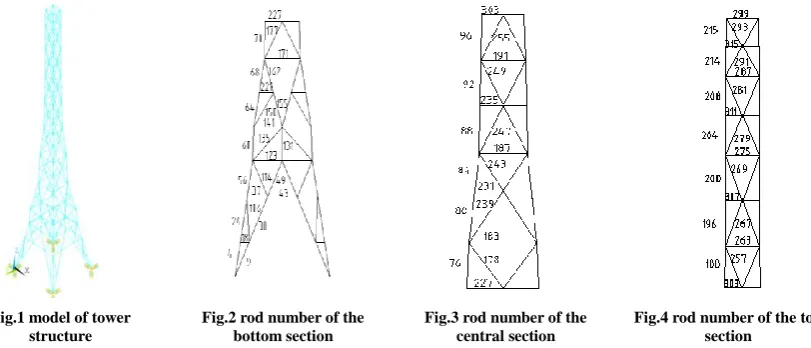
[image:5.595.101.507.196.370.2]A communication tower (shown in Fig. 1 ~ Fig. 4) is taken as an example to verify the proposed method. The tower is
30
m
high, made up of five kinds of equilateral angle iron. The total quantity of bars is 316. The fundamental wind pressure and bar yield strength are both in line with the normal distribution, Their average value is
w0
0.45
KN m
/
2and
235
N mm
/
2, and the variable coefficients are set as 0.3 and 0.1 respectively. The parametric model and Monte-Carlo method are adopted to calculate the structure failure probability under the largest designed wind load at45
. The analysis of the structure’s reliability adopts three judge rules, namely largest structural displacement, component’s maximum stress and instability failure.Fig.1 model of tower structure
Fig.2 rod number of the bottom section
Fig.3 rod number of the central section
Fig.4 rod number of the top section
[image:5.595.147.465.467.575.2]We can conclude from the calculation that the occurrence probability of component’s instability failure is far larger than that of the other two judge rules, which suggests that the damage of tower structure is mainly controlled by the component’s instability failure, which coincides with the fact in which instability failure is common in tower structure. Considering the symmetry of the tower structure, the component weight coefficients of one eighth tower bars are calculated. Results are shown in Table 1.
Table 1: weight coefficient of element
chord bars diagonal web bars horizontal bars Number weight coefficient Number weight coefficient Number weight coefficient
60 7.930E-2 114 3.324E-2 43 4.412E-4 68 7.928E-2 30 3.215E-2 183 4.038E-4 64 7.914E-2 9 2.287E-2 141 5.782E-5 80 7.327E-2 243 1.046E-2 123 2.783E-5 72 7.312E-2 239 1.045E-2 221 1.930E-5 84 7.252E-2 177 8.921E-3 171 3.816E-6 76 7.241E-2 178 8.903E-3 37 3.067E-6 56 6.686E-2 135 6.034E-3 18 3.924E-7
… … … …
It can be seen from Table 1 that: 1) the coefficients of chord bars are twice higher than those of diagonal web bars, which suggests that chord bars have the greatest influence on the structure’s failure probability, following by diagonal web bars, and the horizontal bars the smallest. This is in line with the concept in practically design that chord bars are the most important and the horizontal bars the weakest; 2) the weight coefficients of the chord bars in the deformation area of the structure’s cross-section is the largest, which suggests that chord bars in the variable cross-section has the largest influence on the reliability of the structure. This is consistent with the practical situations that deformations are frequent to happen in the cross-section of the tower structure. Obviously, to enhance the health monitoring and damage identification of the key components is of vital importance to ensure the reliability of the structure. To this communication tower, it is of great significance to reinforce the damage monitoring to its key components like No.60, No.68, No.64, No.80, No.72, No.76, No.84, and No.56, So the damage identification will mainly on key components of No.60, No.64, No.68, No.72 and No.80 in this article.
and damage state under fluctuating wind load can be calculated by ANSYS with structure damping ratio 0.02 and time step 0.002s, Fig.6 shows the acceleration signal and corresponding WVD at test point 2. Fig.7 shows the WVD of acceleration signal when key component of No.60 is damaged.
0 10 20 30 40 50 60
18 21 24 27 30 33 36 39
t(s)
v
(m
/s
)
Fig.5 Wind speed time history and frequency spectrum
0 20 40 60
2
1
0 1 2
t(s)
a
(m
/s
^
2
)
WVD Fig.6 Acceleration signal and WVD
WVD
Fig.7 WVD Fig.8 test point 5
Comparing with the Fig.6 and Fig.7, when damage occurs on the key component (damage degree of 20%), WVD will show its remarkable variation. That is to say,the damage identification via WVD coefficient is viable. Then the WVD coefficient was calculated at the test points with
f
2.684
Hz
(close to the natural frequency of the structure), there are obvious difference between the key components undamaged and damaged (shown as Fig.8 and Fig.9 at test point 5 and 7). From this, we can judge whether damage occur or not.Fig.9 test point 7 Fig.10 average value of WVD coefficient
When the damage of the key components occur, the average values of the WVD coefficients of test points measured before and after the damage can be used to identify the damage position of the key components. Fig.10 shows that the average values differ by the damaged place of the key components.
CONCLUSION
A damage identification method for the tower structure which is based on the analysis of key components is put forward in this paper, and conclusions can be drawn as follows:
(1) Through computing the decrease of structure system reliability caused by the component resistance decrease, the component weight coefficient is introduced and used to found out the key components. These key components of the structure are mainly located at the places of weakness, where the stresses are concentrated, such as legs and cross-section variant. Therefore, it is of great importance to monitor and identify the damage to the key components in ensuring the safety of the tower structure.
(2) A method has been proposed to simplify the damage identification of tower structure for these key components which were easily damaged and have serious influence on the tower structure if they are damaged. This method can provide some references to efficiency improvement of damage identification for these complicated spatial rods structures.
(3) A damage sensitive feature based on the Wigner-Ville distribution (WVD) of the acceleration signals under fluctuating wind is derived, which can effectively identify the damage and damage location of the key components without using modal parameters and has a good application prospect.
REFERENCES
[1]Benedikt Weber, Patrick Paultre, 2010. Journal of Structural Engineering, 136(3):307-316. [2]He Min-juan, Liang Feng, Ma Ren-lel, 2010. Journal of Vibration and Shock, 33(1):77-80. [3]Lam Heung-fai, Yin Tao, 2011. Engineering Structures, 33(5):1459-1478.
[4]Li Hong-nan, Bai Hai-feng, 2007. Civil Engineering, 40(2):39-46.
[5]Lin You-xin, Zhou Cui, Li Hong-nan, et al, 2013. Journal of Disaster Prevention and Mitigation Engineering, 33(1):102-107.
[6]Liu Gang, Yang pu, Qin Yang, et al, 2012. Journal of Vibration, Measurement & Diagnosis, 32(3):471-476. [7]Lou Wen-juan, Lin Bao-long, 2006. Engineering Mechanics, 23(1):157-162.
[8]Luo Zhong-wei, 2010. Reliability analysis of truss bridge structural system and recognition of component importance. Guangzhou: South China University of Technology.
[9]Rong Hai-cheng, Ma Jian-xun, 2001. Journal of Xi’An Jiao Tong University, 35(12): 1300-1304.
[10]Yang Chao-shan, 2011. Damage identification based on WVD amplitude and its experiment test of a UHV transmission tower scale-mode. Chongqing: Logistical Engineering University.
[11]Yin T, Lam H F, Chow H M, et al, 2009. Engineering Mechanics. 31(9):2009-2019.