International Journal of Emerging Technology and Advanced Engineering
Website: www.ijetae.com (ISSN 2250-2459, ISO 9001:2008 Certified Journal, Volume 3, Issue 6, June 2013)
192
Traditional SDLC Vs Scrum Methodology – A Comparative
Study
M. Mahalakshmi
1, DR. M. Sundararajan
21
Research Scholar, St. Peter’s University, Avadi , India
2Asst. Professor, Department of Computer Science, Govt. Arts College for Men, Nandanam, Chennai-35
Abstract— Many new software development approaches were introduced to fit the new cultures of the software development companies. Most software companies nowadays aim to produce valuable software in short time period with minimal costs. Software development is expanding and is becoming more complex. Customer requirements are frequently changing and making it even more difficult. Traditional SDLC are not able to meet the requirements of the market. Scrum Methodology were thus introduced to meet the new requirements of the software development companies. This paper presents a review of Scrum Methodology, describes about it and difference between Traditional SDLC (Waterfall) and SCRUM.
Keywords— SDLC, SCRUM, SCRUM Roles, Meetings, Artifacts
I. INTRODUCTION
Software Development Life Cycle (SDLC) consists of
few phases like planning, analysis, design and
implementation. Many number of SDLC models have been created like Waterfall, Spiral and V-model etc. Software development process is otherwise called as SDLC. There are many number of new approaches, SCRUM (Agile methodology) is one of them. Agile consists of many methodologies but SCRUM is most famous and powerful methodology which provides benefit to companies. SCRUM is simple for managing difficult projects. SCRUM is an agile process. It is used at many companies with success when compare to traditional SDLC model.
In our comparative study we are going to discuss about which model is best whether traditional or new SDLC model.
II. WATERFALL [8]
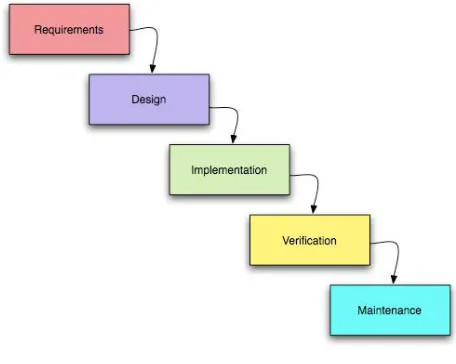
The Waterfall model is one of the traditional SDLC model, it follows only the sequential order. It flows steadily downwards. It is used in software development process.
We cannot change anything based upon customer requirements, since it follows sequential order.
[image:1.612.329.557.302.484.2]This leads to face these problems - Customer will not get satisfaction, requirements will be in pending, no profit, waste of time.
Fig 1. Traditional Model
III. SCRUM [2]
SCRUM was initiated by Ken Swaber in 1995. It was included in agile methodology since it contains the same concepts of agile. A SCRUM is a team pack, where everyone in the team acts together. It delivers the project within time and with minimal cost.
How SCRUM differs from Waterfall? - Different Roles
International Journal of Emerging Technology and Advanced Engineering
Website: www.ijetae.com (ISSN 2250-2459, ISO 9001:2008 Certified Journal, Volume 3, Issue 6, June 2013)
193
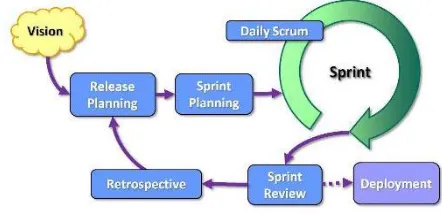
Fig 2. SCRUM Development life cycle
IV. SCRUM ROLES [3]
Different scrum roles are there like Product owner, Scrum master, Scrum team.
A. Product Owner
Customer representative
Works with the team
He / She maintains the product backlog
Prioritizes product requirements
Interface between the team and the business
Define the features of the product
Decide on product release date and content
Be responsible for the profit
Prioritize and adjust features, as needed
Responsible for final approval
Accept or reject work results
B. SCRUM Master
Helps the team members and responsible for
removing obstacles.
Scrum master has a leadership role over team
members
Be responsible for managing the process
He/ She responsible to run the daily scrum, sprint
planning meetings
Maintains documentation required
Protect the team from external interferences
C. SCRUM Team
Develops product
Each team member is responsible for their work.
They contributes their best for each sprint
Includes 5-10 people in a team
Two kind of teams are there, like self-organizing and
cross-functional team.
Responsible for failure or success
Team members can be Programmers, testers, user
experience designers, etc
V. MEETINGS
A. Sprint planning meeting
Sprint planning meeting is conducted by the
product owner , team member and the scrum master
Product owner is responsible for prioritizing the
items which is more important.
Sprint planning meeting focusing on what to do
and how to do
B. Sprint
Changes will not accepted while in Sprint
C. Daily Scrum
Scrum master and development team members
report to each other
Daily meeting about 15 minutes
Three questions are generated in this sprint - What they did yesterday?
-What they plan to do till next meeting?
- What difficulties are there in their way?
D. Sprint Review meeting
[image:2.612.329.550.560.667.2]Is done after every Sprint and the product owner reviews and revised the sprint planning meeting after review meeting, Provide feedback after sprint review meeting
International Journal of Emerging Technology and Advanced Engineering
Website: www.ijetae.com (ISSN 2250-2459, ISO 9001:2008 Certified Journal, Volume 3, Issue 6, June 2013)
194 E. Scrum retrospective meeting [4]
- Discuss about their experiences and problems faced
- Discuss about what to be followed and not to be followed to improve further and typically 15–30
minutes of meeting. It will be done after every sprint
Whole team will participates in this meeting, Scrum Master, Product owner, Team and Customers also
VI. ARTIFACTS
A. Product Backlog
The product backlog is an ordered list of "requirements" that is maintained for a product. It contains Product Backlog Items that are ordered by the Product Owner. Product owner decides about the priorities of the user stories. Product owner can re-prioritize the list during or end of the sprint. It is transparent to all stakeholders.
B. Sprint backlog
The sprint backlog is the list of work the Development Team must address during the next sprint. Requirement should not be changed during sprint execution.
C. Burndown chart
The sprint burn down chart is a displayed chart showing remaining work in the sprint backlog. Updated every day, it gives a simple view of the sprint progress. It also provides quick visualizations for reference.
VII. CASE STUDY
Let us have a comparative study which model will be effective in the below models and the advantages & disadvantages of choosing the model.
1. Traditional Model (Waterfall Model) 2. New Methodology ( SCRUM)
VIII. COMPARATIVE STUDY OF WATERFALL VS SCRUM
[8][11]
A. WATERFALL
- Waterfall follows each step in a linear path. - Plans all features for simultaneous implementation - Designs all features
- Implements all features - Tests all features
-Each phase of development proceeds in order without any overlapping.
-Each phase task to be completed within a specified time period
-The documentation and testing happens at the end of each phase, which helps in maintaining the quality of the project.
- In waterfall model the defect were found very late If requirements is not clear in this model, it is difficult to complete the project. After completing the first phase only we can proceed with next phase.
Fig 4. Waterfall Model phases
Advantages [9]
- It is sequential model, So it’s easy to implement.
-The amount of resources required to implement this model are minimal.
-Proper documentation is followed for the quality of the development.
Disadvantages [8] [9]
-The problems with one phase are never solved completely during that phase and it leads to many problems
-If client want the requirement to be changed ,it will not implemented
-Freezes scope – Customer requirements contract -Estimates schedule – Delivery time is intended
In spite of the disadvantages, the many advantages of this model ensure that it remains one of the most popular models used in the field of software development.
B. SCRUM [6]
- Scrum is series process of sprints.
- Scrum is a Lightweight Process Framework .
- Scrum is the Agile process frameworks.
- Scrum is tries to build a better approach of handling
software development.
- As compared to traditional project management
approach, Scrum has very less documentation and is less complicated.
- A short, fixed schedule per cycle with adjustable
scope.
International Journal of Emerging Technology and Advanced Engineering
Website: www.ijetae.com (ISSN 2250-2459, ISO 9001:2008 Certified Journal, Volume 3, Issue 6, June 2013)
[image:4.612.58.557.62.543.2]195
Fig 5. SCRUM Design
Advantages
– Scrum provides customer satisfaction by optimizing
turnaround time and responsiveness to requests.
– Increase the quality
– Accept and expect the changes
– Provide better estimates while spending less time
creating them
– Be more in control of the project schedule
– Scrum is ideal for rapidly changing, accumulating
requirements.
– Benefits to customer and project manager
– Scrum is fast, quick and can adapt changes easily
– Freezes schedule – Short Sprint by short Sprint
– Estimates scope – Top feature, then next feature
– Never changes the schedule, or Sprint
– Adjusts the scope if needed to meet release dates
– Work estimates are much easier.
– Work proceeds and completes more logically.
Disadvantages [7]
– Documentation is very less
– Team members dedication is very important
– Team work is highly essential
– If team members does not cooperate well, the project
[image:4.612.336.554.146.540.2]will face failure
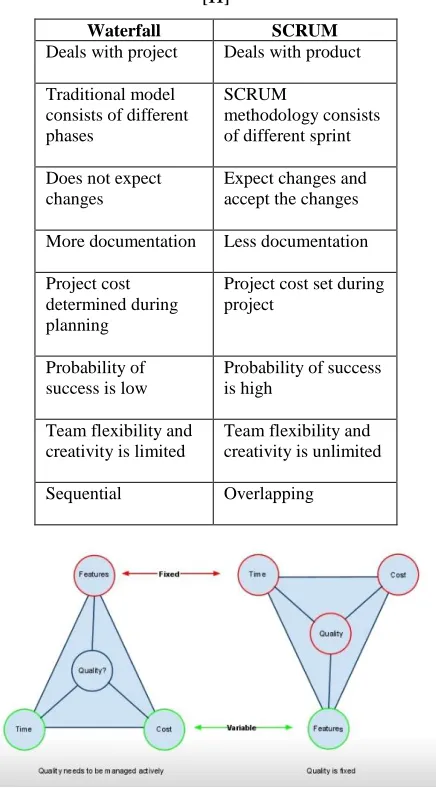
TABLE I
Comparison between Traditional (Waterfall) and SCRUM (Agile) [11]
Waterfall SCRUM
Deals with project Deals with product
Traditional model consists of different phases
SCRUM
methodology consists of different sprint
Does not expect changes
Expect changes and accept the changes
More documentation Less documentation
Project cost determined during planning
Project cost set during project
Probability of success is low
Probability of success is high
Team flexibility and creativity is limited
Team flexibility and creativity is unlimited
Sequential Overlapping
Fig 6. Waterfall Vs SCRUM
IX. CONCLUSION
International Journal of Emerging Technology and Advanced Engineering
Website: www.ijetae.com (ISSN 2250-2459, ISO 9001:2008 Certified Journal, Volume 3, Issue 6, June 2013)
196
- SCRUM is best if the requirements frequently change.
- WATERFALL is best if there is no change in the
requirements.
REFERENCES
[1] http://www.mountaingoatsoftware.com/topics/scrum
[2] http://en.wikipedia.org/wiki/Scrum_%28development%29
[3] M. Singh, U-SCRUM: An Agile Methodology for Promoting
Usability. In Ag. AGILE '08. Conference, Toronto, 2008, 555-560.
[4] C. Jakobsen and J. Sutherland, “Scrum and CMMI – Going from
Good to Great: are you ready-ready to be done-done?,” in Agile 2009, Chicago, 2009.
[5] K. Schwaber and J. Sutherland. The Scrum Guide. Scrum.org, 2010.
[6] A. Sutherland, J. Sutherland, and C. Hegarty, “Scrum in Church:
Saving the World One
[7] J. Sutherland, “Future of Scrum: Parallel Pipelining of Sprints in Complex Projects,” in AGILE 2005 Conference Denver, CO: IEEE, 2005.
[8] Waterfall model, From Wikipedia,
http://en.wikipedia.org/wiki/Waterfall_model
[9] Weisert, C. (2003). Waterfall methodology: there's no such thing.
[10] K, P. (2010). "Doctoral research in Sweden Implementing Lean and
Agile Software Development in Industry”.
[11] Schwaber, K. (2002). M. B. “Agile Software Development with
Scrum”.
[12] Woodward, E., S. Surdek, and M. Ganis, A Practical Guide to
Distributed Scrum. 2010: IBM Press.