AIR BREAKDOWN CHARACTERISTICS IN PLANE-PLANE AND SPHERE GAP ELECTRODE CONFIGURATION UNDER LIGHTNING IMPULSE
HAIRIEROSNIZA BINTI ROSDI
A project report submitted in partial fulfillment of the requirement for the award of the
Master of Electrical Engineering
Faculty of Electrical and Electronic Engineering Universiti Tun Hussein Onn Malaysia
ABSTRACT
This report describes the air breakdown characteristics in plane-plane and sphere gap electrode configuration under lightning impulse. The breakdown in air (spark breakdown) is the transition of a non-sustaining discharge into a self-sustaining discharge. In electrical power system, high voltage power equipments are mainly subjected with spark over voltage. This over voltage which may causes by the lightning strokes, switching action and so on. In this project, two different electrodes (plane-plane and sphere gap) are used to study the air breakdown characteristics. This two electrodes are tested by using different gap start with 0.5 cm, 1.0 cm until 2.5 cm. Refer to British Standard BS EN 60060 that explained detail about the general definitions and test requirements for high voltage test techniques to construct in this project. In addition, TERCO lightning impulse circuit are use to obtain the lightning impulse waveform. To estimate U50 during the experimental, up and down
method are used with the value of n ≥ 20. Finite element method magnetic software (FEMM) is use to shows the potential higher electric field occurs around the electrodes. Vector and contour around the electrodes also can be viewed. From this project can conclude that electric field distribution between two conductors (or electrodes) depends on applied voltage (U50), gap between electrodes, types and
surface of electrodes. In the end of this project, the relationship between voltage (U50) and gap, electric field (|Emax|) and gap, field utilization factor (η) and gap, U50
and field utilization factor (η) and electric field (|Emax|) and field utilization factor (η)
VII
ABSTRAK
Laporan ini menerangkan ciri-ciri pecahan udara (air breakdown) dalam konfigurasi elektrod rata-rata (plane-plane) dan sfera dibawah denyutan kilat. Pecahan didalam udara (spark breakdown) adalah peralihan pelepasan tidak kekal ke dalam pelepasan kekal. Di dalam sistem kuasa elektrik, kebanyakan peralatan kuasa voltan tinggi sering dikaitkan dengan percikan lebihan voltan. Lebihan voltan ini disebabkan oleh panahan kilat, tindak balas suis dan sebagainya. Dalam projek ini, dua elektrod yang berbeza (elektrod rata-rata dan sfera) digunakan untuk mengkaji ciri-ciri pecah tebat udara. Kedua-dua elektrod ini diuji dengan jarak yang berbeza iaitu 0.5 cm, 1.0 cm sehingga 2.5 cm. Merujuk kepada piawai British BS EN 60060 yang menjelaskan secara terperinci mengenai definisi umum dan keperluan ujian untuk teknik ujian voltan tinggi dalam menjalankan projek ini. Di samping itu, litar denyut kilat TERCO yang digunakan untuk mendapatkan bentuk gelombang denyut kilat. Untuk menganggarkan U50 semasa eksperimen dijalankan, kaedah naik dan
turun digunakan dengan nilai n ≥ 20. Perisian magnet kaedah elemen terhingga (FEMM software) digunakan untuk menunjukkan medan elektrik yang lebih tinggi yang berpotensi berlaku di sekeliling elektrod. Vektor dan kontur di sekitar elektrod juga boleh dilihat. Daripada projek ini boleh disimpulkan bahawa taburan medan elektrik di antara dua konduktor (atau elektrod) bergantung kepada voltan yang dimasukkan (U50), jarak antara elektrod, jenis dan juga permukaan elektrod. Di akhir
projek ini, hubungan antara voltan (U50) dan jarak, medan elektrik (|Emax|) dan jarak,
faktor penggunaan medan (η) dan jarak, U50 dan faktor penggunaan medan (η), dan
juga medan elektrik (|Emax|) dan faktor penggunaan medan (η) telah dibina dengan
LIST OF CONTENT
TITLE I
DECLARATION II
DEDICATION IV
ACKNOWLEDGEMENT V
ABSTRACT VI
LIST OF CONTENT VIII
LIST OF TABLE XI
LIST OF FIGURE XII
LIST OF SYMBOLS AND ABBREVIATION XIV
CHAPTER 1 INTRODUCTION 1
1.1 Project background 1
1.2 Problem statement 3
1.3 Objective 3
1.4 Project scope 3
1.5 Organization of the project 4
CHAPTER 2 LIGHTNING AND AIR BREAKDOWN: A REVIEW 6
2.1 Introduction 6
2.2 Lightning 6
2.3 Sparkover 8
2.4 Flashover 9
2.5 Puncture 10
2.6 Lightning impulse 10
2.7 Air breakdown 12
IX
2.7.2 Streamer mechanism 14
2.8 Capacitive divider 16
2.9 Previous related works 17
CHAPTER 3 LIGHTNING IMPULSE TEST PROCEDURES
AND SIMULATION MODEL 20
3.1 Introduction 20
3.2 Methods to obtain lightning impulse 20
3.3 TERCO lightning impulse circuit 21
3.4 Procedure for the lightning impulse set up 28 3.5 Single-stage impulse voltage generator 30 3.6 Finite element method magnetics software 31
3.6.1 Create the model 33
3.6.2 Assign boundary condition and material 34
3.6.3 Mesh 34
3.6.4 Solver 35
3.7 50% disruptive discharge voltage, U50 36
CHAPTER 4 BREAKDOWN PROPERTIES OF AIR UNDER LIGHTNING IMPULSE: EFFECT OF
ELECTRODE GEOMETRY AND GAP LENGTH 38
4.1 Introduction 38
4.2 Result from experimental circuit 38
4.3 Result in FEMM software 41
4.3.1 Electric field intensity |Emax| 41
4.3.2 Voltage density 45
4.3.3 Contour and vector 49
4.4 Sphere gap and plane-plane electrodes configurations
results 51
4.5 Relationship for U50 (kV) versus gap (cm) 52
4.6 Relationship for electric field, Emax (kV/cm) versus
4.7 Relationship for field utilisation factor,η versus
gap (cm) 54
4.8 Relationship for U50 (kV) versus field utilisation
factor, η 55
4.9 Relationship for electric field, Emax (kV/cm) versus
field utilisation factor, η 56
CHAPTER 5 GENERAL CONCLUSION AND FUTURE WORK 58
5.1 Conclusion 58
5.2 Recommendations for future works 59
XI
LIST OF TABLES
2.1 The tolerance for lightning impulse 11
2.2 The summary for the previous work 19
3.1 Component description for the experimental setup lightning
impulse waveform 23
4.1 U50 experimental result for sphere gap and plane-plane
electrodes 41
4.2 Maximum electric field intensity |Emax| from simulation 42
4.3 Voltage density data in FEMM simulation 46
4.4 Sphere gap configuration result 51
LIST OF FIGURE
2.1 Lightning 7
2.2 Top cities in Malaysia with highest lightning days per annum 7
2.3 Illustrate for spark over 8
2.4 Sparkover occur in air 8
2.5 Illustrate for flash over 9
2.6 Flash over occured on surface of insulator 9
2.7 Illustrate of puncture 10
2.8 The standard lightning impulse voltage waveform 11 2.9 Lightning impulse voltage chopped on the front 12 2.10 Lightning impulse voltage chopped on the tail 12
2.11 Townsend‟s mechanism 13
2.12 Ionization process 14
2.13 Distortion of electric field by space charge 15 2.14 Secondary avalanches formation by photo electrons 15 2.15 The capacitive divider that are connected in series 16
3.1 Methods to obtain lightning impulse 21
3.2 The experimental setup lightning impulse waveform in the laboratory 22 3.3 The experimental setup of lightning impulse waveform in TERCO
manual guide 22
3.4 Block diagram for the lightning impulse circuit 27
3.5 Step to ON at the control board 29
3.6 Step to OFF at the control board 30
XIII 3.10 Assign boundary condition and material for sphere gap and
plane-plane electrodes configurations 34
3.11 Mesh are generated for sphere gap and plane-plane electrodes
Configurations 35
3.12 Density plot of voltage by default 36
3.13 The flowchart procedure of general up and down method 37
4.1 The impulse lightning waveform 39
4.2 Zoom in scale at front time, T1 for lightning impulse waveform 39
4.3 Lightning impulse waveform chopped on the tail 40 4.4 Electric field intensity |E| for sphere gap and plane to plane 42 4.5 Zoom in scale line for the selection point from simulation named
as point a to b for sphere gap and plane-plane electrodes 43
4.6 Legend for electric field intensity |E| 44
4.7 Graph for electric field intensity |E| at point a to b for sphere gap
electrodes 44
4.8 Graph for electric field intensity |E| for point a to b for plane-
plane electrodes 45
4.9 Voltage density for sphere gap and plane-plane 46 4.10 Point a to b to plot graph voltage density electrodes configuration 47
4.11 Legend for the voltage density 48
4.12 Graph for voltage density for point a to b sphere gap configuration 48 4.13 Graph for voltage density for point a to b plane-plane configuration 49 4.14 Equipotential line for electrodes sphere gap and plane to plane 50 4.15 Electric flux density for electrodes sphere gap and plane-plane 50 4.16 Relationship between U50 (kV) and gap (cm) 53
4.17 Relationship between Emax (kV/cm) and gap (cm). 54
4.18 Relationship between field utilisation factor, η versus gap (cm) 55 4.19 Relationship for U50 (kV) versus field utilisation factor, η for the
sphere gap and plane-plane electrodes configuration 56 4.20 Relationship for electric field, Emax (kV/cm) versus field utilisation
LIST OF SYMBOLS AND ABBREVIATIONS
Emax - Maximum electric field
U50 - 50% probability voltage to breakdown
η - Field utilisation factor
AC - Alternative current
DC - Direct current
FEMM - Finite element method magnetic
HV - High voltage
CHAPTER 1
INTRODUCTION
1.1 Project background
In the wide of engineering‟s world, built a perfect and safe condition system to the consumer always be the main important aspect for an engineer. Every analysis result is highly important to achieve the mission and goal. For example, to design of overhead line, substation equipment and various air insulated high voltage equipment, the fundamental characteristics of the electrical breakdown have to understand. All the aspect for the electrical breakdown must be examined. British standard are use in this project as guidance for the high voltage test technique. This British Standard is the UK implementation of EN 60060-1:2010 [1]. It is identical to IEC 60060-1:2010. BS EN 60060-1:2010 explained detail about the general definitions and test requirements for high-voltage test techniques.
In addition, this project consists of experimental setup and software simulation. For the experimental setup, TERCO lightning impulse circuit is used to obtain the lightning impulse waveform. The lightning impulse waveform could be observed by using oscilloscope which is connected to the circuit. The most important thing before conducting the experiment is to make sure the experiment is to produce lightning impulse. Besides, during conducting the experiment, the safety aspects always come first.
In addition, this project also use up and down method. This method is use to determine the U50 during the experiment. U50 is 50% probability breakdown voltage.
The data for voltage are taken until n ≥ 20 to estimate U50. ± 3% of voltage also
consider in decrease or increase the voltage value during the experimental with the interval time for voltage is 60 second.
Furthermore, these projects use FEMM software to simulate electric field in electrostatic problem. The estimation of U50 from the experimental results are
applied into the FEMM software. The actual dimensions for the electrodes are drawn in this software. The estimation value of U50 will be applied in this software to define
the voltage for the electrodes. Means, the maximum or minimum electric field that occurs surrounding the electrodes could be seen. Electric field intensity shows the electric field strength in order to evaluate the electrical stress and breakdown characteristics between two different types of electrodes. In addition, vector and contour around the electrodes also can be viewed. From this project can conclude that electric field distribution between two conductors (or electrodes) depends on applied voltage (U50), gap between electrodes, types and also the surface of
electrodes.
3 needed. This thesis is also important in application such as in power transformer, switch gear, overvoltage arrester, insulator, power cable and transformer.
1.2 Problem statement
Sparkover voltage is the mainly cause damage to high voltage power equipment in electrical power system. Usually, lightning strokes cause the overvoltage [2]. In order to avoid the overvoltage in high voltage power equipment, the study of air breakdown voltage with difference electrode configuration plane-plane and sphere gaps. This air breakdown will generated by using lightning impulse test. From this air breakdown, the different electrodes may determine which configuration of electrodes will more easily to breakdown.
1.3 Objective
The main aim in this project is to find the air breakdown voltage experimentally for different electrodes (plane-plane and sphere gap) by using lightning impulse test. Objective for this project is:
i. To find the electric field for different electrodes (plane-plane and sphere gap) for a given voltage by using FEMM software.
ii. To construct relationship between voltage (U50) versus gap, electric field
(|E|) versus gap, field utilization factor (η) versus gap, U50 versus field
utilization factor (η), and electric field (|E|) versus field utilization factor (η).
1.4 Project scope
In order to achieve the objectives of the project, several scopes have been outline. The following are the scopes of the project:
ii. Generate the air breakdown voltage by using lightning impulse setup by refer to TERCO manual guide in UTHM High Voltage Laboratory.
iii. The simulation of electric field between the electrodes will be simulating by using Finite Element Method Magnetic (FEMM) software.
iv. The TERCO‟s single stage voltage impulse generator capable to produced lightning impulse at maximum 140 kV.
v. Gap between electrodes start with 0.5 cm, 1.0 cm, 1.5 cm, 2.0 cm until 2.5 cm are used for measurement of air breakdown voltages and electric field of the high voltage equipments.
vi. Use air = gas @ atmosphere P = 1 bar.
vii. Temperature and humidity effect are not considered.
1.5 Organization of the project
This project divided into five chapters which are including the introduction, lightning and air breakdown: a review, lightning impulse test procedures and simulation models, breakdown properties of air under lightning impulse: effects of electrode geometry and gap lengths and lastly, general conclusion and future works. This thesis focused on the air breakdown characteristics in plane-plane and sphere gap electrode configuration under lightning impulse.
Firstly, chapter 1 describes on the project background and problem statement to explain in detail for this project. This project also elaborates the project objectives and several scopes or the limitation that had been outlined to achieve the objectives. Besides, the organization of the thesis also included as the outlines for this project.
Next, in chapter 2, it discussed more on theory and literature reviews that related to this project. In this chapter, the general knowledge about the lightning, air breakdown, and lightning impulse will be covered. Previous related works in this chapter helps a lot to guide and as references in this project.
5 Then, chapter 4 described the result for the air breakdown characteristics in plane-plane and sphere gap electrodes configuration from the experimental and also in FEMM simulation. The main content of chapter 4 is the results from the simulations followed by comprehensive discussions on the findings. From the experiment, the reading of U50 obtained from up and down method. The data is used
to view the electric field surrounding the electrodes configuration by using FEMM software. Comparison between two electrodes are shown with the helped of graph.
CHAPTER 2
LIGHTNING AND AIR BREAKDOWN: A REVIEW
2.1 Introduction
Literature review is a process of collecting and analyzes data and information that are related to this study. By refer from variable source such journals, books, websites and articles, the data and information can be collected.
2.2 Lightning
Lightning can be defined as an electrical discharge between cloud and earth, of atmospheric origin, comprising one or more impulses of many kilo amps [3]. It can also be defined as a transient, high current discharge whose path length is measured in kilometers [3]. Lightning has an extremely high current, high voltage and transient electric discharge. It is transient discharge of static electricity that serves to re-establish electrostatic equilibrium within a storm environment [4]. Lightning is natural phenomena that are always happened in our country, Malaysia.
7
High during inter-monsoon (April to May)
Moderate during Southwest monsoon (May to Sept)
[image:17.595.121.515.147.414.2] Low during Northeast monsoon (Dec to March)
Figure 2.1 : Lightning [8]
[image:17.595.121.515.466.718.2]2.3 Sparkover
[image:18.595.194.438.204.401.2]Sparkover defined as disruptive discharge that occurs in a gaseous or liquid dielectric [1]. Figure 2.3 shows the illustrated for spark over while for figure 2.4 shows the sparkover occured in air.
Figure 2.3 : Illustrate for sparkover (reproduced from [1])
[image:18.595.153.484.455.728.2]9
2.4 Flashover
[image:19.595.130.430.197.387.2]Flashover defined as disruptive discharge that occurs over the surface of a dielectric in a gaseous or liquid dielectric [1]. Figure 2.5 shows the illustrate for flashover while figure 2.6 shows the flashover occurred on surface of insulator .
Figure 2.5 : Illustrate for flashover (reproduced from [1])
Figure 2.6 : Flashover occurred on surface of insulator [10]
solid
[image:19.595.202.435.441.722.2]2.5 Puncture
[image:20.595.186.450.176.392.2]Puncture can defined as disruptive discharge that occurs through a solid dielectric [1]. Figure 2.7 shows the illustrated of puncture.
Figure 2.7 : Illustrate of puncture (reproduced from [1])
2.6 Lightning Impulse
Lightning impulse voltages is a overvoltage due to lightning are considered as an external overvoltage and are dependent on the system voltages. Also known as fast-front overvoltages or FFO. This is due to very fast rise-time occur on the waveform shape. The standard waveform used for testing is 1.2/50 μs. 1.2 μs represent the rise time T1while 50 μs is a decay-time T2 [2].
11
Figure 2.8 : The standard lightning impulse voltage waveform [11]
Due to many reasons such as equipments accuracy / aging, weather condition, humidity and extra, it may be difficult to generate an accurate impulse waveforms in the laboratory that can follow exactly the specific standard 1.2/50 μs of FFO. Table 2.1 shows the tolerance for lightning impulse.
Table 2.1 : The tolerance for lightning impulse
Lightning Impulse Front Time (T1) Tail Time (T2)
Tolerances ± 30% ± 20%
Standard time, us 1.2 50
Voltage 0.93Vpeak 0.5Vpeak
Lightning impulse waveform will chopped when air breakdown occured which a disruptive discharge causes a rapid collapse of the voltage, practically to zero value. The standard impulse chopped by an external gap with a time to chopping value between 2 μs to 5 μs [1]. There are two time chopping occur:
[image:21.595.161.476.512.585.2]Figure 2.9 shows the lightning impulse voltage chopped on the front while figure 2.10 shows lightning impulse voltage chopped on the tail. The different between this waveform is the time chopping that occurs whether on the front time or tail time.
[image:22.595.141.496.426.639.2]Figure 2.9 : Lightning impulse voltage chopped on the front [11]
Figure 2.10 : Lightning impulse voltage chopped on the tail [11]
2.7 Air Breakdown
13 breakdown is due to the ionization in which electrons and ions are created from neutral atoms or molecules, and their migration to the anode and cathode respectively leads to high currents. Townsend theory and Streamer theory are the present two types of theories which explain the mechanism of breakdown under different conditions as temperature, pressure, nature of electrode surfaces, electrode field configuration and availability of initial conducting particles. Normally air medium is widely use as an insulating medium in different electrical power equipments and over head lines as its breakdown strength is 30 kV/cm.
2.7.1 Townsend’s Mechanism
[image:23.595.123.513.485.730.2]The townsend discharge is named after John Sealy Townsend, who discovered the fundamental ionization mechanism by his work between 1897 and 1901 [3]. It is also known as a "Townsend avalanche". Townsend‟s mechanism is based upon, ionisation collision in the gas, ionisation collision on the surface of the cathode and photo-ionisation [11]. Basically, anode is positive polarity (+ve), cathode is negative polarity (-ve). Positively charge ions (cations) moves towards cathode while negatively charged ions (anions) moves toward anode [11]. Figure 2.11 shows townsend‟s mechanism process.
In region i, starting with low voltages, then current increase linearly with voltage up to saturation level (io) when all electron conduct. For region ii, current io
remains constant between V1 and V2. At region iii, after V2, current growth exponentially. Exponential current to ionisation of gas by electron collision. Rapid increase of ionisation processes in the gap region are called avalanches process. Region iv, anod current increase very sharply. Current magnitude reach infinity and the value is limited only by the external resistance. Now, the gas is to be breakdown.
2.7.2 Streamer Mechanism
Streamer breakdown of gases developed by Loeb, Meek and Roether [3], streamer propagation is due to the appearance of secondary electrons ahead of the streamer because of photoionization of the gas by radiation from streamer itself [11]. This type of breakdown mainly arises due to the added effect of the space-charge field of an avalanche and photo-electric ionization in the gas volume [11].
[image:24.595.233.435.516.676.2]Ionization process by collision cause negative charges to anode and positive charge to cathode [11]. Ionization process will create avalanches of electron that must lighter and higher mobility compare to positive ion. Therefore the electron will fill the head and the positive ion occupied the tail. Figure 2.12 shows ionization process.
Figure 2.12: Ionization process [11]
15 the tail. The field behind and a head of avalanches is increase by the space charge, ɛr.
The field between the electron and the cloud is reduced. αd increase, field distortion
increase. When αd at critical value, space charges field is comparable to ɛo. „α‟ is an
[image:25.595.240.397.258.442.2]average number ionising collision made by one electron per unit drift in the direction of the field [11]. This condition will create an intense ionistion and excitation of the gas partical in front of the avalanches head. Excited atoms return to normal. The process will release of photon, which turn generate secondary electron by the photo ionisation process. Figure 2.13 shows the distortion of electric field by space charge.
Figure 2.13 : Distortion of electric field by space charge [11]
[image:25.595.238.435.599.744.2]Photo ionisation will generate further auxilary avalanches. Photon travel with the speed of light. The process rapidly develop conduction channel and develop propagation streamer. Streamer proceed across the gap and to form a conducting filament of high ionised gas between electrodes. The gap therefore breakdown. Figure 2.14 shows the secondary avalanches formation by photo electrons.
2.8 Capacitive divider
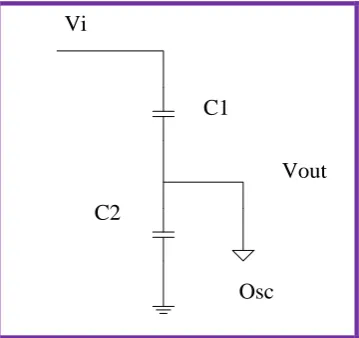
[image:26.595.248.428.319.488.2]A capacitive divider consists of two capacitors in series. It is commonly used to create a reference voltage, or to get a low voltage signal proportional to the voltage to be measured, and may also be used as a signal attenuator at low frequencies. For direct current and relatively low frequencies, a capacitive divider may be sufficiently accurate if made only of capacitors, where frequency response over a wide range is required, (such as in an oscilloscope probe), the voltage divider may have capacitive elements added to allow compensation for load capacitance. In electric power transmission, a capacitive voltage divider is used for measurement of high voltage. Figure 2.15 shows the capacitive divider that is connected in series.
Vi
Osc C1
C2
Vout
Figure 2.15 : The capacitive divider that are connected in series.
Formula for capacitive divider
𝑉𝑜𝑢𝑡 = 𝐶2
𝐶1 + 𝐶2∗ 𝑉𝑖
17
2.9 Previous related works
The thesis entitled “Measurement of air breakdown voltage and electric field using standard sphere gap method” is a project to simulate the air breakdown voltage experimentally in high voltage laboratory, standard diameter of 25 cm sphere are used for measurement of air breakdown voltage and electric field of high voltage equipment. This project is a work from Paraselli Bheema Sankar. From the referred thesis, it shows that the author has find the sphere gaps are commonly used for measurements of peak values of high voltages and have been adopted by IEC and IEEE as a calibration device. The sphere gaps are filled up with insulating medium such as liquid insulation (transformer oil), solid insulation (polyester, paper) and gas insulation (SF6, N2, CO2, CCl2F2 etc). Normally air medium is widely used as an
insulating medium in different electrical power equipment as its breakdown strength is 30kV/cm. Therefore electrical breakdown characteristic of small air gap under the different applied voltage has its great significance for the design consideration of various air insulated HV equipment. In the author‟s work to simulate the air breakdown voltage experimentally in high voltage laboratory, standard diameter of 25 cm spheres are used for measurement of air breakdown voltages and electric field of the high voltage equipment. Finite element method is also used for finding the electric field between standard sphere electrodes. The relative air density factor and maximum electric field are measured in MATLAB environment for different temperature and pressure. The electric field distribution for sphere gap arrangements is also calculated with the help of COMSOL [12].
assessment. The comparison of microstructure before and after the breakdown test reveals the information about the effects of electrical stress on the insulating paper.
The thesis entitled “Impulse breakdown voltages of ester-based transformer oils determined by using different test methods” use three different testing methods including rising-voltage method (refer to ASTM and IEC Standards), up-and-down method and multiple-level method, were employed to determine the lightning impulse breakdown voltage of two ester-based oils, Midel 7131 as synthetic ester and FR3 as natural ester [14]. This project is a work from Q. Liu, Z.D. Wang and F. Perrot. From the author‟s results clearly indicated that test methods have significant influence on breakdown voltage measurement values.
The thesis entitled “Simulation of air breakdown mechanism using different electrodes” that observe the effect on insulation due to breakdown mechanism, the insulation samples are collected both before and after breakdown voltage test and analysis by using Scanning electron microscope (SEM) [15]. This project is a work from A Srikant and Shekar Chandra Pradhan. From the author‟s results clearly indicated that the SEM analysis showed the level of detoriation in three different insulation papers and it observed from the SEM analysis that the detoriation of such insulation is minimum for lamiflex paper.
19 Table 2.2 : The summary for the previous work
Title Author Project Description
Measurement of air breakdown voltage and electric field using standard sphere gap method
Paraselli Bheema Sankar
Simulate the air breakdown voltage experimentally in high voltage laboratory, standard diameter of 25cm sphere is used for measurement of air breakdown voltage and electric field of high voltage equipment.
An experimental study of air breakdown voltage and its effects on solid insulation
Subrata Karmakar Protect such equipments different types of conducting electrodes having protective gap are used widely throughout the world. Impulse breakdown voltages
of ester-based transformer oils determined by using different test methods
Q. Liu, Z.D. Wang and F. Perrot
Determine the lightning impulse breakdown voltage of two ester-based oils, Midel 7131 as synthetic ester and FR3 as natural ester.
Simulation of air breakdown mechanism using different electrodes
A Srikant and Shekar Chandra
Pradhan
Observe the effect on insulation due to breakdown mechanism, the insulation samples are collected both before and after breakdown voltage test and analysis by using Scanning electron microscope (SEM).
Air breakdown characteristics in rod-plane gaps due to repetitive nanosecond-pulses
Shao Tao, Sun Guangsheng, Yan Ping, Wang Jue and
Zhang Shichang
Focuses on the pulse breakdown characteristics of non-uniform field using rod-plane gaps due to repetitive pulses at different pressures
CHAPTER 3
LIGHTNING IMPULSE TEST PROCEDURES AND SIMULATION MODEL
3.1 Introduction
This project deals with the experiment set up for air breakdown characteristic in plane-plane and sphere gap electrode configuration by using TERCO circuit. From FEMM software, the different result electric fields are simulating for plane-plane and sphere gap electrodes. The method and technical strategies implied are the most important disciplines.
3.2 Methods to obtain lightning impulse
21
Start
Research and literature review
Planning and select suitable method for project
Test project in HV lab
Lightning impulse
Save the lightning waveform using MS
excel
End
No
[image:31.595.219.391.75.566.2]Yes
Figure 3.1 : Methods to obtain lightning impulse
3.3 TERCO lightning impulse circuit
Component description for the experimental setup of lightning impulse waveform shown in table 3.1. Figure 3.4 shows the block diagram for the lightning impulse circuit to make it easier to refer.
Figure 3.2 : The experimental setup of lightning impulse waveform in the HV laboratory
[image:32.595.129.507.443.676.2]23 Table 3.1 : Component description for the experimental setup lightning impulse
waveform (reproduced from [20])
NO. COMPONENT
DESCRIPTION
COMPONENT TERCO
TYPE
QUANTITY
1 HV Test Transformer
Produce AC high voltage (140kV)
HV9105 1
2 Control Desk
Control and operate high voltage AC/ DC/ Impulse test equipment
HV9103 1
3 Impulse capacitor
(Smoothing Capacitor)
generation of impulse voltages
Used as smoothing capacitor in DC voltage generation.
HV9112 1
4 Load Capacitor
Measurement of impulse voltages.
HV9120 1
5 Silicon Rectifier
Use in impulse voltage and DC voltage generation.
6 Charging Resistor
For multi stage impulse voltage test equipment and current limiting resistor in DC voltage generation.
HV9121 1
7 Wavefront Resistor
For generation of impulse voltages.
Determine the rise time of the impulse voltage
HV9122 1
8 Wavetail Resistor
For generation of impulse voltages.
Determine the time to half value of the impulse voltage
HV9123 1
9 Sphere Gap
Pre-settings of Impulse voltage peak.
HV9125 1
10 Insulating Rod
Insulating component.
HV9124 2
11 Connecting Rod
Conductive connection element.
REFERENCES
[1] BSI standards publication “High voltage test techniques, part 1 : general definitions and test requirements”, BS EN 60060-1:2010.
[2] Subir Ray “ An introduction to high voltage engineering”, published by Prentice-Hall of India Private Limited, New Delhi, third printing, 2004. [3] Dalina Johari “Hybrid Evolutionary Programming-Artificial Neural
Network-Based Lightning Prediction System”, Faculty of Electrical Engineering, Universiti Teknologi Mara, August 2009.
[4] K. Srinivasan and J.Gu. Lightning as Atmospheric Electricity, IEEE CCECE/CCGEI, Otawa, May 2006.
[5] Ministry of Science, Technology and Innovation, Jabatan meteorlogi malaysia, 2013, http://www.met.gov.my, access date : 18th March 2014. [6] L.M. Ong, and H. Ahma, “Lightning Air Terminals Performance Under
Conditions Without Ionization And With Ionization”, Institute Of High Voltage And High Current, 2003. UTM Skudai, Malaysia.
[7] National Lightning Safety, USA, 2010.
[8] The Baritone, adventures in the world of opera, 2009, http://thebaritone.blogspot.com/2012/12/malaysia-tour-day-19-lightning strikes.html, access date : 6th May 2014.
[9] Jeff Behary, The Turn Of The Century Electrotherapy Museum, 2007, http://www.electrotherapymuseum.com/2007/FitzgeraldPancake/, access date : 6th May 2014.
[11] Dr. Md Nor Ramdon, “HV generation and testing 1.0” UTHM Slides High voltage engineering (MEK 10303).
[12] Paraselli Bheema Sankar, “Measurement of air breakdown voltage and electric field using standard sphere gap method”, National Institute of Technology, Rourkela, June 2011
[13] Subrata Karmakar, “An experimental study of air breakdown voltage and its effects on solid insulation”, J. electrical system 8-2 2012: 209-217
[14] Q. Liu, Z.D. Wang and F. Perrot, “Impulse breakdown voltages of ester-based transformer oils determined by using different test methods”, The University of Manchester, 2009.
[15] A Srikant and Shekar Chandra Pradhan, “Simulation of air breakdown mechanism using different electrodes”, National Institute of Technology, Rourkela, June 2011
[16] Shao Tao, Sun Guangsheng, Yan Ping, Wang Jue and Zhang Shichang, “Air breakdown characteristics in rod-plane gaps due to repetitive nanosecond-pulses”, Institute ofElectrical Engineering, Chinese academy of Sciences, 2005
[17] Meng Weifang, “Simulation of electric and magnetic fields using FEMM 4.2 - User handbook and Definition of examples”, Aachen University of Applied Sciences, Jülich , Germany, June 2011
[18] E. Kuffel, W. S. Zaengl and J. Kuffel “ High voltage engineering : fundamental”, published by Butterworth-Heinemann, second edition, 2000. [19] D. F. Warne “Newnes electrical power Engineer‟s handbook”, published by
Elsevierpublications, second edition, 2005.
[20] S. Pillai and R. Hackam “Electric field and potential distributions for unequal spheres using symmetric and asymmetric applied voltages” IEEE Transactions on Electrical Insulation, Vol. EI-18, No. 5, October 1983. [21] N. K. Kishore, G. S. Punekar, H. S. Y. Shastry, “Spark over in sphere gaps
with alternating voltages and perturbed electric fields”, annual report conference on „Electrical Insulation and Dielectric Phenomena‟, 2009.
63 [23] Y. Nishikori, S. Kojima, and T. Kouno “A study of the field utilization factor and the maximum electric field at spark over of the standard sphere gaps” Translated from Denki Gakkai Ronbunshi, Vol. 21-B, No. 3, March 2001. [24] IEEE Standard Technique for High Voltage Testing, IEEE-std. 4-1995, New
York 1995.
[25] Rakosh Das Begamudre, “Extra High Voltage AC Transmission Engineering”, published by New Age International (P) Limited, 3rd edition 2006.
[26] David Meeker, Finite Element Method Magnetics, 2003, http://femm.neil.williamsleesmill.me.uk/femm-manual.pdf, access date: 10th August 2013.
[27] TERCO manual guide
[28] Osamu Fujii, Takahiro Hayakawa, Yukio Mizuno and Katsuhiko Naito, “Evaluation of Humidity Correction Factor of Disruptive Discharge Voltage of Standard Sphere Air Gaps”, IEEJ Trans., Published by John Wiley &Sons, Inc., 2008
[29] P. N. Mikropoulos, C. A. Stassinopoulos and B. C. Sarigiannidou, “Positive Streamer Propagation and Breakdown in Air: the Influence of Humidity”, IEEE Transactions on Dielectrics and Electrical Insulation, Vol. 15, No. 2, April 2008.
[30] F. W. Peek, “The Sphere Gap as a Means of Measuring High Voltage”, Presented at the 31st Annual Convention of the American Institute of Electrical Engineers, Detroit, Mich. June 24, 1914.
[31] W.Hauschild and W.Mosch, “Statistical Techniques for High-voltage Engineering”, Bristol, England, J.W.Arrowsmith Ltd., 1992.
[32] E. P. Krider, R. C. Noggle, and M. A. Uman, “A gated wideband magnetic direction finder for lightning return strokes”, Journal of Applied Meteorology, vol. 15, no. 3, 1976, pp. 301-306.
![Figure 2.1 : Lightning [8]](https://thumb-us.123doks.com/thumbv2/123dok_us/8770168.898497/17.595.121.515.466.718/figure-lightning.webp)
![Figure 2.4: Sparkover occur in air [9]](https://thumb-us.123doks.com/thumbv2/123dok_us/8770168.898497/18.595.194.438.204.401/figure-sparkover-occur-in-air.webp)
![Figure 2.6 : Flashover occurred on surface of insulator [10]](https://thumb-us.123doks.com/thumbv2/123dok_us/8770168.898497/19.595.130.430.197.387/figure-flashover-occurred-on-surface-of-insulator.webp)
![Figure 2.7 : Illustrate of puncture (reproduced from [1])](https://thumb-us.123doks.com/thumbv2/123dok_us/8770168.898497/20.595.186.450.176.392/figure-illustrate-puncture-reproduced.webp)
![Figure 2.8 : The standard lightning impulse voltage waveform [11]](https://thumb-us.123doks.com/thumbv2/123dok_us/8770168.898497/21.595.161.476.512.585/figure-standard-lightning-impulse-voltage-waveform.webp)
![Figure 2.10 : Lightning impulse voltage chopped on the tail [11]](https://thumb-us.123doks.com/thumbv2/123dok_us/8770168.898497/22.595.141.496.426.639/figure-lightning-impulse-voltage-chopped-tail.webp)
![Figure 2.11 : Townsend‟s mechanism [11]](https://thumb-us.123doks.com/thumbv2/123dok_us/8770168.898497/23.595.123.513.485.730/figure-townsend-s-mechanism.webp)
![Figure 2.12: Ionization process [11]](https://thumb-us.123doks.com/thumbv2/123dok_us/8770168.898497/24.595.233.435.516.676/figure-ionization-process.webp)
![Figure 2.13 : Distortion of electric field by space charge [11]](https://thumb-us.123doks.com/thumbv2/123dok_us/8770168.898497/25.595.240.397.258.442/figure-distortion-electric-field-space-charge.webp)