The Development of Caring Thinking Skills Inventory
Based on Problem Scenarios: A Study of Validation
and Reliability
Ufuk Uluçınar1,*, Asım Arı2
1Division of Curriculum and Instruction, Faculty of Education, Uşak University, Turkey 2Division of Curriculum and Instruction, Eskişehir Osmangazi University, Turkey
Copyright©2019 by authors, all rights reserved. Authors agree that this article remains permanently open access under the terms of the Creative Commons Attribution License 4.0 International License
Abstract
Caring thinking as a higher order thinkingtype has both cognitive and affective components, as Lipman stated. Attributed as thinking depending on affects,
emotion, the heart, beliefs, it is associated with the processes of Krathwohl’s affective domain taxonomy. In this study, therefore, it was aimed to develop an inventory
of caring thinking skills towards middle school students, which was designed by and grounded on Krathwohl’s taxonomy. For the inventory, the processes of sequential exploratory mixed design were employed in this study. The
caring thinking skills inventory accounts for 20 problem
scenarios, which have 5 options, and 100 items. The lowest point is 20, and the highest point is 100. Giving an answer is quite easy. The degree to what students think caringly
can be measured using an answer key which rating of items ranging from 1 to 5 in each scenario. The inventory
designed and developed to understand if caring thinking is a measurable and improvable skill and whether it is valid and reliable data collection instrument as a result of respectively, qualitative and quantitative studies performed. It is recommended that the inventory should be used in measuring students’ affective behaviors, dispositions, and
skills toward real world experiences.
Keywords
Caring Thinking, Inventory, AffectiveDomain in Taxonomy, Higher Order Thinking
1. Introduction
Generally, all the societies aim to educate individuals
who think. They meet societal needs regarding both their
own self – control and responsibilities. From the past to present, educators have tried to explain the concept ‘thought’ by means of ‘mind’ and ‘sense’ via informal or formal curricula. Splitter pointed out an assumption that
teaching to learn better means thinking better as an ideal
[1]. In that case, teaching ‘thought on thinking’ [2] an
advanced thinking type is an educational ideal in terms of own learning of the individual and societal necessities.
Therefore, higher order thinking skills can be seen as an ideal method for what a thinking type is.
Based on historical and conceptual analysis of higher
order thinking skills like critical thinking, problem solving, decision making, and creative thinking, it’s roles on
education, and significance in curricula, and efficiency have been discussed (Streib, 1991). As it will be
understood, these skills represent abilities greatly based on
cognitive fundamentals. That is, we employ logical rules, criteria, standards, reasons, and methods suitable to our
thoughts in critical thinking. We also discover novel ways
to express ourselves, and the environment; we try to reveal beyond unseen innovations before employing creative
thinking [3]. Furthermore, we use hypothesis, credible and reliable sources, scientific research methods, assumptions, possible best appropriate solutions in problem solving.
However, the affective dimension of these skills has been undermined in education. Sharp pointed out that emotions need to be incorporated into the inquiry community based
these skills [4]. While we employ them in using the right to
choose, and making a decision, these choices, and decisions have an impact on our judgments. Therefore, the role of emotions indeed, stands for our thoughts which help to reach our judgments [3]. In this respect, it has been
emphasized that individuals need to think with their emotions, that is, thinking caringly while they think
critically and creatively. Thusly, a higher order thinking
occurred without caring is devoid of the element of values.
The number of study on caring thinking is extremely
limited. A part of them is review; some are on document analysis. For example, Fard, Nasrabadi & Heidari
scrutinized the stories in Masnavi according to Lipman’s
critical, creative, and caring thinking skills in them. Caring thinking skills are encountered as well as critical and
creative thinking. In all the three stories, normative thinking is identified. Appreciative and emphatic thinking
are absent in all the stories. The authors argued that the
stories include normative thinking, and that have a crucial
impact on strengthening students’ caring thinking [4].
Similarly, in a study of Shaari & Hamzah (2018) on document analysis, they compared Lipman’s thinking, and
Islamic cognitive processes models in terms of cognitive
principles, the dimensions of caring thinking, thinking
logic, the structure of human being, and roles. Appreciative
thinking is associated with thankfulness (syukr); affective thinking explains the ability to and control emotions, and
temper as stated in love (mahabbah), and patience (sabr) in Islamic perspective. Active thinking includes action decisions taken to act as related to hope (raja), and fear (khawf) concepts. According to them, Islam encourages normative thinking since it set forth
reflection/self-regulation, and repentance (tawbah).
Emphatic thinking corresponds to “poor” process in
counterpart model (faqr). The thinking logic of Lipman
model focuses on just ‘human development for human’
while Mohd Daud Hamzah and Abdul Kadir Arifin’ model
deals with more scale discourse. As for the structure of human being, Lipman model emphasizes both mental, and
emotional balance, other hand, the model of Islamic perspective suggest that human character is more holistic.
Caring thinking in Islam comprises the external and internal characteristics of self-transformation, and renovation [5].
Dombayci suggested that the content and methods about how the environmental ethics can be taught through caring
thinking. He stated also that classroom community of inquiry can affect the development of caring thinking.
Dombayci, set forth three books to be used in contexts where caring thinking can be stimulated. These books titled
‘The Giving Tree, The Lorax and The Little House’ contain the examples of environment ethics. He argues that the environment ethics can be taught by means of focus
questions, and processes incentive caring thinking. By him,
the instructional process will contribute to understand the
principles of sustainable living via caring thinking. It can be possible to build a sustainable society, show respect, and care for the community of life, improve the quality of human life, preserve vitality, and variety of the Earth, change personal attitude, and practices, be careful toward community own environments, and create global value
based partnerships via caring thinking [6].
Sharp focused greatly on the development of emotions in
caring thinking. If someone wants to make students good
judgments, he or she must educate their emotions. Because,
caring thinking encourages thinking, and emotions. Meanwhile, caring thinking aims to reinforce causal awareness, dialog, understanding, and inquiry as well as it
promotes to students think the reasonableness of emotions
in given context. Therefore, she emphasizes the education
of emotions via classroom philosophy of inquiry. Transforming the traditional classrooms into inquiry community helps not only students think more; but also the
development in emotional maturity. The community strengthens the development of critical, creative, and
caring thinking. A classroom community of inquiry should provide students with the following opportunities, as well
as critical, and creative thinking: (1) identifying own
emotions, (2) helping students reveal the underlying belief of emotions, (3) helping them the way to understand, and identify their emotions, (4) helping them get rid of the
emotions that they could make no sense for themselves [7]. Having done an empirical study of teaching caring
thinking, Lee & Chung, aims to promote children’ caring
thinking through philosophical community of inquiry. A 12
weeks’ inquiry research were conducted to understand how caring thinking can be revealed in this community, and all
the processes were recorded. 5 dimensions, and 38
characteristics of caring thinking were observed in the
community of inquiry. With increase in the number of such
activities, the amount of concepts associated with caring
thinking ascended. As caring thinking changed, the
direction of discussion flew the teacher-student to student-student interaction. It helped to improve caring thinking skills [8].
Caring thinking has been taught in ‘Philosophy for Children’ as well as critical and creative thinking in order
to acquire students’ philosophical attitude and higher order
thinking skills in 46 countries. Similarly, in Turkey, The Ministry of National Education prepared ‘the thinking skills’ curriculum which aims to teach students to think
accurately for 6-8 graders. The focus of this curriculum is ground on the teaching critical, creative, and caring
thinking skills based on ‘Philosophy for Children’ program.
With a general expression, it aims to cultivate the individuals who think on own thought, recognize the ways of their own thinking, show the respect for other thoughts,
use an accurate and caring language in interaction with the people, and have an accumulation of knowledge and
culture of discussion [9]. However, caring thinking as a higher order thinking skill has been still not included in
interdisciplinary curricula just as critical and creative
thinking in the context of Turkey. Nonetheless, this situation is an issue of another study. Since the caring
thinking skills have been addressed at first in this
curriculum, the audience of this inventory is middle school students. The data were obtained from 7th grade (14 years old in average) students.
Although Lipman defined conceptually caring thinking as a combination of critical thinking and creative thinking,
he did not present neither theoretical nor empirical
evidence about the role of critical thinking on the process
of caring thinking [10]. The inter-associations of higher
discovered, and interpreted. For example, an analysis, and interpretation made about how to and where use problem
solving skills in thinking critically is a significant finding.
It is possible to say that such an association contributes to educators teach effectively them. In addition, these questions need to be inquired in order to facilitate to perform multidimensional thinking education in the school: which higher order thinking skills do have an effect on decision making? Which thinking skill is priority than
others and which thinking skills do work simultaneously?
[10]. Streib answered these questions in his doctorate thesis
entitled ‘the history and analysis of critical thinking’, and
revealed clearly interconnections of higher order thinking skills. Another way to explain the relationships but theoretical scrutinization is empirical results as mentioned previously. However, the fact that the absent of any data
collection instrument measuring caring thinking make it no
possible statistically the testing of the interconnections of
caring thinking and other higher thinking skills. Therefore,
this study aims to contribute to solve theoretical and practical problems by developing a data collection
instrument measuring caring thinking skills in the
literature.
Beyond the definition, and dimensional characteristics
of caring thinking that Lipman conceptualized [2], there is little information, and explanations about what the connections between caring thinking and affective
structures are. It is obscure which he/ she employs affective
structures while an individual thinks caringly. Caring thinking relies on affective components like curiosity, love,
scary, trust, hate, values, beliefs, preferences, concern, attitudes, and motivation. In this context, the issue of another is to determine how caring thinking is associated
with the characteristics expressed above. It has been thought that it will help to teach them efficiently, and in proper in affective behavior education. Krathwohl, Bloom
& Masia developed affective domain taxonomy which
helps to teach students values, emotions, beliefs, attitudes etc. and it has systematic and hierarchical multistage
framework consisting sequentially receiving, responding, valuing, organization, and characterization [11]. In this study, we ground on these processes designing caring
thinking skills inventory. By courtesy of the inventory, we can measure the degree to affective behaviors and dispositions the individuals have displayed against real world problems as well as caring thinking.
Furthermore, it is seen that many scales, interviews, tests, or inventories are present when we have searched the literature on the data collection tools measuring higher
order thinking skills. For example, The California Critical
Thinking Skills Test, The California Critical Thinking Dispositions Inventory, Cornell Critical Thinking Test,
Critical Thinking Interview, and The Ennis-Weir Critical Thinking Essay Test on critical thinking were developed by
many theorists, which has universal prominent usage [12].
There are also pretty instruments on creative thinking: The
Creativity Assessment Packet by Frank Williams, (1980, 1993), The Williams Scale, Exercise in Divergent Thinking (Form A, and B), Torrance Tests of Creative Thinking (Verbal Form A- Figural Form A),
PYTHAGORAS: Form B/C, Experimental Measures of
Verbal and Nonverbal Creativity by Greg A. Grove (1999),
The Wechsler Abbreviated Scale of Intelligence (WASI) by David Wechsler (1999), The Luscher Color Test by Max Luscher, (1948, 1969), and The Preconscious Activity
Scale by John L. Holland, and Leonard L. Baird (1968).
Moreover, for reflective thinking, a Reflective Thinking
Open-Ended Questionnaire and Interview Questionnaire
by Mirzaei, Phang & Kashefi [13], The Rubric for
Evaluating Portfolio Reflective Thinking instrument by
Pennington [14], and a Questionnaire of Assessing Reflective Thinking in Solving Design Problems (ARTiD)
by Hong and Choi [15], and Reflective Teaching Observation Instrument by Jadallah [16] were developed.
Beyond the definitions of caring thinking as one of the higher order thinking skills, the need of empirical studies
on the contributions of caring thinking as explained above has been uttered. Therefore, to develop the caring thinking skills inventory for middle school students may be a helpful device to solve on these issues.
1.1. Caring Thinking
Caring thinking is an affective education approach conceptualized firstly by Matthew Lipman who was
founder for the Philosophy for Children in USA [17]. He
defined that caring thinking represents a formula that combines critical and creative thinking [3]. It includes the forms leading to emotions transform to the choices, decisions, and judgments. These forms stand for structures
helping to people think caringly toward self, others, the
environment, and the principles [18]. It refers to the type of
thinkingwith the heart, namely, thinking with emotions. Sharp defined caring thinking as a combination of affective and cognitive processes [7]. With a general expression, it was explained as thinking based on the individual’s own
values. It helps to students develop a powerful values
system to make rigor, passionate decisions. It also consists
of valuing other people, respecting for them, compassion, improvement, consolation, concerning about them, raising, showing an emphatic, sympathy, appreciation, and celebration.
1.1.1. Appreciative Thinking
This type of caring thinking is called as appreciative
thinking since it refers to thinking based on the facts, or
objects, and the human that the individual gives an importance, values, and appreciates. That the person appreciates any object or the other people needs to be interested in them, being a significant for them, or making
any sense for self-respect. Appreciative thinking also
makes any sense. Valuing any object or the person means appreciating, or prizing it. It has two dimensions. First dimension is valuing tangible objects sensual and esthetics appeal rather than monetary values. In other words, it is valuing the nature, art, or objects of which the value and beauty are seen clearly. Another dimension of caring
thinking is that people value abstract facts like attitude,
behavior, or personal characteristics. Furthermore, a feature of this thinking type is that it relies on ethics and
moral principles [7]. 1.1.2. Affective Thinking
Affective thinking refers the affective and cognitive response to controversial issues. In other words, it is the reaction that the individuals display against the feelings revealed about facts, and events that they value or
appreciate. Affective thinking is an effective response that an individual, who has a clear understanding or a powerful justice sense about what is right and what is wrong, gives
against making a fault. Fundamental regulative ideas and actions are as follows: Moral, feeling the fault, ethics,
evaluation, judgment, norms, responding, unethical
behavior, unmoral behavior, making it proper, and feeling
the right.
1.1.3. Active Thinking
Active thinking is regarded as the state of acting toward
what we value or care about. It also cares about passionately toward a situation based on a reason. The
thinking type needs to use a language, prepare a plan, and
act it toward a reason or thought. The concepts and
processes of active thinking are improvement, acting,
development, formation, protection, conservation, cultivation, sustain, and taking precautions.
1.1.4. Normative Thinking
Normative thinking is a skill type of caring thinking that
it can be performed in the local or global contexts. Students usually are concerned with universal law, principles, global
issues like the protecting environment, animal, and human rights. Empathy, moral imaginative power, and avoiding
egocentric thinking appear in normative thinking. The
sensitive to discrepancies between ideals and current
situations, conceptualizing issues that society undergo, and
coming up with the solutions, and dealing with in-depth human and global challenges are the fundamentals of
normative thinking [7]. It also involves actions like predicting, generalizing, criticizing, improving, creating a plan, reflecting, considering the possibilities, designing,
and seeking better one.
1.1.5. Empathic Thinking
The term ‘empathy’ has varied meanings, but according to Lipman [2], it was defined as ‘feeling, thinking, or
behaving as if we had experienced the event, situation, or
challenge the others did.’ That is, a way to taking care of
the others is to think if we had their emotions, perspectives,
or thoughts eluding own our emotions, and perspectives.
2. Design
2.1. The Research Model
Aiming to develop an inventory of caring thinking skills towards middle school students, the processes of
sequential exploratory mixed design were employed in
this study. The researcher utilizes firstly qualitative
findings (exploratory) to develop an instrument or a theory, and then tests the validity and reliability of the instrument that he/she has designed based on these qualitative results in quantitative phase [19,20]. In this context, the processes employed in qualitative and quantitative steps are as follows:
2.1.1. Constructing Problem Scenarios
Problem scenarios were prepared suitably to the
attainments of an affective-based curriculum. In this respect, 20 problem scenarios which meet 20 objectives or attainments (Appendix A) were written. Moreover, they
were constructed in that way compass four each scenario
for appreciative thinking, affective thinking, active thinking, normative thinking, and emphatic thinking. While constructing them, we applied the opinions of an
expert on test development in order to assess the general
structure of the inventory, and an expert on Turkish
language to determine the appropriateness of scenarios prepared – developmental stages of middle school students. In order that the inventory developed can be applied to students validly, and effectively, scenarios need to be considered issues such as (a) students’ development stage, and interests, (b) themes, (c) subject, and (d) content conformity [21, 22]. Since scenarios consist of paragraphs changing three-five rows, we also took the views of an expert on reading skills in order to strengthen
the structure validity of the inventory against the
possibility of measuring only reading skills of students.
2.1.2. Assessing the Content Validity of the Appropriateness of Scenarios – Attainments
We applied the opinions of experts in order to assess the
scenarios written in terms of grammar and manner of telling, relevance of scenario – attainment, and intelligibility.
2.2. A Scenario Example
Emrah, who is son of a rich family decides to be a teacher and left from the management of father’s company.
Whereas his mother and father’s insistences, Emrah comes as a teacher to Gürlek village situated in Banaz town, Uşak
a village road looking alike a muddy footpath. Salih is a
son of family, whose mother deals with chores, and father runs coffeehouse of the village. Emrah stating first ‘Hello
‘to Salih, said that “My name is Emrah, and I have been appointed here as teacher. What’s your name?” from tiny
and frail boy, it calls Salih as the reply to him with a hoarse
sound”. When Salih hears that Emrah is a teacher, his eyes shine. He asked that “are you really a teacher? Emrah said
that yes, I am a teacher, can you take me the village? Salih,
standing up with an enterprise manner proceed together
with the teacher to the village. The teacher says that what’s
this, Salih? Showing a home in ruins at the entrance of the
village. Salih says it was our village’s school, and could not been used for long time since a teacher has not come here, therefore, it stood still. So, we cannot go to the school.” The teacher is shocked after this response reaches the old
school. He sees a worse scene when he enters the school.
Desks are broken, mice strolling around them. The teacher Emrah was different ideals coming to the village, and he has disappointed, now.
Attainment Students will be tidy both themselves, and the environment in case of mess considering their current principles. Not at all Little Moderately Extremely Quitely
Appropriateness [1] [2] [3] [4] [5]
Intelligibility [1] [2] [3] [4] [5]
[image:5.595.68.528.356.443.2]For each scenario, experts were asked to assess (a) impaired expression, (b) written error, (c) appropriateness of scenarios – attainments, and (d) intelligibility of scenarios. Demographical data of experts participated in this phase of the study is in Table 1.
Table 1. Demographical data of the experts participated in the study of content validity of Compatibility of scenarios – attainment
Code name Tittle Expertise area Years of work experience
C.T. Assoc. Prof. Science education 16
Z.B. Assoc. Prof. Turkish language education 15 Y.A. Assist Prof. Curriculum and instruction 8
E.K. Assist Prof. Science education 7
Y.T.D. Assist Prof. Curriculum and instruction 12
2.2.1. Obtaining Students’ Written Statements on the
Scenarios
The data were obtained from students for the writing
items. They were asked to read each scenario, and express
their opinions of situation in the scenarios following the possibilities. The sample of data collection form created in
the booklet format is below.
Emrah, who is son of a rich family decides to be a teacher and left from the management of father’s company.
Whereas his mother and father’s insistences, Emrah comes as a teacher to Gürlek village situated in Banaz town, Uşak
province. He encounters Salih with his worn out clothes in
a village road looking alike a muddy footpath. Salih is a
son of family, whose mother deals with chores, and father runs coffeehouse of the village. Emrah stating first ‘Hello
‘to Salih, said that “My name is Emrah, and I have been
appointed here as teacher. What’s your name?” from tiny,
and frail boy, it calls Salih as the reply to him with a hoarse
sound”. When Salih hears that Emrah is a teacher, his eyes shine. He asked that “are you really a teacher? Emrah said
that yes, I am a teacher, can you take me the village? Salih,
standing up with an enterprise manner proceed together with the teacher to the village. The teacher says that what’s
this, Salih? showing a home in ruins at the entrance of the
village. Salih says it was our village’s school, and could not been used for long time since a teacher has not come here, therefore, it stood still. So, we cannot go to the school.”
The teacher shocked after this response reaches the old
school. He sees a worse scene when he enters the school. Desks are broken, mice strolling around them. The teacher
Emrah was different ideals coming to the village, and he has disappointed, now.
TIP. You have two possibilities. Firstly, let read Possibility 1. If this option is suitable for you, you can mark
it. If it is not, you should answer the question in few
sentences in Possibility 2.
Possibility 1 If you think teacher Emrah will go back due to bad conditions, you can mark the right box. [ ]
Possibility 2 What ideals may teacher Emrah come to the village regarding school environment? If you were teacher Emrah, what would you do to regulate the school? Please, write this reason.
Note for students. After you make your interpretations about scenarios above, please do not regulation again. Let proceed next one.
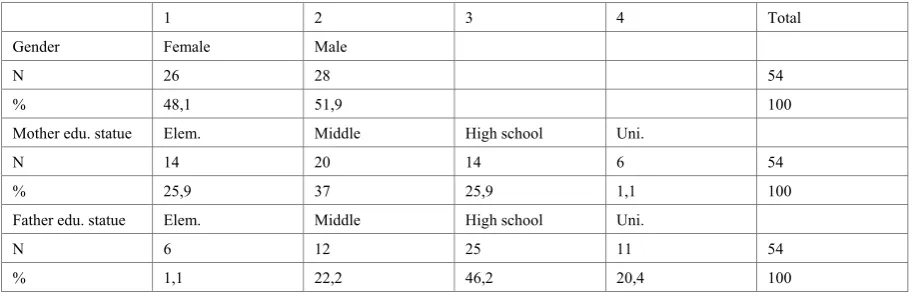
We applied to students’ views to write items of scenarios of caring thinking skills inventory. 54 middle school students
[image:6.595.70.528.445.592.2]were randomly chosen from a school at a medium layer socioeconomically. Demographical information of students is presented in Table 2.
Table 2. Demographical information of students whose responses were applied for writing items of scenarios in caring thinking skills inventory
1 2 3 4 Total
Gender Female Male
N 26 28 54
% 48,1 51,9 100
Mother edu. statue Elem. Middle High school Uni.
N 14 20 14 6 54
% 25,9 37 25,9 1,1 100
Father edu. statue Elem. Middle High school Uni.
N 6 12 25 11 54
% 1,1 22,2 46,2 20,4 100
2.2.2 Writing the Items of Scenarios by Stages of
Krathwohl Affective Domain Taxonomy
The caring thinking skills inventory, which was designed basing on affective domain taxonomy by Krathwohl, Bloom, and Masia is grounded on a powerful theory scientifically [11]. After students’ responses of scenarios were obtained qualitatively, the items of scenarios have been written. These items were constructed hierarchically in five stage based on affective domain taxonomy of Krathwohl, Bloom, and Masia. These stages are; (a) uncaring thinking, (b) awareness/ meaning (c) valuing, (d) reasoning/ organization, (e) caring thinking or behavior. Written statements or responses from students were classified, and organized.
Problem scenarios were constructed considering the
dimensions of appreciative thinking, affective thinking, normative thinking, active thinking, and emphatic thinking of caring thinking. The items of problem scenarios created
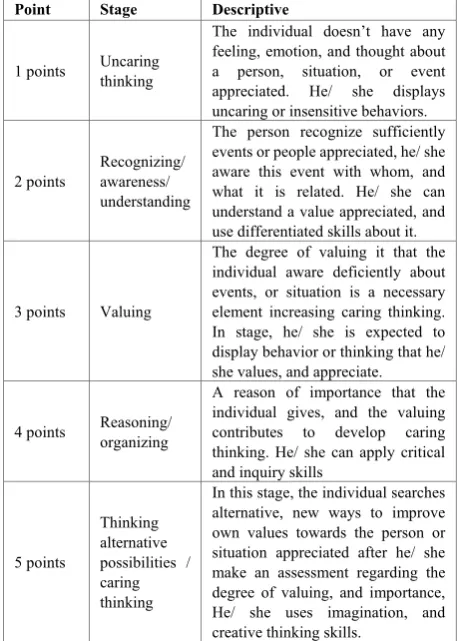
for each type of caring thinking were written considering five stages mentioned above. A table including stages,
descriptive, and pointing of five caring thinking skills were
[image:7.595.59.288.371.692.2]created.
Table 3. The Points, Stages, and Descriptive of Appreciative Thinking Skills
Point Stage Descriptive
1 points Uncaring thinking
The individual doesn’t have any feeling, emotion, and thought about a person, situation, or event appreciated. He/ she displays uncaring or insensitive behaviors.
2 points Recognizing/ awareness/ understanding
The person recognize sufficiently events or people appreciated, he/ she aware this event with whom, and what it is related. He/ she can understand a value appreciated, and use differentiated skills about it.
3 points Valuing
The degree of valuing it that the individual aware deficiently about events, or situation is a necessary element increasing caring thinking. In stage, he/ she is expected to display behavior or thinking that he/ she values, and appreciate.
4 points Reasoning/ organizing
A reason of importance that the individual gives, and the valuing contributes to develop caring thinking. He/ she can apply critical and inquiry skills
5 points
Thinking alternative possibilities / caring thinking
In this stage, the individual searches alternative, new ways to improve own values towards the person or situation appreciated after he/ she make an assessment regarding the degree of valuing, and importance, He/ she uses imagination, and creative thinking skills.
2.2.3. Assessing Compatibility of the Items of Scenarios – the Stages of Taxonomy
The items of caring thinking skills inventory were
suitably written based on the stage of affective domain taxonomy benefiting from students’ written expressions. In order to assess whether the items conform or not to the stages, face validity was performed.
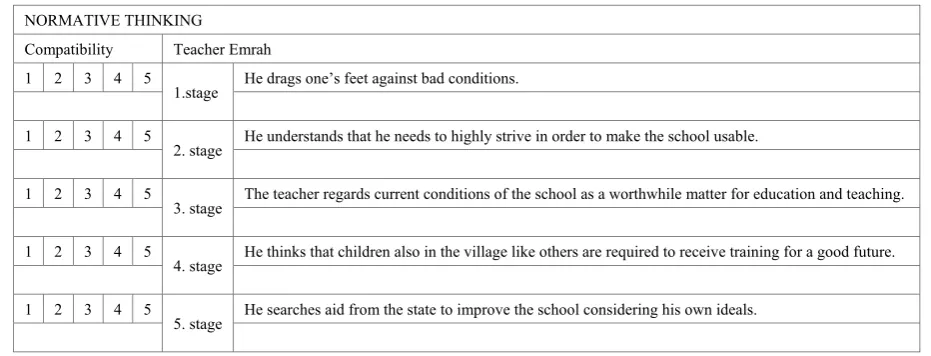
Face validity is a type of validation that a researcher reaches an agreement that the instrument really measures fact or concept targeted by examining the items of a questionnaire. The experts assess it if each item meets a given conceptual structure or theme by meaning, and logically [23]. They were expected to assess if the items written meet the criteria determined for each stage by comparing the items in each stage with criteria in same
stages. They also were asked to write the ideal item expected to be when the items are not suitable to the stages
stated. Furthermore, they were asked to do ratings (1-5) in order to assess the degree of compatibility of the items –
stages.
Emrah, who is son of a rich family decides to be a teacher and left from the management of father’s company.
Whereas his mother and father’s insistences, Emrah comes as a teacher to Gürlek village situated in Banaz town, Uşak
province. He encounters Salih with his worn out clothes in a village road looking alike a muddy footpath. Salih is a
son of family, whose mother deals with chores, and father runs coffeehouse of the village. Emrah stating first ‘Hello
‘to Salih, said that “My name is Emrah, and I have been appointed here as teacher. What’s your name?” from tiny,
and frail boy, it calls Salih as the reply to him with a hoarse
sound”. When Salih hears that Emrah is a teacher, his eyes shine. He asked that “are you really a teacher? Emrah said that yes, I am a teacher, can you take me the village? Salih, standing up with an enterprise manner proceed together with the teacher to the village. The teacher says that what’s
this, Salih? showing a home in ruins at the entrance of the
village. Salih says it was our village’s school, and could not been used for long time since a teacher has not come here, therefore, it stood still. So, we cannot go to the school.”
The teacher shocked after this response reaches the old
school. He sees a worse scene when he enters the school.
Desks are broken, mice strolling around them. The teacher Emrah was different ideals coming to the village, and he has disappointed, now.
Considering scenario above, what do you expect teacher
NORMATIVE THINKING
Compatibility Teacher Emrah 1 2 3 4 5
1.stage He drags one’s feet against bad conditions.
1 2 3 4 5
2. stage He understands that he needs to highly strive in order to make the school usable.
1 2 3 4 5
3. stage The teacher regards current conditions of the school as a worthwhile matter for education and teaching.
1 2 3 4 5
4. stage He thinks that children also in the village like others are required to receive training for a good future.
1 2 3 4 5
5. stage He searches aid from the state to improve the school considering his own ideals.
We applied to the opinions of three experts to perform the face validation. Demographical information of experts took
[image:8.595.64.530.77.255.2]part in this stage of the study were presented below:
Table 4. Demographical data of experts participated in a study of face validation for compatibility of items – taxonomical stages
Code name Title Expertise area Seniority
S.G.M Assist Prof. Instructional technologies 10 H.B. Assist Prof. Psychological Counselling, Guidance 9
U.B. Res. Assist. Dr. Sociology/ Philosophy 7
Three experts participated in a study of face validation for compatibility of items – taxonomical stages. Their expertise is on Instructional Technologies, Psychological Counselling, Guidance, and Sociology/ Philosophy.
Second phase of exploratory sequential mixed design consists of the implementation of the instrument, calculating lower %27 – upper %27 item discrimination to perform structure validation and computing the reliabilities of scenarios. 2.2.4. Appling the Inventory of Caring Thinking Skills
The pilot study was carried out in order to perform the construct validity of the inventory of caring thinking skills.
Demographical data of whose students participated in pilot study of the instrument was presented as below: Table 5. Demographical data of whom students participated in pilot study of the instrument
1 2 3 4 Missing Total
Gender Female Male
N 103 81 184
% 56,0 44,0 100
Mother education
statue Elem. school Mid. school High school University
N 67 54 39 17 7 184
% 36,4 29,3 21,2 9,2 3,8 100
Father education statue Elem. school Mid. school High school University
N 31 43 72 32 6 184
[image:8.595.69.530.305.368.2]% 16,8 23,4 39,1 17,4 3,3 100
Table 5 shows that 103 female (%56), and 81 male (%44) students took part in pilot study of instrument. The
[image:8.595.69.528.487.647.2]2.2.5. Calculating Lower %27 – Upper %27 Item Discrimination Indices
The following types of content and face validation were performed respectively; the construct validity was carried out. The lower %27 – upper %27 item discrimination analysis, one of the methods of construct validation was executed. The item discrimination indices are a coefficient that test developers use to test the efficiency of items [24]. The discrimination of an item can be measured comparing the number of individuals have upper point, answering correctly an item with the number of individuals lower points, answering correctly an item. If there is any discrimination between people with upper and lower points, it means that more people in upper level will be answering correctly any item than that of in lower level [25].
2.2.6. Computing the Reliability of the Inventory
It donates reliability that to determine if the responses given for the scenarios produce the consistent measures. Item total correlation for each scenario, and Cronbach alpha coefficient of all the inventory were calculated testing the reliability of inventory.
3. Findings
This section involves the findings revealed in the
development of caring thinking skills inventory based on
problem scenarios.
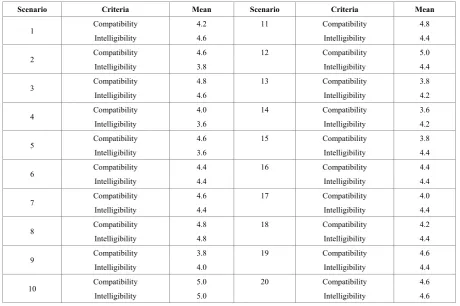
3.1. The Results of Content Validity about Appropriateness of Scenarios – Attainments The results of content validity performed to determine if each problem scenarios are suitable to attainments constructed are as follows:
Table 6. The results of content validity about appropriateness of scenarios – attainments
Scenario Criteria Mean Scenario Criteria Mean
1 Compatibility 4.2 11 Compatibility 4.8
Intelligibility 4.6 Intelligibility 4.4
2 Compatibility 4.6 12 Compatibility 5.0
Intelligibility 3.8 Intelligibility 4.4
3 Compatibility 4.8 13 Compatibility 3.8
Intelligibility 4.6 Intelligibility 4.2
4 Compatibility 4.0 14 Compatibility 3.6
Intelligibility 3.6 Intelligibility 4.2
5 Compatibility 4.6 15 Compatibility 3.8
Intelligibility 3.6 Intelligibility 4.4
6 Compatibility 4.4 16 Compatibility 4.4
Intelligibility 4.4 Intelligibility 4.4
7 Compatibility 4.6 17 Compatibility 4.0
Intelligibility 4.4 Intelligibility 4.4
8 Compatibility 4.8 18 Compatibility 4.2
Intelligibility 4.8 Intelligibility 4.4
9 Compatibility 3.8 19 Compatibility 4.6
Intelligibility 4.0 Intelligibility 4.4
10 Compatibility 5.0 20 Compatibility 4.6
Intelligibility 5.0 Intelligibility 4.6
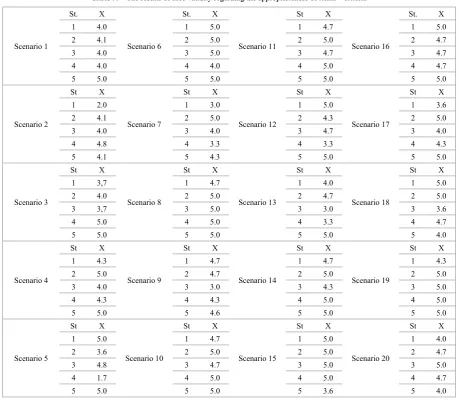
It is seen that the arithmetic average of evaluation points from five experts in study of content validity changes from 3.8
to 5.0 as for the rules of Turkish grammar, and intelligibility, the arithmetic average of scenarios ranges from 3.6 to 5.0.
The results show that scenarios conform to the attainments, and they have high intelligibility. 3.2. The Findings of the Responses of Students for Constructing Items of Scenarios
The responses of students have been analyzed to write the items of scenarios of caring thinking skills. As explained
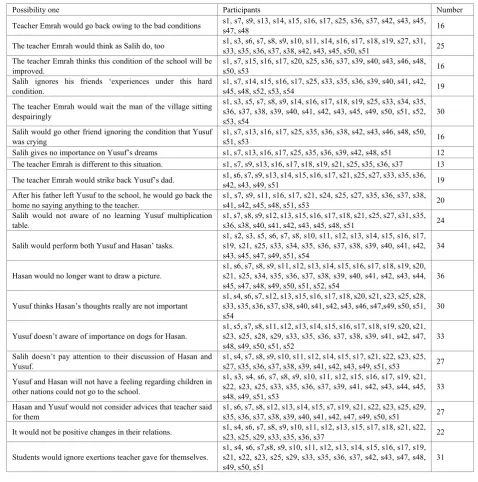
[image:9.595.68.529.315.621.2]Table 7. The number of students selecting the first possibility by scenarios
Possibility one Participants Number
Teacher Emrah would go back owing to the bad conditions s1, s7, s9, s13, s14, s15, s16, s17, s25, s36, s37, s42, s43, s45, s47, s48 16
The teacher Emrah would think as Salih do, too s1, s3, s6, s7, s8, s9, s10, s11, s14, s16, s17, s18, s19, s27, s31, s33, s35, s36, s37, s38, s42, s43, s45, s50, s51 25 The teacher Emrah thinks this condition of the school will be
improved. s1, s7, s15, s16, s17, s20, s25, s36, s37, s39, s40, s43, s46, s48, s50, s53 16 Salih ignores his friends ‘experiences under this hard
condition. s1, s7, s14, s15, s16, s17, s25, s33, s35, s36, s39, s40, s41, s42, s45, s48, s52, s53, s54 19 The teacher Emrah would wait the man of the village sitting
despairingly
s1, s3, s5, s7, s8, s9, s14, s16, s17, s18, s19, s25, s33, s34, s35, s36, s37, s38, s39, s40, s41, s42, s43, s45, s49, s50, s51, s52,
s53, s54 30
Salih would go other friend ignoring the condition that Yusuf
was crying s1, s7, s13, s16, s17, s25, s35, s36, s38, s42, s43, s46, s48, s50, s51, s53 16 Salih gives no importance on Yusuf’s dreams s1, s7, s13, s16, s17, s25, s35, s36, s39, s42, s48, s51 12 The teacher Emrah is different to this situation. s1, s7, s9, s13, s16, s17, s18, s19, s21, s25, s35, s36, s37 13 The teacher Emrah would strike back Yusuf’s dad. s1, s6, s7, s9, s13, s14, s15, s16, s17, s21, s25, s27, s33, s35, s36, s42, s43, s49, s51 19 After his father left Yusuf to the school, he would go back the
[image:10.595.57.536.89.572.2]home no saying anything to the teacher. s1, s7, s9, s11, s16, s17, s21, s24, s25, s27, s35, s36, s37, s38, s41, s42, s45, s48, s51, s53 20 Salih would not aware of no learning Yusuf multiplication
table. s1, s7, s8, s9, s12, s13, s15, s16, s17, s18, s21, s25, s27, s31, s35, s36, s38, s40, s41, s42, s43, s45, s48, s51 24
Salih would perform both Yusuf and Hasan’ tasks. s1, s2, s3, s5, s6, s7, s8, s10, s11, s12, s13, s14, s15, s16, s17, s19, s21, s25, s33, s34, s35, s36, s37, s38, s39, s40, s41, s42, s43, s45, s47, s49, s51, s54 34
Hasan would no longer want to draw a picture. s1, s6, s7, s8, s9, s11, s12, s13, s14, s15, s16, s17, s18, s19, s20, s21, s25, s34, s35, s36, s37, s38, s39, s40, s41, s42, s43, s44, s45, s47, s48, s49, s50, s51, s52, s54 36
Yusuf thinks Hasan’s thoughts really are not important s1, s4, s6, s7, s12, s13, s15, s16, s17, s18, s20, s21, s23, s25, s28, s33, s35, s36, s37, s38, s40, s41, s42, s43, s46, s47,s49, s50, s51,
s54 30
Yusuf doesn’t aware of importance on dogs for Hasan. s1, s5, s7, s8, s11, s12, s13, s14, s15, s16, s17, s18, s19, s20, s21, s23, s25, s28, s29, s33, s35, s36, s37, s38, s39, s41, s42, s47, s48, s49, s50, s51, s52 33 Salih doesn’t pay attention to their discussion of Hasan and
Yusuf. s1, s4, s7, s8, s9, s10, s11, s12, s14, s15, s17, s21, s22, s23, s25, s27, s35, s36, s37, s38, s39, s41, s42, s43, s49, s51, s53 27 Yusuf and Hasan will not have a feeling regarding children in
other nations could not go to the school.
s1, s3, s4, s6, s7, s8, s9, s10, s11, s12, s15, s16, s17, s19, s21, s22, s23, s25, s33, s35, s36, s37, s39, s41, s42, s43, s44, s45,
s48, s49, s51, s53 33
Hasan and Yusuf would not consider advices that teacher said
for them s1, s6, s7, s8, s12, s13, s14, s15, s7, s19, s21, s22, s23, s25, s29, s35, s36, s37, s38, s39, s40, s41, s42, s47, s49, s50, s51 27 It would not be positive changes in their relations. s1, s4, s6, s7, s8, s9, s10, s11, s12, s13, s15, s17, s18, s21, s22, s23, s25, s29, s33, s35, s36, s37 22
Students would ignore exertions teacher gave for themselves. s1, s4, s6, s7,s8, s9, s10, s11, s12, s13, s14, s15, s16, s17, s19, s21, s22, s23, s25, s29, s33, s35, s36, s37, s42, s43, s47, s48,
s49, s50, s51 31
Table 8. The coding of students’ opinions in Scenario 1 regularly into stages of normative thinking Stage of
response Statements
Second stage S27. He may have dreamed a spectacular school environment S44. The teacher, Emrah may have come with different ideals.
Third stage
S33. He has come to teach students literacy
S34. Because, my goal is to become a teacher, and provide with a good future.
S23. If I were him, I would gather money to improve the school, also do best one of my capabilities because education is very important.
Fourth stage S34. He may have come to the village with imagination which conditions are better. If I were him, I would regulate regularly cooperating with students. Because, my goal is to become a teacher, and provide with a good future.
Fifth stage
S21. Incase children remain educated, I would call Ankara, and wanted to meet the needs of desks, tables, schools.
S22. I would talk with the headman of the village, I said him that the school must be repaired, and maintained, I would help it. Since every child has the right of read, and help it to the happiness and education of new generation.
S51. I would give teaching students there taking many employees to the village, and improving worn out school in order to choose a good job when they are grown.
case of they read in the scenarios or conditions. Although they tend to choose the possibility one owing to some students avoid of stating their opinions, or they have a will to choose easy one, we revealed that they marked this option consciously. It was benefited from the responses given for ‘Possibility two’ to write the items of scenarios. As the
theoretical bases of caring thinking are stated, the behavior patterns of caring thinking were scrutinized beside uncaring
behavior. The items of scenarios were written by these stages. These items were obtained through the coding of students’ responses into taxonomical stages properly. The interpretations students made on each scenario in the inventory were presented in Table 8.
As it was mentioned above, the responses of students on scenarios were obtained and classified by the stages of Krathwohl’s taxonomy. Then, the statements appropriate for the context of story flow, and scenario logic were chosen, as are demonstrated itallically in Table 8.
3.3. The Findings about Face Validity to Assess Appropriateness of Scenarios Items – Criteria
For the face validity, we asked three experts to assess the compatibility of 100 items in 20 problem scenarios, and
[image:11.595.68.527.275.674.2]criteria or descriptors for the stages of caring thinking. The results of their assessments are as follows. Table 9. The results of face validity regarding the appropriateness of items – criteria
Scenario 1
St. X
Scenario 6
St. X
Scenario 11
St X
Scenario 16
St. X
1 4.0 1 5.0 1 4.7 1 5.0
2 4.1 2 5.0 2 5.0 2 4.7
3 4.0 3 5.0 3 4.7 3 4.7
4 4.0 4 4.0 4 5.0 4 4.7
5 5.0 5 5.0 5 5.0 5 5.0
Scenario 2
St X
Scenario 7
St X
Scenario 12
St X
Scenario 17
St X
1 2.0 1 3.0 1 5.0 1 3.6
2 4.1 2 5.0 2 4.3 2 5.0
3 4.0 3 4.0 3 4.7 3 4.0
4 4.8 4 3.3 4 3.3 4 4.3
5 4.1 5 4.3 5 5.0 5 5.0
Scenario 3
St X
Scenario 8
St X
Scenario 13
St X
Scenario 18
St X
1 3,7 1 4.7 1 4.0 1 5.0
2 4.0 2 5.0 2 4.7 2 5.0
3 3,7 3 5.0 3 3.0 3 3.6
4 5.0 4 5.0 4 3.3 4 4.7
5 5.0 5 5.0 5 5.0 5 4.0
Scenario 4
St X
Scenario 9
St X
Scenario 14
St X
Scenario 19
St X
1 4.3 1 4.7 1 4.7 1 4.3
2 5.0 2 4.7 2 5.0 2 5.0
3 4.0 3 3.0 3 4.3 3 5.0
4 4.3 4 4.3 4 5.0 4 5.0
5 5.0 5 4.6 5 5.0 5 5.0
Scenario 5
St X
Scenario 10
St X
Scenario 15
St X
Scenario 20
St X
1 5.0 1 4.7 1 5.0 1 4.0
2 3.6 2 5.0 2 5.0 2 4.7
3 4.8 3 4.7 3 5.0 3 5.0
4 1.7 4 5.0 4 5.0 4 4.7
5 5.0 5 5.0 5 3.6 5 4.0
[image:11.595.69.527.275.680.2]3.4. The Findings of Structure Validation of Inventory of Caring Thinking Skills
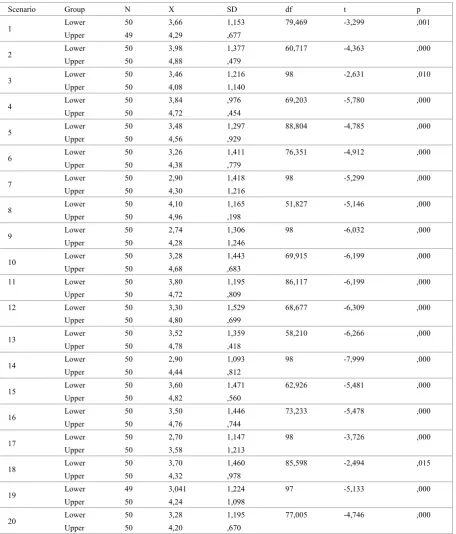
The independent t test was performed to calculate item
[image:12.595.71.528.144.679.2]discrimination indices for lower %27- upper %27 groups, which is one of validation types of structure. The results of independent groups t test are presented in Table 10.
Table 10. The Results of Independent Groups t Tests for the Lower – Upper %27 Groups Item Discrimination İndices
Scenario Group N X SD df t p
1 Lower 50 3,66 1,153 79,469 -3,299 ,001
Upper 49 4,29 ,677
2 Lower 50 3,98 1,377 60,717 -4,363 ,000
Upper 50 4,88 ,479
3 Lower 50 3,46 1,216 98 -2,631 ,010
Upper 50 4,08 1,140
4 Lower 50 3,84 ,976 69,203 -5,780 ,000
Upper 50 4,72 ,454
5 Lower 50 3,48 1,297 88,804 -4,785 ,000
Upper 50 4,56 ,929
6 Lower 50 3,26 1,411 76,351 -4,912 ,000
Upper 50 4,38 ,779
7 Lower 50 2,90 1,418 98 -5,299 ,000
Upper 50 4,30 1,216
8 Lower 50 4,10 1,165 51,827 -5,146 ,000
Upper 50 4,96 ,198
9 Lower 50 2,74 1,306 98 -6,032 ,000
Upper 50 4,28 1,246
10 Lower 50 3,28 1,443 69,915 -6,199 ,000
Upper 50 4,68 ,683
11 Lower 50 3,80 1,195 86,117 -6,199 ,000
Upper 50 4,72 ,809
12 Lower 50 3,30 1,529 68,677 -6,309 ,000
Upper 50 4,80 ,699
13 Lower 50 3,52 1,359 58,210 -6,266 ,000
Upper 50 4,78 ,418
14 Lower 50 2,90 1,093 98 -7,999 ,000
Upper 50 4,44 ,812
15 Lower 50 3,60 1,471 62,926 -5,481 ,000
Upper 50 4,82 ,560
16 Lower 50 3,50 1,446 73,233 -5,478 ,000
Upper 50 4,76 ,744
17 Lower 50 2,70 1,147 98 -3,726 ,000
Upper 50 3,58 1,213
18 Lower 50 3,70 1,460 85,598 -2,494 ,015
Upper 50 4,32 ,978
19 Lower 49 3,041 1,224 97 -5,133 ,000
Upper 50 4,24 1,098
20 Lower 50 3,28 1,195 77,005 -4,746 ,000
Upper 50 4,20 ,670
In order to determine the discrimination indices of items for each scenario in the inventory, t value of the difference of arithmetic averages of lower – upper %27 groups were calculated. As a result of independent t test for two sample, it is seen that t values differ in significantly for each scenario (p<.05). This finding indicates that the items in each scenario and
3.5. The Findings of the Reliability of the Inventory of Caring Thinking Skills
In order to calculate the reliability of the inventory of
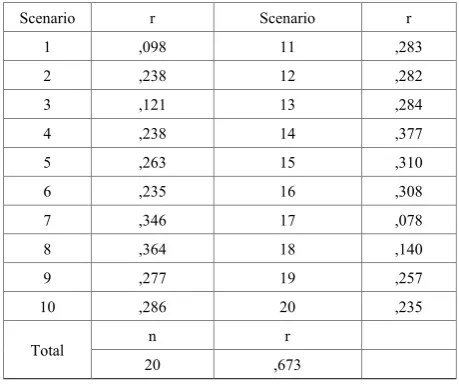
caring thinking skills, internal consistency was scrutinized.
Table 11. Results of Inner Consistency Coefficients of Reliability of Caring Thinking Skills Inventory
Scenario r Scenario r
1 ,098 11 ,283
2 ,238 12 ,282
3 ,121 13 ,284
4 ,238 14 ,377
5 ,263 15 ,310
6 ,235 16 ,308
7 ,346 17 ,078
8 ,364 18 ,140
9 ,277 19 ,257
10 ,286 20 ,235
Total n r
20 ,673
The results of reliability show that the degree of item total correlation or internal consistency is above .20 in Table 9. However, it has seen that item total correlation coefficient of only two scenarios are below .10. Besides, Cronbach alpha coefficient of the inventory of caring
thinking skills is calculated as .673.
4. Conclusions, Discussion &
Recommendations
The inventory designed and developed to understand if
caring thinking is a measurable and improvable skill is valid, and reliable data collection instrument as a result of respectively, qualitative and quantitative studies performed. It is seen that the degree of the compatibility of scenario – attainment is extremely good based on content validity. Then, the students’ responses about scenarios were corrected, and made it comprehensible, and the data were classified into proper steps, or stages. For the face validity performed to understand to the degree what each statement is suitable to the stages of affective domain taxonomy of
Krahtwohl, Bloom & Masia [11], the experts’ assessments indicate that they meet greatly criteria foreseen, but items in some scenarios are not suitable for them sufficiently. So, necessary suggestions from the experts were considered, and regulated. The revisited version of the inventory was applied to students, and the inventory is a discriminative characteristic that the individual thinks caringly and uncaringly as a result of lower %27 – upper %27 group analysis. It was reached evidence that it is a reliable instrument as calculated to be .672. Since the caring
thinking skills inventory, including 20 scenarios in booklet
format takes one hour to complete it, the reliability
coefficient of it is .70 below. The reliability value of Cornell Critical Thinking Test which is similar to our
inventory also is .62. It has been said that it gives reliable results, which is extremely acceptable, and used in many studies as a universal criterion [12]. The problem scenarios in the inventory consist of 20 connected, sequential events. The hero has five ways to choose in the scenarios. They are
asked to answer the question ‘which ways would they
choose if students were the hero’. Therefore, the caring
thinking skills inventory accounts for 20 problem scenarios, which have 5 options, and 100 items. The lowest point is 20, and the highest point is 100. To be answered is quietly easy.
The degree to what students think caringly can be
measured using an answer key which rating of items ranges
from 1 to 5 in each scenario. Although advantages such as
the caring thinking skills inventory is a multiple choice test, based on the story, and is easy to calculate, it can be regard as a disadvantage the fact that it takes long time decreases
its usability. The usage span of the inventory is approximately 40-50 minutes.
Finally, the following the types of content and face validation, it has been seen that each scenario has any discriminating characteristic by means of lower %27 – upper %27 discrimination analysis in the pilot study. It shows that each scenario measures really the construct desired. The value found in the results of reliability analysis demonstrated the similarity of coefficient revealed from some measurement instruments (for example, Cornell Critical Thinking Test) in the literature. Thereby, it is
possible to say that the inventory validated is reliable. The inventory is a part of the process of a curriculum
development based on affect in the context of Turkey.
Although the process of constructing scenarios depends on objectives which were specified, and derived from students’ needs in this context, these objectives reflect potential experiences occurring in a daily life in any country or community. The scope of use in global sense is quite wide. It is a data collection instrument to be applied on students of which they range from middle school to university in different cultures, and contexts. As Sharp stated, caring
thinking reinforces students to establish a sound value
system, from which to make sound and compassionate judgments. It also directs at moral and aesthetic
perceptions. We display affective states such as prizing, esteeming, cherishing, healing, consoling, taking care of, nurturing, empathizing, sympathizing, valuing,
appreciating, celebrating, and responding to the other in
caring thinking. Caring thinking arises from our perceptual,
sensual and emotional lives and determines for how we
behave in an event. In this respect, it is an inevitable skill
for human life, and it should be involved in curriculum [7].
In consideration of knowledge mentioned previously, caring thinking is limited as a research subject although it
is not a new concept. A way to incorporate caring thinking
[image:13.595.59.289.165.358.2]frameworks, or concepts of human development. It has been thought that caring thinking should be included to
curricula to establish relationships with these concepts.
Making these connections can produce ideas regarding
where, how, which situation, when the inventory can be used. One of the concepts implied is character, and character education. Bialik, Bogan, Fadel & Horvathova
uncovered six qualities and associated concepts of human
character. (1) Mindfulness (Wisdom, self-awareness, self-management self-actualization, observation etc.); (2)
Curiosity (Open-mindedness, exploration, passion, self-direction, motivation, initiative, innovation etc.); (3) Courage (Bravery, determination, fortitude, confidence,
risk taking, persistence, toughness etc.); (4) Resilience
(Perseverance, grit, tenacity, resourcefulness, spunk,
self-discipline, effort, diligence etc.); (5) Ethics (Benevolence, humaneness, integrity, respect, justice,
equity, fairness, kindness, altruism etc.); (6) Leadership
(Responsibility, abnegation, accountability, dependability, reliability, conscientiousness etc.) [26]. It can be said that these qualities are associated with characteristics of caring
thinkers. Helping individuals increase caring thinking skills contributes to the character development. In this respect, students’ performances (affective behavior
dispositions, caring thinking skills etc.) can be measured in
educational projects to conduct in the context of character education. So that, the changes in students’ development through curriculum delivered can be understood. Similarly, as Sharp said, it can be addressed in moral and values
education since caring thinking is the skill which provides
with a sound, values system helping to students makes
sound, passionate judgments. Either a value or a belief necessarily rests on assumptions and actions of all the
dimensions of caring thinking. No matter which method
you choose, whether it is qualitative one (action research, case study, phenomenology etc.) or whether it is quantitative one (survey, experimental design etc.), values education studies can be conducted suitable to value components underling in the inventory. For this, you read
carefully the content of scenarios, and attainments based on
them. Caring thinking is a related skill with moral
structures. Because, recognizing a problem as moral one is
a judgment; defining a moral problem is an issue of caring
thinking [7]. From this standpoint, caring thinker deals
with a problem considering moral norms, principles, and values, and acts it. Caring thinking can be addressed as a
part or component of moral education. The usage of this inventory with the research methods expressed above can be just a part of your research. The inventory can be employed in a practical study which aims to transform emotions to thought or behavior in positive direction. For, our emotions help to distinguish what it is significantly moral in a situation. The moral need uncovering in most cases underlies in an emotion as can be described as moral perceptions. Thus, emotions are fundamental drives of
thought and judgments. Moral judgments arise from them.
One of the most fundamental factors for teaching of
caring thinking is Philosophy for Children (P4C) established by Matthew Lipman. Known as ‘thinking skills’
program which aims to develop critical, creative, and
caring thinking skills [27], P4C helps positively also
students’ affective development [28]. This philosophical
movement is an approach to enable students’ skills for
inquiry to reach reasonable, judgments regarding questions,
and issues that arise in their own experiences. With aim of
developing pro-social behaviors, and reducing violence,
the focus of a number of P4C is on caring thinking [29].
C4P provides with the opportunities for students’ rational,
creative, and caring thinking by developing their thinking, and social skills in the classroom. Thus, it helps to
transform the world to a better place [30]. For him,
acquisition of caring thinking can be achieved through
philosophical dialog in the community of inquiry [31]. Eventually, the all the discussions reveal that educational
projects on C4P or a research by using the approach to the
community of inquiry contribute to acquire students’
caring thinking. This inventory can be used as an
Appendix A
Appendix A consists of a list of attainments suitable to scenarios of the inventory which were constructed around the types of caring thinking including appreciative thinking, affective thinking, normative thinking, active thinking, and emphatic thinking.
Scenario The types of caring thinking Attainments
1 Normative thinking Students can regulate self-care ability in daily life using normative thinking skills. 2 Active thinking Students can demonstrate conservative behaviors against animal abuse or nature harassment that they observed in their environment using active thinking skills.
3 Active thinking Students can produce a way of sbad conditions of people living at their environments. olutions using active thinking skills as to as minimize the 4 Affective thinking Students can employ affective thinking skills to encourage them to reach a given ideal. 5 Active thinking Students can think actively in order to perform seriously and caringly the tasks given. 6 Emphatic thinking Students can affect positively emotions of a person whom they saw his/ her sad appearances employing emphatic thinking skills.
7 Emphatic thinking Students cskills. an motivate their friends to cheer on a particular target using emphatic thinking
8 Affective thinking Students can show susceptibility to the events regarding the child abuse using affective thinking skills.
9 Normative thinking Students can immoral situations using normative thinking skillsthink one’s best moral norms when they feel or experience different
10 Appreciative thinking Students can think ways to atone a close friend whom they broke his or her heart in daily life by using appreciative thinking skills.
11 Normative thinking Students can find ways to increase the learning degree of their friends with learning deficiencies to the desired level using normative thinking skills.
12 Normative thinking Students can pay attention to abide by cooperation rules with people whom they study in daily life using normative thinking skills.
13 Affective thinking Students can develop an positive thinking skills. attitude toward activities that they like using affective 14 Appreciative thinking Students can show respect for different ideas using appreciative thinking skills.
15 Emphatic thinking Students can think emphatically in sanctity or past experiences regarding both self or the others.
16 Active thinking Students can soothe their friends in an environment where a quarrel happens by means of active thinking skills.
17 Emphatic thinking Students can demonstrate their compassion for the children devoid of the school employing emphatic thinking skills.
18 Appreciative thinking Students can appreciate individual’s advices that they value in daily life via appreciative thinking skills.
19 Affective thinking Students can display polite behaviors toward the individuals in their world using affective thinking skills.
REFERENCES
L. J. Splitter. On the theme of “Teaching for higher order [1]
thinking skills, Critical Thinking Across the Disciplines,
Vol. 14, No. 4, 52-65, 1995.
M. Lipman. Thinking in Education, Cambridge University
[2]
Press, UK, 2003.
M. Lipman. Caring as thinking,Inquiry: Critical Thinking
[3]
across the Disciplines, Vol. 15, No.1, 1-13. 1995.
F. A. M. Fard, H. A. B. Nasrabadi, M. H. Heidari.
[4]
Philosophy for children: Capacity evaluation of humorous stories in Masnavi based on “Lipman's views on philosophical thinking components, Educational Research and Reviews, Vol 11, Issue 12, 1154-1160, 2016.
A. Shaari, A. Hamzah. A Comparative Review of Caring
[5]
Thinking and Its Implications on Teaching and Learning.
Malaysian Journal of Learning and Instruction: Vol. 15, No.
1, 83-104, 2018.
M. A. Dombaycı. Teaching of Environmental Ethics:
[6]
Caring Thinking. Journal of Environmental Protection and
Ecology 15, No 3A, 1404–1421, 2014.
A. Sharp. Education of the emotions in the classroom [7]
community of inquiry, Gifted Education International, Vol. 22, No. 2, 248-257, 2007.
C-H. Lee & D. Chung. Young Children's Caring Thinking.
[8]
Proceedings of the Xxii World Congress of Philosophy, Vol. 27, 45-54, 2008.
MoNE. Primary Thinking Education Teacher Guide Book.
[9]
The Turkish Ministry of National Education. Ankara, 2011. J. T. Streib. History and analysis of critical thinking. [10]
Unpublished Doctorate Thesis, Memphis State University,
USA, 1992.
D.R., Krathwohl, B.S., Bloom, B.B. Masia, Taxonomy of
[11]
Educational Objectives, the Classification of Educational goals. Handbook II: Affective Domain, David McKay Co., Inc New York, 1964.
C. Akar, İlköğretim öğrencilerinde eleştirel düşünme
[12]
becerileri, Yayımlanmamış doktora tezi, Gazi Üniversitesi Eğitim Bilimleri Enstitüsü, Ankara, 2007.
F., Mirzaei, F.A., Phang, H. Kashefi. Measuring teachers’ [13]
reflective thinking skills. Procedia - Social and Behavioral Sciences, Vol. 141, 640-647, 2014.
R. Pennington. Reflective thinking in elementary preservice
[14]
teacher portfolios: can it be measured and taught? Journal of Educational Research and Practice, Vol. 1, No. 1, 37–49, 2011.
Yi-Chun Hong, Ikseon Choi. Assessing reflective thinking
[15]
in solving design problems: The development of a questionnaire, British Journal of Educational Technology, Vol. 46, No. 4, 848-863, 2015.
E. Jadallah. The development of a reflective teaching [16]
observation instrument, Unpublished Doctorate Thesis, The
Ohio State University, USA, 1994.
T. C. Leong. What is caring thinking? Teaching caring
[17]
thinking: Vision, clarifications, justifications and
applications, Eric Lau Raffles Girls’ School (Secondary), Retrieved September 10, 2010 from
http://conference.nie.edu.sg/paper/Converted%20Pdf/ab00
553.pdf, 2005.
H. Bacanlı. Dört katlı düşünme modeli. Bilim ve Aklın
[18]
Aydınlığında Eğitim, Vol. 13, No. 146, 29-36, 2012.
W. A. Edmond, T. D. Kennedy. An Applied Guide to
[19]
Research Designs: Quantitative, Qualitative, and Mixed Methods (Second edition), Sage, USA, 2017.
S. Hesse-Biber, R. B. Johnson. The Oxford Handbook of
[20]
Multimethod and Mixed Methods Research Inquiry, Oxford University Press, England, 2010.
S. Dilidüzgün. Çağdaş Türk Yazını: Yazın Eğitimine Atılan
[21]
Ilk Adım. Yapı kredi Yayınları, Ankara, 1996.
S. Sever. Çocuk ve Edebiyat. Tudem Yayınları, İzmir,
[22] 2008.
O, Sangoseni, M. Hellman, C. Hill. Development and
[23]
validation of a questionnaire to assess the effect of online learning on behaviors, attitudes, and clinical practices of physical therapists in the United States regarding evidenced-based clinical practice, Internet Journal of Allied
Health Sciences and Practice, Vol. 11, No. 2, 1-12, 2013.
R. L. Brennan. A generalized upper-lower ıtem
[24]
discrimination index. Educational and Psychology Measurement, Vol. 32, 289-303, 1972.
S. Matlock-Hetzel. Basic concepts in item and test analysis.
[25]
Paper presented at the Annual Meeting of the Southwest
Educational Research Association, Austin, TX, 1997.
M. Bialik, M. Bogan, C. Fadel, M. Horvathova. Character
[26]
Education for the 21st Century: What Should Students Learn? Center for Curriculum Redesign, Boston, Massachusetts, 2015.
M. A. Paine. The Pedagogy of Philosophy for
[27]
Children/Philosophical Enquiry. Master Thesis, Research University of York, 2012.
A. Lancaster-Thomas. How effective is Philosophy for
[28]
Children in contributing to the affective engagement of
pupils in the context of secondary Religious Education? P4C and Religious Education Journal of Philosophy in
Schools, Vol. 4, Issue 1, 102-122, 2017.
J. Oyler. Philosophy with Children: The Lipman-Sharp [29]
Approach to Philosophy for Children. In: Peters M. (eds) Encyclopedia of Educational Philosophy and Theory.
Springer, Singapore, 2016.
M. Lipman. Moral education higher‐order thinking and
[30]
philosophy for children. Early Child Development and Care, Vol. 107, Issue 1, 61-70, 1994.
C. Phillips., S. Café. The Efficacy of the Lipmanian
[31]