Physical and Mechanical Properties of Fired Clay Bricks Incorporated
with Cigarette Butts: Comparison between Slow and Fast Heating Rates
Aeslina Abdul ~ a d i r ' . ~ ,
Abbas ~ o h a j e r a n i ~ ~ ~
'senior Lecturer, (PhD), Department of Environmental and Water Resources, Faculty of Civil and Environmental Engineering, Universiti Tun Hussein Onn Malaysia (UTHM), 86400 Parit Raja, Batu
Pahat, Johor Darul Takzim. Malaysia. 2
Senior Lecturer (PhD), School of Civil, Environmental and Chemical Engineering, RMlT University, Melbourne, Australia
Keywords: Heating rate; Fired clay brick; Cigarette butt; Physical and mechanical properties
Abstract. In general, firing process in brick manufacturing could affect the properties, colours and appearance of the brick. The main purpose of this study was to evaluate the effect of different heating rates on physical and mechanical properties during the firing of standard bricks and bricks incorporated with cigarette butt (CB). In this investigation, two different heating rates were used: slow heating rate (2°C min-l) and fast heating rate (5°C miurnin'). Samples were fired in solid forms fiom room temperature to 1050°C. All bricks were tested for their physical and mechanical properties including compressive strength, initial rate of absorption and density. Higher heating rates decrease compressive strength value but slightly increase the initial rate of absorption and density properties respectively. In conclusion, higher heating rates are able to produce adequate physical and mechanical properties especially for CB Brick.
Introduction
Brick is one of the most accommodating masonry units due to its properties. The firing process could affect the physical and mechanical properties, colours and appearance of the manufactured brick. Many studies have been carried out by manipulating the firing process at different temperature, utilizing fast firing and traditional firing but most of the research are more focusing on the physical and mechanical properties of fired clay bricks only [1,2,3]. For instance; studies by Dunham et a1 [1,2]
investigated shorter firing times in the manufacturing of clay bricks while Dondi et al. [3] compared the influences of fast firing and traditional firing on physical and mechanical properties of clay bricks. Therefore, previous research contains very limited discussion on the effect of different heating rates, particularly on physical and mechanical properties of manufactured fired clay bricks incorporating with different types of waste. Currently, due to the demand of bricks as building materials, many researchers have investigated the potential wastes that can be recycled or incorporated into fired clay bricks. Owing to the flexibility of the brick composition, different types of waste have been successfully incorporated into fired clay bricks by previous researchers. It is apparently vary from the most commonly used wastes such as the various types of fly ash and sludge, to rice husk, bagasse, pineapple leaves, oil palm fruit bunch and cigarette butts [4,5,6,7]. In this study, two types of brick samples were used: the standard clay bricks and clay bricks incorporated with cigarette butts (CB). Recycling cigarette butts as an inert component into clay bricks can be a practical solution to one of the important pollution problems in the world [7]. The main purpose of this work was to evaluate the effect of slow heating rate and fast heating rate on the physical and mechanical properties and also appearance of standard bricks (without any incorporation of waste) and bricks incorporated with CB.
202 Information Technology for Manufacturing Systems IV
Materials and Methods
In this study, in order to investigate the physical and mechanical properties, standard clay brick and CB brick samples are prepared in extruded forms. The preparation of the manufacturing standard clay brick and clay brick incorporated with CB samples were explained in detail in the previous work 171. In this investigation, standard and fired clay brick samples with 5% of CB content were prepared. The brick samples were manufactured in three different sizes: cube (100 x 100 x 100 mm), brick (225 x 110 x 75
mm)
and beam (300x
100 x 50 mm), according to the minimum requirements of testing in compliance with AustraLianNew Zealand Standard [8]. The brick samples were dried for 24 hours inthe oven at 105OC prior to heating experiments.
Two different heating rates were used: 2°C mm' and 5°C min-'. Samples were fired in solid forms fi-om room temperature to 1050°C. Heating time required with slow heating rate (2°C min-') is 8.8 hours whilst fast heating rate (5°C min-') used in the firing proces only required 3.5 hours. Physical and mechanical laboratory tests (compressive strength, initial rate of absorption and dry density) in accordance with the standard [8] were carried out to determine the performance of clay bricks and CB bricks fired at these two different heating rates. All results reported are means of three values.
Results
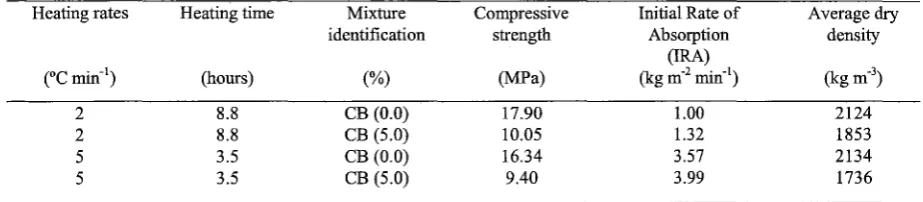
The effects of slow and fast heating rates on the physical and mechanical properties of standard brick and CB brick are presented in Table 1.
Table 1 Physical and mechanical properties of brick samples fired at different heating rates
Heating rates Heating time Mixture Compressive Initial Rate of Average dry identification strength Absorption density
(IRA)
("C m i d ) (hours)
(XI
(MPa) (kg m-2 min-') (kg m-3)Compressive strength. Firing standard clay bricks at fast heating rate (5°C rnin-') reduced the measured values gradually but not significantly for compressive strength. Compressive strength values is 17.90 MPa at 2OC min-', but as the heating rate increased to 5°C min-' the strength slightly decreased to 16.34 MPa. The results demonstrated that, there were no significant changes between the heating rates applied. As for CB brick, there was also no significant difference between the compressive strength ofbricks frred at 2OC min-' and 5°C rnin", which were 10.05 MPa and 9.40 MPa respectively. Compressive strength is important for the determination of the load bearing capability of the brick. Nevertheless, different strengths of brick have different applications. Common minimum values recommended for characteristic compressive strength for non-load-bearing and load-bearing fired clay bricks are 3 to 5 MPa and 5 to 10 MPa respectively [9, 10, 111.
Initial Rate of Absorption (IRA). Fast heating rates appear to slightly increase the initial rate of absorption values of standard brick. Lower results were obtained at 2OC min' with 1 .OO kg m-2 min' but then increased to 3.57 kg m-2 min-' at 5OC min-'. The same increasing trend with CB brick also was obtained when firing at fast heating rate. The results increased fiom 1.32 kg m-2 midl to 3.99 kg m-2 min-' at 2OC min-' and 5°C m l ~ l ' accordingly. According to the Australian Standard [12],
IRA
should be between 0.2 to 5 kg n~'~min-'. Low water infiltration into the brick indicates good durability of the brick and resistance to the natural surroundings.
[image:2.599.80.542.359.460.2]kg m-3 at 2°C min-I to 1736 kg m-3 as fast heating rates were carried out at 5°C min-l. This effect is different compared to standard bricks due to the addition of CBs. The formation of the pores could be attributed to the presence of volatile organic content in the added CB that burnt off during the firing process. However, the reduction in dry density was a useful result which exhibited the potential use of the fired clay bricks as light-weight building materials. Low-density or light-weight bricks have great advantages in construction including, for example, lower structural dead load, easier handling, lower transport costs, lower thermal conductivity and a higher number of bricks produced per tonne of raw materials. Light bricks can be substituted for standard bricks in most applications, except when bricks of higher strength are needed or when a particular look or finish is desirable for architectural reasons. According to AS 3700 (2001) [12], the dry density of the standard clay brick is between 1800 to 2000 kg m-3.
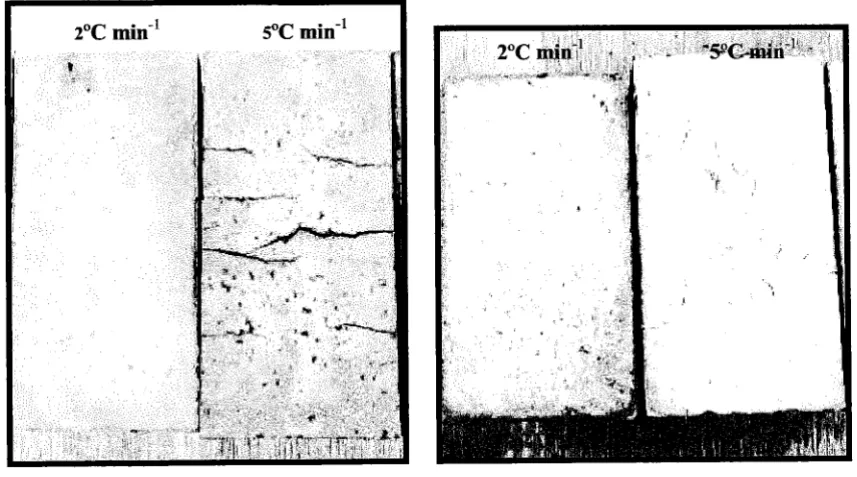
Appearance. In terms of appearance, firing at 2°C min-' resulted in a better end-product compared to
5°C mink' for both types of fired brick samples. Nevertheless, for standard brick, firing at fast heating
rate (5 "C min-'), good results were obtained for cube and brick size samples (Fig. I), but beam samples were disintegrated and the tensile strength value was not obtained for the standard brick samples. For CB bricks sample, owing to the incorporation of CBs into the clay bricks, when the CB bricks were fired at 5°C min-', there is no major disadvantage to cube, brick (Fig. 2) and beam size samples, except for the black coring effect inside the brick due to incomplete combustion of the organic content. In terms of colour, standard brick give more natural red colour compared to CB brick. However, this could be an advantage for CB brick as nowadays different colour schemed and textures are available to meet the design criteria.
Fig. 1 Standard bricks fired at 2°C min-' and 5°C nin-' Fig. 2 CB bricks fred at 2°C minminl and 5°C mid1
heating rates heating rates
Conclusion
[image:3.597.96.525.364.602.2]204 Information Technology for Manufacturing Systems IV
Therefore, CB brick and fast heating rate should be considered as an option in the brick industry in order to minimize the manufacturing cost. The changes do not critically affect the properties of fired clay bricks and significantly reduce environmental pollution, shorter firing duration, thus offering the potential for greater energy efficiency.
Acknowledgement
The results presented in this paper are part of an ongoing research on Recycling Cigarette Butts. The authors would like to thank Buttout Australia and Boral Bricks Pty Ltd for supplying the cigarette butts and soil, respectively, for this study.
References
[I] KL. Rasmussen, G.A. De La Fuente, A.D. Bond, K.K. Matheesen and S.D. Vera: PotteryJiring
temperatures: a new method for determining the firing temperature of ceramics and burnt clay,
Journal of Archaeological Science Vol. 39 (2012), p. 1705-1716.
[2] A.C.
Duhham,
A.S. McKnight and I. Warren: Mineral assemblages formed in Oxford ClayJiredunder dzflerent time-temperature conditions with reference to brick manufacture, Proceedings of
the Yorkshire Geological Society Vol. 53 (3), (2001), p. 221-230.
[3] M. Dondi, M. Marsigli and LVenturi: Microstructure and mechanical properties of clay bricks:
comparison between fast,firing and traditionalfiring, Brit. Cerarn. Trans. Vol. 98 (I), 1999,
p.12-18.
[4] C.M. Chan: Effect of Natural Fibres Inclusion in Clay Bricks: Physico-Mechanical Properties, World Academy of Science, Engineering and Technology, (201 l), p. 5 1-57.
[5] B.E.E. Hegazy, H.A. Fouad and A.M. Hassanain: Brick Manufacturing from Water Treatment
Sludge and Rice Husk Ash, Australian Journal of Basic and Applied Sciences, Vol. 6(3), (2012),
p. 453-461.
[6] P. Lertwattanaruk and J. Choksiriwanna: The Physical and Thermal Properties of Adobe Brick
Containing Baggase for Earth Construction, Journal of ArchitecturaVPlanning Research and
Studies, Vol. 5(1), (2011), p.187-199.
[7] A. Abdul Kadir and A.A. Mohajerani: Recycling cigarette butts in light-weightfired clay bricks, Proceedings of the Institution of Civil Engineers (UK). Vol. 164 (5), (201 I), p. 210-229.
[8] A u s t r a l i d e w Zealand Standard AS/NZS. Method 1 4456.1 (2003).
[9] AustraliadNew Zealand Standards AS/NZS 3700:2001. Masonly structures (2001).
[I 0] Information on fkom http://www.electronicblueprint.com.aulspecifications/l2MASONRY .doc.
The Premier Building Speczjication, Detailing and Training Reference.
[I 11 W.H. Arnold, S.R. Davies, G.P. Sinha and B.P. Sinha: Design of Masonry Structures. Taylor & Francis, (2004).
[12]Australidew Zealand Standards AS/NZS 4455.1:2008. Masonry units, pavers, flags and
Physical and Mechanical Properties of Fired Clay Bricks Incorporated with Cigarette Butts: Comparison between Slow and Fast Heating Rates