The Influence of Virtual Learning Environments in
Students' Performance
Paulo Alves
1,*, Luísa Miranda
1,2, Carlos Morais
1,21Polytechnic Institute of Bragança, Campus de S. Apolónia, Bragança, Portugal 2University of Minho, Largo do Paço, Braga, Portugal
Copyright©2017 by authors, all rights reserved. Authors agree that this article remains permanently open access under the terms of the Creative Commons Attribution License 4.0 International License
Abstract
This paper focuses mainly on the relation between the use of a virtual learning environment (VLE) and students’ performance. Therefore, virtual learning environments are characterised and a study is presented emphasising the frequency of access to a VLE and its relation with the students’ performance from a public higher education institution during the academic year of 2014-15. The main aim of this research work is to obtain indicators which may help understand relations between the use of VLEs and students’ performance. Finding the frequency of access to the VLE and assessing the consequences of such use represent challenges to which teachers and researchers try to respond in order to know students better and consequently, develop strategies which meet their interests and needs. This study is mainly quantitative with descriptive features, involving data obtained from literature research and from experimental research using a sample of approximately 6300 undergraduates. The data was extracted from the VLE and student registration system databases using learning analytics procedures. The results show that there are relatively positive indicators regarding students’ access to a virtual learning environment and the relation between such access and their performance.Keywords
ICT, Virtual Learning Environment, Learning Analytics, Students’ Performance1. Introduction
Virtual learning environments are consolidated within education institutions. Therefore, it does not seem relevant to question their acceptance. However, it is a challenge to turn them into an important contribution to students’ performance.
There are many variables which influence students’ performance, making it virtually impossible to identify them all and even more difficult to assess the influence of each one
of them on the learning results. This paper focuses particularly on the importance of the number of students’ accesses to the virtual learning environment and on assessing possible relations between the number of accesses and students’ performance, translated into indicators associated with: the number of course units (CU) which students passed or failed, the number of CUs in which they were registered, and the mean of the marks of the CUs which they passed, among others.
Within the context of this study, the number of accesses to the virtual learning environment will, in some situations, be considered as an independent variable and the performance variables will be considered as dependent variables.
The search for more and better education has been one of the concerns of almost every country in the world. In this attempt to do the best, great importance has been given to strategies based on information and communication technologies (ICT), in which, over the last years, the digital has taken precedence over the analogue. Therefore, in order to promote and improve teaching and learning within higher education, higher education institutions have adopted learning management platforms hereinafter referred to as Virtual Learning Environments (VLEs). These environments have been used both by institutions directed towards distance learning and by institutions essentially directed towards onsite learning.
The strong implementation of VLEs in higher education institutions justifies the concern with such environments so as to assess their influence on students’ performance. Consolidating the use of these environments implies their contextualisation within the formal teaching and learning processes as well as questioning their potentialities according to their known and consolidated features, namely the ones associated with traditional onsite classroom learning.
In order to assess the influence of VLEs on students’ performance, a study was conducted with the undergraduates of a Portuguese public higher education institution.
Identifying the students’ frequency of access to their institution VLE;
Assessing the degree of association between the number of accesses to the VLE and the variables related to students’ performance;
Relating the frequency of access to VLEs to students’ performance.
This paper will hereafter be developed considering the main topics: ICT and virtual learning environments in higher education; methodology; results; and conclusions.
2. Virtual Learning Environments in
Higher Education
2.1. Virtual Learning Environments
Virtual learning environments have been associated with formal learning and with relationships between teachers, students and school. There is an increasing interest in the virtual learning environments supported by the internet, namely among education institutions, students and teachers.
The concept of virtual learning environment (VLE) could be considered as a dynamic concept due to the constant evolution of digital technologies, to its features and potentialities, and to the importance that such environments have within the learning processes.
Educational systems based on the web are being used by an increasing number of universities, schools and companies, not only to incorporate web technology into their courses, but also to complement their traditional face-to-face courses. These systems gather a great quantity of data which is valuable to analyse the course contents and students’ use [1].
Learning environments based on the use of technology and digital resources are mediators in the learning process through the activities they allow. This is due to the fact that they facilitate interaction and interrelation within a continuous communication process, thus enhancing the construction and reconstruction of knowledge and meanings as well as the formation of habits and attitudes within a framework that is common to all the ones involved in the educational process [2].
The use of VLEs within each context implies the acknowledgment of their main features and potentialities. Learning environments and contexts are dynamic and multidimensional concepts which emerge from the new educational conceptions and practices in the digital society.
In the view of Morais, Alves and Miranda [3], the main potentiality of VLEs is the provision of a set of tools aiming to support the production and distribution of contents, communication, and the assessment of the teaching and learning process.
Bearing in mind the highlighted features, the concept of virtual learning environment involves several dimensions. The most relevant ones are associated with virtual space,
time, resources, and strategies. VLEs provide institutions with great quantities of information and the possibility to manage it and provide it to their members in a simple way and with a guarantee of quality and validity.
The features and potentialities of VLEs turn them into spaces which allow the testing, promotion and support of new highly planned and directed teaching and learning strategies. The observation of a constant dynamism is advisable in the use of the resources and in the changes witnessed around such resources, as this will allow them to be considered as a context for the building of learning processes [4].
From a pedagogical perspective, the VLEs used in education institutions boost advance and originate innovative experiences. However, they are mainly directed towards the production and distribution of contents. These environments typically replicate traditional teaching through the online distribution of contents, messages and notices, and online communication through discussion forums and chats.
The potentialities of web 2.0 and the changes in the use of network technologies have come to fill in some of the VLEs limitations and to enable the construction of new interaction and learning spaces. This challenges educators and researchers to think of student-centred pedagogical approaches.
Virtual learning environments enable learning to take place according to the elements present in the learning environment, based on a continuous scale ranging from the elements specified in the environment to the elements emerging from use [4].
Dahlstrom, Brooks, and Bichsel [5] concluded that 74% of teachers say that VLEs are a very useful tool to the improvement of teaching; 71% of teachers say that VLEs are a very useful tool to the improvement of students’ learning; 99% of institutions use a VLE; 85% of teachers use the VLE; 56% of teachers use it on a daily basis; 83% of students use the VLE; and 56% say they use it in all or in most course units.
Morais, Alves, and Miranda [3] concluded that the VLE tools most valued by the highest percentage of teachers, over 90%, are resources (supporting the course unit), notices, messages, students’ register and summaries. The same authors also observed that the digital resources features which are most valued by teachers were accessibility, user-friendliness, integration with the virtual learning environment and PDF download. Also, the aspects most valued by teachers regarding the use of ICT in the course units they teach were the digital resources availability and access, the time saving and the improvement of communication with students. Among these, the least valued one was the improvement of communication with students [6].
several players in the process [7].
Bearing in mind that the results displayed in this paper come from a large quantity of data, we present a brief theoretical ground of learning analytics.
2.2. Learning Analytics
The challenges of online education and the adoption of educational technologies have created a new opportunity to obtain indicators about students’ learning. Similarly to what happens with the majority of information systems, students’ interactions in VLEs regarding their online learning activities are all obtained and stored. This digital data (logs) can be analysed in order to identify behaviour patterns which may provide indicators concerning educational practice [8].
The analysis of the data obtained from users’ interaction with technology has attracted the attention of researchers in the sense of a promising approach aiming to improve understanding of the learning process. This aim motivated the appearance of the new research field, learning analytics, whose area is intimately related to educational data mining [8].
Learning analytics consists of analysing learning data which enables teachers, course designers and VLE administrators to search for patterns and information underlying learning processes. The main aim of learning analytics is to improve learning results and processes. The basic learning unit within virtual learning environments is interaction, but there is no consensus yet on which interactions are relevant to an effective learning [7].
According to Siemens and Gašević [9], learning analytics can be defined as the “collection, analysis and communication of data concerning students and their contexts for the purpose of understanding learning and optimising the environments where it occurs.” Based on this concept, it is necessary to know what data is stored by the system and to place it into a context which gives it meaning for the analysis. This way, it will enhance the understanding and the optimisation of learning processes within VLEs [10]. Two of the tasks most frequently adopted and associated with learning analytics have consisted of predicting students’ learning success and providing proactive feedback [11]. There seems to be consensus on what the study object of learning analytics is: the analysis of VLEs interaction data by using techniques of data extraction and data mining, so that the relations, useful information and knowledge on the learning processes can be inferred.
Learning analytics emerges from two converging trends: the increasing use of VLEs in education institutions and the application of data mining and business intelligence techniques.
The idea underlying learning analytics comes from the great quantity of data, known as big data, regarding the activity of all the stakeholders involved in the learning process, as such activity is registered by the VLE and stored in databases [7].
According to Greller and Drachsler [12], six dimensions are associated with each learning analytics initiative so that it might be successful: the stakeholders, such as students, teachers, administrators and workers; the goals, which consist of the stakeholders’ interests in the learning analytics initiative; the data, resulting from the actions and activities developed by students, teachers, administrators and others stakeholders within the institution; the analytical tools, involving theories related to the behaviours of the several players in the educational environment and how such behaviours influence the results; the technologies, which consist of hardware and software including analysis algorithms reports and tools for visualizing in different formats; the external constraints such as conventions, norms and legal demands pertinent for data privacy; and the internal limitations such as the skills of the various stakeholders taking part in the learning analytics initiative.
Learning analytics is not a new concept for higher education, since higher education has always used large quantities of data. However, the current analytic systems give the possibility of gathering large quantities of data centralised in a consistent way, analysing it quickly and distributing the results of the analysis in ways which are easy to understand. Furthermore, both the development of learning data mining techniques and the data storage and processing capacity allow us to go beyond conventional reports about the past and to move on towards a time in which we can predict, with reasonable precision, the learning results of future students, namely concerning school drop risks, integration difficulties or learning difficulties [13].
2.3. Virtual Learning Environments and Their Relation to Students’ Performance
Virtual learning environments have had great relevance in the support and promotion of formal education, since it is in formal education institutions that the educational guidelines and curricula of each country are implemented. However, within a perspective of change and innovation, VLEs may play a paramount role in supporting learning in non-formal and informal contexts. The concept of Innovation, which is used in current society, implies a need for change or renovation, or a need for doing something new.
Gašević, Dawson, Rogers and Gasevic [14] showed that the association of data regarding students’ activities in a VLE with students’ performance is moderated by the teaching conditions. The same authors used a regression model associating the combination of data from nine degree courses in an Australian university. Their results showed that only the variables number of logs, number of operations done in forums and resources represented significant indicators of students’ performance, and that these three variables account for 21% of the variability in students’ performance.
allowing the prediction of students’ performance. Overlooking the teaching conditions may lead to an overestimation or an underestimation of the effects of the VLE features on students’ academic success. This fact has wider implications for the institutions seeking generalised models to identify students at risk of academic failure [14].
The capacity to identify students at risk of academic failure at an early stage enables a proactive approach towards the implementation of strategies aiming at teaching quality and at the permanence of those students in the teaching and learning process.
According to Mah [15], student retention is an important issue for higher education institutions as withdrawals from higher education prior to degree completion remain at about 30% in the member countries of the Organisation for Economic Cooperation and Development.
Monitoring students’ activity with virtual machines and applying data-driven machine learning methods on students’ profiles and log files from LMS databases allow the detection of students at-risk at an early stage [16]. According to Norton [17], the data on how a student is interacting with their course and their institution can be an indicator as to how engaged the student is, and subsequently how likely they might be to drop out.
Tracing and analysing LMS data during courses helps instructors predict final course achievement and provides proactive feedback and adequate interventions to students [18]. In the University of Maryland, United States, a study was conducted and the conclusion was that the students who obtained low grades used the VLE 40% less than those with C grades or higher. In another study in California State University, Chico, it was found that the use of a virtual learning environment can be used as a proxy for student effort, and VLE use explained 25% of the variation in final grades [19].
Wolff, Zdrahal, Nikolov, and Pantucek [20] developed and tested models aiming to predict students’ failure by using VLEs data in combination with assessment data, based on the history record of activities in the VLE as well as other sources of data.
Research on learning analytics as well as educational data mining revealed a high potential to contribute to the understanding and optimisation of the learning process [21].
3. Methodology
The nature of this study is quantitative and the main data collection tool used was the desk review. The data was obtained from databases associated with the institution virtual learning environment and student registration system. The access and obtainment of the data complied with the institution privacy policy regarding authorization, access to the data and confidentiality. The validity of the data is guaranteed as it was stored in reliable databases officially monitored by entities from the institution in which the
students are registered.
The data refers to 6347 undergraduates, thus matching the whole of students registered in the group of schools which compose the institution in the academic year of 2014-2015 (September 1 2014 to July 31 2015). The main sample subjects’ features to be highlighted are:
53.1% are female, 46.9% are male;
The age mean is 23.4 years old, the mode is 21 years old, the median is 22 years old and the standard deviation is 5.9;
Regarding the year of the degree course in which they are registered, 49% are registered in the first year, 27.4% in the second year, 20.3% in the third year, and 3.3% in the fourth year.
They belong to five schools hereinafter referred to as school A, B, C, D and E. The percentage of students registered in each school is of 12.9%, 14.1%, 22.5%, 17% and 33.5%, respectively. Bearing in mind the Fields of Science and Technology (FOS) adopted by the OECD, the main fields taught in each school are: School A – Agricultural Sciences; School B – Social Sciences and Humanities; School C – Engineering and Technology and Social Sciences; School D – Social Sciences; School E – Medical and Health Sciences. All the tools and potentialities of the VLE are equally available in all the schools of the institution.
It is paramount to obtain indicators regarding the influence of the VLE on students’ performance. Therefore, special focus will be laid on the number of students’ accesses to the institution VLE (N_accesses). Based on the distribution of the number of accesses to the VLE, we will assess the relations with the following variables: number of course units in which students are registered (N_cou_reg); number of course units which students passed (N_cou_pass); number of course units which students failed (N_cou_fail); and the mean of marks of the course units which students passed (Mean_mark). In order to simplify the text of the paper, the variables will be hereinafter referred to according to their code.
Bearing in mind the large range of the number of accesses to the VLE, between zero and 1532, as well as the need to explore relations which might be useful to assess the importance of VLEs in students’ performance, we decided to divide the students into five groups according to the distribution of the number of accesses.
to the VLE and the dependent variables are the following: N_cou_reg; N_cou_pass; N_cou_fail; Mean_mark.
We will present descriptive or inferential statistics on the variables under study, and we will assess the correlation between the variable number of accesses and each of the other variables which were defined.
4. Results
In this part we present the answers to the research questions associated with the assessment of the influence of VLEs on higher education students’ performance. It is not easy to obtain results which enable us to infer the impact of VLEs in terms of advantages or disadvantages, or the influence of the teaching and learning strategies using VLEs on students’ performance. However, despite the impossibility of obtaining results with the desired evidence, this study is relevant and useful because it questions generalised strategies used in higher education and it enables the obtainment of indicators which may help decision-making regarding the use of ICT by teachers, students, researchers and institutions.
These results suggest that online students have different approaches to learning and this has a reflection on different uses of the VLE. Within the VLE, students can click to learn, read a file, take notes, print or save in the computer for further offline use. Within this context, as stated by Wolff et al. [20], it is not possible to infer conclusions on students’ involvement based solely on the number of times a student clicks whenever they access the VLE. However, they may be indicators of possible mistakes made by students, shown by changes in the user’s activity when compared with their previous behaviour.
We will start by assessing whether the number of students’ accesses to the VLE is related to the variables regarding
students’ performance by using the appropriate correlation coefficients. The correlation measures the relation between variables, highlighting that the Pearson correlation coefficients should be used when the variables are quantitative and have a normal distribution whereas the Spearman correlation coefficients should be used when the variables do not have a normal distribution.
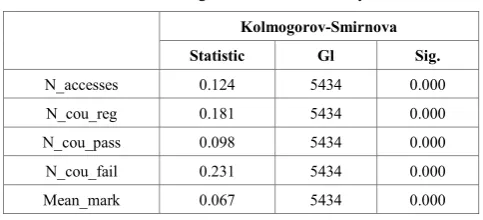
In order to assess whether the variables under study have a normal distribution or not, we used the SPSS program (Statistical Package for the Social Science) as well as the Kolmogorov-Smirnov normality test. The results obtained are presented in Table 1.
Table 1. Kolmogorov-Smirnov Normality Test
Kolmogorov-Smirnova
Statistic Gl Sig.
N_accesses 0.124 5434 0.000
N_cou_reg 0.181 5434 0.000
N_cou_pass 0.098 5434 0.000
N_cou_fail 0.231 5434 0.000
Mean_mark 0.067 5434 0.000
Lilliefors significance correlation
Bearing in mind the data in Table 1 and considering as null hypothesis for each of the variables that “the distribution is normal”, we observe that, based on the level of significance found, the null hypothesis must be rejected, in other words, it is not possible to consider these distributions as normal distributions, which implies that the Spearman correlation coefficient is the one to use in the analysis of the relation between the variables.
[image:5.595.311.553.242.352.2]Therefore, the data regarding the correlation between the variable N_accesses and each one of the variables N_cou_reg, N_cou_pass, N_cou_fail and Mean_mark are presented in Table 2.
Table 2. Correlation between variables (Spearman rho)
Variables/correlation coefficient N_cou_reg N_cou_pass N_cou_fail Mean_mark
N_accesses 0.299** 0.596** -0.240** -0.051**
Sig. (bilateral) .000 .000 .000 .000
N 6347 6347 6347 5434
According to Morais [22], when the correlation coefficient (δ) is not negative, the correlation is considered very low if δ∈[0; 0.2[, low if δ∈[0.2; 0.4[, moderate if δ∈[0.4; 0.7[, high if δ∈[0.7; 0.9[ and very high if δ∈[0.9; 1]. When the correlation coefficient (δ) is negative, the correlation is considered very high if δ∈[-1; -0.9], high if δ∈]-0.9; -0.7], moderate if δ∈]-0.7; -0.4], low if δ∈]-0.4; -0.2] and very low if se δ∈]-0.2; 0].
Bearing in mind the above classification, we observe that there is a low positive correlation between the variables N_accesses and N_cou_reg, a moderate positive correlation between the variables N_accesses and N_cou_pass, a low negative correlation between the variables N_accesses and N_cou_fail, and a very low negative correlation between the variables N_accesses and Mean_mark.
In light of this, we can infer that the higher the number of accesses to the VLE was, the higher the number of course units that students passed was. Also, the number of accesses to the VLE did not influence the mean of marks of the course units which students passed.
Overall, the data does not allow an inference of strong relations between the number of accesses to the VLE and the variables associated with students’ performance. However, by considering the variability of the number of accesses, we should not exclude the possibility of the existence of indicators which may show differences among groups regarding students’ performance according to the lower or higher number of accesses to the VLE. Thus, bearing in mind the number of accesses of each subject to the VLE, we were able to divide the 6347 subjects into five independent groups defined as: group1=[0, p20]; group2=]p20, p40]; group3=]p40, p60]; group4=]p60, p80]; group5=]p80, p100]. Here, as referred before, p20, p40, p60, p80 are the respective percentiles 20, 40, 60 and 80 of the distribution of the number of students’ accesses to the VLE.
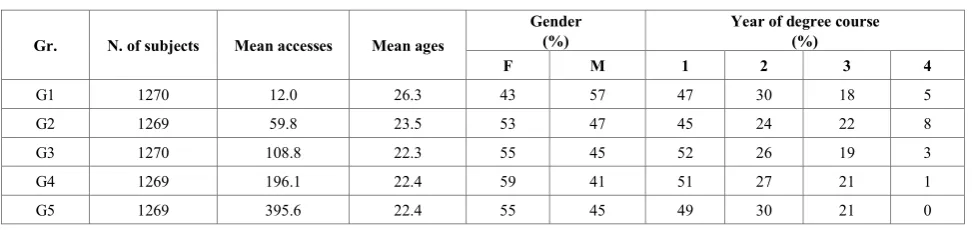
The result of the constitution of groups is that the higher the number of the group is, the higher the mean of the number of its students’ accesses to the VLE is too. Table 3 shows the characterisation of each group.
Taking into account that five groups were considered regarding the number of accesses to the VLE, it is relevant to justify that the five groups have distinctive features concerning the number of accesses, that is, to justify that
there are significant differences between the means of each pair of groups as far as the number of accesses is concerned. Therefore, by using the Levene test to assess the homogeneity of variances, and considering as a null hypothesis that the variance is identical in the five groups, we observed a level of significance of 0.00. This implies the rejection of the null hypothesis. Therefore, it is possible to say that the groups are significantly different in terms of variance, which makes it impossible to use the t-Student test to compare the means of the number of accesses to the VLE. Since there is no homogeneity of variance in the groups, we used the Welch and the Brown-Forsythe robust tests in order to compare the means of accesses to the VLE between groups, using the null hypothesis that the means are identical in the groups.
After applying the Welch and the Brown-Forsythe tests, we obtained a level of significance of 0.00 for each of the tests, which implies that the null hypothesis can be rejected, that is, it is possible to say that there are significant differences between the means of the number of accesses to the VLE of each pair of groups.
By conducting these statistical procedures and by assuming groups with significant differences regarding the number of accesses to the VLE, we proceeded to the analysis of the results regarding students’ performance, in an attempt to assess whether or not these differences lead to differences in the students’ performance results.
[image:6.595.63.552.609.724.2]In order to explore possible relations between the number of each student’s accesses to the VLE and their performance, and bearing in mind that the subjects were divided into five different groups according to their number of accesses, we compared those groups in terms of the mean of the course units in which students were registered, the mean of the number of course units which they passed, the mean of the number of course units which they failed, the mean of the marks obtained in the course units which they passed, the percentage of course units passed relatively to the number of units in which they were registered, the percentage of students who passed at least one course unit, and the percentage of students who did not pass any course unit. The data regarding students’ performance is presented in Table 4.
Table 3. Characterisation of the study groups according to the number of accesses to the VLE
Gr. N. of subjects Mean accesses Mean ages
Gender
(%) Year of degree course (%)
F M 1 2 3 4
G1 1270 12.0 26.3 43 57 47 30 18 5
G2 1269 59.8 23.5 53 47 45 24 22 8
G3 1270 108.8 22.3 55 45 52 26 19 3
G4 1269 196.1 22.4 59 41 51 27 21 1
Table 4. Data regarding students’ performance per group
Groups Mean of CU registered Mean of CU passed CU passed (%) Mean of marks
1 7.4 1.6 21.6 13.6
2 8.5 4.7 55.3 13.1
3 9.9 6.9 69.7 12. 8
4 10.5 8.1 77.1 12.8
5 11.0 8.8 80.0 12.9
Bearing in mind that the higher the number of the group the higher the mean of the number of accesses, we may agree that group 1 has a “very low” number of accesses to the VLE, group 2 has a “low” number of accesses, group 3 has a “moderate” number of accesses, group 4 has a “high” number of accesses and group 5 has a “very high” number of accesses.
The data presented in Table 4 enables the observation that except for the mean of the marks obtained, the trend in all the other variables is for the values of the variables to increase in the same sense as the increase of the numbers of the groups. This indicates that the higher the mean of the number of accesses to the VLE is, the higher the values associated with students’ performance are in the variables regarding the mean of units passed and the percentage of course units passed according to the number of units in which students are registered.
Given that the number of course units which students passed is one of the strongest indicators of students’ academic success, we will check whether there are significant differences between each pair of groups regarding the variable Mean of CU passed.
Since the data in Table 4 indicates the existence of marked differences among the several groups, we determined whether the data distribution was normal by using the test Kolmogorov – Smirnov, and the homogeneity of variance by using the Levene test. Given that the assumptions of normal distribution and homogeneity of variance were not verified, we looked for a less demanding test as far as normality and homogeneity are concerned. Thus, since we intend to compare the means of five groups, two by two, we will proceed to the comparison of multiple means by using the Tukey test.
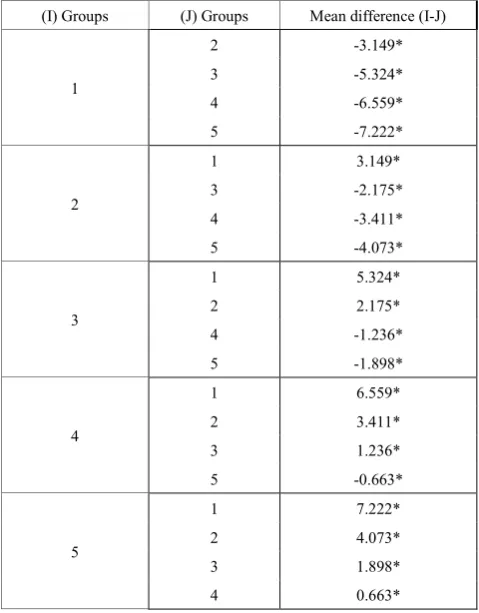
For Maroco [23], ‘Tukey’s test is one of the most robust to deviations from normality and homogeneity of variances (conditions which, like ANOVA, must be verified in order to apply means multiple comparisons…) for large samples (…).’ The results of the application of the Tukey test are presented in Table 5.
The analysis of Table 5 allows the observation of significant differences between the means of numbers of units passed between each pair of groups, at a level of significance below 0.05. By crossing the data from Tables 4 and 5, we can state that as far as the number of course units passed is concerned, the groups composed of the subjects showing a higher frequency of accesses to the virtual
environment obtained higher results than the groups composed by the subjects with lower frequency of accesses to the virtual environment.
Table 5. Multiple comparisons of the means of the curricular units passed, using the Tukey HSD test.
(I) Groups (J) Groups Mean difference (I-J)
1
2 -3.149*
3 -5.324*
4 -6.559*
5 -7.222*
2
1 3.149*
3 -2.175*
4 -3.411*
5 -4.073*
3
1 5.324*
2 2.175*
4 -1.236*
5 -1.898*
4
1 6.559*
2 3.411*
3 1.236*
5 -0.663*
5
1 7.222*
2 4.073*
3 1.898*
4 0.663*
*. The mean difference is significant at level 0.05.
With regard to the students’ performance, we also highlight that the percentage of undergraduates who passed at least one course unit varied from group to group, with group 1 revealing the minimum percentage and group 5 the maximum one. The percentages in groups 1, 2, 3, 4 and 5 were of 46.6%, 86.6%, 96.6%, 98.9% and 99.4%, respectively. Conversely, the percentage of students failing all course units revealed the opposite trend, with groups 1, 2, 3, 4, and 5 showing the percentages of 53.4%, 13.4%, 3.4%, 1.1% and 0.6%, respectively.
[image:7.595.61.550.93.186.2] [image:7.595.312.552.273.580.2]indicates that the lower the number of accesses to the VLE is, the higher the percentage of course units students failed is.
The highest means of marks, namely 13.6 and 13.1 were observed respectively in groups 1 and 2, very low and low access to the VLE, whereas the lowest means were observed in groups 3, 4 and 5 of moderate, high and very high access, with means of 12.8, 12.8 and 12.9, respectively. These results may have been conditioned by other variables, namely by the number of course units in which each student was registered, since the lower the number of course units each subject is registered in, the more time they will have to study for each of those course units. This may justify the higher means of marks in the groups with lower numbers of accesses to the VLE.
The coding which was presented enables us to infer that the mean of the number of units in which students were registered varies in an ascending trend from group to group, recording the minimum value of 7.4 in the group showing a very low number of accesses and the value of 8.8 in the group whose number of accesses is very high. Similarly, the mean of the course units which students passed varies ascendingly from 1.6 in the group with very low accesses to 8.8 in the group with very high accesses.
The percentage of course units students passed relatively to the units they are registered in also varies ascendingly, reaching a minimum of 21.6% in the group with very low accesses and a maximum of 80.0% in the group with very high accesses. Similarly, the percentage of subjects who passed at least one course unit follows an ascending trend, revealing a minimum of 46.6% in the group of very low accesses and a maximum of 99.4% in the group of very high accesses.
According to the constitution of groups and to the results presented, we can assure that the higher the mean of accesses to the VLE is, the higher will be: the number of units in which the student is registered, the percentage of course units
passed relatively to the units they are registered in, and the percentage of course units the student passed. Conversely, the lower the mean of accesses is, the higher the percentage of students who failed at least one course unit is.
One question raised in any research is to know the degree of association between the variables and whether or not the differences found are statistically significant.
Therefore, in order to assess the degree of association between the variables and the statistical significance of the influence that the accesses to the VLE have on the students’ performance results, we take the groups defined as 1, 2, 3, 4 and 5 once more, and we consider the number of accesses to the VLE (N_accesses) as the independent variable and as dependent variables:
Number of course units in which the student is registered (N_cou_reg);
Number of course units which the student passed (N_cou_pass);
Number of course units which the student failed (N_cou_fail);
Mean of marks of the course units which the student passed (Mean_mark).
[image:8.595.65.548.530.720.2]The results regarding the degree of association between the variable associated with the number of accesses to the VLE and the performance variables are presented in Table 6. By using the classification proposed by Morais [30], which was previously mentioned, it is possible to observe that the correlation is very low or low in all the situations studied, that is, there is a weak degree of association in all groups between the variable regarding the number of accesses to the VLE and each of the variables: number of course units in which the student is registered, number of units which the student passed, number of units which the student failed, mean of marks of the course units which the student passed.
Table 6. Correlation between the variable N_accesses and the variables of students’ performance (Spearman rho)
Groups Variables/correlation coefficient N_cou_reg N_cou_pass N_cou_fail Mean_mark
1 N_accesses .005 .311** -.118** -.135**
Sig. (bilateral) .860 .000 .000 .001
N=1270 1270 1270 1270 592
2 Sig. (bilateral) N_accesses .132** .000 .244** .000 -.064* .023 -.048 .109
N=1269 1269 1269 1269 1099
3 N_accesses .083** .139** -.048 -.038
Sig. (bilateral) .003 .000 .086 .186
N=1270 1270 1270 1270 1227
4 N_accesses .012 -.012 .025 .007
Sig. (bilateral) .657 .658 .368 .805
N=1269 1269 1269 1269 1255
5 N_accesses .053 .057* -.005 .019
Sig. (bilateral) .060 .042 .845 .506
N=1269 1269 1269 1269 1261
Table 7. Test for Equality of Variances
Levene
statistics gl1 gl2 Sig.
Mean_mark 143.672 4 5429 .000
N_cou_reg 231.215 4 5429 .000
N_cou_pass 34.738 4 5429 .000
Table 8. Robust Tests for Equality of Means
Statistics gl1 gl2 Sig.
Mean_mark Welch 15.694 4 2290.406 .000
Brown-Forsythe 22.320 4 2848.402 .000
N_cou_reg Welch 186.084 4 2266.429 .000
Brown-Forsythe 220.428 4 2604.886 .000
N_cou_pass Welch 369.214 4 2402.623 .000
Brown-Forsythe 330.785 4 4966.180 .000
a. F distributed asymptotically.
After analysing the degree of association between the variables, we proceed to the comparison between the means of the results obtained by each of the five groups in order to assess the existence of significant differences between them, in any of the variables studied.
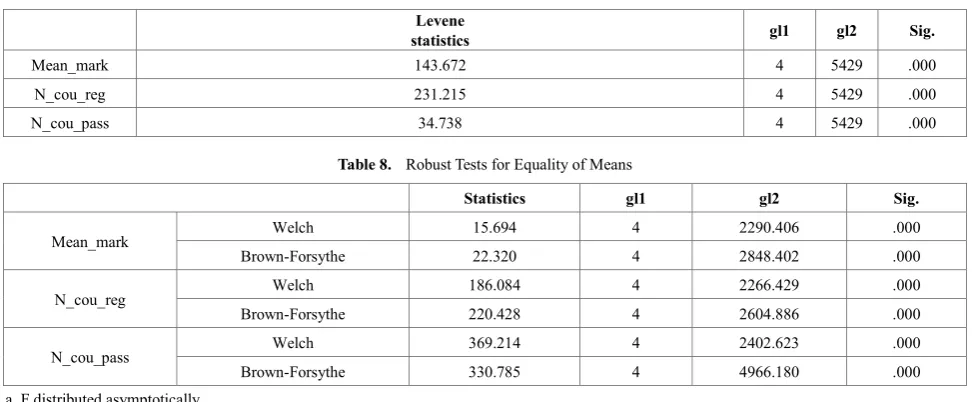
By applying the Levene Test for Equality of Variances, we obtained the data presented in Table 7.
According to the data displayed in Table 7, and assuming the null hypothesis of the equality of variances between groups, we can state that it is possible to reject the null hypothesis at a significance level of 0.000, which means there is no observable equality of variances between the groups.
Therefore, in order to compare the means between groups, the Welch and Brown-Forsythe test was used. The results are presented in Table 8.
By observing Table 8, it is possible to reject the null hypothesis of equality between the means. Therefore, we can admit that there are significant differences between the means of the groups in the variables under analysis.
In a nutshell, although the degree of association between the number of accesses and the variables of performance is translated into a low or very low level of correlation, significant differences can be observed between the groups in the variables regarding the marks obtained in the course units in which the students are registered, the number of course units in which they are registered and the number of units they passed. In the last two variables, the mean is all the higher as the number of accesses to the VLE increases.
As implications we can highlight that knowing the frequency of undergraduates’ accesses to the virtual learning environment enables the obtainment of indicators of the student’s profile regarding learning results, namely concerning the number of course units they pass. Here, there is a strong trend towards the evidence that the higher the number of accesses to the virtual environment, the higher the number of course units the student passes. What’s more, an
early acknowledgement of the frequency of accesses to the virtual environment may enable the student, the teachers and the education institution to develop procedures to avoid academic failure or dropout.
5. Conclusions
In the conclusions, we present a summary of the main results obtained from a study conducted in the academic year of 2014-2015, involving 6347 undergraduates from a Portuguese public higher education institution. This study aimed to assess the frequency of students’ access to the virtual learning environment (VLE) adopted by the institution, as well as the relation between the frequency of access to the VLE and the students’ performance. The nature of the study was quantitative and the data was obtained from databases associated with the VLE.
Among the overall results, we highlight:
The number of accesses to the VLE is quite diversified, varying from zero to 1532 accesses;
There is a positive moderate correlation (0.6) between the variables regarding the number of students’ accesses to the VLE and the number of course units students passed, and there is a very low negative correlation between the variables regarding the number of students’ accesses to the VLE and the mean of the marks of the course units students passed;
The higher the number of accesses to the VLE is, the higher the number of course units students passed is; The number of accesses to the VLE did not influence
the mean of the marks of the course units which students passed.
[image:9.595.62.549.89.290.2]performance. Therefore, the 6347 subjects who took part in the study were integrated in five groups of identical size according to their number of accesses to the VLE. The groups were defined as follows: group1=[0, p20], group2=]p20, p40], group3=]p40, p60], group4=]p60, p80] and group5=]p80, p100], where p20, p40, p60 and p80 correspond to the respective percentiles of 20, 40, 60 and 80 of the distribution of the students’ number of accesses to the VLE. The rounded off means of the numbers of accesses to the VLE of group 1 to group 5 are of 12, 60, 109, 196 and 396, respectively. There are significant differences between the several groups as far as the means of the number of accesses to the VLE are concerned.
The results obtained regarding students’ performance enable us to infer that the higher the mean of the group’s accesses to the VLE is, the higher are: the number of course units in which the student is registered, the number of units they passed, the percentage of units they passed relatively to the units they are registered in, and the percentage of course units the student passed. Also, the higher the mean of the group’s accesses to the VLE is, the lower the percentage of students who failed all the course units is.
Significant differences were found between the means of the numbers of course units passed at a level of significance below 0.05 between the groups composed of subjects showing a higher frequency of accesses to the virtual environment and the groups of subjects with lower frequencies of accesses to the virtual environment.
The analysis of the correlation between the variables in each of the groups shows that there is, in each of the five groups, a weak degree of association between the variables regarding the number of accesses to the VLE and each of the variables associated with students’ performance.
By applying the appropriate statistical tests, we observed that there are significant differences between the means of the five groups concerning the variables: mean of the marks of the units which students passed and number of course units which students passed.
The results concern only one higher education institution and therefore, cannot be generalised. However, these results show relatively positive indicators regarding students’ access to a virtual learning environment and the relation between such access and their performance.
REFERENCES
[1] Valsamidisa, S., Kazanidisa, I., Petasakisa, I., Kontogiannisb, S., & Kolokithaa, E. E-Learning Activity Analysis. Procedia Economics and Finance. 9. pp. 511 – 518. 2014.
[2] Becerra, E., García, M. C., & Chávez, R. Ambiente de aprendizaje con uso de tecnología en la formación docente inicial y las habilidades intelectuales. In R. E. Navarro, M. J. Pacheco, Y. N. Rangel, & M. S. Montoya (Eds.), Foro interregional de investigación sobre entornos virtuales de
aprendizaje: Integración de redes académicas y tecnológicas. México: Redtic. pp. 154–164. 2011.
[3] Morais, C., Alves, P., & Miranda, L. Valorização dos ambientes virtuais de aprendizagem por professores do ensino superior. In Á. Rocha, L. Reis, M. Cota, M. Painho, & M. Neto (Eds.), Sistemas e Tecnologias de Informação. 8ª Conferência Ibérica de Sistemas e Tecnologias de Informação. Lisboa: AISTI/ISEGI. pp. 289-294. 2013.
[4] Zitter, I., Bruijn, E., Simons, P., & Cate, T. Adding a design perspective to study learning environments in higher professional education. High Educ 2011. 61. pp. 371-386. [5] Dahlstrom, E., Brooks, C., & Bichsel, J. The Current
Ecosystem of Learning Management Systems in Higher Education: Student, Faculty, and IT Perspectives. Research report. Louisville, CO: ECAR, September 2014. Available online: http://www.educause.edu/ecar.
[6] Alves, P., Miranda, L., & Morais, C. Open Educational Resources: Higher Education Students’ Knowledge and use. In Rikke Ørngreen & Karin Tweddell Levinsen (Eds.), Proceedings of the 13th European Conference on e-learnig ECEL 2014. Reading, UK: Academic Conferences and Publishing International Limited. 2014. pp. 11- 18
[7] Agudo-Peregrina, A., Iglesias-Pradas, S., Conde-González, M., & Hernández-García, A. Can we predict success from log data in VLEs? Classification of interactions for learning analytics and their relation with performance in VLE-supported F2F and online learning. Computers in Human Behavior 2014. 31. pp. 542–550.
[8] Gašević, D. & Siemens, G. Let’s not forget: Learning analytics are about learning. TechTrends 2015. 59(1). pp. 64-71 [9] Siemens, G., & Gašević, D. Guest Editorial - Learning and
Knowledge Analytics. Educational Technology & Society 2012. 15(3). pp. 1-2.
[10]Ferguson, R. The state of learning analytics in 2012: A review and future challenges. Technical report KMI-12-01. UK: Knowledge Media Institute, The Open University. 2012. [11]Dawson, S., Gašević, D., Siemens, G., & Joksimovic, S.
Current State and Future Trends: A Citation Network Analysis of the Learning Analytics Field. In Proceedings of the Fourth International Conference on Learning Analytics And Knowledge. New York, NY, USA: ACM. 2014. pp. 231–240.
[12]Greller, W., & Drachsler, H. Translating learning into numbers: A generic framework for learning analytics. Educational Technology & Society 2012. 15(3). pp. 42–57.
[13]ECAR Working Group. The Predictive Learning Analytics Revolution Leveraging Learning Data for Student Success. Available online: http://net.educause.edu/ir/library/pdf/ewg1 510.pdf.
[14]Gašević, D., Dawson, S., Rogers, T., & Gasevic, D. Learning analytics should not promote one size fits all: The effects of instructional conditions in predicting academic success. Internet and Higher Education 2016. 28. pp. 68–84.
[16]Papamitsiou, Z., & Economides, A. Learning Analytics and Educational Data Mining in Practice: A Systematic Literature Review of Empirical Evidence. Educational Technology & Society, 17 (4), 49–64. 2014.
[17]Norton, P., Porter, S. From Bricks to Clicks: the potential of data and analytics in Higher Education, The Higher Education Commission, Available online: http://www.policyconnect.or g.uk/hec/research/report-bricks-clicks-potential-data-and-ana lytics-higher-education. 2016.
[18]You, J. W. Identifying significant indicators using lms data to predict course achievement in online learning. The Internet and Higher Education, 29:23–30. 2016.
[19]Sclater, N., Peasgood, A., & Mullan, J. Learning analytics in higher education. A review of UK and international practice. Full report. JISC. Publiziert unter der Lizenz CC BY, 4(22.04), 2016.
[20]Wolff, A., Zdrahal, Z., Nikolov, A., & Pantucek, M. Improving retention: predicting at-risk students by analysing clicking behaviour in a virtual learning environment. In Third Conference on Learning Analytics and Knowledge (LAK 2013). Leuven: Belgium. 2013. pp. 145–149.
[21]Baker, R. and Siemens, G. Educational data mining and learning analytics R.K. Sawyer (Ed.). Cambridge handbook of the learning sciences. Cambridge University Press. Cambridge. UK. 2014.
[22]Morais, C. Complexidade e comunicação mediada por computador na aprendizagem de conceitos matemáticos: Um estudo no 3.º ciclo do ensino básico. Tese de Doutoramento em Educação - Área do Conhecimento de Metodologia do Ensino da Matemática. Braga. Universidade do Minho. 2000. [23]Maroco, J. (2010). Análise estatística: Com utilização do SPSS