THE
VALUE
OF
T-GIUESE-SUPPORTING
USABILITY
EVALUATION
PRACTICES
DURING
DEVELOPMENT
PRODUCT:
A
CONTROLLED
EXPERIMENT
1FOUAD ABDULAMEER SALMAN, 2AZIZ BIN DERAMAN, 3MASITA BINTI ABDUL JALIL
School of Informatics and Applied Mathematics
University Malaysia Terengganu (UMT)
21030 K. Terengganu, Terengganu Malaysia
E-mail: [email protected], [email protected], [email protected]
ABSTRACT
Despite having different underlying concepts, both agile methods and usability evaluation ultimately aim at producing high quality software. This paper presents the results of an empirical study on incorporating usability evaluation activities within an agile development plan. The study includes an experiment testing the effectiveness and efficiency of the proposed tool in implementing the quality aspect of usability. 32 novice participants were divided equally into a group using the conceptual tool and another using ISO standards. Both groups conducted a usability evaluation based on the same project (registered students system). It is concluded that the conceptual tool significantly helps inexperienced software teams to incorporate usability work within an agile environment.
Keywords: Controlled experiment, Usability Evaluation, Software Development Process, ISO Standards
1. INTRODUCTION
High-level usability is acknowledged as a significant feature of interactive software systems. Conversely, poor usability and inefficient end product design are prevalent causes for failed software products [1, 2, 3]. Thus, usability evaluation activities are crucial in software development, especially for agile approaches during the design and development stages for efficient feedback collection. Usability evaluation is applied in software projects to improve product usability and overall quality while reducing risk of failure and long term costs [4]. However, the time- and effort intensive nature of usability evaluations
discourage agile software teams from
implementation despite the promise of valuable feedback [5]. Therefore, an integration based approach toward tests is gaining interest in agile environments.
There are many reported approaches to integrating usability in agile environments, from various aspects. [6] advocates including the Big Design Up Front (BDUF) approach in agile development, where the design details are presented before coding and testing programmes so to minimize later revisions. In contrast, the Extreme
Scenario-based Design (XSBD) proposed by [7] relies on a centralized design record (CDR) which facilitates communication between the major stakeholders (namely the agile experts, usability specialists and management), and acts as a reference for usability experts for usability testing and design matters. The storyboarding approach described by [8] is an iterative and low reliability agile prototyping technique that can revamp software design without involving extensive coding of modules. Another methodology, the U-SCRUM attempts to streamline the evaluation process based on the needs of the end user, which are divided into functionality- or usability-focused. This approach proposed by [9] differs from its predecessor, SCRUM by catering to more than one product owner and has been reported to produce better
improvements in usability. Most of these
approaches are feasible on an operational level, yet suffer from low transferability to other practical situations due to highly specific activities and methods. A more abstract view of integration is worthy of further investigation.
The International Organization for
Standardization (ISO) has defined the standard guidelines to deal with different aspects of
evaluation. Specifically, the ISO 9241-11 [10]
provides guidance on user-oriented design
processes. Other relevant ISO standard guides are ISO/IEC 14598 [11] and ISO TR 16982 [12]. The standards serve to define predictable and repeatable processes and form a common knowledge base, both of which greatly help software development teams in timely and effective identification and planning of usability activities alongside ongoing software design processes.
Unfortunately, international standards are
perceived by agile development teams as
impractical for supporting software development teams in agile environments, and thus are not implemented to reap the above mentioned benefits [13]. We propose a conceptual tool as a guide derived from international standards for potential
incorporation points (activities, and artifacts)
between usability evaluation and software
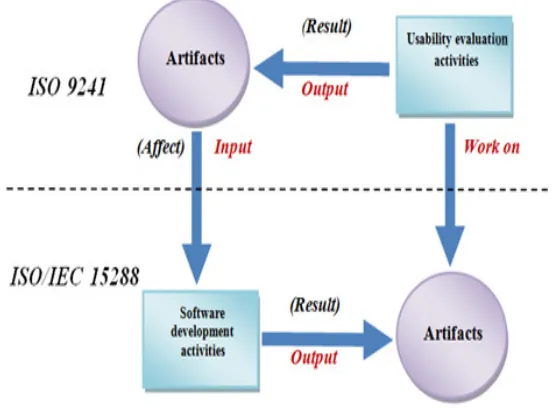
[image:2.612.168.447.317.521.2]development process (T-GIUESE), which enables the quality aspect of usability to be implemented smoothly, as well as educate and persuade the understanding and usage of standards related usability evaluation. This tool comprises the fundamental activities and artifacts from UE relevant to usability evaluation and similar features from SE that is pertinent to the development process. Potential incorporation points were highlighted. Activities were also linked with artifacts to show dependencies and relationships. Convergence artifacts of both disciplines were identified and shown. (See Figure 1)
Figure 1: incorporating usability evaluation into development process activities
The tool could benefit development teams as follows: assisting the nomination of appropriate usability evaluation methods; documentation and communication of results; defining fields of competencies for roles in agile development projects; all of which result in quality of use. Furthermore, the tool enables the clear discussion and comparison of processes within organizations through a model, leading to clear identification of incorporation aspects. Existing process models can be both enhanced and evaluated through this tool.
Agile development teams routinely handle complex tasks and extensive methodologies, so the
is whether T-GIUESE better supports the needs of a software team than conventional ISO standards.
2. USABILITY EVALUATION ACTIVITIES
WITHIN AGILE PLAN
Agile methodologies attempt to improve software quality and responsiveness to client requirements, yet usability aspects in agile environments appears to be poorly defined, resulting customers or users feeling overwhelmed with system functionality concerns that result from insufficient attention to product usability issues [14]. Literature reports also indicate that agile teams are concerned with the lack of attention to usability evaluation and usability engineering in general within agile environments [9, 15, 16, 17, 18, 19, 20, 21]. Agile methods are focused on people instead of processes, hence the agile team must address usability in a way that enables successful incorporation into software engineering. Evaluation of an agile development team’s performance in
setting, prioritizing and evaluating usability aspects during project planning acknowledges the multiple interpretations for the term “performance”. In this study, performance is evaluated from the aspects of effectiveness and efficiency. The evaluation of performance will be from the aspects of efficiency and effectiveness[22] [23], which are terms defined by [24] to measure performance abilities such as development of corporate and employee styles, motivation of staff commitment, and development of employee’s skills. These terms are selected due to high similarities with our evaluation outcome.
Performance = effectiveness x efficiency;
Effectiveness: The accuracy and
completeness with which agile practitioners can
produce usability evaluation activities and
dependencies within project plans.
Efficiency: The ratio between production
of the usability evaluation activities and
[image:3.612.136.474.381.461.2]dependencies to the time consumed by agile practitioners for production.
Figure 2: Measuring the effectiveness and efficiency of the compared tools
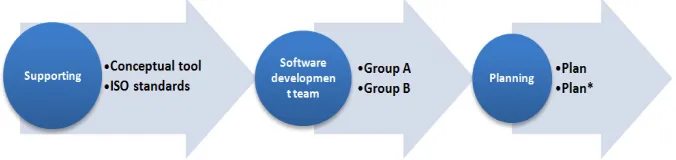
Figure 2 above is an abstract
representation of the evaluation setup of two different tasks, where one is supported by T-GIUESE and another by ISO for both effectiveness and efficiency according to one set of inputs (Task Instructions). Two different sets of outputs (plan and plan*) are produced with the objective of producing the most appropriate plan for the project.
This general setup, which transforms inputs into useful outputs is adopted from [25] as well as [26]. It is assumed that there exists a
function for Effectiveness with parameters
consisting of a set of inputs and a set of outputs to
return a measurement of efficiency and
effectiveness for an appropriate plan goal. In the
situation where Effectiveness (plan)* >
Effectiveness (plan), then (ISO) is defined as being more effective than (T-GIUESE). Additionally, if
efficiency (plan) > efficiency (plan)*, then (T-GIUESE) is defined as being more efficient than (ISO) and vice versa.
3. DESCRIPTION OF THE EXPERIMENT
We conducted an experiment with the conceptual tool (T-GIUESE) for purpose to
examine the usefulness of the tool for
inexperienced agile practitioners.
Setting: The experiment was conducted in
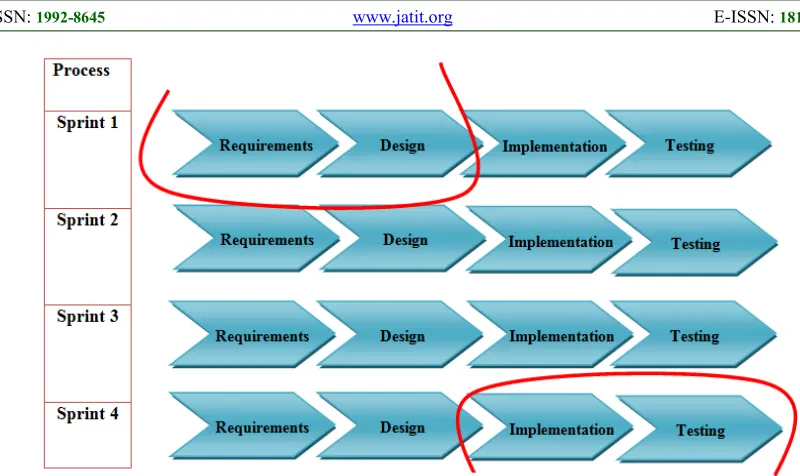
Figure 3: Specific phases for experimental in iterative planning
Participants took a short course in usability evaluation from the author of the paper consisting of the following modules:
A. Introduction to usability evaluation. B. Usability evaluation activities and artifacts. C. ISO standards related usability evaluation.
Each module contains a one-hour lecture and a one-hour discussion. The experiment was conducted after completion of the final module, C. The module consists of a presentation on the activities in a usability evaluation and the relevant techniques for each activity. The main literature
was the standards document (ISO 9241)
supplemented with selected articles. The lectures of the modules had the following contents:
1. The purpose of a usability evaluation, the concept of usability and overview of the activities and artifacts involved in a usability evaluation.
2. Basic decisions, field versus lab, the test monitor role and the test report.
3. Creation of test context, tasks assignments, conducting the test and the think-aloud technique.
4. Interpretation of data, the ISO definition, task load, identification of usability problems, exercises in identification and categorization of usability problems.
5. Presentation of experiences from our evaluation, heuristic evaluation, comparison with think-aloud method, and training of novices in usability evaluation.
Subjects: The participants in the
experiment were 32 second-year Computer Science undergraduate students of university Malaysia Terengganu (UMT). The 13 male and 19 female participants are aged between 20 to 21. They were offered participation as a voluntary exercise, but were promised feedback on their projects.
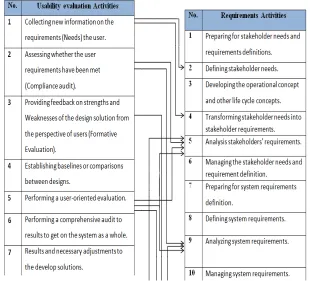
Conceptual tool: The experiment
Figure 4: Exchange of information between artifacts and activities
[image:5.612.151.461.401.682.2]Test procedure: The students were told during the introduction to the experiment that there would be an exercise on usability evaluation planning but without further details. They were then divided into two groups of equal size and allowed to complete the experiment without time constraints, resulting in sessions lasting between 1 to 1.5 hours.
They were informed about a required reading handout that describes the sprints relevant to the software development process. Then, they were guided through a description of usability evaluation requiring the information described in the handout and finally, they were asked for making usability evaluation plan to apply within these sprints.
Participants were given the appropriate
supporting documents for the comparison
experiment between the T-GIUESE and ISO standards a day before for their perusal and
comprehension. To minimize variations in
comprehension level and time during this portion, the experimenter read the Task Instructions aloud to the participants while taking questions from the audience. Participants were given an Answer Packet while reading the final page of the Task Instructions. Both groups were allowed unlimited time to complete the planning task. After completing said task, the groups were asked to explain their solution in detail to the experimenter to disambiguate any hand-writing or diagrammatic confusion.
Data collection: The main result was the
activities and artifacts list produced by each group. In additional information are the working diaries maintained by students, which detailed their observations and problems. We shall discuss only the activities and artifacts lists in this paper.
4. RESULTS
The key results from our experiment are outlined in the following sections. First, we present suggestions for usability evaluation activities and artifacts from the comparison between the two participating groups of students. Secondly, we outline the total number of activities and relevant independence suggested by the groups for each plan, and finally we present the time consumed for task planning by each participant group.
4.1 The Conceptual Tool and ISO Standards
4.1.1 Plans of individuals
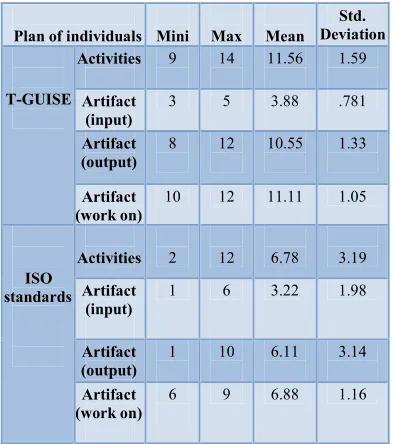
Table 1 summarizes key results on the plans suggested by the Group A (T-GIUESE) and Group B (ISO) participants. The table shows that T-GIUESE participants generally suggested a higher number of activities and artifacts on all phases. However, the high standard deviation indicates major variability between subjects in the ISO group as measured from the total number of suggested activities and artifacts. One participant suggested only 2 activities compared to 12 from another participant (SD=3.19). The same variances were not present in the T-GIUESE group, whereby the activities suggested had a narrower range of 9 to 14 (SD=1.59).
The T-GIUESE participants suggested more activity-relevant artifacts than the ISO
participants. On average, the T-GIUESE
[image:6.612.320.517.462.684.2]participants suggested 3.88, 10.55 (input/output) artifacts compared to the 3.22, 6.11 artifacts suggested by the ISO participants. However, we found only minor differences for the software development process artifacts.
Table 1:Descriptive Statistics for activities and relevant independence for the two approaches
Plan of individuals Mini Max Mean Std. Deviation
T-GUISE
Activities 9 14 11.56 1.59
Artifact (input)
3 5 3.88 .781
Artifact (output)
8 12 10.55 1.33
Artifact (work on)
10 12 11.11 1.05
ISO standards
Activities 2 12 6.78 3.19
Artifact (input)
1 6 3.22 1.98
Artifact (output)
1 10 6.11 3.14
Artifact (work on)
6 9 6.88 1.16
activity could be extracted from the goal description. We found that the ISO participants suggested a higher number of these non-activities (M=1.33) compared the T-GIUESE subjects (M=0.44). Similarly, the ISO participants suggested more artifacts which were considered inaccurate, irrelevant or incomprehensible (M=2.44) compared to the T-GIUESE participants (M=0.88).
4.1.2 Plans of groups
[image:7.612.99.290.318.597.2]Having outlined and discussed the average numbers of added activities and artifacts of usability evaluation within each plan (group A and B), we continue by showing total numbers of activities for the two setups, see Table 2.
Table 2: Total number of activities and relevant independence for the two groups
Phase
Plan of groups
R e q u ir em e n
t De
si g n Im p le m e n ta tio n a tio n T e st in g T o ta l M e a n T-GUISE
Activities 3 2 4 3 12 3.00
Artifact (input)
2 1 2 0 5 1.25
Artifact (output)
3 2 3 3 11 2.75
Artifact (work on)
3 2 3 3 11 2.75
ISO standards
Activities 1 2 3 2 8 2.00
Artifact (input)
1 1 2 0 4 1.00
Artifact (output)
1 2 3 2 8 2.00
Artifact (work on)
1 2 2 2 7 1.75
From Table 2. above, the distribution of identified activities and artifacts among different phases in both groups were rather different. The number of activities in plan A was higher than for plan B, caused by the suggestion of four activities by Group A. Accordingly, plan A contained more artifacts (27) than plan B (19). However, the implementation phase has the most activities (4, 3) as well as the most artifacts (3, 3). There was no
phase with the least activities or artifacts since all results were almost at a similar level.
Some of the activities suggested by the participants in both plans A and B were considered non-activities when meaningful activities cannot be extracted from the goal description, and when they were considered inappropriate or relevant to the concerned phase or sprint. We found more non-activities suggested in plan B (M=0.37) than in plan A (M=0.16). Similarly, we classified some artifacts as inaccurate, irrelevant or incomprehensible in relation to the suggested activities. Plan B contained more of these irrelevant artifacts (M=0.35) compared to plan A (M=0.22).
4.1.3 Time planning of the two groups
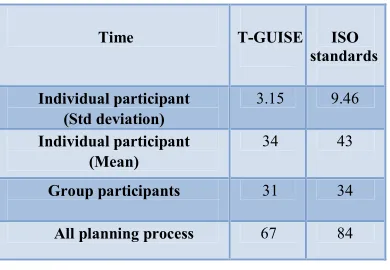
Completion time needed was measured as a final metric of participant performance. Table 3 outlines the time distribution for task planning. We measured the time from 3 scenarios: time consumed individually to suggest activities and artifacts before group discussion, time taken for group discussion before releasing the plan, and total time consumed for the entire planning process.
The table shows that individual group A participants took less time to perform the planning task, averaging 34 minutes from a range of 29 to 38 minutes. Group B participants averaged 43 minutes from a range of 20 to 56 minutes. As indicated by the high standard deviation, group A and group B spent significantly different times on the suggested activities and artifacts in their plan, which is 9.46 for group B and 3.15 for group A. Only minor differences were observed in the measured discussion time for participants in each group before plan release. Furthermore, group B took a longer time (84 minutes) to complete the entire planning process compared to 67 minutes for group A.
Table 3: Time planning of the two groups
Time T-GUISE ISO
standards
Individual participant (Std deviation)
3.15 9.46
Individual participant (Mean)
34 43
Group participants 31 34
[image:7.612.322.517.603.738.2]5. DISCUSSION
The experiment showed major
improvements caused by provision of T-GIUESE on the number of activities and artifacts considered by the participants while preparing a plan for usability aspects. The results indicated that the conceptual tool had helped the participants to suggest and recommend usability evaluation activities and artifacts for their work. In fact, the T-GIUESE participants on average suggested a higher number of convenient activities and artifacts compared to the ISO participants. We can infer that the T-GIUESE significantly helps users remember the activities that need to be considered when proposing a plan or project. In contrast, ISO standards alone seem applicable for incorporation of usability evaluation, but are challenging to grasp in their entirety due to looseness of composition in the absence of process or organizational specific details. Thus, the ISO participants are confused whether their proposed activities are sufficient.
Overall, the average T-GIUESE
participant suggested 4 more activities and 7 more artifacts than the average ISO participant. This indicates that the visual potential incorporation points are easy to follow and simplifies the process
of incorporating usability work in plans.
Furthermore, it creates more realistic expectations of the number of required artifacts (ie: input and output) in the development process.
There is opposition to using practical guidelines related to usability such as T-GIUESE by agile practitioners, as they are uncommon in agile environments and inessential to the agile process despite the clear advantages of a risk of usability approach. However, usability integration is not something that can be ignored while applying a method in agile software projects. Though many development organizations describe great success in using agile development processes, none of them explicitly describe the inclusion of usability activities [28].Therefore, the acceptance of tool among agile practitioners in companies needs to be evaluated to glean their actual perspectives on the concept of usability integration.
Secondly, the participants using the T-GIUESE suggested fewer non-activities. The bulk of the non-entries recorded (12 out of 16) were reported by the ISO participants. Thus, our tool
seemed to support the meaningful and
comprehensible presentation of activities by participants. It is acknowledged that neither T-GIUESE nor ISO standards can uncover all activities and artifacts involved, as there are variations in software companies from size, market sector, time in business, management style, location, to the type of provided services and
products [29]. Nonetheless, standards are
universally agreed guidelines and form a reasonable
basis for improving the transferability of
incorporation processes.
Software development teams often under-suggest activities and artifact related usability issues in agile environments due to constraints of time and high levels of required effort [5]. Our results confirmed this issue as our participants unsurprisingly only proposed common activities. Despite seeing the big picture from the conceptual tool and having the clarity to select appropriate usability activities, participants still hesitated to imply usability activities. Therefore, we think there is a need for another tool besides T-GIUESE, that supports the timely and relevant selection and application of usability evaluation methods and
techniques for agile development iteration
planning.
However, Group A identified more activities and artifacts for all four phases except the design phase which showed an equal number of activities. From this, it seems our conceptual tool helps reduce the considerations for constraints as
the T-GIUESE participants planned more
effectively, which resulted in a more accurate and complete list of activities and artifacts than the ISO participants.
From the perspective of efficiency, the experiment showed that T-GIUESE significantly reduced the time consumption of the participants for planning. Participants who used T-GIUESE spent 67 minutes for all planning tasks, in contrast with 84 minutes by the ISO participants. Evidently T-GIUESE helped the participants significantly in making suggestions for the activities, as well as consider the relevant independence when preparing a plan for usability aspects. The experiment also showed major variability in time consumption between individual ISO. The same variability was
not found among individual T-GIUESE
lists compared to the ISO participants. The conceptual tool has been developed entirely from ISO international standards, yet facilitates its application in a simplified and clear way. Other researchers have worked with the business perspective of marketing activities. It may be possible to combine these two approaches into an enhanced conceptual tool.
6. CONCLUSION
This paper presents a conceptual tool, T-GIUESE which was designed based on the ISO international standards 9241 and 15288. It aims to improve the quality of usability implementation by agile software teams through conveying the “big picture” of potential incorporation points in both fields. The conceptual tool was evaluated in an
empirical study on incorporating usability
evaluation activities within an agile development plan.
Through this study, the performance of two groups of novice participants using the T-GIUESE tool and ISO standards respectively were compared. The results showed that the T-GIUESE group performed better on identification of appropriate activities and artifacts by average per participant and group. These results indicate a clear potential usefulness of the conceptual tool as it improves the planning performance of novice participants.
ACKNOWLEDGEMENT
This research was funded by the Ministry of Education under the Fundamental Research Grant Scheme (FRGS 2013-2), University Malaysia Terengganu.
REFRENCES:
[1] Fairbanks, Rollin J., and Stanley Caplan, "Poor interface design and lack of usability testing
facilitate medical error", The Joint
Commission Journal on Quality and Safety, Vol. 30, No. 10, 2004, pp. 579-584.
[2] Shitkova, Maria, Justus Holler, Tobias Heide, Nico Clever, and Jörg Becker, "Towards Usability Guidelines for Mobile Websites and Applications", In Wirtschaftsinformatik, 2015, pp. 1603-1617.
[3] Aguilar, Maria, and Claudia Zapata, "Integrating UCD and an Agile Methodology in the Development of a Mobile Catalog of Plants", In Advances in Ergonomics Modeling, Usability & Special Populations, Springer International Publishing, 2017, pp. 75-87. [4] da Silva, Tiago Silva, Milene Selbach Silveira,
and Frank Maurer, "Usability evaluation practices within agile development", In System Sciences (HICSS), 48th Hawaii International Conference on, IEEE, 2015, pp. 5133-5142. [5] Gil, Juan Miguel Lopez, Maite Urretavizcaya
Loinaz, Begona Losada, and Isabel Fernandez Castro, "Field vs. Laboratory Usability Evaluations: a Study on a Context Dependent Mobile Application Developed with an Agile
Methodology", IEEE Latin America
Transactions Vol. 14, No. 1, 2016, pp. 339-348.
[6] Ferreira, Jennifer, James Noble, and Robert Biddle, "Up-front interaction design in agile development", In International Conference on Extreme Programming and Agile Processes in
Software Engineering, Springer Berlin
Heidelberg, 2007, pp. 9-16.
[7] Lee, Jason Chong, D. Scott McCrickard, and K. Todd Stevens, "Examining the foundations of agile usability with eXtreme scenario-based design", In IEEE Agile Conference, 2009, pp. 3-10.
[8] McNeill, Marc, "User centered design in agile application development", Thought Works Ltd, 2000.
[9] Singh, Mona, "U-SCRUM: An agile
methodology for promoting usability," In Agile, AGILE'08. Conference, IEEE, 2008, pp. 555-560.
[10] ISO 9241-210: Human---centered design processes for interactive systems. ISO, Genf, 2010.
[11] ISO/IEC 14598-6:Software engineering — Product evaluation — Part 6: Documentation of evaluation modules Genf, 2001.
[12] ISO TR 16982: Usability methods supporting human-centred design, 2002.
[13] McMichael, Bill, and Marc Lombardi, "ISO 9001 and Agile development," In Agile Conference (AGILE), IEEE, 2007, pp. 262-265.
[14] Ahmad, Wan Fatimah Wan, Saad Masood
Butt, and Lukman Rahim, "Usability
International Visual Informatics Conference, Springer International Publishing, 2013, pp. 640-651.
[15] Larusdottir, Marta, Jan Gulliksen, and Åsa Cajander, "A license to kill–Improving UCSD in Agile development," Journal of Systems and Software, 2017, pp. 214-222.
[16] Larusdottir, Marta Kristin, Emma Run Bjarnadottir, and Jan Gulliksen, "The focus on usability in testing practices in industry," In Human-computer interaction, pp. 98-109. Springer Berlin Heidelberg, 2010.
[17] Amiri, Zahra Askarinejad, "Challenges and weaknesses of agile method in enterprise
architecture", International Journal of
Computer Science and Engineering Survey Vol. 3, No. 6, 2012.
[18] Ferreira, Jennifer, James Noble, and Robert Biddle, "Agile development iterations and UI design", In Agile Conference IEEE (AGILE), 2007, pp. 50-58.
[19] Kuusinen, Kati, Tommi Mikkonen, and Santtu
Pakarinen, "Agile user experience
development in a large software organization: good expertise but limited impact", In International Conference on Human-Centred
Software Engineering, Springer Berlin
Heidelberg, 2012, pp. 94-111.
[20] Eke, B. O., and E. O. Nwachukwu, "Software Engineering Process: Yaam Deployment In E-Bookshop Use Case Scenario", Journal of
Theoretical & Applied Information
Technology Vol. 30, No. 2, 2011.
[21] Shehzad, Khurram, Mohammad Daud Awan, Sanam Shahla Rizvi, and Malik Sikandar Hayat Khiyal, "A Hybrid Technique based on
Standard SRS Modules for Software
Requirement Prioritization", Proceedings of Informing Science & IT Education Conference (InSITE), 2014.
[22] Bartuševičienė, Ilona, and Evelina Šakalytė, "Organizational assessment: effectiveness vs.
efficiency", Social Transformations in
Contemporary Society, 2013, pp. 45-53. [23] Heilman, Savannah C., and Lance
Kennedy‐Phillips, "Assessment matters:
Making assessment easier with the
Organizational Effectiveness Model", About Campus 15, no. 6, 2011, pp. 29-32.
[24] Mouzas S., "Efficiency versus effectiveness in business networks", Journal of Business Research, Vol. 59, no. 10, 2006, pp. 1124-113.
[25] Sink, D. Scott, and Thomas Tuttle, “Planning and measurement in your organization of the
future”, Industrial Engineering And
Management, 1989.
[26] Bartuševičienė, Ilona, and Evelina Šakalytė, "Organizational assessment: effectiveness vs.
efficiency", Social Transformations in
Contemporary Society, 2013, pp. 45-53. [27] Fouad A. S., Aziz D., Masita A., “Towards
Producing Usable Software: A Model for Incorporating Usability Evaluation Activities during Product Development Based on ISO
Standards”, International Journal of
Management and Applied Science, Vol. 2, No. 12, Dec.-2016.
[28] Sohaib, Osama, and Khalid Khan, "Integrating usability engineering and agile software development: A literature review", In Computer design and applications (ICCDA), 2010 international conference on, vol. 2, IEEE, 2010, pp. 22-32.
[29] Maciaszek, Leszek A., and Joaquim Filipe, “Evaluation of Novel Approaches to Software Engineering”, 10th International Conference, ENASE 2015, Barcelona, Spain, April, 2015, Revised Selected Papers, Springer, Vol. 599, 2016, pp. 29-30.