Baggott, Glenn K. and Rayne, Richard C. (2007) The use of computer-based
assessments in a field biology module. Bioscience Education 9 , ISSN
1479-7860.
Downloaded from:
Usage Guidelines:
Please refer to usage guidelines at or alternatively
Research Article
The use of computer-based assessments in a field biology
module
Glenn K Baggott and Richard C Rayne
School of Biological and Chemical Sciences, Birkbeck, University of London
Date received: 30/03/2007 Date accepted: 21/05/2007
Abstract
Formative computer-based assessments (CBAs) for self-instruction were introduced into a Year-2 field biology module. These CBAs were provided in ‘tutorial’ mode where each question had context-related diagnostic feedback and tutorial pages, and a self-test mode where the same CBA returned only a score. The summative
assessments remained unchanged and consisted of an unseen CBA and written reports of field investigations. When compared with the previous three year-cohorts, the mean score for the summative CBA increased after the introduction of formative CBAs, whereas mean scores for written reports did not change. It is suggested that the increase in summative CBA mean score reflects the effectiveness of the
formative CBAs in widening the students’ knowledge base. Evaluation of all assessments using an Assessment Experience Questionnaire indicated that they satisfied the ‘11 conditions under which assessment supports student learning’. Additionally, evidence is presented that the formative CBAs enhanced self-regulated student learning.
Keywords: computer-based assessment, formative, fieldwork, self-regulated learning
Introduction
way we introduced a greater element of self-regulation of student learning than previously (Nicol and Macfarlane-Dick, 2006).
In changing this module we integrated the formative CBAs fully with other assessments and ensured that the automated feedback provided by the CBAs was consistent, as far as practicable, with current recommendations for effective feedback (Gibbs and Simpson, 2004–05). Consequently, CBAs were intended to satisfy the relevant ‘conditions’ of the ’11 conditions under which assessment supports learning’ (Gibbs et al, 2003; See Appendix: Supplementary material 1) and all assessments were evaluated within the framework of Gibbs & Simpson’s (2003) Assessment Experience Questionnaire.
Module structure
This module is the students’ first introduction to ecology and data analysis, although all previously had completed a module about report writing. Students attend five teaching sessions one month before a residential field course, where they undertake fieldwork. Three sessions address the basic ecological theory underpinning the fieldwork; one session is used to practice data analysis techniques used for fieldwork; and one session is devoted to 5-minute oral presentations by pairs of students. Students devise agreed peer assessment criteria for these presentations. At the residential field course students undertake three field investigations (intertidal communities of the rocky shore, plant communities, freshwater communities) on three separate days and a project lasting 2 days. All fieldwork is undertaken in groups of 3–4 students with laboratory sessions every evening. In these sessions data collation and analysis is undertaken collaboratively within groups and with tutor-student discussions. The project also provides extensive opportunities for tutor and peer dialogue. Project outcomes are communicated orally to fellow students by 10-minute presentations; these are assessed by peers using the criteria developed in the pre-field course session.
The assessment has both formative and summative elements. In 2003–05, students were issued with a CD containing formative CBAs during the pre-field course sessions; a second CD was issued at the residential field course. All CBAs were provided in a ‘tutorial’ mode where each question returned context-related diagnostic feedback and contained tutorial materials. The same CBAs were also delivered in a ‘self-test’ mode that returned a score without feedback. The CD’s also contained lecture handouts, field protocols and additional learning resources, including images.
graded, with written feedback from the tutor, one month after submission. The feedback comprised annotations and a page of commentary identifying how effective each report was as a scientific communication and how well it had addressed the intended learning outcomes.
Methods CBAs
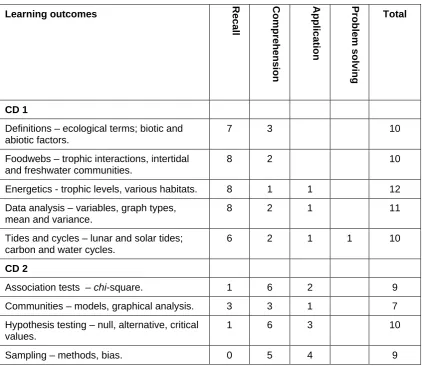
CBAs were constructed using TRIADS software (CIAD, 2007). For each question students could access tutorial pages (Appendix: Supplementary material 2 and 3) and, on submitting their answer, diagnostic feedback was displayed providing hints for correct completion if an incorrect response had been given (Supplementary material 3). Model answers were not used. CBAs on the first CD were designed to promote learning of ecology basics and practice essential skills. CBAs on second CD were designed to support the field investigations. Assessment items were composed using the RECAP taxonomy (Imrie, 1995; Table 1) and grouped into CBAs by intended learning outcomes (Table 2). The items within each CBA on CD 1 were arranged to contain a preponderance of recall questions and distributed to address the learning outcomes of the pre-field course sessions. Similarly, CBAs on CD2 were distributed to cover the learning outcomes of the field investigations but used mainly comprehension and application items (Table 2). For the unseen summative CBA, assessment items covered all of the non-skills related learning outcomes and were distributed across RECAP categories and the module overall learning outcomes (Table 3).
Table 1 The criteria used to classify CBA items by cognitive type using the RECAP taxonomy (modified from Imrie, 1995)
Recall
The answers are information previously encountered in course materials or directed reading. Text or images exactly as in source. The only requirement for a correct selection is the accurate, appropriate, recall of the term, definition, or statement.
Comprehension
The answers, text, or images have not been seen by the student in the course materials or in directed reading. Selection of the correct answer(s) depends on an understanding of the question posed and use of concepts to identify the correct selection.
Application
The student is required to apply the concepts appropriate to the question posed. The answers, text, or images, have not been seen by the student in the course materials. Differs from comprehension in that the student is uses their understanding to produce a defined outcome. This outcome may be a sequence/list, classification or numerical solution.
Problem solving (synthesis)
Table 2 The number of CBA items on the CD’s categorized by the RECAP taxonomy in relation to intended learning outcomes. Each of the sets of specific learning outcomes indicated by the topic titles in bold, with gloss in italics, constituted a separate CBA.
Learning outcomes
Recall Co
mpre
hens
ion
Applica
tion
Problem sol
v
ing
Total
CD 1
Definitions – ecological terms; biotic and abiotic factors.
7 3 10
Foodwebs – trophic interactions, intertidal and freshwater communities.
8 2 10
Energetics - trophic levels, various habitats. 8 1 1 12
Data analysis – variables, graph types, mean and variance.
8 2 1 11
Tides and cycles – lunar and solar tides; carbon and water cycles.
6 2 1 1 10
CD 2
Association tests – chi-square. 1 6 2 9
Communities – models, graphical analysis. 3 3 1 7
Hypothesis testing – null, alternative, critical values.
1 6 3 10
Sampling – methods, bias. 0 5 4 9
Evaluation
Table 3 The number of items, categorised by the RECAP taxonomy and overall learning outcomes, used in the summative CBA. Learning outcomes were: 1. to have an appreciation of the biological diversity of animals and plants; 2. to have gained specific knowledge about three types of ecological communities; 3. to have gained a working knowledge of how to analyse and present ecological data.
Recall Comprehension Application Problem
solving
1 2 2
2 4 1
Learning outcome assessed
3 1 5 3 1
Total 7 8 3 1
On the basis of the responses to this question answers were categorized into 1) responses indicating improvement of student learning – CBAs helped
understanding of topics, CBAs helped respondent improve, respondent found diagnostic feedback useful, or respondent used the tutorial pages; 2) responses indicating preparation for the summative CBA – CBAs provided
exam practice, respondent wanted model answers, respondent used CBAs for numeracy practice;
3) responses other than these categories - respondent valued 24x7 access; respondent liked interactivity and graphics.
Results
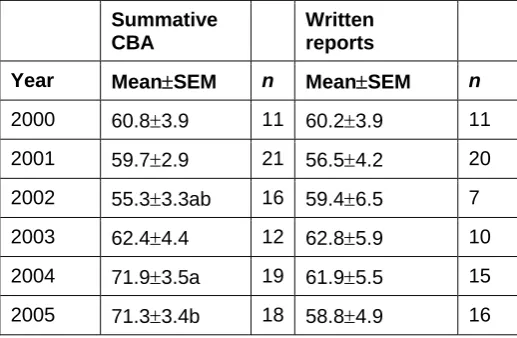
When compared with 2000–02, mean scores for the summative CBA increased after the introduction of formative CBAs, whereas mean scores for written reports did not change (Table 4). Mean scores for recall items were higher in 2004 (68.4±2.9%; mean±SEM) and 2005 (69.2±4.3%) than in 2003 (56.5±5.0%). Mean scores for comprehension and application items were higher than those for recall items (70.7±3.3% and 76.7±4.9%, respectively), and did not change from 2003 through 2005. Marks for the different types of written reports were all strongly correlated with each other (Table 5); although significant, coefficients were much smaller for the correlations between the summative CBA and written reports scores.
Table 4 Assessment scores (%) for summative CBA and written reports before and after the introduction of formative CBAs in 2003. Summative CBA means sharing superscripts differ at p<0.01 (Tukey post-hoc mean comparisons family error rate 0.05; one-way ANOVA for years F=3.92, p=0.003)
Summative CBA
Written reports
Year Mean±SEM n Mean±SEM n
2000 60.8±3.9 11 60.2±3.9 11
2001 59.7±2.9 21 56.5±4.2 20
2002 55.3±3.3ab 16 59.4±6.5 7
2003 62.4±4.4 12 62.8±5.9 10
2004 71.9±3.5a 19 61.9±5.5 15
[image:6.595.168.427.585.754.2]Table 5 Pearson correlation coefficients for summative assessments 2003 through 2005 (n=41). All significant at p<0.001.
Written reports intertidal
communities
plant communities
freshwater communities
project
plant communities
0.777
freshwater communities
0.694 0.854
Writ
ten rep
o
rts
project 0.780 0.878 0.888
summative CBA
0.483 0.544 0.569 0.532
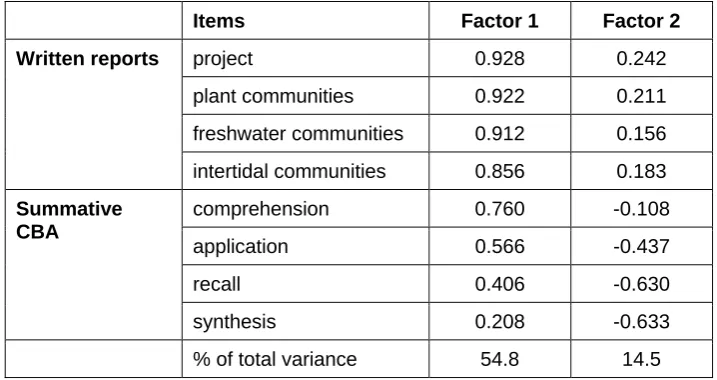
A factor analysis of summative CBA item RECAP type (Table 3) and written report type was undertaken for 2003–05. With no rotation and eigenvalues greater than 1, this analysis identified two factors accounting for 69.3% of the variance, with the first four factors accounting for 89.0% of the total variance. For factor 1 the loadings were comprised of two groups. High scores for factor 1 were associated with coursework items and comprehension questions (Table 6). Other examination items contributed less to the factor 1 score. Factor 2 divided into coursework and examination items: high scores for factor 2 were associated with high coursework percentages and low exam item percentages. There were no differences between the cohorts 2003–05.
Table 6 Principal component factor analysis with item loadings for all forms of assessed written reports and summative CBA items categorized by the RECAP taxonomy, for 2003 through 2005 (n=41).
Items Factor 1 Factor 2
project 0.928 0.242
plant communities 0.922 0.211
freshwater communities 0.912 0.156
Written reports
intertidal communities 0.856 0.183
comprehension 0.760 -0.108
application 0.566 -0.437
recall 0.406 -0.630
Summative CBA
synthesis 0.208 -0.633
% of total variance 54.8 14.5
Evaluation
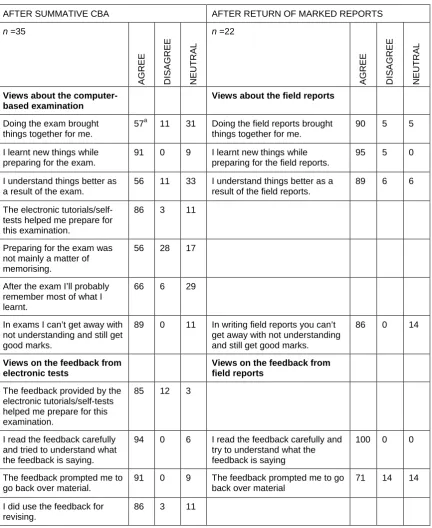
[image:7.595.118.477.451.641.2]assessment of their understanding (‘…you can’t get away with not understanding and still get good marks’). A majority of students claimed to have utilized both CBA and written feedback (‘I read the feedback carefully…’), that feedback assisted understanding (‘The feedback helped me to understand…’), and that feedback helped them improve (‘I can see from the feedback what I need to do to improve’). In the case of ‘tutorial’ CBAs a majority of respondents claimed not to have understood most of the feedback, yet most said it had helped them ‘..understand things better’.
Table 7 Student views about different modes of assessment for year cohorts 2003–05. In all years questionnaires were administered immediately after the summative CBA and after return of marked field reports and final module grade.
AFTER SUMMATIVE CBA AFTER RETURN OF MARKED REPORTS
n =35
AGREE DISAGREE NEUTRAL
n =22
AGREE DISAGREE NEUTRAL Views about the
computer-based examination
Views about the field reports
Doing the exam brought things together for me.
57a 11 31 Doing the field reports brought
things together for me.
90 5 5
I learnt new things while preparing for the exam.
91 0 9 I learnt new things while preparing for the field reports.
95 5 0
I understand things better as a result of the exam.
56 11 33 I understand things better as a result of the field reports.
89 6 6
The electronic tutorials/self-tests helped me prepare for this examination.
86 3 11
Preparing for the exam was not mainly a matter of memorising.
56 28 17
After the exam I’ll probably remember most of what I learnt.
66 6 29
In exams I can’t get away with not understanding and still get good marks.
89 0 11 In writing field reports you can’t get away with not understanding and still get good marks.
86 0 14
Views on the feedback from electronic tests
Views on the feedback from field reports
The feedback provided by the electronic tutorials/self-tests helped me prepare for this examination.
85 12 3
I read the feedback carefully and tried to understand what the feedback is saying.
94 0 6 I read the feedback carefully and try to understand what the feedback is saying
100 0 0
The feedback prompted me to go back over material.
91 0 9 The feedback prompted me to go back over material
71 14 14
I did use the feedback for revising.
The feedback helped me to understand things better.
82 3 15 The feedback helped me to understand things better.
86 0 14
I understood most of the feedback.
14 74 11 I understood most of the feedback.
70 15 15
I can see from the feedback what I need to do to improve.
68 12 21 I can see from the feedback what I need to do to improve.
73 14 14
[image:9.595.84.522.77.161.2]a. Percentage of responses. Students were asked to indicate whether they strongly agree, agree, disagree, strongly disagree or were neutral about each statement. In this table responses for strongly agree and agree have been aggregated, as have strongly disagree and disagree categories. For statements in italics the wording used was phrased negatively (Supplementary Material 1 and 2). In his Table these statements are rephrased positively so that ‘agree’ indicates that the respondent felt their learning experience had been improved.
Students were also asked what aspects of the ‘tutorial’ and ‘self-test’ CBAs did they find most useful as a learning resource. When surveyed after the summative CBA, the most frequent responses indicated that the formative CBAs provided exam practice (28%), followed by respondents liking diagnostic feedback (15%) and the opinion that CBAs helped understanding (13%). When surveyed after return of the reports, the most frequent responses indicated that formative CBAs helped the understanding of topics (36%), followed by the opinions that CBAs provided exam practice (13%) and that CBAs helped the respondent improve (13%). When these responses were categorised into either a) the formative CBAs helped understanding or b) they provided examination practice, and surveyed after the summative CBA, more students said the CBAs helped them prepare for the unseen CBA (61%) than assisting their understanding the topics (39%) (χ2 = 6.25, 1 d.f., P=0.01). In contrast, when surveyed after return of the reports, only 23% said CBAs were used in preparation for the summative CBA. Correspondingly, representative student comments emphasizing the utility of ‘tutorial’ CBAs in assisting understanding were,
‘the visual learning helped comprehension…was most useful especially the feedback where comprehension had been less than full’.
‘…learnt in my own time with tutorials and feedback errors…seems a more active way of learning – more enjoyable’.
In contrast, typical comments emphasizing the use of formative CBAs for summative CBA preparation,
‘Good preparation for the types of questions that would be asked..’
‘it would be helpful …to include the option of displaying the correct answer.’
Students also reported that both ‘tutorial’ and ‘self-test’ CBAs helped them regulate their own learning. Typical comments included,
‘The combination was good. I could do a self test and then go back over the tutorials.’
‘…showed me where I should concentrate…allowed me to test myself without the pressure of having a mark…’
‘…I could use them in my own time and go over tricky bits as often as I liked...’
‘…being able to do them whenever…were interactive – not just reading.’
When asked, after the return of marked reports, whether the feedback from assessments would assist in future assessment tasks, 90% agreed it would help them to write laboratory reports, 63% agreed it would help prepare for examinations, and 76% felt it would help them write essays.
Discussion
The availability of formative CBAs in 2003–05 was associated with a significant increase in summative CBA mean score but not the mean score for written reports (Table 4). This was despite that the second set of CBAs specifically addressed the field investigations (Table 2) and student comments indicating their use of formative CBAs to master the field investigations. The increase in summative CBA mean score was due to higher scores for recall questions, although mean scores for these were still lower than for comprehension or application questions. Thus it is possible that formative CBAs were facilitating surface learning strategies through recall of facts. In contrast, the various types of written report required higher cognitive skills than recall, and indeed the summative CBA overall scores were poorly correlated with scores for the different types of report (Table 5). However, the comprehension questions of the unseen CBA had a factor loading similar to the written reports (Table 6) indicating the likelihood that these items assessed student cognitive skills akin to those assessed by written reports.
A reason for this disparity may be indicated by student comments about their use of formative CBAs. Whilst most students said they used formative CBAs to prepare for the summative CBA (Table 7), the comments suggested students were of two types: those who perceived the formative CBAs specifically as training for the unseen CBA, and those who found they assisted in understanding the module content. Conceivably, then, these two groups may correspond to those employing surface and deep learning strategies, as has been often described in the literature (e.g. Biggs, 1993; Beishuizen and Stoutjesdijk, 1999; Karabenick and Collins-Eaglin, 1997; Scouller, 1998). However, it is striking that one month after the summative CBA, when compared to immediately after it, significantly fewer students commented that the formative CBAs served as practice for the unseen CBA. We suggest that, rather than formative CBAs simply promoting surface learning, they were markedly effective in structuring the students’ access to disparate sources of information and so improving the students’ knowledge base. Certainly, the majority of students agreed that the feedback from all assessments, and specifically both ‘tutorial’ and ‘self-test’ CBAs, showed them how they could close the gap between the learning outcomes and their performance.
9 (Table 8). When surveyed just after the summative CBA, a majority of students felt they didn’t understand most of the automated feedback yet said it helped them understand things better and helped them improve (Table 7). This inconsistency arose, we suggest, from the structure of the automated feedback. Model answers to questions were deliberately not supplied; rather, hints for successful completion were provided, although by following the hints a correct completion would be achieved. The small number of comments requesting model answers would also be consistent with this interpretation. Thus we suggest the agreement with the question ‘I don’t understand some of the feedback’ (Supplementary material 1) reflects the formative structure of the feedback.
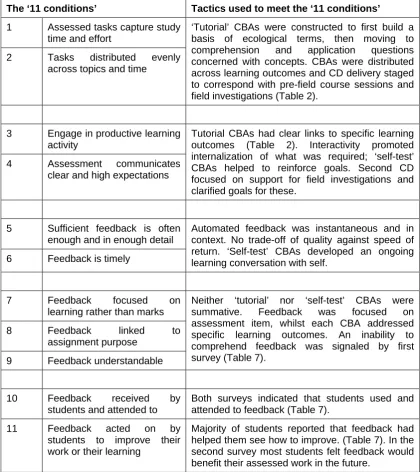
Table 8 The tactics used to attain the ’11 conditions under which assessment supports student learning (after Gibbs & Simpson, 2003).
The ‘11 conditions’ Tactics used to meet the ‘11 conditions’
1 Assessed tasks capture study
time and effort
2 Tasks distributed evenly
across topics and time
‘Tutorial’ CBAs were constructed to first build a basis of ecological terms, then moving to comprehension and application questions concerned with concepts. CBAs were distributed across learning outcomes and CD delivery staged to correspond with pre-field course sessions and field investigations (Table 2).
3 Engage in productive learning
activity
4 Assessment communicates
clear and high expectations
Tutorial CBAs had clear links to specific learning outcomes (Table 2). Interactivity promoted internalization of what was required; ‘self-test’ CBAs helped to reinforce goals. Second CD focused on support for field investigations and clarified goals for these.
5 Sufficient feedback is often
enough and in enough detail
6 Feedback is timely
Automated feedback was instantaneous and in context. No trade-off of quality against speed of return. ‘Self-test’ CBAs developed an ongoing learning conversation with self.
7 Feedback focused on
learning rather than marks
8 Feedback linked to
assignment purpose
9 Feedback understandable
Neither ‘tutorial’ nor ‘self-test’ CBAs were summative. Feedback was focused on assessment item, whilst each CBA addressed specific learning outcomes. An inability to comprehend feedback was signaled by first survey (Table 7).
10 Feedback received by
students and attended to
Both surveys indicated that students used and attended to feedback (Table 7).
11 Feedback acted on by
students to improve their work or their learning
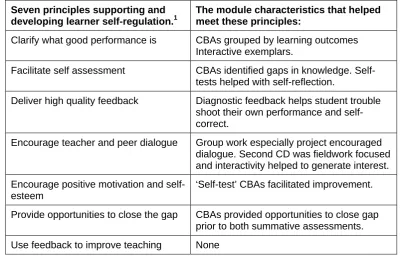
The formative CBAs and module activities proved successful in promoting the principles for self-regulation of student learning (Nicol and Macfarlane-Dick, 2006). As Table 9 indicates, formative CBAs helped promote five of the seven principles with the encouragement of teacher and peer dialogue relying on the main strength of field-based teaching – the extensive opportunities for group work and discussion. Whilst arguably fieldwork modules are the best opportunity to develop student self-regulation of learning, as an integral part of the ‘hidden curriculum’, the evidence from student comments suggests it is possible to enhance this by the appropriate use of formative CBAs. Indeed, digital technology can be very effective in promoting self-regulation of learning (Nicol and Milligan, 2006). Thus there is further scope to make field-based modules even more effective for learning in biology.
Table 9 The extent to which the module characteristics promoted student self-regulation of learning.
Seven principles supporting and
developing learner self-regulation.1
The module characteristics that helped meet these principles:
Clarify what good performance is CBAs grouped by learning outcomes
Interactive exemplars.
Facilitate self assessment CBAs identified gaps in knowledge.
Self-tests helped with self-reflection.
Deliver high quality feedback Diagnostic feedback helps student trouble
shoot their own performance and self-correct.
Encourage teacher and peer dialogue Group work especially project encouraged
dialogue. Second CD was fieldwork focused and interactivity helped to generate interest.
Encourage positive motivation and self- esteem
‘Self-test’ CBAs facilitated improvement.
Provide opportunities to close the gap CBAs provided opportunities to close gap
prior to both summative assessments.
Use feedback to improve teaching None
1. Nicol and Macfarlane-Dick (2006)
In summary, the introduction of formative CBAs with feedback into a field-based module was associated with an increase in mean score for the summative CBA; mean scores for written reports did not change. We conclude this reflects the increased opportunity for students to widen their knowledge base. The use of automated feedback was an effective tactic to achieve the ’11 conditions under which assessment supports student learning’ (Gibbs et al, 2003) and there was evidence that the formative CBAs enhanced self-regulated learning, a common characteristic of field-based modules.
Acknowledgement
Communicating Author
Dr Glenn K Baggott, School of Biological and Chemical Sciences Birkbeck, University of London, Malet Street, LONDON WC1E 7HX. Tel:020 6244 Fax:020
7631-6246 Email: [email protected]
References
Andrews, J., Kneale, P., Sougnez, W. , Stewart, M., and Stott, T. (2003) Carrying out Pedagogic Research into the Constructive Alignment of Fieldwork. Planet, issue 11, available at
http://www.gees.ac.uk/pubs/planet/index.htm (accessed 10 February 2007)
Beishuizen, J. J. and Stoutjesdijk, E. T. (1999) Study strategies in a computer assisted study environment. Learning and Instruction, 9 (3), 281-301
Besenyei, L., Watkin, G., and Oliver, K. (2003) An evaluation of the
educational effectiveness of fieldwork within environmental science awards at the University of Wolverhampton, CELT Learning and Teaching Projects 2003/04 available at http://hdl.handle.net/2436/3694 (accessed 10
February 2007)
Biggs, J. B. (1993) What do inventories of students' learning processes really measure? A theoretical review and clarification. British Journal of
Educational Psychology,63, 3-19
Boyle, A, Conchie, S., Maguire, S., Martin, A., Milsom, C., Nash, R.,
Rawlinson, S., Turner, A., and Wurthmann, S. (2003) Fieldwork is Good? The Student Experience of Field Courses. Planet, issue 11 available at http://www.gees.ac.uk/pubs/planet/index.htm (accessed 10 February 2007)
Centre for Interactive Assessment Development (CIAD). (2007) CIAD Home. http://www.derby.ac.uk/ciad/ (accessed 29 March 2007)
Elkins, J.T. and Elkins, N.M.L. (2006) Improving Student Learning During Travel Time on Field Trips Using an Innovative, Portable Audio/video System. Journal of Geoscience Education, 54 (2), 147-152
Gibbs, G and Simpson, C (2003) Measuring the response of students to assessment: the Assessment experience Questionnaire. 11th Improving Student Learning Symposium, pp 1-12
Gibbs, G and Simpson, C (2004-5) Conditions under which assessment supports students’ learning. Learning and Teaching in Higher Education
Issue 1, 3-31
Gibbs, G., Simpson, C. and Macdonald, R. (2003) Improving student learning through changing assessment – a conceptual and practical framework. European Association for Research into Learning and Instruction, EARLI Conference, Padova
Heads of University Biological Sciences (HUBS) (2006) Curriculum and the Benchmark/Teaching Field Biology, available at http://www.biohubs.org.uk/ (accessed 2 February 2007)
Karabenick, S. A. and Collins-Eaglin, J. (1997) Relation of perceived instructional goals and incentives to college students' use of learning strategies. Journal of Experimental Education, 65 (4), 331-341
Kent, M., Gilbertson, D.D., and Hunt, C.O. (1997) Fieldwork in geography teaching: A critical review of the literature and approaches. Journal of Geography in Higher Education, 21 (3), 313-332
Nicol, D.J. and Macfarlane-Dick, D. (2006) Formative assessment and self-regulated learning: a model and seven principles of good feedback practice. Studies in Higher education, 31 (2), 199-218
Nicol, D. J. & Milligan, C. (2006), Rethinking technology-supported
assessment in terms of the seven principles of good feedback practice. In
Innovative Assessment in Higher Education, eds. Bryan, C. and Clegg, K., pp 1-14. London, UK: Taylor and Francis.
Panizzon, D. L. and Boulton, A. J. (2004) Strategies for enhancing the learning of ecological research methods and statistics by tertiary
environmental science students. Bioscience Education e-Journal, volume 4 available at
http://www.bioscience.heacademy.ac.uk/journal/vol4/beej-4-1.htm (accessed 14 February 2007).
Smith, D. (2004) Issues and trends in higher education biology fieldwork.
Journal of Biological Education, 39 (1), 6-10
The Higher Education Academy: Centre for Bioscience (2004) Fieldwork, available at
Appendix
Supplementary material 1 Eleven conditions under which assessment supports student learning (source: Gibbs et al, 2003)
Quantity and distribution of student effort
1. Assessed tasks capture sufficient study time and effort
2. These tasks distribute student effort evenly across topics and weeks
Quality and level of student effort
3. These tasks engage students in productive learning activity
4. Assessment communicates clear and high expectations to students
Quantity and timing of feedback
5. Sufficient feedback is provided, both often enough and in enough detail
6. The feedback is provided quickly enough to be useful to students
Quality of feedback
7. Feedback focuses on learning rather than on marks or students themselves
8. Feedback is linked to the purpose of the assignment and to criteria
9. Feedback is understandable to students, given their sophistication
Student response to feedback
10. Feedback is received by students and attended to
Supplementary material 2
Screen shots of a question using randomised numbers to practice computations.
Supplementary material 3
Screen shots of a question with an animation as part of the tutorial material.
Supplementary material 4 Questionnaire administered after the summative CBA
Strongl
y
agre
e
Agree Neutral Disagree Strongl
y
disa
gre
e
Your views about the computer-based examination
Doing the exam brought things together for me.
I learnt new things while preparing for the exam
I understand things better as a result of the exam.
The electronic tutorials/self-tests helped me prepare for this examination.
Preparing for the exam was mainly a matter of memorising.
After the exam I’ll probably forget most of what I learnt.
In exams you can get away with not understanding and still get good marks.
Your views on the feedback from electronic tests
The feedback provided by the electronic tutorials/self-tests helped me prepare for this examination
I read the feedback carefully and tried to understand what the feedback is saying
The feedback prompted me to go back over material
I did not use the feedback for revising.
The feedback helped me to understand things better.
I don’t understand some of the feedback.
I can seldom see from the feedback what I need to do to i
Your views on the learning resources
The following learning resources were useful in preparing for this examination
a) the CD
b) the booklet
c) the website and its self-tests
d) Birkbeck library
The availability of the electronic tutorials/self-tests on CD was useful to me
The availability of the electronic tutorials/self tests on the web was useful to me
What aspects of the electronic tutorials/self tests did you find most useful as a learning resource?
Please write your answer overleaf
Supplementary material 5 Questionnaire administered after return of marked reports and module grade.
Strongl
y
agre
e
Agree Neutral Disagree Strongl
y
disa
gre
e
Your views about the field reports
Doing the field reports brought things together for me.
I learnt new things while preparing for the field reports.
I understand things better as a result of the field reports.
In writing field reports you can get away with not understanding and still get good marks.
Your views on the feedback from field reports
I read the feedback carefully and try to understand what the feedback is saying
The feedback prompted me to go back over material
The feedback helped me to understand things better.
I don’t understand some of the feedback.
I can seldom see from the feedback what I need to do to
Your views on the learning resources
The following learning resources were useful in preparing for field reports
a) the CD
b) the booklet
c) the website and its self-tests
d) Birkbeck library
The availability of the electronic tutorials/self-tests on CD was useful to me
The availability of the electronic tutorials/self tests on the web was useful to me
Your views on all the assessments
Feedback from assessments will assist me in writing laboratory reports in the future
Feedback from assessments will assist me in preparing for examinations in the future
Feedback from assessments will assist me in writing essays in the future
Now, after writing field reports and receiving your feedback, what aspects of the electronic tutorials/self tests did you find most useful as a learning resource?
Please write your answer overleaf