ORIGINAL RESEARCH ARTICLE
EFFECT OF PU CONCENTRATION ON DEVELOPMENT OF WATER BASED POLYURETHANE
COATED POLYESTER
Supriya Pandit and *Smita Bait
Colour and Chemical Lab, Wool Research Association, Thane, India
ARTICLE INFO ABSTRACT
The coating and lamination gives a powerful tool for the advancement of textile technology. It provides the opportunities to produce the special fabrics like water-proof resistant tarpaulins, coverings, large tents. Waterproof breathable fabrics are one of the harsh weather fabrics that protect the wearer without hampering their efficiency. Garments made from such fabrics keep away water from entering and wetting the body but allow the passage of air and moisture. The passage of water vapour from the garment makes it breathable and hence comfortable. One of the different methods of achieving waterproof breathable fabrics is application of polyurethane paste coating on the substrate. These coatings work on the principle of adsorption and diffusion and desorption of water vapour. Today waterproof breathable fabrics are largely manufactured by Paste coating with solvent based polyurethane emulsions. Solvent based emulsion coating causes adverse health hazards because of solvent evaporation during curing stage. Therefore the current study is an attempt to substitute current solvent based PU emulsion coating technology with water based PU emulsion. Here the performance of environmentally friendly water-based polyurethane dispersions (PUD) for waterproof breathable coating was studied and compared with commercial solvent based waterproof breathable fabric. Also the effect of variation in PU concentration in coating paste on the breathability of polyester was evaluated.
Copyright © 2019,Supriya Pandit and Smita Bait. This is an open access article distributed under the Creative Commons Attribution License, which permits unrestricted use, distribution, and reproduction in any medium, provided the original work is properly cited.
INTRODUCTION
During any physical activity the body provides cooling partly by producing insensible perspiration. If the water vapour produced, increases the relative humidity of the atmosphere inside the clothing sufficiently to cause sensible perspiration and increased thermal conductivity of the insulating air then the clothing becomes uncomfortable. In extreme cases hypothermia can result as the body loses heat too rapidly causing a decrease in core temperature. If the sensible perspiration cannot evaporate and the thermal insulation of the clothing remains high then the body is prevented from cooling and hyperthermia can result. Even small deviations from normal skin and core temperature can cause discomfort and reduction during physical activity (David A. Holmes, 2000). Waterproof breathable fabrics are designed for use in garments that provide protection from the weather that is from wind,
rain and loss of body heat (Sanjay et al.). Waterproof fabric
completely prevents the Penetration and absorption of liquid
*Corresponding author: Smita Bait,
Colour and Chemical Lab, Wool Research Association, Thane, India.
water, in contrast to water-repellent (or shower-resistant) fabric, which only delays the penetration of water. Traditionally, fabric was made waterproof by coating it with a continuous layer of impervious flexible material. The first coating materials used was animal fat, wax and hardened
Vegetable oils. But waterproof breathable fabrics prevent the
penetration of liquid water from outside to inside the clothing yet permit the penetration of water vapours from inside Waterproof breathable fabrics. Designing a suitable breathable fabric is quite complex and requires the understanding of textile and polymer science, human physiology and dynamics of moist vapour transport across the fabrics and clothing assemblies. Moisture vapour transport through waterproof breathable fabric and clothing system is dependent on the temperature gradient across the waterproof breathable layer, the humidity of the clothing microclimate, and the interaction between water-vapour and the clothing layers. Fundamental considerations that need to be considered while designing a breathable fabric are
Water proofness
Mass of the fabric
ISSN: 2230-9926
International Journal of Development Research
Vol. 09, Issue, 01, pp.25293-25297, January, 2019
Article History:
Received 22nd October, 2018
Received in revised form 03rd November, 2018
Accepted 14th December, 2018
Published online 30th January, 2019
Key Words:
Water based polyurethane emulsion, waterproof breathable coating, Moisture vapour transmission rate, Air permeability, Tearing strength, Moisture management properties, Hydrostatic head test,
Viscosity, and Solid content.
Citation: Supriya Pandit and Smita Bait, 2019.“Effect of PU Concentration on Development of Water Based Polyurethane Coated Polyester”, International Journal of Development Research, 9, (01), 25293-25297.
Durability/flexibility of coating/laminating
Comfort level
Aesthetic property
Water-vapor transmission
Effectiveness of clothing against wind chill factor
Durability: tear tensile and peel strength; flex and
abrasion resistance
Launder ability
Tape seal ability with good adhesion
Strength of coating
Good washability/dry clean ability
Resistance to insect repellents
Good hydrostatic resistance (Mukhopadhyay and
Midha, 2008; Lomax, 1985; Chinta and Darbastwar Satish, 2014).
There are several methods which can be used to obtain fabrics which are both breathable and waterproof. These can be divided into three groups:
Densely woven fabrics
Membranes
Coatings
Coated fabrics with waterproof breathable fabrics consist of polymeric material applied to one surface of fabric (Lomax,
1991; Mayer et al., 1989). Polyurethane is used as the coating
material. The coatings are of two types:
1. Micro porous membranes
2. Hydrophilic membranes.
In micro porous membrane the coating contains very fine interconnected channels much smaller than finest raindrop but
larger than water vapour molecules (Jang et al., 2012; Manjeet
Jassal et al., 2004). Hydrophilic coatings is same as
hydrophilic membrane but the difference between the micro porous and hydrophilic material is the former water vapour passes through the permanent air-permeable structure whereas the later transmits vapour through mechanism involving adsorption-diffusion and de-sorption (Krishnan, 1992; Kyong
Ah Hong et al., 2015).
MATERIAL AND METHODS
Raw material: Untreated PET fabric (navy Blue, GSM 66.30)
Chemicals used
Appretan Liq-solvent free polyurethane emulsion, Antimussol UDF liq- modified silicone with emulsifiers, Nuva ARC-
Dispersion of fluorine compound, Arkophob®DANNew
liq-polyurethane,aqueousdispersion, Lutexal ESL liq. - Synthetic
thickener. All chemicals used are procured from Archroma, Then.
Method of Application
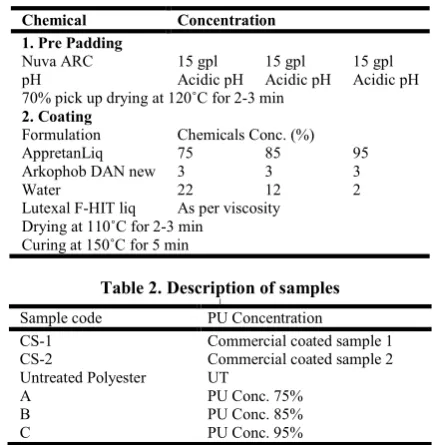
Coating technology was used for the application of the water based polyurethane to polyester fabric. Prior to coating fabric is padded with water repellent finish, (Nuva ARC). The type of coating was knife over roller coating, and the machine used was the lab scale coating machine (Taskar Engineering, Ahmadabad). The effect of variation in PU concentration in coating paste on the breathability of polyester was evaluated and three concentration of water based PU were used such as 75%, 85% and 95% along with water, fixer and thickener.
Table 1. Water based polyurethane coating recipe formulation
Chemical Concentration
1. Pre Padding
Nuva ARC 15 gpl 15 gpl 15 gpl pH Acidic pH Acidic pH Acidic pH 70% pick up drying at 120˚C for 2-3 min
2. Coating
Formulation Chemicals Conc. (%)
AppretanLiq 75 85 95
Arkophob DAN new 3 3 3
Water 22 12 2
Lutexal F-HIT liq As per viscosity Drying at 110˚C for 2-3 min
[image:2.595.323.540.67.290.2]Curing at 150˚C for 5 min
Table 2. Description of samples ]
Sample code PU Concentration
CS-1 Commercial coated sample 1 CS-2 Commercial coated sample 2 Untreated Polyester UT
A PU Conc. 75%
B PU Conc. 85%
C PU Conc. 95%
Testing
1. Viscosity and solid content of coating paste: Solid content of coating paste were determined by subjecting the paste to a temperature of 105°c for 4 hrs, till the constant weight was attained. Viscosity was measured using Brookfield Viscometer (Model DV2T, spindle SC4-25Z)
2. GSM and %Add on: Samples are conditioned to moisture equilibrium for the required time as specified in standard test method. Then weight per square meter is calculated using the following formula.
GSM = [{W/(X x Y)}x 1000 x 1000]
Where
GSM = Gram per square meter of the fabric, W = Weight of the specimen in gram. X = Average length of the swatch in mm,
Y = Average width of the swatch in mm. Based on the GSM % add on is calculated by following formula.
% add on= [{GSM after coating-GSM before coating)/ GSM before coating}x 100]
3. Tearing Strength (ASTM D1424): For the determination of tearing strength by the falling pendulum type apparatus, ASTM D1424 test method is used. This test method, using a falling-pendulum Elmendorf type apparatus, covers the determination of the force required to propagate a single-rip tear starting from a cut in a fabric.
4. Moisture vapour transmission rate (BS 7209): To test the breathability of fabrics, moisture vapour transmission rate measurement is made. To evaluate the MVTR of coated fabric, evaporative dish method following the British Standard BS 7209:1990 was used. The testing was carried out at standard laboratory conditions of 65±2% relative humidity and 20± 2° C temperature.
The MVTR values were calculated using the following
equations and measured in g/m2/day
MVTR= 24M/AT
Where
T, time between equilibrium and end of the test after 6 hours; and A, area of specimen exposed.
5. Hydrostatic head test (ISO 811): Hydrostatic head tester is used for determining the resistance of fabrics to water penetration. ISO 811 test method which is intended for dense fabrics like tarpaulins, tenting is used for testing.
6. Spray test (AATCC 22): Water proofness of coated fabric on both coated and uncoated side is tested by spray test (AATCC 22).
7. Moisture Management Test (AATCC 195): Moisture management properties of commercial and developed coated textile fabric are tested by AATCC 195 test method.
8. Air Permeability of coated fabric (ASTM D 737): This test method is for measuring the permeability of fabrics to air and is applicable to industrial fabrics that are permeable to air.
RESULTS AND DISCUSSION
[image:3.595.307.560.165.246.2]1. Viscosity and solid content: Viscosity (Model DV2T, spindle SC4-25) and Solid content of coating paste is reported in Table 3.
Table 3. Viscosity and solid content of coating paste
PU Concentration Spindle Speed (rpm) Viscosity (cP) Solid Content (%)
75% 10 13145 35.32
85% 15 15163 37.22
95% 30 17195 39.81
[image:3.595.310.554.375.448.2]2. GSM and %Add-on: In the case of commercial PU coated fabric, GSM ranges between 101.14 - 89.34. GSM of untreated polyester is 66.3. As the PU concentration increases from 75% to 95% add on increases from 13.34 to 17.20%. During process parameter optimization it is observed that optimum add-on is obtained when fabric is coated with 95% PU concentration and 150°C curing temperature and 5min curing time. Fabric coated at optimised parameters shows GSM of 77.71 giving 17.20% add-on after coating.
Table 4. GSM and % add-on of commercial and water based PU coated Polyester
Sample code GSM Add on
CS-1 101.14 -
CS-2 89.34 -
UT 66.3 -
A 75.15 13.34
B 76.25 15.00
C 77.71 17.20
3. Tearing Strength of water based PU coated Polyester:
From the results mentioned in the table no. 4, it is observed that after coating warp wise and weft wise tearing strength decrease significantly but the obtained tearing strength is comparable with the commercial sample. The tearing strength is more vital in heavy duty fabrics. So it is important to know the effects of the fabric structural parameters on the tearing resistance of these types of coated fabrics. Generally, high tearing strength is achieved by providing a degree of mobility for the fibres and yams within the structure. When a fabric is being torn, there is a concentration of stress at the apex of the tear. Some degree of mobility within the structure, particularly
[image:3.595.33.291.378.418.2]in shear, permits this stress to be distributed over a broader area, and permits the yarns to bunch together to resist the propagation of the tear. When a coating is applied over the fabric, the degree of mobility possible within the structure is almost invariably reduced. As a result, it is usually found that the tearing strength of the fabric reduced.
Table 5. Tearing strength of commercial andwater based PU coated Polyester
Sample code Tearing Strength Value (in cN)
Warp Weft
CS-1 1180.3 838.4
CS-2 1204.6 833.9
UT 1749.6 1102.46
A 1156.5 861.9
B 1177.3 847.7
C 1185.4 822.4
4. Moisture vapour transmission rate (BS 7209):
Commercially available PU solvent coated fabric shows
MVTR values in the range of 505.03- 401.23 g/m2 /day.
MVTR of untreated polyester is 1351.11g/m2 /day and fabric
coated at optimised parameters shows MVTR of 529.91 g/m2
/day. From the results it is observed that maximum Moisture vapour transmission rate is obtained when fabric is coated at 95% PU concentration.
Table 6. MVTR of commercial andwater based PU coated Polyester
Sample code Weight after WVP
1 hr. Testing (gm) 5 hrs. Testing (gm) 24M/AT (g/m2/day)
CS-1 132.78 132.21 505.03
CS-2 133.92 133.35 401.23
UT 132.840 131.320 1351.11
A 132.720 132.120 523.21
B 132.210 131.613 523.34
C 131.730 131.140 529.91
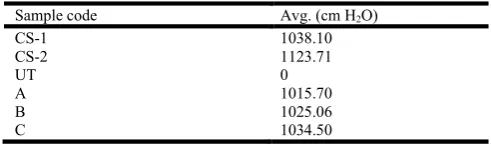
5. Hydrostatic head test (ISO 811): In hydrostatic head test, fabric is subjected to increasing hydrostatic pressure. When the third drop penetrates the specimen (drops on the edge are excluded), the actual height of the hydrostatic pressure is read and the test is terminated. According to ISO 811, materials with a hydrostatic head of more than 150 cm can be designated, in general, as rainproof/waterproof. Commercially available PU solvent coated fabric shows hydrostatic head values in the range of 1038.1-1123.71 cm whereas, hydrostatic head of untreated polyester is 0 cm and fabric coated at optimised parameters shows hydrostatic head of 264.50 cm. From the results obtained it is observed that as the concentration of PU increases hydrostatic head value increases.
Table 7/ Hydrostatic head test of commercial and water based PU coated Polyester
Sample code Avg. (cm H2O)
CS-1 1038.10
CS-2 1123.71
UT 0
A 1015.70
B 1025.06
C 1034.50
[image:3.595.34.290.571.647.2] [image:3.595.310.556.660.732.2]Developed coated sample shows 80 rating on uncoated side and coated side shows spray test rating of 70 with fabric coated with 75 and 85% PU concentration and at 95% PU concentration rating improves to 90. Optimum water proof nature is obtained when fabric is coated at 95% PU concentration.
7. Moisture Management Test (AATCC 195): Fabric liquid moisture transport properties in multi-dimensions, called moisture management properties significantly influence human perceptions of moisture sensation. This method can be used to quantitatively measure liquid moisture transfer in one step in a fabric in multiple directions. Moisture spreads on both surface of the fabric and transfer from one surface to the opposite. Ten indices are introduced to characterize the liquid moisture management properties of fabric. From the MMT test result it is observed that all developed coated samples are waterproof and their moisture management parameters are comparable with commercial solvent coated sample.
Air Permeability of coated fabric (ASTM D 737):
Resistance to wind penetration is usually assessed by measuring air permeability. The air permeability of textile fabrics is determined by the rate of flow of air passing perpendicularly through a given area of fabric is measured at a given pressure difference across the fabric test area over a given time period. The main aim of the studies of an air permeability of textile materials is usually to find a relationship between an air permeability and structure of textiles. The porosity has a very strong influence on uncoated textile materials air permeability. Air permeability is increased as pore size is increased.
The air permeability of coated fabrics is very low. The air permeability values of the coated samples were found to be orders of magnitude lower than the control (uncoated) fabric sample. The reduction in the air permeability values with increase in hydrophobic component suggests a continuous, defect-free film. The higher add-on values also gave better barriers to air penetration as expected.Commercially available PU solvent coated fabric shows air permeability values in the range of 0.1124- 0.12 cm3/cm2/s, whereas untreated polyester fabric shows air permeability value of 40.96. Maximum air permeability is obtained at 95% PU concentration.
Conclusion
[image:4.595.45.550.75.154.2]The demand for moisture management and highly breathable fabric constructions is growing at the same time regulatory pressures to reduce or eliminate solvents and VOCs remain strong globally. Water based PU emulsions offer a viable alternative to solvent-containing PU emulsion used to produce commercial waterproof breathable fabrics. The robust emulsion stability and functionality of these water based products provide new tools to meet the changing ecological and technical demands of the coated fabrics market. The environmentally friendly Water based PU coating technology opens a window of opportunity into a broad range of applications that go beyond the textile coating industry. By using Environment friendly water based Polyurethane, fixer and thickener a new coating formulation were developed. Developed coated fabric shows highest breathability, air permeability and water proofness performance at 95% PU concentration, 150°C curing temperature and 5 mins curing time. And the performance of the developed garment is
Table 8. Spray test rating of commercial and water based PU coated Polyester
Sample code Rating
Uncoated Side Coated Side
CS-1 100 70
CS-2 80 70
UT 0 0
A 80 70
B 80 70
[image:4.595.49.552.184.312.2]C 90 70
Table 9. Spray test rating of commercial and water based PU coated Polyester
S.N Fabric
Description
Wetting time (sec)
Absorption rate (%sec)
Max. Wetted radius (mm)
Spreading speed (mm/sec)
One way transport capability (OWTR)
Overall moisture management capacity (OMMC)
T B T B T B T B
1 CS-1 3 1 5 1 1 1 1 1 1 1
This is water-proof fabric.
2 CS-2 3 1 4.5 1 1 1 1 1 1 1
This is Water Proof fabric.
3 UT 5 5 2 3 2 2 5 5 5 5
This is water penetration fabric
4 A 2 1 5 1 1 1 1 1 1 4
This is water proof fabric
5 B 3 1 4 1 1 1 1 1 1 1
This is water proof fabric
6 C 3 1 4 1 1 1 1 1 1 1
This is water proof fabric
T-Top surface, B-Bottom surface
Table 10. Air permeability of commercial and water based PU coated Polyester
Sample code Air Permeability (cm3/cm2/s)
CS-1 0.120
CS-2 0.112
UT 40.96
A 1.188
B 0.351
[image:4.595.45.552.349.419.2]comparable with commercially available solvent based PU coated polyester.
Acknowledgement: The authors’ gratefully acknowledge the financial support received from Ministry of Textiles, Govt. of India for funding this research. Authors are also thankful to Archroma, Thane for proving their expert guidelines and chemicals required for the study specially we are thankful to Mr. Prabhat Trivedi, Mr. Alex Pandian, Mr. Rajesh Tendulkar and Ms. Pratima Pathak for their guidance.
REFERENCES
David A. Holmes 2000, Performance Characteristics of Waterproof Breathable Fabrics, JIT, Vol. 29(4), 306-316 Desai, V. M., Athawale, V. D. 1995. Water
Resistant-Breathable Hydrophilic Polyurethane Coatings, Journal of Coated Fabrics, 25(1), 39–46.
Dr. S. K.Chinta, Darbastwar Satish 2014. Studies in Waterproof Breathable Textiles, IJRDET, Vol. 3(2), 16-20
Jang, Jong Yoon, et al., 2002. Effect of process variables on
molecular weight and mechanical properties of water-based polyurethane dispersion, Colloids and Surfaces A: Physicochemical and Engineering Aspects, Vol. 196(2-3), 135–143.
Krishnan S. 1992. Technology of Breathable Coatings, Journal of Coated Fabrics, Vol. (22), 71-74.
Kyong Ah Hong, Hwa Sook Yoo, Eunae Kim, 2015. TRJ, Vol. 85(2), 160–170
Lomax G. R., 1991. Breathable, Waterproof Fabrics Explained, TIB, Vol. 20(4), 12-16.
Lomax, R. G. 1985. The Design of Waterproof, Water
Vapor-Permeable Fabrics. JIT, Vol.15(1), 41-46
ManjeetJassal, Amit Khungar and Pushpa Bajaj, 2004. Waterproof Breathable Polymeric Coatings Based On Polyurethanes, JIT, Vol. 33(4), 269-280
Mayer W., Mohr U. &Schuierer 1989. International Textile Bulletin, Vol.2, 18
Mukhopadhyay, A., Midha, V. K. 2008. A Review on Designing the Waterproof Breathable Fabrics Part I: Fundamental Principles and Designing Aspects of
Breathable Fabrics. JIT, Vol. 37(3), 229
Sanjay S. Chaudhari, Rupali S. Chitnis, Rekha Ramkrishnan, Waterproof Breathable Active Sports Wear Fabrics, The