1314
E-COMMERCE STRATEGY USING BY SUNK COST AND
MARKET ENTRY STRATEGY ON BRAND EXTENSION IN
THE ERA OF COMSUMPTION POLARIZATION
1JUNSIK KWAK
1 Associate Professor, Dongseo University, Division of Business, Busan, Korea
E-mail: 1[email protected]
ABSTRACT
The size of E-commerce and M-commerce is increasing day by day in the era of consumption polarization. As online commerce evolves, consumers have the opportunity to conveniently compare, analyze and shop more products. As competition intensifies, the likelihood of success for new products is decreasing, and companies are forced to consider brand extension strategies that leverage existing brands' reputations. Companies are using a "line extension" strategy to name existing brand name for new products in the same category, or a "category extension" strategy to name existing brand name (hereinafter “parent brand”) for new products in other categories. In the case of new products launched in other product category, similarity with parent brand is very important. On the other hand, when making decisions, people are influenced by the time and effort invested in the past, not the future benefits and costs. Sunk cost effect is the great tendency to continue past decisions regardless of changes in circumstances due to the time, effort, and money invested in the past. In this study, we examined whether the consumer’s evaluation of the extended product in online depends on sunk cost, similarity, and market entry strategy when the category extension is performed. As a result, the three way interaction effect of sunk cost, similarity and market entry strategy was significant in the purchase intention. Specifically, in the case of low similarity, the probability of purchasing the extended brand was high only in the condition of the sunk cost and acquisition of the related company. On the other hand, when the similarity is high, the probability of purchasing the extended brand was high only in the condition of the sunk cost and internal R&D. In the case of low similarity for new product success probability, it is found that there is the highest purchase intention with sunk cost and acquisition of the related company. However, in case of high similarity, there is no significant difference in success probability with conditions. This result suggests practical implications that it is effective to use different communication strategy depending on similarity, sunk cost, market entry strategy when launching extended brand.
Keywords: Extended Brand, Sunk Cost, Market Entry Method, Purchase Intension, Consumption Polarization
1. INTRODUCTION
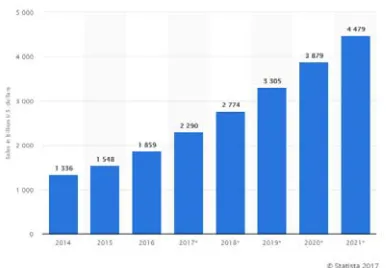
The off-line strategy in which consumers buy products face-to-face is changing into a way to collect and purchase product information virtually on-line, mobile, etc. with the advent of PCs and Smartphone in the era of consumption polarization. Due to the diversification of sales channels, consumers can select a sales channel when purchasing products according to their needs and distributors are achieving a qualitative improvement in consumption by operating an integrated channel with a simple increase in the number of channels. The growth of online shopping market and the integration of offline channels due to mobile are digitizing everyday life and creating new consumption trends. As a result, shopping trends
e-1315 commerce sales worldwide from 2014 to 2021 are expected to increase from 1,336 billion dollars to 4479 billion dollars.
Figure 1: retail e-commerce sales worldwide from 2014 to 2021 (source: https:// www.statista.com/statistics/
379046/worldwide-retail-e-commerce-sales)
Recently, there has been a surge in the number of Omni channel seller who utilize both online and offline channels. Square and Mercury Analytics conducted survey for 1,164 U.S. business owners in 2017. Square and Mercury Analytics asked them whether they are an Omni-channel seller. The survey results are as follows.
- 56% have a physical store
- 21% have a pop-up store or pop-up at events - 34% sell through their own website (using a website building platform)
- 25% sell through Facebook (40% on social media as a whole)
- 16% sell through Amazon (more should, considering almost half of purchases begin here) - 22% sell through other marketplaces (including Amazon, Etsy, eBay, etc.)
[Source: https://www.bigcommerce.com/blog/ecommerce-trends]
They found some interesting trend. First, Americans prefer to shop online than offline (51% vs. 49%). Second, 46% of American small businesses have no their own website even though E-commerce is growing 3% year-over-year. Third, brand is still important because 74% of Americans have bought some products at large online/offline brand name retailers.
While the cost of launching new products increases with the intensification of competition in the market, the probability of success is decreasing.
Companies use consumers' well-known brand awareness and favorable associations to reduce consumer anxiety due to the acceptance of new products [1]. To date, research on brand extension studies has been conducted extensively on factors that influence brand extension [2], and feedback effects on brand extension [3]. Since it has been very broad, it has made a lot of contributions both academically and practically. Existing studies have made many contributions both academically and practically. As a result of the previous research, it was found that the evaluation of the extended brand was more favorable when the extension was made to the product category with high similarity. However, there is a lack of research on the factors that have a positive effect on the extended brand when expanding to the low similarity category [4]. Therefore, in this study, we examined the factors that have a positive effect on expanding the brand into the low similarity category. Especially, we focused on how the sunk cost and market entry strategy affect the extended brand evaluation.
2. THEORETICAL BACKGROUND
2.1 Brand Extension
In the study of brand extensions carried out so far, it is common that fit or similarity between parent brand and extended brand has the greatest influence on extended brand evaluation. The fit and similarity between parent brand and extended product, which have an important influence on the extended brand evaluation, are largely classified according to feature based similarity [1], usage based similarity [5], concept similarity [6], and goal (purpose) similarity [5] First, the feature based similarity is that the extended brand is more favorable when as extended brand share more common attributes of parent brand. In other words, when there are many common attributes, the positive affect or brand association of the parent brand is better transferred to the extended brand, so the higher the feature based similarity, the more favorable the extended brand is.
1316 feature based similarity. Especially when the brand is extended to complementary products such as coffee and creamer, razors and shaving cream, the evaluation of extended brand becomes more favorable [7].
Third, concept consistency is that the consumer judges the parent brand and the extended brand more similar if the image or concept between the parent brand and the extended brand is similar even though the shared attribute is low. However, this concept consistency is more pronounced in prestige oriented products than functional oriented ones [6].
Lastly, Goal based similarity is the highest concept. When the parent brand and the extended brand have a common goal, consumers judge the parent brand and the extended brand to be more similar. It is a more comprehensive concept than one attribute, usage context, and concept similarity [5]. The results of previous studies show that the parent brand’s favorable attitude (associative content, emotions, etc.) is better transferred to the extended brand when the similarity (attribute, use situation, concept, and goal) of parent brand and extended product is higher. Therefore, the higher the similarity, the more positive the evaluation of extended brand. On the other hand, even in the case of low similar extensions, extended brand evaluation is favorable when given positive information with high diagnostic value for extended brand. This is because positive information is evaluated more as a diagnostic than negative information about extended brand to consumers in low similar extension [3]. In other words, in a low similar extension situation, consumers have negative associations or beliefs about extended brands due to low similarity. If a positive evaluation of a low similar extended brand is presented to the consumer, the negative associations and beliefs of the low similar extended brand are reduced. In addition, even if it is a low similar extension, the extended brand evaluation can be changed depending on whether the extended brand is released in the near future or in the far future [8]. In the case of the distant future, people evaluate the low similar extended brand negatively because it is based on desirability. In the near future, the similarity between the parent brand and the extended brand is higher due to the conservative generalization tendency (Day and Bartels 2008), in which people tend to perceive the similarity between events in the near future. The extended brand is evaluated positively.
2.2 Sunk Cost Effect
In general, in economics, sunk cost refers to irreversible costs that cannot be recovered from the costs incurred after making a decision. [9] Sunk cost is not only the historical cost of making decisions in the past, but also the costs that cannot be changed by current and future decisions. Therefore, it is a reasonable decision to not consider the sunk cost when making a decision. This is because reasonable decisions must be made only by the difference between the incremental costs and the incremental benefits that occur after the present, not the past investments. But, people have greater tendency to keep prior decision regardless of change situation after having invested time, effort, and money. This is called the 'sunk cost effect'. [10] From a reasonable and rational point of view, the sunk cost effect is a very irrational behavior of decision maker. Because the sunk cost effect is the act of discarding money after the wrong investment, the decision maker should be careful not to be affected by the sunk cost effect. The sunk cost effect is a very powerful effect that occurs in various situations such as the context of personal decision making [11], judgment in waiting [12], gambling [13], Decision making [14], financial decision making [15]. The sunk cost effect also occurs in situations where the performance of an employee is measured [16]. Let's take a look at the scenario that Arkes and Blumer used in the study of sunk cost effects. “You are a president of an airplane manufacturing company. You can invest $ 10 million in the company's research of radar blank plane. This project is aim to make a radar-blank plane that is not caught by ordinary radar. When the project is 90% complete, other companies began release radar blank plane. Also, the company's plane is faster and more economical than the plane you are making. (Question) Do you want to invest 1 million research funds to make your radar blank plane?” [9] Investing the remaining $ 1 million in this situation is irrational. However, the results were very impressive. If there is no investment cost, only 17% (10 out of 60) of participants made decision to invest 1 million dollars. But 85% (41 out of 48) of participants have invested 1 million dollars of their research funds to complete the project.
1317 come to the theater than those who purchased the commuter pass with discount. Every price ($8, $13, $15) is the money that they paid in the past, so they should not be affected by the use of the theater.
The result, however, was that the person who purchased the commuter pass at the regular price use more theater for the first six months than the person who purchased the commuter pass with discounted price because they do not want to waste money. In other words, when people invest money and do not consume purchased resources, they regret watching the wasted resources. So once you invest money, you try to consume it.
This sunk cost effect appears even when seeking advice to other people, but it becomes more apparent when making decisions.
2.3 Market Entry Method
There are two ways that companies use to enter new markets. First, it is to acquire related technology through self-research and development for a long time. However, this strategy is time-consuming and can miss market opportunities. The second way to enter a new market is to take over a company that has done business for a long time in the market you want to enter. Although this strategy is costly, it has the advantage that it can acquire related technology in a short time. Indeed, large corporations around the world have been expanding their businesses this way in the early days. For example, Google acquired YouTube in 2006 for $ 1.65 billion. At the time of the acquisition, there was criticism that it was too expensive, but YouTube sold $ 6 billion in sales in 2015. The artificial intelligence company Deep Mind, acquired in 2014, developed AlphaGo and sprinkled topics. Samsung Electronics also succeeded “Samsung Pay” in the mobile payment market thanks to the US Company “Loop Pay”, which was acquired in 2015.
So how does the sunk cost and market entry affect the evaluation of extended brand? In general, people will consider how well company know about new products and how much resources company have invested in evaluating new products. The sunk cost will show how much resources the company has invested in. In addition the way of entering the market, especially acquisitions, will show how much know-how the company has for new products. Therefore, the sunk cost and related acquisitions could have a positive impact on the extended brand evaluation. Furthermore, these effects will be greater when new products are launched in categories with less similarity than
when they are launched in a category with a high similarity.
H1. Similarity, sunk cost and market entry strategy affects the evaluation of extended brand
H2. Similarity, sunk cost and market entry strategy affects the purchase intension of extended brand
H3. Similarity, sunk cost and market entry strategy affects the success probability of extended brand
3. ONLINE SURVEY
3.1 Participants
This study was started to investigate the effect of the sunk cost and market entry method on brand extension. The purpose of this study is to investigate the purchase intention of the extended brand. So children and teenagers were excluded from the actual survey. A total of 200 people attended the experiment through an online survey A total of 178 respondents except the 22 unfairly respondents were analyzed. The demographic profile of the participant is as follows. Male (48.3%) and female (51.7%) participated in the study. 20s (26.4%), 30s (19.7%), 40s (25.8%), over 50s (28.1%) participated in the age groups. Students (10.7%), workers (62.9%), housewives (12.4%) and others (14%) participated in the occupation. As a result of analyzing the groups by age, sex and occupation, the evaluation of extended products by group did not differ greatly. Therefore, in the final analysis, the analysis was conducted as one group.
3.2 Procedure
1318 Table 1: Conditional Scenarios
1. Low similarity, no sunk cost, internal R&D Hewlett-Packard (HP) enters the sporting goods market
- Various sports goods will be released
- Plan to scout a large number of sports equipment specialists next week.
2. Low similarity, no sunk cost, external acquisition Hewlett-Packard (HP) enters the sporting goods market
- Various sports goods will be released
- Plan to acquire a sporting goods manufacturing company next week
3. Low similarity, sunk cost, internal R&D
Hewlett-Packard (HP) enters the sporting goods market
- Various sports goods will be released
- This year, 20 billion won will be spent on large-scale scouts
4. Low similarity, sunk cost, external acquisition Hewlett-Packard (HP) enters the sporting goods market
- Various sports goods will be released
- Acquired a sporting goods production company with 20 billion won this year
5. High similarity, no sunk cost, internal R&D Hewlett-Packard (HP) enters the computer furniture market
- Various computer furniture will be released - Plan to scout a large number of computer furniture specialists next week.
6. High similarity, no sunk cost, external acquisition Hewlett-Packard (HP) enters the computer furniture market
- Various sports goods will be released
- Plan to acquire a computer furniture manufacturing company next week
7. High similarity, sunk cost, internal R&D
Hewlett-Packard (HP) enters the computer furniture market
- Various computer furniture will be released - This year, 20 billion won will be spent on large-scale scouts
8. High similarity, sunk cost, external acquisition
Hewlett-Packard (HP) enters the computer furniture market
- Various computer furniture will be released - Acquired a computer furniture production company with 20 billion won this year
After viewing the scenario, respondents answered the following questions. What do you think about new HP products?(2 items), If you are interested in purchasing related products, would you like to purchase a new HP product?(2 items), How much do you think the success rate of new HP products is ?(1 item), What do you think about the relevance of new products to HP and HP? (3 items), What do you usually think about the "HP" brand? (2 items), If you look at the article, "HP" Do you have any previous investment to enter new business? (Manipulation check item)
3.3 Results
3.3.1 Evaluation of extended brand
First, we examined the effect of similarity, sunk cost, and market entry strategy on extended brand evaluation. For the analysis, the covariance was included in the usual HP evaluation. as shown in Table 2, the main effect of similarity was not significant (F (1,169) = 2.398, p = .123). There was no difference in the evaluation of new products in the high similarity (computer furniture M = 3.74) and in low similarity (sporting goods, M = 3.51). The main effect of sunk cost was not significant (F (1,169) = .158, p = .691). There was no difference in the evaluation of new products in sunk cost condition (M = 3.64) and in no sunk cost condition (M = 3.60). The main effect of market entry strategy was not significant (F (1,169) = .027, p = .870). There was no difference in the evaluation of new products in the internal R&D condition (M = 3.59) and in the external acquisition condition (M = 3.65).
1319 Table 2: Purchase Intension By Similarity, Sunk Cost,
And Market Entry Strategy
Source
Type III Sum of Squares
df Mean
Squares F sig
corrected model 35.842 8 4.480 7.692 .000
intercept 18.744 1 18.744 32.180 .000
hp 31.167 1 31.167 53.508 .000
similarity (Sim) 1.397 1 1.397 2.398 .123
sunk cost (SC) .092 1 .092 .158 .691
market entry
strategy(MEM) .016 1 .016 .027 .870
Sim * SC .105 1 .105 .180 .672
Sim * MEM 1.472 1 1.472 2.527 .114
SC * MEM .020 1 .020 .034 .854
Sim * SC * MEM 1.388 1 1.388 2.383 .125
Error 98.439 169 .582
Total 2471.5 178
Corrected Total 134.281 177
3.3.2 Purchase intension of extended brand Second, we examined the effect of similarity, sunk cost, and market entry strategy on purchase intention of extended brand. For the analysis, the covariance was included in the usual HP evaluation.
As shown in Table 3, the main effect of similarity was not significant (F (1,169) = 652, p = .105). There was no difference in the evaluation of new products in the high similarity (computer furniture M = 3.70) and in low similarity (sporting goods, M = 3.45). The main effect of sunk cost was not significant (F (1,169) = .277, p = .599). There was no difference in the evaluation of new products in sunk cost condition (M = 3.67) and in no sunk cost condition (M = 3.51). The main effect of market entry strategy was not significant (F (1,169) = .143, p = .706). There was no difference in the evaluation of new products in the internal R&D condition (M = 3.57) and in the external acquisition condition (M = 3.56). The two way interaction of similarity and sunk cost is not significant (F(1,169)=.063, p=.802). The two way interaction of similarity and market entry strategy is not significant (F(1,169)=978, p=.324). The two way interaction of sunk cost and market entry strategy is not significant (F(1,169)=.053, p=.818). But, as shown in Table 3, three way interaction of similarity, sunk cost, and market entry strategy is significant (F(1,169)=4.240, p=.041) .
Table 3: Purchase Intension By Similarity, Sunk Cost, And Market Entry Strategy
Source Type III Sum of
Squares df
Mean
Squares F sig
corrected model 39.989a 8 4.999 7.606 .000
intercept 15.931 1 15.931 24.241 .000
hp 33.912 1 33.912 51.602 .000
similarity (Sim) 1.743 1 1.743 2.652 .105
sunk cost (SC) .182 1 .182 .277 .599
market entry
strategy(MEM) .094 1 .094 .143 .706
Sim * SC .041 1 .041 .063 .802
Sim * MEM .643 1 .643 .978 .324
SC * MEM .035 1 .035 .053 .818
Sim * SC *
MEM 2.786 1 2.786 4.240 .041
Error 111.062 169 .657
Total 2423.500 178
Corrected Total 151.051 177
In detail, as shown in <Figure 2>, in the case of low similarity, sunk cost and external acquisition condition (M=3.7) has the highest purchase intention than no sunk cost and internal R&D (M=3.4), no sunk cost and external acquisition (M=3.4), and sunk cost and internal R&D (M=3.4).
Figure 2: Purchase Intention In Low Similarity
[image:6.612.337.501.452.601.2]1320 business that has been doing business for a long time may have a more positive impact on consumer evaluation.
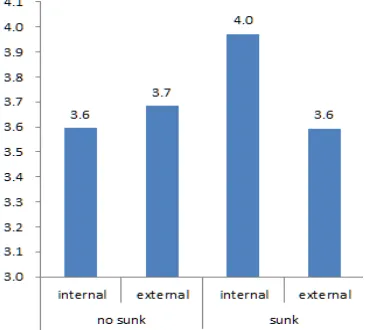
[image:7.612.104.290.201.366.2]Meanwhile, as shown in <Figure 3>, in the case of high similarity, sunk cost and internal R& (M=4.0) has the highest purchase intention than no sunk cost and internal R&D (M=3.6), no sunk cost and external acquisition (M=3.7), and sunk cost and external acquisition (M=3.6)
Figure 3: Purchase Intention In High Similarity
These results suggest that if a brand is extended to a high similar product category, the consumer will think that the company has some degree of expertise. Therefore, rather than acquiring other companies with heterogeneous cultures, developing internally and launching new products will have a more positive impact on the intention to purchase extended brands.
3.3.3 Success probability of extended brand
Lastly, we examined the effect of similarity, sunk cost, and market entry strategy on success probability of extended brand. For the analysis, the covariance was included in the usual HP evaluation. The main effect of similarity was not significant (F (1,169) = 4.891, p = .028). That is, people were more likely to succeed in products with high similar (sporting goods, M=47.13%) than products with low similarity ((computer furniture M=54.72%). The main effect of sunk cost was not significant (F (1,169) =1.663, p = .199). There was no difference in the evaluation of new products in sunk cost condition (M = 48.94%) and in no sunk cost condition (M = 54%). The main effect of market entry strategy was not significant (F (1,169) = 1.266, p = .262). There was no difference in the evaluation of new products in the internal R&D
condition (M = 49.05%) and in the external acquisition condition (M = 52.71%).
The two way interaction of similarity and sunk cost is not significant (F(1,169)=.619, p=.432). The two way interaction of similarity and market entry strategy is significant (F(1,169)=4.087, p=..045). The two way interaction of sunk cost and market entry strategy is not significant (F(1,169)=.035, p=.852). Three way interaction of similarity, sunk cost, and market entry strategy is significant (F(1,169)=1.227, p=.270) .
Table 3: Purchase Intension By Similarity, Sunk Cost, And Market Entry Strategy
Source Type III Sum of
Squares df
Mean
Squares F sig
corrected model 11859.9 8 1482.4 4.337 .000
intercept 3987.5 1 3987.5 11.666 .001
hp 6035.1 1 6035.1 17.656 .000
similarity (Sim) 1671.9 1 1671.9 4.891 .028
sunk cost (SC) 568.3 1 568.3 1.663 .199
market entry
strategy (MEM) 432.7 1 432.7 1.266 .262
Sim * SC 211.6 1 211.6 .619 .432
Sim * MEM 1397.1 1 1397.1 4.087 .045
SC * MEM 11.8 1 11.8 .035 .852
Sim * SC * MEM 419.4 1 419.4 1.227 .270
Error 57767.6 169 341.8
Total 529754 178
Corrected Total 69627.5 177
[image:7.612.310.526.236.466.2]In detail, as shown in <Figure 3>, in the case of low similarity, external acquisition condition (M=51.56%) has the higher success than internal R&D (M=42.87). in the case of high similarity, there is no significant difference between external acquisition (M=53.77%) and internal R&D (M=55.66%).
1321 4. CONCLUSION AND LIMITATION
As competition intensifies, companies are struggling with a variety of ways to lower risk and increase their chances of success. Brand extension is one of the ways to solve the problems of these companies. However, as discussed in the previous research results, it is not clear that companies can only expand to similar fields as existing brands. Companies want to expand their brands to areas that are far from well-known areas. Therefore, company needs a strategy that can be applied to similar extension as well as low similar extension.
So far, much research has been done on brand extension. Based on the existing research, it was found that similarity or fit between parent brand and extended brand affects extended brand evaluation. Also, similarity was divided into function, image, use situation and goal similarity. Furthermore, there are studies on the moderating variables affecting the extended brand. However, there have been few studies on the effects of the sunk cost and market entry method on the brand extension. Therefore, it is meaningful to understand the effect of the sunk cost and the market entry method on the extended brand evaluation.
In this study, we examined the factors that may influence the evaluation of extended brand. The first is the sunk cost. As sunk cost effect, people tend to consider past investments when they make a decision. The sunk cost is a cost that cannot be recovered, but it also shows the willingness to do something. In this study, we examined the influence of the "will" of the buried cost on the extended brand evaluation. The second factor affecting the extended brand evaluation is the corporate strategy to enter the new market. In other words, when trying to enter into other fields than existing business, the way that companies can choose is to develop internal human resources or acquire external companies. Developing internal human resources is not costly, but it is time consuming. But acquiring a business takes less time, but is costly. Therefore, companies should establish appropriate market entry strategies in accordance with the characteristics of the business they are trying to enter.
The results that similarity, sunk cost, and market entry strategy influence on the extended brand evaluation are as follow. First, it was found that the brand extension similarity, sunk cost, and market entry strategy were not significant when evaluating new products. Second, similarity, sunk cost, and market entry strategy influence on the purchase intension of extended brand. That, in the
case of low similarity, sunk cost and external acquisition condition has the highest purchase intention than other conditions. This result suggests that acquiring other company is effective in inducing a positive evaluation of consumers when the brand is extended to category with a low similarity. Meanwhile, sunk cost and internal R&D condition has the highest purchase intention than other conditions in the case of low similarity. This result suggests that developing human resources is effective in inducing a positive evaluation of consumers when the brand is extended to category with a high similarity. Third, similarity and market entry strategy influence on the success probability of extended brand. Consumers think that internal R & D is more likely to succeed than external acquisition in low similar extension.
There are some limitations to this study. First, care should be taken to generalize this result because the research was conducted only on HP products. In addition, since HP is recognized as a computer-related company, expansion to other areas is not easy. In the previous studies, it was found that firms with high typicality had a lot of restrictions on brand extension. For example, in the case of Kleenex, which is representative of tissue paper, even if other products are made, it is easy to cause negative associations due to association with toilet paper. On the other hand, symbolic products such as Mont Blanc can be extended to almost all luxury products such as fountain pens, bags, belts and clothing. Therefore, in future research, it will be necessary to verify whether the sunk cost and the market entry strategy have the same effect in the case of symbol products such as Mont Blanc.
Second, In this study, HP manipulated similarities by making sporting goods and computer furniture. However, since there is not much difference in similarity between sporting goods and computer furniture, it may be necessary to select a product group that has a similarity to each other more clearly.
Third, this study was conducted through on line surveys, so it was not properly controlled for the participants. Although manipulation check items are used to exclude respondents who have responded inappropriately, experiments may need to be conducted under more stringent conditions.
1322 Samsung's entry into the mobile payment market after acquiring Loop Pay is a good example of "low similar, sunk cost, and external acquisition" in this study. On the other hand, scouting new workforce and relocating personnel within the group when creating e-Samsung would be an example of "low similar, sunk cost, and internal R & D". Therefore, by selecting a suitable company for each sector and measuring the performance of the company from a longer-term perspective, it will be possible to grasp the flow of changes in customer evaluation in the market rather than at a specific point in time.
Finally, it is necessary to clarify more clearly the role of sunk cost in future research. In this study, we shared the sunk cost conditions based on the fact that we invested in the past and that we will invest in the future. In this study, however, if the sunk cost is showing the company's "willingness" to expand its business into an irrelevant sector, It is likely that it can tell the same message to your customers that you have already invested and will invest. In this study, considering the fact that the effect of the sunk cost is not shown, it is necessary to clarify this point more clearly in future studies.
ACKNOWLEDGEMENT:
This work was supported by the Ministry of Education of the Republic of Korea and the National Research Foundation of Korea (NRF-2017S1A5A2A01026639)
REFRENCES:
[1] Reddy, Srinvas K., Susan L. Holak, and Subodh Bhat, "To Extend or Not to Extend: Success Determinants of Line Extensions," Journal of
Marketing Research, Vol. 31, May, 1994,
242-262.
[2] Aaker, David and Kevin Lane Keller, "Consumer Evaluations of Brand Extension,"
Journal of Marketing, Vol. 54, January, 1990,
27-41.
[3] Ahluwalia, Rohini and Zeynep Gurhan-Canli, "The Effects of Extensions on the Family Brand Name: An Accessibility- Diagnosticity Perspective," Journal of Consumer Research, Vol 27, Dec, 2000, 371-381.
[4] Kwak, Junsik, “How does the sunk cost affect brand extension communication”, ICCCA 2017,
Proceedings.
[5] Martin, Ingrid M. and David W. Stewart, "The Differential Impact of Goal Congruency on Attitudes, Intentions, and the Transfer of Brand
Equity," Journal of Marketing Research, Vol.38, November, 2001, 471-484.
[6] Park, C Whan, Sandra Milberg, and Robert Lawson, "Evaluation of Brand Extensions: The Role of Product Feature Similarity and Brand Concept Consistency," Journal of Consumer Research, Vol.18, September, 1991, 185-193. [7] Chakravarti, Dipankar, Deborah J. MacInnis,
and Kent Nakamoto, "Product Category Perception, Elaborative Processing and Brand Name Extension Strategies," in Advances in
Consumer Research, Vol. 16, 1990, 910-916.
[8] Kwak, Junsik, “The Effect of Temporal Distance on the Evaluation of Similarity and Extended Brand: Focusing on Temporal Construal Theory,” Journal of Marketing
Management Research, Vol. 13, No.4, 2008,
57-70
[9] H. S. Arkes and C. Blumer, “The psychology of sunk costs,” Organizational Behavior and
Human Decision Processes, vol. 35, 1985, pp.
124-140,
[10] R. H. Thaler, “Toward a Positive Theory of Consumer Choice,” Journal of Economic
Behavior and Organization, vol. 1, 1980,
pp.39-60.
[11] G. B. Northcraft and M. A. Neale, “Opportunity Costs and The Framing of Resource Allocation Decisions,” Organizational Behavior and
Human Decision Processes, vol.37, 1986,
pp.348-356.
[12] J. Z. Rubin and J. Brockner(1975), “Factors affecting entrapment in waiting situations: The Resencrantz and Gulidenstern Effect,” Journal
of Personality and Social Psychology, vol.31,
1975, pp.1054-1063.
[13] H. R. Arkes and P. Ayton, “The Sunk Cost and Concorde Effects: Are humans less rational than lower animals?” Psychological Bulletin, vol.125, no.5, 1999, pp.591-600.
[14] B. E. McCain, B. E. “Continuing Investment under Conditions of Failure: A Laboratory Study of Limits to Escalation,” Journal of
Applied Psychology, vol.71, 1986, pp.280-284.
[15] B. M. Staw and J. Ross, “Behavior in Escalation Situations: Antecedents, Prototypes, and Solution,” in Research in Organizational Behavior, edited by S. Cummings and B. Staw. Greenwich, Conn.: JAI Press, 1987.