ISSN Online: 2327-5960 ISSN Print: 2327-5952
The Complementary Stereotypes about the
Rich and the Poor: A Study in China
Su Tao, Lijun Ha, Cancan Yuan
School of Marxism, China University of Geosciences (Beijing), Beijing, China
Abstract
This research aims to investigate the contents and characteristics of stereotypes about the rich and the poor groups of the public. One hundred and fifty two participants freely report 2813 words of stereotypes about the rich and the poor. Results show that, the contents of stereotypes about the rich and the poor consist of three dimen-sions which are competence, sociability and morality. Generally, the rich has been seen as high competence, low sociability and bad morality, while the poor has been seen as low competence, mid sociability and good morality. The valences between competence and morality are negatively correlated, which means the stereotypes of competence and morality are complementary. The utilitarianism and pragmatism explanations and the system justification theory are discussed.
Keywords
Stereotype, Stereotype Content Model, Complementary, The Rich and the Poor
1. Introduction
Stereotype is a cognitive structure consisting of the perceiver’s knowledge, beliefs and expectation about a social group. It’s a relatively fixed concept or view of the characte-ristics and causes of a group member [1]. As a specific schema, it plays an important role in people’s social cognition and behavior. For the purpose of saving cognitive re-sources and promoting cognitive processing, people will tend to adopt cognitive short-cuts to directly determine their coping styles according to the social category to which the target belong.
Since the cognitive processing mechanism of stereotypes needs to be verified in dif-ferent cases, many researchers began to simplify the description of stereotypes and try to distinguish social groups by only a few dimensions. The most influential model is the
How to cite this paper: Tao, S., Ha, L.J. and Yuan, C.C. (2016) The Complementary Stereotypes about the Rich and the Poor: A Study in China. Open Journal of Social Sci- ences, 4, 113-122.
http://dx.doi.org/10.4236/jss.2016.411009
Received: October 21, 2016 Accepted: November 22, 2016 Published: November 25, 2016
Copyright © 2016 by authors and Scientific Research Publishing Inc. This work is licensed under the Creative Commons Attribution International License (CC BY 4.0).
stereotype content model (SCM) proposed by Fiske et al. [2]. The model is a two- dimensional model consisted with warmth and competence. The content of stereotype is combined of these two dimensions. Warmth and competence derive from the per-ception of social status. The relative position of groups in social status can predict their interrelationships on warmth and competence. Low competitive groups are considered to be warmth, while high competitive groups are not; high-status groups are considered as high competence, while low-status groups are not. Since the two dimensions are so important, the relationship between them is also a widely discussed issue. The SCM points out that, stereotypes are contradictory and mixed, consisting of a positive evalu-ation of one dimension and a negative evaluevalu-ation of another. Many groups are seen as competent but not warmth (e.g. Asians, Jews and the rich) or warmth but incompetent (e.g. disabled, elderly and housewives); some groups are low in both dimensions (Poor and homeless); only the reference group, which is the in-group or the social prototypi-cal group (middle-class white), is rated as “double-high” [3]. In recent years, research-ers try to explore the relationship between warmth and competence. Results show that the social perception of warmth and competence often show a compensatory relation-ship [4]. In another word, people tend to perceive some groups are warmth and in-competent, while other groups are competent but not warmth.
2. Methodology
2.1. ParticipantsOne hundred and fifty two participants are involved, 69 males and 83 females, aged from 20 to 47 with average of 31.42 ± 5.73. The participants are selected from 28 pro-fessions, such as government staff, business managers, office workers, doctors, teachers, sales staff, technical staff, students, freelancers etc.; covering 24 provinces and auto-nomous regions, such as Beijing, Shanghai, Tianjin, Guangxi, Heilongjiang, Jiangxi, Hunan etc.
All the participants are middle social status in China (annual household income from 80,000 to 350,000 RMB, average of 13.31 ± 4.32 million RMB). Those are ordinary people in China, not belonging to the rich or the poor. Number of the sample is based on the criteria that almost no new stereotype words are reported and the dimensions tend to be stable.
2.2. Methods
The participants were asked to write 10 adjectives to describe the basic characteristics of the poor and the rich. Each participant was asked to rate both groups. The sequence is balanced, that half of them evaluate the rich first and the others evaluate the poor first.
3. Results
3.1. The Dimensions of Stereotypes
A total of 2813 adjectives were obtained, including 1382 words describing the rich and 1431 words describing the poor. Some of these words do not meet the requirements of this study: some words describe the living conditions of the poor and the rich, such as “rich”, “stimulate domestic demand”, “luxury car and beauty”, “life distress” etc.; some describe the image of the poor and the rich, such as “dressed”, “belly”, “short stature”, “short hair” etc. Removed these invalid words, 2716 words finally left, which are 1317 words for the rich and 1399 words for the poor.
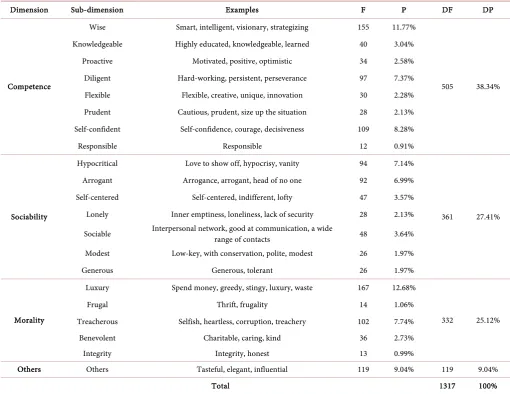
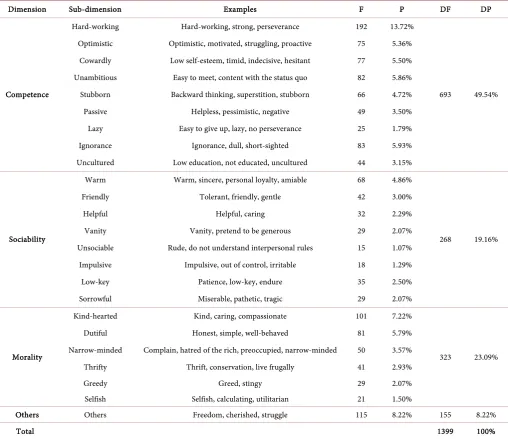
The adjectives were analyzed by NVivo 8.0 qualitative data analysis software, and three-level registration was conducted according to the rooting theory. Comparing with the SCM, three core conceptual dimensions were extracted from the characteristics of the rich and the poor, which are competence, sociability and morality. Each dimension contains 5 to 9 specific characteristics, having both positive components and negative components (see Table 1 and Table 2).
The first dimension of the stereotypes about the poor and the rich is competence, which is consistent with the SCM. It describes intelligence, ability and mentality of the group. The rich are described as intelligent, self-confident, motivated, hard-working, active, knowledgeable, flexible and innovative; while the poor are described as not edu-cated, conservative, pessimism, laziness, low capacity, but hard-working and strong.
sociability. The rich are described as arrogant, supercilious, hypocrisy, indifference and showing off. They have good communication skills, but developing relationships only for utilitarian purposes and calculating. The poor are described as warm, kind, toler-ance and affinity. They are willing to help others, but vanity and impulse.
About 1/4 of the words cannot be classified as the competence or sociability. They are moral judgments about the life style, behavior and value of the groups, can be named as morality. Most people considered the rich as greedy, corrupt, treacherous and extravagant. They are spendthrift, but also showed some charity and integrity. The poor are considered to be good, kind-hearted, honest, but selfish, calculations and nar-row-minded.
3.2. The Valences of Stereotypes
[image:4.595.42.553.296.690.2]In order to measure the stereotypes about the rich and the poor more accurately, the
Table 1. Coding of stereotypical adjectives about the rich.
Dimension Sub-dimension Examples F P DF DP
Competence
Wise Smart, intelligent, visionary, strategizing 155 11.77%
505 38.34% Knowledgeable Highly educated, knowledgeable, learned 40 3.04%
Proactive Motivated, positive, optimistic 34 2.58%
Diligent Hard-working, persistent, perseverance 97 7.37% Flexible Flexible, creative, unique, innovation 30 2.28% Prudent Cautious, prudent, size up the situation 28 2.13% Self-confident Self-confidence, courage, decisiveness 109 8.28%
Responsible Responsible 12 0.91%
Sociability
Hypocritical Love to show off, hypocrisy, vanity 94 7.14%
361 27.41% Arrogant Arrogance, arrogant, head of no one 92 6.99%
Self-centered Self-centered, indifferent, lofty 47 3.57% Lonely Inner emptiness, loneliness, lack of security 28 2.13%
Sociable Interpersonal network, good at communication, a wide range of contacts 48 3.64%
Modest Low-key, with conservation, polite, modest 26 1.97%
Generous Generous, tolerant 26 1.97%
Morality
Luxury Spend money, greedy, stingy, luxury, waste 167 12.68%
332 25.12%
Frugal Thrift, frugality 14 1.06%
Treacherous Selfish, heartless, corruption, treachery 102 7.74%
Benevolent Charitable, caring, kind 36 2.73%
Integrity Integrity, honest 13 0.99%
Others Others Tasteful, elegant, influential 119 9.04% 119 9.04%
Total 1317 100%
Table 2. Coding of stereotypical adjectives about the poor.
Dimension Sub-dimension Examples F P DF DP
Competence
Hard-working Hard-working, strong, perseverance 192 13.72%
693 49.54% Optimistic Optimistic, motivated, struggling, proactive 75 5.36%
Cowardly Low self-esteem, timid, indecisive, hesitant 77 5.50% Unambitious Easy to meet, content with the status quo 82 5.86% Stubborn Backward thinking, superstition, stubborn 66 4.72%
Passive Helpless, pessimistic, negative 49 3.50%
Lazy Easy to give up, lazy, no perseverance 25 1.79%
Ignorance Ignorance, dull, short-sighted 83 5.93%
Uncultured Low education, not educated, uncultured 44 3.15%
Sociability
Warm Warm, sincere, personal loyalty, amiable 68 4.86%
268 19.16%
Friendly Tolerant, friendly, gentle 42 3.00%
Helpful Helpful, caring 32 2.29%
Vanity Vanity, pretend to be generous 29 2.07%
Unsociable Rude, do not understand interpersonal rules 15 1.07% Impulsive Impulsive, out of control, irritable 18 1.29%
Low-key Patience, low-key, endure 35 2.50%
Sorrowful Miserable, pathetic, tragic 29 2.07%
Morality
Kind-hearted Kind, caring, compassionate 101 7.22%
323 23.09%
Dutiful Honest, simple, well-behaved 81 5.79%
Narrow-minded Complain, hatred of the rich, preoccupied, narrow-minded 50 3.57% Thrifty Thrift, conservation, live frugally 41 2.93%
Greedy Greed, stingy 29 2.07%
Selfish Selfish, calculating, utilitarian 21 1.50%
Others Others Freedom, cherished, struggle 115 8.22% 155 8.22%
Total 1399 100%
positive and negative level of each word was rated by two researchers on a 7 points score, which is −3 (extremely negative) to 3 (extremely positive). The interrater reliabil-ity r = 0.93. The average score of two raters is used as the valence of each word. The va-lences are added respectively on the competence, sociability and morality dimensions. The overall valence is total of all three dimensions. The descriptive statistics of each dimension and overall are shown in Table 3.
Table 3. Descriptive statistics of the stereotypes valences (N = 152).
Dimension Competence Sociability Morality Overall
M SD M SD M SD M SD
The rich 1.58 0.75 −0.67 1.43 −1.37 0.92 −0.02 0.89 The poor −0.88 0.94 0.14 1.27 1.34 0.96 0.10 0.91
Table 4. Correlation between the stereotypes valences (N = 152).
The rich The poor
Com Soc Mor Com Soc Mor
Com 1 Com 1
Soc −0.181** 1 Soc −0.391*** 1
Mor −0.213** 0.104 1 Mor −0.091 0.266** 1
Note: Com = competence, Soc = Sociability, Mor = Morality; *p < 0.05, **p < 0.01, ***p < 0.001.
3.3. The Complementary Characteristics of Stereotypes
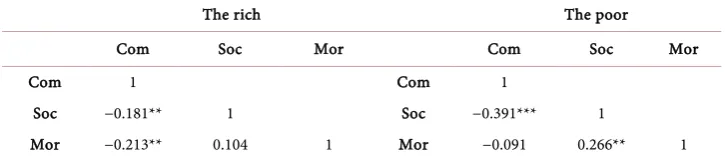
The correlations between different dimensions of the stereotypes about the poor and the rich are calculated. The results are shown in Table 4.
For the rich, the evaluation of competence is negatively correlated with the evalua-tion of sociability and morality. That is, the overall evaluaevalua-tion tends to be balance and compensation: the more positive evaluation on competence, the more negative evalua-tion on sociability and morality. For the poor, the negative correlaevalua-tion between compe-tence and sociability is significant, while between compecompe-tence and morality is not. The overall evaluation on the poor is also compensated: the more negative evaluation of competence, the more positive evaluation of sociability. This is a phenomenon of com-pensatory stereotype.
4. Discussion
4.1. The Theoretical Basis of Morality Dimension
[image:6.595.192.555.185.265.2]and proposed a seven-factor model. The dimensions of good-heartedness and honesty are related to morality [11]. Through factor analysis, Sun found that the stereotypes about Chinese and other 10 countries held by Chinese adolescents consist of 10 dimen-sions. Morality dimension has the highest factor loading [12]. From the results of the present study and studies above, it can be seen that the SCM cannot fully meet the cross-cultural situation. In many cultures, moral judgment of the group is also an im-portant part of the stereotypes.
The sociability dimension, which is similar with warmth in SCM, does not play a sig-nificant role in prejudice. The biases toward the rich and the poor mainly come from differences in moral judgment. The highlight of morality may be affected by long- standing view on the rich and poor in China. As early as two thousand years ago, there is a statement that “The rich are not benevolent; the benevolent are not rich” in the Chinese culture classics “Mencius”. This idea is rooted in the moral value of Confu-cianism, which are “cherish the ethics, contempt the interests”, “keep the laws of un-iverse, eradicate the desire of human”, and “advocate the public and restrain the pri-vate”. This moral standard reflects 3 contradictions between ethics and interests, laws and desire, public and private. In this value system, many folks and proverbs with ex-treme bias are widely recognized and handed down, such as “People will not be rich without windfall”, “there is no official without corruption, no businessman without treachery” etc. Thus there are deep ideological roots and cultural foundation of the an-tagonism between rich and benevolence in China. Because of the influence of ancient Chinese thought, many rich peoples were described as “speculation” during Chinese economic reform. The pay and return of them are considered as not equal, which called “not righteousness”. When the rich get rich, some have failed to meet requirements of “in success, try to let others be benefited”. Some rich people are exposed as greedy, corruption, extravagance, which called “not benevolence”. In summary, “rich” and “not benevolence” are related in Chinese traditional culture, which led to a difference be-tween stereotypes about the poor and the rich.
4.2. Implications for Compensatory Stereotypes
The public evaluate the rich as low morality and sociability but high competence, and the poor as high morality but low competence, i.e. complementary stereotypes. This phenomenon can be explained from two perspectives.
should be pay more attention. From this perspective, three-dimensional model of competence, sociability and morality is reasonable. The competence of the group can be inferred from the social status. The competence of advantage group is high; the compe-tence of disadvantage group is low. When the group or individual has low compecompe-tence, indifferent or immoral will not pose a threat. So for the optimistic expectations, people will evaluate the group or individual as high sociability and good morality. However, when the group or individual has high competence, due to caution, some preparation will help dealing with the coming threat. Therefore, the group or individual will be evaluated as low sociability and bad morality.
A more persuasive explanation is the system justification theory. According to the theory, there is a general psychological need to justify and rationalize the status quo, to view the social status quo as good, fair, legal and satisfactory [13]. One of the means to idealize the status quo is complementary stereotypes, which gives the advantage and disadvantage group compensatory trait, so that each group has their own unique pros and cons. Through this way, people can maintain a balanced view of the social groups. In literature, movies and pop culture, the poor are seen as more honest and happy than the rich [14]. These complementary stereotypes can help individual create a comforta-ble “equality illusion”. This theory holds the same view with China traditional theories. The Taoist advocate the balance of Yin and Yang, and Confucianism emphasizes the “golden mean”. In Chinese culture, people tend to thinking dialectically. They would find the positive traits of negative group and negative traits of positive groups. They see the whole society as balanced, and you win some and lose some. Based on this view, the negative stereotype about the rich may have the significance of maintaining social fair-ness, stabilizing the social law and order. Although there is no direct evidence to prove that, but the related research, such as Weng’s research showed that people with low sense of fairness prone to despise the rich and pity the poor. If the sense of unfairness from deprivation enhances, the hatred of the rich will occur [15]. Li based on the “Chi-nese general social survey” data, found that there is a high correlation between sense of fairness and perception of social conflict. The higher the sense of unfairness, the greater the perception of social conflict is [16]. This dynamic process can be interpreted as: in-dividuals with high sense of unfairness take some defense mechanism, such as hatred of the rich and enhance perception of group conflict, to maintain the “believe in a just world” belief.
In general, the complementary stereotypes about advantages of disadvantaged groups have a psychological adaptive function, and it cannot be eliminated. The negative impact of group conflict can reduced to some extent by de-categorization, re-categorization and sub-categorization, but cannot be completely eradicated. To promote equal access, communication and mutual understanding among different groups and embrace the multicultural values are the keys to solve these problems.
5. Conclusions
namely, competence, sociality and morality.
2) The rich has been seen as high competence, low sociability and bad morality, while the poor has been seen as low competence, mid sociability and good morality. 3) The stereotypes of competence and morality are complementary.
Acknowledgements
This research is supported by the Projects of Philosophy and Social Sciences Research of Beijing (Grant No. 12SHC024).
References
[1] Lindzey, G., Gilbert, D. and Fiske, S.T. (1998) The Handbook of Social Psychology (Vol. 1). Oxford University Press, Oxford.
[2] Fiske, S.T., Cuddy, A.J., Glick, P. and Xu, J. (2002) A Model of (Often Mixed) Stereotype Content: Competence and Warmth Respectively Follow from Perceived Status and Compe-tition. Journal of Personality and Social Psychology, 6, 878-902.
https:/doi.org/10.1037/0022-3514.82.6.878
[3] Cuddy, A.J., Fiske, S.T. and Glick, P. (2008) Warmth and Competence as Universal Dimen-sions of Social Perception: The Stereotype Content Model and the Bias Map. Advances in Experimental Social Psychology, 40, 61-149. https:/doi.org/10.1016/S0065-2601(07)00002-0 [4] Yzerbyt, V., Provost, V. and Corneille, O. (2005) Not Competent But Warm... Really?
Compensatory Stereotypes in the French-Speaking World. Group Processes and Intergroup Relations, 3, 291-308. https:/doi.org/10.1177/1368430205053944
[5] Cuddy, A.J., Fiske, S.T., Kwan, V.S., Glick, P., Demoulin, S., Leyens, J.P. and Htun, T.T. (2009) Stereotype Content Model across Cultures: Towards Universal Similarities and Some Differences. British Journal of Social Psychology, 1, 1-33.
https:/doi.org/10.1348/014466608X314935
[6] Zheng, J. And Liu, L. (2012) Undergraduates’ Stereotype on Migrants Workers: Content and Structure. Youth Studies, No. 4, 35-44.
[7] Matsumoto, D. (2001) The Handbook of Culture and Psychology. Oxford University Press, Oxford.
[8] Poppe, E. and Linssen, H. (1999) In-Group Favoritism and the Reflection of Realistic Di-mensions of Difference between National States in Central and Eastern European National-ity Stereotypes. British Journal of Social Psychology, 1, 85-102.
https:/doi.org/10.1348/014466699164059
[9] Mosquera, P.M.R., Manstead, A.S. and Fischer, A.H. (2002) The Role of Honour Concerns in Emotional Reactions to Offences. Cognition and Emotion, 1, 143-163.
https:/doi.org/10.1080/02699930143000167
[10] Wojciszke, B. (2005) Affective Concomitants of Information on Morality and Competence.
European Psychologist, 1, 60-70. https:/doi.org/10.1027/1016-9040.10.1.60
[11] Wang, D. and Cui, H. (2007) Chinese-Western Differences of Personality Structure and Specialty of Chinese Personality. Advances in Psychological Science, 2, 196-202.
[12] Sun, L. (2004) Adolescents’ Stereotypes of Some Familiar Nations or Ethnics. Ph.D. Thesis, Huazhong University of Science and Technology, Wuhan.
[14] Kay, A.C. and Jost, J.T. (2003) Complementary Justice: Effects of “Poor but Happy” and” Poor but Honest” Stereotype Exemplars on System Justification and Implicit Activation of the Justice Motive. Journal of Personality and Social Psychology, 5, 823.
https:/doi.org/10.1037/0022-3514.85.5.823
[15] Weng, D. (2010) Individual’s Feeling of Fairness and Personality Orientation in Con-sciousness of Class. Sociological Studies, 1, 85-110.
[16] Li, L., Tang, L. and Qin, G. (2012) “Fear of Inequality, But More Fear of Unfairness”: Sense of Fairness and Consciousness of Conflict in the Period of Social Transformation. Journal of Renmin University of China, 4, 80-90.
Submit or recommend next manuscript to SCIRP and we will provide best service for you:
Accepting pre-submission inquiries through Email, Facebook, LinkedIn, Twitter, etc. A wide selection of journals (inclusive of 9 subjects, more than 200 journals)
Providing 24-hour high-quality service User-friendly online submission system Fair and swift peer-review system
Efficient typesetting and proofreading procedure
Display of the result of downloads and visits, as well as the number of cited articles Maximum dissemination of your research work
Submit your manuscript at: http://papersubmission.scirp.org/