Spatial Image Watermarking by Error-Correction
Coding in Gray Codes
Tadahiko Kimoto
Faculty of Science and Engineering, Toyo University, Kawagoe, Japan. Email: [email protected]
Received May 8th,2013; revised June 8th, 2013; accepted July 8th, 2013
Copyright © 2013 Tadahiko Kimoto. This is an open access article distributed under the Creative Commons Attribution License, which permits unrestricted use, distribution, and reproduction in any medium, provided the original work is properly cited.
ABSTRACT
In this paper, error-correction coding (ECC) in Gray codes is considered and its performance in the protecting of spatial image watermarks against lossy data compression is demonstrated. For this purpose, the differences between bit pat-terns of two Gray codewords are analyzed in detail. On the basis of the properties, a method for encoding watermark bits in the Gray codewords that represent signal levels by a single-error-correcting (SEC) code is developed, which is referred to as the Gray-ECC method in this paper. The two codewords of the SEC code corresponding to respective watermark bits are determined so as to minimize the expected amount of distortion caused by the watermark embedding. The stochastic analyses show that an error-correcting capacity of the Gray-ECC method is superior to that of the ECC in natural binary codes for changes in signal codewords. Experiments of the Gray-ECC method were conducted on 8-bit monochrome images to evaluate both the features of watermarked images and the performance of robustness for image distortion resulting from the JPEG DCT-baseline coding scheme. The results demonstrate that, compared with a con- ventional averaging-based method, the Gray-ECC method yields watermarked images with less amount of signal distor- tion and also makes the watermark comparably robust for lossy data compression.
Keywords: Gray Code; Error-Correcting Code; Digital Watermark; Spatial Domain; JPEG DCT-Based Compression
1. Introduction
Digital watermarking is a technique for uniting digital signals and additional data, which are commonly called watermarks, so as to make changes in the signals imper- ceptible [1]. As for image signals, a watermark is em- bedded into a source image in a manner such that the resulting degradation of image quality is hardly notice- able. The watermark is to be recovered afterward for verifying the ownership of the image, for instance. From the viewpoint of signal domains to directly modify for expressing watermarks, the watermarking techniques are mainly divided into two categories: spatial-domain-based techniques and transform-domain-based ones.
In transform-domain-based image watermarking, pixel values of a source image, which are expressed in quan- tized signal levels, are first transformed into frequencies using a signal transformation such as the discrete cosine transform (DCT). These frequencies are, then, modified so as to include a watermark. Lastly, a watermarked im- age is produced from the modified frequencies by the in- verse transformation and re-quantization. The changes in
frequencies made by the watermark are inversely trans- formed to the changes in pixel values and thereby, they are dispersed over the watermarked image in such a way that the image distortion can be less conspicuous. Quan- tizing errors, however, generally result from the re-quan- tization of the inverse transforms. These errors disturb the transform domain as a result. Hence, the watermark essentially needs to be embedded with redundancies in the transform domain. These redundancies can also lead to some extent of robustness of the watermarks against signal changes in the spatial domain.
small change in a pixel value is likely to cause a signifi- cant change in the binary representation [2]. However, spatial-domain watermarks are nevertheless used in a number of applications such as steganography and fragile watermarking for content authentication.
As regards today’s digital systems, data are usually compressed for transmission, storage, etc. When a water- marked image is transmitted through an image commu- nication system, the image is usually compressed by, for example, the JPEG coding scheme before transmission. Hence, when the image is recovered at the receiver, it is distorted due to the lossy data compression. Because such lossy data compression is a kind of usual processing in communication systems, if watermarking is carried out before transmission, the watermark must be robust against at least the distortion caused by a data compression method being in use.
Wang et al. proposed the pixel surrounding (PS) method as a spatial-domain-based image watermarking method, and reported that the watermarks embedded by the method can survive JPEG lossy compression [3]. The PS method reduces effects of signal distortions on the embedded watermark by averaging pixel values, which is a kind of low pass filtering. On the other hand, error cor- recting techniques in channel coding such as the Bose- Chaudhuri-Hockquenghem (BCH) codes [4] can be used to improve robustness of spatial-domain watermarks [5]. A number of the related coding methods were studied in the late 1990’s [2]. Most of such error-correction coding (ECC) methods have been applied to transform-domain watermarks [6].
With regard to signal bits, a quantized signal level is generally represented by a natural binary code, which is one of equal-length codes. Another equal-length code is the Gray code (also called the reflected binary code). This code has the property that any two adjacent code- words differ in only one bit position. Thus, small changes in a signal level are unlikely to affect all the bits of the codeword [7]. Accordingly, if the number of the changed bits is limited, they can be corrected by using error-cor- recting codes. In this paper, we consider watermarking by using both the Gray code to express the spatial do- main and an error-correcting code to achieve robustness to signal changes. The objective of robustness here is to survive ordinary data compression such as the JPEG lossy coding.
The rest of this paper is organized as follows. Section 2 describes the codeword properties of Gray code. In the section, first, a single bit position where two adjacent codewords differ is given as a function of a signal level. Then, for each difference signal-level, the distribution of bit positions where two codewords just apart by the level from each other differ is demonstrated and compared with that in the case of the natural binary code. After
formalizing the watermarking of signal codewords, Sec- tion 3 presents a scheme of error-correction coding in the Gray code representation. Based on the properties of the Gray code described in the preceding section, signal codewords involving single-error-correcting codewords are defined. The performance of error correction in the change of signal levels is verified by stochastic analyses. In Section 4, results of some experiments conducted on test images are presented to demonstrate performance of the proposed method, referred to as the Gray-ECC method, by comparison with the PS method. To begin with, the procedures for implementing the Gray-ECC method in image watermarking are defined. In addition, with regard to the PS method being compared, the imple- menting procedures are explained on referring to [3], and its properties depending on the parameter values are dis- cussed to make a reasonable comparison with the ECC method. Then, both the image quality and the capability of robustness to JPEG lossy compression are evaluated from the experimental results. Section 5 concludes the paper.
2. Properties of Gray Code
2.1. Difference between Two Adjacent Codewords
First of all, we define the notation used in this paper. An
m-bit Gray code is transformed from the natural binary code of the same length. Let Rm denote the decimal range
of m-bit quantized levels , and let CR generally
represent an m-bit binary code that consists of code- words corresponding to respective levels in Rm. The m-bit
[0, 2m1]
2m
natural binary codeword
bm1b b1 0
for a levelm
R
is just the binary representation of v; that is,
1
0 2
m i i i
b
(1)where bi is either 0 or 1 for . Let CRN
denote the m-bit natural binary code and 0,1, , 1
i m
RNC be the codeword in CRN associated with a level vRm. The m-bit Gray codeword
gm1g g1 0
for a level v iscalculated from the CRN
by the relation1
i i i
g b b (2) for i0,1, , m1. In Equation (2), denotes the exclusive OR operation, and bmthat the equation needs is
temporary here and supposed to be 0. Let CRG denote the
m-bit Gray code and CRG
vm v R
be the codeword in CRG
associated with a level .
1 1 0
RN m
C v b b b
1
1 1RN m
C v b b
and , and
the respective succeeding codewords and
1 1 0RG m
C v g g g
b0
1 1 0RG m
C v g g g . Then, the difference between
RG
C v CRG
v1
m 1 1 0
and
is expressed as the bit sequence that, by using Equation (2) with the as-
sociative and commutative laws of the exclusive OR op-eration, is given by the relations
1 1i gi gi bi bi bi bi
m
(3)
for i0, 1,, 1. From another viewpoint, the least significant bits of any CRN
v1,
J J
1 0
J J b b b
can be expressed as ; that is, a certain exists, and
and for . Here, we
define if v is even. Note that the corresponding
bits in are . Then,
1 0 01 1
J J
b b b
0
J
b b1
0
J
1
RN
C v
0
J , , 0
10 0
2
1, 0
.
0, 1 1
j j
j J
b b
J j m
4)
Using this relation in Equation (3) yields 1,
0,
i
i J
i J
(5)
for i0, 1,,m1. Thus, CRG
v and CRG
v1
differ in only one bit J, and J depends on the bit pat-tern of CRN
v
1
C v
or equivalently, on the value of v. Con- sequently, the bit position J where and
differ is given by
vRG C
RG
0, if is even
. max 1 2 , if is oddj
v J
j v v
(6)
In addition, it is found that J1 if v is odd.
2.2. Difference between Two Codewords
The difference between CRG
v and CRG
v d
,where d (≥1) is a difference signal-level, is given by the result of accumulating bit changes from CRG
vthrough CRG
v d
. Hence, these two codewords differin those bit positions where the bit inversion occurs once or odd times during the accumulation. For d≥ 2, thus, one or more bits differ between the codewords, and the loca- tions of difference bits are determined from the starting level v. Consequently, the distribution of differ- ence bits in the entire m-bit codeword for all v’s that sat- isfy v d Rm is derived using Equation (6).
Let m = 8 as a practical example. For d = 1, 128 even
values of 255 v’s yield the difference bit g0’s between
RGC v and CRG
v d
. Out of the 127 possible code-word pairs of odd v, 64 pairs have the difference bit at g1, 32 pairs at g2, 16 pairs at g3, 8 pairs at g4, 4 pairs at g5, 2 pairs at g6, and one pair at g7. For d = 2, if v is even, then
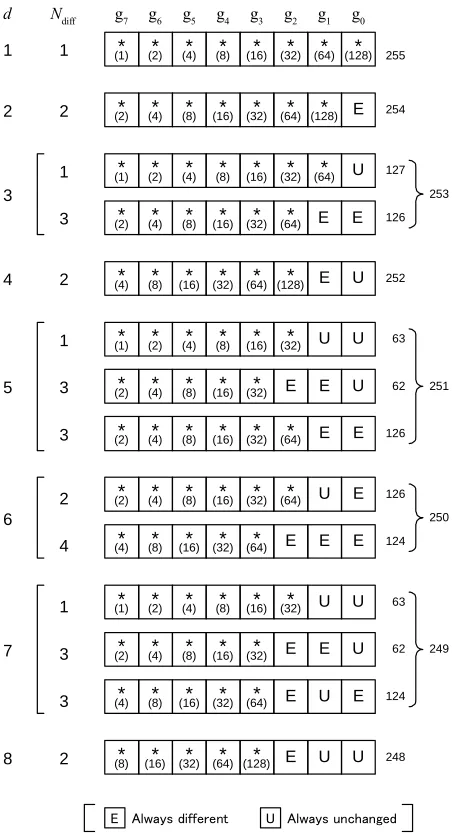
v + 1 is odd, and vice versa. As a result, any codeword pair has a difference bit g0 and another one; out of 254 possible codeword pairs, 128 pairs have the different g1, 64 pairs g2, 32 pairs g3, 16 pairs g4, 8 pairs g5, 4 pairs g6, and 2 pairs g7. For d = 3, in the case where v is even, in any one of 127 possible codeword pairs, the g0’s are same because v + 2 is also even, and the bits are different in one of the other seven bit-positions. For the other 126 pairs where v is odd, two codewords differ in three bit-positions composed of g0, g1 and one of the other six positions. Figure 1 illustrates the distributions of the
difference bits in
g7g g1 0
for each value of d from 1 to 8, for instance.2.3. Comparison with Natural Binary Code As for m-bit natural binary representations, the difference between two codewords is analyzed as below. The num- ber, μ, of bit positions where two adjacent codewords differ ranges from 1 to m. For each μ, there are 2m possible codeword pairs, and any of the pairs differs in the bit positions from 0 through 1. For a difference signal-level d = 2, the number, also denoted by μ, of bit positions where two codewords CRN
v and CRN
v2
differ ranges from 1 to m− 1. There are 2m possible codeword pairs for each μ, and any of the pairs differs in the bit positions from 1 through μwhile the b0’s are al- ways the same. For a difference signal-level d = 3, the number of bit positions where two codewords CRN
vand CRN
v3
differ ranges from 2 to m. The differ- ence between the codewords gets more complicated than that for the above d = 2 or d = 1, while the b0’s are al- ways different.As the above examples demonstrate, for a given dif-ference signal-level d, with regard to the pairs of code-words whose levels are apart by d from each other, the number of bit positions where two Gray codewords differ lies in a narrower range than that of bit positions where two natural binary codewords differ.
3. Error-Correcting in Gray Code
3.1. Formalization of Watermarking Codewords The process of watermarking signals in code representa- tions can be expressed in a generalized form as below.
1) Embedding process
E E E E E E E E E E E E E E E E E U U U U U U U U U U U U g0 g1 g2 g3 g4 g5 g6 g7 * (128) * (64) * (32) * (16) * (8) * (4) * (2) * (128) * (64) * (32) * (16) * (8) * (4) * (128) * (64) * (64) * (32) * (16) * (8) * (4) * (2) * (64) * (32) * (16) * (8) * (4) * (2) * (64) * (32) * (16) * (8) * (4) * (2) * (1) * (1) 255 252 254 253 127 126 * (32) * (16) * (8) * (4) * (2) * (1) 63 * (32) * (16) * (8) * (4) * (2) * (1) 63 * (32) * (16) * (8) * (4) * (2) 62 * (32) * (16) * (8) * (4) * (2) 62 126 124 * (32) * (16) * (8) * (4) * (2) * (64) * (32) * (16) * (8) * (4) * (64) * (32) * (16) * (8) * (4) 124 * (64) * (32) * (16) * (8) * (4) * (2) 126 * (128) * (64) * (32) * (16) * (8) 248 250 249 251
Always different Always unchanged
E U 1 5 7 6 2 3 4 8 1 1 1 3 3 3 2 4 3 2 1 3 2 2
[image:4.595.60.287.83.500.2]d Ndiff
Figure 1. Distributions of difference bits between two 8-bit Gray codewords apart by a difference signal-level d from each other, for : Ndiff denotes the number of difference bits occurring in a codeword; the numbers writ- ten in the right side denote the total numbers of codeword pairs to which the bit distributions apply; the number writ- ten at each bit position in parentheses denotes the number of codeword pairs which differ at the position; the asterisks indicate those bit positions only one of which differs at the same time.
1, 2, , 8
d
is, 1
R m
C c R for R C
c by
1 ,
R R m
C c v cC v v R (7)
where a unique v is determined for each c since the code
CR is a one-to-one mapping. As for a watermarking algo-
rithm to be considered, let us regard both of the embed- ding of watermarks and the extracting of watermarks as kinds of point operations where the processing for any signal in a signal sequence depends only on the value of
that signal. Also, for simplicity, we assume that one wa- termark bit is embedded in one chosen signal.
Suppose that a source signal sequence, X, and a wa- termark-bit sequence, W, are given. In the embedding process, first, the value vx of a given signal x in X is
mapped to the codeword cx in CR; that is,
x C vR xc . (8)
Next, for a given watermark bit , a procedure, named EMBED, performs embedding w into cx; this is expressed in the form of a point operation such that
w W
EMBED ,
y w
c cx
(9)where cy is the resulting codeword and cyCR. The
signal value, vy, that cy represents is given by
1
y R y
v C c , (10)
and the source signal x is replaced with the signal of the level vy. Let Y denote the entire sequence of the replaced
signals. Thus, the signal sequence X is changed to Y with the watermark W embedded there. The difference of the signal values vx and vy, which is generally referred to as
an embedding distortion, degrades the signal quality of Y
from X.
2) Extracting process
Assume that, undergoing some signal processing such as data compression, the above sequence Y changes to another one, Z, of different signal values. In the water-mark recovering process, a procedure for extracting wa-termark bits from codewords in CR is defined as the
fol-lowing inverse process of Equation (9): Referring to the procedure as EXTRACT, we can write it in the form of a point operation; that is, using the notation of Equation (9),
EXTRACT y
w c . (11)
To extract the watermark from Z using this procedure, first, the value, vz, of each signal in Z is mapped to the
codeword, cz, in CR; that is, similarly to cx of Equation
(8),
z C vR zc . (12)
Then, the procedure performs on cz as
EXTRACT z
w c (13) where w' is the resulting bit.
Robust watermarking requires w' to be equal to w in spite of the change in signal level from vy to vz. However,
if vz vy, then obviously, C vR
z C vR
y becauseof the one-to-one mapping of the code. As a result, the change in codeword is likely to lessen the reliability of a watermark extracted from the resultant codeword.
codewords affects directly the extraction of watermark bits. This also implies that for the purpose of recovering watermarks, it is sufficient to recover at least those bits of a codeword which affect the embedded watermark.
3.2. Single-Error-Correcting in Gray Code When a signal changes by one level, one bit of the cor- responding Gray codeword changes. Accordingly, the changed bit can be corrected by means of a single-error- correcting (SEC) code. Then, we employ single-error- correction coding in watermarking to make embedded watermarks completely robust against a change by one level in any signal.
1) Encoding procedure
The processing of encoding watermark bits with a SEC code can be involved in the embedding operation EMBED of Equation (9). Let CE denote an error-cor-
recting code to be used, which is assumed to be a linear block code in this paper, and nE be the code length of CE.
For a signal level vx and a watermark bit w, given the
corresponding codeword cx C vR
x , EMBED
cx,w
can be defined by the following two steps. Note that we still use a general notation of CR as the code that repre-
sents signal levels.
(EN.1) Generate a codeword, cw, in CE corresponding
to the bit value of w.
(EN.2) Replace nE consecutive bits of cx from a speci-
fied bit position k (≥ 0) with all the bits of cw. Here, the bit position 0 designates the least significant bit (LSB). The resulting codeword is equivalent to cy of Equation (9). Let us define a REPLACE operator to implement the operation of this step in the form
REPLACE , ,
y x k
c c cw . (14)
In the above procedure, the codeword cx is changed depending on both cw and k. The change in codeword immediately affects the signal level and the resultant level vy is determined. To reduce the embedding distor-
tion, y x, a code CE of short codewords is desirable.
A binary linear SEC code of the minimum code length is a (3, 1, 3) code consisting of two 3-bit codewords that are apart by the Hamming distance of 3 from each other and that correspond to respective values of an informa- tion bit 0 and 1. A typical (3, 1, 3) code is the so-called (3, 1) repetition code or also known as the general Hamming (3, 1) code [4]. Regarding each watermark bit as the in- formation bit per codeword, we concentrate on a (3, 1, 3) code from now on.
v v
2) Determining signal codewords
Given a source signal and a watermark bit, to reduce the embedding distortion, from those codewords which include the error-correcting codeword corresponding to the watermark bit in the same bit-position, the one that
results in the smallest embedding distortion must be chosen as the encoded codeword of the signal. The prob- lem of choosing such codewords can be simplified in the way below.
Suppose that a (3, 1, 3) code CE
cE0,cE1
where the two codeword cE0 and cE1 correspond to respective watermark bits of 0 and 1 is given. Given a code CR forrepresenting signal levels, for each value of watermark bit, putting the corresponding error-correcting codeword into all the codewords of CR by means of the REPLACE
operator with a specified value of k, we obtain a subset- code of CR, expressed in the form
,| REPLACE , , ,
W k b
E b R
C
k C
c c c c c (15)
for b = 0 and 1 respectively. From each subset-code, a set of all signal levels that the codewords of the subset-code represent is obtained such that
1
, | , ,
k b R W k b
U u u C c c C (16) It follows that Uk,0 and Uk,1 are subsets of Rm. Thus,
these subsets consist of signal values that each have had a watermark bit embedded by the error-correcting code.
For a given signal level vxRm and a watermark bit
0, 1w , we choose such a level, vy, as closest to vx
from Uk, w. That is, vy is determined so that
,min k w
y x v U x
v v v v
x v w. (17)
It can be proved that in the case that the Gray code CRG
is used as CR, the unique vy exists closest to each vx in
either Uk,w. Let us denote the choosing operation of
Equation (17) by the operator ENCODE in the form
ENCODE ,
y
v . (18)
This operator involves Uk, 0 and Uk, 1 that both have been made from CR and CE by Equations (15) and (16).
The signals of a sequence X are thus encoded one by one to the single-error-correctable values, which compose the watermarked sequence Y.
3) Determining SEC codewords
Since CE affects Uk, 0 and Uk, 1 through Equations (15) and (16), embedding distortions also depend on the code- words comprised in CE. On the assumptions that each
level in Rm is equally likely to occur for any signal and
also that a watermark bit is a random variable, for a given code CE
cE0,cE1
and a bit-position parameter
2 1 2
0
2 1 2
0 1 1
MSE ENCODE , 0
2 2 1
ENCODE , 1 . 2
m
m
m v
m v
v v
v v
(19)
In fact, if CR has a periodic structure in codeword bits,
the above ranges of summation can be reduced.
There exist the following four kinds of pair of 3-bit codewords that are apart from each other by Hamming distance of 3: (i) {(000), (111)}, (ii) {(001), (110)}, (iii) {(011), (100)}, and (iv) {(010), (101)}. Under the condi-tion of using the Gray code CRG as CR, the expected MSE
values of Equation (19) were calculated not only for each of the four codeword pairs but also for each bit position k
of 0 and 1, respectively. The results are listed in Table 1,
together with the peak-signal-to-noise ratio (PSNR) val-ues in decibels (dB) defined by
2 102 1
PSNR 10 log (dB)
MSE
m
. (20)
On the above assumptions for stochastic analysis, the codes (i) and (iii) have exactly the same MSE values, and so do the codes (ii) and (iv) for both the bit positions. As shown in Table 1, the codes (i) and (iii) yield less distor-
tion than the codes (ii) and (iv). On the other hand, as shown later, all the four codeword pairs have almost the same performance in error correction. Consequently, the codeword pair (iv) has been selected as CE for the Gray
code; denoted by CEG, that is, CEG
010 , 101
. Werefer to the encoding by the ENCODE operator with CEG
and the position parameter k = 0 as ECCG0 and that with
CEG and k = 1 as ECCG1. The encoding with the bit posi-
Table 1. Expected MSEs for (3, 1, 3) SEC codes embedded in Gray codes. (a) Bit position k = 0; (b) Bit position k = 1.
(a)
Pair cE0,cE1 MSE PSNR (dB)
(i) 000 111 12.5 37.2
(ii) 001 110 8.5 38.8
(iii) 011 100 12.5 37.2
(iv) 010 101 8.5 38.8
(b)
Pair cE0,cE1 MSE PSNR (dB)
(i) 000 111 44.7 31.6
(ii) 001 110 29.7 33.4
(iii) 011 100 44.7 31.6
(iv) 010 101 29.7 33.4
[image:6.595.86.286.89.152.2] [image:6.595.335.501.368.708.2]tion of k > 1 is no longer practical for 8-bit signals due to large embedding distortions.
Figure 2 shows the relationship between source signal
levels vx and encoded signal levels vy of Equation (18) in
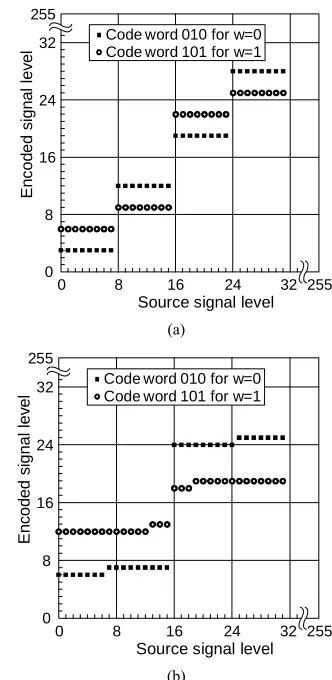
ECCG0 and ECCG1. The relationship in the interval of 16 source levels and that in the interval of 32 source levels repeat periodically over the 8-bit dynamic range for ECCG0 and ECCG1, respectively. In the period of ECCG1, the stepwise changes differ for the two codewords. With regard to embedding distortions, the magnitude of dif- ference in signal levels caused by ECCG0 is less than or equal to 6, and that caused by ECCG1, less than or equal to 12.
4) Decoding procedure
Given a signal sequence Z that has come from Y de- scribed in Section 3.2 (2), the process for decoding signal values to extract watermark bits is described as follows. Assume that both the error-correcting code
0, 1
E E E
C c c and the bit-position parameter k that have been used for Y are known to the decoder. Let vzbe
the value of a signal z in Z, and let czdenote C vR
z . (DE.1) Obtain a codeword, e, from cz by separating nECode word 010 for w=0 Code word 101 for w=1
0 8 16 24 32 255 0
8 16 24 32 255
Source signal level
E
n
cod
ed signa
l
lev
e
l
(a)
Code word 010 for w=0 Code word 101 for w=1
0 8 16 24 32 255 0
8 16 24 32 255
Source signal level
E
n
co
d
e
d
si
g
n
a
l
le
v
e
l
[image:6.595.56.286.539.736.2](b)
consecutive bits starting at the bit position k. We define the operator SEPARATE that performs this bit-operation as
SEPARATE z, ,k nE
e c (21)
where actually nE3 for the (3, 1, 3) code CE.
(DE.2) The codeword e, which might have been dis- torted, is supposed to be decoded by using CE. To im-
plement the decoding, assuming all distorted codewords are equally likely, we use a maximum-likelihood decod- ing method [4]. By the method, e is mapped to one of the two codewords cE0 and cE1 such that is closer to e than the other in terms of the Hamming distance. Let e' be the resulting codeword.
(DE.3) The bit value, w', corresponding to e' in CE is
immediately obtained as the watermark bit extracted from vz.
We express the procedure that performs the above three steps for a given vz by the operator DECODE of the
form
DECODE z
w v (22)
which is implicitly associated with CE and k.
3.3. Stochastic Analysis of Error-Correcting Performance
Error-correcting performance of ECCG0 and ECCG1 are revealed by stochastic analysis below.
1) Error-correcting capabilities for a single level- change
For each encoded signal level where k is given and , given a difference signal-level d
satisfying , whether the result of decoding u
+ d, that is, agrees with b or not ,
k b
u U
u d
0, 1b
m
u d R
DEC
b ODE
is determined. The agreement between the two bits b and
b' depends on the difference between the two error-cor- recting codewords, cEb of CRG
u and a' ofthat is obtained by
RG C u d
SEPARATE CRG u d k, , 3
a (23)
If the Hamming distance between cEb and a' is either 0 or 1, then a' is mapped to cEb in the decoding procedure and thus, b' agrees with b. Otherwise, a' is mapped to the other error-correcting codeword cEb, where b denotes the 1's complement of b, and consequently, b' is regarded as b .
Because the difference bits between two signal code- words CRG
u and CRG
u d
depend on the u in, we define a ratio of the correctly decoding of sig- nals for the entire as follows. First, the whole of
those values of which are allowed to increase by d
within Rm is described by a set,
,
k b
U
, k b U
,
k b U
, k bU d , such that
, ,
k b k b
U d u u d| Rm, u U
, k bU d
. (24)
Then, out of the values in , a set, Tk b,
d ,of those values which, after increasing by d, still contain correctly decodable error-correcting codewords is ex- pressed in the form such that
, | , ,
k b Eb k b
T d u h c a 1, u U d (25)
where a' is the same as that of Equation (23) and
,
h x y denotes the Hamming distance between two codewords x and y. Supposing that signal values in Uk b, are equally probable, we estimate the probability of the correctly decoding of Uk b, for a variable d, denoted by
, k bP d , by the ratio
, k b, k b,
k b
P d T d U d , (26) where S denotes the number of elements in a set S, for b = 0 and 1, and k = 0 and 1 according to Section 3.2 (3).
On the additional assumption that watermark bits are random variables, an estimate of the correctly decoding probability of ECCGk, for k = 0 and 1, can be defined as
follows. For the definition, Pk b,
d and Pk b,
d ofthe same d are put together by taking the average of the two values on the assumption that a signal change by d
levels and that by −d levels are equally likely to happen to any level in Uk b, . In fact, because of the symmetrical structure of Gray code, it holds that
,
d,
k b k b
U d U and Tk b,
d Tk b,
d for any possible d and each b. Then, the overall probability of correctly decoding by ECCGk for a variable d, denoted by
G kP d , is defined by
,0 ,0
,1 ,1 4
G k k k
k k
P d P d P d
P d P d
, (27)
where d > 0 .
As regards ECCG0, Figure 3(a) shows the variation of
0 GP d with d, where let , for instance. In this case,
32
d
b b
P0, d P0, d , for b = 0 and 1, and for any possible d, and they have one of three values 0, about 0.5 and 1 if d is so small that U0,b
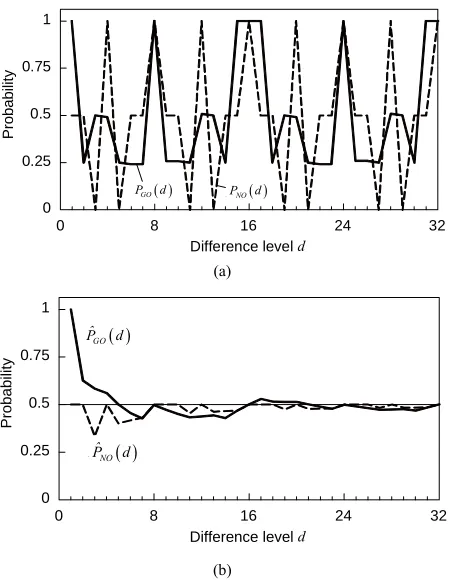
d , the denominator of Equation (26), is composed of a lot of elements. As shown in Figure 3(a), PG0
d 0 for any d, and
0 GP d has one of three values about 0.25, about 0.5,
For comparison, we define a (3, 1, 3) code, denoted by
CEN, to use for the natural binary code CRN. Two code-
words in CEN have been determined from MSE values
similarly to those in CEG; that is, CEN
011 , 100
.We refer to the encoding by the ENCODE operator with
CEN as the natural ECC method, and let ECCNk denote the
natural ECC method with the position parameter k, where practically or 1. Note that no operation is actually needed for the transformation between m-bit binary sig- nal values and m-bit codewords in CRN. Also, the ex-
pected probability of correctly decoding by ECCNk for a
0
k
difference signal-level d, denoted by , is defined similarly to , for and 1 respectively. The variation of with d is added in Figure 3(a) by
the broken line. For any possible d, each of
N kP d
G kP d
0 NP d
0
k
0,bP d
and has either 0 or 1, for and 1, and consequently, has one of three values 0, 0.5 and 1. Particularly for , .
0,b P d
0 N P0
b
1 0.5
d1 PN
d 0
2) Error-correcting capabilities for multiple level- changes
The decoding properties are estimated under the con- dition that all the changes up to d levels occur in the en-
1
0.75
0.5
0.25
0
0 8 16 24
Difference leveld
Proba
bilit
y
32
GO
P d PNO d
(a)
1
0.75
0.5
0.25
0
0 8 16 24 32
Difference leveld
Probability
GO
ˆP d
NO ˆP d
(b)
Figure 3. Performance of Gray-ECC in comparison with natural ECC for codeword position of 0 (k = 0). (a) Cor- rectly decoding probabilities; (b) Accumulative probabili- ties.
coded signals. For the estimation, supposing that all the difference signal-levels in the range from 1 to d are equally likely, we define the accumulative probability of correctly decoding by ECCGk, denoted by PˆG k
d inthe form of a function of d, by averaging from j1 through d; that is,
1
ˆ d
G k G k
j
P d P j d
, (28)
for k0 and 1 respectively. Similarly to PˆG k
d , theaccumulative probability of correctly decoding by ECCNk,
denoted by PˆN k
d , is defined for each k0 and 1. The variation of PˆG0
d32
with d is shown in Figure
3(b), where let d , with the variation of PˆN0
d depicted for comparison by the broken line. PˆG0
d is found to be greater than 0.5 for . Hence, ECCG0 is expected to achieve the error correction in this range of d. As the figure shows, with increasing d,4
d
0 ˆ
G
P d gets close to 0.5. In contrast, ˆ 0
0.5 for any d. ThisN
P d
result indicates that ECCN0 has no capacity of correcting errors for those signals which have undergone change by various levels.
Effects of selected codewords in CEG on the error-
correcting performance have been also evaluated. For this purpose, by replacing the codeword pair in CEG with
each one of the three other codeword pairs (i), (ii) and (iii) previously mentioned in Section 3.2 (3), both the corre- sponding PG0
d and PˆG0
d were calculated. In com- parison among the four codeword-pairs, the variations of these probabilities with d have been found to be almost the same. Consequently, the four codeword-pairs have no difference in error-correcting performance.3) Bit position of error-correcting codewords
For the bit position k1, the performance of ECCG1 has been evaluated. The variation of with d is shown in
Figure 4(a), compared with that of PN1
d . In ECCG1,
1,b 1,b
P d P d for b0 and 1, and for any possi- ble d; they have one of five values 0, about 1/4, about 1/2, about 3/4 and 1. As Figure 4(a) illustrates, accordingly,
1
G
P d has one of five values about 1/4, about 3/8, about 1/2, about 5/8 and 1. Particularly for d2 as well as d1, PG1
d 1. In addition, the variations of
1 ˆ
G
P d and PˆN1
d with d are both depicted in Fig-ure 4(b). As this figure shows,
becomes grea-1 ˆ
G
P d
ter than 0.5 for d 11. This range of d is much wider than that in ECCG0. Figure 4 also indicates that the fact
1 1 3 4
N
P results in that ˆ 1
0.5forN
[image:8.595.61.286.400.690.2]1
0.75
0.5
0.25
0
0 8 16 24 32
Difference leveld
P
robabilit
y
1
G
P d PN1 d
(a)
1
0.75
0.5
0.25
0
0 8 16 24 32
Difference leveld
P
robabilit
y
1
N ˆP d
1
G
ˆP d
(b)
Figure 4. Performance of Gray-ECC in comparison with natural ECC for codeword position of 1 (k = 1). (a) Cor- rectly decoding probabilities; (b) Accumulative probabili- ties.
Hence, ECCN1 is barely expected to achieve the error correction in this range of d.
From the above stochastic analyses, the advantages of the Gray code over the natural binary code in the ECC method are summarized as follows:
a) For any d, PG k
d 0 while PN k
d 0 for some of d’s.b) For a given k, PG k
d PN k
d for some of d’s, in particular for d 1.These advantages result from the limited distribution of bit positions where two codewords differ as described in Section 2.2. Because of the advantages, ECCGk achie-
ves the capability of correcting “errors”, namely signal- level changes particularly if the changes are limited in a small range.
4. Experiments
4.1. Watermarking Procedures
The procedures for implementing the ECC method, which means both the Gray-ECC and the natural ECC by generalization, is introduced in this section. Source ima- ges are assumed to be monochrome images or signals of one channel of color images, and a signal level of each pixel is represented by an m-bit code in natural binary notation. Using a general notation, for an image f, let
denote a pixel, or equivalently a pixel value at the coordinates
( , )
f x y
( , )x y on the image plane. A watermark is a sequence of bits, and the bits are supposed to be embedded into a source image one by one in order.
1) Embedding procedure
Given a source image, fX, of the size NX by NY pixels
and a watermark-bit sequence W
w w0, 1,,wNW1
, where NW is the number of watermark bits
NW N NX Y
andwi
0, 1 for i0, 1,,NW 1,the embedding procedure performs according to the following steps:
(WE.1) Choose NWpoints
x yi, i
,0, 1, , W 1
i N , out of the coordinates of fX in a man-
ner such that all the NW points are situated separately on
the image plane. Let the sequence of the ordered points be represented by K; that is,
0, 0 , 1, 1 , , NW 1, NW 1
K x y x y x y .
(WE.2) According to K, obtain a pixel sequence, X, from fX; that is, X
x x0, 1,,xNW1
where
,
i fX x yi i
x for i0, 1,,NW1.
(WE.3) For each pixel xi in X, , encode the pixel value with a given watermark bit wi
using the operator ENCODE of Equation (18), so that 0, 1, , W 1
i N
ENCODE , ,
i X i
v f x yi wi . (29)
Then, replace the value of xi with vi. Expressing the
resultant pixel by yi, we thus obtain the sequence
0, 1, , NW 1
Y y y y .
(WE.4) Substitute yi in Y for the pixel at
x yi, i
in the image fX for i0, 1,,NW1. Thereby the water-marked image, fY, is achieved.
The sequence K is supposed to be associated with each
fY, and it must be protected from unauthorized use. We
here refer to the ratio of NW to the number of pixels in fX
as an embedding pixel ratio ; that is,
W X Y
N N N
. (30) 2) Extracting procedure
Given an image, fZ, that is assumed to be derived from
the above fY, the procedure for extracting watermarks
from fZ is as follows:
(WD.1) Using the same K as that has been used in the embedding procedure for fX, obtain a pixel sequence, Z,
from fZ; that is, Z
z z0, ,1 ,zNW1
where zi fZ
x yi, i
for
x yi, i
1
K, 0, 1, , W
i N .
(WD.2) For each pixel zi of Z, , decode a bit, w'i, from the pixel value using the operator
DECODE of Equation (22). We thereby obtain the bit 0, 1, , W 1
sequence W
w w0, 1,,wNW1
.4.2. Pixel Surrounding Method
The performance of the proposed ECC method has been compared with that of the conventional pixel surrounding (PS) method [3]. The procedures of the PS method are outlined below. In addition, our analysis will reveal its essential properties in terms of embedding distortions and robustness.
1) Embedding procedure
Given a source image fX and a sequence of NW
watermark bits, the embedding procedure is as follows: (PE.1) As in the step (WE.1) of the ECC method, de- termine a sequence of NW points in fX. Let K denote the
sequence, and the same notation as that in the ECC pro- cedure is used here.
(PE.2) According to K, obtain a sequence, X, of NW
pixels from fX.
(PE.3) Foreach xi in X, calculate the mean value, ai, of
the eight pixels surrounding xi in the neighborhood of 3 by 3 pixels. Thus, a sequence A
a a0, ,1 ,aNW1
is obtainedfor all i0, 1,,NW1.(PE.4) For the ith watermark bit wi
0, 1 , replace the signal value of xi with aˆi such that, if 0 ˆ
, otherwise
i i
i i
a w
a a
(31) for i0, 1,,NW1, where is a specified positive value of signal level. Letting x'i denote the resultant pixel,
we thereby obtain a pixel sequence
0, 1, , NW 1
X x x x .
(PE.5) Substitute x'i in X' for the pixel at
x yi, i
inthe image fX. Let fY( )P be the resulting image, so that
( )P , ˆ
Y i i
f x y ai for i0, 1,,NW1.
2) Extracting procedure
The procedure for extracting watermarks from a given image, ( )P
Z
f , that is supposed to come from the above ( )P
Y
f is as follows:
(PD.1) Using K that has been determined in the step (PE.1), obtain a pixel sequence, Z, from fZ( )P ; that is,
where for
0, ,1 , NW 1
Z z z z
i, i
i,f( )P x
i Z yi
z x y K, i0, 1,,NW1.
(PD.2) For each zi in Z, calculate the mean value, a''i,
in the neighborhood of zi in the same way as in the step (PE.3). Then, a sequence A
a a0 , ,1 ,aNW1
is ob- tained.(PD. 3) By comparing the signal value ( )P
,
Z i i
f x y
with a''i, a bit value, w''i, is determined in a manner such
that
( )
0, if ,
1, otherwise
P
Z i i i
i
f x y a
w
(32)
for i0, 1,,NW 1. Thus, the bit sequence
0, 1, , NW 1
W w w w
( )
is obtained as a watermark ex-
tracted from P Z f .
3) Embedding distortions
Embedding distortions caused by the PS method are signal changes at the embedding points. To estimate the amount of the distortion, we use the measurement of MSE between the two images fX and fY( )P , expressing it
by MSEPS. The general definition of MSE between two images f1 and f2 of the same size of NH by NV pixels is
22 1
1
MSE , ,
x y
H V
f x y f x y
N N
(33)
where the summation is taken over the entire image area. Replacing f1 and f2 in Equation (33) with the respective images of fX and fY( )P yields directly the form of MSEPS. Based on the definition, the value of MSEPS for a given is approximately proportional to the embedding ratio. Using MSEPS instead of MSE in Equation (20), we can also obtain the value of PSNR.
At each of the embedding points in ( )P Y
f , the pixel has a value different from the average of its neighborhood pixels by according to Equation (31). Then, the pixel value can be regarded as the sum of the spatial average and a noise signal that is randomly chosen between and () on the assumption that the watermark bits are random variables. Hence, the image ( )P
Y
f gets closer to a result of spatial averaging with decreasing , and accordingly, it looks more blurring, particularly when the embedding pixel ratio is large and close to 1.
4) Robustness
In the step (PE.3) of the above embedding procedure, the neighborhood averaging is carried out using source signal levels of fX and hence, the resulting average at
each point is independent of the situations of any other points of K. In addition, the steps (PE.4) and (PE.5) are implemented by point operations. Accordingly, the steps from (PE.2) through (PE.5) can be accomplished by a parallel processing with the 3 by 3 operator applied to fX
at each point of K. The pixels of ( )P Y
f are consequently generated from fX independently of each other.
On the other hand, in the extracting procedure, the step (PD.2) involves the calculation in the neighborhood in
( )P Z
on the situations of the other points of K as described below. Suppose that a point of K, say,
x yj, j
, has its neighbors including another point of K, say,
x y,
. Also, suppose a mean value, a'j, calculated in theneighborhood around
x yj, j
in ( )P Yf . Then, a'j is no
longer equal to ajobtained in the step (PE.3) due to the
difference between the level of ( )P
, andY
f x y
x
,
X
f x y
x .
The difference between the mean values aj and a'j has
a certain effect on the performance of watermark extrac- tion. The condition for extracting correct watermark bits from ( )P
Y
f is given from Equation (32) as
( ) j where j ajaj. This interval of j
just depends on . If j is larger than , either a
watermark bit of 1 or that of 0 is unable to recover, according to whether j is positive or negative. Hence,
all the watermark bits would be hard to recover even from the watermarked and still unchanged image without any limitation of the situations of embedding points. The condition sufficient for correctly recovering all the watermark bits is that every point of K is situated outside the 3 by 3-pixel neighborhoods of any other points of K. Note that satisfying this condition makes the embedding pixel ratio unable to exceed 1/9.
As for a processed and probably changed image ( )P Z f , let us express the pixel values and the mean values calcu- lated in the step (PD.2) by the relations
( )P , ( )P i fZ x yi i fY x yi i
,
(34) andi ai a
i (35) respectively, for . Substituting these expressions in Equation (32), we find that if
0, 1, , W 1
i N
( ) i where i i i, the watermark bit of
either value is to be correctly extracted from ( )P Z f . If ( )
i
, the watermark bit of 1 is lost, and otherwise, the watermark bit of 0 is lost.
4.3. Experimental Methods
The experimental procedure that was carried out to eva- luate the ECC method is described here. Some 8-bit mo- nochrome images of 256 by 256 pixels, such as com- monly used “Lena,” were used as source images in the experiment. The embedding of watermark bits was ca- rried out for all the pixels of a source image so that the performance with the upper limit of the embedding pixel ratio, that is, 1 could be evaluated. Note that the
watermarking is actually to be implemented with 1 to hide where watermarks are embedded. As an instance of watermark, W, a sequence of 256 × 256 bits was ge- nerated using a pseudo-random number generator with a computer, and thus, W
w w0, 1,,wNW1
where256 256
W
N .
The procedure applied to each source image, fX,
consists of the following steps:
(EX.1) Embed W into fX by the ECC method. Let fY
denote the resulting image. Then, measure a PSNR value between fX and fY.
Here, ECCG0 and ECCG1 were used as the Gray-ECC method, and also, ECCN0 and ECCN1 were used for com- parison. Furthermore, the PS method was implemented for fX with 1 and various values of . Thus the re-
spective fYs were produced from each fX by these meth-
ods.
(EX.2) Compress fY using the JPEG DCT-baseline
system, and decompress the resultant data to reconstruct an image, fZ. Then, measure a PSNR value between fY
and fZ to estimate the amount of distortion caused by the
JPEG lossy compression.
To obtain various amount of distortion, the JPEG cod- ing performance was varied by multiplying the entire lu- minance-quantization matrix that is specified as the re- commended one in [8] by a constant and thus, several fZs
with the various distortions were produced for each fY.
(EX.3) Extract a watermark-bit sequence from fZ using
the decoding procedure corresponding to each embed- ding method. Let the resulting bit-sequence be
0, 1, , NW 1
W w w w .
We define a watermark-bit correct ratio, RC, of fZ as the
ratio of correct watermark bits among those extracted from fZ. Using the above W and W', it can be calculated
by
1 0 1
W
N
i i
i C
W
w w
R
N
. (36)RC of fY can be defined similarly from a watermark-bit
sequence extracted from fY.
As described in the step (EX.1), all the methods are compared under the condition that the embedding pixel ratio 1. As for other values of , due to the point operation in these methods, generally, MSE values be- tween fX and fY defined by Equation (33) vary almost in
proportion to of fY for each fX.
4.4. Experimental Results and Discussion 1) Quality of watermarked images
Table 2(a) lists PSNR values of the watermarked
images fY obtained by applying each of the ECC methods
Table 2. Embedding distortions by ECC methods. (a) PSNR (dB); (b) WSNR (dB).
(a)
Image ECCG0 ECCG1 ECCN0 ECCN1
Lena 38.8 33.4 40.7 35.6
Aerial 38.8 33.3 40.7 35.7
Peppers 38.8 33.4 40.7 35.6
Parrots 38.8 33.2 40.7 35.6
Average 38.8 33.3 40.7 35.6
(b)
Image ECCG0 ECCG1 ECCN0 ECCN1
Lena 42.5 37.1 44.7 39.2
Aerial 42.6 37.0 44.7 39.4
Peppers 42.4 36.8 44.5 39.0
Parrots 42.2 36.7 44.3 39.1
Average 42.4 36.9 44.6 39.2
“Peppers”, and “Parrots”. Compared among these images, the PSNR values given by each method are almost the same; the PSNR values given by ECCG0 and those given by ECCG1 agree well with the respective values obtained by the stochastic analysis (previously shown in Table 1),
and so do the PSNR values given by ECCN0 and ECCN1. On the average, PSNR values of the results of ECCG1 are about 5.5 dB smaller than those of the results of ECCG0 for any test image; PSNRs of the results of ECCGb are
about 2 dB smaller than those of the results of ECCNb for
and 1. Note that RC of fY by any ECC method is
equal to 1. 0
b
In addition, weighted signal-to-noise ratio (WSNR) values were calculated from the difference between fY
and fX. In the calculation, the viewing distance of 13
inches and the image resolution of 200 pixels per inch were assumed. Table 2(b) lists the WSNR values of the
results of each ECC method for the four test images. On the average in the ECC methods, each watermarked image has a WSNR value 3.7 dB larger than the PSNR value.
With regard to the PS method, Table 3(a) shows
PSNR values and RCs of fY obtained by the experiment
using the four test images with 1 and various va- lues of ; Table 3(b) shows those values for 3
and some values of ; Table 3(c) shows WSNR values
for 1 and some δs. The results for 1 in Table 3(a) demonstrate that the PSNR values are substantially
small and more than 10 dB smaller than those of ECCG0 even for 1. Increasing decreases the PSNR values whereas achieving large values of RC requires
Table 3. Watermarking results of PS method. (a) PSNR (dB) and RC with ρ = 1; (b) PSNR (dB) and RC with δ = 3;
(c) WSNR (dB) with ρ = 1.
(a)
Lena Aerial Peppers Parrots
δ PSNR RC PSNR RC PSNR RC PSNR RC
1 27.5 0.72 25.3 0.60 28.5 0.76 27.8 0.83
3 27.2 0.88 25.1 0.76 28.2 0.89 27.5 0.93
5 26.7 0.93 24.8 0.85 27.5 0.93 27.0 0.96
10 24.9 0.97 23.5 0.95 25.3 0.97 25.0 0.98
15 22.9 0.99 21.9 0.98 23.2 0.99 22.9 0.99
(b)
Lena Aerial Peppers Parrots
ρ PSNR RC PSNR RC PSNR RC PSNR RC
1 27.2 0.88 25.1 0.76 28.2 0.89 27.5 0.93
1/2 30.3 0.92 28.1 0.84 31.2 0.93 30.4 0.96
1/4 33.3 0.96 31.1 0.90 34.2 0.96 33.3 0.97
(c)
δ Lena Aerial Peppers Parrots
3 30.4 27.4 30.5 30.3
5 30.0 27.2 30.0 29.8
large values of . It is also revealed from Table 3(b)
that for any of the test images, although the PSNR value increases linearly with decreasing as expected, it is still small even for 1 4: The PS method with 3 and 1 4 is comparable to ECCG1 in terms of PSNR. Also, from a comparison between Tables 3(a) and (c),
we find that each watermarked image has a WSNR value, on the average, 2.7 dB larger than the PSNR value.
To evaluate image appearance, Figure 5 shows exam-
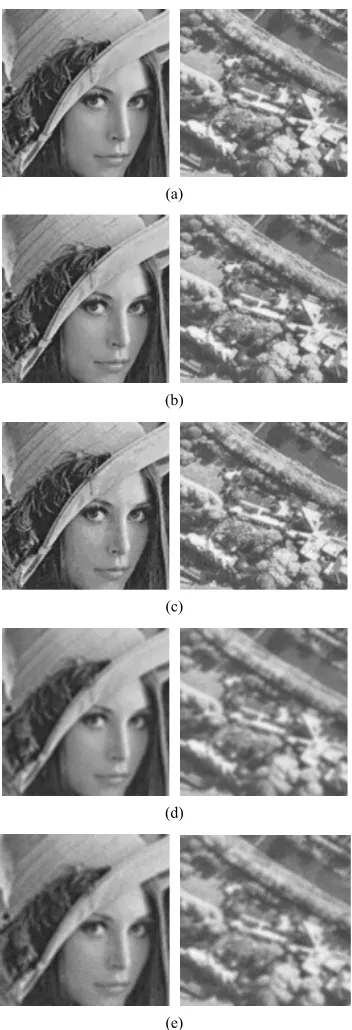
ples of the watermarked images. The ECCG0 hardly yields perceptible distortions on the resulting images as shown in Figure 5(b). As seen in Figure 5(c), on the
contrary, the ECCG1 tends to generate visible artifacts similar to “false contours” [7] particularly in areas of smooth gray levels. As for the PS method, the image degradation is mainly due to the averaging operation, which is a kind of low-pass filtering: the watermarked images of small δs as shown in Figure 5(d) look
considerably blurred; the images of large δs look grainy as well as blurred as seen in Figure 5(e).
2) Error-correcting capability
(a)
(b)
(c)
(d)
[image:13.595.85.261.81.596.2](e)
Figure 5. Examples of images “Lena” (left) and “Aerial” (right): (a) source images; results of watermarking (b) by ECCG0, (c) by ECCG1, (d) by PS method with ρ = 1 and δ = 3, and (e) by PS method with ρ = 1 and δ = 5. All the images show the 128 by 128-pixel section centered in their respec- tive images.
results. As a measure of the capability, we define a error-correction success ratio, RS, of fZ for fY as the ratio
of those pixels from which correct watermark bits are able to be extracted among those watermarked pixels of
fZ whose signal levels differ from those of fY. To
formulate RS for calculation, let Kerr be a set of locations of those watermarked pixels whose values differ between
fY and fZ; that is,
err ,
, , , ,
i i
i i Z i i Y i i
K x y
x y K f x y f x y
. (37)
Then, using the original watermark W and the extrac- ted W', RS can be calculated by
1 0
err
1 W
N
i i
i S
w w
R
K
(38)where Kerr represents the number of elements of Kerr. Before evaluating error-correcting performance, we examine the amount of signal distortion caused by JPEG compression. Figure 6 shows examples of occurrence
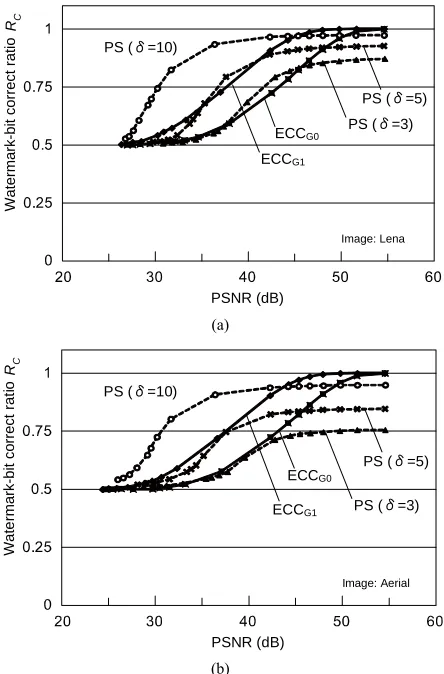
[image:13.595.316.534.500.645.2]frequencies of difference levels between a JPEG-com- pressed image and its source image for various degrees of data compression. As this figure demonstrates, the dif- ference levels tend to concentrate into small ones and also, the range is limited to a few levels particularly in the distorted images of PSNR larger than 40 dB.
Figure 7 shows the experimental results for two test
images, depicting variations of RS with PSNR values of
JPEG-compressed images for each of the ECC methods. Both the images have almost the same result. These ex- perimental results agree well with the stochastic analyses described in Section 3.3: As the PSNR value increases, the MSE value equivalently decreases, and accordingly, the difference levels concentrate in a narrow range as
Figure 6 has shown. Hence, the accumulative probability
of correct decoding can explain the variation of RS: RS
values of ECCG0, ECCG1, ECCN0 and ECCN1 get close to
0 8 16 24
0 1 2
(a) (b)
(c) (d)
Magnitude of difference level
R
e
lat
iv
e
frequenc
y
32