2016 International Conference on Mathematical, Computational and Statistical Sciences and Engineering (MCSSE 2016) ISBN: 978-1-60595-396-0
A QR Code Image Recognition Method for
an Embedded Access Control System
Zhe DONG
1, Feng PAN
1,*, Chao PAN
2, and Bo-yang XING
1 1School of Automation, Beijing Institute of Technology, Beijing, 100081, P. R. China2Kunming Institute of Physics, Kunming, 650000, P. R. China
*
Corresponding authorKeywords: QR code, Image preprocessing, Embedded, Access control system.
Abstract. As an important identity authentication for monitoring human ingress and egress, the embedded access control system requires more convenient and accurate implement. The traditional access key cannot meet the new requirement for temporary visitors. Therefore, an embedded access control system with QR (Quick Response) code recognition as a digital key is proposed in this research. Moreover, the preprocessing image method for QR code picture is improved in terms of accuracy. The Filtering-Binarization-Filtering procedure is used to deal with the crude QR snapshot under uneven illumination conditions. As shown in the comparison with other classic methods, the results in the experiment demonstrates the good performance and efficiency of the proposed method.
Introduction
For the sake of the security of restricted facilities, an efficient access control system is required to verify the authentication of personnel and visitors [1]. In order for a system to function more rapidly and accurately, there is a need to provide an easy and reliable access key for those temporary visitors to get the ingress without undue delays, while keep facility secure at the same time. QR(Quick Response) code, which was invented in 1994 by a company named Denso[2] and approved as an ISO international standard in 2000[3], has been adopted and developed widely in various applications in Asia based on the camera on mobile phones and other intelligent terminals. With the characteristics of higher capacity and higher density than other two-dimensional matrix symbols, QR code could be a useful digital key for access control system.
There are many advantages of QR code as an authentication of access control system, such as low cost, simple operation process and safety. However, the original QR code images are difficult to identify sometimes because of various shoot conditions, such as skew projection, scratches, low contradistinction, highlight spots, non-homogeneous lighting and other various mixed conditions [4]. Thus, the recognition methods of QR code image is highly concerned by many researchers. Based on the discipline of basic image processing, the general recognition steps of a QR code picture include gray conversion, binarization, filtering, orientation, error correction and decoding [5]. Zou Xiong et al. [6] adopted the first binarization and then filtering sequence to save the image preprocessing time, however, the important message might be missing. Homkajorn et al. [7] introduced an advance technique on removing scratch or damage on QR code. Liang et al.[8] proposed a capable real-time algorithm for mobile use, while the recognition rate in complex lighting conditions didn’t perform well. Ohbuchi et al. [9] introduced barcode readers using the camera device in mobile phones, but the proposed method relied on two specific conditions which are not realistic assumption in usual environment. Okazaki et al. [10] presented implications for the effective use of QR code in different media which gave a benchmark for utilizing QR code.
accuracy performances. In Section 4, sample sets of QR code images are used to evaluate the performance of the proposed method by comparing its results with those obtained from the classic approaches. Main conclusions of this paper are drawn in Section 5.
System Scheme
In this section, the general scheme of the access control system is depicted and an embedded hardware architecture, as one of the essential implement of whole system, is proposed to support software development.
For security reasons, temporary visitor seeking entry to restricted facilities is tightly controlled. Issuing access passes and maintaining a database of identification information are essential functions for an access control system or apparatus to monitor and control ingress and egress. Without loss of generality, Figure 1 shows an access control system scheme with the function of camera snapshot input, data storage and information verification.
[image:2.595.157.441.275.347.2]QR Code Input QR Code Input Decoding Process Decoding Process Information Storage Information Storage Error Notification Error Notification Open the Lock Open the Lock Match the Password? Yes No
Figure 1. The scheme of access control system.
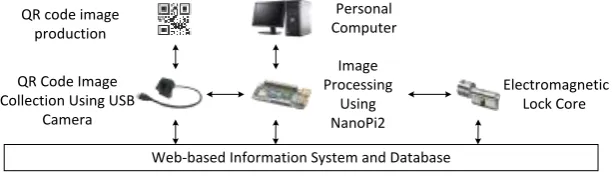
The design and development of an embedded access control system usually include two parts, hardware and software. To begin with, our hardware architecture of the system is shown in Figure 2. The embedded architecture proposed in this research contains a USB camera for QR code collection, a NanoPi2 [11] for image processing, an electromagnetic lock core and a web-based information system.
Web-based Information System and Database QR code image
production
QR Code Image Collection Using USB
Camera Personal Computer Image Processing Using NanoPi2 Electromagnetic Lock Core
Figure 2. The proposed embedded hardware architecture.
As for software, the QR code image processing procedure of such a system generally involves two key issues. The first one is the preprocessing of QR code image recognition, which aims to identify the snapshot accurately for next steps and will be our research focus in this paper. The second issue is the orientation and decoding process of the QR code, which already has some available and efficient implement tools.
The QR Code Image Recognition Algorithm
In this section, a preprocessing procedure is proposed to improve the accuracy of QR code recognition under the circumstance of low contrast and uneven illumination.
[image:2.595.145.452.448.536.2]Secondly, due to the complex imaging conditions and uneven illumination, the noise of the QR code picture is inevitable. Filtering and binarization are the next procedure before decoding and displaying the results. In order to obtain a binary image, the important factor is to determine the threshold method. The global threshold method which is adopted by Otsu[12] is not suitable for variable lighting conditions, while the local threshold method[5] costs amount of calculation. Our method focuses on the uneven illumination conditions and tries to improve the accuracy of image recognition. The proposed procedure is in Table 1.
Table 1. Filtering-Binarization-Filtering (FBF) Procedure.
Algorithm Filtering-Binarization-Filtering (FBF) Procedure
Input: QR code figure with noise Output: QR code ready for orientation
1 Gray Conversion: Obtain a black-white image with gray valuew[13]
r g b
wC R C G C B, where Cr 0.299,Cg 0.587,Cb0.114
2 Median Filtering: Considering the low contrast or small code area of original QR image, the sobel operator [14] is used to enhance the edge. Then find the middle value of corresponding gray pixel of each filtering window by sorting.
3 Binarization: Calculating the threshold of each pixel t x y( , )
( , ) 0.5 (max ( , ) min ( , ))
t x y f xm y n f xm yn ; t m t, t n t. Then turn each pixel ( , )x y into binaryt x y( , ).
4 Mean Filtering: As a linear filter, it is used for smoothing the binary image for better recognition.
Evaluation and Discussion
Table 2. Results of different image recognition methods.
No. Method Output
(low contrast)
Output
(over-exposure)
Output
(uneven)
1 Original QR code image
2 Obtus –
Gaussian Laplace Filter
3 Gaussian Laplace Filter - Obtus
4 Gaussian Filter - Bernsen
5
Median Filter –
[image:3.595.78.520.416.755.2]6 The Proposed FBF method
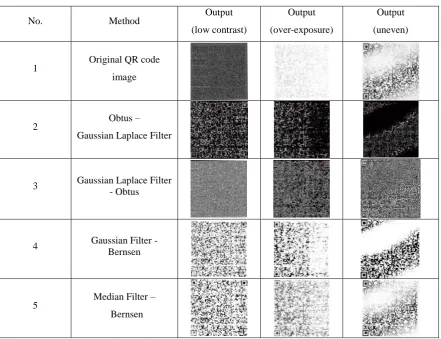
This section describes the testing results for the evaluation of the proposed FBF method. Several sets of QR code examples are used to demonstrate the performance of the image recognition methods. The results of Bernsen[15] method, Otsu method and other classic method are used for comparison with the proposed method. Applying these methods mentioned above, the results are shown in Table 2.
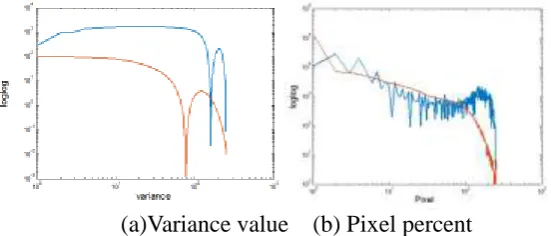
The QR code image under different light conditions, such as low contrast, over-exposure image and uneven illumination are listed in the Table 1. The Obtus method is used as a binarization and then Gaussian Laplace Filter is applied to get a set of results, which shows that it is not suitable for QR code image recognition. Moreover, the Gaussian Filter and Median Filter are used with Bernsen method. These methods can recognize the low contrast and over-exposure image, however, it has some difficult to deal with the sample of uneven illumination condition. Our proposed method show better performance in all QR code samples, especially in uneven ones. The variance value and pixel percent of uneven samples are shown in Figure 3. The orange line in Figure 3 demonstrates the Gaussian Filter - Bernsen method and blue one shows the proposed FBF method. Due to the edge operator, the enhanced-edge has obvious advantages of the results. The blue line shows less information missing and less noise in the proposed procedure.
[image:4.595.149.425.379.497.2](a)Variance value (b) Pixel percent
Figure 3. Difference betweenGaussian Filter - Bernsen method and proposed method.
Conclusion
In this paper, the scheme of an embedded access control system is outlined and a Filtering-Binarization-Filtering method is proposed to deal with the QR code image recognition processing, especially the picture under uneven illumination condition. The proposed method has better performance to enhance the edge and the second filter after the binary image is used to smooth the result for better recognition. The experiments are conducted to compare the proposed method with classic method to evaluate the efficiency of the proposed one. It is shown that the proposed method achieves improved performance in terms of accuracy and can be utilized for the embedded access control system.
Reference
[1] Zagami, Anthony. "Access control system." U.S. Patent No. 6,394,356. 28 May 2002.
[5] Liu, Yue, Ju Yang, and Mingjun Liu. "Recognition of QR code with mobile phones." 2008 Chinese Control and Decision Conference. IEEE, 2008.
[6] Zou Xiong, Guo-dong Liu, and Jian-min Wang. "Study on the sequence of steps in the QR code image preprocessing." Future Computer and Communication (ICFCC), 2010 2nd International Conference on. Vol. 3. IEEE, 2010.
[7] Homkajorn, Kamon, Mahasak Ketcham, and Sartid Vongpradhip. "A technique to remove scratches from QR code images." International Conference on Computer and Communication Technologies. 2012.
[8] Liang, Ying-Hong, et al. "Real time recognition of 2D bar codes in complex image conditions." 2007 International Conference on Machine Learning and Cybernetics. Vol. 3. IEEE, 2007.
[9] Ohbuchi, Eisaku, Hiroshi Hanaizumi, and Lim Ah Hock. "Barcode readers using the camera device in mobile phones." Cyberworlds, 2004 International Conference on. IEEE, 2004.
[10] Okazaki, Shintaro, Hairong Li, and Morikazu Hirose. "Benchmarking the use of QR code in mobile promotion." Journal of Advertising Research 52.1 (2012): 102-117.
[11] http://wiki.friendlyarm.com/wiki/index.php/NanoPi_2/zh
[12] Otsu, Nobuyuki. "A threshold selection method from gray-level histograms."Automatica 11.285-296 (1975): 23-27.
[13] Kumar, Tarun, and Karun Verma. "A Theory Based on Conversion of RGB image to Gray image." International Journal of Computer Applications 7.2 (2010): 7-10.
[14] Gonzalez, Rafael C., and Richard E. Woods. "Digital image processing." Nueva Jersey (2008).