2017 2nd International Conference on Computer, Network Security and Communication Engineering (CNSCE 2017) ISBN: 978-1-60595-439-4
Machine Learning Approach for Malware Detection by Using APKs
Rubata RIASAT
1,4, Muntaha SAKEENA
2, Abdul Hannan SADIQ
5,
Chong WANG
1,4, Chang-you ZHANG
3,4and Yong-ji WANG
1,4*
1State key laboratory of Computer Science, Institute of Software, Chinese Academy of Sciences, Beijng, 100190, China.
2
College of Electrical and Mechanical Engineering, National University of Science and Technology Islamabad, 44000, Pakistan.
3
Laboratory of parallel Software and Computational Science, Institute of Software, Chinese Academy of Sciences, Beijing,100190, China
4
University of Chinese Academy of Sciences, Beijing, 100049, China. 5
Comsats Institute of Technology, Islamabad, 44000 Pakistan.
*Corresponding author
Keywords: Machine learning, Malware detection, Android, Reverse engineering, APKs.
Abstract. An android mobile phone is one of the most anticipated smart phone operating systems on the market. The open source Android platform not only allow developer to take full advantage of the mobile system, but also raises significant issues related to malicious applications (Apps). Although understanding the android malware using dynamic analysis can provide a compressive view and it is still subjected to high cost in environment development and manual effort in investigation. In this study our proposed approach provides a static and dynamic analyst paradigm for detecting android malware. The mechanism considers the static information including permissions, deployment of components, intent message passing and API calls for characterizing the android application behavior. In order to recognize different intentions of android malware, different kind of clustering and classification can be applied to enhance the malware detection capability. Our approach extracts the information from the each APKs manifest file, and regards component (Activity, Receiver, Services) as entry points drilling down for tracing API calls related to permissions. Next it applies detection methods based on matching (Signature matching) and learning (SVM and random forest) algorithm to classify the applications as benign or malicious. The experimental results show that the accuracy of our approach is better than one of the well-known tool, Androguard, also it is efficient since its take half of the time than Androguard to predict 600 applications as benign or malicious. The open source Android platform allows developer to take full advantage of the mobile.
Introduction
publication in the Google Android Market. Malware applications commonly used three types of penetration techniques for installation, activation, and running on the Android system: Downloading, Repackaging and Updating, these techniques are more difficult for detection. Malware developers may still use repackaging but instead of enclosing the inflict code to the App, they include an update component that will download malicious code at runtime. Most malware detection methods based on content signatures, such as a list of malware signature definition. The disadvantage of this detection method is that users are only protected from malware that are detected by most recently updated signatures, but not protected from new malware (i.e. zero-day attack). A previous study of the malicious patterns has concluded that “Signature-based approaches never keep up with the speed at which malware is created and evolved” [4]. With attention to the rapid growth of malicious Apps and the disappointing results of current security software [5], there is a pressing need to develop effective solutions to detect malware on the smartphone platform. Instead of using static signatures, an effective alternative solution is to use characteristic and behavioral-based methods which try to detect malware by observing the statistic and/or dynamic behavior and features of mobile applications. One of the most popular behavioral methods is malware detection based on static requested permissions, which check what types of resources, such as Wi-Fi network, user location, and user contact information, an App is requesting for installation (Android provides over 130 permissions for developers to control the resources that an App can request[6]). Although pure permission based method is simple and have moderate good results but its performance is not reliable. This is mainly because developers can freely request any permission they want, so they can mock the requested permissions of benign applications. On the other hand, observing dynamic behavior of Apps, such as dynamic API calls, is more accurate than permission based methods in capturing runtime activities of the App. But analyzing Apps’ runtime dynamic behaviors is not simple and requires sophisticated skills and platforms which cause cost overhead and time consuming process. Motivated by the above observations, we propose a framework for analyzing and classifying Android applications based on machine learning techniques. The framework rests on a combination of requested permission and static API call behaviors, and extracts features from these behaviors and builds classifiers to detect malicious applications. We obtain 87.70% accuracy which exposes a reliable method to protect against malicious destructive activities.
The remainder of the paper is structured as follows. Related works are described in Section 2. Section 3 briefly describes Android application structure and its security approach. Section 4 briefly describe the Android Analysis Techology and Our methodology is introduced in Section 5, Experiments and comparisons are reported in Section 6, and we conclude the paper in Section 7.
Related Work
applications. Zhou et al. [14] first proposes to use permission behavior to detect new Android malware and then applies heuristic filtering for detecting unknown Android malware. This hybrid method, called DroidRanger, resolves the disadvantage of lacking ability to detect unknown malware. All these existing methods have essentially advanced the Android malware detection, but the misuse detection is not adaptive to the novel Android malware and always requires frequent updating of the signatures. In comparisons, our work is motivated by some of the above techniques and approaches, but with focus on developing simple and effective malware detection approaches, without relying on complex dynamic runtime analysis and any static predefined malware signatures. We combine permissions and API calls as features to characterize malware, and use machine learning techniques to automatically extract patterns to differentiate benign and malicious Apps.
Android Security
Most of the Android malicious applications by using android operating system itself to vulnerability to achieve the purpose of malacious attacks, such as the 2011 TouchLogger [1, 15] access to the mobile motion sensor, accelerometer and gyroscope record user caused by touching the the screen position of the migration and vibration feedback, on the data mining , to deduce the user’s personal privacy and account password, similar and with the help of a voice messages SoundComber [16]. In addition, papathanasiou found a triggered by a specific telephone number Rootkit [17], will open a reverse with access TCP connection. The research and application of android malware is closely related to the charateristics of the android platform respectively from the composition of android and the structure of android security mechanism focuses on several aspects such as android applications.
Android System Architecture
Android is designed for mobile devices with resource constraints. It provides a sandboxed application execution environment where a customized embedded Linux system interacts with the phone hardware and off-processor cellular radio while the Binder middleware and application API runs on top of Linux. As shown in Figure 1, Android is effectively a software stack for mobile devices that includes an operating system, middleware and key applications and uses a modified version of the Linux kernel. The Linux 2.6.x kernel lying at the foundation of the Android platform serves as a hardware abstraction layer, which offers an existing memory management, process management, security and networking model upon which the rest of the Android platform is built. The native libraries such as SQLite, Webkit and SSL, layered on top of the Linux kernel, provide most of the functionality of the Android system. The Application framework layer provides all the APIs that the applications require to access the device hardware: location information, running background services, etc. The application’s only interface to the phone is through these API’s. Each application is executed within a Dalvik Virtual Machine (DVM) running under a unique UNIX uid. At the higher operating system layers we have the user applications such as the phone application, home application, etc. which are pre-installed and other applications that are downloaded from the Google Play market or alternative marketplaces or even installed manually from .apk files. These additional apps extend the functionality of the smartphone and pose potential threat to user security and privacy if they happen to be malicious. In this paper our main research focused on the application layer.
Android Application Basics
Android applications (or apps) are written in java programming language. The Android SDK tools compile the code—along with any data and resource files—into an Android package, an archive file with an .apk suffix. All the code in a single .apk file is considered to be one application and it is this file that Android-powered devices use to install the app.
manifest file. The manifest file also states the user permissions that the application requires, such as internet access or read-access to the user’s contacts.
Android apps are distributed as self-contained packages called APKs. An APK (Android Package) is a compressed (ZIP) bundle of files typically consisting of: AndroidManifest.xml (manifest file), classes.dex (A single file which holds the complete bytecode to be interpreted by Dalvik VM). Other binary or XML-based resources required by the app to run may be held in res/ and assets/ folders. The detection strategy developed in this paper leverages the applications reliance on the platform APIs and their structured packaging to extract certain properties that could serve as indicators of suspicious activity, such as intent to exfiltrate sensitive information, launch a malicious payload at runtime, or presence of embedded secondary payload in the external folders etc. These properties then form the basis of our SVM and Random forest classifier, which is used to determine whether a given Android app is harmless or suspicious.
[image:4.612.83.305.231.389.2] [image:4.612.304.526.232.392.2]
Figure 1. Android System Architecture [19]. Figure 2. Android Sandbox Mechanism.
Android Platform Security Mechanism
Access Control Mechanism. Android in the application framework level component provides restricted access to the resource control mechanism, access to the application will need to explicitly apply Manifest.xml file, and once the user agreed to request permission application, the application of all the components. They have received appropriate permissions. This relatively coarse-grained access control mechanism, mainly in two aspects: the user privileges for the next application requirements in most cases can only select fully accepted or rejected directly, there is no choice; permissions cannot be applied, such as geographic information with specific scenes, etc. change. These defects caused a series of security problems.
Sandbox Model. Android sandbox model is between an application on a virtual machine layer provides a separation mechanism. Shown in Figure 2, each Android application installation is assigned a user UID, they correspond to different running processes and virtual machines. Sandbox model is the basis Androids access control mechanisms.
Signature Verification Mechanism. Android installation package file for each signature is required, the installation, the system will perform its signature information than the integrity judgment procedure to determine whether the .apk file can be installed, to a certain extent, to achieve security purposes. Signature information placed in the META-INFO .apk file after extracting the folder, where MANIFEST.MF document is a summary document, generate SHA1 digest for all non-signed .apk file to check whether the package has been modified; and eventually the developers to digest signature stored in CERT.SF file, the corresponding public key signature file stored in CERT.RSA.
Application Reverse Engineering
involved are shown in Figure 3. To parse the .dex file, a tool called Baksmali [20] is used, which is a disassembler for the dex format used by Dalvik. Baksmali disassembles .dex files into multiple files with .smali extensions. Each .smali file contains only one class information which is equivalent to a Java .class file.
Figure 3. Automated reverse engineering of the Android Apps with the java-based APK analyzer.[21].
Android Analysis Technology
Static Analysis. Static analysis method refers to the manner, without running the code through lexical analysis, syntax analysis, control flow and data flow analysis technology to scan the program code, verification code whether meet the specification, safety, reliability, maintainability and other indicators of a code analysis technology. The prestigious Riskranker [22] and Passive Content Leaks [23] and so on all is a static method is adopted to improve the resolution. Germany's Daniel Arp et al also proposed DREBIN [24] summarizes the static analysis of a series of features, including hardware configuration, request permission, application components, Intent Filter, sensitive API, used by permission, network address, etc.
Dynamic Analysis. Unlike a static method, dynamic analysis is mainly used for android applications provide controlled runtime environment, mounted with the simulator to run android APP, and monitor the runtime behavior, such as application sent over the network information, mutual sharing of data between applications, application access to resources, and so on. Both tracking method based on tag data, when the tag data is sent out is controlled environment that the test application for malicious; There are statistical analysis applications run several times after the data using classification algorithms to determine. DroidBox [25], TaintDroid [26] is famous android dynamic analysis model, the other 2014 DroidDolphin [27] path, with applications in more than one time triggered a series of combination of the frequency of a given event or events as features for classification. Robiah [28] and others are obtained by static and dynamic analysis of the characteristics of the effect of classification. Although dynamic analysis technology has good detection effect, but its weakness is that takes up too many resources and time consuming, it is difficult to realize the online service.
Methodology
There are three main identification method malicious Android application testing, the system combinestwo typesbased on matchingbasedlearning,in whichthree representativeachievespecific identificationalgorithm - signaturesmatchand use ofAPIand permissions,SVM andrandomforest classification. The followingintroducesthe preprocessing processwe need,and thenimplementtwo methods thataredescribedin the following sections.
APK Preprocessing
Decompile APK. For Android application package files, we first need to do some preparatory workin order tofurther analysiscarried out smoothly.In this step,we mainlyuse the command-line tool.
2) calculate the MD5 value of APK file, query in the database, if you already have the record APK file, the next operation is not necessary, apply directly to the current settings for this application. 3) use APKTool to decompile the APK files, resource files, the Manifest.XML configuration file and smali source code.
4) using AAPT tool to view the application of some very basic information, such as the name of the application.
Parsing Code Signature. After the preliminary processing or preprocessing, we proceed to APK static analysis, extraction detection methods used for generating feature data. In this step, we mainly use third-party tools Androguard and in combination with other tools, to extract work package as a class, complete extraction operation by calling its object method. We mainly extract the following information:
1) the application package name, release date, version number, etc. 2) to apply for the permissions and relevant explanation.
3) the signature information, including signature files, signer, whether self-signed, expiration date, etc.
4) Certificate information, including the certification authority, such as root certificate is trusted. 5) Component information, including application of activities, services, content providers, Broadcasters, etc.
6) API call information
7) Control flow graph in the form of a string.
Feature Generation.
1. CFG features: For matching signature-based detection, control flow graph we do some pretreatment, then submitted to the classifier, similar input = output. This feature extractor primarily to safeguard the unity of the process provided.
2. API feature: for SVM classifier, the use of sensitive API and application permissions as the classification basis, the feature extractor in the first step to get the API call information as input, the main check on network, camera, text messages and other sensitive operations the method, first remove the initialization, destruction and some routine operations, get a new list of sensitive API, then the standard list comparison, the record contains a method 1, otherwise marked 0, the resulting vector as a string of 0 and 1.
3. Permission features: from the Google official documentation site permissions to the present from the earliest version of all the Android SDK, and remove their duplicate part, the first step to obtain permission for comparison, final feature vector as a permission to establish 0-1.
Our ultimate combination of these three characteristics, the latter two are 0-1 since the vector, put them together, for the former it still remain independent. Expressions features are combined in Python dictionary objects, we put it into a database and made available to the classifier.
Signature Matching Based Detection
This detection method is the determination reference Androguard application of risk means; CFG Pictured features to the application, by comparison with known malicious applications were discriminated. Firstly, following the full process of the detection method, and then were elaborate its core issues.
Signature Matching Process. The core problem is based on two things - how to represent the Android application, how to calculate the similarity between applications and the high similarity to known malicious applications judgments as malicious. Then elaborate on these two points, respectively.
configuration file.
[image:7.612.162.449.73.243.2]
Figure 4. Feature Signature Sample Configuration file.
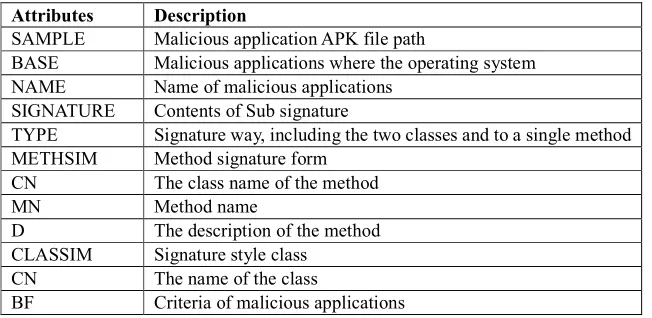
The following is adetailed descriptionof the feature signature sample configuration file in Table.1.
Table 1. Feature signatue configuration.
Attributes Description
SAMPLE Malicious application APK file path
BASE Malicious applications where the operating system
NAME Name ofmalicious applications
SIGNATURE Contents of Sub signature
TYPE Signature way, including the two classes and to a single method
METHSIM Method signature form
CN The class name of the method
MN Method name
D The description of the method
CLASSIM Signature style class
CN The name of the class
BF Criteria of malicious applications
Similarity Calculation. For the application under test, we iterate over all known malicious applications and compute the similarity between them. First of all, is to read a malicious application corresponding configuration file, find the location of the application under test corresponding, treat measure used for feature signatures generated after calculating the NCD(Normalized Compression Distance)distance of two string.NCDdistanceis defined as follows:
WhereinZ (a)refers tothe sub-Zis compressedacompressedbinarystringlengthand Z (a + b) is the stringof a and b after compressed binary string length. In this system, we usedthe compressionbased onbase64.
Detection Based on Supervised Learning
As already mentioned, detection based on supervised learning the basic all follow feature extraction - training - test a set of framework, this system has realized the SVM classifier and random forest classifier, in order to avoid repetition, there is only an example for the SVM is to supervise the implementation process of the learning method.
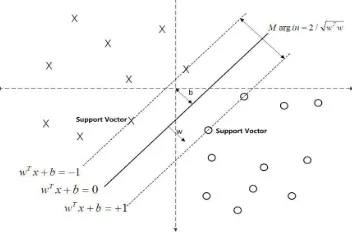
SVM Principle. SVM classification is based on the assumption of a linear separable, that is defined in the feature vector high-dimensional space, there is a hyperplane point area which separates
NCDz(a,b)= Z(a+b)−min{Z(a),Z(b)}
[image:7.612.145.471.302.461.2]and represent the point of malicious applications and represents normal application, specifically shown in the below drawing and Figure 5.
Figure 5. SVM Principle diagram.
And the SVM training purpose is to find all the hyperplane in the minimize the loss function. Once the data is linear, we need the help of nuclear, is to find a separable hypersurface, through nuclear transformation can translate into hyperplane.
Experimental Results
In order to evaluate the proposed approach, we make experiment for evaluating the effectiveness of our Approach. In addition, we compare our approach with one of the well- known Android malware detection tools, called Androguard, a signature based tool [29],[30] published at blackhat2011. In our experiments, malicious Apps are labeled as positive and benign Apps are considered as negative samples. The detailed information about malware and benign app collection is described in the next subsection, all experiments are carried out on the following test environment.
Hardware environment: Mac Retina Pro, Memory:8G, CPU: Core clocked i5,2.6GHZ, Operating System: OSX 10.10.3, Development Language: Python
Data Collection. We collect android malware from “Contagio mobile” [31] site that seem the only one Android malware public dataset. Test data sets taken from two main sections - reptiles crawling and contagio malicious applications library, a total of more than 600 samples, which weed out incomplete, repeated after a total of 536, including the normal application of 248, 288 malicious applications. we have taken 388 samples as a training set, in which the normal application of 67, malicious applications 81; the remaining 148 samples as a test set to see the effect of the detection system.
The detection rate and false positive rate is the result of the analysis which is very important indicator, the detection rate refers to the number of detected malicious applications accounted for all of the test set number of malicious applications proportions, false positive rate represents the number of normal application convicted of malicious account all of the normal number of applications ratio test set.
The test results are shown in Table 2.
Table 2. Performance of different Detection Algorithms.
Detection Methods
Detection Rate
Misjudgment Rate
Processing Time
Signature Match 2.10% 0 1m
SVM 74.00% 7.40% 20s
Random forest 85.10% 9.00% 20s
Signature Match + SVM 74.00% 7.40% 1 m
Signature Match + Random forest 86.40% 8.90% 1m
[image:8.612.144.468.608.744.2]Experimental Discussion. We analyze that the feature based Signature matching method has poor performance, which is due to malicious applications feature signature database used in the test is Androguard public in 2011, the majority of malicious applications are now rare, which means that the vast majority of the sample for the test set which belong to new applications for its low detection rate is understandable. This method does not require training, and there is almost no case of miscarriage of justice, it is determined to make a high-reliability, its detection capabilities will expand with the characteristic signature database updates and enhancements.
SVM classifier and random forest classifier compared to random forest classifier detection rate by about 10%, while the false positive rate increased by only 2%, but that does not mean random forest classifier to excellent in SVM, as adopted in the form of feature vectors 0-1, more suitable for decision trees, random forests algorithm in this category. When the characteristic form becomes complicated, SVM for numerical feature vector is still able to achieve good results for many types of hybrid feature vectors such as String + Float, through the use of nuclear methods continue to apply. That is, although in the present experiment, the performance of SVM is less than the random forest, but it applies more features and in most cases have good and acceptable results.
SVM and Random forest classification method of combining the detection rate for a small amount of increase, but the rate of false positives increases correspondingly large, nearly 3%. This situation is due to the combination of a variety of detection methods strategy is simple - as long as there is a considered to be malicious, it is identified as malicious; - great loss not detected than miscarriage of justice may have caused, but this approach is not unreasonable more. Overall, the combination of a variety of methods for detecting the effectiveness, there is much room for improvement. On the processing time, it is easy to see most of the time spent learning detection method based on APK resolution phase, phase identification and classification of the time spent little or negligible. Corresponding features signature-based matching method because of the need and Signature library Malicious applications for comparison, it takes a relatively long time.
Conclusion
In this paper we analyzes and studies the today's mainstream Android malicious applications analytical methods, including two major categories; static analysis and dynamic analysis, and collate and summarize the current three categories of malicious applications discriminating method - matching based, pattern-based and learning based detection. In this paper, based on the static analysis and learning-based detection methods, combining traditional detection methods based on matching using WEB technology to design and implement an online Android malicious application detection system.
The greatest feature of this system is 1) to expand its own database, and with the increase in the number of applications continues to improve known detection results, the detection process is quick precision; 2) is better able to support most of the detection method, able to integrate different detection methods and analysis features, and allows the combination of various methods, with great scalability.
The proposed online detection system has been basically achieve the functionality, but there are still many problems and shortcomings. Because of the loosely coupled structure, the detection method and classification characteristics are not user friendly. So these properties can still be modified for making the software user friendly by using high concurrency scenarios sufficient treatment capacity of APK parsing. In future, we will solve the problems of online detection system to improve on Android platform security policies more in detail.
Acknowledgment
References
[1] Malware, Malware Definition by Wikipedia the free Encyclopedia
http://en.wikipedia.org/wiki/Malware - cite note-2.
[2] Sami, A., et al., Malware detection based on mining API calls, in Proceedings of the 2010 ACM Symposium on Applied Computing. 2010, ACM: Sierre, Switzerland. p. 1020-1025.
[3] AppBrain, Number of android applications,online at: https://www.appbrain.com/stats/ number-of-android-apps.
[4] Mihai Christodorescu, S.J., Static Analysis of Executables to Detect Malicious Patterns. 12th USENIX Security Symposium, 2003: p. 169-186.
[5] Jiang, Y.Z.X., Dissecting Android Malware: Characterization and Evolution. 2012 IEEE Symposium on Security and Privacy, 2012: p. 95 - 109.
[6] Developer, A., Android developer page for Android Manifest Permission group
http://developer.android.com/reference/packages.html.
[7] Shabtai, A., et al., "Andromaly": a behavioral malware detection framework for android devices. J. Intell. Inf. Syst., 2012. 38(1): p. 161-190.
[8] Arnold, J.O.K.W.C., Automatic Extraction of Computer Virus Signatures. In Proceedings of 4th Virus Bulletin International Conference, 1994: p. 178-184.
[9] M.G. Schultz, E.E., F. Zadok, S.J. Stolfo, Data mining methods for detection of new malicious executables. Proceedings 2001 IEEE Symposium on Security and Privacy. S&P 2001, 2001: p. 38-49.
[10] Zhu, X.J.X., vEye: behavioral footprinting for self-propagating worm detection and profiling. Knowledge and Information Systems, 2009. 18(2): p. 231-262.
[11] Jiang, Y.Z.X., Dissecting Android Malware: Characterization and Evolution. IEEE Symposium on Security and Privacy, 2012: p. 95-109.
[12] Burguera, I., U. Zurutuza, and S. Nadjm-Tehrani, Crowdroid: behavior-based malware detection system for Android, in Proceedings of the 1st ACM workshop on Security and privacy in smartphones and mobile devices. 2011, ACM: Chicago, Illinois, USA. p. 15-26.
[13] Min Zhao, T.Z., Fangbin Ge, Zhijian Yuan, RobotDroid: A Lightweight Malware Detection Framework On Smartphones. journal of Networks, 2012. 7(4): p. 715-722.
[14] Yajin Zhou, Z.W., Wu Zhou, Xuxian Jiang, Hey, You, Get Off of My Market: Detecting Malicious Apps in Official and Alternative Android Markets. network and distributed system security symposium, 2012.
[15] Liang Cai, H.C., TouchLogger: Inferring keystrokes on touch screen from smartphone motion. 67 Proceedings of the 6th USENIX Workshop on Hot Topics in Security (HotSec). 2011.
[16] Roman Schlegel, K.Z., Xiaoyong Zhou, Mehool Intwala, Apu Kapadia, and XiaoFeng Wang, Soundcomber: A Stealthy and Context-Aware Sound Trojan for Smartphones. In Proceedings of the 18th Annual Network & Distributed System Security Symposium (NDSS ’11): p. 17–33.
[17] You, D.H. and B.N. Noh. Android platform based linux kernel rootkit. in 2011 6th International Conference on Malicious and Unwanted Software. 2011.
[19] Android, D., Android developers, [online]:http://developer.android.com/.
[20] Baksmali, Online: https://github.com/JesusFreke/smali.
[21] Muttik, S.Y.Y.S.S.G.M.I., A New Android Malware Detection Approach Using Bayesian Classification. 2013 IEEE 27th International Conference on Advanced Information Networking and Applications (AINA), 2013: p. 121 - 128.
[22] Jiang, M.G.Y.Z.Q.Z.S.Z.X., RiskRanker: scalable and accurate zero-day android malware detection. international conference on mobile systems, applications, and services, 2012: p. 281-294.
[23] Yajin Zhou, X.J., Detecting Passive Content Leaks and Pollution in Android Applications. network and distributed system security symposium, 2013.
[24] Daniel Arp, M.S., Malte Hubner, Hugo Gascon, Konrad Rieck, DREBIN: Effective and Explainable Detection of Android Malware in Your Pocket. network and distributed system security symposium(NDSS), 2014.
[25] Alazab, M., et al., Analysis of Malicious and Benign Android Applications, in Proceedings of the 2012 32nd International Conference on Distributed Computing Systems Workshops. 2012, IEEE Computer Society. p. 608-616.
[26] Enck, W., et al., TaintDroid: An Information-Flow Tracking System for Realtime Privacy Monitoring on Smartphones. ACM Trans. Comput. Syst., 2014. 32(2): p. 1-29.
[27] Wu, W.-C. and S.-H. Hung, DroidDolphin: a dynamic Android malware detection framework using big data and machine learning, in Proceedings of the 2014 Conference on Research in Adaptive and Convergent Systems. 2014, ACM: Towson, Maryland. p. 247-252.
[28] Yusof, M.Z.M.U.S.S.M.F.A.S.R.S.R., Analysis of Features Selection and Machine Learning Classifier in Android Malware Detection. International Conference on Information Science & Applications (ICISA), 2014: p. 1-5.
[29] Androguard, Androguard. online: http://code.google.com/p/androguard/.
[30] Anthony Desnos, G.G., Android: From Reversing to Decompilation. 2011.
![Figure 1. Android System Architecture [19]. Figure 2. Android Sandbox Mechanism](https://thumb-us.123doks.com/thumbv2/123dok_us/286773.1029409/4.612.304.526.232.392/figure-android-system-architecture-figure-android-sandbox-mechanism.webp)
![Figure 3. Automated reverse engineering of the Android Apps with the java-based APK analyzer.[21]](https://thumb-us.123doks.com/thumbv2/123dok_us/286773.1029409/5.612.142.455.127.254/figure-automated-reverse-engineering-android-apps-based-analyzer.webp)