2017 2nd International Conference on Computational Modeling, Simulation and Applied Mathematics (CMSAM 2017) ISBN: 978-1-60595-499-8
Resource Leveling with Soft Precedence Relations
Qian ZHANG
1and Xin ZOU
2,*1
State Grid Energy Research Institute, Beijing, China
2
Department of Economic Management, North China Electric Power University, Baoding, China
*Corresponding author
Keywords: Project scheduling, Resource leveling, Soft precedence relations, Network analysis.
Abstract. This paper presents a mixed-integer linear model for solving the resource leveling problem with soft precedence relations. The model allows reversing of a work sequence of activities and aims to minimize the sum of the costs resulting from the fluctuations in resource usage from period to period without exceeding the specified deadline. The effectiveness of the proposed model is verified using an illustrative project, with the results showing that using soft precedence relations between activities provides more potential for reducing the fluctuations of resource utilization.
Introduction
Resource leveling is a resource management technique that aims to reduce the fluctuations of resource utilization during the course of project makespan, while complying with a prescribed project completion time [1]. Resource fluctuations can increase financial burden or risk of project accidents, and therefore efficient resource leveling approaches must help to schedule project activities such that resource utilization is as smooth as possible over the entire planning horizon.
In literature, many methods have been developed to deal with the resource leveling problem using techniques such as mathematical programming models [2], heuristic procedures [3-5], and intelligent algorithms [6-10]. All these methods assume fixed precedence relations, hence requiring the work sequences to remain unchanged. However, in real projects, activities commonly have more than one work sequence, i.e., the relations between activities may be of a “soft” character. Current models do not account for this fact, thereby requiring the planner to choose a specific logical sequence based on a set of assumptions [2]. In the worst case, the sequence chosen by the planner might be far from optimal, with lower optimization efficiency. On the other hand, efficiency is gaining more and more importance as a competitive factor for construction companies. Therefore, it is important to account for different work sequences between activities, when considering project scheduling.
This paper aims at developing a mixed-integer linear model for solving resource leveling problems considering soft precedence relations. The proposed model is augmented with additional relations, in order to guarantee the feasibility of project networks. Finally, an illustrative example is used to validate the effectiveness of the proposed model.
Scheduling with Soft Precedence Relations
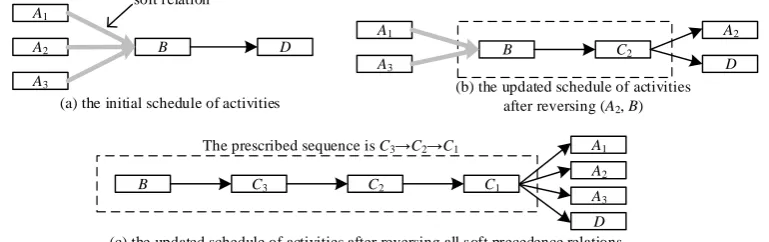
Generally, assume an activity B is connected with multiple soft precedence relations , k= 1,…,K, as shown in Fig. 1. When these relations are reversed, there may be additional works {Ck} that
must be performed after activity B. The {Ck} are not included in the initial schedule, and their
presence may affect the implementation of other activities, as a result of resource or space restrictions. To avoid such interferences, this paper requires the {Ck} to be scheduled sequentially and to precede
[image:2.595.105.490.182.303.2]all successors of activity B and the activities Ak whose relations with activity B have been reversed.
Figure 1 explains the above rules in detail in terms of a simple example.
A1
B D
A2
A3
soft relation
A1
B A3
C2
A2
D
B C3
D C2 C1
A1
A2
A3 (a) the initial schedule of activities
(b) the updated schedule of activities after reversing (A2, B)
(c) the updated schedule of activities after reversing all soft precedence relations The prescribed sequence is C3C2C1
Figure 1. Example of scheduling multiple soft precedence relations.
Model Formulation
We consider projects described by activity-on-node networks , where V={0,1,…,n,n+1} is the set of vertices and E is the set of arcs. Dummy activities 0 and n+1 represent the beginning and completion of a project, respectively. The project begins at time zero and must be delivered before the prescribed deadline T. Let denote the set of resources required for performing project activities. Each activity has a given duration and requires units of resource per day. For the fictitious activities, we set and for all .
The set , representing precedence relations between activities, consists of two disjoint subsets, F, a set of fixed relations, and S, a set of soft relations. The set S includes two disjoint subsets,
S1 and S2. If the reversal of a soft relation does not produce an additional work, then ;
otherwise, and the associated additional work is labeled with the symbol “ .” Let
and be the duration and requirement per unit time of resource of the additional work , respectively. For each , the set consists of all possible additional work after activity j. According to the assumption discussed in the above section, the additional work in SAj
must be scheduled in a pre-specified and feasible sequence PSj. In this paper,
means that the additional work precedes .
Introduction of Additional Relations
An activity cannot start before the completion of the activities that restrict its starting. This requirement must be satisfied even if a soft precedence relation is to be reversed. To guarantee the feasibility of network G, some additional relations (possibly redundant) should be identified and considered. For each , Jaskowski and Sobotka [12] added additional relations by assuming that all of the predecessors of activity i must also be predecessors of j and that all of the successors of
j must be the successors of i. This paper adopts the same approach to adding additional relations. As a result, for every activity h in set and activity k in set , the additional relation (h, j) and (i, k)
succeeding activities of activity i, respectively. Let be the updated network with
additional relations, where the arc set consists of all fixed and additional relations.
Proposed Mixed Integer Linear Model
A set Wj of possible start times is defined for each activity . A decision on which time to start is
modeled in terms of binary variables . If activity j starts at time t, ; otherwise, . Variables yij take value one, if the soft precedence relation between activity i and j is reversed,
and zero in the other case. Similarly, a set and variables are defined for each
additional instance of work . If starts at time t, ; otherwise, . In addition, variables , and are also considered. and are the number of units of resource k acquired and released at time t, respectively. indicates the time of finishing activity j
and the additional works . Finally, we consider the objective of minimizing the sum of the costs for covering the fluctuations in resource usage from period to period. The mathematical model of the current problem (a mixed-integer linear model) takes the following form.
(1)
(2)
(3)
(4)
(5)
(6)
(7)
(8)
(9)
(10)
(12)
(13) In the objective function (1), constants denote the cost of acquiring and releasing one unit of resource k, respectively. Constraints (2) guarantee that each activity has exactly one start time. Constraints (3) ensure that each additional work is also assigned an exact start time. Constraints (4) estimate the values of for all . Constraints (5) balance the resource allocations. Constraints (6) require that the additional work is performed after activity j, if the relation is reversed, where M is an arbitrarily large constant. Constraints (7) guarantee that all additional work (if produced) in SAj is scheduled in a pre-specified and feasible sequence PSj.
Constraints (8) and (9) estimate the values of for all . Constraints (10)-(12) ensure that the precedence relation constraints and the soft precedence relation scheduling rules are satisfied.
Case Study
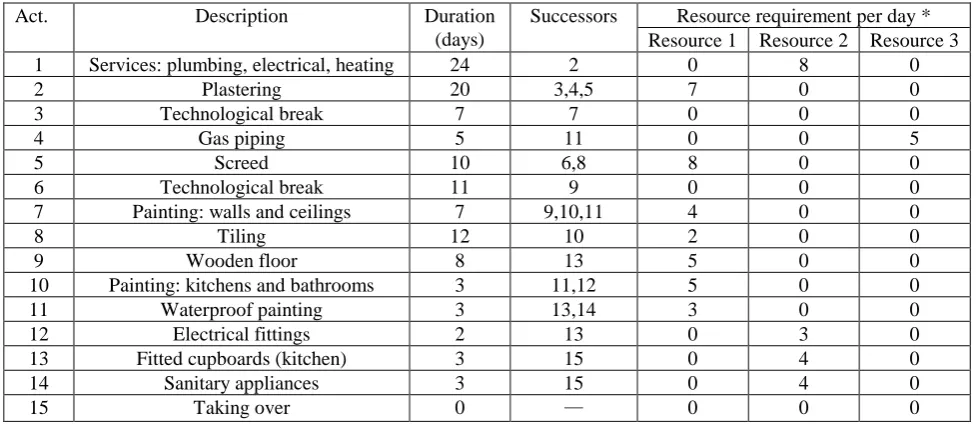
To illustrate the effectiveness of the model, this paper considers a residential building project that is presented by [12]. The data describing the activities (activity number, duration, and corresponding resource requirement per day) are shown in Table 1. There are two soft precedence relations in set S1
and three in set S2, where the relations (2,5), (8,10), and (7,9) result from space restrictions; the
relation (7,10) is produced by painting tool limitations; the relation (9,13) stems from apartment layouts and disturbances caused by crews carrying cupboard elements.
Additional works will be necessary in the following cases: (1) if activity 5 is done before activity 2, the additional work [2,5] with duration of 2 days, requiring 2 units of resource 1 per day, is needed to prevent staining with plaster mortar; (2) when activity 9 is performed before activity 7, floor covering (i.e. the additional work [7.9]) is needed, which has a duration of 1 day and requires 1 unit of resource 1 per day; and (3) if activity 10 is implemented before activity 8, some local repainting (i.e. the additional work [8,10]) is to be expected, which has a duration of 1 day and requires 3 units of resource 1 per day. Nine additional relations have been identified and added to the project network, which are (1,5), (2,8), (2,9), (3,10), (5,10), (7,12), (8,11), (8,12), and (9,15). For this example project, we assume that the costs of acquiring and releasing one unit of resource k are set to 1 for any
[image:4.595.54.543.571.783.2]. The project deadline T=76 days are also assumed.
Table 1. Activity durations and their resource requirements.
Act. Description Duration
(days)
Successors Resource requirement per day *
Resource 1 Resource 2 Resource 3
1 Services: plumbing, electrical, heating 24 2 0 8 0
2 Plastering 20 3,4,5 7 0 0
3 Technological break 7 7 0 0 0
4 Gas piping 5 11 0 0 5
5 Screed 10 6,8 8 0 0
6 Technological break 11 9 0 0 0
7 Painting: walls and ceilings 7 9,10,11 4 0 0
8 Tiling 12 10 2 0 0
9 Wooden floor 8 13 5 0 0
10 Painting: kitchens and bathrooms 3 11,12 5 0 0
11 Waterproof painting 3 13,14 3 0 0
12 Electrical fittings 2 13 0 3 0
13 Fitted cupboards (kitchen) 3 15 0 4 0
14 Sanitary appliances 3 15 0 4 0
The following versions of the model are analyzed:
Case I: The model does not allow for reversing the soft precedence relations. At present, the problem reduces to the classical resource leveling problem that minimizes the variations of resource utilization from period to period.
Case II: The model allows for reversing the soft precedence relations.
A computer package called LINGO (LINGO 11.0) is used on a personal computer to solve the above models of the example project. Fig. 2(a) shows the project schedule after leveling for Case I. The total cost for covering the fluctuations in resource utilization from period to period is 66. When the soft precedence relation are allowed to reverse (i.e. Case II), the total cost resulting from the resource fluctuations reduces to 60. The corresponding project schedule after leveling is shown in Fig. 2(b), where the soft precedence relations (7,10) and (8,10) are reversed. In other words, to smooth resource allocation, painting kitchens and bathrooms (activity 10) must be performed before painting walls and ceilings (activity 7) and before tiling (activity 8). Also, additional local repainting work (work ID: [8,10]) must be performed on day 58. Comparison based on this example indicates the advantages of incorporating soft relations into resource leveling problems.
1 2 3
4 5 6 7 8 9 1 0 1 1 1 3 1 4
10 20 30 40 50 60 70
0
Activity 12
Duration (days) (a) Case 1
1 2 3
4 5 6 7 8 9 1 0 1 1 1 3 1 4
10 20 30 40 50 60 70
[image:5.595.64.524.297.368.2]0 Activity 12 The additional work [8,10] Duration (days) (b) Case 2
Figure 2. Project schedule after resource leveling.
Summary
This paper proposed a mixed-integer linear programming model for the resource leveling problem. Unlike existing methods, our model considers soft precedence relations during the optimization process, which makes it possible to start some activities earlier and increases the potential to reduce the fluctuations in resource utilization. To enable the planner to obtain an efficient schedule, we also consider additional works caused by changing the work sequence between activities. The analysis results based on a simple project support the argument: using soft precedence relations provides more flexibility in scheduling under the pressure of smoothing resource utilization. This paper encourages the planners to use the plan produced by the proposed model, since the optimal solution obtained by the proposed model is better than the traditional model in most situations, or at least not worse than it.
Acknowledgement
The authors would like to acknowledgment the National Natural Science Foundation of China (71701069) and Fundamental Research Funds for the Central Universities (2017MS175).
References
[1] D.H. Jun, K. El-Rayes, Multiobjective optimization of resource leveling and allocation during construction scheduling, J Constr Eng M, 137 (2011) 1080-1088.
[2] J. Rieck, J. Zimmermann, T. Gather, Mixed-integer linear programming for resource leveling problems, Eur J Oper Res, 221 (2012) 27-37.
[3] A.R. Burgess, J.B. Killebrew, Variation in activity level on a cyclic arrow diagram, J Ind Eng, 13 (1962) 76-83.
[5] A.M.S. Hiyassat, Modification of minimum moment approach in resource leveling, J Constr Eng M, 126 (2000) 278-284.
[6] K. El-Rayes, D.H. Jun, Optimizing resource leveling in construction projects, J Constr Eng M, 135 (2009) 1172-1180.
[7] A. Senouci, N. Eidin, Use of genetic algorithm in resource scheduling of construction projects, J Constr Eng M, 130 (2004) 869-977.
[8] J.Q. Geng, L.P. Weng, S.H. Liu, An improved ant colony optimization algorithm for nonlinear resource-leveling problems, Comput Math Appl, 61 (2011) 2300-2305.
[9] G.K. Koulinas, K.P. Anagnostopoulos, A new tabu search-based hyperheuristic algorithm for solving construction leveling problems with limited resource availabilities, Automat Constr, 31 (2013) 169-175.
[10] A. Damci, D. Arditi, G. Polat, Impacts of different objective functions on resource leveling in line-of-balance scheduling, KSCE J Civ Eng, (2015) 1-10.
[11] W.C. Wang, Impact of soft logic on the probabilistic duration of construction projects, Int J Proj Manage, 23 (2005) 600-610.