2016 International Congress on Computation Algorithms in Engineering (ICCAE 2016) ISBN: 978-1-60595-386-1
1 INTRODUCTION
With the rapid development of China’s education, the primary education and higher education present an upward trend, the number of people enrolled increases year by year, and the teaching scale increases con-stantly, thus providing a broader development space for the development of the school. Meanwhile, it brings a lot of problems, of which the teaching quality assessment currently becomes a major problem. The teaching quality directly determines the future devel-opment of the students. Therefore, in terms of the teaching ethnics or China’s long-term interests in the future, the reasonable and effective education assess-ment has an important significance on the improve-ment of the teaching level and teaching quality.
Due to many factors in the teaching evaluation and many subjective factors in the evaluation, a lot of teaching evaluations have major one-sidedness. Therefore, in order to reduce unreasonable assessment, some scholars carry out the research. For example, Wang Zhengwu applied the neural network to the classroom teaching quality evaluation. This method lays a foundation to the development of the neural network in the teaching evaluation in terms of the idea and technology. However, considering the limitations of the neural network, this paper proposes a fuzzy neural network model according to the characteristics
of the teaching assessment, and applies the documen-tary method and mathematical statistical method for data analysis and processing, and finally carries out verification.
2 FUZZY NEURAL NETWORK SYSTEM
The fuzzy system is a theory based on the fuzzy set, which mainly handles complex problems, such as fuzzy control, fuzzy reasoning, fuzzy recognition and fuzzy measurement and so on. In the traditional theory, the characteristic function can only take two values, 0 and 1. The fuzzy set adopts the concept of member-ship function, and its characteristic function is ex-tended to [0, 1].
Fuzzy set: assuming that A:U[0,1],UU(x)is a universal set (U), a fuzzy set is U, and U(x) is A, the membership function of U (x) reflects the membership of x in the fuzzy set.
The fuzzy system has the capability on the infor-mation expression and the analysis and processing, which is fuzziness based on the precise description of the mathematical linguistics. The basic calculation unit of the neural network is an artificial neuron, which simulates the structure and function of the cer-ebral neurons, with a strong self-learning ability. It finally puts forward the specific structure network of
Applied Research of Fuzzy Neural Network
Algorithm in Teaching Evaluation
Chunyi Lou
,Liang Lu
,Ying Shi
&Yan Ding
Department of Foreign Languages, Qinghuangdao Institute of Technology, Qinhuangdao, Hebei, China
ABSTRACT: In order to improve the teaching level of the current colleges and universities in China, and es-tablish the international first-class schools, various education classes carry out the college teaching quality as-sessment. In view of the limitations and progressiveness of the teaching quality assessment in the neural net-works, this paper with a plenty of fuzzy information proposes a fuzzy neural network model, and organically combines self-adaption, recognition with fuzzy information processing, and carries out verification by the use of simulating calculation methods. Finally, the authors through this paper obtains that the fuzzy neural network has a better evaluation, and proves the scientificity, simplicity and operability of the method, thus achieving that the model has a broad application prospect.
artificial neurons through adjustment of continuous learning. The knowledge of fuzzy neural network is transformed into a model by the use of the fuzzy neu-ral network, and then an algorithm is used to train the neural network, and the accuracy of the system model increases. The principle of the structure of fuzzy sys-tem is shown in Figure 1:
Figure 1. Structure of fuzzy system.
2.1 Data mining of fuzzy neural network
For multi-attribute database, the attribute of each database is a continuous variable. If you want to ex-tract the attribute of relations between rules n and other attributes, the input number (n) can be expressed as
x
1,
x
2,
x
n , and the corresponding outputn
x
x
x
1,
2,
, m can be expressed asy
1,
y
2,
y
m. In this type of problem, by the use of membership func-tions, they can be converted to fuzzy input and fuzzy output of the corresponding membership values. These are used as a training sample, and the following forms may be obtained:If (x11), (x22), and (xnn), (y11),
)
(y22 , (ymm) and
(,,,,,) are symbolic relations, i and iare fuzzy attributes (which are big, medium, small and so on).The steps extracted by the use of the fuzzy neural network system are as follows.
2.2 Standardization of sample data
The processing of data standardization refers to pre-processing of sample data. The eigenvalue is mapped to the region [0, 1], and the main fuzzy steps are as follows:
First, there is a need to determine the evaluated ob-ject. It affects the variables by y factors, and its factor set is , then the first-grade evaluation indica-tor is defined as:
,
( i i, i, , j)
(1)
So the corresponding second-grade evaluation indi-cator is:
1, 2, 3, ,n
(2) The third-grade evaluation indicator is:
1 2 3
1, 2, 3, , n
j
(3)
And specify that,
( 1, 2, 3, , , 1, 2, 3, )
n
j j y n m
The weight of each variable is different, so the de-gree of impact is different for the determined evalua-tion level. We assume that its evaluaevalua-tion set is:
1, 2 3 4 5
( , , , )
i
b b b b b b (4)
Where: b(i 1,2,3, ,y)
i For the weight value in the above formula, based on common sense, we know thatbi0, and:
y
i i
b
1
1
If each factor
b
i containsn
sub-factors, its factor set is:) , , ,
( i,1, i,2 i,3 i,n
i
(5)The corresponding weight value is: )
, ,
( i,1, i,2 i,3 i,n i b b b b
b (6)
For the weight value i
b of
i,j, based on com-mon sense, we know that bi,j0 and:
n
j j i
b
1
, 1 (7)
According to the above formula, the first-grade weight is 100%, and the second-grade weight is:
1 2 3
( , , , n)
i
b b b b b (8)
The corresponding third-grade weight set is:
1 2 3 4 1 1 1 1 1 2
( , , , , , j )
i n
b b b b b b b (9) Assuming that the vector set of the evaluation membership is:
1, 2, 3, 4, 5
n n n n n n
g j g j g j g j g j g j (10)
Then the corresponding membership matrix is:
1 1 1 1 1 1
2 2 2 2 2 2
3 3 3 3 3 3
11 12 13 14 15
11 12 13 14 15
11 12 13 14 15
1 2 3 4 5
n n n n n
n
g g g g g g
g g g g g g
g g g g g g g
g j g j g j g j g j
g
After integration of the above process, the first-grade evaluation result is:
(
1,
2,
3,
4,
5)
n n n n n n n
g
H
g j g j
g j g j
g j
Then the second-grade evaluation result is:
1 2 3
(
,
,
,
,
n)
g
H
g g g
g
The above process is normalized. Assuming that f samples,
f x x
x1, 2, , each sam-ple
x
i has n sample indicators, z1,z2,,zn.ij
x
refers to the quantity sample i of the quantity indicator
[image:3.516.270.451.222.394.2]j, and then the sample indicator n of the sample f is shown in Table 1:
Table 1. Sample data.
Factor
z
1 z2
zn1
x
x11 x12
x1n2
x
x21 x22
x2n
f
x xf1 xf2
xfnThe average value and standard derivation of the quantity indicator j of the sample j:
f
i ij
j x
f x
1 1
(12)
f
i j ij
j x x
s
1
2 )
( (13)
Standardization of raw data is:
j j ij
ij
x
x
s
x
'
(
)
/
(14)The data in the compression specification [0, 1] us-es the extreme value standardization formula, namely:
' min '
max '
min '
j j
j ij ij
x x
x x x
(15)
In this formula, ' '
2 '
1j,x j, xfj
x are between the
minimum value ' min
j
x and maximum value ' max
j x , xij is a standardized indicator.
2.3 Structure of fuzzy neural network
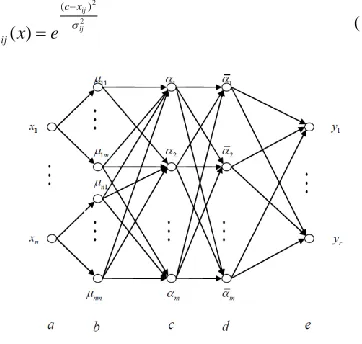
The structure of fuzzy neural network is shown in the following diagram. The first layer is an input layer, which can put the input value into the next layer, and the number of nodes at this layer is n. The second layer is a membership function layer, the member
education of each input element can calculate the membership function of the corresponding fuzzy set of linguistic variables at this layer, and each node repre-sents a linguistic variable value. The third layer is the matching of fuzzy rules, which calculates the extent of application of each rule, and the number of nodes at this layer is m. The third and fourth layers are fully connected, the data at the third layer achieves stand-ardization at the fourth layer, and the number of nodes at this layer is m. The fifth layer is an output layer; the output data at this layer can be determined by output of fuzzy linguistic variables through weighting coeffi-cients and membership functions.
To input data, the membership function is selected as the normal distribution function:
2 2
) (
)
( ij
ij
x c
ij x e
u
(16)
Figure 2. Fuzzy neural network structure.
n
i1,2, , n is a dimension of the input variables. m
j1,2, , m is a division of fuzzy classification. ij
x and ij are respectively the center and the width of the membership function, that is, to respectively convert the input value into linguistic variables (which are big, medium and small and so on) at the second layer.
The first layer is an input layer, x(x1,x2,xn) can be transformed into the next layer.
The second layer can calculate a fuzzy set under the jurisdiction of the input value of the membership function ij.
Each node at the c layer represents a fuzzy rule. The application program can calculate the degree of each rule, which is minimized calculation:
j j nj
j m j min
1 ,
2 ,
, 1,2,
(17)m j m j j j
j , 1,2,
1
(18)
Clarity calculation is achieved at the e layer:
r i y m j j ij
i , 1,2,
1
(19)
The output data can be transformed into fuzzy lin-guistic variables through the membership function. Between the fourth layer and the fifth layer,
ij
is the membership of the fourth layer
j
and the fifth layer yi.
2.4 Network learning
The learning process of the fuzzy neural network is a multi-variable optimization process. For the parame-ters of the fuzzy neural network, there is a need to learn the central value
ij
c and the width ij
of the connection weight
ij at the fifth layer and the fuzzy membership function.The error function of the system is:
r i i i y Y E 1 2 ) ( 2 1 (20) iY
andy
i are respectively the expected output and actual output, of which r is the number of output. The nature of the calculation from the input layer to the output layer is a multilayer feed-forward back-propagation network. It can be designed through the error back propagation method, the simulation of BP neural network and the adjustment of ij, cij andij
.
For each sample data, the first step is to calculate each input node before the output value of each node, and then use the back propagation algorithm from the output node to calculate the partial derivatives of all hidden nodes.
Use the optimization and adjustment algorithm at the first step, and finally learn the algorithm parameter adjustment, thus we can obtain:
ij ij ij E k k 1) ( )
( (21)
ij ij ij c E k x k x
1) ( )
( (22)
ij ij ij E k k 1) ( )
( (23)
0
is the learning rate.When the system error reaches the given minimum error range and after the finish of learning fuzzy
neu-ral network, the data mining can be used.
2.5 Rules selection
After the success of the network training, there is a need to summarize the required fuzzy neural network with fuzzy rules. According to the membership func-tion values of the value output of the center, and the transformation output values of the membership func-tion of the fuzzy language values, fuzzy language values and the maximum membership degree, they are selected as the output values. If(x1
1), (x2
2),and (xnn), and then (y
i), the rule ex-traction can be calculated.If the input variables are converted into fuzzy lin-guistic variables, the rules of
f
m
n
can be ex-tracted from n input, and the same rules are deleted, there are alsomn
h
rules. However, we are not interested in mnh rules. In other words, these rules are not always meaningful. We need to find re-dundant rules, and extract interesting rules. Through setting up a threshold
rule, we need practical significance. h mn k N nk , 1,2,
(24)
The rules which are less than a threshold can be used as redundant rules. Therefore, the interesting rules and the rules with practical significance can select a large number of rules. The values can be dif-ferent according to difdif-ferent needs. Therefore, the number of rules extraction is different. Based on the needs, the rules extraction is a valid conclusion of data mining.
3 APPLICATION OF FUZZY NEURAL
NET-WORK ALGORITHM IN TEACHING EVALU-ATION
Through looking up the relevant literature, and practi-cal test of the scholars, experts and other personnel, combined with the actual situation of a college, seven indicators that can be determined are mainly shown as follows:
1) The indicator of teaching efficiency is deter-mined according to the teaching objectives, student testing and feedback;
2) The indicator of teaching ability is determined according to the teaching quality, accuracy of the ex-perimental operation, analyzing problems and accurate narration.
4) The indicator of teaching content is determined according to the emotional attitude, permeation of the perspective on value, cultivation of learning ability, and practicality, advancement and scientificity of the reserved knowledge;
5) The indicator of teaching design is determined according to the design of teaching process, specificity of the teaching strategies and teaching objectives;
6) The indicator of teaching attitude is determined according to the degree of course familiarity, earnest teaching, upright teaching attitudes, counseling and homework correcting;
7) The indicator of teacher quality is determined according to the graceful appearance and mandarin level of the teachers.
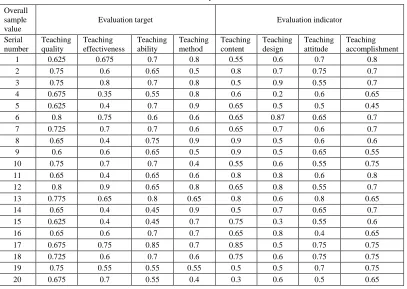
Later, the teachers, leaders, relevant experts and scholars are recruited to attend a lecture, and a com-prehensive and objective score is given to the lectures of the teachers according to seven indicators. In addi-tion, a certain number of students are randomly se-lected to give a score. Finally, compare the score of the students, teachers, leaders, scholars and experts, and select consistent results as a research case. Among
the selected data, one part is as the test standard of the neural network results, and the remaining part is as the training data of the neural network. According to the characteristics of fuzzy neural network, the data is input after processing, as shown in the Table 2.
The former fifteen values in the above table are in-put values of the samples. The remaining five values are the testing sample values of the fuzzy neural net-work results. The data is analyzed according to the above algorithm and trained by the use of multi-layer fuzzy neural network, with the results as shown in the Table 3.
As can be seen from the Table 3, the error between the fuzzy neural network running result and original data is very small. If more samples are adopted, the fuzzy neural network can be completely applied to the evaluation of teaching quality.
4 CONCLUSION
[image:5.516.57.464.65.354.2]The college teaching evaluation plays an important role in training high-level teachers in universities and Table 2. Sample data.
Overall sample value
Evaluation target Evaluation indicator
Serial number
Teaching quality
Teaching effectiveness
Teaching ability
Teaching method
Teaching content
Teaching design
Teaching attitude
Teaching accomplishment 1 0.625 0.675 0.7 0.8 0.55 0.6 0.7 0.8 2 0.75 0.6 0.65 0.5 0.8 0.7 0.75 0.7 3 0.75 0.8 0.7 0.8 0.5 0.9 0.55 0.7 4 0.675 0.35 0.55 0.8 0.6 0.2 0.6 0.65 5 0.625 0.4 0.7 0.9 0.65 0.5 0.5 0.45 6 0.8 0.75 0.6 0.6 0.65 0.87 0.65 0.7 7 0.725 0.7 0.7 0.6 0.65 0.7 0.6 0.7 8 0.65 0.4 0.75 0.9 0.9 0.5 0.6 0.6 9 0.6 0.6 0.65 0.5 0.9 0.5 0.65 0.55 10 0.75 0.7 0.7 0.4 0.55 0.6 0.55 0.75 11 0.65 0.4 0.65 0.6 0.8 0.8 0.6 0.8 12 0.8 0.9 0.65 0.8 0.65 0.8 0.55 0.7 13 0.775 0.65 0.8 0.65 0.8 0.6 0.8 0.65 14 0.65 0.4 0.45 0.9 0.5 0.7 0.65 0.7 15 0.625 0.4 0.45 0.7 0.75 0.3 0.55 0.6 16 0.65 0.6 0.7 0.7 0.65 0.8 0.4 0.65 17 0.675 0.75 0.85 0.7 0.85 0.5 0.75 0.75 18 0.725 0.6 0.7 0.6 0.75 0.6 0.75 0.75 19 0.75 0.55 0.55 0.55 0.5 0.5 0.7 0.75 20 0.675 0.7 0.55 0.4 0.3 0.6 0.5 0.65
Table 3. Comparison with the multi-layer fuzzy neural network system results and original data identification values.
Sample serial number 15 16 17 18 19 20 Evaluation objectives 0.75 0.85 0.625 0.675 0.625 0.8 Neural network
colleges. And this paper applies the fuzzy neural net-work model to evaluation of the teaching level, and proves that the use of this method has a certain ad-vancement and scientificity through case verification. The utilization of the fuzzy neural network enables the colleges and universities to carry out an objective evaluation of the teaching quality, thus playing a posi-tive role in the improvement of China’s college teach-ing quality.
REFERENCES
[1] Xie Hongyan, Zhu Yunhua, Liu Jun, Yang Xiaoyan, Hu Jinsong, & Qin Zhifeng. 2015. Research of college ex-periment teaching quality evaluation based on neural network. China Modern Education Equipment. (11): 12-16.
[2] Chen Hangyu, & Chen Suhong. 2005. Vision of con-struction of classroom teaching quality evaluation sys-tem of college teachers. Economic and Social Develop-ment, 6: 19-22.
[3] Zhao Limin, & Li Hua. 2012. Application of fuzzy ana-lytic hierarchy process in the project management risk assessment. Guizhou Hydropower, (02): 6-8.
[4] Yan Taishan, Guo Guanqi, Pan Li, & Fang Xin. 2013. An evaluation method for classroom teaching quality of university’s public elective course based on neural net-work. Journal of Hunan Institute of Science and Tech-nology (Natural Sciences), (02): 10-12.
[5] Wang Tong, & Ding Lei. 2011. Research of performance evaluation and appraisal strategy based on fuzzy neural network classification algorithm. Modern Distance Ed-ucation, (02): 5-7.