2017 2nd International Conference on Information Technology and Industrial Automation (ICITIA 2017) ISBN: 978-1-60595-469-1
A Method of
l
0
Restriction with Multi-scale
Product for Image Denoising
Hui Wang, Xiangxu Xie*, Yongfa Ling and Chunhua Gao
ABSTRACT
In order to eliminate image noise and retain more image feature information, this paper introduced an image denoising method based on sparse representation and
multidimensional calculation under l0 restriction, using l0 restriction to optimize dictionary atoms according to the randomness of image noise and directly eliminate atoms that have been used less frequently to improve calculation effectiveness. Besides, since residual images may also contain useful information, noise reduction was conducted against residual images by applying wavelet transform modulus maximum and multi-scale product calculation, the result of noise reduction realized through dictionary sparse representationwas integrated with the result of denoising residual images firstly to obtain denoised images. The result of the experiment shows that comparing with K-SVD algorithm, the time complexity of the algorithm used in the paper is lower and therefore can obtain higher PSNR value.
INTRODUCTION
advantage of the fact that sparse expression can be conducted for image information through dictionary, but can be conducted for noise. Aharon[1] et al. put forward K-SVD (K-Singular Value Decomposition) algorithm to use cosine dictionary as the initial dictionary, conduct sparse segmentation against images in combination with orthogonal matching pursuit algorithm and upgrade dictionary through learning training. However, if there is strong noise, the denoising effect of images could not be that ideal. YANG et al.[2] pointed out that image denoising algorithm based on sparse expression and non-local regular item should be used together with K-SVD algorithm to improve its denoising performance through dictionary optimization. The time complexity of algorithm in this case, however, is relatively high. In addition, LIU et al.[3], in accordance with K-SVD dictionary learning and image segmentation theory, studied the denoising of colorful images and usedK-SVD algorithm to do the task. The algorithm requires that the selected weight parameter λ be approximate to the noise standard deviation. JIAO et al.[4] segmented images containing noise into background block set and content block set, using average filtering method to denoise the background block set and K-SVD algorithm to denoise the content block set. However, in this case, the denoising effect of the algorithm is largely determined by the result of the preprocessing step where images are segmented into background part and image content part.; LI et al.[5], combining wavelet transform and sparse expression method, used K-SVD algorithm to denoise the low-frequency image component after wavelet transform and threshold contraction algorithm to denoise high-frequency image component. In this case, although noise in high-frequency image component is eliminated, some specific information is also filtered.
Moreover, more and more researchers have also noticed that residual images often contain a large amount of useful information and have introduced a series of methods basing on residual image processing to improve the performance of image denoising algorithm[6-11]. In this light, this paper, while studying the image denoising algorithm based on K-SVD and using the useful information in residual images, applied improvedK-SVD method to denoise images. Firstly, algorithmswere
IMAGE DENOISING METHOD COMBINING MULTISCALE PRODUCT AND DICTIONARY SPARSE EXPRESSION
Super-complete Dictionary Learning Image Denoising Method based on l0 Restriction
If in the given set D{ ,d kk 1, 2,..., }K , unit vector dk constitutes
N-dimensional Hilbert space H RN , and K N , set D can be called a super-complete dictionary. Sparse coefficients can be obtained with OMP orthogonal matching pursuit algorithm, on which basis the dictionary can be upgraded directly (atoms containing relatively large amount of noises are eliminated) and thereby the signal can be denoised. As for sparse coding model
yDx, according to the corresponding relationship between the row vector of
sparse coefficient matrix and the line vector of dictionary D (dictionary atoms), the 0
norm of each row vector xi in sparse coefficient matrix X can be calculated. If
0
|xi|| T and T is an empirical value (in this paper, T=10), that is, the number of
non-zero elements in the ith row vector is smaller than T , it indicates that the
corresponding ith atom di in dictionary D is not used in the iteration process of
OMP algorithm that frequency. On the contrary, di has been used for many times.
In noisy images, the appearance of noise is random. During sparse coding process, noisy atom in the dictionary would be used for a relatively few times and the corresponding atom can be eliminated directly when upgrading the dictionary, leaving the upgraded dictionary reconstruct signal to reduce noise, which can realize a relatively low time complexity.
Wavelet Transform Modulus Maxima and Multi-scale Product
The multi-scale approach turns out to be a good way to achieve the effective edge information. By calculating the multi-scale product, the wavelet transform coefficients in adjacent scales are multiplied to enhance the edge coefficients and reduce the noises. However, due to the strong correlation between the scale space on the image's edge, when the wavelet coefficients in adjacent scale are multiplied, the results will contain the edge information between different scales. After that, threshold process with local modulus maxima was performed on the wavelet transform coefficients to obtain the de-noised image.
When the scale was s, assume: 2 1 ( , ) ( , ) s x y x y
s s s
(2)
then, in the scale s, the 2 two-dimensional wavelet functions were defined as:
2
2 ( , ) 1
( , ) ,
( , ) 1
( , ) ,
x s x
s
y s y
s
x y x y
x y
x s s s
x y x y
x y
y s s s
(3)
When scale s2j , the 2 two-dimensional dyadic wavelet transform
components of image f x y( , ) were:
2 2
2 2
2
(f* )( , ) f( , )
2 (f* )( , ) f( , ) (f* )( , )
j j j j j x j y x y
x y x
x y
x y x y
y
(4)
where 2j ( , )
x
f x y
and 2j ( , )
y
f x y
respectively denotes the 2 gradient vector
components of image f x y( , ), in the horizontal and vertical directions after
processing by the smooth function s( , )x y . The corresponding normalized
scale product was:
1 1 1 1 2 2 2 2 2 2 2 2 2 2
f( , ) f( , ) f( , )
f( , ) f( , )
f( , ) f( , ) f( , )
f( , ) f( , )
j j j j j j j j j j x x x x x y y y y y
x y x y
P x y
x y x y
x y x y
P x y
x y x y
(5)
The product modulus and direction of the wavelet transform of gradient vector
2
(f* j)( , )x y
in the adjacent scale were:
2 2
2 f( , ) | 2j f( , ) | | 2j f( , ) |
x y
j
M x y P x y P x y
(6)
2 2
2
f( , ) f( , ) arctan
f( , )
j
j
y j
x
P x y
A x y
P x y
(7)
The local maxima of 2 f( , )
j
M x y
on the direction 2 f( , )
j
A x y
of the gradient
vector was the feature point of image f( , )x y .
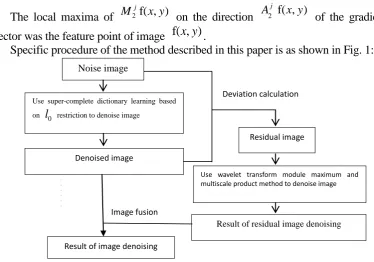
[image:5.612.107.482.85.347.2]Specific procedure of the method described in this paper is as shown in Fig. 1:
Figure 1. Procedure of the method described in the paper.
NUMERICAL EXPERIMENT
In this paper, experiments have been conducted for4 standard testing images, including 512x512 Lena, Boat and Barbara and 256×256 House. The result of image denoising obtained in this paper was compared with the method in reference [13] and the effectiveness of the method described in this paper was verified.
Experiment Result
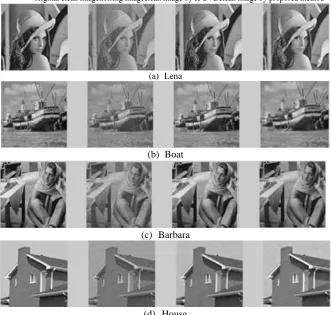
White gaussian noise (average value: 0; standard deviation: ) was added into the above 4 testing images. K-SVD algorithm and the method described in this paper were used for denoising experiment. Fig.2 has shown the denoising result of the 4 images by using the aforesaid algorithms (standard deviation of the white Gaussian noise added in the Figure is 25).
Deviation calculation
. .
. .
. .
Noise image
Use super-complete dictionary learning based
on
0
l restriction to denoise image
Denoised image
Residual image
Use wavelet transform module maximum and multiscale product method to denoise image
Result of residual image denoising
original clean imagenoising imageclean image by K-SVDclean image by proposed method
(a) Lena
(b) Boat
(c) Barbara
(d) House
Figure 2. Comparison of Denoising Results.
Performance Analysis
[image:6.612.131.463.94.409.2]The denoising results were measured with objective evaluation index, Peak Signal to Noise Ratio (PSNR). Since white noise was added randomly, when calculating PSNR, this paper chose to calculate for 10 times and obtain the averaged value, so as to evaluate the denoising performance of different algorithms more objectively. The PSNR comparison result is as shown in Table 1:
Table 1 Result of PSNR Comparison
Test images Algorithm 15 25 35 45
Lena
K-SVD 33.68 31.31 29.68 28.35
Proposed Method 34.51 31.85 31.26 28.81
Boat K-SVD 31.72 29.30 27.73 26.44
Proposed Method 32.88 30.05 28.12 26.69
Barbara Proposed Method 33.21 30.01 28.02 26.35
House K-SVD 34.34 32.11 30.17 28.73
Proposed Method 35.27 32.64 30.48 28.96
According to Table 1, it can be concluded that the denoising result of the algorithms described in this paper is higher than that of K-SVD algorithm by 0.5
dB in terms of PSNR. Besides, the algorithms described in this paper, by
operating against atoms when upgrading the dictionary, could directly eliminate atoms that were used for only a few times. Therefore, comparing with K-SVD algorithm, the algorithms described in this paper is lower in terms of time complexity.
CONCLUSIONS
This paper used sparse expression under l0 restriction and image denosing method based on wavelet transform modulus maximum and multiscale product calculation to denoise images through dictionary sparse expression and thereby obtain residual component of noisy images. As for the residual component, this paper used wavelet transform modulus maximum and multiscale product calculation method to reduce noise, integrated the denoised images obtained through sparse expression and denoised images obtained through processing residual component and thereby obtain the final denoised image. After being compared with K-SVD algorithm, the algorithms described in this paper have better performance in terms of calculation speed and PSNR value and can achieve better visual effect of denoised images.
ACKNOWLEDGEMENT
This research was supported by the fundproject of 2017KY0651 (The basic ability promotion project of Young teachers in Guangxi universities), 2016ZZSK15, 2013LX141, 1608027.
Journal of Nanjing University of Science and Technology, 2016,40(05):607-612.
4. Jiao Li-Juan, Wang Wen-jian. Speeded-up K-SVD Image Denoising Algorithm[J], Journal of Chinese Computer Systems, 2016,37(07):1608-1612.
5. Li Huibin, Liu Feng. Hybrid image denosing method based on wavelet transform as well as on a sparse and redundant representations model [J]. Journal of Image and Graphics, 2012,17(09):1061-1068.
6. Brunet D, Vrscay E R, And Wang Z. The use ofresiduals in image denoising[C]. Proceedings of the International Conference on Image Analysis and Recognition, Halifax, 2009: 1-12. 7. Chen J, Tang C K, And Wang J. Noise brush: interactive high quality image noise
separation[J]. ACM Transactions onGraphics, 2009, 28(5): 146: 1-10.
8. Pyo Y, Park Rh, and Chang S. Noise reduction in high-iso images using 3-d collaborative filtering and structure extraction from residual blocks[J]. IEEE Transactions onConsumer Electronics, 2011, 57(2): 687-695.
9. Zhong H, Yang C, and Zhang X H. A new weight fornonlocal means denoising using method noise[J]. IEEE SignalProcessing Letters, 2012, 19(8): 535-538.
10. Kumar B K S. Image denoising based on non-local meansfilter and its method noise thresholding[J]. Signal, Image andVideo Processing, 2012, 7(6): 1211-1227.
11. Romano Y and Elad M. Improving K-SVD denoising bypost-processing its method noise[C]. IEEE InternationalConference on Image Processing, Melbourne, 2013: 435-439.
12. Wang Hui, Sun Hong. A method of low-rank decomposition with multi-scale product for moving object detection[J], Journal of Signal Processing. 2016, 36(12):1425-1433.