2018 International Conference on Modeling, Simulation and Analysis (ICMSA 2018) ISBN: 978-1-60595-544-5
A Simulation Study of Controlling the Movement of Jets Slug
De-shuai YIN
1, Xin JIA
2,*, De-rong TANG
2, Yang-xiao-xiao LU
1and Pu-xing WANG
31Jiujiang National Science and Technology Co. Ltd. Jiujiang, Jiangxi 330400, China;
2School of Mechanical Engineering, Nanjing University of Science and Technology, Nanjing 210094, China;
3Huaihai Industrial Group Co. Ltd. Changzhi, Shanxi 046000, China;
*Corresponding author
Keywords: LS-DYNA, Control, Slug, The blocking slug device, Jets without slug, Structural parameters.
Abstract. A device was designed to form the shaped charge jets without slug based on the structure of 56mm shaped charge, and the movement of slug was under controlled through the use of this device. A numerical simulation of the shaping of jets under the structure of shaped charge was carried out by LS-DYNA. On the premise of the device wall thickness 1mm, the angle of middle part and the height of the lower part, here the 2 structural parameters of the blocking slug device are considered as the factors affecting the shaping of the jets without slug. Through simulation, the best structural parameters of the device are as follows: 45 degree of the inclination of the middle part and 0mm of lower part. Under this structural parameter, the device can make shaped charge fully molded without slug.
Introduction
In the modern war, Aphe has been one of the important weapons against armored targets. High temperature and high pressure produced by shaped charge warhead explosion after the detonation to destroy the liner to form high-speed metal jet. At present, the research on the technology of shaped charge at home and abroad mainly focuses on the design of new structure of new type of liner, the application of new materials, the application of high explosives, the selection of detonation mode, the control of explosive detonation wave propagation process and the improvement of processing
methods[1]. However, restricted by the structural characteristics and forming mechanism of shaped
charge, the penetration efficiency of jet can not be further improved without increasing the charge and charge diameter.
Tandem shaped charge warhead greatly improves Shaped Charge warhead penetration power [2].
Tandem shaped charge is to set up two or more than two cumulative charges in the direction of warhead axis. The purpose is to connect two and two more fluids to form a continuous jet to improve penetration depth[3]. At present, two forms of tandem charge structure are known; one is a series structure of reverse initiating. The warhead of such structures is the first stage detonation of the second level charge farther away from the target plate on the same axis, and the jet formed through the front central tube and then penetrated into the armor. The second charge detonation pressure generated after a certain space for the first charge was detonated, a device being used to take a slug slower as part of the truncation, may reduce required between the two jet delay time, thus forming a high-speed continuous jet, improve the penetration capability of the warhead[4].
The technology of accumulating charge is also widely used in engineering. The typical application is that the technology is used in oil drilling of oil perforated projectiles. The problem of pestle plugging caused by the metal drug cover of the oil perforated projectile can be solved by non-slug jets formed by changing the charge structure [5, 6].
detonation wave produced by the detonation of the accumulating charge, then liner of the device is crushed and begin to converge to the axis to interfere with the movement of the jet, the low speed pestle was truncated, and jets without slug is shaped.
Another way, a baffle with a hole in the middle is placed at the bottom of the liner. When the jet moves along the axis through the hole on the baffle, the larger diameter slug can’t through the hole and is truncated.
In this paper, a reverse charge structure is used to form a non-slug jet. The numerical simulation method is considered to study the shaping of the jets without slug. A device is designed to form jets without slug based on the structure of 56mm shaped charge, and the movement of slug is under controlled through the use of this device. On the premise of the device wall thickness 1mm, the angle of middle part and the height of the lower part, here the 2 structural parameters of the device are considered as the factors affecting the shaping of the jets without slug.
Structure Design and Simulation Model Establishment
Structure Design of Shaped Charge for Controlling the Movement of Slug
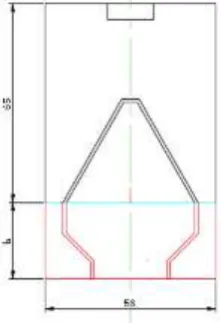
[image:2.595.239.350.315.477.2]The device is designed to control the movement of the slug, and the structure is shown in Figure 1:
Figure 1. Shaped charge with a blocking slug device.
The schematic diagram of the interference of the slug movement is shown in Figure 2:
Figure 2. The process of the slug being disturbed.
When the caliber of charge is certain, the upper diameter of the device should not be too large, because too large will not be conducive to the propagation of detonation waves around the liner, thus affecting the detonation of the location charge of the device. In this paper, the effect of the jetting pestle movement and the effect on the jet molding are studied with the change of the structure parameters of the device.
Parameters of Materials[7]
Explosive
[image:2.595.132.464.523.601.2]Table 1. Parameters of the 8701 explosive.
𝜌0/(g/cm3) D/(km/s) 𝑃𝑐𝑗/GPa A/GPa B/GPa 𝑅1 𝑅2 𝜔 1.695 8.425 29.66 854.5 20.493 4.6 1.35 0.25
Where 𝜌0 is the density of explosive; D stands for detonation velocity; 𝑃cj stands for C-J pressure; 𝐴, 𝐵, 𝑅1, 𝑅2, 𝜔 is the material characteristic parameter of the explosive.
The Selection of the Material of the Liner and theBlocking Slug Device
In this paper, the same high-conductivity anoxic copper is selected as the material for manufacturing the liner and the device. The Johnson-Cook constitutive model is considered to describe the behavior of metals in large deformation, high strain rate, and high temperature conditions, the GRUNNEISEN equation is used as the state equation. Material parameters are shown in table 2 and 3.
Table 2. Parameters of constitutive equation of oxygen free copper.
G/GPa A/GPa B/GPa n c m 𝑇𝑚/K
47.7 0.09 0.292 0.31 0.025 1.05 1360
Table 3. State equation parameters of oxygen free copper.
𝜌0/(g/cm3) 𝐶1/(km/s) 𝑆1 𝛾 𝑇𝜏/K
8.96 3.94 1.49 1.99 293
Where 𝜌0 is the density of the selected material; 𝐶1 represents the adiabatic sound velocity in the
material; and 𝑆1 is a coefficient.
Simulation Modeling
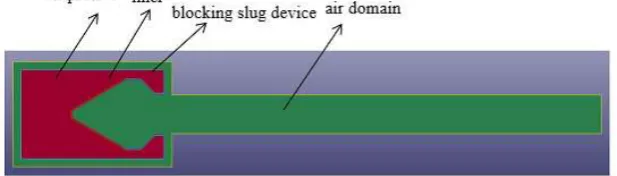
[image:3.595.143.452.549.637.2]To verify the blocking device has the function of controlling the motion of the jet slug, the numerical simulation method is used to simulate the process of forming the non-slug jet. In order to reduce the time spent on numerical calculations, the axisymmetric aggregate charge structure is simplified to a 1/2 model for simulation, and add symmetry constraints on the symmetric surface. The model consists of a liner, an explosive, a blocking slug device and an air domain. Euler algorithm is adopted in the model, and Euler grid is adopted for grid. The three-dimensional finite element model established by ls-dyna software is shown in Figure 3.
Figure 3. Finite element model of the blocking slug device.
The specific parameters of the shaped charge structure for simulation are as follows: the diameter of the liner mouth is 42.3mm, the wall thickness of the conical liner with equal thickness is 1mm, the cone angle is 60 degrees, and the diameter of the charge is 56mm. Vertex center single point detonation method is used to detonate the charge.
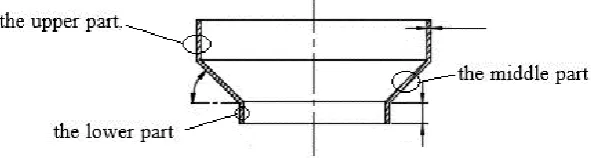
Study on the Influence of the Structure Parameters of Blocking Slug Deviceon the Jet Molding
Figure 4. Schematic diagram of device structure.
Study on the Influence of the Tilt Angle of the Middle Part of the Device on Jet Forming.
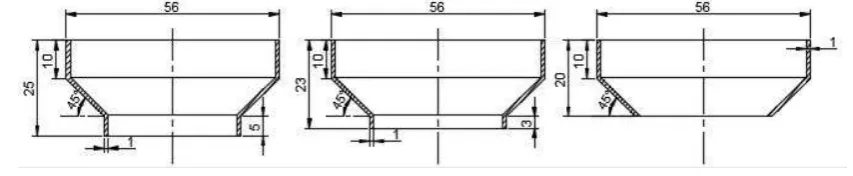
[image:4.595.92.502.302.391.2]On the premise of 1mm thickness of the device wall, the total height and lower height of the device remain unchanged, and the influence of the tilt angle of the middle part of the device on the non-slug jet forming is studied. The size of the lower part of the device is much smaller than that of the middle part, and the influence on the jet is also mainly caused by the middle part of the device. Therefore, the first group of simulation deletes the lower part of the device. In this paper, the angle of the middle part of the device is divided into three cases of 30 degrees, 45 degrees, 60 degrees (and the angle of X axis). The CAD diagram of the device is shown in Figure 5.
Figure 5. The CAD diagram about the angle of the middle part.
The jet shaping of the typical time in the simulation is selected as the following:
[image:4.595.62.506.415.742.2]
Slug at 150𝜇s lateral pressure gradient of the device in 18𝜇s lateral velocity gradient of the device in 18𝜇s
Figure 6. The situation at 30 degrees.
Slug at 114𝜇s lateral pressure gradient of the device in 18𝜇s lateral pressure gradient of the device in 18𝜇s
[image:4.595.183.489.607.716.2]
Slug at 100𝜇s lateral pressure gradient of the device in 18𝜇s lateral pressure gradient of the device in 18𝜇s
Figure 8. The situation at 60 degrees.
In the three scheme, the blocking slug device starts to interfere with the jet at 20𝜇s, the lateral pressure on the jet is 8.69GPa, 16.9GPa and 10.38GPa, and the lateral velocity is 932m/s, 1314m/s and 849m/s. When the charge diameter is constant, the ratio of the charge quality to the device quality increases with the decrease of inclination angle, and the crushing speed of the device is also increased, but its lateral velocity decreases. So the maximum lateral velocity is obtained when the angle is 45 degrees. Device after being crushing interferes the jet become stronger with the decrease of the angle, therefore, the diameter of the jet after truncation increases with the increase of the angle. The movement of the jet is observed in the simulation, and it is found that the disturbed position of the jet is dispersed under the large dip angle. According to the above analysis, the best effect of shaping jets without slug can be obtained when the angle of middle part in the blocking slug device is 45 degrees.
Study on the Influence of the Height of the Lower Part of the Device on Jet Forming.
[image:5.595.125.501.67.218.2]The size of the lower part of the blocking slug device is much smaller than that of the middle part, and the influence on the jet is also mainly caused by the middle part of the device, so the simulation of this section is based on the conclusions obtained in the previous section. In the study of this section, the height of the lower part of the device is divided into three schemes: 5mm, 3mm and 0mm, and their CAD drawings are shown in Figure 9.
Figure 9. The CAD diagram about the height of the lower part.
The jet shaping of the typical time in the simulation is selected as the following:
Slug at 140𝜇s lateral pressure gradient of the device in 18𝜇s lateral pressure gradient of the device in 18𝜇s
[image:5.595.81.508.482.570.2]
Slug at 140𝜇s lateral pressure gradient of the device in 18𝜇s lateral pressure gradient of the device in 18𝜇s
Figure 11. When the height of the lower part is 3mm.
Under the three schemes (situation under 0mm of lower part is shown in fig.7), the crushed blocking slug device begins to disturb the jet with the lateral pressure of about 17GPa around 20s. The jets slug can be truncated while the blocking slug device equips shorter lower part. The span of the disturbed position of the jet increases with the increase of the height of the lower part of the device. At the same time, the effect of pressure leads to the fracture of the jet in the subsequent stretching process, and the jets fracture earlier under higher height of the lower part in the device. The existence of the lower part of the device destroys the shape of the main part of the jet, so the lower part of the blocking slug device should be removed.
Conclusion
(1) Theblocking slug devicecan effectively control the movement of the slug, and the head speed of
the jet is not affected.
(2) The wall thickness of theblocking slug device is 1mm, and rationally ignoring the influence of
the lower height of the device, when the angle of middle part is 45°, the crushed device can obtain maximum lateral velocity, the jets can be shaped smoothly and in good shape.
(3) With the wall thickness of theblocking slug device is 1mm and the angle in the middle part of
the device is 45 degrees, the span of the disturbed position of the jet increases with the increase of the height of the lower part of the device, and the jet fractures during subsequent stretching. So, removing the lower part of the device can intercept the slug earlier and keep the main part of the jet intact.
Reference
[1] Zheng-xiang Huang, Theory and practice of shaped charge. Beijing Institute of Technology Press, 2014.
[2] Xu-gui Wu, Hong-bo Hu, lv Zhou, Shi-lu Xiao and Guo-ping Wang. Parameter design of series warhead [J]. Journal of Projectiles, Rockets, Missiles and Guidance, 1994, 2: 21-26.
[3] Hou-jie Tu, Shou-rong Yun and Heng-yang Zhao. Study on the effect of the first stage explosion on the second stage for the blasting series warhead. Acta Armamentarii, 2001, 265-374.
[4] Tong Zhang, Shi-qing Yang, Song-lin Xu, ect. The technical characteristics and development trend of series warhead [J]. Winged Missiles Journal, 2006, 36(10): 51-54.
[5] Xin-sheng Wang. Optimize the design and development of high shot density oil perforator [D]. Jilin University, 2013.
[6] Hui-sheng Shi. Influence of liner density distribution on the penetration performance of oil well jet perforator [J]. Explosive Materials, 1997, 26(4): 1-4.