The London School of Economics
and Political Science
Positive Incentives for Ecosystem Services
Matthew Cranford
A thesis submitted to the Department of Geography and
Environment of the London School of Economics for the
degree of Doctor of Philosophy
Declaration
I certify that the thesis I have presented for examination for the M.Phil/Ph.D. degree of the London School of Economics and Political Science is solely my own work other than where I have clearly indicated that it is the work of others (in which case the extent of any work carried out jointly by me and any other person is clearly identified in it).
The copyright of this thesis rests with the author. Quotation from it is permitted, provided that full acknowledgement is made. This thesis may not be reproduced without my prior written consent.
I warrant that this authorisation does not, to the best of my belief, infringe the rights of any third party.
I declare that my thesis consists of 60,026 words.
Statement of use of third party for editorial help
Abstract
Use of payments for ecosystem services (PES) has grown around the world in recent years. Although there has been extensive discussion of how best to define PES and what is PES or ‘PES-like’, at the core of all definitions and all PES programmes is the
delivery of a positive incentive to induce socially preferred environmental behaviour. Despite this, research on PES design has to date focused more on broader policy design than on incentive choice and design. In the developing world, PES are broadly
perceived as a useful tool for environmental policy, but it is here that a continuing proliferation of programmes is occurring in many varied contexts. That has motivated a variety of approaches to be taken to PES, and prompted revisionists to call PES
‘incentives’, ‘rewards’, ‘compensation’, or something else besides ‘payments’.
There are two primary academic objectives of this Ph.D. The first is to conceptualise PES as a broad category of positive incentives and explore the variation within that category. That is done through a) a conceptual review of PES; b) a review of empirical research on incentive design for PES; and c) an empirical study creating a typology of PES.
The literature review also highlights a few key considerations for incentive design relevant to developing country contexts that have not yet been adequately addressed. The second objective of the Ph.D. is to contribute, albeit in a small way, to addressing those key considerations through three empirical studies.
The contribution of this work to academic knowledge is twofold: 1) Through literature reviews and empirical methods, this paper offers an overarching synthesis of
Acknowledgements
For support throughout my Ph.D. studies and writing of this thesis, I am extremely grateful to Susana Mourato as my Ph.D. supervisor and mentor, Martin Stanley (of the Holly Hill Trust) for fieldwork funding and support, and Charlie Palmer for additional academic guidance. I am also very thankful for the support provided by my family, specifically Judith Cranford, Roy Cranford and Annemarie Pitts.
In relation to Chapter 4, thank you to Genevieve Bennett and Gena Gammie of Ecosystem Marketplace/Forest Trends, for allowing me access to their data and for fruitful collaboration on previous work that is not part of this thesis, but provided a test run for the methods used in Chapter 4.
In relation to Chapter 5, thank you to all those that provided support with fieldwork and background information. Rainforest Concern (RC) and Consorcio Toisan (CT) provided on-the-ground support in Ecuador. Thank you to Fiona Perez (RC) and Jose Cueva (CT) for providing logistical support and background information, and to Freddy Villalba, Gustavo Nogales, and Juan Guevara (all of CT) for their help with survey
implementation. Additionally, thank you to Jefferson Mecham (ALLPA) and Maya Kocian (Earth Economics) for providing background information about the case study area.
Thank you also to all the people that provided support with fieldwork and background information for Chapter 6. Thank you to Jorge Plazas who supported survey
implementation in the field. Thank you also to Alejandro Calvache (The Nature
Conservancy; TNC), Libia Cifuentes and Carloz Florez (both of Empresa de Acueducto y Alcantarillado de Bogotá), Andrés Lizarazo (Patrimonio Natural), and Jose Yunis (TNC) for providing background information and advice.
Table of Contents
!"#$%&'$ (((((((((((((((((((((((((((((((((((((((((((((((((((((((((((((((((((((((((((((((((((((((((((((((((((((((((((((((((((((((((((((((((((( )!
!'*+,-./01/2/+$# (((((((((((((((((((((((((((((((((((((((((((((((((((((((((((((((((((((((((((((((((((((((((((((((((((((((((((((( 3!
4(567/%78/- (((((((((((((((((((((((((((((((((((((((((((((((((((((((((((((((((((((((((((((((((((((((((((((((((((((((((((((((((((((((((( 4)! 4(4(59&'*1%,:+0 ((((((((((((((((((((((((((((((((((((((((((((((((((((((((((((((((((((((((((((((((((((((((((((((((((((((((((((( 4)! "#"#"#!$%&'()*+*,- ##################################################################################################################### ".! "#"#/#!0*123!*)!4%5%+*6(),!1*2)7&(%3################################################################################# "8! 4(;(5</#/&%'=5>:/#$8,+#5&+05?,7/.$@(((((((((((((((((((((((((((((((((((((((((((((((((((((((((((((((((((((( 4A! "#/#"#!9:;!<3!()1%)7(5%3 ############################################################################################################ /=! "#/#/#!$-6%3!<)4!<77&(>27%3!*?!9:;####################################################################################### /"! "#/#@#!9:;!4%3(,)!%+%'%)73 ##################################################################################################### /"! 4()(5B/$=,0,.,18'&.5!CC%,&'=((((((((((((((((((((((((((((((((((((((((((((((((((((((((((((((((((((((((((((((((((( ;;! "#@#"#!A(7%&<72&%!&%5(%B ########################################################################################################### //! "#@#/#!C(31&%7%!1D*(1%3 ############################################################################################################## /@! 4(3(56:$.8+/5,D5E=(F(((((((((((((((((((((((((((((((((((((((((((((((((((((((((((((((((((((((((((((((((((((((((((((((((((((((( ;3! "#E#"#!F5%&5(%B!GHD<67%&!"I################################################################################################### /J! "#E#/#!H*)1%672<+!><3(3!GHD<67%&!/I#################################################################################### /J! "#E#@#!A(7%&<72&%!&%5(%B!GHD<67%&!@I ################################################################################## /J! "#E#E#!H<7%,*&(3(),!9:;!GHD<67%&!EI#################################################################################### /J! "#E#J#!H<3%!3724-!GHD<67%&!JI################################################################################################# /.! "#E#.#!H<3%!3724-!GHD<67%&!.I################################################################################################# /.! "#E#8#!H*)1+23(*)3!GHD<67%&!8I############################################################################################## /.!
)(5I+'/+$87/5F/#81+5D,%5E&@2/+$#5D,%5G',#@#$/25H/%78'/# ((((((((((((((((((((((((((((((((((( 3)! )(4(5I+$%,0:'$8,+ (((((((((((((((((((((((((((((((((((((((((((((((((((((((((((((((((((((((((((((((((((((((((((((((((((((((((((( 3)! )(;(5!0,C$8,+5&+05E&%$8'8C&$8,+(((((((((((((((((((((((((((((((((((((((((((((((((((((((((((((((((((((((((((((((( 3L! @#/#"#!Q4*67%&3!*?!1*)3%&5<7(*)!6&<17(1%3######################################################################## EJ! @#/#/#!9<&7(1(6<)73!()!1*)3%&5<7(*)!6&*,&<''%3########################################################## E8! )()(5GH5E%,780/%5E%/D/%/+'/#5D,%5EGH5!$$%8":$/# ((((((((((((((((((((((((((((((((((((((((((((((((( L4! @#@#"#!H*)7&<172<+!<77&(>27%3 ################################################################################################## J.! @#@#/#!P)1%)7(5%!?*&' ################################################################################################################# JO! @#@#@#!P)37(727(*)<+!<77&(>27%3################################################################################################# ./! )(3(5M+%/#,.7/05I##:/#58+5EGH5F/#81+(((((((((((((((((((((((((((((((((((((((((((((((((((((((((((((((((((((( N3! @#E#"#!R<&N%7!1*)37&<()73######################################################################################################### .J! @#E#/#!P)?*&'<7(*)!<3-''%7&(%3########################################################################################### .8! @#E#@#!S%D<5(*2&<+!1*)3(4%&<7(*)3####################################################################################### 8@! )(L(5H:22&%@ (((((((((((((((((((((((((((((((((((((((((((((((((((((((((((((((((((((((((((((((((((((((((((((((((((((((((((((((((( JK!
3(5!5O@C,.,1@5,D5E&@2/+$#5D,%5G',#@#$/25H/%78'/#P5O=/5'&#/5,D5C&@2/+$#5D,%5 -&$/%#=/05#/%78'/#(((((((((((((((((((((((((((((((((((((((((((((((((((((((((((((((((((((((((((((((((((((((((((((((((((((((((((( JA!
L(5S%/08$T"&#/05E&@2/+$#5D,%5G',#@#$/25H/%78'/#P5G780/+'/5D%,25&5'=,8'/5 /UC/%82/+$58+5G':&0,%(((((((((((((((((((((((((((((((((((((((((((((((((((((((((((((((((((((((((((((((((((((((((((((((((((44;!
L(4(5I+$%,0:'$8,+ ((((((((((((((((((((((((((((((((((((((((((((((((((((((((((((((((((((((((((((((((((((((((((((((((((((((((((44;! L(;(5O,-&%05S%/08$T"&#/05E&@2/+$#5D,%5G',#@#$/25H/%78'/# (((((((((((((((((((((((44)! L()(5B/$=,0# ((((((((((((((((((((((((((((((((((((((((((((((((((((((((((((((((((((((((((((((((((((((((((((((((((((((((((((((((((44K! J#@#"#!H<3%!3724-!*?!7D%!P)7<,!U*)%!*?!:12<4*& ########################################################### ""O! J#@#/#!;2&5%-!<)4!1D*(1%!%V6%&('%)7 ############################################################################## "/"! J#@#@#!:1*)*'%7&(1!?&<'%B*&N!<)4!'*4%+!36%1(?(1<7(*)######################################## "/J! L(3(5</#:.$#5&+05E,#$T/#$82&$8,+5!+&.@#8#(((((((((((((((((((((((((((((((((((((((((((((((((((((((((((4;A! J#E#"#!C%31&(67(5%!37<7(37(13################################################################################################## "/K! J#E#/#!R*4%+!&%32+73################################################################################################################# "@=! J#E#@#!W%+?<&%!1D<),%!<33*1(<7%4!B(7D!%)5(&*)'%)7<+!1*)4(7(*)<+(7-############## "@/! J#E#E#!;('2+<7(),!4%'<)4##################################################################################################### "@J! L(L(5F8#':##8,+ ((((((((((((((((((((((((((((((((((((((((((((((((((((((((((((((((((((((((((((((((((((((((((((((((((((((((((((((4)K! J#J#"#!;2''<&-!*?!1<3%!3724- ############################################################################################# "@O! J#J#/#!HSM9:;!<3!()1%)7(5%#################################################################################################### "@K! J#J#@#!P'6+%'%)7(),!HSM9:; ############################################################################################### "E=! L(N(5H:22&%@ ((((((((((((((((((((((((((((((((((((((((((((((((((((((((((((((((((((((((((((((((((((((((((((((((((((((((((((((((43;!
N(5I+'/+$87/5S=,8'/5&+05V,8+$5W8&"8.8$@58+5E&@2/+$#5D,%5G',#@#$/25H/%78'/#P5 G780/+'/5D%,25&5'=,8'/5/UC/%82/+$58+5S,.,2"8&((((((((((((((((((((((((((((((((((((((((((((((((((43)!
.#J#"#!9:;!<)4!HD(),<Y<!L<7(*)<+!9<&N########################################################################### ".J! .#J#/#!C%3(,)(),!9:;Z!P)1%)7(5%!1D*(1% ########################################################################### ".O! .#J#@#!C%3(,)(),!9:;Z!X*()7!+(<>(+(7- ################################################################################## "8=! N(N(5H:22&%@ ((((((((((((((((((((((((((((((((((((((((((((((((((((((((((((((((((((((((((((((((((((((((((((((((((((((((((((((((4J;!
J(5S,+'.:#8,+#((((((((((((((((((((((((((((((((((((((((((((((((((((((((((((((((((((((((((((((((((((((((((((((((((((((((((((((((((((4J3! J(4(5I+$%,0:'$8,+ ((((((((((((((((((((((((((((((((((((((((((((((((((((((((((((((((((((((((((((((((((((((((((((((((((((((((((4J3! J(;(5EGH5F/#81+5G./2/+$# ((((((((((((((((((((((((((((((((((((((((((((((((((((((((((((((((((((((((((((((((((((((((((4J3! 8#/#"#!R<&N%7!1*)37&<()73###################################################################################################### "8E! 8#/#/#!P)?*&'<7(*)!<3-''%7&(%3######################################################################################## "88! 8#/#@#!S%D<5(*2&<+!1*)3(4%&<7(*)3#################################################################################### "8K! J()(5O@C/#5&+05!$$%8":$/#5,D5EGH(((((((((((((((((((((((((((((((((((((((((((((((((((((((((((((((((((((((((((((4KR! J(3(5EGH5I+'/+$87/# (((((((((((((((((((((((((((((((((((((((((((((((((((((((((((((((((((((((((((((((((((((((((((((((((4K;! J(L(5X:$:%/5</#/&%'=(((((((((((((((((((((((((((((((((((((((((((((((((((((((((((((((((((((((((((((((((((((((((((((((((((4K)!
Tables
Table 1: Definitions and conceptualisations of payments for ecosystem services ...32! Table 2: Lancastrian studies focused on ES supplier preferences for the attributes of
programmes that offer PES. ...54! Table 3: Attributes analysed in 19 Lancastrian studies of potential ES providers’
preferences for PES-programme attributes. ...56! Table 4: The cost and adequacy of monitoring contract compliance in select PES case
studies...69! Table 5: Variables included in LCA of PWS incentive packages. ...87! Table 6: PWS programme information tested as covariates to the LCA through a
simultaneous MNL...89! Table 7: Institutional variables used to develop descriptive statistics ...91! Table 8: Estimated parameters of the four types of incentive packages as determined by
LCA,...95! Table 9: Estimated coefficients for MNL of class membership ...99! Table 10: Proportion of observed programmes predicted to be members of each class
that have the stated characteristics. ...103! Table 11: Summarising the characteristics of PES used for watershed services ...107! Table 12: Approaches for incorporating an environmental condition into lending...115! Table 13: Summary of cash flow models of shade-grown coffee, mixed agroforestry,
and sustainable forestry systems in the Intag River Region of Ecuador...120! Table 14: Attributes and levels for choice experiment in Intag agroforestry survey....123! Table 15: Variables included in the models of loan choice. ...127! Table 16: Select descriptive statistics of the sample compared with information from
censuses and other studies...130! Table 17: Mixed logit model of loan choice ...131! Table 18: Mean marginal willingness to pay (MWTP) for a loan where annual interest
rate (%) is the price parameter. ...134! Table 19: Three subgroups with differing MWTP for the agroforestry condition ...135! Table 20: Simulating demand for loans with an agroforesty condition...136! Table 21: Comparing the annual loan repayment if the condition is met to the repayment required if the condition is not met ...137! Table 22: Perceptions of cash and non-cash payments for ecosystem services in a
Table 45: Attributes and levels for choice experiment in Chingaza PES survey. ...153!
Table 25: Ranking of incentive types by respondents to Chingaza PES survey...156!
Table 26: Observed heuristics by CE respondents...156!
Table 27: Respondent opinions on the pros and cons of incentive attributes. ...157!
Table 28: Variables included in the models of incentive preference...158!
Table 29: Mixed logit model of incentive choice ...159!
Table 30: Mean marginal willingness-to-accept (MWTA) to participate in a PES programme ...161!
Figures
Figure 1. Cumulative number of programmes that use PES to protect watershed
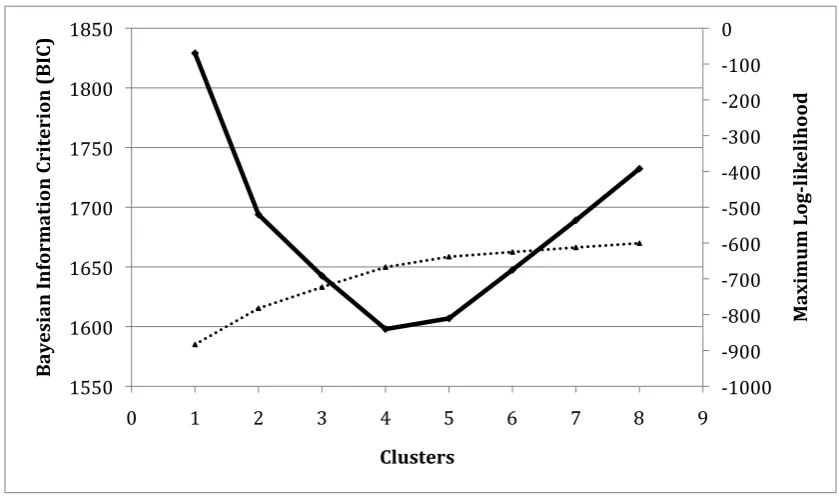
services...18! Figure 2: PES in the policy framework. ...37! Figure 3: The supply of pro-social behaviour under motivation crowding...75! Figure 4: Bayesian Information Criterion (BIC; solid line) and maximum log-likelihood for basic LCA models ...94! Figure 5: Predicted probability of latent class membership (y-axis) in Asia relative to
country wealth (x-axis). ...100! Figure 6: Predicted probability of latent class membership (y-axis) in Latin America
relative to country wealth (x-axis). ...100! Figure 7: Predicted probability of latent class membership (y-axis) in Africa relative to
country wealth (x-axis). ...101! Figure 8: Conceptualising credit-based payments for ecosystem services (CB-PES). 117! Figure 9: Map of Ecuador (left) indicating the location of Imbabura Province, and map
of Imbabura Province (right) with the ecological boundary of Intag-Manduriacos ecological zone overlaid...119! Figure 10: Example of choice card in choice experiment for CB-PES. ...124! Figure 11: Histogram of the proportion of the sampled population with a given marginal willingness-to-pay for the agroforestry condition (MWTPAFC)...135! Figure 12: Example of a choice card from the Chingaza PES survey...154! Figure 13: Change in mean MWTA (y-axis) as the number of partner households (i.e.
additional to the respondent household) within a jointly liable group increases (1-6, x-axis)...163! Figure 14: Change in mean MWTA for in-kind incentives (y-axis) as drive time to a
household’s community increases (x-axis). ...163! Figure 15: Predicted participation (y-axis) in the PES program offering USD 100 (COP
184,000) per family per year, as group size for joint liability increases (x-axis). 166! Figure 16: Predicted participation (y-axis) in PES program with joint liability across
Equations
Equation 1: Latent class model...84!
Equation 2: Bayesian Information Criterion...85!
Equation 3: Estimating the minimum sample size for choice experiments...125!
Equation 4: Random utility function with random parameters...125!
CHAPTER 1
Overview
1.1. Background
In 2002, Landell-Mills & Porras (2002) reviewed 287 market mechanisms for forest environmental services in developed and developing countries. It was the first attempt to catalogue such mechanisms on that scale, and remains one of the most cited
documents on the topic.1 As such, it provides a benchmark against which to identify how the discourse and experience with such mechanisms has evolved. In the past decade, three key aspects at the foundation of that study have changed.
First, there has been a move away from discussing market mechanisms as a broad category of environmental policy instruments and towards discussing payments for ecosystem/environmental services (PES). Programmes that use PES were originally defined as a market or market-based mechanism, but have more recently been defined as a broad category of policies that include markets for ecosystem services (MES) (e.g., Sommerville et al. 2009), or in other words, that PES programmes can be market-based or non-market-based (Farley & Costanza 2010).
The shift is evident in the fact that while market mechanisms are often conceptualised as important to internalise environmental externalities that arise from traditional market failures, Farley & Costanza (2010) call it paradoxical that market mechanisms based in more traditional economic thinking are proposed to fix market failures. They instead suggest that a PES programme can only address the key market failures that lead to an undersupply of ecosystem services (ES) “to the extent that it differs from conventional markets, not to the extent that it mimics them” (pg. 2064). That appears to manifest in implementation of PES. For example, prominent examples of PES originally intended to follow the idea of a market mechanism do not (at least yet) look much like a market mechanism (McAfee & Shapiro 2010; McElwee 2012; Fletcher & Breitling 2012).
That shift in perception of market mechanisms and PES has occurred as part of a broader evolving conceptualisation of what PES actually are. That is the second aspect that has changed. Still the most cited definition of PES, Wunder (2005) defines them as:
1. A voluntary transaction; where
2. A well-defined ES (or a land-use likely to secure that service); is being 3. ‘Bought’ by a (minimum one) ES buyer; from
4. A (minimum one) ES provider;
5. If and only if the ES provider secures ES provision (conditionality).
From about 2009, numerous studies have offered different definitions. Some claim to be refinements of Wunder’s definition (e.g. Sommerville et al. 2009; Swallow et al. 2009), while others are more critical of that definition (e.g., Muradian et al. 2010; van
Noordwijk & Leimona 2010), and some try to provide a synthesis of the different definitions and approaches (Tacconi 2012).
The evolving definition has itself also occurred within a larger change. The third aspect that has shifted is that experience with PES around the world has notably increased in the past decade, with an important increase in developing countries. For example, Landell-Mills & Porras (2002) identified 4 mechanisms that they classified as
biodiversity credit/offset programmes, 75 as forest carbon offset programmes, and 41 as proposed and ongoing payments for watershed services (PWS). In 2010, Madsen et al. (2010) identified 39 active biodiversity credit/offset programmes and 25 in
development. Similarly, Peters-Stanley et al. (2013) indentified 162 active forest carbon programmes in 2012.Finally, Bennett et al. (2013) identified 205 active incentive-based watershed programmes in 2011, and 76 in development. At least 120 of those active and 38 in development are PWS (see Chapter 4), and depending on one’s definition of PES, it could be more.
The shift in thinking leads to questions of what PES actually are and based on that, how they should be designed if not as a ‘market’ mechanism. As elaborated further in
market-based mechanisms (Fisher et al. 2010) or to non-market-market-based programmes and policies.
As PES are defined as incentives, there should be a greater focus on incentive choice and design in relation to PES. As elaborated further in Chapter 4, previous
characterisations of PES have often focused on institutional aspects and relation to markets (Swallow et al. 2009; Smith et al. 2006; Scherr et al. 2006), or the broader paradigm framing a PES transaction (Muradian et al. 2010; van Noordwijk & Leimona 2010). Although these are both helpful approaches to understanding policy design, much less attention has been paid to the incentives that are broadly agreed to be at the heart of such policies. A literature relevant for incentive design of PES exists, but there is only a small, emerging literature specifically focused on the topic.
In addition, the discourse on PES has always been largely defined by experience in developing countries. That includes the shift in this discourse. For example, many of the refinements and critiques of the original definition of PES have been motivated, at least in part, by the variety of PES programmes observed in developing countries, many of which do not fit the original definition (Muradian et al. 2010; van Noordwijk & Leimona 2010; Sommerville et al. 2009). That poses many areas of research that need to be addressed. In particular, with such a variety and prevalence of PES in developing countries, the question arises of how best to design such incentives in a developing country context. Some insight can come from more thorough analysis of what currently exists, which is becoming possible as PES become better researched and reported, and more information is available. Some insight might also come from other places. Lessons on incentive design, particularly in a developing country context, can be drawn from related areas of economics. As Fisher et al. (2010, pg. 1260) state, “care must be taken to make sure that the lessons we learn while heading down the PES path were not already learned in other contexts, with other literatures, and other buzzwords.” As such, this Ph.D. draws from multiple economic sub-disciplines, particularly environmental/ ecological economics and development economics.
introduction, the second section elaborates three key research questions. The third section then clearly outlines each chapter of this Ph.D., their specific aims, and which research questions they address.
1.1.1. Terminology
In relation to terminology, the PES literature is diverse in a number of ways, including working definitions of PES; context of specific case studies; and intellectual or
ideological views of the researcher. As such, the terminology used in this Ph.D. tries to be broad and inclusive, but also as precise and easy to use as possible. The choice of terminology is not intended to support any particular viewpoint.
First, the focus of this Ph.D. is on the positive incentives (i.e. ‘payments’) provided to the ES provider, with an agnostic stance to the various mechanisms through which that incentive can be channelled. The definitions and conceptualisations of these
programmes and policies continue to undergo dynamic debate. There are many similarities between them, however, and so they are addressed collectively here. The term PES is used to describe the general class of positive incentives used to induce a socially preferred behaviour, with the aim of increasing the supply of ES, irrespective of whether the programme through which that incentive is provided is called AES, PES, a market for ES, or something else.
Second, the recipients of the incentive are in many cases owners of farms of forests, but in some cases are also users of common pool resources. As such, they will at times be referred to as ‘resource users’, a term that encompasses all owners or users of land, water, timber, fish, etc. More often, and in the context of PES specifically, they are referred to as the ‘providers’ of ES. In terms of contract and incentive research, they would be considered the agent, while the ES buyers would be considered the principal.
Third, the term ‘ecosystem services’ is used because it indicates changes in land use and natural capital. All of the literature reviewed and analysis conducted is based on
incentives that are intended to induce a greater provision of the benefits that people receive from nature, which is how ES are often defined (Millennium Ecosystem
Assessment 2005). Swallow et al. (2009) describe the difference between environmental services and ecosystem services is that the former does not include provisioning
does not focus on ecosystem goods that arise through provisioning services (e.g. timber), but some do focus on the provision of water.
Additionally, the use of the term ‘ecosystem services’ is not intended to imply that the studies focussed on programmes that provided incentives based on a strict measure of ecosystem service output. A few did, but the vast majority of studies look at incentives used to induce a change in actions by resource users, which in turn is believed to provide increased levels of ecosystem services.
Finally, in some parts of the world, ‘environmental services’ can refer to services provided using grey infrastructure. That is a particular risk for the water sector. The research presented here, however, is all focused on land- or ecosystem-based behaviours and so the term ‘ecosystem services’ helps to reinforce that.
1.1.2. Focus on developing countries
Payments for ecosystem services are used across the world, but this Ph.D. will focus on the design of PES in developing countries, specifically low- or middle-income countries as classified by the World Bank.2 Although developed countries have a longer and deeper history with PES, the difference is slight. Further, evidence suggests that the majority of active programmes now occur in developing countries. Of the 205
incentive-based watershed programmes identified by Bennett et al. (2013), 113 (55%) of the active programmes and 53 (72%) of the programmes under development are located in low- and middle-income countries.3 The data from Bennett et al. (2013) was filtered for relevance to this Ph.D., and 120 programmes4 more strictly defined as those that use PES—payments for watershed services (PWS) programmes—were analysed in Chapter 3. The picture is similar for this reduced sample. An approximately equal
2 See World Bank country classifications at http://data.worldbank.org/about/country-classifications/country-and-lending-groups.
3 Based on GNI/capita in 2011. That is the latest year for which World Bank data is available for all countries represented in this database, and is the focus year of Bennett et al. (2013)
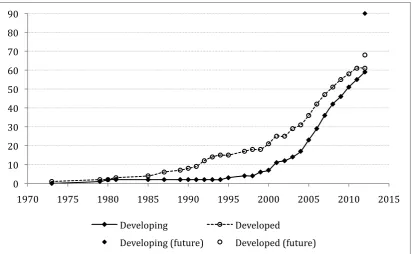
number of PWS programmes were identified in developed and developing countries around 2012. Of the PWS programmes under development in that database, many more occur in developing countries, indicating that that the number of PES programmes for watershed services either currently, or will very soon, outnumber those in developed countries (Figure 1).
Figure 1. Cumulative number of programmes that use PES to protect watershed services, in developed and developing countries, based on year programme was established. The future estimate is based on the programmes identified as in development around 2012, and from that group only include the ones far enough developed to identify that they plan to use PES. Source: Bennett et al. 2013.
In addition to PWS programmes, many more programmes use PES to incentivise
biodiversity conservation, environmentally friendly agricultural practices, and provision of land-based carbon services throughout the developing world. The use of PES in developing countries is likely to continue to increase, driven by various international agenda and dynamics related to environment and development. These include efforts by parties to the UN Convention on Biological Diversity, REDD+ under the UN
Framework Convention on Climate Change, related concepts and initiatives such as green growth, and general increased demand from citizens for a healthy environment as countries become wealthier.
In addition to the prevalent use of PES in developing countries, the discourse on PES has been largely shaped by experience in developing countries. Arguably the most cited and researched PES programme is that of Costa Rica (Porras et al. 2013), originally developed through a World Bank project. The earliest conceptualisations and definitions
=! "=! /=! @=! E=! J=! .=! 8=! O=! K=!
"K8=! "K8J! "KO=! "KOJ! "KK=! "KKJ! /===! /==J! /="=! /="J!
C%5%+*6(),! C%5%+*6%4!
were based on experience from World Bank projects (Pagiola & Platais 2002) along with experience from the Center for International Forestry Research (Wunder 2005). Later re-definitions and re-conceptualisations of PES, critiquing the originally proposed defining characteristics of PES, were also based on experience in developing countries: what could be considered the basis of the ecological economics approach to PES was explicitly grounded in experience in developing countries (Muradian et al. 2010); experiences in Latin America have led to an approach framing the incentive exchange as a reciprocal exchange (Asquith 2011; Rare 2010); and experience in Asia inspired a paradigm-based categorisation of PES (van Noordwijk & Leimona 2010). Specific projects have even claimed their own unique approach to PES in developing countries, often with a focus on equity in the provision of PES, including WWF’s Equitable Payments for Ecosystem Services (e.g. Kwayu et al. 2013) and the World Agroforestry Centre’s Rewarding Upland Poor for Environmental Services (e.g. Leimona et al. 2009) projects.
In short, not only are PES more and increasingly numerous in developing countries, but it is also PES experience in developing countries that has inspired so many variations on how PES are defined. A focus on PES in developing countries is not only more relevant for these reasons, but the variety of PES makes for more interesting and fruitful research on the choice and design of incentives.
1.2. Research Questions and Novelty
In light of that background and focus, the overarching objective of the research presented here is to contribute to the growing body of knowledge on designing PES. Although many researchers and practitioners are interested in different facets of designing PES programmes, this Ph.D. is novel in its focus on PES as incentives. Significant research and literature is devoted to the design of policies and instruments, through which PES are provided, but that on incentive design for PES is much smaller.
After this overview, the following five chapters each make a contribution to this literature that, taken together, help to advance knowledge on the design of PES
1. What is the state of knowledge on PES as incentives? 2. What types of incentives are used as PES?
3. How can PES be designed to overcome some of the issues related to incentives highlighted in the literature?
1.2.1. PES as incentives
What is the state of knowledge on PES as incentives?
Chapter 2 reviews the definitions and conceptualisations of PES. It finds that the
definition of PES has evolved away from a focus on institutions and mechanism design. Instead, all definitions converge on PES as a class of incentives provided through different types of policies and mechanisms that align with varying types of framing and paradigms (e.g., Wunder 2005; Engel et al. 2008; Muradian et al. 2010; Tacconi 2012). Sommerville et al. (2009) aptly describe ‘PES’ as an umbrella term, recognising the variety of PES observed in implementation. The chapter goes on to describe a
conceptualisation of PES as a class of incentives that can link to a variety of actors and policy instruments and institutions. The conceptualisation is closest to that presented by Sommerville et al. (2009).
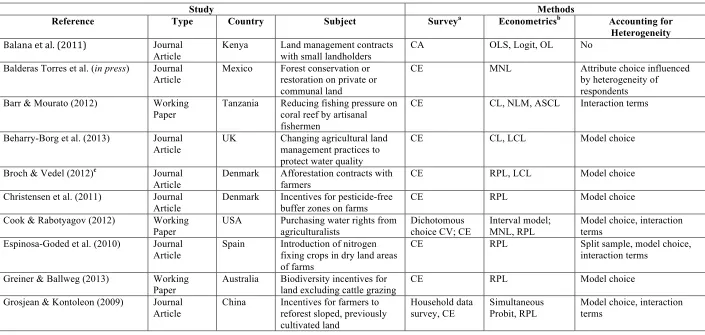
Chapter 3 then illustrates that, although there is convergence on PES as incentives, researchers are only just beginning to specifically focus on understanding how best to design such incentives. There is a large body of literature on land-use technology adoption or participation in incentive-based programmes, but it generally treats any incentive for a change in behaviour as a generic, homogenous incentive. A smaller literature has emerged that analyses incentive choice and design in a PES context. The core of this literature is nearly 20 studies that use discrete choice analysis (DCA) to explore the preferences of potential ES provider for different incentive attributes. Additionally, across the PES literature some specific issues related to incentive design have emerged that are particularly relevant to PES in developing countries, but with limited empirical evidence of their effect on optimal choice and design of PES.
the concept and knowledge base of PES as a class of incentives linking land-use decisions with a broader institutional framework.
1.2.2. Types and attributes of PES What types of incentives are used as PES?
Previous categorisations and typologies of PES programmes focussed on the institutional aspects of policies or their relation to markets (e.g. Scherr et al. 2006; Swallow et al. 2009; Smith et al. 2006), or on the framing or paradigm of the
arrangement through which PES are provided (e.g. van Noordwijk & Leimona 2010). No effort has yet been made to characterise the types of incentives that comprise the class of incentives called PES.
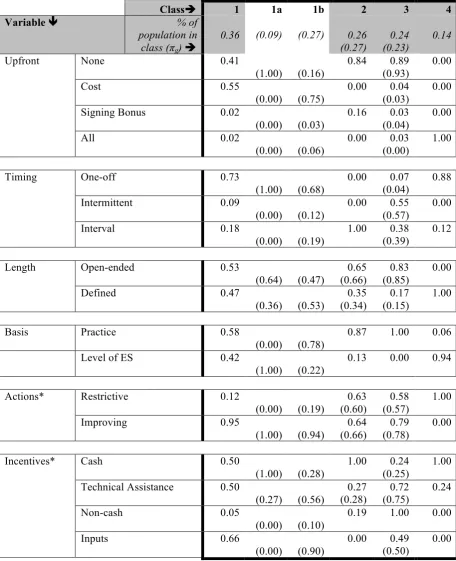
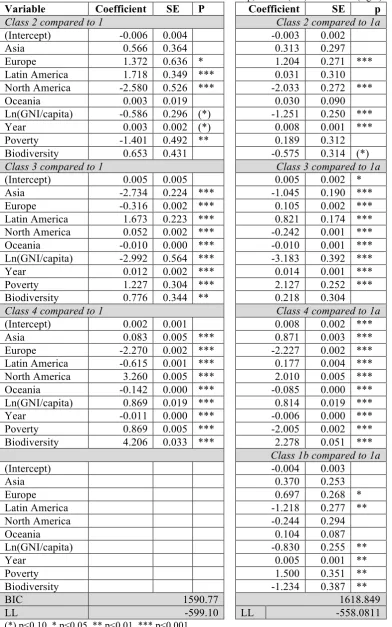
Chapter 4 does this using data on PES in the context of watershed conservation. Using latent class analysis (LCA), a typology of payments for watershed services (PWS) is defined based on incentive attributes identified in Chapter 3 (literature review) as potentially affecting ES providers’ willingness to accept PES.
The chapter is novel as no other study has yet characterized types of PES as incentives, and no study, irrespective of conceptual approach, has yet used a model-based method for developing a typology. All previous efforts have been qualitative and somewhat opaque in how defining variables where chosen and/or applied. Further, through this approach, observations can be made on the contexts in which different types of PES are used. In particular, the chapter explores how the prevalence of different types of PES changes with a country’s development.
In addition to providing input to Chapter 4, Chapter 3 also helps answer this research question directly. Types of PES are defined by the attributes that comprise them. Understanding both the types of PES and all actual or potential incentive attributes, provides a common language, and more importantly, a critical knowledge base to inform PES design and research.
1.2.3. PES design elements
As noted above, Chapter 3 includes two parts: a systematic review of studies that use DCA to assess ES providers’ preferences for incentive attributes, and a review of three broad issues related to incentive design that have emerged from the PES literature. These three issues are the existence of market constraints, information asymmetries, and behavioural (i.e. ‘non-rational’) considerations. Chapters 5 and 6 are two case studies that follow the emerging practice in the literature of using DCA to study incentive attributes, but study specific incentive types and attributes in relation to overcoming the three identified issues.
Chapter 5 studies preferences for a novel incentive called credit-based PES. The study highlights interesting conclusions related to this form of PES. It also addresses the issue of indirect incentives, a possible solution to overcoming market constraints, and how such incentives are perceived, which relates to behavioural considerations.
Chapter 6 studies a long-standing question of whether to use cash or in-kind incentives and provides insight into specific reasons both ES provider and buyer may prefer in-kind incentives. These reasons relate to market constraints, information asymmetries and behavioural considerations. In addition, Chapter 6 also researches the novel PES attribute of group liability, an innovation borrowed from microfinance economics, to address the issue of information asymmetries.
Together, these two chapters draw not only from environmental/ecological economics, but also learn from development and behavioural economics to explore a number of novel or important attributes of PES. They also advance knowledge of PES design in respect to the three highlighted issues. Other studies on PES that use similar methods as in Chapters 5 and 6 tend to focus on preferences for the incentive attributes and do not go much further. The case studies here are designed to ensure that understanding of preferences in these cases will be helpful, albeit in a small way, to informing incentive design for PES more broadly.
1.3. Methodological Approach 1.3.1. Literature review
2 and 3, and as a component of Chapters 4-6. In Chapters 2 and 3, extensive review of many aspects of literature related to PES was carried out, with a portion of that review carried out systematically. The focus of Chapter 2 was to review papers that defined or conceptualised PES. Previous academic and grey literature papers that do so and are also prevalently cited were compared across various themes, with the most interesting and relevant highlighted in that chapter. In Chapter 3, two types of review are carried out. The first is a systematic review of papers that use similar methods to study potential ES providers’ preferences for incentive attributes of PES. Following similar reviews of related topics, a vote-count methodology was carried out to compare across the studies (Delacote et al. 2012; Knowler & Bradshaw 2007; Prokopy et al. 2008). The second part of the chapter is less systematic and more discussion-based. Drawing from PES literature as well as other economic sub-disciplines, key issues related to incentive design for PES that are not yet resolved are discussed.
1.3.2. Discrete choices
The consumer choice can be divided into a discrete choice about what to consume and a continuous choice about how much to consume (Hanemann 1984). Discrete choice analysis (DCA) isolates the first part to determine what goods a consumer demands (Hoyos 2010). A fundamental component of DCA is to follow Lancastrian theory of consumer demand that the goods can be considered a bundle of attributes (Lancaster 1966).
The approach was originally developed to predict market demand by consumers, and early applications were made in the fields of transportation, energy, housing and marketing (Train 2009), but its use to assess design of environmental policies is increasing. It became popular among environmental economists as a tool for understanding individuals’ preferences for environmental attributes through stated preference (SP) studies (Hoyos 2010), and has been used to evaluate preferences for forests (Brey et al. 2007), wetlands (Carlsson et al. 2003), beaches (Beharry-Borg & Scarpa 2010), landscape beauty (Dachary-Bernard & Rambonilaza 2012), fish (Agimass & Mekonnen 2011), and cultural heritage (Choi et al. 2010), amongst many other
environs and ES.
supply of ES. It has begun to be used to ex-ante assess land or resource users’ preferences for the attributes of incentive and incentive-based policies, such as agri-environmental schemes in Europe (Christensen et al. 2011; Espinosa-Goded et al. 2010; Ruto & Garrod 2009), reforestation incentives in China (Grosjean & Kontoleon 2009; Qin et al. 2011), and marine PES in Tanzania (Barr & Mourato 2012). Studies that follow a discrete choice approach to studying PES are the ones systematically reviewed in Chapter 3, and these set a precedent for the methods used in the case studies in Chapters 5 and 6.
Both Chapters 5 and 6 study local ES providers’ stated preferences for incentive choice and design using a discrete choice experiment (CE). The CEs are designed and
implemented using good and common practice for environmental economics (Hoyos 2010) and analysed using advanced simulation-based methods (Train 2009). Detailed description of the experimental design and specification of econometric models for analysis are provided in each chapter.
Another method used for Chapter 4 is latent class analysis (LCA) combined with a multinomial logistic (MNL) regression model. Although the approach to Chapter 4 is founded more in cluster analysis, LCA and MNL both form an integral part of the DCA toolbox. Additionally, as with the CEs in Chapters 5 and 6, the approach taken in Chapter 4 views PES as a bundle of incentive attributes, and categorises types of PES based on different combinations of attributes. As such, although it is not specifically DCA that is used in Chapter 4, the methods can be considered an extension of the DCA approach. As with Chapters 5 and 6, a detailed description is provided in Chapter 4.
Finally, the data used is mostly primary, but some secondary data. Chapter 4 uses data obtained from a different study that used a combination of primary and secondary data. It was founded on a survey of PES programme managers, but additional coding was required, much of which is based on publicly available information. Chapters 5 and 6 use solely primary data collected specifically for those two case studies.
1.4. Outline of Ph.D.
five analytical chapters, plus a final chapter that summarises and draws conclusions. To summarise this first overview chapter, an outline of all chapters is presented.
1.4.1. Overview (Chapter 1)
The aim of the current chapter is to provide an introduction and overview of the entire Ph.D. It does not include any true academic discussion or research, but explains the overarching objective of the Ph.D., broad research questions to be addressed, and clear outline and aims of each of the following chapters.
1.4.2. Conceptual basis (Chapter 2)
The primary aim of Chapter 2 is to present the definition and conceptualization of PES that is used throughout the Ph.D. It does this by reviewing the literature that defines and conceptualises PES, and finding what they all have in common and how, in other ways, the thinking on PES has evolved. It contributes most to Research Question 1.
1.4.3. Literature review (Chapter 3)
Chapter 3 presents a more traditional review of empirical literature. It does this in two parts. The first part focuses on specific attributes of PES incentives and is based around a systematic review of 19 identified studies that use DCA to analyse multiple attributes of PES in a single case study. The first half heavily informs Chapter 4, and both halves contribute to Research Questions 1 and 2. The second part of the literature review then identifies and discusses three key issues emerging in the PES literature for which little empirical research has been carried out. It informs the case studies in Chapters 5 and 6, and the most heavily weighted Research Question 3.
1.4.4. Categorising PES (Chapter 4)
The aim of Chapter 4 is to explore the types of incentives that could be considered PES, and increase the understanding of the contexts in which different types are used,
important attributes identified in the first part of the Literature Review (Chapter 3), and 2) illuminate the contexts in which different types of PWS are used currently around the world.
1.4.5. Case study (Chapter 5)
Chapter 5 presents a case study of a developing PES programme in Ecuador. The study had two aims: 1) to explore the dynamics of a novel type of PES, credit-based PES (CB-PES), and 2) to analyse how what many would consider an indirect incentive can help overcome market constraints and align with lessons from cognitive studies on
improving incentive design. Both are issues highlighted in the second part of the Literature Review (Chapter 3). To achieve these aims, a CE was carried out with households in the Intag River Region of the Northern Ecuadorian highlands. It was analysed using a mixed logit (MXL) model, the new standard in DCA.
1.4.6. Case study (Chapter 6)
Chapter 6 presents a case study of a developing PES programme in Colombia. The study had two aims, both of which relate directly to issues highlighted in the second part of the Literature Review (Chapter 3). First, it aimed to better understand the reasons for preferring cash or non-cash incentives. Second, it aimed to understand potential ES providers’ perceptions of group liability in PES contracts. To achieve these aims, a CE was carried out with households living around the Chingaza National Park near Bogota, Colombia. Again, a MXL model was used to analyse the results.
1.4.7. Conclusions (Chapter 7)
CHAPTER 2
CONCEPTUAL BASIS
Payments for Ecosystem Services as Incentives
2.1. Introduction
As payments for ecosystem services (PES) have proliferated globally, in particular to induce the provision of regulating and cultural ecosystem services (ES), various definitions and conceptualisations of PES have emerged. The dominant earlier conceptualisation of PES programmes was that they are market-based mechanisms (Pagiola & Platais 2002) that could be conceptualised as a Coaseian transaction (Engel et al. 2008). PES programmes have most often been described as market-based or market-like mechanisms ever since (Farley & Costanza 2010; Fletcher & Breitling 2012).
Defining PES as a market-based mechanism, however, does not accurately reflect the various types of PES programmes that have been implemented (Muradian et al. 2010; Tacconi 2012). The definitions and conceptualisations of PES over the past decade have all presented slightly different ideas of how PES relate to markets. In particular, later conceptualisations clarify that not all PES are market-based, define market-based PES as a subset of all PES (Muradian et al. 2010), and posit that market-based PES are only appropriate in certain contexts to provide certain ES (Farley & Costanza 2010; Kemkes et al. 2010).
In addition to debate about whether or not being market-based is a defining
characteristic of PES, the defining quality of other characteristics has been questioned due to variation observed across PES programmes. Those characteristics include,
among others, how important economic incentives are to PES programmes (Muradian et al. 2010), how strict conditionality is (Farley & Costanza 2010; van Noordwijk & Leimona 2010), and the voluntary basis of PES (Vatn 2010). Different opinions on the connection of PES with markets and these other characteristics have led some to outline two broad approaches to PES: the environmental economics approach and the
Yet, there are significant overlaps between these approaches (Tacconi 2012). The most basic and consistent overlap has so far failed to be widely acknowledged, or at least has been lost in a more ideological discourse. Fundamentally, all of the most prolific papers defining and conceptualizing PES agree that incentives are the core of all PES
programmes (see Section 2.3). Losing this focus on incentives is detrimental to ensuring that PES are optimally designed and implemented, however and wherever in the world they are used.
Only a few papers have explicitly explored PES programmes as incentive-based mechanisms. Notably, Jack et al. (2008) were the first to describe PES programmes as based mechanisms’ in the academic literature, but used the term ‘incentive-based mechanism’ synonymously with ‘market-‘incentive-based instrument’ (MBI). As implied above, the current PES discourse would argue that market-based instruments should be considered a different, but perhaps overlapping, concept to incentive-based mechanisms (Muradian et al. 2010; Farley & Costanza 2010).
This chapter attempts to define and conceptualise PES as incentives and PES
programmes as incentive-based mechanisms, recognising the many varied contexts in which PES are used. That chapter provides the conceptual basis for the rest of this Ph.D. Following this introduction, Section 2.2. presents three key trends in PES
conceptualisations. Aligning with those trends, Section 2.3. presents the definition and conceptualisation of PES as a broad class of positive incentives. Section 2.4.
summarises.
2.2. Refocusing on PES as Incentives
From reviewing the literature that defines, conceptualises, and/or categorises PES, three key concepts emerge that support a conceptualisation of PES as incentives. The
direction of discourse on PES has recognised that 1) PES programmes are a broad heterogeneous class of interventions, that 2) is only partly comprised of MBIs, but 3) there is little recognition that across all definitions, conceptualisations, and
2.2.1. PES are heterogeneous
In a review of MBIs for biodiversity (BD) and ecosystem services (ES), Broughton & Pirard (2011, pg. 1) claim, “MBIs for [BD and ES] constitute an extremely
heterogeneous group that makes little sense from an economic theory perspective as it mixes apples and oranges.” They continue, emotively noting that, “MBIs as a category look more like an asylum country for all tools with a price component.”
The situation is analogous for PES. Pirard (2012, pg. 61) describes that PES “may be understood as a principle—paying for the provision of a service—or as a specific type of instrument.” It is in attempting to define PES as a particular type of instrument that the PES discourse has mixed apples and oranges. In their review of PES literature, (Schomers & Matzdorf in press, pg. e1) write, “PES remains a multi-facetted term with many diverse definitions coexisting”. That is manifest, for example, in the persistent discussion of PES versus PES-like mechanisms (Wunder 2005; Muradian et al. 2010).
The cause of so many diverse definitions appears to be that many types of interventions follow PES in principle as described by Pirard (2012), but are heterogeneous in aspects of implementation. The discourse on PES has evolved to recognise that PES are a heterogeneous class of interventions. Wunder's (2005) original definition of PES is still the most cited, but as described by the author himself, it was narrow and intended to be a theoretical ideal used to help understand PES. Authors involved in the early
conceptualisation of PES recognised that the theoretical ideal of PES was adjusted in practice to meet the “messiness of the real world” (Engel et al. 2008; pg. 672). Other academics, building in large part on experience in developing countries, went a step further and specifically sought to expand and revise the conceptualisation of PES to match theory with on-the-ground practice and the variety of programmes called PES (Muradian et al. 2010).
Evidence of the diversity of PES comes from the many different attempts to characterise or categorise PES. Wunder (2005) offers three binary characteristics by which to
Other authors provide specific categories. Engel et al. (2008) adapts Wunder's (2005) characterisation of public and private programmes, to introduce a now prevalently cited divide of user-financed and government-financed PES. The former generally aligns with what Schomers & Matzdorf (in press) categorise as programmes that follow the
Coaseian conceptualisation of PES and the latter with those that follow the Pigouvian conceptualisation. Other types of PES also exist, which Schomers & Matzdorf (in press) place in a third category of PES that align with conceptualisations beyond Coase and Pigou. Various other categorisations and characterisations of the heterogeneous
universe of PES have also been offered as discussed more in Chapter 4 (e.g., Swallow et al. 2009; van Noordwijk & Leimona 2010; Lockie 2013).
2.2.2. Non-market PES are most prevalent
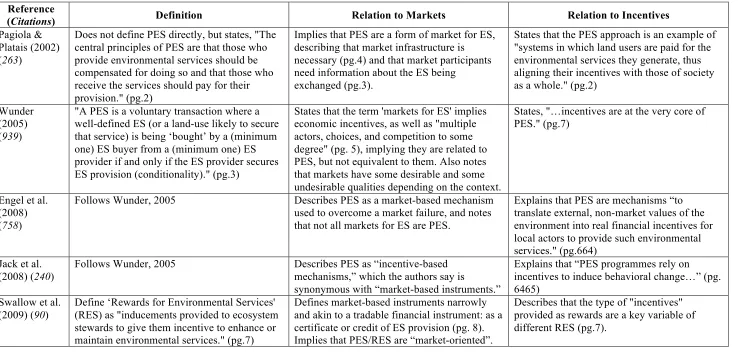
As noted above, PES have most often been described as market-based or market-like mechanisms (Farley & Costanza 2010; Fletcher & Breitling 2012), but it is unclear why this is the case. Table 1 presents how different conceptualisations of PES have defined the relationship of PES to markets. Pagiola & Platais (2002) indirectly describe PES as markets in multiple ways (e.g., there is a need to establish market infrastructure, pg. 4), yet that concept quickly evolved. Wunder & Vargas (2006, pg. 29) state, “Instead of true markets, what we mostly find in the real world—both in developed but especially in developing countries—are bilateral, mutually-negotiated agreements between
ecosystem service users and providers.” Wunder (2005) describes that the term markets for ES (MES) implies the use of economic incentives, as well as "multiple actors, choices, and competition to some degree" (pg. 5), implying they are related to PES, but not equivalent to them.
One resulting interpretation is that MES are a subset or type of PES. Scherr et al. (2006, pg. 5) describe their use of ‘PES’:
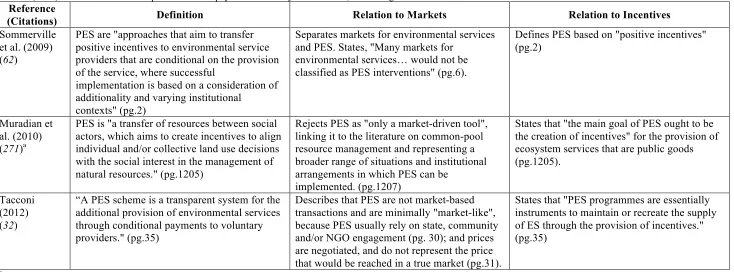
Sommerville et al. (2009) agree with the dichotomy of market-based versus one-off/project-based, framing it in terms of negotiations, and broadly refer to MES as a subcategory of PES.
What has been described as the ecological economics approach to PES describes market and non-market PES (Muradian et al. 2010; Farley & Costanza 2010), and contests that market payment mechanisms are rarely appropriate based on the fundamental
characteristics of ES and the contexts in which PES are implemented (Farley & Costanza 2010). Taking a slightly different approach, others simply state that market PES are rarely observed. Tacconi (2012) explains that PES usually rely on state, community and/or NGO engagement, and prices are negotiated, and do not represent the price that would be reached in a true market. A series of papers diving deeply into PES experiences in a few developing countries find that broadly, even when the original view or conceptualisation of PES in the policy design process was as a market
Table 1: Definitions and conceptualisations of payments for ecosystem services, with Google Scholar citation counts as of 29 December 2013. Reference
(Citations) Definition Relation to Markets Relation to Incentives
Pagiola & Platais (2002) (263)
Does not define PES directly, but states, "The central principles of PES are that those who provide environmental services should be compensated for doing so and that those who receive the services should pay for their provision." (pg.2)
Implies that PES are a form of market for ES, describing that market infrastructure is necessary (pg.4) and that market participants need information about the ES being
exchanged (pg.3).
States that the PES approach is an example of "systems in which land users are paid for the environmental services they generate, thus aligning their incentives with those of society as a whole." (pg.2)
Wunder (2005) (939)
"A PES is a voluntary transaction where a well-defined ES (or a land-use likely to secure that service) is being ‘bought’ by a (minimum one) ES buyer from a (minimum one) ES provider if and only if the ES provider secures ES provision (conditionality)." (pg.3)
States that the term 'markets for ES' implies economic incentives, as well as "multiple actors, choices, and competition to some degree" (pg. 5), implying they are related to PES, but not equivalent to them. Also notes that markets have some desirable and some undesirable qualities depending on the context.
States, "…incentives are at the very core of PES." (pg.7)
Engel et al. (2008) (758)
Follows Wunder, 2005 Describes PES as a market-based mechanism used to overcome a market failure, and notes that not all markets for ES are PES.
Explains that PES are mechanisms “to translate external, non-market values of the environment into real financial incentives for local actors to provide such environmental services." (pg.664)
Jack et al. (2008) (240)
Follows Wunder, 2005 Describes PES as “incentive-based mechanisms,” which the authors say is
synonymous with “market-based instruments.”
Explains that “PES programmes rely on incentives to induce behavioral change…” (pg. 6465)
Swallow et al. (2009) (90)
Define ‘Rewards for Environmental Services' (RES) as "inducements provided to ecosystem stewards to give them incentive to enhance or maintain environmental services." (pg.7)
Defines market-based instruments narrowly and akin to a tradable financial instrument: as a certificate or credit of ES provision (pg. 8). Implies that PES/RES are “market-oriented”.
Table 1 (cont.): Definitions and conceptualisations of payments for ecosystem services, with Google Scholar citation counts as of 29 December 2013. Reference
(Citations) Definition Relation to Markets Relation to Incentives
Sommerville et al. (2009) (62)
PES are "approaches that aim to transfer positive incentives to environmental service providers that are conditional on the provision of the service, where successful
implementation is based on a consideration of additionality and varying institutional
contexts" (pg.2)
Separates markets for environmental services and PES. States, "Many markets for
environmental services… would not be classified as PES interventions" (pg.6).
Defines PES based on "positive incentives" (pg.2)
Muradian et al. (2010) (271)a
PES is "a transfer of resources between social actors, which aims to create incentives to align individual and/or collective land use decisions with the social interest in the management of natural resources." (pg.1205)
Rejects PES as "only a market-driven tool", linking it to the literature on common-pool resource management and representing a broader range of situations and institutional arrangements in which PES can be
implemented. (pg.1207)
States that "the main goal of PES ought to be the creation of incentives" for the provision of ecosystem services that are public goods (pg.1205).
Tacconi (2012) (32)
“A PES scheme is a transparent system for the additional provision of environmental services through conditional payments to voluntary providers." (pg.35)
Describes that PES are not market-based transactions and are minimally "market-like", because PES usually rely on state, community and/or NGO engagement (pg. 30); and prices are negotiated, and do not represent the price that would be reached in a true market (pg.31).
States that "PES programmes are essentially instruments to maintain or recreate the supply of ES through the provision of incentives." (pg.35)
[image:33.842.58.792.124.396.2]
2.2.3. PES are supply-side incentives
Although there are different conceptualisations of PES, there are many similarities among them. For example, Tacconi (2012) describes the environmental economics and ecological economics approaches as the two broadest and most directly competing approaches to PES, but also explains there is notable overlap between the two. The one crucial consistency across all points of view, including these two approaches, is that incentives are the core of all PES programmes (Table 1).
The environmental and ecological approaches have strong agreement on this point. From papers characterised as promoting the environmental economics approach, Wunder (2005, pg. 7) states, “incentives are at the very core of PES.” Similarly, Engel et al. (2008, pg. 664) explain, PES are “a mechanism to translate external, non-market values of the environment into real financial incentives for local actors to provide such [environmental] services.” The ecological economics approach agrees significantly. Muradian et al. (2010), who critiqued other aspects of the environmental economics approach, state, “the main goal of PES ought to be the creation of incentives” for the provision of ES that are public goods (pg. 1205). In an attempt to reconcile the two approaches, Tacconi (2012, pg. 35) states, “PES programmes are essentially instruments to maintain or recreate the supply of ES through the provision of incentives.”
Through the evolving discourse and experience with PES, it has emerged that not only are PES incentives, but specifically they are most commonly viewed as supply-side incentives, and PES programmes are a supply-side innovation. Wunder (2008) explains two arguments for why PES are innovative. The first is that it is a supply-side
receiving the ES being provided, such as offsetting their own negative influence on the level of ES. The key consistency on incentives across the Coaseian, Pigouvian, and all other approaches, is that positive incentives are given to the provider of ES. Simply, the heart of PES is not that the user pays; it is that the provider gets. That is borne out in practice, where the Pigouvian approach, which is focussed on the supply-side, is the most prevalent, followed by programmes that are neither Pigouvian nor Coaseian. Coaseian-type programmes, which have the largest correlation to the user pays concept, represent the smallest category of PES programmes (Schomers & Matzdorf, in press).
To clarify, users are still the most prevalent financiers of PES programmes, but they do not provide funding to all PES programmes, and so a definition of PES aiming to be inclusive of the majority of programmes in existence cannot be defined as user pays. Martin-Ortega et al. (2012) reviewed 40 payments for watershed services (PWS) programmes in Latin America and found that around 60% of them included financing from water users. Similarly, in the study of 120 PWS programmes presented in Chapter 4, 65% of programmes received funding from direct beneficiaries of the ES, but only 42% received user financing exclusively. At the same time, 56% received funds from a public entity’s general budget.
Sommerville et al. (2009, pg. 3) recognise that the provider-gets aspect is the defining characteristic of PES and explain, “The use of positive incentives [to the ES provider], including (but not limited to) payments, is the core ideology of PES.” Fisher et al. (2010, pg. 1253) also implicitly recognise this, stating, PES are “an important
mechanism for linking conservation outcomes to market-based incentive approaches” (emphasis added). Further evidence is found in the fact that while the term ‘payments’ can indicate a link between a user and provider, suggested alternate terms for PES are rewards, compensation, benefits, or (positive) incentives, all terms that are more supply-side orientated.
2.3. Defining PES as Positive Incentives 2.3.1. Definition and conceptualisation
conceptualisation of PES as positive incentives for ES is presented here that is used throughout the remainder of this Ph.D.. The definition put forward most closely resembles that from Sommerville et al. (2009), which has a strong focus on positive incentives, but here it is streamlined and followed by a slightly different
conceptualisation.
For the purposes of this Ph.D., PES are defined as: 1. Positive, and
2. (at least somewhat) conditional, 3. incentives intended to motivate
4. socially preferred behaviour related to the environment.
The term ‘incentive’ in this case is used as a broad term that includes payments, subsidies, rewards, compensation, remuneration or any other transfer of resources that would induce a land user to provide ES (see Wunder 2005 and Swallow 2009 for descriptions of payments, rewards and compensation). The definition does not go so far as to rename PES as positive incentives for ecosystem services—PIES—although an argument could be made to do so. Although there are connotations associated with the term ‘payment’ that may make it more restrictive than the term ‘incentive’, it is also a fairly generic term for a positive and conditional incentive and is the most widely used in the literature. For these reasons, the term PES will continue to be used, but defined as a class of positive incentives broader than just financial incentives, and so the term ‘incentivising’ will be preferred over ‘paying’ ES providers. Further, PES are
specifically positive incentives, which is in contrast to negative incentives such as fees or charges that may also be used to induce socially preferred behaviour related to the environment.
Muradian et al. (2010) and Tacconi (2012) explicitly reserve the term ‘PES’ for the incentive, using the term ‘PES programme’ to describe the broader policy and
institutional structure through which that incentive is provided. The same will be done here, meaning a ‘PES’ is an incentive and a ‘PES programme’ could be referred to as an incentive-based mechanism.
around the world. Additionally, although beneficiaries of ES can provide funding, PES are not defined by the user paying. Incentives may be funded voluntary and transferred directly from an ES beneficiary to provider, they may be funded through taxation and be paid by the government to land-users, or they may be funded through a number of other mechanisms and transferred through a variety of institutional arrangements. The key is that PES are the incentives delivered to ES providers, which can occur through many different types of mechanism or institutional structure, and so PES are defined as provider gets (Figure 2).
Figure 2: PES in the policy framework. Based on Parker et al. (2012). Public and civil organisations are grouped together as public-good providers.
The visual representation of this conceptualisation (Figure 2) has actors and institutions in boxes, and transfers of resources represented by arrows. The transfer from ES buyers to the central institutional arrangements can occur through a number of different
fundraising mechanisms, such as voluntary payments, pollution charges, resources taxes, budget appropriations, and more. The figure then represents the observation that the majority of PES are provided through an intermediary institution, such as an organisation, trust, bank, or market. That creates a degree of separation between the payer and the ES provider. In some cases, although the minority of what is observed globally, the payer may bypass the intermediary institution and directly incentivise the provider (which is why the intermediary institution is represented with a dashed box). In other cases there may be multiple intermediaries, for example, a farmer receives
That also clarifies the relationship of PES to markets. As described by Fisher et al. (2010), PES can link a MBI to an environmental outcome. For example, forest users may sell land-based carbon credits onto voluntary carbon markets (potentially via another intermediary aggregating farmers’ carbon credits), or water quality trading between point-source polluters may permit those polluters to purchase credits generated by farmers reducing their own pollution. At present, however, very few true markets for ES exist.
The conceptualisation of PES as incentives is important because not recognising the agreement that PES are incentives permits the policy discourse to be driven by more ideological stances on the role of markets and inaccurate or inappropriate comparisons between different policy tools. Losing this focus on incentives is also detrimental to ensuring that PES are optimally designed and implemented, however and wherever in the world they are used. These two issues are now addressed in turn.
2.3.2. Considering PES in policy design
The shift from defining PES programmes as market-based mechanisms to incentive-based mechanisms may appear a semantic discussion on the surface, but that delineation is tangibly important for the policy discourse in two ways.
First, the delineation mitigates an ideological conflict. Based on the prolific early framing of PES as a market-based mechanism by practitioners and academics, policy makers also viewed PES programmes as market-based mechanisms. That placed PES distinctly in the realm of neoliberal policies and means that there is an ideological conflict about the use of PES, just as there is an ideological conflict about neoliberal policies generally, particularly in many developing countries.
A clear example of this phenomenon is in the text of the United Nations (UN)
Convention on Biological Diversity (CBD). At the start of the 10th Conference of the Parties to the CBD in 2010, PES were included in the draft text related to resource mobilization as one of six innovative financial mechanisms (Cranford & Parker 2010). Reference of innovative financial mechanisms was drastically reduced in the final text,5 and the list of specific mechanisms that included PES was dropped, in part due to a push