Three Essays on International Trade,
Foreign Influence, and Institutions
Roberto Bonfatti
A thesis submitted to the Department of Economics
of the London School of Economics and Political Science
for the Degree of Doctor of Philosophy
UMI Number: U615314
All rights reserved
INFORMATION TO ALL USERS
The quality of this reproduction is dependent upon the quality of the copy submitted. In the unlikely event that the author did not send a complete manuscript and there are missing pages, these will be noted. Also, if material had to be removed,
a note will indicate the deletion.
Dissertation Publishing
UMI U615314
Published by ProQuest LLC 2014. Copyright in the Dissertation held by the Author. Microform Edition © ProQuest LLC.
All rights reserved. This work is protected against unauthorized copying under Title 17, United States Code.
ProQuest LLC
D e c la ra tio n
I certify th at the thesis I have presented for examination for the M Phil/PhD degree of the London School of Economics and Political Science is solely my own work other than where I have clearly indicated th a t it is the work of others (in which case the extent of any work carried out jointly by me and any other person is clearly identified in it).
The copyright of this thesis rests with the author. Quotation from it is permitted, provided that full acknowledgement is made. This thesis may not be reproduced without the prior written consent of the author.
I warrant th a t this authorization does not, to the best of my belief, in fringe the rights of any third party.
A cknow ledgm ents
I am deeply indebted to Tim Besley and Robin Burgess for their invalu able help and assistance over the years. I can now appreciate how long the route between my first days at LSE and this moment was. Their assistance during the years was essential to keep me on track, and taught me so much about how to do research in economics.
I would like to thank all STICERD members and visitors who contributed to making my period a t LSE very fruitful and stimulating indeed, and some of my new colleagues in Oxford. Special thanks go to Leila Alberici, Radu Ban, Oriana Bandiera, Francesca Bastagli, Robert Bates, Erlend Berg, Sue Coles, Jane Dickson, Dave Donaldson, Maitreesh Ghatak, Anisha Ghosh, Torfinn Harding, Rocco Macchiavello, Guy Michaels, Gerard Padro-i-Miquel, Ameet Morjaria, Peter Neary, N athan Nunn, Torsten Persson, Ronny Razin, Steve Redding, James Robinson, Angela Swain and Tony Venables. I bene fited from the helpful comments of seminar participants in Barcelona, Berlin, Cambridge, Essex, LSE, Lucca, Naples, Oxford, Padova, Paris and Rome.
Financial support from the Ente Einaudi, the Economic and Social Re search Council, the London School of Economics and Political Science, the Royal Economic Society and St John’s College is gratefully acknowledged.
On a more personal note, I am deeply grateful to my parents, my brother, and a precious bunch of ever-lasting friends. They all contributed their fair bit to the completion of this thesis. Of course, a very special thank goes to Lucia, whose day-to-day love and support has been a key ingredient of my work.
A b stract
This thesis is about the link between international trade (and the eco nomic fundamentals th a t determine it) and a country’s economic power. In C hapter 1 and 2, I define economic power as the capacity to impose - at
little enough cost - harmful trade sanctions on other countries. I study how a “strong” country can use its economic power to influence policy and insti tutional change in a “weak” country. This foreign influence interacts heavily with domestic politics in Chapter 1. Here, I study how an incumbent elite
C ontents
1 Foreign Influence and the Cold War H istory of Dem ocracy
in Latin America 10
1.1 In tro d u c tio n ... 11
1.2 Stylized facts and key q u e s tio n s ... 16
1.2.1 Historical background ... 16
1.2.2 US influence and the Cold-War history of democracy in Latin A m e r ic a ... 19
1.2.3 Three key questions... 22
1.3 Model ... 24
1.3.1 Domestic economy and politics ... 25
1.3.2 International economy and p o l i t i c s ... 28
1.3.3 Expropriation and sanctions: a reputation game . . . . 30
1.3.4 T im in g ...31
1.3.5 E q u ilib riu m ... 32
1:3.6 Predictions ... 48
1.3.7 Welfare ... 51
1.5 Case S tu d ie s ... 58
1.5.1 C u b a ...58
1.5.2 C h ile ...63
1.5.3 V e n e z u e la ... 71
1.6 C o n c lu sio n s... 77
1.7 A p p e n d i x ... 80
2 Decolonization: the Role o f Changing World Factor Endow m ents 99 2.1 In tro d u c tio n ... 100
2.2 Colonialism, trade and e x tr a c tio n ... 104
2.3 The m o d e l...110
2.3.1 Economic model ... I l l 2.3.2 Political M o d e l ...118
2.3.3 E q u ilib riu m ... 122
2.4 Historical E v id e n c e ...132
2.4.1 The American Revolution and the Seven Years’ War: the Link R e c o n s id e re d ...133
2.4.2 The Spanish Empire: Decadence, Revival and Fall, 1590-1810 ... 141
2.4.3 Self-Governing Colonies: the case of Canada and Aus tralia ...149
2.5 C o n c lu sio n s... 167
3 Foreign Influence and the International Trade in N atural R e
sources 182
3.1 In tro d u c tio n ... 183
3.2 Structure of the international oil market and oil diplomacy . . 187
3.3 M o d e l ... 189
3.3.1 A three-country trade m o d e l... 189
3.3.2 Equilibrium trade p o l i c y ... 194
3.3.3 Long-term c o n t r a c t s ... 196
3.3.4 Oil d ip lo m a c y ...199
3.4 Equilibrium & W e lf a r e ... 200
3.4.1 Oil contracts and optimal trade p o l i c y ... 201
3.4.2 Oil diplomacy and the allocation of oil contracts . . . . 207
3.4.3 Welfare ... 219
3.5 D iscu ssio n ... 222
3.6 C onclusion...225
List o f Figures
1 .1 CIA interventions and democracy in Latin America, 1945-1989 2 2
1.2 Democracy in Chile, 1945-1989... ... 67
1.3 Democracy in Venezuela, 1945-1989 ... 71
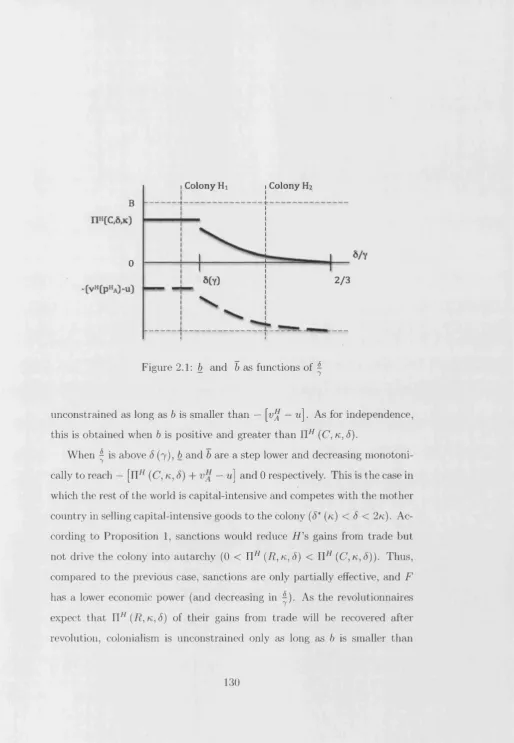
2.1 b and b as functions of ^ ...130
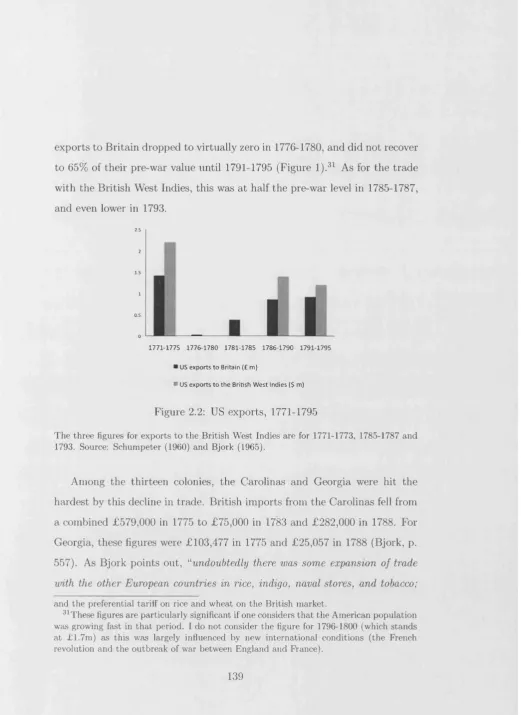
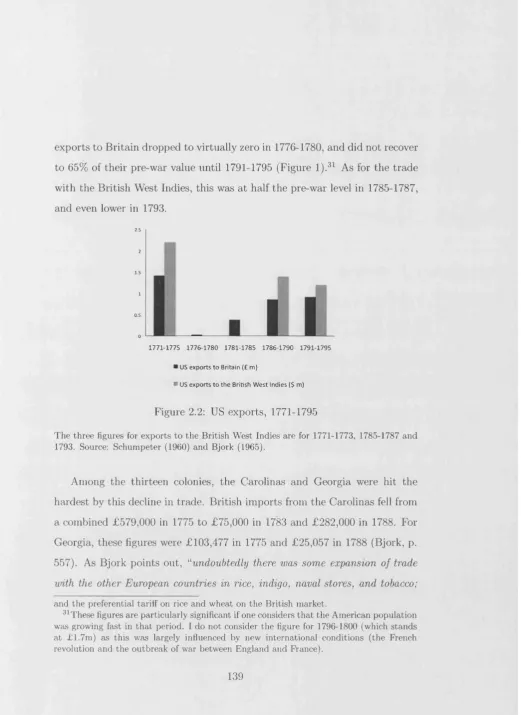
2 .2 US exports, 1771-1795 ... 139
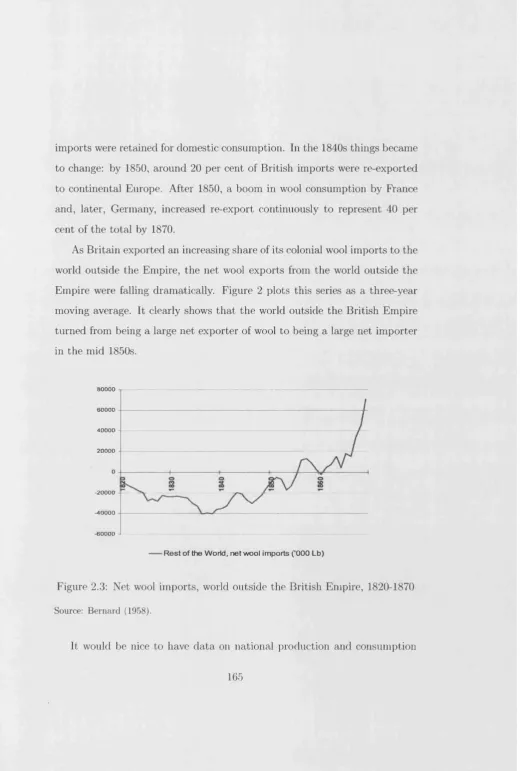
2.3 Net wool imports, world outside the British Empire, 1820-1870 165 3.1 Possible values of yA and y B...193
3.2 Illustration of Lemma 1 205 3.3 Illustration of Proposition 3 ... 213
3.4 Illustration of Proposition 4 ... 217
3.5 Aid p a i d ... 218
C hapter 1
Foreign Influence and th e Cold
War H istory o f D em ocracy in
Latin A m erica
The recent political economy literature on regime change and non-democratic
politics has not paid enough attention to the role of foreign influence. I look
at the Cold War history of democracy in Latin America and construct a the
ory of power allocation in the presence of foreign influence. In this theory,
the outcome of a distributional conflict between an incumbent group and
a challenger is altered by the capacity of the incumbent to obtain external
support from a key trading partner. This capacity is grounded in the incum
bent larger exposure to the international economy, which makes him easier
to control from the exterior, using th e threat of trade sanctions. I also allow
for the possibility th a t there is international competition for the geopolitical
is determined by economic or political self-interest. I argue th a t this theory
can help understand the Cold War history of democracy in Latin America,
but th a t it is useful in a number of other contexts as well.
1.1
Introd u ction
In recent years, the political economy literature has put considerable effort
in studying the economic determinants of regime change and non-democratic
politics. For example, a series of papers have studied the transition to democ
racy in Western Europe and other parts of the World (e.g. Lizzeri and
Persico, 2004; Llevador and Hoxoby, 2005; Acemoglu and Robinson, 2006).
Other work has focused on the allocation of power within weakly institution
alized polities (e.g. Heilman and Wantchekon, 2000; Padro-i-Miquel, 2007).
While some of these papers do consider the effect of changing international
economic conditions on regime change and non-democratic politics (see, for
example, Chapter 10 in Acemoglu and Robinson, 2006), these are normally
seen as shaped by the interaction of domestic players only.1
There is, however, considerable evidence th a t regime change and non-
democratic politics are influenced by foreign interventions as well. Looking
at democratization, for instance, one finds many examples of how the US
supported coups against democracy during the Cold War: to cite but a few,
the coups in Iran (1953), Guatemala (1954), and Chile (1973). T hat Cold
War interventions were largely detrimental to democratization is established
empirically by Easterly, Satyanath, and Berger (2008), who use recently de
classified material to show th a t covert CIA and KGB interventions resulted
in a decline in democracy both in th e short and in the long run. On the
other hand, recent interventions such as the war on Iraq or Afghanistan have
been decisive to the current democratization attem pt in these countries. Nor
do foreign interventions only seem to arbitrate between democracy and au
tocracy: for example, the history of post-colonial Africa is full of instances
in which former colonial powers supported one group or another at the lead
of non-democratic regimes.2 Finally, foreign intervention is not only limited
to full-fledged military operations. For example, M obutu’s long permanence
in power was facilitated by the timely release of economic aid in periods of
economic distress; in today’s Zimbabwe and Sudan, the entrenchment of the
ruling elite is made easier by the diplomatic support th a t these countries
receive from China.
In this paper, I look at the history of US interventions in Latin America
to construct a theory of power allocation in the context of foreign influence.
This theory helps understand the Cold War history of democracy in Latin
America. At the same time, it shed lights on the reasons why, by hindering
th e democratization process, the US went against its long-standing foreign
policy goal of supporting democracy abroad. Finally, while the theory is
based on what were the key determ inants of foreign interventions in Latin
America - the wish to protect and promote foreign investors, and the need
to secure the geopolitical alliance of intervened countries - I argue th a t it is
general enough to be useful in other contexts as well.
The model builds on the distributional conflict between two groups, a po
litical incumbent and a challenger, in the context of a small open economy.
P a rt of the value of this economy relies on a peaceful trade relation with a
large foreign country, and I assume th a t members of the incumbent group
have a higher per capita stake in this part of the economy than members of
the challenging group. International economic relations are shaped by repu
tation: in particular, a large foreign investment position may force the large
country to impose costly sanctions against a government who expropriates.
I construct a simple reputation game, and derive conditions under which the
threat of sanctions becomes credible: when these conditions are met, the
incumbent is blessed with a greater capacity to commit to protecting foreign
rents, relative to the challenger. I add to this picture the international compe
tition between two large countries (the one already mentioned, plus another
one) who both care about the small country’s geopolitical alignment. This is
a choice over which the two groups do not have an intrinsic preference, but
th a t can be used to secure economic support from the second large country.
Thus, a key cost of sanction for the first large country lies in the risk th a t
the sanctioned government ends up in the opponent’s camp.
In this environment, if the large country has the capacity to intervene in
the political life of the small country, the incumbent may want to use foreign
rents strategically, so as to secure some external support. Such support is mo
tivated by the perspective of a conflictual relation between the large country
and a successful challenger: crucially, this conflict is fueled by both economic
nationalism and geopolitical adversity, but this second element is entirely
derive several predictions on the link between the small country’s economic
and political conditions and the capacity of the incumbent to entrench itself
with external support. I argue th a t the theory can help understand why US
foreign policy was largely detrimental to democracy during the Cold War,
in sharp contrast with one of its most long-standing goals. I illustrate this
using a few case studies. I conclude by suggesting th a t the model provides
a good starting point for analyzing these issues in a broader context, as it
lends itself to several simple extensions.
The paper adds to the political economy literature on democratization.
This can be organized into two main strands, one th a t focuses on redistri
bution as a driver for democratization (e.g. Acemoglu and Robinson, 2006),
another th a t postulates th a t it is economically profitable for the ruling group
to share power with a broader sets of citizens, (e.g. Lizzeri and Persico,
2004).3 I borrow the basic structure of the model from papers in the first
group, b u t innovates on these by specifically looking at the case of foreign
influence. To the best of my knowledge, the only paper to have done this
before is Aidt and Albornoz (2009), who adapt the Acemoglu and Robinson
(2006) model to account for foreign interventions. My paper shares one key
element with this paper, namely the incumbent’s advantage in committing
to a better treatm ent for foreign investors. It is however quite different in at
least two im portant respects. First, I present an alternative mechanism for
why the elite cares about foreign investors, one th a t puts trade and reputa
tion at centre stage. Second, while Aidt and Albornoz (2009) only look at
the protection of foreign investors as a motivation for foreign intervention, I
suggest a mechanism th a t relates protection to a broader set of geopolitical
issues. Because of these different modeling choices, the two papers offer sets
of results th a t are largely complementary to each other.
The paper is also related to two very recent strands of literature on foreign
influence. The first is an empirical literature based on declassified CIA and
KGB materials. Beside the above mentioned Easterly et A l (2008) paper,
the two other papers in this literature are Dube, Kaplan, and Naidu (2008)
- who look at the effect of covert CIA interventions on the stock market
performance of companies involved in the intervened country - and Easterly,
Nunn, Satyanath, and Berger (2009), who look at the consequences of CIA
interventions for the intervened country’s trade relations. The second (to
which the paper is more loosely related) is a theoretical literature who studies
the efficiency implications of cross-border lobbying (Endoh, 2005; Aidt and
Hwang, 2008a, 2008b; Antras and Padro, 2009; Bonfatti, 2010).
The paper is organized as follows. Section 2 provides an historical overview
of the case of Latin America and sets out the key questions th a t I want to
address. Section 3 develops the theory. Section 4 uses the theory to provide
a general interpretation of the Latin American case, and to answer the key
questions. Section 5 uses country studies to further illustrate this interpre
1.2
Stylized facts and key questions
I begin by providing some background info on the pre-1945 history of rep
resentative institutions in Latin America, and on the strengthening of US
influence over this period. I then describe how democracy evolved during
the Cold War, and how US influence played a role in this. I conclude by
setting out the key questions th a t my model wants to address.
1.2.1 H isto rica l background
Most Latin American countries established representative institutions during
the course of 19th century. These, however, remained firmly in the hands
of a small elite of landowners and businessmen until the middle of the 2 0th
century. In fact, a series of electoral restrictions prevented the masses from
participating in election (see Hartlyn, 1994). Furthermore, with a few ex
ceptions (such as Chile and Uruguay), these institutions remained very weak
relative to the army, and could therefore be overthrown when they did not
provide sufficient guarantees of social stability.
In the first half of the 20th century, however, the pressure for social
and political change became increasingly strong. On one hand, since the
1890s, labour demonstrations and strikes became widespread. These were
normally put down by the army, leading to violent clashes and bloodshed.
On the other, from the 1920s onwards a large number of new radical parties
were founded (see Angell, 1994), which set out to conquer power through
the elite’s representative institutions. These parties were very diverse in
two common goals: the implementation of domestic redistributive reforms,
and the adoption of a nationalistic stance towards foreign investors, which
they saw as agents of foreign imperialism.
The first half of the 2 0th century was also the period in which the US
became extremely influential in Latin American affairs. This had roots in
the expansion of the US as the leading political and economic power of the
Western hemisphere. On the political side, US supremacy was embedded in
the two key principles leading its foreign policy. The first, established by the
Monroe Doctrine of 1823, stated th a t any attem pt by a European power to
colonize or otherwise interfere with states in the Americas would be taken as
act of hostility by the US government. While challenged a few times in 19th
century, the Monroe doctrine became largely inviolable by the first half of the
20th century (Brzezinski, 1992, p. 39). The second principle was established
by the Roosevelt Corollary to the Monroe Doctrine (1904), and attributed
to the US the right to intervene in the domestic affairs of a Latin American
country where its investments would come under threat.
On the economic side, US influence was first of all the result of its increas
ingly im portant role as Latin America’s trade partner. Since the 1860s, the
Latin American economies relied heavily on the export of agricultural and
mineral commodities or, where industrialization had already taken place, on
imported intermediates and machinery.4 In the first half of the 20th century,
the US displaced Europe as Latin America’s main trading partner, getting
to absorb more th an 50% of the trade of many countries by the early 1950s.5
This made it very influential with the local elite, who controlled a large share
of the land farmed for export agriculture and looked to foreign markets for
its consumption patterns (see, for example, Feinberg, 1974, p. 31). The US
also became the region’s leading supplier of private capital: following to two
periods of buoyant growth (1914-1929 and 1945-1960) the stock of US FDI
grew to US$ 8.8bn by 1960, or almost 40% of all US direct investments out
side North America.6 In many countries, US investments came to dominate
the local economy, expanding not only in agriculture and mining but also
in manufacturing and utilities. Finally, the US became a leading source of
intergovernmental loans and aid.
In the first three decades of the century, the US intervened militarily
in a number of Central American and Caribbean countries, to protect its
investments along the lines of the Roosevelt Corollary7. Sometimes, these
interventions were simply directed at physically protecting American invest
ments during political turmoil. More often, however, the US participated
actively in putting down rebellions, helping the local elite to m aintain polit
ical stability. This pattern of interventionism came to a halt with the onset
of the Great Depression, as the inflow of American investments virtually
stopped and the Roosevelt Corollary was substituted by (Franklin D.) Roo
5For example, the average share of the US in total exports and imports in 1950-1954 was 61% and 76% in Cuba, 66% and 45% in Ecuador, 26% and 56% in Venezuela, and 50% and 55% in Chile (Mitchell, 1989.)
6This share is much lower today (around 20%). Source: Historical Statistics of the United States, Millennial Edition on line.
sevelt’s “Good Neighbor Policy” . This was just a tem porary interruption,
though.
1.2.2
U S in flu en ce and th e C old-W ar h isto ry o f d em o c
racy in L atin A m erica
After 1945, two key political developments took place. On one hand, the new
reformist parties managed to push through electoral reforms th a t greatly in
creased voter turnout in most Latin American countries (Hartlyn, 1994, pp.
130-131), and political mobilization increased dramatically. In several coun
tries, the reformists were able to go to power after obtaining an electoral vic
tory: this was for example the case of Guatemala (1945), Venezuela (1944),
Costa Rica (1948) and Bolivia (1952). Because of the economic national
ism of the reformist parties, this increased electoral competition brought
fresh uncertainty for American investors, and renewed tension with the US
government. In Guatemala, for example, American land holdings were ex
propriated with little compensation. In Venezuela, the government took a
series of landmark measures th a t reduced the privileges of the American oil
companies.
On the other hand, the Cold War created a second key tension between
the reformist parties and the US government. Initially, the Cold War touched
Latin America only marginally, as the key front was Europe and the death
of Stalin (1953) put the USSR on the defensive for a few years. W ith the
advent of Khrushchev (1958), however, a distinctively new phase started, one
in which “Eurasia was still the central stake but no longer the central front” ,
by encirclement” , (Brzezinski, 1992, p. 38). In this crucial phase - which
lasted until about 1979, when the USSR shifted its attention to Afghanistan
and Eastern Europe, as well as to internal problems - superpower competition
had a significant impact on political evolutions in Latin America.
As p art of its plan to “encircle” the West, the USSR launched a large-
scale effort to secure alliances in the region. This included the strengthening
of ties with communist parties and guerrilla groups, as well as the provision
of economic support to governments th a t rejected American influence. Just
how dangerous this could be for US geopolitical interests became soon clear:
within three years from the Cuban Revolution (1959) - and one year since
Castro had completely nationalized American investments in the island -
Soviet ballistic missiles were installed at a short distance from US territory,
sparking one of the most dangerous crises of the entire Cold War. Crucially,
Soviet activism increased the American diffidence for many reformist leaders
with radical views. W hether they were communist or not, these came to
be seen as not only a threat to American investors, but also a geopolitical
threat.
As its economic and geopolitical interests came under threat, the US
intervened a large number of times to tilt the local political balance in fa
vor of conservative/centrist governments. This p attern of interventionism
intensified markedly in the 1960s and 1970s, when Cold War competition
was at its highest. Among the intervention tools used were aid paid to con
servative/centrist governments, trade or aid sanctions against radical gov
ernments, and covert CIA interventions to influence the results of elections,
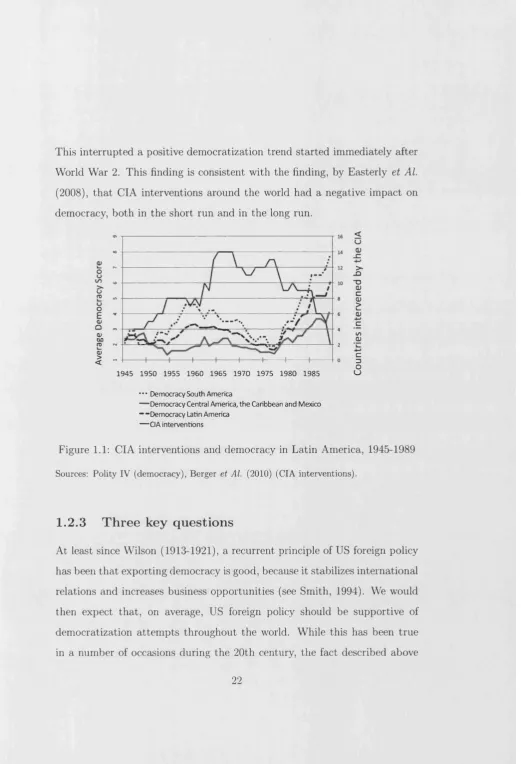
This interrupted a positive democratization trend started immediately after
World War 2. This finding is consistent with the finding, by Easterly et A l
(2008), th at CIA interventions around the world had a negative impact on
democracy, both in the short run and in the long run.
o o TO o £ <u Q (V CUD TO i_ (U > < os *■4 < U CD X 4-» > • XI T 3 CD C CD £ CD 4-> c l/l CD C 3 o o
1945 1950 1955 1960 1965 1970 1975 1980 1985
• • • Democracy South America
“ “ Democracy Central America, th e Caribbean and Mexico ~ “ Democracy Latin America
— CIA interventions
Figure 1.1: CIA interventions and democracy in Latin America, 1945-1989
Sources: Polity IV (democracy), Berger et Al. (2010) (CIA interventions).
1.2.3
T hree key q uestions
At least since Wilson (1913-1921), a recurrent principle of US foreign policy
has been that exporting democracy is good, because it stabilizes international
relations and increases business opportunities (see Smith, 1994). We would
then expect that, on average, US foreign policy should be supportive of
democratization attem pts throughout the world. While this has been true
in a number of occasions during the 20th century, the fact described above
[image:23.595.25.547.24.789.2]radical reformist parties were electorally quite successful, these interventions
went systematically against the consolidation of democracy. The most strik
ing examples of this are the coups in Guatem ala (1954) and Chile (1973). On
the wake of American interventionism, the 1960s and 1970s witnessed a broad
reversal of the pattern of democratization th a t had started after the war. The
only three marked exceptions8 to this were Costa Rica, where democracy was
in place since 1946, and Colombia and Venezuela, which became relatively
democratic in the early 1960s and remained steadily so through the rest of
the Cold War.
The p attern of US interventionism in Latin America is illustrated in the
following figure, which reports the CIA intervention measure constructed by
Easterly et Al. (2010). The authors use recently declassified CIA material
to construct an indicator variable th a t equals one in all country-year obser
vations where the CIA either installed or supported the leader of a foreign
country in office.9 In the figure, I report the number of Latin American
countries where this variable is one in any given year. The series clearly
shows th a t the number of interventions jum ped up after 1960, to fall sig
nificantly only towards the end of the 1970s. The figure also reports the
average Polity IV democracy score for all Latin American countries. This
is a variable th a t takes value between 0 and 1 0, where 0 is least democratic
and 10 is most democratic. Particularly for the case of South America, the
series confirms th a t the intensification of US interventionism in the 1960s
and 1970s was matched by a sharp decline in the average level of democracy.
8Excluding Jamaica, who remained a British colony until 1962.
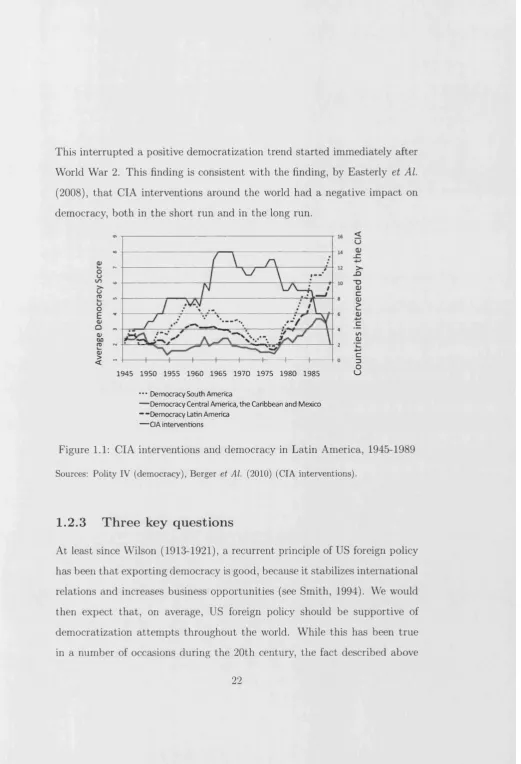
This interrupted a positive democratization trend started immediately after
World War 2. This finding is consistent with the finding, by Easterly et Al.
(2008), th at CIA interventions around the world had a negative impact on
democracy, both in the short run and in the long run.
o o TO o £ <u Q (V CUD TO i_ (U > < os *■4 < U CD X 4-» > • XI T 3 CD C CD £ CD 4-> c l/l CD C 3 o o
1945 1950 1955 1960 1965 1970 1975 1980 1985
• • • Democracy South America
“ “ Democracy Central America, th e Caribbean and Mexico ~ “ Democracy Latin America
— CIA interventions
Figure 1.1: CIA interventions and democracy in Latin America, 1945-1989
Sources: Polity IV (democracy), Berger et Al. (2010) (CIA interventions).
1.2.3
T hree key q uestions
At least since Wilson (1913-1921), a recurrent principle of US foreign policy
has been that exporting democracy is good, because it stabilizes international
relations and increases business opportunities (see Smith, 1994). We would
then expect that, on average, US foreign policy should be supportive of
democratization attem pts throughout the world. While this has been true
in a number of occasions during the 20th century, the fact described above
[image:25.595.25.547.24.789.2]suggest th a t the US went systematically against the democratization of Latin
America in the 1960s and 1970s. The basic question th a t we need to address
is then why was this so? In other words, why was democracy a threat to US
interests in those specific circumstances?
At some level, it is clear from our previous discussion th a t economic
nationalism had a key role. Because this happened to be very strong with
the radical parties th a t were likely to dominate elections, democracy was
a direct th reat to American investments in Latin America. But this takes
us to our first key question: was it just accidental th a t the radicals were
so more nationalistic than the elite, or was this related to the underlying
democratization process? And more in general, under what conditions can we
expect democracy to lead to nationalistic policies against foreign investors?
Our previous discussion also highlighted the role of the Cold War. Namely,
the radical parties were seen as more likely to switch side to the Soviet Union,
implying a large geopolitical cost for the US. This explanation is consistent
with the fact th a t American interventionism was most intense - and the fate
of democracy bleakest - when Cold War competition was strongest (Figure
1). But then a second key question is: why were the radical parties less
willing to (or able) to sign up for a geopolitical alliance with the US? After
all, both proximity and for economic complementarity seemed to make this a
natural alliance. Notice th a t ideology is all but a satisfactory answer: many
of the most successful reformist parties where not communist, nor did they
entertain close ties with Moscow (Angell, 1994). In fact, many of them were
opposed to communism in the 1960s and 1970s.
detri-suggest th a t the US went systematically against the democratization of Latin
America in the 1960s and 1970s. The basic question th a t we need to address
is then why was this so? In other words, why was democracy a threat to US
interests in those specific circumstances?
At some level, it is clear from our previous discussion th a t economic
nationalism had a key role. Because this happened to be very strong with
the radical parties th a t were likely to dominate elections, democracy was
a direct th reat to American investments in Latin America. But this takes
us to our first key question: was it just accidental th a t the radicals were
so more nationalistic than the elite, or was this related to the underlying
democratization process? And more in general, under what conditions can we
expect democracy to lead to nationalistic policies against foreign investors?
Our previous discussion also highlighted the role of the Cold War. Namely,
the radical parties were seen as more likely to switch side to the Soviet Union,
implying a large geopolitical cost for the US. This explanation is consistent
with the fact th a t American interventionism was most intense - and the fate
of democracy bleakest - when Cold War competition was strongest (Figure
1). But then a second key question is: why were the radical parties less
willing to (or able) to sign up for a geopolitical alliance with the US? After
all, both proximity and for economic complementarity seemed to make this a
natural alliance. Notice th a t ideology is all but a satisfactory answer: many
of the most successful reformist parties where not communist, nor did they
entertain close ties with Moscow (Angell, 1994). In fact, many of them were
opposed to communism in the 1960s and 1970s.
mental to democracy, we have mentioned a few exceptions. In Colombia,
Venezuela and Costa Rica, US foreign policy actively supported the consoli
dation of democracy. In the case of Venezuela, this was despite the nation
alism of the key reformist party (Alianza Democratica) which led in 1976
to the nationalization (with little compensation) of the American oil com
panies. My final question is then: what explains the different experience of
these countries?
In the next question, I set up a model th a t will help us interpret the facts
described in this section, and provide an answer to these questions.
1.3
M od el
The section is organized as follows. I begin by modeling a distributional
conflict between an incumbent group and a challenger in a small open econ
omy (3.1). I then introduce the possibility th a t the incumbent may exchange
rents to foreign investors for protection from the government of a large trad
ing partner, who may also be competing with a second large country for
geo-political predominance in the area (3.2). Crucially, the actions of the
trading partner are constrained by the need to preserve a reputation of in
transigence towards expropriation (3.3). After summarizing the timing of the
model (3.4), I solve for the equilibrium (3.5), and conduct some comparative
statics (3.6). I conclude the section by looking at the welfare consequences
1.3.1
D o m e stic eco n o m y and p o litic s
There is a small country, Home (H), which is populated by a continuum of
citizens with mass 1. The economy of this country is such th a t it generates
aggregate (transferable) utility Y + Y* for its citizens. While Y is not af
fected by the country’s external relations ( “autarchy utility” ), Y* relies on
a peaceful relations with two large trade partners, A and B ( “gains from
trade”). I normalize Y* to 1.
Citizens are split into two groups, called a and b. The two groups have
mass 5 and 1 — 5 respectively. W ithin each group, citizens are identical.
In the aggregate, the two groups initially own Ya and Yb of autarchy utility
(thus, Ya + Yb = Y ), while trade utility is entirely owned by group a. Thus,
group a is more ’’outward-oriented” than group b.10
Initially, group a is in power. However group b can overthrow a a t a
stochastic, aggregate cost /i. The cost /i is distributed as a uniform over
the interval [0, M], with M high enough (so th a t there is always a positive
probability th a t a is overthrown). This cost does not depend on any other
param eter in the model (but notice th a t I always keep the size of the economy
constant at Y + 1 ). If 6 goes to power, it can change policy in such a way th a t
a looses X < Y a of its autarchy utility, and its entire trade utility.11 This
results in a gain + 1) for b, where 7 E (0,1) captures the distortions
associated with redistribution. Notice th a t even for 7 very close to 1, there
is an amount Ya — X of a ’s autarchy utility th a t is non appropriable by b.
10To assume that group b owns a share of Y* does not change qualitatively the results of the model.
This could reflect, for example, the existence of non-excludable public goods.
Before the cost of revolution is realized and b decides whether to overthrow
a or not, a may decide to award rents R to investors from A. These have an
equal cost for all citizens. For example, mineral concessions may be granted
to companies from A a t excessively favorable terms, therefore decreasing the
public funds available for financing various public goods. Alternatively, com
panies from A may be favored in the allocation of various public contracts,
from the management of utilities to the procurement of various government
purchases. More in general, the government may discriminate in favor of A ’s
companies or goods, therefore creating a loss from reduced competition th a t
is widely spread across the economy.
After rents have been allocated, the cost of revolution realizes. Before b
makes a decision on whether to overthrow a or not, A may decide to intervene
to hinder 6’s ascent or consolidation into power. The most intuitive way to
think about this is direct military help to the ruling government. However
A ’s intervention may also take the form of economic assistance, for example
a loans in the middle of a crisis. I assume th a t if A invests c to this purpose,
the cost of revolution increases to fi + c.
After a revolution decision has been made, whoever is in power may decide
to expropriate A by imposing a tax r on R. For simplicity, I assume th a t r
is non distortionary, and th a t it can only take value 0 (no expropriation) or
1 (expropriation).
Assume th a t citizens within each group are identical. Then, if rents R
have been granted, the per capita utility of the two groups in the two political
Va(a) = Y “^ 1 - -R[l - T(a)]
Vb(a) = T 3 7 ~ ^I1 _ r(“)l
Va(b) = Y° s X - fl[l - t(6)]
yb(b) =
y*+7(-y+ij-/*-c _ B[1 _
t(6)]Where yi(j) denotes the per capita utility of a citizen from group i when
group j is in power, and r ( j) is the expropriation level chosen by group j
when in power.
The ex-ante (per capita) welfare of the two groups is:
= (1 - IT) - R[r(b) - r ( a ) ] ) + ya(b) (1.1)
w h = * ( t - V ~~ ~ + y«(a ) ( L2)
where ir is the (endogenous) probability th at b overthrows a. Before
proceeding, I make the following key assumption:
7 1
S >
1 - 5
Assumption 1 requires th a t a successful challenger group has a lower per
capita trade utility than the incumbent group had when in power. This could
be the case for two reasons: first, group a may be much smaller than group b
(8 low), so th a t the importance of trade utility gets diluted upon bJs advent
to power, despite the fact th a t trade utility is fully re-distributed. Second,
trade utility could be very inefficient to redistribute, so th a t not much is left
for b to care about ( 7 low). Both reasons may be valid in the case of Latin
America in the 1950s and 1960s. There, on one hand, the value of export
crops was largely captured by a handful of landed elite, as was the gain from
consumption of luxury import goods; on the other hand, the new industrial
sector - th a t relied on imported intermediates - was probably quite hard to
expropriate.
1.3.2
In tern a tio n a l eco n o m y and p o litics
The world outside H is made up of two large countries (A and B ). As
mentioned above, a can affect A ’s payoff by awarding it rents R. After the
revolution decision is made, however, whoever is in power may decide to re-
appropriate A ’s rents. At the same time, however, A can impose economic
sanctions against H , therefore destroying its trade utility. Thus, sanctions
have a cost 1 for H . They also have a cost (3 > 0 for A.
H can affect the two large countries’ payoffs by choosing its geopolitical
alignment a. This is chosen after the expropriation and sanctions decision,
and can be set to a = A (when H allies itself to A), or to cr = if (when it
allies with B ). The payoffs to A (B ) in the two cases are S and 0 (0 and S)
where S is the strategic value of if . I assume th a t the alignment decision
has no impact on i f ’s payoff.
When A imposes sanctions against if, B can alleviate their cost by 1 — (f),
where <j> £ [0,1]. Thus, by resorting to B, i f can reduce the cost of sanctions
to (f). For simplicity, I assume th a t B can alleviate sanctions at no benefit nor
cost. I also assume th a t for B to be willing to alleviate the cost of sanctions,
i f must set a = B . When sanctions are not imposed, on the contrary, the
choice of a has no effect on i f ’s payoff. There are at least two ways in
which this assumption could be justified. First, it could be th a t i f auctions
off its geopolitical alignment to the highest bidder. In such an auction, no
bidder could outbid the other when sanctions are not imposed, bu t B would
certainly outbid A when sanctions are imposed. This is because B would
be in the position of alleviating sanctions at no cost. Alternatively, it could
be th a t the th reat of sanction itself is w hat induces H to aligns itself with
A, in th a t this latter country has a higher capacity th an B to create trade
disruption in H . Once this capacity has been used, however, B would always
have the upper hand, by using the threat of not mitigating sanctions.
W A = I (a = A ) S + (1 - t)R - I(T = 1) ( 3 - c
WB = I(<j = B ) S ■
(1.3) (1.4)
Where T takes value 1 if sanctions are imposed, 0 otherwise.
1.3.3
E xp rop riation and san ction s: a re p u ta tio n gam e
While A can threaten sanctions against an expropriating H , the fact th a t
(3 > 0 makes sure th at these are never ex-post optimal. In the case of Latin
American countries like Cuba or Chile, however (as in many other real world
cases), US sanctions were indeed enforced because of a need by the US to
build a reputation as a punisher of expropriating countries. This need was
motivated by the ramification of US interests in the American continent,
and the risk th a t other countries could follow suit had the expropriation by
these countries not been punished. In this subsection, I enrich the model
with a simple reputation game where the threat of sanctions may become
credible. The role of this is to uncover a link between the functioning of
foreign influence and the param eter /?, through the credibility of sanctions.
Suppose th a t agents estim ate th a t with some small probability p A is
’’ideological” . An ideological A is identical to a ’’normal” A, except for
the fact th a t it receives a high exogenous benefit g > S from imposing
sanctions against an expropriating H . Next, suppose th a t there are other n
entrenched in power, A ’s rents have been set to some value R everywhere,
and the cost to A from imposing sanctions is fixed at some low value j3 <
g —S. This captures well the case of Latin America, where US interests were
dispersed in a series of small, elite-controlled countries, often in competition
among each other to sell agricultural products on the US market.
After H has decided whether to expropriate A or not, A has decided on
sanctions against H , and H has possibly secured £?’s commercial support by
setting a = B , the ”reputation game” takes place. This may extend over up
to n periods, and unfolds as follows:12
• In period 1, if none of the n countries wants to expropriate, nothing
happens, and the game ends. Otherwise, one of the others may ex
propriate, A may impose sanctions against it, and this may obtain B ’s
help after setting a = B.
• In period s = 2, ...,n , nothing happens if the game has ended at some
earlier period. Otherwise, the same events as in period 1 take place.
1.3.4
T im in g
The timing of the overall game is as follows:
1. a awards rents R to A;
2. N ature picks the cost of revolution //; A observes this, and invests c to
increase the cost to fi + c;
3. b decides whether to overthrow a or not;
4. Whoever is in power decides whether to expropriate A (r = 1) or not
( r = 0);
5. A decides whether to impose sanctions against H, and H sets a. In the
presence of sanctions, H must set a = B to obtain f?’s help. Otherwise,
the choice of a has no consequences on H ’s payoff.
6. The reputation game takes place.
7. All payoffs realize.
1.3.5
E q u ilib rium
I solve for the equilibrium using backward induction.
P e rio d 6. The role of the reputation game is to derive conditions under
which it is optimal for A to impose sanctions against an expropriating H.
Because this p art of the model has nothing innovative (being largely based
on Kreps and Wilson, 1982, and Milgrom and Roberts, 1982) and its techni
calities are largely extraneous to the main argument of the paper, I keep the
details in the Appendix. Here, I limit myself to describing the main result of
the model, and its intuition.
The key assumption of the model is the existence of an ideological version
S). As long as the economic cost of imposing sanctions is low (and we are
assuming (3 < g — S ), the ideological A can be expected to impose sanctions
no m atter what. Given this, A may want to impose sanctions in order to
build a reputation as ideological, and therefore discourage expropriation in
other countries. Thus, reputation considerations increase the probability of
sanctions above p; and because the value of reputation is increasing in the
number of observing countries, the probability of sanctions is highest in the
case of the country who expropriates first. But when this probability is
high enough - because the overall number of countries is large enough - no
country ever want to be first, therefore creating an equilibrium where no one
expropriates. If n is large enough, such an equilibrium exists no m atter how
small is p. This result is reported in Lemma 1:
L e m m a 1 For any arbitrarily small p, there exists a finite n such that if
n > n and no info on the type of A can be extracted from previous rounds,
the reputation game ends immediately (none of the countries expropriates).
In this case:
• I f P + S < g, the unique equilibrium is one where A imposes sanctions
against an expropriating H ;
• I f P + S > g, two equilibria exists, one where A imposes sanctions
against an expropriating H , one where it does not.
The second part of Lemma 1 considers how reputation affect the attitu de
of A towards expropriation in H. As in the case of all countries where its
actions are under scrutiny, A does not want be recognized as non ideolog
of potential expropriations, A is always willing to impose sanctions in this
country, provided th a t these are needed to mask its non-ideological status.
Here comes the key point, as sanctions tu rn out to not always be needed in
the case of H . Remember th a t the cost of sanctions is allowed to take on
different values in this country. When the cost is high ((3 > g — S), H is
strong enough th a t the ideological type itself would not enjoy punishing it:
this generates an equilibrium where A is able to not impose sanctions, and
still defend the anonymity of its status.
Thus, the main result of the reputation game is th a t when enough many
countries are watching, the th reat of sanctions is always credible when their
cost is low. W hen their cost is high, the th reat can or cannot be credible,
depending on the equilibrium we are in. In the rest of the paper, I show th a t
the credibility of sanctions may have quite im portant consequences for the
political economy of H . Before moving on, however, I restrict the model to
focusing on the case where reputation is very important:
A s s u m p tio n 2: n > n.
This fits rather well the case of the US, whose investors had ramified rents
in Latin America in the 1950s and 1960s. T h at reputation was a key element
driving US policy in those years is evident from a number of facts, including
the reaction to expropriation in Cuba and Chile and th e passing of legisla
tion th a t forced the President to cutoff aid to countries who expropriated US
investments.13
P e rio d 5. Whenever sanctions are imposed, it is strictly optimal for
whoever is in power to set a = B . On the contrary, when there are no sanc
tions the government of H is perfectly indifferent on its choice of alignment:
in this case, I assume th a t all governments set a = A .14
P e rio d 4. W hen we are in an equilibrium with no sanctions, it is clearly
optimal for whoever is in power to set r = 1. W hen we are in an equilibrium
with sanctions, instead, the government sets r = 1 if and only if the benefits
from expropriation are higher than the cost from sanctions. If a is still in
power, this requires that:
Notice th at, under Assumption 1, R < R. This implies th a t the two
groups have a similar attitu d e towards expropriation for R < R and R > R
- neither of them expropriates in the first case, they both do in the second R > ^ = R
o (1.5)
If, instead, b has replaced a, the requirement is:
(1.6)
case - while they differ for R < R < R, with b being pro-expropriation and
a pro-foreigners.
P e r io d 3. At this stage, b decides whether to overthrow a or not by
comparing the benefit and cost of this. In an equilibrium with no sanctions,
the condition for revolution to take place is:
j ( X + 1) > / i + c (1.7)
Condition (1.7) says th a t b overthrows a if and only if the aggregate
gain from domestic redistribution is higher than the aggregate cost from
revolution. Notice th a t the gain from revolution does not depend on R , as
revolution brings no policy gain in the domain of expropriation.
Consider now an equilibrium with sanctions. If R < R (as will be the
case in equilibrium), the revolution condition becomes:
7(X + 1) + max[0, (1 — 5)R — ^7] > /z + c (1.8)
The gain from revolution is now the sum of domestic redistribution and a
potential gain from expropriation. Looking at (1.5), it is easy to see th a t the
latter is strictly positive if and only R 6 [#, R]. This reflects the fact th at,
for these intermediate values of rents, revolution becomes a way to impose
W hen the level of rents is low, on the contrary (R < R ), the two groups agree
on a pro-foreigners stance, and revolution returns to be a purely domestic
m atter (as it would do when R > R, as the two parties would then agree on
full expropriation).
Thus, while in an equilibrium with no sanctions revolution is only mo
tivated by redistributive considerations, in an equilibrium with sanctions it
may be motivated by a conflict over policy towards foreign investors. This
resonates well with the case of Latin America in the 1950s, when the key re
distributive issue th a t motivated the opposition to the ruling elite was often
intertwined with a conflicting view over economic nationalism. There, the
ruling group was blamed for being, out of self-interest, too lenient towards
US investors. However beside animating the opposition to the ruling elite,
economic nationalism was a key source of tension between the Latin America
opposition groups and the government of the United States, whose political
influence played a key role in the region. To the study of this tension I now
turn.
P e rio d 2. W hen fi is low enough to result in a revolution, A may choose
to intervene to try and keep a in power. For this to be attractive to A,
however, it must have a reason to prefer the rule of a to the rule of b. Clearly,
in an equilibrium w ithout sanctions, A has no reason to do so, as both parties
can be expected to expropriate. Similarly, in an equilibrium with sanctions
A has no strict preference for a when R < R or R > R. Thus, in all these
cases A sets c = 0. Plugging this in (1.7) and rearranging, the condition for
/i < -y(X + 1 ) (1.9)
Clearly, the probability th a t b overthrows a does not depend on R in this
case, as rents neither affect the incentives of b to revolt nor induce A to take
a’s side in domestic politics.
W hen we are in an equilibrium with sanctions and R G [#, i2], on the
contrary, A has two good reasons to strictly prefer a to b: first, it can be
expected th a t A ’s rents are safe under a, while they would be expropriated
under 6’s rule. Second, because reputation obliges A to react to expropriation
with sanctions, it can also be expected th at b will tu rn its foreign policy
alignment to 6. The overall loss to A from a change in regime is then R + P + S ,
and this is also the maximum th a t A is willing to spend to keep a in power.
Plugging c = R + p + S in (1.8), we find the maximum fi for which revolution
takes place, /I:
H < 7 (X + 1) - SR - <fo - P - S = JX(R) (1.10)
Because JI is decreasing in R, the probability th a t b overthrows a is now
decreasing in the amount of rents granted to A. This result may be unex
pected, considered th at, as we saw above, rents may have an inflammatory
impact on revolutionary activity. However two opposite effects are now at
making revolution more attractive. On the other hand, rents increase the
effort put by A in keeping a in power, making revolution harder to accom
plish. Because the benefit of expropriation are not fully appropriated by 6,
however (they are equally spread across the population) an increase in rents
increases the prize from revolution by less than it increases A ’s willingness to
invest in counterinsurgent activities, ensuring th a t the second effect always
dominates.15 This result suggests th a t the concessions of rents to American
investors could represent a tool of entrenchment for the Latin American elite,
despite the fact th a t it created further discontent among the people.
It is useful to summarize the these results in a proposition:
P r o p o s itio n 1 A helps a remain in power if and only if we are in an
equilibrium with sanctions, and R E [5, i?]. In this case, the probability that
b overthrows a is decreasing in R.
Proposition 1 implies th a t the incumbent group may want to strategi
cally set R E [R, when we are in the equilibrium with sanctions, so as to
induce A to take its side in the domestic struggle for political power. This is
possible because, under Assumption 1, a has a commitment advantage over
6, in th a t it is more sensitive to the conditions of the international economy
than b while in government. Having established the relation between R and
the probability th a t a remains in power, I close the model by studying the
optimal choice of R in period 1.
P e rio d 1. I begin this section by introducing a final assumption:
A s s u m p tio n 3
7(X + 1) > 0(1 + 7) + P + S (1.11)
The assumption asks th a t the redistributive considerations pushing for
regime change ( 7 (A + 1)) are strong enough relative to the international
determinants of the maximum size of A’s intervention (j3 + S). This seems
plausible in the context of 20th century Latin America, where wealth inequal
ity was huge and redistribution the key goal of the radical opposition parties.
As I will clarify shortly, the role of Assumption 3 is to rule out an equilibrium
where foreign influence leads to a zero probability th a t a is overthrown.
In what follows, I will show th a t there are two types of equilibrium path
one of which has foreign influence. I begin by laying out the properties of
each path and will then discuss when each of them comes about.
The first equilibrium path has no foreign influence. It has the following
properties:
E q u ilib riu m p a th w ith n o fo reig n influence:
• a sets R = 0;
• b goes to power when /z < /z(0), which happens with probability 7r =
M »
• Whoever is eventually in power aligns itself with A.
The second equilibrium path has foreign influence, and has the following
properties:
Equilibrium path w ith foreign influence
• a sets R = R*, where:
R if R < R
f l * = < = R if R € ( R t R) (1.12)
R if R > R
• A supports a in power whenever there is need, and up to a maximum
expenditure R* + (3 + S;
• b goes to power when /z < Ji(R*), which happens with probability
' if r- < r
w = < w - *y+s +0+(1+jXx +1) - M if R ‘ e ( R , R ) (1.13)
■
w _iQ + ±±i±s
if
R, > R
• If a remains in power, it does not expropriate and aligns itself with A;
if b goes to power it expropriates and aligns itself with B.
The two paths have very different properties. On the path w ithout foreign
influence, the incumbent does not seek foreign support, and regime change
is not affected by external interventions. In this case, the challenger stages
a revolution when the gain from domestic redistribution is larger than the
cost of confronting the incumbent. This maps into a probability W of regime.
Along this path, the international relations between H and A are always
good: this is because sanctions are never an issue (there are no rents to be
expropriated), and no group has any reason not to align itself with A. On
the path with foreign influence, on the contrary, the incumbent awards an
amount of rents (R *) to A. This amount is such th a t the incumbent, but
not the challenger, can commit not to expropriate rents in the future. This
induces A to intervene in support of the incumbent. In this case, revolution
takes place when the prize from redistribution and expropriation is larger
than the cost of confronting the joint forces of the incumbent and A. As
change to 7r. Along this path, the international relations between H and A
are good if the incumbent remains in power. If the incumbent is overthrown,
on the contrary, relations with A are conflictual, as the challenger is hit by
trade sanctions and aligns itself with B.
Plugging Assumption 3 in the expression for 7r when R* = R reveals th a t
the role of this assumption is to avoid 7r going to zero, a case th a t I want to
avoid because of its scarce realism. An obvious substitute of Assumption 3
would have been to model the return to foreign interventions as sufficiently
decreasing in the size of the intervention. This, however, would have required
giving up the linear structure of the model, a complication th a t would bring
no additional insights. I thus prefer to stick to Assumption 3 in w hat follows.
The key results of the paper are presented in Proposition 2:
P r o p o s itio n 2 Define the following condition:
5M - (X + 1)(1 + 57 ) + £ §
P + S > ( h
(
i- S ) (
x+
i) - 6 4
h(1'14)
Then, under Assumption 1-3:
1. I f condition (1-14) is not satisfied, the unique equilibrium path is with
out foreign influence.
2. I f condition (1-14) is satisfied, the unique equilibrium path is with for
eign influence if j3 + S < g; it may be with or without foreign influence
P ro o f. Prom Lemma 1, we know th a t equilibria can be of two types: one
where A adopts a strategy of reacting to expropriation with sanctions, and
one where it adopts a strategy of not reacting (notice th a t expropriation can
remain an off-equilibrium event in both cases). Begin by considering the first
type. Prom Lemma 1, a t least one such equilibrium always exists. The first
step is to show th at, if the optimal choice of R is 0 or R*, the equilibrium
path look exactly like in our two cases. This follows immediately from our
backward induction, and from the fact th a t by plugging R* and JL{.) in:
Pr{a is overthrown} = P r{fi < m ) }
V(R)
= i-M
one derives 7r as in equation (1.13).16 The next step is to show th a t, in
this type of equilibrium, 0 and R* are, indeed, the only two possible optima.
Furthermore, we need to show and th a t R * is the optimum when condition
(1.14) is satisfied,0 is the optimum when i t ’s not. The maximand of a is:
A W fj{R) = <
” (f - 1 ? )
-
R) + y°(b) = HR)
if
R
€ OS,
R)
K
(f
- 2ij p 1) ( ^i 1 - R ) + y a { b ) = m )
if
R £ ( R , R )
I will now separately derive the maximum of $ (R ) and &(R) and compare
them. Because R ) is strictly decreasing in R, its unique maximum is
R = 0. As for $ ( # ) , its strict concavity17 ensures th a t it also admits a
unique maximum. Its unconstrained maximum is found by plugging in /Z(.)
and maximizing with respect to R. This yields:
Having found the two maxima, I now derive a sufficient and necessary
condition for Wjj(R*) > W #(0), or $(R*) > ^(0 ). Clearly, $ (R ) > ^ (0 ) is
sufficient. But this condition is also necessary: this is immediately evident
for the case R* = R; but when R* > R, it is always $ ( # ) > ^ (0 ),