BIROn - Birkbeck Institutional Research Online
Garnett, Michael (2013) Fischer-style compatibilism. Analysis 73 (2), pp.
387-397. ISSN 0003-2638.
Downloaded from:
Usage Guidelines:
Please refer to usage guidelines at or alternatively
Fischer-Style Compatibilism
John Martin Fischer’s new collection of essays, Deep Control: Essays on freewill and
value (Oxford University Press, 2012), constitutes a trenchant defence of his well-known
compatibilist approach to moral responsibility (Fischer 1994, 2006, Fischer and Ravizza 1998).
Predominantly a collection of detailed responses to recent critics, this is not a book for
beginners. It is, however, essential reading for specialists, as well as useful reading for
non-specialists seeking a snapshot of the current state of the debate.
Fischer’s papers are dense with argument and alive with original and productive ideas.
As is customary, however, I here focus only on lines of thought that failed to convince. In
particular, I discus two arguments: one aimed at vindicating Frankfurt-style counterexamples
in deterministic contexts, and one aimed at undermining the ‘source’ incompatibilist’s
conception of moral responsibility.
1. Defending Frankfurt
Once upon a time, all major parties to the freewill debate seemed to agree with the
principle that an agent is morally responsible for performing a given act only if he or she could
have done otherwise. The consensus ended in 1969 with Harry Frankfurt’s famous (alleged)
counterexample to this Principle of Alternate Possibilities (hereafter: PAP). In Frankfurt’s
case, Jones chooses and acts in such a way that we are willing to hold him morally responsible
for what he does. Unbeknownst to him, however, Black was all along waiting in the wings
ready to prevent him from doing otherwise (we may imagine that Black is closely monitoring
Jones, ready to intervene at the first sign of his making an unwelcome decision). Yet since
Black is never called upon to act, and since Jones therefore acts entirely on his own steam,
most retain their judgement that Jones is morally responsible for his action. Thus he could not
This apparent refutation of PAP is an obvious boon to those who believe that moral
responsibility is compatible with causal determinism, since it suggests that we may be
responsible for our actions regardless of whether determinism rules out alternative
possibilities. Predictably, therefore, those who regard moral responsibility as incompatible
with determinism have fought back, defending PAP from Frankfurt’s attack. Their efforts
have largely coalesced around an argumentative strategy known as the Dilemma Defence
(Kane 1985, Widerker 1995). This involves asking Frankfurt whether his scenario takes place
in a deterministic or in an indeterministic world—either answer, it is claimed, creates
insuperable difficulties for him.
To see this, suppose first that Jones acts under determinism. In that case, the
incompatibilist will deny straightaway that Jones can be morally responsible for his action. So,
although Jones may well be unable to do otherwise, it cannot be assumed (without begging the
question against the incompatibilist) that he is responsible for what he does. So we do not
have a counterexample to PAP. Suppose, second, that Jones acts under indeterminism. Now
we seem to have created a problem for Black, who is unsure when to intervene. He cannot
intervene before Jones has made his decision, since (given indeterminism) he has no way of
knowing how Jones is going to decide before he does so. And he cannot intervene after Jones
has made his decision, since then it will be too late: Jones will already have chosen from
amongst open alternatives, and so will have had the power to do otherwise. It seems that there
is no coherent indeterministic description of the case that serves as a counterexample to PAP.
So, either way, PAP stands.
Debate rages. For the most part, proponents of Frankfurt’s counterexample have
conceded that its deterministic incarnations are question-begging, and have focused their
energies on formulating sophisticated versions that are able to succeed in refuting PAP on the
that Frankfurt’s argument can indeed be vindicated on the indeterministic horn. But he also
believes that it can be vindicated on the deterministic horn—and it is this latter claim that I
wish to examine here.
In previous work, Fischer (1999 and 2002) has challenged the assumption that
deterministic Frankfurt cases necessarily beg the question against the incompatibilist (see also
Haji and McKenna 2004). His basic insight is this: to refute PAP, Frankfurt needs to show not
that Jones is morally responsible for his action despite lacking alternatives, but rather that the
issue of whether he had alternatives is irrelevant to his responsibility. So in fact the
incompatibilist may be granted her assumption that, under determinism, Jones cannot be
responsible for his action: the question remains whether Jones’ alleged nonresponsibility under
determinism is due to his inability to do otherwise. (Note that not all incompatibilists hold that
determinism rules out responsibility by ruling out alternatives (Strawson 1986, Smilansky
2000, Pereboom 2001).)
According to Fischer, the Frankfurt cases do indeed demonstrate that Jones’ lack of
alternatives is irrelevant to his moral responsibility. This is because Black’s presence, which
ensures that Jones cannot do otherwise, is intuitively irrelevant to the question of Jones’
responsibility. After all (so the thought goes), it would be bizarre to think that Black could
make such a crucial difference just by sitting there, causally inert. So this opens the way for
the compatibilist to make something like the following argument (c.f. Fischer 2012: 41-2):
(1) Black’s presence renders it true that Jones cannot do otherwise.
(2) Black’s presence is irrelevant to Jones’ moral responsibility.
(3) Therefore, the fact that Jones cannot do otherwise is irrelevant to Jones’ moral
responsibility.
However, the incompatibilist has what looks like an obvious retort. This is to say that
it is not, in fact, Black’s presence that makes it true that Jones cannot do otherwise, but
determinism that makes it true that Jones cannot do otherwise (Goetz 2005, Palmer 2005). If it
is indeed determinism itself, and not the presence of Black, that rules out Jones’ alternatives,
then (1) is false. And the argument cannot be rescued simply by replacing ‘Black’s presence’
with ‘determinism’, since it would certainly be question-begging to assume, in (2), that
determinism is irrelevant to Jones’ moral responsibility. So Fischer’s argument fails.
In response to this problem, Fischer writes:
Why does the explanation in terms of causal determination ‘crowd out’ all other explanations,
including the explanation in which Black plays a crucial role? Let’s say that materialism
about mental states is true, and, further, that determinism obtains. So there presumably exists
an explanation of an agent’s choices and behaviour entirely in terms of physical states and laws
of nature. Why does it follow… that we cannot also have a perfectly good explanation of the
agent’s choices and behaviour in terms of his desires, beliefs and intentions?... Why… is it just
obvious that a prior state of the universe (together with the laws of nature) explaining why
Jones cannot… choose otherwise leaves no room for any other explanation of Jones’
inability—such as the presence of Black, his device, and his dispositions (in a causally
deterministic context)? (2012: 48)
Fischer is of course correct that the argument requires only that Black’s presence be an
explanation, and not the only explanation, of Jones’ lack of alternatives. Moreover, one way in
which we might provide multiple (complete) explanations of the same phenomenon is by
providing explanations at different levels. This, I take it, is how Fischer understands the
situation with respect to our competing explanations of Jones’ lack of alternatives: one
explanation (determinism) operates at the physical level, and the other (Black’s presence)
argument might be sound. However, it is not: Black’s presence fails to constitute the right sort
of explanation at either level, and the whole issue of competing levels of explanation is, in
fact, a distraction.
Suppose that a main track runs from A to D, with another track branching off at B. The
set of points that would switch a train onto the branch-line at B are rusted shut. So a train
starting from A has no choice but to continue straight on to D. This, I take it, is analogous to
how an incompatibilist pictures a normal agent, such as Jones, facing an ‘alternative’ under
determinism: determinism, like the rusted points, blocks off any genuine possibility of Jones
doing otherwise.
Suppose next that the branch-line that diverges at B in fact simply loops round and
rejoins the main track, ending also at D. So it is now the case that, even were a train to switch
over at B (despite the rusted points), it would still end up at D. The looping branch-line
therefore plays a role with respect to the train similar to the role that Black plays with respect
to Jones (though this case is not, and is not intended to be, an exact analogy to a Frankfurt
case). That is, even were Jones to begin to choose otherwise (despite determinism), Black
would ensure that Jones would still end up back performing the action he is in fact determined
to perform. This is then a genuine case of overdetermination. We have two perfectly good
explanations of why the train will end up at D: because the points are rusted shut, and because
the branch-line loops round. The same is true of why Jones will perform his action: because
determinism is true, and because of Black’s presence. Were this the whole of the situation,
Fischer would have his premise (1).
Yet matters are more complex. Recall that the reason the compatibilist is here
attempting to demonstrate that Frankfurt’s counterexample refutes PAP in a deterministic
context is so as to show that Frankfurt has a way through the dilemma put to him by the
deterministic horn will be of little use to the compatibilist if it relies on her already having a
way through on the indeterministic horn, for then the Dilemma Defence has already been put
to rest. So in evaluating attempts to save Frankfurt’s argument on the deterministic horn, we
should assume that we do not already have a way of saving his argument on the indeterministic
horn. That is, we should assume that, absent determinism, Black’s strategy would not succeed
in fully expunging Jones’ alternatives; Black needs determinism. Otherwise the compatibilist
is simply expending philosophical effort for no dialectical gain.1
Perhaps it will be objected that, in order to have a way through the dilemma on the
indeterministic horn, we need a case both in which Black succeeds in expunging Jones’
alternatives and in which Jones is morally responsible for his action. So we could have a case
in which, absent determinism, Black’s strategy would succeed in expunging alternatives, but in
which we nevertheless do not have a way through on the indeterministic horn, since it cannot
be shown that Jones remains responsible. Yet this would therefore be a case in which Black
expunges Jones’ alternatives in a way that also expunges his moral responsibility. If Black’s
intervention has this effect under indeterminism, there will be reason to think that it will have
this effect under determinism, and so (2)—the premise concerning the irrelevance of Black’s
presence to Jones’ responsibility—will be undermined. In attempting to produce a
1 Fischer (2011: 43-4) mentions two other reasons why it might be useful for a compatibilist to formulate a
deterministic Frankfurt case, therefore, it is simply of no dialectical use to the compatibilist to
assume that Black can pull off his trick without the help of determinism.2
So suppose then that there is a secondary branch-line branching off from the first
branch-line at C (see Figure 1). This secondary branch-line does not loop back round to D.
Yet, as with the turning at B, the points at C are rusted shut. So a train taking the first
branch-line will, as before, end up at D, but this is now the case only because the points at C are rusted
shut, and not because of the nature of the branch-line itself. In sum: a train, starting from A,
will end up at D; it will do so, first, because the points at B are rusted shut and so it cannot turn
off from the main-line; second, because even if it were to turn off at B, it would proceed back
round to D, due to the nature of the branch-line together with the fact that the points at C are
also rusted shut.
Say that we now ask the question: why does a train, starting from A, have no alternative
but to end up at D? Is it (i) because the points are rusted shut at B and C, or (ii) because of the
partially looping first branch-line? I take it that the answer is clearly (i).
2 This is a dialectical point that may not have been fully appreciated by Haji and McKenna (2006). In support of
(1)—the claim that Jones’ lack of alternatives is due to Black—they introduce a case, taken from Pereboom (2003), that purports to show that Black can eliminate Jones’ alternatives (in a responsibility-preserving way) under indeterminism. It is indeed true that, if this case stands up to scrutiny, we have reason for accepting (1). But it is also true that, if it stands up to scrutiny, it already provides a vindication of Frankfurt’s argument (under indeterminism), thus rendering redundant the attempt to vindicate it under determinism.
A D
B C
Moreover, parallel conclusions hold for Black and determinism, and they do so
regardless of the level at which we describe Frankfurt’s case. Say that we describe it entirely
mechanistically, considering only Jones’ physical states, and perhaps replacing Black with a
simple robot that monitors Jones’ neurological processes and is primed to intervene in them
under certain conditions. Thus Jones will end up performing his specified action come what
may. This is because, first, determinism ensures that his neurological processes can unfold in
only one way; second, because even were they to begin to unfold in some other way, they
would still ultimately issue in the same result, due to the robot’s presence together with
determinism. I take it to be intuitively obvious that the explanation of Jones’ lack of
alternatives is here the truth of determinism, and not the presence of the robot (just as the
explanation of the train’s lack of alternative destinations is the rusted points, and not the
partially looping branch-line).
Now say that we adopt instead the intentional stance (Dennett 1973), and describe the
case with reference to Jones’ and Black’s psychological states and processes. Note that, in
order to maintain dialectical relevance, we must assume that causal determinism holds at this
level of explanation—since Black must be able to know, on the basis of Jones’ psychological
states, what Jones will decide in advance of his deciding it. That is, if we had a method of
making the argument work at the psychological level without assuming psychological
determinism—that is, under psychological indeterminism—then we would already have a
method of answering the Dilemma Defence on the indeterministic horn, and we would not
need this argument in the first place. So Jones has no alternative but to act as he does: this is
due, first, to the truth of psychological determinism, and, second, to the presence of Black
together with the truth of psychological determinism. The shift to the intentional stance makes
truth of psychological determinism, and not the mere presence of Black, that explains Jones’
lack of alternatives.
I am not convinced, therefore, that Fischer has shown there to be a sound response to
the Dilemma Defence on the deterministic horn of the dilemma. Yet Fischer also indicates a
backup position (2012: 42-7; see also Haji and McKenna 2004). This is that, even if
deterministic versions of the Frankfurt cases turn out to beg the question against the committed
incompatibilist, they need not do so against the ‘floating voter’ not yet persuaded by either
party to the debate. In particular, Fischer considers an audience that is as yet unsure whether
or not determinism rules out alternative possibilities. To this audience, a Frankfurt-style
compatibilist might argue as follows (c.f. Fischer 2012: 44-6):
(1) It is uncertain whether determinism alone prevents Jones from doing otherwise.
(2) It is certain that Black (together with determinism) prevents Jones from doing
otherwise.
(3) Intuitively, Black’s presence is irrelevant to Jones’ moral responsibility.
(4) Therefore, the fact that Jones cannot do otherwise is irrelevant to Jones’ moral
responsibility.
However, it is not immediately obvious that there is indeed a substantial constituency
to which this particular argument can appeal. The problem is with (1). Any potential audience
for this argument must at least understand what the doctrine of determinism is. They will,
therefore, understand that determinism rules out alternative possibilities in some senses and not
in others, and they will also understand, presumably, just which sorts of alternatives it rules out
and which it does not. After all, this is not an issue that is typically treated as controversial.
Nearly everyone agrees, for instance, that determinism does not take away merely conditional
and the laws are not fixed, though it does take away counterfactual possibilities where the past
and the laws are fixed, as well as any kind of physical possibility. What is controversial, and
forms the major focus of the dispute, is which (if any) of these types of alternative are relevant
to moral responsibility: when philosophers argue over whether determinism rules out
alternatives, they are arguing over whether determinism rules out alternatives in the sense
required for moral responsibility.
To defeat this argument, then, it seems that all an incompatibilist need do is separate
out the various possible senses in which Jones might be ‘prevented from doing otherwise’, and
invite her opponent to run separate versions of it corresponding to each of these senses. As
regards any one version of it there will not, I expect, be much uncertainty whether determinism
prevents Jones from doing otherwise in that particular sense (so long as the audience meets
the minimal condition of understanding what is meant by ‘determinism’). Since the audience
will in no case be disposed to accept (1), each version of the argument, and hence the general
version of the argument set out above, can be expected to fail.
2. ‘Source’ Incompatibilism
While most incompatibilists have traditionally held that determinism rules out moral
responsibility by virtue of eliminating alternatives, ‘source’ incompatibilists claim that
determinism rules out responsibility directly, by eliminating us as the ultimate sources of our
actions. The idea is that to be truly responsible for an event the buck for producing that event
must stop with us, but that, under determinism, the buck never stops with us, always being
passed on back into the indefinite past. Thus ‘we cannot shirk the perspective from which all
that happens is ultimately a matter of luck’ (Smilansky 2000: 284-5).
(1) It is fair to hold a person morally responsible for her actions only if she is the ultimate
source of those actions.
(2) If determinism is true then no person is the ultimate source of her actions.3
(3) Therefore, it is never fair to hold a person morally responsible for her actions.
Fischer attempts to undermine this argument by challenging (1), arguing that it
encapsulates an ‘over-inflated’ and ‘metaphysically extravagant’ conception of moral
responsibility. According to him, the source incompatibilist holds that moral responsibility for
an action requires total control over that action, where ‘An agent has total control over X if and
only if for any factor f which is a causal contributor to X and which is such that were f not to
occur, then X would not occur, the agent has control over f’ (2012: 171). Yet this, Fischer
argues, is an implausible requirement, since not only do we clearly lack such total control over
our actions, but we lack it in ways that do not, intuitively, seem to have much bearing on our
moral responsibility.
As Fischer points out (2012: 168-71), there are indefinitely many facts that are causally
necessary for our performing the actions we do: for instance, that the sun continues to shine,
that the air continues to be breathable, that we have not just been struck by lightning or a
meteorite, that there has not just been an earthquake, that our parents fed and cared for us, and
so on. We are not responsible for any of these things—but, equally, our nonresponsibility for
these causal factors seems clearly irrelevant to the issue of whether we are morally responsible
for what we do. No one was ever excused of a crime on the grounds that she lacked control
over whether or not she was stuck by lightning just prior to acting: our ordinary notion of
moral responsibility allows plenty of room for this kind of luck.
Smilansky has responded to this challenge as follows:
Luck is undoubtedly present in our lives, but the central question is how its presence is
manifested… luck is not located in some corner but, when we look deeply, we see that it goes
all the way through… Fischer attempts to turn the table on the sceptics by pushing them to
acknowledge that they themselves do not mind the presence of a large measure of luck. But
this wrongly locates the sceptical worry, which is whether, if we look deeply, anything but luck
remains.(2003: 274-5)
Fischer replies (2012: 176-7) by first conceding that, while his examples all concern
uncontrolled necessary conditions of our acting as we do, determinism seems to entail the
existence of an uncontrolled sufficient condition of our acting as we do (i.e. the past together
with the laws of nature)—and that lacking control over a sufficient condition may well be a
different matter from lacking control over a merely necessary condition. Nevertheless, Fischer
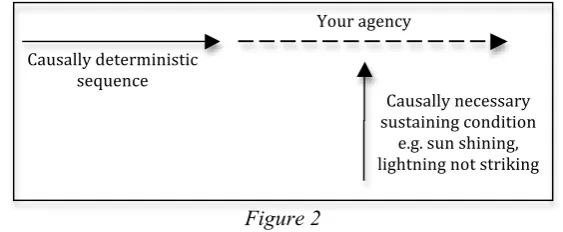
issues the following challenge to source incompatibilists. Inviting us to consider Figure 2, he
writes:
My question is this: if one is not troubled by the existence of the vertical line, why be troubled
by the horizontal line? They are both the same in the sense that they represent ‘external’ factors
that are entirely outside the relevant agent’s control; in virtue of what is the horizontal line
troubling in a way in which the vertical line isn’t? A mere appeal to ‘externality’ will not
distinguish the two lines—they are equally ‘external’ to the Agency Line. Similarly, the sun is
‘external’ to the agent in just the same way as the antecedent causal sequence—each equally
impugns Total Control, and both introduce just the same sort of luck. (2012: 183)
Your agency
Causally necessary sustaining condition
e.g. sun shining, lightning not striking Causally deterministic
[image:13.595.147.429.442.558.2]sequence
Yet we must be careful to distinguish totality from ultimacy. Whereas the totality of
one’s control may be understood along the lines Fischer outlines, the ultimacy of one’s control
is surely not to be understood in terms of the number of causal factors one controls but in terms
of the source and nature of one’s control over them. Specifically, the crucial issue for
ultimacy is whether the relevant causal chains terminate in one’s own agency or carry on
through one’s agency and onwards into the distant past. Indeed, ultimacy in this sense is
neither necessary nor sufficient for totality. Suppose that one has total control over the
occurrence of some event, in Fischer’s sense of having control over every necessary condition
of its occurrence. If one controls these causal factors merely in the way that a thermostat
controls the temperature of a room, then one’s control is not ultimate in the relevant sense,
despite its totality. Conversely, if one has ultimate control over just one necessary condition of
an event’s occurrence, then one has a kind of ultimate control over its occurrence (in the sense
that one wields a ‘veto’ over it), even if this control is merely partial.
To elaborate: suppose that you are preparing to perform some action A. And suppose
that you have ultimate control over only one of the many causally necessary sustaining
conditions mentioned by Fischer, such as the condition that you not be struck by lightning.
That is, we are imagining a bizarre case in which you have ultimate control over lightning, but
not over anything else—including the beliefs and desires that are deterministically (let us
suppose) now leading you to do A. Since not being struck by lightning is a necessary condition
of your doing A, your ultimate control over its striking grants you a sort of veto over whether
you do A, and therefore ultimate (though partial) control over your doing A. It puts the issue of
whether or not you do A in your own hands, albeit crudely. Similarly, I take it, such ultimate
though partial control over your doing A also renders you ultimately though partially
responsible for doing A. (Of course, since your only available means of preventing yourself
very heinous indeed, in which case we may well blame you for not striking yourself down with
lightning.)
Thus the source-incompatibilist, having distinguished ultimacy from totality, may
reasonably claim that ultimate control over any causal contributor to an event is sufficient to
get moral responsibility for that event off the ground (Istvan 2011). The totality of one’s
control—and hence the totality of one’s responsibility—is then a subsequent issue. The source
incompatibilist may therefore agree with Fischer that there is no relevant difference between
the horizontal and vertical lines in Figure 2, insisting simply that were the agent to be the
ultimate source of either line, she would then bear a kind of ultimate responsibility for what
she does. And while we generally take it for granted that we are not the ultimate sources of the
factors represented by the vertical line, determinism guarantees that we are not the ultimate
sources of any of the factors represented by either line. This, then, is how determinism might
be taken to rule out moral responsibility on source incompatibilist grounds.
Of course, the compatibilist will simply deny that responsibility requires any amount of
such ‘ultimate’ control: mere thermostat-style control, or some highly sophisticated version of
this, may be claimed to be sufficient. So it is unlikely that the incompatibilist’s invocation of
the sourcehood requirement will grant her an argument capable of swaying a committed
compatibilist. However, this was presumably never the source incompatibilist’s aim. Instead,
her talk of sourcehood and ultimacy is best heard as an attempt to articulate a central
incompatibilist concern in a way that makes it compelling to ‘floating voters’ not yet under
compatibilism’s sway. This, as we have seen, is a perfectly reasonable dialectical aim—and it
References
Dennett, D. C. 1973. Mechanism and responsibility. In Essays on Freedom of Action ed. T. Honderich, 157-84. Boston, Routledge and Kegan Paul.
Fischer, J. M. 1994. The Metaphysics of Free Will: A study of control. Wiley-Blackwell.
Fischer, J. M. 1999. Recent work on moral responsibility. Ethics 110: 93-139.
Fischer, J. M. 2002. Frankfurt-style compatibilism. In Contours of Agency: Essays on themes from Harry Frankfurt, ed. S. Buss and L. Overton, 1-26. MIT Press, Bradford Books.
Fischer, J. M. 2006. My Way: Essays on moral responsibility. Oxford University Press.
Fischer, J. M. 2012. Deep Control: Essays on free will and value. Oxford University Press.
Fischer, J. M. and M. Ravizza. 1998. Responsibility and Control: A theory of moral responsibility. Cambridge University Press.
Frankfurt, H. G. 1969. Alternate possibilities and moral responsibility. Journal of Philosophy 66: 829-39.
Goetz, S. 2005. Frankfurt-style counterexamples and begging the question. Midwest Studies in Philosophy 29: 83-105.
Haji, I. and M. McKenna. 2004. Dialectical delicacies in the debate about freedom and alternative possibilities. Journal of Philosophy 101/6: 299-314.
Haji, I. and M. McKenna. 2006. Defending Frankfurt’s argument in deterministic contexts: a reply to Palmer. Journal of Philosophy 103/7: 363-72.
Istvan, M. A. 2011. Concerning the resilience of Galen Strawson’s basic argument. Philosophical Studies 155/3: 399-420.
Kane, R. 1985. Free Will and Values. Albany: State University of New York Press.
Mele, A. R. and D. Robb. 1998. Rescuing Frankfurt-style cases. Philosophical Review 107: 97-112.
Palmer, D. 2005. New distinctions, same troubles: a reply to Haji and McKenna. Journal of Philosophy 102/9: 474-82.
Pereboom, D. 2001. Living Without Free Will. Cambridge: Cambridge University Press.
Pereboom, D. 2003. Source incompatibilism and alternative possibilities. In Moral Responsibility and Alternative Possibilities, ed. D. Widerker and M. McKenna, 185-99. Aldershot, UK: Ashgate.
Smilansky. S. 2003. Compatibilism: the argument from shallowness. Philosophical Studies 115: 257-82.
Strawson, G. 1986. Freedom and Belief. Oxford: Oxford University Press.