
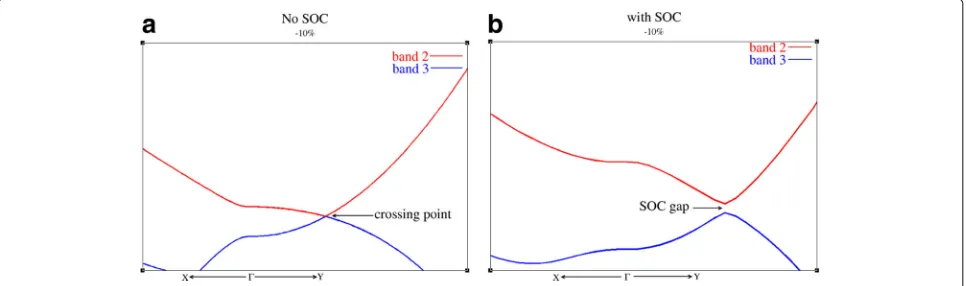
Spin Orbit Coupling Gap and Indirect Gap in Strain Tuned Topological Insulator Antimonene
Full text
Figure
Related documents
In einer Multizenterstudie von 2001 allerdings zeigte sich, daß nach entsprechender Trainingsphase eine vergleichbare Rate an Sentinellymphknoten- Darstellungen auch nach
Differences in teachers’ effectiveness scores of male and female teachers with respect to their training (trained/untrained) and marital status (married/unmarried) as observed in
Detection of metallo-beta- lactamase producing Pseudomonas aeruginosa strains isolated from patients suffering from burns in Ahvaz, Iran. Peymani A, Nahaei MR, Farajnia S,
The achievements of their multi-lingual customer service showed immediate results and sales grew rapidly. Therefore, Folksam connected diversity di- rectly to its
Data will be collected by means of semi- structured interviews with IREPS directors and ARS public health directors (8 people). Based on the be- haviour change wheel theory [23] and
flect the cluster-level co-occurrence relationships between all candidate words in the documents of the given cluster. The saliency scores of the words are computed based on
Passive voice: “ Greta was encouraged by the crowd.” subject + to be + past participle of verb + optional prepositional phrase using by.. Look at the examples below of how
Traditionally, boiled rice is a staple diet with fermented and non-fermented legume (mostly soybeans) products, vegetables, pickles, fish, and meat in Far-East Asia, South Asia,
