Citation:
Dobson, VJ (2017) Collaborating to Increase Ebook Accessibility for All. Collaborate: Libraries in Learning Innovation, 2.
Link to Leeds Beckett Repository record: http://eprints.leedsbeckett.ac.uk/4558/
Document Version: Article
Creative Commons: Attribution 4.0
The aim of the Leeds Beckett Repository is to provide open access to our research, as required by funder policies and permitted by publishers and copyright law.
The Leeds Beckett repository holds a wide range of publications, each of which has been checked for copyright and the relevant embargo period has been applied by the Research Services team.
We operate on a standard take-down policy. If you are the author or publisher of an output and you would like it removed from the repository, please contact us and we will investigate on a case-by-case basis.
Collaborate: Libraries in Learning Innovation 2 2017
Collaborating to Increase Ebook Accessibility for All
Vicky Dobson – Senior Information Services Librarian
Leeds Beckett University
Background: Throughout 2016 colleagues from Libraries and Learning Innovation were involved in coordinating a national collaborative audit of eBook accessibility. They led this project with representatives from Jisc, the University of Kent, York St John University, Manchester Metropolitan University and the University of Liverpool.
Introduction
Students with disabilities termed ‘print impairments’ are unable to access printed text, usually due a physical or visual impairment, or a specific learning difficulty (SpLD) such as dyslexia. They comprise a significant proportion of the student population. The latest available figures for Leeds Beckett University indicate that at least half of our disabled students have a print impairment; 48% have a SpLD such as dyslexia (1521 of 3202) and 2% have a visual impairment (64 of 3202). Across the UK Higher Education (HE) sector, approximately 10% of all students have a print impairment (Featherstone, 2015).
Information is often presented in printed format, meaning that students with print impairments can experience significant barriers to accessing the information they need for their studies, which can negatively impact their attainment and ability to succeed on their course.
eBooks offer a potential solution to this. Due to the flexibility inherent to their electronic format, in theory it should be possible to adapt them to meet individual requirements. This may involve changing settings such as the font size and background colour, changing text size or using assistive software to have eBooks read aloud.
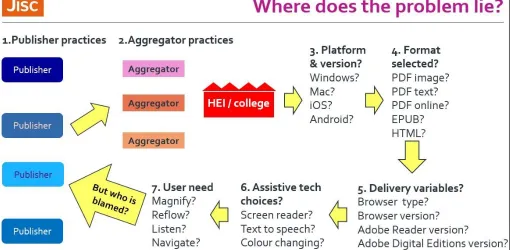
Unfortunately this is not always possible. Due to a variety of factors (some of which are illustrated in Figure 1 below), eBooks are not always fully accessible. For example, it may not be possible to resize the text through an adequate range of zoom levels, and some books may not be compatible with assistive software. There is considerable
variance between different eBooks in regard to accessibility, and without a trial and error approach, students will not necessarily know which features are available on each platform.
The role of library staff is to facilitate access to knowledge. This entails a moral duty to ensure that the eBook platforms to which the Library subscribes are accessible to the people who will be using them. In addition, the Library has a legal duty under the Equality Act 2010 to anticipate the needs of disabled students and to make adjustments accordingly. When significant changes to the Disabled Students Allowance were announced recently, the Government issued guidance on its expectations of institutions (Student Finance England, 2016), and eBooks were mentioned specifically:
“The e-book platforms to which institutions subscribe should be as accessible as possible (e.g. enable adjustments to font size and display colour; enable text to be read by text-to-speech tools)”
Collaborate: Libraries in Learning Innovation 2 2017
2
procuring eBooks and supporting students inusing them.
Through discussions on LIS-ACCESSIBILITY, a JISCMail mailing list for sharing best practice around supporting students with disabilities, it was agreed that a clearer picture of the accessibility of eBooks provided to the UK HE sector would be beneficial. Consequently, a need was identified for a project to develop a practical tool to benchmark the accessibility of eBooks, that would capture the experience of the end-user and be simple enough to be used and understood by non-experts. It was hoped that such a tool would offer a shared framework through which library staff and eBook providers could discuss accessibility and bring about improvements.
Aims and objectives
The ultimate aim of the eBook Audit was to effect improvements in eBook accessibility, so students can access the information they need to succeed at University. This is of potential benefit to all students; just as ramps intended for wheelchair users can be useful for all, increasing accessibility for one group of people results in improvements for everybody.
The project aimed to achieve this through the following objectives:
Assess the accessibility of eBooks from different providers, with a focus on reflecting the end-user experience Make this information publicly
available, with the aim of:
o Giving a more complete and transparent picture of the accessibility of eBooks provided to the UK Higher Education sector
o Motivating eBook providers to make improvements to accessibility in order to increase their ranking in relation to their competitors
o Helping library and disability staff to more effectively support students by signposting them to information on which accessibility features are likely to be available for different eBooks
Produce a simple and easily understandable guide to key accessibility concepts in order to raise awareness across the sector
Empower library staff, who may not necessarily be accessibility experts, to liaise with eBook providers about accessibility and advocate for their disabled students to negotiate improvements
Methods
The team behind the audit decided to take a crowdsourcing approach, in order to share the workload and increase the impact of the project by involving as many people as possible. They joined up with the National Consortia for Monographs e-books sub group which was also planning to audit the accessibility of eBook platforms in order to inform procurement decisions.
The decision was made to focus on the most widely used eBook platforms across the HE sector. The LIS-ACCESSIBILITY JISCMail list was used to crowdsource a list of these. Forty-four platforms were identified to be audited, including 15 of the platforms subscribed to by Leeds Beckett University. LIS-ACCESSIBILITY was also used to refine the questions that would be used to assess the eBooks (eBook Accessibility Audit Project Team, 2016a), and to recruit volunteers for conducting the audits. These volunteers came from 33 institutions, representing 20% of the UK HE sector.
A range of online training and support materials were produced to introduce key accessibility concepts and assist the volunteers in completing the audit (eBook Accessibility Audit Project Team, 2016b). Additionally, a hands-on training event was organised for members of NoWAL (North West Academic Libraries) who would be involved in the Audit.
it. Some platforms offer eBooks in multiple formats, with varying levels of accessibility. Therefore, the spreadsheet was designed to also show the scores each platform would have achieved if all the questions were answered for its best and worst performing formats, illustrating the variability in accessibility between different formats, and the potential for improvement if all formats were as accessible as the best performing one. The spreadsheet also includes more sophisticated functionality, such as dashboards which allow the user to assign importance weightings to different accessibility criteria using slider bars. Lists are then generated ranking platforms and publishers according to the chosen ratings (eBook Accessibility Audit Project Team, 2016c).
It was important for the eBook audit to be a collaborative project, involving representatives from the book supply industry. Rather than criticising them, the project aimed to work together to develop a shared understanding of accessibility and how it can be improved for the benefit of eBook users.
To achieve this, Alistair McNaught (of Jisc) who was part of the project team liaised with the Publishers Association Accessibility Action Group, and through them issued a briefing to publishers about the project. It was hoped that this would encourage them to engage with and contribute to it. As intended, the briefing resulted in a lot of constructive dialogue. Huw Alexander from Sage helpfully agreed to act as a ‘critical friend’ of the project, and a number of other suppliers also provided invaluable feedback, including Elsevier, Oxford University Press, Cambridge University Press, VitalSource, Bloomsbury and Pearson. Five providers volunteered to audit themselves.
The Audit was launched in late July 2016, with audits being completed between July and August 2016. Almost 280 eBooks were audited, from 65 publishers across the 44 platforms identified.
Results
The results of the Audit are published on the E-book Audit 2016 website (eBook Accessibility Audit Project Team, 2016d). The scoring spreadsheet mentioned previously is available to download from the ‘Download key files’ page
Individual feedback reports were also produced for each platform (eBook Accessibility Audit Project Team, 2016e). The table on page six of these reports may be of particular interest to library staff supporting students. It indicates the likelihood that a particular accessibility feature will be available on each platform, giving a snapshot of the accessibility of the platform and enabling staff to signpost students to platforms which are likely to meet their requirements.
Average scores ranged from 35% - 68%, indicating significant variability between platforms, and highlighting considerable room for improvement, even for the higher performing platforms.
Discussion
Caveats
When considering the results of the project, it is important to keep in mind the limitations of its scope. The project covered academic eBooks produced for the UK HE sector, and did not include commercial mass-market eBooks such as fiction. It aimed to capture the end-user experience, and as such it was a non-technical accessibility survey designed to be completed by non-experts. There are some important aspects of accessibility which were beyond the scope of the project, including, for example, the responsiveness of providers to requests for eBook files in accessible formats for students who are unable to use eBooks.
Achieving accessibility
Collaborate: Libraries in Learning Innovation 2 2017
4
further influenced by the device and operatingsystem they are using, which format they choose to access the eBook in, and the applications or
Figure 1 - Flow diagram showing potential ‘accessibility attrition’ points (2017)
software they are using, as well as their knowledge of how to use the available accessibility features.
In light of this, action is needed at each stage of the process to ensure an accessible experience for the end-user. It is important for the publisher to supply accessible files and not, for example, image PDFs. These are actually just images of text and it is not possible to select the text within them, which is problematic for assistive software users. It is recommended that the providers of eBook platforms use the audit as a checklist to see how they can improve their platform to better serve their users, with a particular focus on providing useful and thorough accessibility information on the Help pages, clearly stating what functionality their platform has and how to use it, as well as features that are not available, to avoid users wasting their time with trial and error. Those involved in supporting disabled students can also help through user-education around the features available in different applications and software and how these can be used to optimise the accessibility of eBooks.
Staff development
A follow-up questionnaire was circulated to those involved in the audit to capture the staff
development resulting from it and to identify areas for further training or support (eBook Accessibility Audit Team, 2016f). The results indicated that for over 70% of people this was their first experience of auditing eBook accessibility, illustrating the value of the audit in raising awareness of accessibility. The majority of audit participants reported feeling more empathy for their disabled learners and better equipped to advise them as a result of taking part. The majority also felt that better accessibility information should be provided by suppliers and that eBook accessibility should influence library procurement, and a significant number felt that accessibility should influence reading list recommendations.
[image:5.612.57.567.59.309.2]address some of the identified training needs; during the workshops participants are given the opportunity to try assessing an eBook against some of the criteria used in the Audit project and assisted to access an eBook using a text-to-speech application.
User education
Leeds Beckett University Library has used the results of the audit to produce updated FAQs for students on using the accessibility features of eBooks, which include guidance on changing the text size, font and background colour, and having eBooks read aloud. These are available on the Library website (Leeds Beckett University, 2017). A page has also been added to the E-Book Audit 2016 website outlining the key elements of accessibility, to act as a primer for anybody wanting to know more about eBook accessibility (eBook Accessibility Project Team, 2016i).
Informing procurement decisions
Colleagues at Leeds Beckett University are looking into using the audit criteria to update the Library’s preferred licensing terms for eBook procurement. This is a document used when negotiating with eBook providers, outlining our ideal requirements for an eBook platform. When institutions are purchasing single title eBooks which are available from multiple providers, there is also potential to use the audit results to select the most accessible one.
The positive engagement of suppliers with the audit so far has been very encouraging. For example, in response to it, Askews and Holts circulated accessibility guidance to their
customers,
which is available on the E-book Audit 2016 website. Jacqui Holborn, Customer Care Director, stated “Askews and Holts have been pleased to use
the audit as an opportunity to clarify our accessibility guidance for customers.” (eBook Accessibility Audit Project Team, 2016j).
Getting the word out
The project team were very pleased that the eBook Accessibility Audit was shortlisted for the CILIP Community, Diversity and Equality Group Diversity Award 2016 and the Accessible Books Consortium (ABC) International Excellence Award 2017.
The team are exploring various avenues for promoting the Audit to optimise engagement across the sector. Written publicity has been published in various places, including an article in ALISS Quarterly (Watson, 2016) and a UKeIG news update (CILIP, 2016). In addition to the upcoming conference workshops mentioned above, the audit has been promoted at a number of library events, including the 2016 ARLG Conference, a Library Teach Meet at Staffordshire University, a UKSG webinar about eBooks, and a Sherif (formerly JIBS) event on accessibility and e-content, as well as an event at Liverpool Hope University on the implications for libraries of the recent changes to Disabled Students Allowances. Furthermore, it was encouraging to learn recently from a contact of the team that the project was included in a presentation on accessible reading systems given at the CSUN International Assistive Technology conference in San Diego in March, and that it was cited at a European Commission session in Brussels in February 2017, attended by MEPs, policy makers and industry leaders.
Collaborate: Libraries in Learning Innovation 2 2017
6
The team are exploring various avenues forpromoting the Audit to optimise engagement across the sector. Written publicity has been published in various places, including an article in ALISS Quarterly (Watson, 2016) and a UKeIG news update (CILIP, 2016). In addition to the upcoming conference workshops mentioned above, the audit has been promoted at a number of library events, including the 2016 ARLG Conference, a Library Teach Meet at Staffordshire University, a UKSG webinar about eBooks, and a Sherif (formerly JIBS) event on accessibility and e-content, as well as an event at Liverpool Hope University on the implications for libraries of the recent changes to Disabled Students Allowances. Furthermore, it was encouraging to learn recently from a contact of the team that the project was included in a presentation on accessible reading systems given at the CSUN International Assistive Technology conference in San Diego in March, and that it was cited at a European Commission session in Brussels in February 2017, attended by MEPs, policy makers and industry leaders.
Linking with existing guidelines
Colleagues at the University of Southampton are also working on mapping the audit criteria to the categories used in Web2Access (University of Southampton, 2017), a resource which offers users the ability to create and submit accessibility reviews of Web 2.0 services and to view review scores for different services. Inclusion in the well-recognised Web2Access resource would give the Audit additional credibility and help it reach a wider audience, ultimately enabling it to have more of an impact and therefore to be of more benefit to students.
Maintaining currency
The audit questionnaire remains open, and eBook providers are encouraged to re-audit themselves when developments are made to their platform. The project team will add the new audits to the scoring spreadsheet so it continues to be a live document reflecting the current state of eBook accessibility.
The scope for organising a repeat of the Audit in the future or using it as a framework to audit the accessibility of other electronic resources is currently under discussion. Meanwhile, a librarian at the University of Queensland is
planning to use the audit tool and scoring spreadsheet to conduct an eBook accessibility audit in Australia. Her plan is to involve blind students who use screen reading software in assessing the eBooks, adding an extra dimension to the project by more closely capturing the perspective of disabled students.
Conclusion
References
CILIP (2016). eBook Accessibility Audit in UK Higher Education [Online]. Available from: <
https://www.cilip.org.uk/uk-einformation- group/news/ebook-accessibility-audit-uk-higher-education> [Accessed 6 April 2017].
eBook Accessibility Audit Project Team (2016a) eBook Accessibility Audit [Online]. Available
from: <
https://docs.google.com/forms/d/e/1FAIpQLSd3CNb
XwhrdFDFYNV_Z2QKoqsghlmcb5So-Yq0fviLHoLJ7pA/viewform> [Accessed 24 February 2017].
eBook Accessibility Project Team (2016b) Hints
and tips [Online]. Available from:
<https://docs.google.com/document/d/1LSo6eubwW TO_ydg3EKIESpG6f-gZrDthsKCH2N41PaE/edit> [Accessed 15 February 2017].
eBook Accessibility Audit Project Team (2016c) Interactive scoring – beta liteupload [Online].
Available from:
< https://sites.google.com/site/ebookaudit2016/data-and-related-fileds> [Accessed 27 February 2017].
eBook Accessibility Audit Project Team (2016d). E-book Audit 2016 [Online]. Available from: <https://sites.google.com/site/ebookaudit2016/home > [Accessed 20 February 2017].
eBook Accessibility Audit Project Team (2016e)
Individual Platform Feedback Reports
[Online]. Available from:
<https://sites.google.com/site/ebookaudit2016/report s> [Accessed 27 February 2017].
eBook Accessibility Project Team (2016f) E-book audit - how can we help? [Online].
Available from:
<https://docs.google.com/a/leedsbeckett.ac.uk/forms /d/10ZF5o0IuknfNoIgDqgphEltnQLgfwUyBwIOFNZ MR4cY/viewform?edit_requested=true> [Accessed 15 February 2017].
eBook Accessibility Project Team (2016g) E-book audit - how can we help? Responses
[Online]. Available from:
<https://docs.google.com/forms/d/10ZF5o0IuknfNoIg
DqgphEltnQLgfwUyBwIOFNZMR4cY/viewanalytics> [Accessed 15 February 2017].
eBook Accessibility Audit Project Team (2016h). Training and Support [Online]. Available from: <https://sites.google.com/site/ebookaudit2016/traini ng-and-support> [Accessed 18 April 2017].
eBook Accessibility Audit Project Team (2016i). Key elements of e-book accessibility[Online].
Available from:
<https://sites.google.com/site/ebookaudit2016/access ibility-primer> [Accessed 7 April 2017].
eBook Accessibility Audit Project Team (2016j) Askews and Holts use audit to clarify accessibility guidance [Online]. Available from: <https://sites.google.com/site/ebookaudit2016/assign ments/askewsandholtsuseaudittoclarifyaccessibilityg uidance> [Accessed 6 April 2017].
Featherstone, L. (2015) How can you make
resources accessible for those with
disabilities?. Jisc, 13 July [Online blog]. Available from: < https://www.jisc.ac.uk/blog/how-can-you-
make-resources-accessible-for-those-with-disabilities-13-jul-2015> [Accessed 20 February 2017].
Flow diagram showing potential ‘accessibility attrition’ points (2017) [Online image]. Available from:
<https://accessibility.jiscinvolve.org/wp/files/2017/02/ ebookflow.jpg> [Accessed 21 April 2017].
Leeds Beckett University (2017). Accessibility [Online]. Available from: <http://libguides.leedsbeckett.ac.uk/resources/ebook s/accessibility> [Accessed 5 April 2017].
Oxford University Press (2017a). Frequently
Asked Questions [Online]. Available from:
<http://www.oxfordreference.com/page/faq/frequentl y-asked-questions> [Accessed 3 March 2017].
Oxford University Press (2017b). Frequently
Asked Questions (FAQs) [Online]. Available
from:
Collaborate: Libraries in Learning Innovation 2 2017
8
Student Finance England (2016). DisabledStudents’ Allowances – New DSA students [Online]. Available from: <
http://www.practitioners.slc.co.uk/policy-information/guidance-chapters.aspx> [Accessed 3 March 2017].
University of Southampton (2017). Welcome to
Web2Access [Online]. Available from:
<https://web2access.org.uk/> [Accessed 24 February 2017].
Watson, B. (2016) A serendipitous meeting of minds: the background to the eBook accessibility audit (UK Higher Education). ALISS Quarterly, 12 (1). pp. 24-26. ISSN 1747-9258
Web Accessibility Initiative (2012). Web Content Accessibility Guidelines (WCAG)
Overview [Online]. Available from: