mance, 36 (6). 1508 - 1514. ISSN 0096-1523 DOI: https://doi.org/10.1037/a0020412 Link to Leeds Beckett Repository record:
http://eprints.leedsbeckett.ac.uk/33/
Document Version: Article
The aim of the Leeds Beckett Repository is to provide open access to our research, as required by funder policies and permitted by publishers and copyright law.
The Leeds Beckett repository holds a wide range of publications, each of which has been checked for copyright and the relevant embargo period has been applied by the Research Services team.
We operate on a standard take-down policy. If you are the author or publisher of an output and you would like it removed from the repository, please contact us and we will investigate on a case-by-case basis.
Perceptual Learning Immediately Yields New Stable Motor Coordination Andrew D. Wilson1*, Winona Snapp-Childs2, & Geoffrey P. Bingham2
1. Centre for Sports & Exercise Science Institute of Membrane and Systems Biology
University of Leeds Leeds LS2 9JT
UK
2. Department of Psychology Indiana University
1101 E 10th St Bloomington, IN 4701
USA
* Corresponding author
Email: [email protected]
Abstract
Coordinated rhythmic movement is specifically structured in humans. Movement at 0° mean
relative phase is maximally stable, 180° is less stable, and other coordinations can, but must be
learned. Variations in perceptual ability play a key role in determining the observed stabilities, so
we investigated whether stable movements can be acquired by improving perceptual ability. We
assessed movement stability in Baseline, Post Training and Retention sessions by having
participants use a joystick to coordinate the movement of two dots on a screen at three relative
phases. Perceptual ability was also assessed using a 2-alternative forced choice task in which
participants identified a target phase of 90° in a pair of displays. Participants then trained with
progressively harder perceptual discriminations around 90°, with feedback. Improved perceptual
discrimination of 90° led to improved performance in the movement task at 90° with no training
in the movement task. The improvement persisted until Retention without further exposure to
either task. A control group’s movement stability did not improve. Movement stability is a
function of perceptual ability, and information is an integral part of the organization of this
Rhythmic movement coordination is a paradigm case for the study of perception-action, because it involves all the essential features of a perception/action system (voluntary control of limb movements, coordination among multiple limbs or people, and online perceptual (informational) guidance and coupling of the voluntary movement). The key variable in studies of movement coordination is relative phase, a measure of the relative location of two oscillators within their
cycles. 0 mean relative phase means that the two oscillators are at the same point in their cycle
at the same time; 180 means they are at opposite ends of their cycle at the same time; and 90 is the point halfway in between these extremes.
Bimanual rhythmic movement coordination is very specifically structured in humans. 0 and
180 are the only two stable movement coordinations that people can spontaneously produce. Other coordinations can, but must, be learned (e.g. Wenderoth, Bock, & Krohn, 2002; Zanone &
Kelso, 1992a, 1992b, 1997). Without training, movement at 90 is maximally unstable.
Movement at 0 is more stable than at 180 and an increase in frequency leads to increased phase
variability, more so at non-0 phase relations. There is (under a non-interference instruction) a
spontaneous transition to 0 around 3-4Hz, with no tendency to transition from 0 to any other relative phase (Kelso, 1984; Kelso, Scholz & Schöner, 1986; Kelso, Schöner, Scholz & Haken,
1987).
arises in the model from the superposition of two cosine functions, with no reference to the system instantiating the behavior. In addition, Haken et al.‟s talk of attractors (while a convenient descriptive shorthand) is not explanatory. They provided no account of the origin of the potential function. The question therefore remains – why is human rhythmic movement coordination patterned this way?
The Role of Perception: Movements that are trivial when performed in isolation become difficult
to maintain when performed simultaneously as a coordinated movement (Rosenbaum, Dawson & Challis, 2006). This suggests that the constraint on task performance (a preference for symmetrical behaviour) emerges from the coupling entailed by coordination. There is strong evidence that the coupling is in general perceptual, or more precisely, informational. The movement phenomena persist when the oscillators belong to two different people (Schmidt, Carello & Turvey, 1990; Temprado, Swinnen, Carson, Tourment & Laurent, 2003) or when one of them is a simulated oscillator (Buekers, Bogaerts, Swinnen & Helsen, 2000; Wilson, Collins & Bingham, 2005a; Wimmers, Beek & van Wieringen, 1992). In these cases, the coupling was mediated completely by vision.
at all. As frequency was increased, 180° was judged to be increasingly variable and discrimination of phase variability got worse. In other words, discrimination of phase variability follows an inverted, asymmetric U-shaped function of mean relative phase, the same shape as the HKB potential function (see Zaal et al., 2000 for more detail).
The next step was to explicitly manipulate the perceptual information used to perform the task. Changing the information changes the stability of that movement. Bogaerts, Buekers, Zaal, & Swinnen (2003) transformed the visual feedback in a movement task (so that 180° movement produced 0° on a screen, or so that orthogonal movements produced parallel motion on a screen). They found that if the visual signal was at 0°, non-0° movements were stabilized, and orthogonal movements were stabilized by parallel feedback. Wilson et al.. (2005a) replicated this phenomenon using a different paradigm. Participants tracked a computer controlled moving dot on a screen with a joystick controlling a second dot. In one condition, participants moved so as to
produce 0, 90 or 180 between the two dots. Movement stability was an HKB shaped function
Learning New Coordinations: It is possible to learn to move at phases other than 0° and 180°. In
the first learning studies in this field (Zanone & Kelso, 1992a & b, 1997; Kelso & Zanone, 2002), participants were trained to move at 90 or 135 to investigate how this training
generalized to other relative phases and effectors. Learning 90 was described by these authors as a qualitative change in the shape of the HKB potential function (a new attractor in the HKB
potential function). Learning only generalized to the symmetry partner1 of 90, namely 270.
Participants who could already perform 90° were trained to perform 135. In this case, instead,
performance at 90° worsened as performance at 135° improved. The new skill again only
generalized to the symmetry partner of 135 (225). Kelso & Zanone (2002) found a similar pattern of results, but this time also showed that training a new coordination in one set of effectors (e.g. the arms) transferred to a different set of effectors (e.g. the legs). Kelso and Zanone interpreted their results as showing that what is learned is a high-level, abstract (but neurally implemented) dynamic representation of the action.
Another set of learning studies focused in more detail on how learning varies across different parameters that characterize performance (Wenderoth & Bock, 2001) or across different locations in HKB potential function space (Wenderoth et al.., 2002). Wenderoth & Bock showed
that learning to perform 90 seemed to occur over three separable processes, each occurring on
their own time scale. The fastest improvement was in average performance; next fastest was in precision; and slowest was improvements in switching time (the time taken to intentionally switch into 90° from another state). They equated these parameters with attractor location, attractor depth and the steepness of the attractor (Scholz & Kelso, 1990) respectively. This time scale ordering is sensible; you must first produce the target behaviour, and only then can your
performance be constrained to a specific smaller region of the potential function space. This then allows for a period of consolidation in which variability is reduced, and the new pattern to become well learned (more stable).
Wenderoth et al.. (2002) trained participants to produce coordinations that were either 36, 60
or 90 away from 0 or 180. Participants were able to learn these coordinations but they were
not learned in the same way, nor to the same extent. Zanone & Kelso (1994) had predicted that learning rate should vary inversely with the stability of the closest attractor, because competition between learning requirements and intrinsic coordination dynamics would become smaller with
greater distance. Wenderoth et al.. actually found that patterns close to 0 were stabilized faster
than patterns closer to 180 (replicating Fontaine, Lee & Swinnen, 1997). Wenderoth et al.. hypothesized that perception of the movements may be playing a key role, rather than competition between attractors. Specifically, they suggested that because visually presented
phase relations close to 0 are more easily discriminated than those close to 180 (Zaal et al..,
2000), learning 36 is easier than learning 144° because the former can be easily discriminated
from 0, while the latter is not as easily discriminated from 180°. If a person cannot discriminate
between two different movements, they will be unaware that they are moving incorrectly and hence be unable to improve. Learning follows perceptual discriminability.
Current Study: Learning studies all train people to move at a novel coordination by having them
lagging) is not what is being acquired. Second, learning is not specific to the limbs instantiating the movement; for instance, learning to move at 90° generalizes from arms to legs (Kelso & Zanone, 2002). Kelso and Zanone discuss learning in terms of acquiring an abstract dynamical coordinative structure that defines how the limbs are to be controlled, but this, like the HKB model, is just a redescription of the phenomena. Third, learning a novel coordination follows the perceptual consequences of the coordination, and not the specific movements used to produce it (Atchy-Dalama, Peper, Zanone & Beek, 2005). So what is it that changes over the course of learning?
The judgment and movement studies clearly implicate a vital role for perception in determining movement stability (see also Mechsner, Kerzel, Knoblich & Prinz, 2001; Mechsner & Knoblich, 2004). The results of Bogaerts et al.. (2003) and Wilson et al.. (2005a), in which non-0° movements are stabilized by transformed feedback, suggest that movement stability is a function of perceptual ability: the reason 0° is easy while other relative phases are hard is that the requisite information is detected most readily at 0° and less so elsewhere. Improved stability of movement in the various learning studies therefore implies improved perceptual ability; what has changed, we suggest, is the participants‟ ability to detect the requisite information at the novel coordination.
would translate to an improved ability to maintain a movement at 90° in the absence of practice of the actual movement.
Methods
Participants: There were 12 participants (22-54 years old). All were right-handed, had normal or
corrected-to-normal vision and were free from any known neurological defects or motor disabilities. Based on motor performance in the Baseline session, half the participants were assigned to the Experimental Group and half to the Control group (making the two groups matched on initial movement stability). Participants were paid $7 per hour for their time. Ethical approval was granted by the Institutional Review Board at Indiana University, Bloomington.
Design: There were two types of experimental task: 2-alternative forced choice (2AFC)
judgments, and coordinated rhythmic movement. There were then two types of session:
1. Assessment (Baseline, Post Training) consisted of both judgment trials (at both 90° and 180°) and movement trials (moving at 0°, 90° and 180°). There was no feedback for any trial in the Assessment sessions. We also ran a third Assessment session (Retention) with just movement trials.
2. Training consisted only of judgement trials at 90° with feedback. There were no Movement trials during training.
group did three sessions of movement trials only, with no training or feedback, timed similarly to the Experimental group‟s Assessment sessions.
Procedure
1. Judgments: Participants performed a series of 2AFC judgments on displays presented on a
Power Mac G4. There were two tasks: „Choose 90‟ and „Choose 180‟. Each trial consisted of a pair of successively presented stimuli (two dots (~15mm diameter) separated by ~35mm vertical distance moving harmonically on the screen at some mean relative phase, for 4s at 1Hz; the motion of both dots was centered at the screen centre, with amplitude of 300 pixels (~115mm).
One of each pair showed two dots moving at the target relative phase (90 or 180°) and the other
was either the same or different. „Different‟ displays were the target +/- 9°, 18°, 27°, 36° and 45° and the target was either the first or second display – there were therefore 21 different trial types (10 different differences x 2 orders, plus a catch trial where both displays were the target). One demonstration trial of the target phase was given at the start of the Assessment session. No feedback was given during these trials in the Assessment sessions.
In each Training session participants performed 12 blocks of Choose 90 with feedback. The
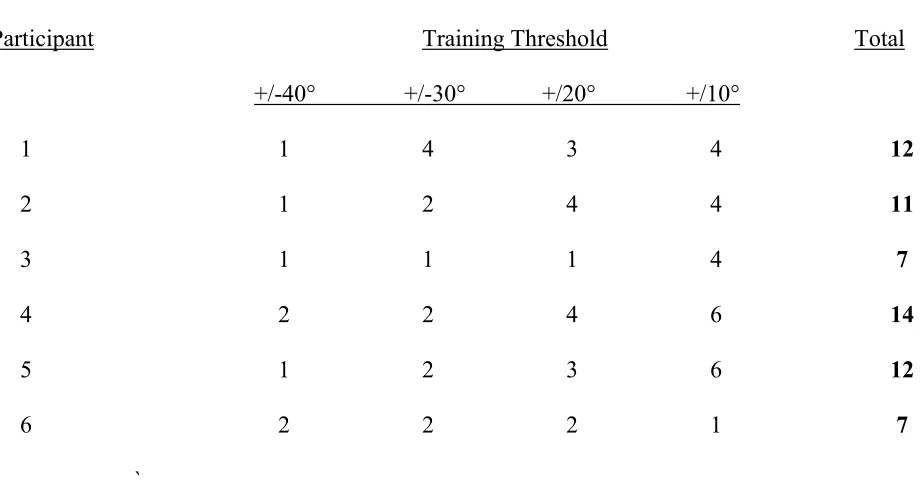
Performance in the Training set determined whether the participant progressed to the next hardest training set in the following session. If the participant was 85% correct for the largest discrimination level within a set then they progressed to the next training set for the next session, otherwise they repeated the current training set in the following session. The participant was, however, automatically moved to the next training set after four repetitions at the same level. Participants were trained for up to six sessions in the hardest discrimination set (refer to Table 1 for specific details). It is important to note that the training did not involve any additional practice at the movement task.
Data Analysis - Judgments: Data from this task were the frequency with which participants
responded “90 First” or “180 First”. The data were analyzed with each trial being described by the magnitude of the phase difference. This places data from ‟45-90‟ trials and „135-90‟ at the same point on the axis, specifically -45. The analogous sorting was also done for the Choose 180° data.
A nominal logistic regression model was fit separately to each data set. The absolute value of the mean relative phase difference at which the probability of responding „90° First‟ was 25% and 75% was computed from each regression curve, and averaged. This provides a measure of the threshold (the magnitude of the difference required before participants were above chance in their discriminations).
2. Movement: Participants sat in front of a Power Mac G4, which was connected to a Logitech
presented a display of two dots, white on a black background, one above the other (screen refresh rate 60Hz, resolution 1024x768, for 30s). The top dot was under the control of the computer, and oscillated at 1.0Hz. The bottom dot was controlled by the participant using the joystick in a smooth, side to side movement (Figure 1 shows a schematic of this setup). The computer recorded the location of the joystick and computer controlled dots.
Participants were instructed to move so as to produce a mean relative phase of 0, 180, or 90, 3
trials of each, blocked by phase and presented in the noted order. Each block began with a 4s demonstration of the required relative phase and a 30s practice trial (not analysed).
Data Analysis - Movement: A 60Hz position time series for both the computer- and person
controlled dots was recorded. The full 30s of data were used, i.e. the time series was not trimmed at the start. After the experiment, these time series were filtered (using a low-pass Butterworth filter with a 10Hz cut-off frequency) and numerically differentiated to produce a velocity time series. The relative phase between the dots was computed at each time step as the difference between the arctangent of each dot‟s velocity divided by position with requisite corrections for the quadrants of the phase plane.
Relative phase is a circular variable, which creates a problem for calculating basic descriptive variables. There are numerous trigonometric methods for performing basic statistical tests (Batschelet, 1981; Fisher, 1993; Mardia, 1972; Jammalamadaka & SenGupta, 2001). The two most useful measures are the mean vector (θ), and the normalized length of this vector (mean vector length; MVL), which ranges from 0-1 and is a measure of within trial stability. We have
that mean direction and stability are independent of one another, and one of the cardinal features of rhythmic movement coordination is that this is not true. MVL for a trial in which an untrained participant attempts 90° is often artificially elevated by them spending long periods of time stably producing, for instance, 0°; performance is indeed stable, but MVL is not reflecting their failure to maintain the target mean relative phase. Wilson et al.. (2005a) addressed this by regressing MVL against phase deviation, and using the intercept (when phase deviation = 0) as an estimate of the movement stability at the target phase.
Here, we have computed a new variable, proportion time on task, which solves the problem more efficiently. For each trial, we took the relative phase time series and computed the proportion of that time series that fell within the range of the target phase +/- a tolerance (here, set to 20°2). This measure ranges from 0-1 and effectively summarises stability of movement at the required relative phase in a single number.
Results
We first analysed the Judgment data to confirm that our Experimental participants had in fact learned as a result of their extensive training. Second, we analysed the Movement data to test the key question of this study – did the perceptual training lead to improved movement stability?
1. Judgments: We performed a repeated measures ANOVA on the mean threshold data from the
Experimental group, with Phase (2 levels: 90°, 180°) and Session (2 levels: Baseline, Post
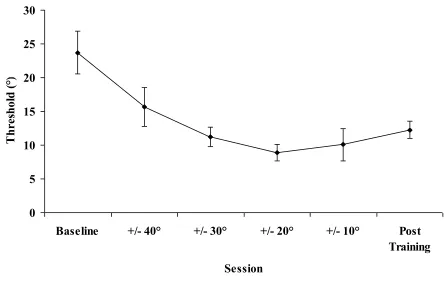
Training) as within subject factors. There was a significant interaction between Phase and Session (F(1,6) = 15.4, p<.05). No other effects were significant. To probe this interaction, we performed two-tailed, paired, t-tests comparing Baseline and Post Training thresholds separately for 90° and 180°. There was a significant difference between thresholds for Baseline vs. Post Training at 90° (t(5) = 4.2, p < 0.01) but not for 180° (p>0.05). Thresholds at 90° improved from Baseline (23.7°, SD=7.8°) to Post Training (12.3°, SD=3.2°) to be the same as at 180° with training, with no change at 180° (average threshold 11.4°, SD = 5.9°).
We also performed a repeated measures ANOVA on the 90° thresholds from the Experimental group with Session (6 levels: Baseline, each of the 4 training levels, Post Training) as a within subject factor (Figure 2). Training thresholds were computed from the data in the best (generally the last) session at a given feedback range. There was a significant main effect of Session (F(5,28) = 3.0, p<.05). The perceptual training was therefore successful. At the start of training, participants were unable to discriminate differences in relative phase between 65° and 115°, i.e. these would all equally be identified as 90°. After training, this interval was only from 80° to 100°. (Recall, we tested threshold both below and above 90° and the thresholds were the same.)
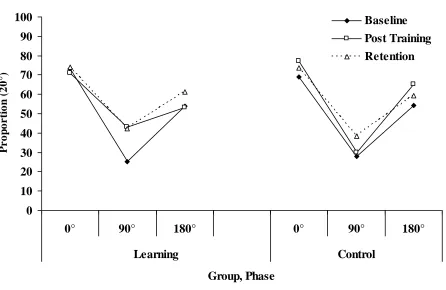
2. Movement (Figure 3): We performed a repeated measures ANOVA on the median proportion
There was a significant main effect of Phase (F(2,20) = 52.5, p<.01) and Session (F(2,20) = 4.9, p<.05) but these were modified by the predicted Phase x Session x Group interaction (F(4,40) = 4.8, p<.01). No other effects were significant. Only participants in the Experimental group improved their movement stability across sessions, and this improvement was restricted to 90°. Control performance remained the same across sessions, and was identical to Baseline performance in the Experimental group. We confirmed this interpretation with two separate repeated measures ANOVAs for each group. The Experimental group showed a main effect of Phase (F(2,10) = 29.4, p<.01) and an interaction between Session and Phase (F(4,20) = 5.5, p<.01), while the Control group showed only a main effect of Phase (F(2,10) = 24.8, p<.01).
General Discussion
A key part to any perception-action account is an account of the learning process. Attention, in E. J. Gibson‟s (1969) terminology, requires education – a perceiver-actor must learn to become sensitive to information that specifies functionally relevant parts of the world. But learning is not just perceptual – learning also entails assembling the action part of the perception-action system, and integrating the perception and action components into a whole, functional, task-specific device (Bingham, 1988). Six participants were trained to improve their perceptual resolution of 90°, and we measured the effect on their movement stability at 90° and 180°. Overall, the participants improved in the perception task, and this translated to improved movement stability at 90° but not at 180°, without further practice of the movement task. As shown by the Control group, there was no significant improvement at movement stability at 90° in the absence of perceptual training.
Initial performance in the Choose 90° task was poor (with high thresholds) and erratic (high between subject variability). This erratic initial performance was not unexpected – previous judgment studies (e.g. Wilson et al.., 2003; Zaal et al.., 2000) have shown that discrimination of 90° is poor, which causes the variability of the judgments of both the mean relative phase and the variability around that mean to be at ceiling. The HKB model describes this in terms of attractors. The purpose of an attractor in a model is to account for a particular structure to behavior in that region of the state space. But attractors are not explanatory, they are descriptive. 0° is not stable because there is an attractor there – there is an attractor there because 0° is stable. The question is therefore, why is there an attractor here, rather than there? The perceptual judgment data (Bingham et al.., 1999, 2000; Zaal et al.., 2001) suggested that the reason is that people have poor access to the requisite information at 90°, better access at 180° and best access at 0°. The advantage in moving to this account is that we could now experimentally investigate the information in a way one cannot investigate an attractor. As we see in the current data, improving access to the information at a location allows behaviour to become structured at that location (i.e. an attractor forms). We demonstrated this here with the Post Training Choose 90° performance – thresholds come down and performance also became qualitatively more consistent across participants. This then led to stable movement, i.e. the formation of an attractor there.
descriptive approach motivated by the HKB model and allows theoretical and empirical investigations of the composition and organisation of the dynamic that is creating the phenomena.
In the current experiment, the improvement in movement stability at 90° occurred in the Post-Training session and persisted in the Retention session with no additional training. In an early version of this experiment (Wilson, 2005) the improvement was not detected until Retention. This quite surprising result was discussed at the time in terms of consolidation (Brashers-Krug, Shadmehr, & Bizzi, 1996; Faugloie, Bardy & Stoffregen, 2006; Karni, Meyer, Rey-Hipolito, Jezzard, Adams, Turner, & Ungerleider, 1998) with the suggestion that the new information variable that had been learned needed to be used in service of an action to complete the perception-action learning process. The current results suggest this may not be entirely correct. The main difference between the current and earlier experiments that we suspect made the difference was the amount of training, which was significantly more extensive in the current experiment. Still, the consolidation phenomenon was quite robust across participants in the previous study, and it remains to explicitly manipulate the amount of training to investigate this further.
Table 1
Number of training sessions at each feedback tolerance level
Participant Training Threshold Total
+/-40° +/-30° +/20° +/10°
1 1 4 3 4 12
2 1 2 4 4 11
3 1 1 1 4 7
4 2 2 4 6 14
5 1 2 3 6 12
6 2 2 2 1 7
`
References
Atchy-Dalama, P., Peper, C. E., Zanone., P. G., & Beek, P. J. (2005). Movement-related sensory feedback mediates the learning of a new bimanual relative phase pattern. Journal of Motor Behavior, 37(3),186-196.
Baldissera, F., Cavallari, P., & Civaschi, P. (1982). Preferential coupling between voluntary movements of ipsilateral limbs. Neuroscience Letters, 34(1), 95-100.
Batschelet, E. (1981). Circular statistics in biology. NY:Academic Press.
Beek, P. J., Peper, C. E., & Daffertshofer, A. (2002). Modelling rhythmic interlimb coordination: Beyond the Haken-Kelso-Bunz model. Brain & Cognition, 48, 149-165.
Bernstein, N. (1967). The coordination and regulation of movements. London: Pergamon Press.
Buekers, M.J., Bogaerts, H. P., Swinnen, S. P., & Helsen, W. F. (2000). The synchronization of
human arm movements to external events. Neuroscience Letters, 290, 181-18.
Bingham, G. P. (1988). Task specific devices and the perceptual bottleneck. Human Movement Science, 7, 225-264.
Bingham, G. P. (2004a). A perceptually driven dynamical model of bimanual rhythmic
movement (and phase perception). Ecological Psychology, 16(1), 45-53.
Bingham, G. P. (2004b). Another timing variable composed of state variables: Phase perception and phase driven oscillators. In Hecht H, Savelsbergh GJP (eds), Advances in Psychology 135: Time-to-Contact. Amsterdam: Elsevier, pp 421-442.
Bingham, G. P., Schmidt, R. C., & Zaal, F. T. J. M. (1999). Visual perception of relative phasing of human limb movements. Perception & Psychophysics, 61, 246-258.
Bogaerts, H., Buekers, M. J., Zaal, F. T. J. M., & Swinnen, S. P. (2003). When visuo-motor incongruence aids motor performance: the effect of perceiving motion structures during transformed visual feedback on bimanual coordination. Behavioral Brain Research, 138, 45-57.
Brashers-Krug, T., Shadmehr, R., & Bizzi, E. (1996). Consolidation in human motor memory. Nature, 382, 252-255.
Cattaert, D., Semjen, A., & Summers, J. J. (1999). Simulating a neural cross-talk model for between-hand interference during bimanual circle drawing. Biological Cybernetics,, 81, 343-358.
Faugloire, E., Bardy, B. G., & Stoffregen, T. A. (2006). The dynamics of learning new postural patterns. Journal of Motor Behavior, 38, 299-312.
Fisher, N. I. (1993). Statistical analysis of circular data. Cambridge, Cambridge University Press.
Fontaine, R.J., Lee, T. D., & Swinnen, S. P. (1997). Learning a new bimanual coordination pattern: Reciprocal influences of intrinsic and to-be-learned patterns. Canadian Journal of Experimental Psychology, 51(1), 1-9.
Gibson, E. J. (1969). Principles of perceptual learning and development. New York: Appleton-Century-Crofts.
Haken, H., Kelso, J. A. S., & Bunz, H. (1985). A theoretical model of phase transitions in human hand movements. Biological Cybernetics, 51(5), 347-356.
Jammalamadaka, S. R., SenGupta, A. (2001). Topics in circular statistics. NJ, World Scientific Publishing.
changes in primary motor cortex. Proceedings of the National Academy of Science, 95, 861-868.
Kelso, J. A. S. (1984). Phase transitions and critical behavior in human bimanual coordination. American Journal of Physiology (Regulatory Integrative Comp. Physiology 15):
R1000-R1004.
Kelso, J. A. S. (1995). Dynamic Patterns: The Self-Organization of Brain and Behavior. Cambridge, MA: MIT Press.
Kelso, J. A. S., & Jeka, J. J. (1992). Symmetry breaking dynamics of human multilimb coordination. Journal of Experimental Psychology: Human Perception and Performance, 18(3), 645-68.
Kelso, J. A. S., Scholz, J. P., & Schöner, G. (1986). Nonequilibrium phase transitions in
coordinated biological motion: Critical Fluctuations. Physics Letters A, 118, 279-284. Kelso, J. A. S., Schöner, G., Scholz, J. P., & Haken, H. (1987). Phase-locked modes, phase
transitions and component oscillators in biological motion. Physica Scripta, 35, 79-87. Kelso, J. A. S., & Zanone, P. G. (2002). Coordination dynamics of learning and transfer across
different effector systems. Journal of Experimental Psychology: Human Perception and Performance, 28(4), 776-797.
Lee, T. D., Swinnen, S. P., & Verschueren, S. (1995). Relative phase alterations during bimanual skill acquisition. Journal of Motor Behavior, 27, 263:274.
Mardia, K.V. (1972). Statistics of directional data. NY: Academic Press.
Mechsner, F., Kerzel, D., Knoblich, G., & Prinz, W. (2001). Perceptual basis of bimanual coordination. Nature, 414, 69-73.
Rosenbaum, D. A., Dawson, A. A., & Challis, J. H. (2006). Haptic tracking permits bimanual independence. Journal of Experimental Psychology: Human Perception and Performance, 32(5), 1266-1275.
Schmidt, R. C., Carello, C., & Turvey, M. T. (1990). Phase transitions and critical fluctuations in the visual coordination of rhythmic movements between people. Journal of Experimental Psychology: Human Perception and Performance, 16(2), 227-247.
Schmidt, R. C., & Turvey, M. T. (1994). Phase-entrainment dynamics of visually coupled rhythmic movements. Biological Cybernetics, 70(4), 369-376.
Scholz, J. P. & Kelso, J. A. S. (1990). Intentional switching between patterns of bimanual coordination depends on the intrinsic dynamics of the patterns. Journal of Motor Behavior, 22(1), 98-124.
Swinnen, S. P., Dounskaia, N., Verschueren, S., Serrien, D. J., & Daelman, A. (1995). Relative phase destabilization during interlimb coordination: the disruptive role of kinesthetic afferences induced by passive movement. Experimental Brain Research, 105(3), 439-454. Swinnen, S. P., Jardin, K., Meulenbroek, R., Dounskaia, N., & Hofkens-Van Den Brandt, M.
(1997). Egocentric and allocentric constraints in the expression of patterns of interlimb coordination. Journal of Cognitive Neuroscience, 9(3), 348-377.
Temprado, J. J., Swinnen, S. P., Carson, R. G., Tourment, A., & Laurent, M. (2003). Interaction of directional, neuromuscular and egocentric constraints on the stability of preferred bimanual coordination patterns. Human Movement Science, 22, 339-363.
Wenderoth, N & Bock, O (2001). Learning of a new bimanual coordination pattern is governed by three distinct processes. Motor Control, 1, 23-35.
Wilson, A. D. (2005). A perception-action approach to rhythmic movement coordination. DAI-B 66/08, p. 4510.
Wilson, A. D., Bingham, G. P. & Craig, J. C. (2003). Proprioceptive perception of phase variability. Journal of Experimental Psychology: Human Perception and Performance, 29(6), 1179-1190.
Wilson, A. D., & Bingham, G. P. (2008). Identifying the information for the visual perception of relative phase. Perception & Psychophysics, 70(3), 465-476.
Wilson, A. D., Collins, D. R., & Bingham, G. P. (2005a). Perceptual coupling in rhythmic movement coordination – stable perception leads to stable action. Experimental Brain Research, 164(4), 517-528.
Wilson, A. D., Collins, D. R., and Bingham, G. P. (2005b). Human movement coordination implicates relative direction as the information for relative phase. Experimental Brain Research, 165, 351-361.
Wimmers, R. H., Beek, P. J., & van Wieringen, P. C. W. (1992). Phase transitions in rhythmic tracking movements: A case of unilateral coupling. Human Movement Science, 11, 217-226.
Zaal, F. T. J. M., Bingham, G. P., & Schmidt, R. C. (2000). Visual perception of mean relative phase and phase variability. Journal of Experimental Psychology: Human Perception and Performance 26, 1209–1220.
Zanone, P. G., & Kelso, J. A. S. (1992b). Learning and transfer as dynamical paradigms for behavioral change. In Tutorials in Motor Behavior II, Advances in Psychology (Stelmach, G., & Requin, J., Eds.). Amsterdam: North-Holland.
Zanone, P. G., & Kelso, J. A. S. (1994). The coordination dynamics of learning: Theoretical structure and experimental agenda. In Interlimb Coordination: Neural, Dynamical and Cognitive Constraints (Swinnen, S., Heur, H., Massion, J., & Casaer, P., Eds.). San Diego,
CA; Academic Press.
Figure Captions
Figure 1. Schematic diagram of the movement task set up. The judgment displays used identical visual stimuli without the joystick.
Figure 2. Mean thresholds (in degrees and with standard error bars) for judgments made by the Experimental group at Baseline, during Training at each of the four sets of intervals tested and at Post Training. Thresholds and standard errors at 90° came down significantly with training. Note that Baseline and Post Training reflect performance in the absence of feedback.
Figure 1
Top dot – computer controlled
Bottom dot – person controlled
Joystick (unseen by participant)
0 5 10 15 20 25 30
Baseline +/- 40° +/- 30° +/- 20° +/- 10° Post
Training Session
T
h
re
sh
ol
d
(
[image:30.612.84.531.84.371.2]°)
0 10 20 30 40 50 60 70 80 90 100
0° 90° 180° 0° 90° 180°
Learning Control
Group, Phase
P
r
o
p
o
r
ti
o
n
(2
0
°)
Baseline
Post Training
[image:31.612.90.536.91.381.2]Retention