A STUDY ON MICRO SMALL MEDIUM ENTREPRENEURS
PREFERENCE AND PROBLEMS TOWARDS BANKING SERVICES
Dr. M. Suryakumar*, Assistant Professor & Research Supervisor, Periyar Institute of Management Studies, Periyar University, Salem, Tamilnadu, India.
T. Thirunavukkarasu**, Ph.D Research Scholar, Periyar Institute of Management Studies, Periyar University, Salem, Tamilnadu, India.
ABSTRACT
This Study was conducted among the Micro Small Medium Enterprise Entrepreneurs using banking services in and around Tiruppur District. Several studies have been conducted on the access and lack of access to facilities among MSMEs. No research has been conducted in Tiruppur district in specific, regarding the level of preference and problems faced by the Micro Small Medium Enterprise Entrepreneurs About various services offered by public, private and Industrial development banks and, in evaluating their satisfaction level towards services offered by them. The ultimate aim of this study is to fill the existing gap in knowledge and act as a stepping stone for future researchers who would like to conduct studies on Micro Small Medium Enterprise. This study helps banks and Micro Small Medium Enterprise in understanding the factors hindering the access to services offered by banks and in doing so, enable them to come up with ways and means of overcoming those challenges. This research is based on the primary data, which was collected among 230 MSME Entrepreneurs in Tiruppur region using well structured questionnaire. This study reveals that, respondents area of residence, gender, educational qualification, nature of business and turnover of respondents concern etc., are some of the major factors contributing to the level of preferences and problems towards services offered by banks.
KEYWORDS: MSME Entrepreneurs, banking services, awareness, satisfaction etc, International Research Journal of Management and Commerce
ISSN: (2348-9766) Impact Factor- 5.564, Volume 4, Issue 9, September 2017 Website- www.aarf.asia, Email : [email protected] , [email protected]
INTRODUCTION
Micro, Small and Medium Enterprises (MSMEs) have been accepted as the engine of
economic growth and for promoting equitable development. MSMEs constitute over 90% of
total enterprises in most of the economies are credited with generating the highest of
employment growth and account for a major share of industrial production and exports. In
India too, the MSMEs plays a pivotal role in the overall industrial economy of the country.
MSMEs in India account for more than 80% of the total number of industrial enterprises and
produce over 8000 value-added products. 1 It is estimated that in terms of value, this sector
accounts for 45% of the manufacturing output and 40% of the total export of the country and
employs over 6 crore people.
Further, in the recent years the MSME sector has consistently registered higher
growth rate compared to the overall industrial sector. The major advantage of this sector is its
employment potential at low capital cost. As per available statistics, this sector employs an
estimated of 6 crore people spread over 2.6 crore enterprises and the labour intensity in the
MSME sector is estimated to be almost 4 times higher than the large enterprises. Micro,
Small, and Medium Enterprises (MSMEs) are the backbone of a nation's economy.
They constitute the bulk of the industrial base and also contribute significantly to their
exports as well as to their Gross Domestic Product (GDP). In order to sustain and grow, it is
very important for the MSMEs around the world not only to deal with big corporate and
Government companies but also to interact amongst themselves to identify new business
opportunities which are huge.
STATEMENT OF THE PROBLEM
Regardless of being in the business for quite a long while, the MSME business people
in Tiruppur organizations were not extending or developing in size and keep on operating in
similar premises. The primary test confronted by MSMEs is absence of capital. Absence of
capital restrains their capacity to develop and grow their organizations. Stringent loan
condition put by banks on MSMEs means that selling products at international markets fail to
get capital for running their businesses; as a result, they fail to grow and remain stagnant. In
this scenario, the following questions arrive in the minds of the researcher,
1. What all the services provided to MSME entrepreneurs by banks?
3. What were the new product requirements of MSME customers?
NEED OF THE STUDY
Empowering entrepreneurs are essential for achieving the goals of sustainable
development and the bottlenecks for their growth most be eradicated to entitle full
participation of the business. Banks are significant providers of credit and different
administrations to MSMEs business visionaries in Tiruppur region. In view of on-going
monetary slowdown in India credit are not effortlessly accessible and past review
demonstrates that substantial organizations can undoubtedly get bank fund and
administrations from different budgetary foundations, similar to securities exchange,
institutional financial specialists, outer business getting. In any case, MSMEs business
visionary's real wellspring of reserve is bank and their own fund. Banks have many product
and services for MSMEs but they are not using it to the maximum extent. Banks are not
reaching out to the MSME and MSME entrepreneurs are also not aware of the products and
services of banks. Hence, the researcher has adopted the title “MSME Entrepreneurs
Awareness, Satisfaction, Preference and Problems towards banking services” with special
reference to Tiruppur district. As a result the desired outcomes of the business are achieved
and more of remunerative business. Hence forth promoting entrepreneurship is certainly a
short cut to rapid economic growth and development.
REVIEW OF LITERATURE
Angayarkanni (2011) in her study on “problems of women entrepreneurs in India” revealed that equally in education is the key to meets other requirements for a culture of peace.
Women continue to face barriers to economic empowerment and entrepreneurship, these
obstacles include discrimination in education, training, hiring, and access to credit the right to
own and inherit properly, lower levels of pay, promotion for equal work and greater domestic
responsibilities for women.
Anamalai S and Buvaneshwari. P (2010) studied that the overall performance of private sector banks during the year 2008-09 was better than the previous year. They broke down the
branch, store per worker and progress per representative, progress per representative ought to
an impressive in vital throughout the year.
Gayathri Balakrishnan .R (2010) studied the awareness level of customer about banking service offered by both the private sector and public sector banks in Gopichetipalayam by
conducting a survey from the bank customers she analysed the awareness level of customers
through chi-square analysis. She found that customers are aware of the services offered by
the banks. She suggested that the life style of customers can be very easy enhanced by the
banks by providing good quality service at the right time and at the right place.
OBJECTIVES OF THE STUDY
1. Study the history and growth of MSME Entrepreneurs and to find the services offered by banks towards MSMEs Entrepreneurs.
2. To find whether MSME Entrepreneurs Preference and Problems towards banking services.
RESEARCH METHODOLOGY
Research is defined as movement from the known to the unknown. It is an effort to
discover something. According to Clifford Woody “Research comprise defining and
redefining problems formulating hypothesis or suggested solutions, collecting/ organizing
and evaluating data making, deduction & research conclusions and at last carefully
testing the conclusion to determine whether they fit the formulation hypothesis.
Research Design
The study is concerned with the entrepreneurs in Tiruppur district. The study
describes the entrepreneurs’ awareness and satisfaction towards banking services and to
analyse their opinion. Research design is a plan of action that guides the entire research in our
Study Descriptive Research Design has been adopted.
Sampling Design and Method
Tiruppur district is one of the largest industrial districts in the state of Tamil Nadu.
Micro, Small and Medium enterprises and agro based industries. The presence of a vast
number of MSMEs in the district reveals the entrepreneurial talent of the population of this
district.
Out of the twenty eight thousand and eighty one units which were functioning in the
year of 2017, the researcher has taken 230 units as sample units for the present study and the
data were collected from the proprietors of these units. Initially, the researcher obtained the
list of total MSMEs in Tiruppur district from District industries Centre (DIC), study and the
data relating to the study were obtained from the proprietors of these two hundred and thirty
units. Probability sampling was applied to select the sample. Simple random sampling has
been adapted for the collection of primary data from the respondents.
Data Collection
Questionnaire is the tool used for collecting data. Data collection method is an
important task in every research process, which comprises of Primary Data and Secondary
Data (The data’s are collected through Structured Questionnaire.)
DATA ANALYSIS AND INTREPRETATOINS
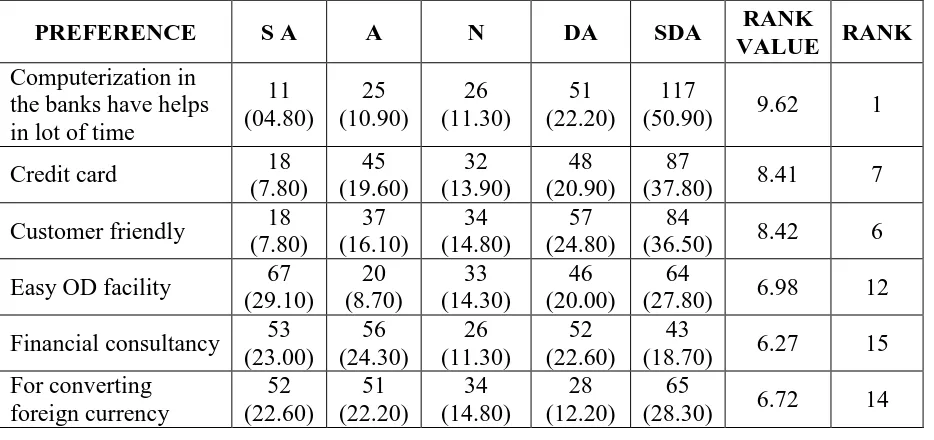
TABLE NO.1: Fried Man rank correlation regarding preference based on entrepreneurs in banking services
(SA- strongly Agree,A-Agree N- Neutral, DA- Disagree, SDA- Strongly Disagree)
PREFERENCE S A A N DA SDA RANK
VALUE RANK Computerization in
the banks have helps in lot of time
11 (04.80) 25 (10.90) 26 (11.30) 51 (22.20) 117
(50.90) 9.62 1
Credit card 18
(7.80) 45 (19.60) 32 (13.90) 48 (20.90) 87
(37.80) 8.41 7
Customer friendly 18
(7.80) 37 (16.10) 34 (14.80) 57 (24.80) 84
(36.50) 8.42 6
Easy OD facility 67
(29.10) 20 (8.70) 33 (14.30) 46 (20.00) 64
(27.80) 6.98 12
Financial consultancy 53 (23.00) 56 (24.30) 26 (11.30) 52 (22.60) 43
(18.70) 6.27 15
For converting foreign currency 52 (22.60) 51 (22.20) 34 (14.80) 28 (12.20) 65
[image:5.595.67.534.509.729.2]For easy fund transfer 35 (15.20) 73 (31.70) 20 (8.70) 44 (19.10) 58
(25.20) 6.77 13
Good customer service 39 (17.00) 33 (14.30) 21 (9.10) 66 (28.70) 71
(30.90) 7.89 10
Government undertaking 45 (19.60) 30 (13.00) 30 (13.00) 84 (36.50) 41
(17.80) 9.18 2
High revenue 26
(11.30) 17 (7.40) 36 (15.70) 67 (29.10) 84
(36.50) 8.67 5
Low processing fees 22 (9.60) 20 (8.70) 41 (17.80) 83 (36.10) 64
(27.80) 8.22 8
RTGS 33
(14.30) 22 (9.60) 34 (14.80) 69 (30.00) 72
(31.30) 8.06 9
Variety of products 19 (8.30) 13 (5.70) 34 (14.80) 82 (35.70) 82
(35.70) 8.78 4
24×7 customer care service 6 (2.60) 19 (8.30) 37 (16.10) 88 (38.30) 80
(34.80) 7.00 11
Others 9
(3.90) 24 (10.40) 31 (13.50) 78 (33.90) 88
(38.30) 9.10 3
Calculated Chi-Square value :184.822
Source: Collected and Computed through questionnaire
INTERPRETATION
Out of 230 respondents 11 (4.80) respondents strongly agree that they preference in
Computerization in the banks have helps in lot of time, 25 (10.90) respondents agree that they
preference in Computerization in the banks have helps in lot of time, 26 (11.30) respondents
neutrally that they preference in Computerization in the banks have helps in lot of time, 51
(22.20) respondents disagree that they preference in Computerization in the banks have helps
in lot of time, 117 (50.90) respondents strongly disagree that they preference
Computerization in the banks have helps in lot of time, And their mean rank is 9.62.
Out of 230 respondents 45 (19.60) respondents strongly agree that they preference in
Government undertaking, 30 (13.00) respondents agree that they preference in Government
undertaking, 30 (13.00) respondents neutrally that they preference in Government
undertaking, 84 (36.50) respondents disagree that they preference in Government
undertaking, 41 (17.80) respondents strongly disagree that they preference Government
undertaking, And their mean rank is 9.18.
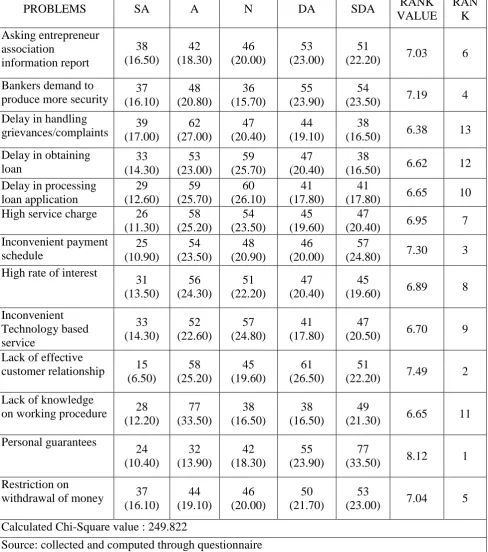
TABLE NO.2: Fried Man rank correlation regarding problems based on entrepreneurs in banking services
PROBLEMS SA A N DA SDA RANK
VALUE RAN K Asking entrepreneur association information report 38 (16.50) 42 (18.30) 46 (20.00) 53 (23.00) 51
(22.20) 7.03 6
Bankers demand to
produce more security (16.10) 37 (20.80) 48 (15.70) 36 (23.90) 55 (23.50) 54 7.19 4
Delay in handling
grievances/complaints (17.00) 39 (27.00) 62 (20.40) 47 (19.10) 44 (16.50) 38 6.38 13
Delay in obtaining loan 33 (14.30) 53 (23.00) 59 (25.70) 47 (20.40) 38
(16.50) 6.62 12
Delay in processing loan application 29 (12.60) 59 (25.70) 60 (26.10) 41 (17.80) 41
(17.80) 6.65 10
High service charge 26
(11.30) 58 (25.20) 54 (23.50) 45 (19.60) 47
(20.40) 6.95 7
Inconvenient payment schedule 25 (10.90) 54 (23.50) 48 (20.90) 46 (20.00) 57
(24.80) 7.30 3
High rate of interest
31 (13.50) 56 (24.30) 51 (22.20) 47 (20.40) 45
(19.60) 6.89 8
Inconvenient Technology based service 33 (14.30) 52 (22.60) 57 (24.80) 41 (17.80) 47
(20.50) 6.70 9
Lack of effective
customer relationship 15 (6.50) 58 (25.20) 45 (19.60) 61 (26.50) 51
(22.20) 7.49 2
Lack of knowledge
on working procedure 28 (12.20) 77 (33.50) 38 (16.50) 38 (16.50) 49
(21.30) 6.65 11
Personal guarantees 24 (10.40) 32 (13.90) 42 (18.30) 55 (23.90) 77
(33.50) 8.12 1
Restriction on
withdrawal of money 37
(16.10) 44 (19.10) 46 (20.00) 50 (21.70) 53
(23.00) 7.04 5
Calculated Chi-Square value : 249.822
Source: collected and computed through questionnaire
INTERPRETATION
Out of 230 respondents 24 (10.40) respondents strongly agree that they problems in
[image:7.595.56.545.98.651.2]personal guarantees, 42 (18.30) respondents neutrally that they problems in entrepreneurs
personal guarantees, 55 (23.90) respondents disagree that they problems in entrepreneurs
personal guarantees, 77 (33.50) respondents strongly disagree that they problems in
entrepreneurs personal guarantees, And their mean rank is 8.12.
Out of 230 respondents 15 (6.50) respondents strongly agree that they problems in
lack of effective and customer relationship, 58 (25.20) respondents agree that they problems
in lack of effective and customer relationship, 45 (19.60) respondents neutrally that they
problems in lack of effective and customer relationship, 61 (26.50) respondents disagree that
they problems in lack of effective and customer relationship, 51 (22.20) respondents strongly
disagree that they problems in lack of effective and customer relationship, And their mean
rank is 7.49.
Out of 230 respondents 25 (10.90) respondents strongly agree that they problems in
handling inconvenient payment schedule, 54 (23.50) respondents agree that they problems in
inconvenient payment schedule, 48 (20.90) respondents neutrally that they problems in
inconvenient payment schedule, 46 (20.00) respondents disagree that they problems in
inconvenient payment schedule, 57 (24.80) respondents strongly disagree that they problems
inconvenient payment schedule, And their mean rank is 7.30.
Out of 230 respondents 37 (16.10) respondents strongly agree that they problems in
bankers demand to produce more security, 48 (20.80) respondents agree that they problems in
bankers demand to produce more security, 36 (15.70) respondents neutrally that they
problems in bankers demand to produce more security, 55 (23.90) respondents disagree that
they problems in bankers demand to produce more security, 54 (23.50) respondents strongly
disagree that they problems bankers demand to produce more security, And their mean rank
is 7.19.
Chi-Square (249.822) the entrepreneurs preference and banking services is differs
FINDINGS
Chi-Square (184.822) the entrepreneur’s preference and banking services are differs.
SUGGESTIONS
i) It is understand from study, the private sector banks and foreign banks are leading the
public sector banks, in terms of better customer service due their strength in speed and
accuracy of conducting bank transaction. Hence the public sector banks can enhance
the speed and accuracy by adopting core banking technology. The speed of the
transaction of SBI has increased by over the folds. All due to the introduction of the
new core banking technology. Since the adoption of core banking technology by SBI
in 2003, the bank has visualized over 60% like in its customer accounts. Only
nationalized banks provide subsidies to the entrepreneurs.
Problems
ii) Majority of the respondents in Tiruppur District feel that they services charges are
high and irrational. The bank should take steps to reconsider the charges for various
banking services including credit card facility. This would increase the scope for high
utilization of banking services by the entrepreneurs in Tiruppur district.
iii) Every bank in Tiruppur district should form a proper “Customer complaint cell”. The
cell should work out an effective strategy to clear these complaints. Main work of this
cell would be customer feedback and entrepreneur satisfaction determination.
Majority of the respondents opinion that collateral security insisted by the lending
institution is not clear to them. There is no clear information available to the MSME
Entrepreneurs regarding the type of collateral security insisted by the lending institution for
loan under different schemes. As there is no specific norm available to the lending institution
regarding the type of asset reviled as collateral and the value of the asset insisted for different
schemes prevailing to MSMEs entrepreneurs for
REFERENCES
BOOKS
2. Kotler. P, “Marketing Management”, 11th Edition, Pearson Education, New Delhi, 2002.
3. Richard I. Levin and David S. Rubin, “Statistics for Management” 7th Edition, Pearson Education, 2002.
4. Sharma. D.D., “Marketing Research”, Second Edition, Sultan Chand & Sons, New Delhi.
5. Kinnear and Taylor, “Marketing Research”, Millennium Edition, Tata McGraw- Hill Publishing Company Ltd, New Delhi.
6. Subbarao. P.S, “Entrepreneurship and Small Business Management”. Discovery publishing House, New Delhi, 2001.
7. Vasant Desai, “Small Scale Industries – Promotional Policies and Strategies”. Vol–7,
Himalaya Publishing House, Mumbai, 1999
8. Raju. K.D, “Small and Medium Enterprises (SMEs): Past, Present and Future in India”.
JOURNALS AND REPORTS
1. Anamalai S and buvaneshwari. P (2010) “studied that the Overall Performance of Private sector Banks” Facts for you vol. 30, No.10, July, pp.22-28.
2. Gayathribalakrishnan .R (2010)“Awareness level of Customer about Banking Service offered by both the Private sector and Public sector Banks” Southern Economist,vol. 19, may -15 2010, pp.13-16
3. Poojameengi (2009) “Customer Satisfaction with Regard to Service Quality of Public sector and Private sector Banks”The Indian Journal of Management Researchaugust vol.viii. No9, pp.7-15
WEBSITES
http://www.tradeindia.com/newsletters/special_report/tips_13_feb_2007.html
http://smesummit.smechamberofindia.com/Preamble.aspx
www. nisc.com
www.ediindia.ac.in
http://www.businessworld.in/news/more/advertising-features/government-for-the-smes/391707/page-1.html
http://www.smeworld.org/story/government-schemes/government-schemes-sme.php