©Electronic Publishing House
SECTIONS OF SIMPLICES
NAGABHUSHANA PRABHU
(Received 28 August 1995 and in revised form 10 October 1995)
Abstract.We show that for d/2 ≤k≤d, the relative interior of every k-face of a
d-simplex∆dcan be intersected by a 2(d−k)-dimensional affine flat. Bezdek, Bisztriczky, and Connelly’s results [2] show that the conditionk≥ d/2above cannot be dropped and hence raise the question of determining, for all 0≤k,j < d, an upper bound on the functionc(j,k;d), defined as the smallest number ofj-flats,j < d, needed to intersect the relative interiors of all thek-faces of∆d. Using probabilistic arguments, we show that
C(j,k;d)≤
d+1
k+1
w+1
k+1 log
d+1
k+1
, wherew=min
max j
2
+k,j
,d
. (∗)
Finally, we consider the functionM(j,k;d), defined as the largest number ofk-faces of ∆d whose relative interiors can be intersected by aj-flat. We show that, for largedand for allksuch thatk+j≥d,M(j,k;d)≤f3j/4−1(d+1,j), wherefm(n,q)is the number ofm-faces in a cyclicq-polytope withn-vertices. Our results suggest a conjecture about face-lattices of polytopes that if proved, would play a useful role in further studies on sections of polytopes.
Keywords and phrases. Simplex, polytope, face-lattice.
1991 Mathematics Subject Classification. 05B35, 52B05, 52B11, 52B30, 52C07.
1. Introduction. A class of problems of continuing interest concerns studying the intersection of an affine flat with the boundary complex of ad-polytope (hereafter called a section of thed-polytope). A diverse body of results about this class of prob-lems has been reported in the literature. O’Neil studied the popular problem of de-termining themaximum number of edges of a d-cube that a hyperplane ofRd can cutand proved a lower bound of(d−d/2)d/d2
[7] (see [3] for follow-up work on this problem). Khovanskii [5] showed that if a hyperplaneHintersects ad-polytopeP (andH+andH−are the two closed halfspaces ofH), then there exists two faces ofP, F1∈H+andF2∈H−such that dim(F1)+dim(F2)≥d−1. Bezdek et al. showed that a hyperplane can intersect the relative interiors of all thek-faces ofd-polytope only if d/2 ≤k[2]. For other results, see [1, 4, 6, 8].
are represented as sections of standard simplices. Yet, surprisingly, little is known about the geometric and combinatorial properties of sections of simplices.
In this paper, we study sections of simplices. Specifically, we show that the relative interiors of all thek-dimensional faces of ad-dimensional simplex,k≥ d/2, can be intersected by an affine flat of dimension 2(d−k)(hereafter, whenever we talk of a flat intersecting a face, we mean that the flat intersects the relative interior of the face even when the term relative interior is dropped). The result yields a counter-intuitive fact that the relative interiors of all the facets of anyd-simplex can be intersected by a 2-dimensional plane. Bezdek, Bistriczky, and Connelly’s result (mentioned above) shows that the restrictionk≥ d/2cannot be dropped from our result. In light of Bezdek, Bisztriczky, and Connelly’s lower bound and our result, an important problem is to determine, for all 1≤j, k < d, the functionC(j,k;d), defined as the smallest number ofj-flats needed to intersect the relative interiors of all thek-faces of ad-simplex. Using probabilistic arguments, we prove the following fairly nontrivial upper bound onC(j,k;d). Let
w=min
max
j
2
+k,j
,d
. (1)
Then for 1≤k,j < d,
C(j,k;d)≤
d+1
k+1
w+1
k+1
log
d+1
k+1
. (2)
Another important problem is to determine, for all 1≤k,j < d, the functionM(j,k;d), defined as the largest number ofk-faces of ad-simplex whose relative interiors can be intersected by aj-flat. Using the above definition ofw, one easily obtains the lower bound
w+1
k+1
≤M(j,k;d) (3)
onM(j,k;d). More interestingly, though, for larged(d > d0)andk+j≥d, we show that the following is a tight upper bound onM(j,k;d).
M(j,k;d)≤f3j/4−1(d+1,j), (4) wherefm(n,q)is the number ofm-faces in a cyclicq-polytope withn-vertices. A tight upper bound forM(j,k;d)whenk+j < dis less tractable. We discuss the source of difficulty whenk+j < dand conclude the paper with some observations about this case and a conjecture about face lattices of polytopes, that if true, would play a useful role in the study of sections of polytopes.
2. Cutting faces of a fixed dimension. For a discussion of the properties of a cyclic polytope used in the proof of the following theorem, the reader is referred to [4].
Proof. LetTdbe the standardd-simplex,
∆d=
Y1,...,Yd+1∈Rd+1
d+1 i=1
Yi=1,Yi≥0, i=1,...,d+1
(5)
andP⊂Rn anyn-dimensional polytope withd+1 facets(n < d+1)that is repre-sented as
P=X∈RnX,Ni ≤1;i=1,...,d+1, (6)
whereNi’s are the normals to the facets and,denotes dot product.
A classic theorem on sections [8, Thm. 12, p. 58] states that there exists ann -dimensional affine flatL⊂Rd+1such thatPis projectively and hence combinatorially equivalent to the polytopeL∩Td. In fact,Lis the image ofRn under the following mapTp:Rn→Rd+1,
Tp(X)=
(1−N1,X),...,(1−Nd+1,X) (d+1)−d+i=11Ni,X
=
1 −N1 ..
. ... 1 −Nd+1
1 X1
.. . Xn
(d+1)−d+i=11Ni,X
, (7)
whereNi’s are treated as row vectors.
Now, takePto be a 2m-polytope combinatorially isomorphic to a dual-cyclic 2m -polytope withd+1 facets. A cyclic 2m-polytope ism-neighborly, i.e., every subset ofmvertices of a cyclic 2m-polytope forms a face. Therefore, in the dual-cyclic 2m -polytope, every subset ofmfacets intersects in a face. Further, in a dual-cyclic 2m -polytope, the intersection of every k facets, 1≤k≤ m, is a (2m−k)-face. Thus, every subset ofj facets of the dual-cyclic 2m-polytopeP, 1≤j≤m, intersects in a (2m−j)-dimensional face ofP. SincePis assumed to haved+1 facets, the number of(2m−j)-faces ofP, 1≤j≤m, isd+1
j
.
Observe thatTPmaps the relative interior of every(2m−j)-face ofPinto the relative interior of a(d−j)-face of∆d. IfF is a(2m−j)-face ofP that is the intersection of facets with normalsN1,...,Nj say, then inTP(F),Y1= ··· =Yj=0. Hence,TP(F)is contained in the(d−j)-face of∆dthat is the intersection of the facetsY
1=0,...,Yj= 0. The foregoing argument also shows that the relative interiors of any two distinct (2m−j)-faces ofPare mapped into the relative interiors of two distinct(d−j)-faces of∆d.
Since the number of(2m−j)-faces ofPequals the number of(d−j)-faces of∆dfor 1≤j≤m, we conclude that the 2m-flatL=TP(R2m)intersects the relative interiors of all the(d−j)-faces of∆dfor 1≤j≤m.
Now, if we setm=d−k, then 1≤j≤mimplies thatd−j≥k. Hence, the 2(d−k) -flatLintersects the relative interiors of all the faces of dimensionkand higher in∆d, which proves the theorem for the standard simplex∆d.
As mentioned earlier, for k ≤ d/2, it follows from Bezdek, Bisztriczky, and Connelly’s result [2] that no proper affine subspace ofRd can intersect the relative interiors of all thek-faces of ad-simplex. Therefore, an important problem is to de-termine for all 0≤k,j < d, the functionC(j,k;d), defined as the smallest number of j-flats,j < d, needed to intersect the relative interiors of all thek-faces of∆d. Using probabilistic arguments, we prove
Theorem2.
C(j,k;d)≤
d+1
k+1
w+1
k+1
log d+1
k+1
, (8)
where
w=min
max
j
2
+k,j
,d
. (9)
Proof. From Theorem 1, we see that forwas defined above, the relative interiors of all thek-faces contained in aw-face of∆dcan be intersected by aj-flat. Since every k-face in anyw-face of∆d can be intersected byonej-flat, an upper bound on the number ofw-faces needed to cover all thek-faces of∆dyields an upper bound on the number ofj-flats needed to intersect all thek-faces of∆d. In the following, we show thatd+1
k+1
w+1 k+1
logd+1 k+1
w-faces suffice to cover all thek-faces of∆d thereby proving the theorem.
LetV= {v0,...,vd}be the vertex-set of∆d. Every subset ofw+1 of thed+1 vertices ofVdetermines aw-faceWwhich containsw+1
k+1
k-faces of∆d. Letᐃ= {W1,...,Wr} be anr-collection ofw-faces of∆d, where Wi,1≤i≤r, are chosen randomly and independently from among thed+1
w+1
w-faces of∆d;W
1,...,Wrneed not all be distinct. Consider an arbitraryk-face ofKof∆d. Let ˜Wbe an arbitraryw-face of∆d( ˜Wneed not necessarily belong to ᐃ). Then the probability that the w-face ˜W contains the k-faceKis
pk⊂W˜=
d−k
w−k
d+1
w+1
=(d−(w−k)k)!(d−!(d−w)w)!!(w(d++11))!!
=(d(w−−k)k)!(w!(d++11))!!(k(k++11))!!=
w+1
k+1
d+1
k+1
.
(10)
Therefore,
PK⊂W˜=1−
w+1
k+1
d+1
k+1
. (11)
P(K⊂W1)∧···∧(K⊂Wr)= 1−
w+1
k+1
d+1
k+1 r . (12)
Label thek-faces of∆d,K
1,...,Kd+1 k+1
. LetAibe the event thatKidoes not belong to
any of thew-faces ofᐃ, 1≤i≤d+1 k+1
. Then the probability that a randomly chosen r-collection ofw- facesᐃdoes not contain at least onek-face is
P
A1∨···∨Ad+1 k+1
≤d+1 k+1
1−
w+1
k+1
d+1
k+1
r . (13)
Therefore, ifP
!
A1∨···∨Ad+1 k+1
"<1, thenP!A¯
1∧···∧A¯d+1 k+1
">0 and hence some
r-collection ofw-faces must cover all thek-faces of∆d. ¯Aidenotes the complement of the eventAi. Thus, we want
d+1
k+1 1−
w+1
k+1
d+1
k+1 r
<1 or rln
1−
w+1
k+1
d+1
k+1
+ln
d+1
k+1
<0 (14)
or
r >
−lnd+k+11
ln1−wk++11#d+k+11
. (15)
The direction of the inequality is changed in equation (15) since, forw < d,w+1 k+1 < d+1 k+1 and hence ln 1−
w+1
k+1
d+1
k+1
<0. (16)
For 0< x <1,−ln(1−x)≥xsincef (x)=e−x−1+x≥0 for 0< x <1(f (0)=0 and f(x) >0 for 0< x <1). Hence,
r > ln
d+1
k+1
w+1
k+1
#d+1
k+1
⇒r >
−ln
d+1
k+1
ln
1−
w+1
k+1
#d+1
k+1
Therefore, for anyr >d+1 k+1
w+1 k+1
lnd+1 k+1
,P
¯
A1∧···∧A¯d+1 k+1
>0 and hence
there exists a collection ofd+1 k+1
w+1 k+1
lnd+1 k+1
w-faces of∆dwhich covers all the k-faces of∆dwhose relative interiors can be intersected by aj-flat.
From the discussion at the beginning of the proof of Theorem 2, we obtain the lower bound
w+1
k+1
≤M(j,k;d), (18)
(see the statement of Theorem 2 for the definition ofw). In the following, we prove a nontrivial upper bound onM(j,k;d). Fork+j≥d(and only whenk+j ≥d), we can assume, without loss of generality, that anyj-flat J intersecting thek-faces of∆d actually intersects thek-faces in general position. That is
Lemma1. For everyj-flatJ, 1≤j < d, there exists another j-flat˜J(obtained by perturbingJ) such that fork≥(d−j),
(1) ˜Jintersects the relative interiors of ak-face of∆dif and only ifJdoes. (2) If˜Jintersects the relative interiors of ak-faceK, thendim(˜J∩K)=k+j−d.
Proof. Thej-flat J can be represented as the solution set of a system ofd−j equations indvariables, i.e.,
j=$x∈Rd|Ax=b;A:(d−j)×dmatrix; rank(A=d−j)%. (19)
Let{K1,...,Kr}be the set of all thek-faces whose relative interiors are intersected by J. LetSibe the affine span ofKi, 1≤i≤r. ThenSican be represented as a system of d−klinear equation indvariables. Let
Si=x∈Rd|Cix=αi, (20)
whereCiis a(d−k)×dmatrix and rank(Ci)=d−k.
SinceJ∩Si=x∈Rd|Ax=b;Cix=αi}, dim(J∩Si)=d−rank&A Ci
'
.Hence, dim(J∩Si)=dim(J∩Ki)=k+j−dif and only if the rank of the matrixMi=A
Ci
= (d−k)+(d−j)=the number of rows inMi.
Clearly, by an infinitesimal perturbationδA, one can ensure that ˜M=A+δA Ci
has rank(d−j)+(d−k)for all 1≤i≤r. Further, since the solution set J depends contin-uously on the entries inA, if the absolute value of each element ofδAis bounded by a sufficiently small+ >0 and
˜J=x∈Rd|(A+δA)x=b, (21)
then ˜J∩relative interior(Ki)= ∅for 1≤i≤r.
The restrictionk+j−d≥0 in the statement of the lemma cannot be done away with because ifk+j < d, then the(2d−k−j)×dmatrixMi(see above) would have more rows than columns. Therefore, in the system of equations
if the rows ofAare perturbed to include full row-rank in the matrixM, the resulting system could become inconsistent. In order to make an inconsistent system consis-tent, the right-hand side constants need to be perturbed and the required perturba-tions of the right-hand side constants may not be small enough to ensure that ˜J will continue to intersect the relative interior of everyk-face that is intersected by J. The restrictionk+j−d≥0 in Lemma 1 carries over to the following Theorem 3. The prob-lem of proving Theorem 3 whenk+j < dis harder and we present some observations about the following Theorem 3.
Theorem3. For largedand for allksuch thatk+j≥d,
M(j,k;d)≤f3j/4(d+1,j). (23) Proof. To determineM(j,k;d), it is sufficient to restrict our attention to thej -flats that intersect the interior of∆d (if the j-flat does not intersect the interior of ∆d, then it intersects the relative interiors of only thek-faces that are contained in a proper subface of∆d. However, clearly,M(j,k;d
1)≤M(j,k;d2)ifd1≤d2). Let J be a j-flat intersecting the interior of∆d. Then
P=J∩∆d (24)
is aj-polytope.
If thej-flat J intersects the relative interior of ak-face K of∆d, then from Lemma 1, we may assume, without loss of generality, that dim(K∩J)=k+j−d. Therefore, the number ofk-faces of∆d whose relative interiors are intersected by thej-flat J is at most the number of(k+j−d)-faces in P. Now, P has at mostd+1 facets as the following argument shows. IfF is any facet of∆dandHthe hyperplane determined byF, thenH∩Pis a face of P (possibly empty). Hence,Hcan contain at most one facet of P. Repeating this argument for thed+1 facets of∆d, the claim follows. Therefore, we conclude thatM(j,k;d)is at most the number of(k+j−d)-faces in aj-polytope with d+1 facets. Dually,M(j,k;d)is at most the number of(d−k−1)-faces in a j-polytope withd+1 vertices. By the Upper Bound Theorem, we conclude that
M(j,k;d)≤fd−k−1(d+1,j), (25) wherefd−k−1(d+1,j)is the number of(d−k−1)-faces in a cyclic j-polytope with d+1 vertices. In order to determine an upper bound valid for allk(i.e., independent of k), we need to maximize the functionfd−k−1(d+1,j)with respect tok. Unfortunately, even though explicit formulae are known forfm(n,j)for all values ofm,n, andj, the problem of maximizingfd−k−1(d+1,j)with respect tokis not tractable. However, in the largedlimit, we can determine the maximum offd−k−1(d+1,j)with respect tok as follows.
We have
ft(n,2m)= m
r=1 n n−4
n−r
r
r
t+1−r
= m
r=1
n(n−r−1)(n−r−2)···(n−2r+1) r!
r
t+1−r
, 0≤t≤2m−1,
ft(n,2m+1)=m r=0
t+2 n−4
n−r
r+1
r+1
t+1−r
= m
r=0
(t+2)(n−r−1)(n−r−2)···(n−2r ) (r+1)!
r+1
t+1−r
, 0≤t≤2m.
(27) Bothft(n,2m)andft(n,2m+1)can be viewed as polynomials ofnwhose coefficients are functions oftandm. In order to determine thetat whichft(n,2m)andft(n,2m+ 1)are maximized for largen, we need to maximize the coefficient of the leading term in the polynomials with respect tot.
The coefficient of the leading term inft(n,2m)is 1
m!
(
m t+1−m
)
, (28)
which is maximized att+1−m= m/2or att=m−1+m/2. On the other hand, the coefficient of the leading term inft(n,2m+1)is
(t+2) (m+1)!
(
m+1 t+1−m
)
=(m+(t+21))!
(
m+1 (t+2)−(m+1)
)
, (29)
which is maximized at(t+2)−(m+1)= (m+1)/2ort=m−1+(m+1)/2(it is easy to verify thatxx−yy
is maximized atx=y−y/2). To summarize, if for large n,ftmax(n,s)≥fi(n,s), 0≤i≤s−1, then
tmax=
m−1+.m 2
/
, ifs=2m,
m−1+
.m+1
2
/
[image:8.516.73.426.74.144.2], ifs=2m+1. (30)
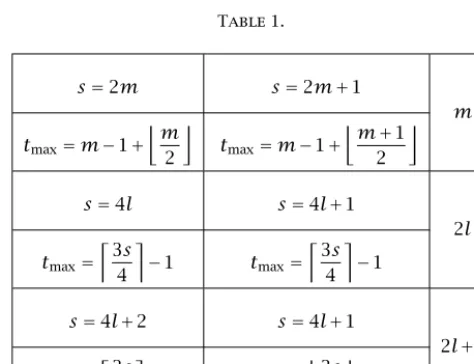
Table 1 expressestmaxin terms of the dimensions. Table1.
s=2m s=2m+1
m tmax=m−1+
m
2
tmax=m−1+
m+1
2
s=4l s=4l+1
2l tmax=
.3s
4
/
−1 tmax=
.3s
4
/
−1
s=4l+2 s=4l+1
2l+1 tmax=
.3s
4
/
−1 tmax=
3s
4
−1
[image:8.516.131.368.426.608.2]the above table for precision.
Recall from an earlier discussion thatM(j,k;d)≤fd−k−1(d+1,j). The above argu-ment shows thatfd−k−1(d+1,j)is maximized ford−k−1∼(3j/4)−1 for larged,
M(j,k;d)≤f(3j/4)−1(d+1,j). (31) Given aj < d, one can find aksuch thatM(j,k;d)attains the upper bound in (31) as follows. Consider a dual-cyclicj-polytope withd+1 facetsC∗(d+1,j). From the proof of Theorem 1, we see that whenC∗(d+1,j)is realized as the intersection of aj-flat J with∆d, the((3j/4)−1)-faces ofC∗(d+1,j)are realized as the intersections of J with the(d−(j/4)−1)-faces of∆d. Settingk=d−(j/4)−1, we see that J intersects f(3j/4)−1(d+1,j) k-faces of∆d, which proves the tightness of the bound in (31).
The requirement thatk+j≥dis crucial in the proof of Theorem 3. Whenk+j < d, ifK1andK2are twok-faces of∆dintersected by aj-flat J, then observe that although J∩K1 andJ∩K2 are not in general(k+j−d)-faces of the j-polytope P=J∩∆d (see the discussion following Lemma 1), they areincomparablefaces of P (recall that two faces of a polytope are said to be incomparable if neither is contained in the other). Hence, we conclude thatM(j,k;d)is bounded above by the size of the largest set of incomparable faces in a j-polytope with at most d+1 facets. In the lattice terminology, a set of incomparable elements in a lattice is called anantichain. Thus, stated differently,M(j,k;d)is bounded by the size of the largest antichain in the face lattice of aj-polytope with at mostd+1 facets. IfQis ann-polytope withf-vector f (Q)=(f0,...,fn−1), then definefmax(Q)=max{fi(Q)|0≤i≤n−1}.
Conjecture1. The size of the largest antichain in the face lattice of ann-polytope withvvertices is at mostfmax(C(v,n)), whereC(v,n)is the cyclicn-polytope withv vertices.
The conjecture, if proved, would imply (together with the asymptotic value of fmax(C(v,n))computed in the proof of Theorem 3) thatM(k,j;d)≤f(3j/4)−1(C(d+ 1,j))for largedeven whenk+j < d.
3. Unresolved problems. In conclusion, we summarize some of the unresolved problems concerning the sections of simplices. We do not believe that the upper bound on C(j,k;d)is tight. Obtaining tight upper and lower bounds on C(j,k;d)appear to be very interesting problems geometrically. Apart from the conjecture mentioned above, the problem of obtaining a tight upper bound onM(j,k;d)which is valid for alldremains open. Finally, while thef-vector of a cyclicd-polytope is shown to peak around(3d/4)−1 when the number of vertices is large, location of the maximum in thef-vector for small vertex-numbers is not well known although explicit formulae are available for the numbers of faces of every dimension in a cyclic polytope.
Acknowledgement. This work was supported in part by an NSF Research Initia-tion Award.
References
[2] K. Bezdek, T. Bisztriczky, and R. Connelly,On hyperplanes and polytopes, Monatsh. Math. 109(1990), no. 1, 39–48. MR 91e:52015. Zbl 712.52012.
[3] M. R. Emamy K.,On the cut-number of the5-cube, Congr. Numer.72 (1990), 179–186, Proceedings of the Twentieth Southeastern Conference on Combinatorics, Graph Theory, and Computing (Boca Raton, FL, 1989). MR 91b:05063. Zbl 706.05039. [4] B. Grünbaum,Convex polytopes, Interscience Publishers John Wiley & Sons, Inc., New York,
1967. MR 37#2085. Zbl 163.16603.
[5] A. G. Khovanskii,Hyperplane sections of polyhedra, toric varieties and discrete groups in Lobachevskii space, Funktsional. Anal. i Prilozhen 20(1986), no. 1, 50–61, 96 (Russian). MR 87k:22015.
[6] P. Kleinschmidt and U. Pachner,Shadow-boundaries and cuts of convex polytopes, Mathe-matika27(1980), no. 1, 58–63. MR 82d:52006. Zbl 428.52004.
[7] P. E. O’Neil,Hyperplane cuts of ann-cube, Discrete Math.1(1971;1972), no. 2, 193–195. MR 45 1043. Zbl 218.05003.
[8] G. C. Shephard,Sections and projections of convex polytopes, Mathematika19(1972), 144– 162. MR 47 4142. Zbl 258.52006.