Copyright © 2003, American Society for Microbiology. All Rights Reserved.
Acquisition and Duration of Vancomycin-Resistant Enterococcal
Carriage in Relation to Strain Type
E. M. Mascini,
1* K. P. Jalink,
1T. E. M. Kamp-Hopmans,
1H. E. M. Blok,
1J. Verhoef,
1M. J. M. Bonten,
1,2and A. Troelstra
1Department of Hospital Hygiene and Infection Prevention, Eijkman-Winkler Centre for Microbiology, Infectious
Diseases, and Inflammation,1and Acute Internal Medicine and Infectious Diseases, Division of Internal
Medicine and Dermatology,2University Medical Center Utrecht, Utrecht, The Netherlands
Received 13 February 2003/Returned for modification 30 April 2003/Accepted 20 June 2003
In May 2000, the first outbreak of vancomycin-resistantEnterococcus faecium(VREF) was detected in the
University Medical Center Utrecht in the nephrology ward. The question arose why some VREF strains spread among hospitalized patients, whereas other strains do not. Thirty patients who were found to be colonized with VREF between May and November 2000 were included in the study. Molecular typing confirmed that 19 of
them carried an identical epidemic strain which harbored theespgene while 11 were colonized by nonepidemic
strains that were allespnegative. Acquisition of the outbreak strain was significantly associated with diabetes
mellitus, renal transplantation, and extensive use of antibiotics, especially cephalosporins, in the 2-month period before the first isolation of VREF. To establish the duration of colonization, prospective surveillance of VREF carriage for a 6-month period starting from the first isolation of VREF was realized for 20 patients. After 6 months, VREF was still recovered from 60% of carriers of the outbreak strain versus 20% of carriers of
nonepidemic strains (P< 0.01). However, antibiotic use during the follow-up period was significantly higher
by carriers of the outbreak strain than by carriers of nonepidemic strains. The fact that the outbreak strain was recovered for a longer period of time than nonepidemic strains may facilitate dissemination of the strain. The results support a careful restrictive antibiotic policy for wards at risk for spread of VREF and
implemen-tation of isolation precautions for patients who are colonized withesp-positive outbreak strains.
Transmission of vancomycin-resistantEnterococcus faecium
(VREF) among patients has been an increasing problem in many American hospitals since the nineties, which mirrors the emergence of methicillin-resistantStaphylococcus aureus. Es-pecially in immunocompromised hosts, VREF strains are im-portant causative agents of nosocomial infections. Such infec-tions are difficult to treat, since VREF strains are no longer susceptible to most antibiotics (7, 23). Therefore, stringent infection control guidelines were recommended by the Centers for Disease Control and Prevention in 1994 to prevent noso-comial spread of VREF (17).
Remarkably, the epidemiology of VREF in the United States is distinct from that in Europe. In The Netherlands, as in other European countries, VREF outbreaks have been re-ported considerably less frequently than in the United States, but carriage of VREF among healthy individuals in the com-munity is not unusual in Europe (13, 28). This phenomenon has been ascribed to the use of the vancomycin analogue avoparcin as a growth promoter in the livestock industry until it was banned by the European Union in 1997 (27). In the United States, where the use of avoparcin has never been allowed, VREF strains are not recovered from nonhospitalized individuals and rarely recovered from farm animals.
Using molecular typing, it was shown that outbreak strains isolated from hospitalized patients are genetically different
from VREF strains present in the fecal flora of nonhospital-ized individuals (29). Interestingly, strains recovered from non-hospitalized persons are genetically related to pig isolates (29). In addition, hospital outbreak strains are distinguished by the presence of the variant esp gene (30). This espgene, which encodes a surface protein, was first identified inEnterococcus
faecalisisolates and has been associated with increased
viru-lence (26).
In May 2000, we experienced the first VREF outbreak in our institute (24). It is not known what determines why some VREF strains spread among hospitalized patients, whereas other strains which circulate in the community do not. In this study, we characterized the epidemiology of colonization with the outbreak strain, comparing risk factors for acquisition of the outbreak strain versus nonepidemic VREF strains. In ad-dition, VREF colonization was monitored in carriers of both the outbreak strain and nonepidemic VREF strains for a 6-month period starting from the date of first isolation of VREF, since several studies have demonstrated that many patients colonized by VREF became persistent fecal carriers, especially those who received antibiotic therapy (6, 10, 19, 22).
MATERIALS AND METHODS
Setting and patients.The University Medical Center Utrecht is a 1,042-bed tertiary care center, where the first VREF outbreak was detected in May 2000. Most patients who were found to be colonized by the outbreak strain were hospitalized in the nephrology ward or were visitors to the hemodialysis ward, but patients with the outbreak strain were also identified in the medical intensive care unit, the neurosurgical ward, and miscellaneous wards (24). The guidelines implemented to prevent nosocomial spread of VREF were based on Hospital Infection Control Practices Advisory Committee guidelines and included sepa-rate rooms, the use of gloves and gowns, disinfection of rooms after patients were * Corresponding author. Mailing address: University Medical
Cen-ter Utrecht, Department of Hospital Hygiene and Infection Preven-tion, HP G 04.614, Heidelberglaan 100, 3584 CX Utrecht, The Neth-erlands. Phone: 31-30-2507625. Fax: 31-30-2541770. E-mail: E.M.Mascini @lab.azu.nl.
5377
on May 15, 2020 by guest
http://jcm.asm.org/
discharged, and the use of vancomycin was limited as much as possible (17). Weekly surveillance cultures were performed for all patients of the nephrology and hemodialysis wards during the outbreak. Isolation precautions were re-stricted to patients who were colonized by epidemic VREF strains; no specific measures were installed for carriers of nonepidemic VREF strains (24). Patients colonized by epidemic VREF strains were labeled in the hospital information system so that isolation precautions for these patients could be installed as soon as they entered the hospital again.
VREF-positive patients from whom follow-up cultures had been taken as part of routine surveillance during the outbreak were included in the study. In addi-tion, 38 patients who were found to be colonized by VREF during this outbreak between May and November 2000 and had been discharged from our hospital were sent a letter in which they were asked to participate in this study of VREF carriage.
Microbiology and molecular typing.Patients were screened for carriage of VREF by culturing rectal swabs in enterococcosel broth (Becton Dickinson, Cockeysville, Md.) supplemented with aztreonam (75 mg/liter) at 37°C. Upon black colorization within 48 h, the broth was subcultured on an enterococcosel agar plate (Becton Dickinson), supplemented with aztreonam and vancomycin (25 mg/liter) at 37°C for 48 h. Black colonies showing gram-positive cocci were identified as VREF by APIstrep (bioMe´rieux, Marcy l’E´toile, France) and E-test (MIC of vancomycin,ⱖ32 mg/liter; bioMe´rieux). VREF isolates were subjected to multiplex PCR to detect vancomycin-resistance genes (vangenes) and toesp
PCR as described previously (12, 30). To detect clustering, characterization of VREF isolates was performed by pulsed-field gel electrophoresis (PFGE) as described previously (1). In addition, normalized PFGE patterns were imported into BioNumerics software (version 3.0; Applied Maths, Sint-Martens-Latem, Belgium). The outbreak strain was defined as avanA-positive,esp-positiveE. faeciumstrain, which was distinguished from nonepidemic strains by PFGE, with a cutoff value of 80% genetic similarity for discrimination between distinct clusters of strains. The outbreak strain has been described in reference 30 and was designated Neth-2-1.
Risk factor analysis for VREF acquisition.Medical records from the included patients were screened for risk factors for acquisition of VREF, including anti-biotic use, medical history, invasive procedures, and length of stay. The records of patients who were carriers of the epidemic strain were compared with those of patients who carried nonepidemic strains.
Follow-up of VREF carriage.Prospective surveillance of VREF carriage was performed to study the duration of colonization. For each patient, the date of first isolation of VREF was designated day 0. For patients who were hospitalized or who were visitors to the hemodialysis ward, surveillance cultures were per-formed weekly. From then on, VREF carriage in patients was monitored for a period of 6 months. Patients who were discharged from the hospital were asked to take rectal swabs on 3 consecutive days each month for a period of 6 months. They received culture materials and an instruction letter which explained how rectal swabs should be taken. Only patients from whom at least three follow-up cultures had been obtained, including at least one culture after 22 weeks of follow-up, were included in the analysis of the follow-up study. Patients whose
last positive cultures were detected before the 22nd week of follow-up and from whom only one or two subsequent negative follow-up cultures were registered were excluded from the analysis. Follow-up of VREF carriage for both patient groups was monitored on a Kaplan-Meier curve. By the end of the follow-up period, patients were classified according to two categories: persisters and con-verters. Persons whose rectal swabs yielded the original VREF strain after 22 weeks had passed since the first isolation of VREF, whether or not alternating with negative culture results, were designated persisters. Converters were de-fined as persons from whom the last three (or more) cultures were negative. The average between the week of the last positive culture and the week of the first following negative culture was designated the week of conversion. In addition, carriage of a newly acquired VREF strain was documented. Length of stay and antibiotic use were registered during the whole follow-up period.
Statistics.Statistical analyses were performed by usingttest, Fisher’s exact test, and2tests. Multivariate analyses were performed by using logistic
regres-sion and a Cox proportional hazard model.Pvalues of⬍0.05 were considered significant. As a measure of association, relative risks were calculated with their 95% confidence limits.
RESULTS
Patients. VREF carriers from whom weekly surveillance
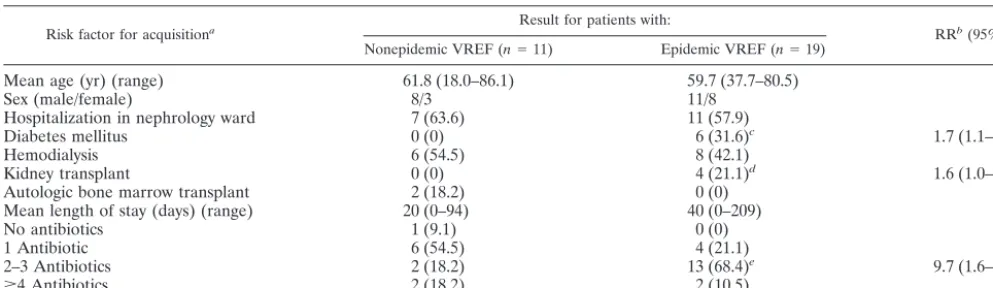
cultures were available included 11 patients at the hemodial-ysis ward and 2 patients who were hospitalized in the nephrol-ogy department. In addition, a total of 38 patients who were found to be carriers of VREF between May and November 2000 were asked to participate in this study of risk factors for acquisition of the epidemic VREF strain and of the duration of colonization with VREF. Seventeen of them responded posi-tively and were included, 18 patients did not participate, and 3 patients had died before start of the study. Thus, a total of 30 patients were included; none of them developed a clinically evident infection caused by VREF. Demographic and clinical data for these patients are given in Table 1.
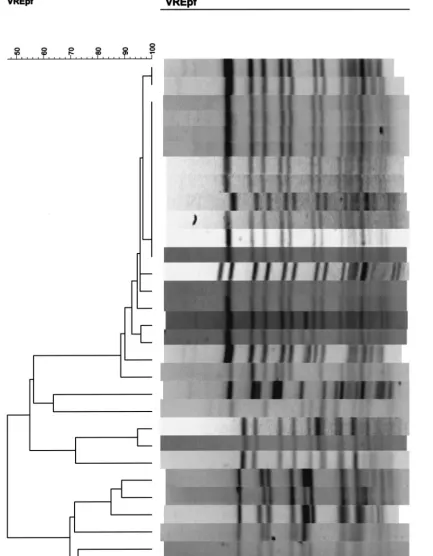
Microbiology and molecular typing.The first VREF isolates
[image:2.603.43.540.81.225.2]from all patients, all from rectal swabs, were available for analysis by PFGE and esp PCR. PFGE analysis revealed at least nine distinct major PFGE types based on a cutoff value of 80% genetic similarity for discrimination between distinct clus-ters of strains. Nineteen patients were found to be colonized by the nosocomial outbreak strain, which clustered with other epidemic genotypes according to amplified fragment length
TABLE 1. Variables in patients who contracted the outbreak strain versus patients who contracted nonepidemic strains (univariate analysis)
Risk factor for acquisitiona Result for patients with: RRb(95% CI)
Nonepidemic VREF (n⫽11) Epidemic VREF (n⫽19)
Mean age (yr) (range) 61.8 (18.0–86.1) 59.7 (37.7–80.5)
Sex (male/female) 8/3 11/8
Hospitalization in nephrology ward 7 (63.6) 11 (57.9)
Diabetes mellitus 0 (0) 6 (31.6)c 1.7 (1.1–2.6)
Hemodialysis 6 (54.5) 8 (42.1)
Kidney transplant 0 (0) 4 (21.1)d 1.6 (1.0–2.5)
Autologic bone marrow transplant 2 (18.2) 0 (0)
Mean length of stay (days) (range) 20 (0–94) 40 (0–209)
No antibiotics 1 (9.1) 0 (0)
1 Antibiotic 6 (54.5) 4 (21.1)
2–3 Antibiotics 2 (18.2) 13 (68.4)e 9.7 (1.6–59.7)
ⱖ4 Antibiotics 2 (18.2) 2 (10.5)
aUnless otherwise indicated, all data are numbers of patients, with percentages of the total number of patients indicated in parentheses. bRR, relative risk.
cP⫽0.037. dP⫽0.102. eP⫽0.008.
5378 MASCINI ET AL. J. CLIN. MICROBIOL.
on May 15, 2020 by guest
http://jcm.asm.org/
FIG. 1. PFGE patterns of VREF isolates from 30 patients. Lanes marked by asterisks represent isolates belonging to the outbreak strain; the remaining lanes represent isolates belonging to nonepidemic strains.
on May 15, 2020 by guest
http://jcm.asm.org/
polymorphism patterns (data not shown) (30). In addition, 11 patients were carriers of nonepidemic strains which were rep-resented by eight other major types (Fig. 1). All isolates which belonged to the outbreak strain harbored the esp gene, whereas this gene was present in none of the nonoutbreak isolates. All patient isolates recovered during the follow-up period were analyzed by PFGE. Each patient from whom VREF was repetitively cultured had a recurrence of coloniza-tion with a strain that was indistinguishable from the prior colonizing strain.
Risk factors for acquisition of the outbreak strain.Patients
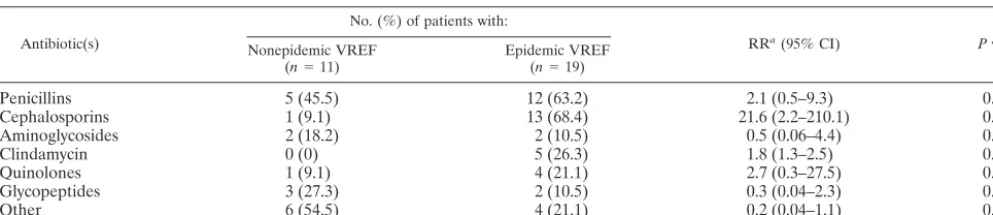
who carried the outbreak strain were compared to patients who were carriers of nonepidemic strains. The receipt of two or more antibiotics and use of cephalosporins and clindamycin during the 2 months prior to the first positive VREF culture were associated with a significantly increased risk for acquisi-tion of the outbreak strain (Table 2). In addiacquisi-tion, diabetes mellitus and renal transplantation were also significant risk factors for acquiring the outbreak strain. Two or more antibi-otics had been prescribed to 4 of 6 patients with diabetes and to 2 of 4 patients who had undergone renal transplantation. After logistic regression, only the use of cephalosporins during the 2 months prior to the first positive VREF culture was a significantly increased risk for acquisition of the outbreak strain (P⫽0.046).
Follow-up study of VREF carriage.Ten patients (9 carrying
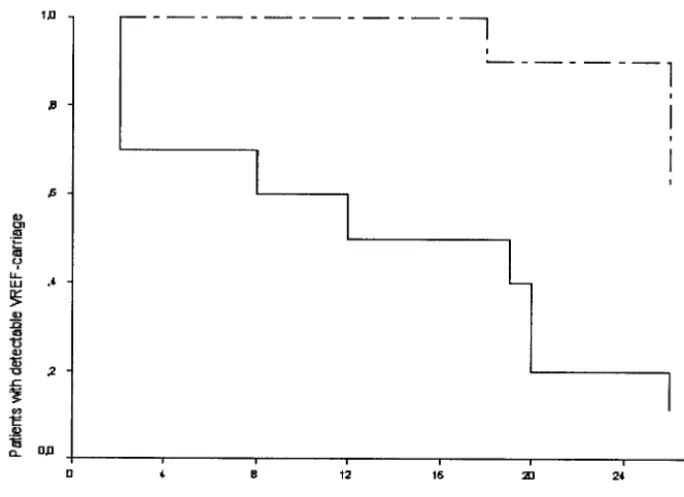
the outbreak strain and 1 carrying nonoutbreak strains) were excluded from follow-up during the study. Cultures had not been taken after 22 weeks from five patients; from three other patients, no more than two follow-up cultures were available at all; and two additional patients who showed positive follow-up cultures before the 22nd week showed only one and two sub-sequently negative cultures, respectively. Thus, 20 of 30 pa-tients fulfilled the inclusion criteria for analysis in the fol-low-up study. From patients who were colonized by the outbreak strain, an average of 10 follow-up cultures was ob-tained (range, 3 to 24) while an average of 13 follow-up cul-tures was available (range, 3 to 23) from patients who were colonized by nonepidemic strains. Forty-seven percent of all follow-up cultures from patients with the outbreak strain were positive versus 15% of all follow-up cultures from patients with nonepidemic strains. One patient who was carrying the out-break strain at time zero converted; the first negative follow-up culture was followed by a series of four negative cultures only. The remaining nine patients, persisters, had positive cultures
in the sixth month of follow-up (Fig. 2). Four of them showed intermittently positive cultures after a series of at least three consecutive negative cultures, with relapse of VREF stool car-riage after up to 15 negative cultures over a 3-month period in one patient. In addition, eight carriers of nonepidemic strains converted while the other two were classified as persisters because of positive cultures after a series of negative cultures, as shown in Fig. 2. After 6 months of follow-up, the outbreak strain was detected in significantly more patients than were nonepidemic strains (2⫽9.899;P⬍0.01). During follow-up,
patients with the outbreak strain had used significantly more antibiotics, especially cephalosporins, than patients colonized with nonepidemic strains, whereas no significant differences with regard to hospitalization were noticed between the two groups (Table 3). In a multivariate analysis using a Cox pro-portional hazard model to control for different lengths of fol-low-up, however, use of cephalosporins was not significantly associated with prolonged VREF colonization. In this model, carriage of the outbreak strain was the only significant risk factor for prolonged carriage of VREF (hazard ratio, 5.6; 95% confidence interval [CI], 1.2 to 25.7;P⫽0.028). In addition to duration of colonization with the initially cultured VREF strain, acquisition of different strain types was documented. No patient who was a carrier of the outbreak strain contracted a new, nonepidemic VREF strain, and none of the carriers of nonepidemic strains was found to be colonized by the outbreak strain over the study period.
DISCUSSION
We studied the epidemiology of colonization with a partic-ular epidemic VREF strain which clustered with other noso-comial outbreak strains and, in accordance with these strains, harbored the espgene (30). For this purpose, we compared patients who acquired the epidemic VREF strain with patients who carried nonepidemic VREF strains. We showed that ac-quisition of the outbreak strain was associated with receipt of two or more antibiotics in the 2-month period before the first isolation of VREF. In multivariate analysis, however, only pre-scription of cephalosporins was significantly associated with acquisition of the outbreak strain. Obviously, clearance of the resident flora by antibiotics was associated with cross-transmis-sion of the outbreak VREF strain between patients. In accor-dance with this, Fridkin et al., who studied acquisition of a dominant VREF strain in their hospital, reported that
acqui-TABLE 2. Antibiotic use in a 2-month period prior to the first isolation of VREF in patients who contracted the outbreak strain versus patients who contracted nonepidemic strains (univariate analysis)
Antibiotic(s)
No. (%) of patients with:
RRa(95% CI) Pvalue
Nonepidemic VREF
(n⫽11) Epidemic VREF(n⫽19)
Penicillins 5 (45.5) 12 (63.2) 2.1 (0.5–9.3) 0.346
Cephalosporins 1 (9.1) 13 (68.4) 21.6 (2.2–210.1) 0.002
Aminoglycosides 2 (18.2) 2 (10.5) 0.5 (0.06–4.4) 0.552
Clindamycin 0 (0) 5 (26.3) 1.8 (1.3–2.5) 0.062
Quinolones 1 (9.1) 4 (21.1) 2.7 (0.3–27.5) 0.397
Glycopeptides 3 (27.3) 2 (10.5) 0.3 (0.04–2.3) 0.236
Other 6 (54.5) 4 (21.1) 0.2 (0.04–1.1) 0.060
aRR, relative risk.
5380 MASCINI ET AL. J. CLIN. MICROBIOL.
on May 15, 2020 by guest
http://jcm.asm.org/
[image:4.603.45.542.90.197.2]sition of this dominant strain among other VREF strains was associated with intensity of antibiotic exposure (14). In our study, patients with diabetes mellitus or renal transplantation contracted the epidemic strain significantly more often than nonepidemic strains. Although not supported by statistical sig-nificance, prolonged hospitalization tended to be related with acquisition of the outbreak strain as well.
While our study evaluated the risk of contracting a particular outbreak strain among all patients who acquired VREF, most other studies addressed risk factors for the acquisition of any VREF strain. Several of these studies also identified antibiotic therapy, especially treatment with antianaerobic antibiotics, vancomycin, and expanded-spectrum cephalosporins (5, 11, 15–16, 20) as risk factors for acquisition of VREF. It is thought that antibiotics promote the overgrowth of VREF in the intes-tinal tract, primarily through the inhibition of intesintes-tinal anaer-obes. Interestingly, Zaas et al. found that diabetes was a risk factor for development of bloodstream infections with VREF
in patients with cancer who were colonized with VREF (31). In addition, other factors such as underlying illnesses, compliance with infection control measures, proximity to other VREF-colonized patients, and prolonged or repetitive hospitalization have been reported to affect acquisition of VREF (3, 5, 8, 16, 20, 31).
[image:5.603.119.461.70.318.2]As patients are identified, it becomes important to know the duration of colonization and when it is safe to remove patients from isolation. The Hospital Infection Control Practices Ad-visory Committee has recommended using three consecutive negative cultures, at least 1 week apart, for determining clear-ance of VREF from a previously colonized patient (17). How-ever, it is known that VREF may be detectable for a prolonged period of up to more than 2 years, sometimes despite numer-ous negative follow-up cultures (22, 25). Unrecognized silent carriage of VREF is among the most important factors leading to person-to-person dissemination in the hospital (9, 21). Therefore, patients who were colonized with the outbreak
FIG. 2. Kaplan-Meier curve of detectable VREF colonization in patients during a 6-month follow-up period starting from the first positive VREF culture. Patients who were colonized with a particular outbreak strain (dashed line) were compared to patients who carried nonepidemic strains (solid line). ThePvalue was 0.0026 by log rank analysis.
TABLE 3. Variables for patients who were colonized with the outbreak strain and patients who carried nonepidemic strains during a 6-month follow-up period starting from the first isolation of VREF
Patient variable during follow-up
Result for patients with:
RRa(95% CI) Pvalue
Nonepidemic VREF
(n⫽10) Epidemic VREF(n⫽10)
Mean length of stay (days) (range) 14.7 (0–57) 44.4 (5–181) 0.12
No. of days on antibiotic
Total 4.8 43.3 0.009
Cephalosporins 1 6 13.5 (1.2–152.2) 0.05
Clindamycin 1 3 3.8 (0.3–45.6) 0.58
Vancomycin 3 2 0.58 (0.08–4.6) 1.0
aRR, relative risk.
on May 15, 2020 by guest
http://jcm.asm.org/
[image:5.603.43.542.617.716.2]strain in our hospital were subjected to isolation precautions during the whole study period, even in the case of repetitive negative follow-up cultures.
In course of the study period, VREF strains were detectable in a decreasing number of patients. Prolonged carriage of the outbreak strain was demonstrated in significantly more carriers of the outbreak strain than in carriers of nonepidemic strains. Remarkably, seven patients who showed a series of at least three negative follow-up cultures, which even amounted to 15 over a 3-month period in one patient, were found to be VREF positive again. Obviously, observed relapses of colonization are at least partly due to the limited sensitivity of VREF culture methods (2, 9). In this respect, the rates of isolation of VREF from stool specimens have been reported to be significantly higher than from rectal swabs, and broth enrichment is recom-mended as well (9, 18). Thus, false-negative cultures may re-flect a decrease in the quantity of VREF to an undetectable level rather than true eradication.
We already showed differences between both patient groups, with more diabetics and renal transplant patients carrying the outbreak strain. Moreover, patients with the outbreak strain also received more antibiotics than patients who carried non-epidemic strains during the follow-up period. In addition, the length of stay for patients with the outbreak strain was consid-erably longer than for patients with nonepidemic strains, but this observation was not supported by statistical significance, probably due to small numbers of patients. Next to strain characteristics, these patient-related factors may affect the du-ration of colonization with VREF. In accordance, Roghman et al. showed that oncology patients with persistent and intermit-tent colonization were more likely to have received vancomy-cin during hospitalization than patients who cleared VREF (25). Byers et al. found that prolonged hospitalization, inten-sive care, and antibiotic use were each associated with pro-longed carriage of VREF (6). Other studies showed that treat-ment with antianaerobic antibiotics promoted high-density colonization in patients who were colonized by VREF (9, 11). It has been reported that VREF isolates showed little vari-ation within individual patients (4). In accordance, PFGE pat-terns of subsequent VREF patient isolates showed that none of the patients who were initially found to be colonized by the outbreak strain acquired another, nonepidemic strain within the follow-up period. In addition, none of the 11 carriers of nonepidemic strains contracted the outbreak strain during the study period, obviously due to successful implementation of isolation precautions for carriers of the outbreak strain.
Some VREF strains, which are recognized in genetic clusters and harbor the espgene, are more prone to nosocomial dis-semination than others (30). This study shows that a particular outbreak strain which belongs to this cluster (strain Neth-2-1 in reference 30) preferentially colonized patients who had been subjected to extensive antibiotic exposure and certain patient categories with underlying illnesses such as diabetes mellitus and renal transplantation. We suggest that a careful restrictive antibiotic policy should be pursued in wards at risk for the spread of VREF to prevent dissemination of epidemic VREF strains. We demonstrated that this outbreak strain was main-tained in the fecal flora of the host for a significantly longer period of time than nonepidemic strains, but we cannot ex-clude the possibility that the extensive use of antibiotics by
patients with the outbreak strain during follow-up contributed to the prolonged duration of colonization. Our results confirm that a series of three negative follow-up cultures does not guarantee elimination of VRE and support the importance of prolonged hygienic precautions for patients who are colonized by outbreak strains that harbor theespgene, especially if these patients are treated (again) with antibiotics. More studies are necessary to elucidate the relative contributions of patient-related factors, antibiotic treatment, and strain characteristics to prolonged duration of VREF colonization.
ACKNOWLEDGMENTS
We thank Armand Paauw and Mabel Beitsma for technical assis-tance.
This study was supported by CVZ/VAZ grant no. 01232.
REFERENCES
1. Antonishyn, N. A., R. R. McDonald, E. L. Chan, G. Horsman, C. E. Wood-mansee, P. S. Falk, and C. G. Mayhall.2000. Evaluation of fluorescence-based amplified fragment length polymorphism analysis for molecular typing in hospital epidemiology: comparison with pulsed-field gel electrophoresis for typing strains of vancomycin-resistantEnterococcus faecium. J. Clin. Microbiol.38:4058–4065.
2. Baden, L. R., W. Thiemke, A. Skolnik, R. Chambers, J. Strymish, H. S. Gold, R. C. Moellering, and G. M. Eliopoulos.2001. Prolonged colonization with vancomycin-resistantEnterococcus faeciumin long term care patients and the significance of “clearance.” Clin. Infect. Dis.33:1654–1660.
3. Bonten, M. J. M., S. Slaughter, A. W. Ambergen, M. K. Hayden, J. van Voorhis, C. Nathan, and R. A. Weinstein.1998. The role of “colonization pressure” in the spread of vancomycin-resistant enterococci. Arch. Intern. Med.158:1127–1132.
4. Bonten, M. J. M., M. K. Hayden, C. Nathan, T. W. Rice, and R. A. Weinstein.
1998. Stability of vancomycin-resistant enterococcal genotypes isolated from long-term-colonized patients. J. Infect. Dis.177:378–382.
5. Byers, K. E., A. M. Anglim, C. J. Anneski, T. P. Germanson, H. S. Gold, L. J. Durbin, B. M. Simonton, and B. M. Farr.2001. A hospital epidemic of vancomycin-resistantEnterococcus: risk factors and control. Infect. Control Hosp. Epidemiol.22:140–147.
6. Byers, K. E., A. M. Anglim, C. J. Anneski, and B. M. Farr.2002. Duration of colonization with vancomycin-resistantEnterococcus.Infect. Control Hosp. Epidemiol.23:207–211.
7. Centers for Disease Control and Prevention.1999. National nosocomial infections surveillance (NNIS) system report, data summary from January 1990-May 1999, issued June 1999. Am. J. Infect. Control27:520–532. 8. D’Agata, E. M. C., W. K. Green, G. Schulman, H. Li, Y.-W. Tang, and W.
Schaffner.2001. Vancomycin-resistant enterococci among chronic hemodi-alysis patients: a prospective study of acquisition. Clin. Infect. Dis.32:23–29. 9. D’Agata, E. M. C., S. Gautam, W. K. Green, and Y.-W. Tang.2002. High rate of false-negative results of the rectal swab culture method in detection of gastrointestinal colonization with vancomycin-resistant enterococci. Clin. In-fect. Dis.34:167–172.
10. Donskey, C. J., C. K. Hoyen, S. M. Das, M. S. Helfand, and M. T. Hecker.
2002. Recurrence of vancomycin-resistantEnterococcusstool colonization during antibiotic therapy. Infect. Control Hosp. Epidemiol.23:436–440. 11. Donskey, C. J., T. K. Chowdhry, M. T. Hecker, C. K. Hoyen, J. A. Hanrahan,
A. M. Hujer, R. A. Hutton-Thomas, C. C. Whalen, R. A. Bonomo, and L. B. Rice.2000. Effect of antibiotic therapy on the density of vancomycin-resistant enterococci in the stool of colonized patients. N. Engl. J. Med.343:1925– 1932.
12. Dutka-Malen, S., S. Evers, and P. Courvalin.1995. Detection of glycopep-tide resistance genotypes and identification to the species level of clinically relevant enterococci by PCR. J. Clin. Microbiol.33:24–27. (Erratum,33:
1434.)
13. Endtz, H. P., N. van den Braak, A. Van Belkum, J. Kluytmans, J. G. M. Koeleman, L. Spanjaard, A. Voss, A. J. L. Weersink, C. M. J. E Vandenbro-ucke-Grauls, A. G. M. Buiting, A. Van Duin, and H. A. Verbrugh.1997. Fecal carriage of vancomycin-resistant enterococci in hospitalized patients and those living in the community in The Netherlands. J. Clin. Microbiol.35:
3026–3031.
14. Fridkin, S. K., D. S. Yokoe, C. G. Whitney, A. Onderdonk, and D. C. Hooper.
1998. Epidemiology of a dominant clonal strain of vancomycin-resistant
Enterococcus faeciumat separate hospitals in Boston, Massachusetts. J. Clin. Microbiol.36:965–970.
15. Fridkin, S. K., J. R. Edwards, J. M. Courval, H. Hill, F. C. Tenover, R. Lawton, R. Gaynes, and J. E. McGowan.2001. The effect of vancomycin and third-generation cephalosporins on prevalence of vancomycin-resistant
en-5382 MASCINI ET AL. J. CLIN. MICROBIOL.
on May 15, 2020 by guest
http://jcm.asm.org/
terococci in 126 U. S. adult intensive care units. Ann. Intern. Med.135:175– 183.
16. Henning, K. J., H. Delencastre, J. Eagan, N. Boone, A. Brown, M. Chung, N. Wollner, and D. Armstrong.1996. Vancomycin-resistantEnterococcus fae-ciumon a pediatric oncology ward: duration of stool shedding and incidence of clinical infection. Pediatr. Infect. Dis. J.15:848–854.
17. Hospital Infection Control Practices Advisory Committee (HICPAC).1995. Recommendations for preventing the spread of vancomycin resistance. In-fect. Control Hosp. Epidemiol.16:105–113.
18. Ieven, M., E. Vercauteren, P. Descheemaker, F. Van Laer, and H. Goossens.
1999. Comparison of direct plating and broth enrichment culture for the detection of intestinal colonization by glycopeptide-resistant enterococci among hospitalized patients. J. Clin. Microbiol.37:1436–1440.
19. Lai, K. K., S. A. Fontecchio, A. L. Kelley, Z. S. Melvin, and S. Baker.1997. The epidemiology of fecal carriage of vancomycin-resistant enterococci. In-fect. Control Hosp. Epidemiol.18:762–765.
20. MacIntyre, C. R., M. Empson, C. Boardman, D. Sindhusake, J. Lokan, and G. V. Brown.2001. Risk factors for colonization with vancomycin-resistant enterococci in a Melbourne Hospital. Infect. Control Hosp. Epidemiol.22:
624–629.
21. Martone, W. J.1998. Spread of vancomycin-resistant enterococci: why did it happen in the United States? Infect. Control Hosp. Epidemiol.19:539–545. 22. Montecalvo, M. A., H. de Lencastre, M. Carraher, C. Gedris, M. Chung, K. Van Horn, and G. P. Wormser.1995. Natural history of colonization with vancomycin-resistantEnterococcus faecium.Infect. Control Hosp. Epide-miol.16:680–685.
23. Murray, B. E.1998. Diversity among mutidrug-resistant enterococci. Emerg. Infect. Dis.4:37–47.
24. Ridwan, B., E. Mascini, N. Van Der Reijden, J. Verhoef, and M. Bonten.
2002. What action should be taken to prevent spread of vancomycin resistant enterococci in European hospitals? Br. Med. J.324:666–668.
25. Roghman, M.-C., S. Qaiyumi, R. Schwalbe, and J. G. Morris.1997. Natural history of colonization with vancomycin-resistantEnterococcus faecium. In-fect. Control Hosp. Epidemiol.18:679–680.
26. Shankar, V., A. S. Baghdayan, M. M. Huycke, G. Lindahl, and M. S. Gil-more.1999. Infection-derivedEnterococcus faecalisstrains are enriched in
esp, a gene encoding a novel surface protein. Infect. Immun.67:193–200. 27. Stobberingh, E., A. Van den Bogaard, N. London, C. Driessen, J. Top, and
R. Willems.1999. Enterococci with glycopeptide resistance in turkeys, turkey farmers, turkey slaughterers, and (sub)urban residents in the south of The Netherlands: evidence for transmission of vancomycin resistance from ani-mals to humans? Antimicrob. Agents Chemother.43:2215–2221. 28. Van den Braak, N., A. Ott, A. van Belkum, J. A. J. W. Kluytmans, J. G. M.
Koeleman, L. Spanjaard, A. Voss, A. J. L. Weersink, C. M. J. E. Vanden-broucke-Grauls, A. G. M. Buiting, H. A. Verbrugh, and H. P. Endtz.2000. Prevalence and determinants of fecal colonization with vancomycin-resistant
Enterococcusin hospitalized patients in the Netherlands. Infect. Control Hosp. Epidemiol.21:520–524.
29. Willems, R. J. L., J. Top, N. van den Braak, A. van Belkum, H. Endtz, D. Mevius, E. Stobberingh, A. van den Bogaard, and J. D. A. van Embden.2000. Host specificity of vancomycin-resistantEnterococcus faecium.J. Infect. Dis.
182:816–823.
30. Willems, R. J. L., W. Homan, J. Top, M. Van Santen-Verheuvel, D. Tribe, X. Manzioros, C. Gaillard, C. M. J. E. Vandenbroucke-Grauls, E. M. Mascini, E. Van Kregten, J. A. Van Embden, and M. J. M. Bonten.2001. Variantesp
gene as a marker of a distinct genetic lineage of vancomycin-resistant En-terococcus faeciumspreading in hospitals. Lancet357:853–855.
31. Zaas, A. K., X. Song, P. Tucker, and T. M. Perl.2002. Risk factors for development of vancomycin-resistant enterococcal bloodstream infection in patients with cancer who are colonized with vancomycin-resistant entero-cocci. Clin. Infect. Dis.35:1139–1146.