Copyright © 2001, American Society for Microbiology. All Rights Reserved.
Multilocus Sequence Typing System for
Campylobacter jejuni
K. E. DINGLE,1F. M. COLLES,1D. R. A. WAREING,2R. URE,2A. J. FOX,3F. E. BOLTON,2 H. J. BOOTSMA,4† R. J. L. WILLEMS,4R. URWIN,1ANDM. C. J. MAIDEN1*
Wellcome Trust Centre for the Epidemiology of Infectious Disease, Department of Zoology, University of Oxford, Oxford OX1 3FY,1The Public Health Laboratory, Royal Preston Hospital, Preston PR2 9HG,2and
The Public Health Laboratory, Withington Hospital, Manchester M20 8LR,3United Kingdom, and Research Laboratory for Infectious Diseases, National Institute of Public Health
and the Environment, 3720 BA Bilthoven, The Netherlands4
Received 20 June 2000/Returned for modification 4 September 2000/Accepted 16 October 2000
The gram-negative bacteriumCampylobacter jejunihas extensive reservoirs in livestock and the environment and is a frequent cause of gastroenteritis in humans. To date, the lack of (i) methods suitable for population genetic analysis and (ii) a universally accepted nomenclature has hindered studies of the epidemiology and population biology of this organism. Here, a multilocus sequence typing (MLST) system for this organism is described, which exploits the genetic variation present in seven housekeeping loci to determine the genetic relationships among isolates. The MLST system was established using 194C. jejuniisolates of diverse origins, from humans, animals, and the environment. The allelic profiles, or sequence types (STs), of these isolates were deposited on the Internet (http://mlst.zoo.ox.ac.uk), forming a virtual isolate collection which could be con-tinually expanded. These data indicated thatC. jejuniis genetically diverse, with a weakly clonal population structure, and that intra- and interspecies horizontal genetic exchange was common. Of the 155 STs observed, 51 (26% of the isolate collection) were unique, with the remainder of the collection being categorized into 11 lineages or clonal complexes of related STs with between 2 and 56 members. In some cases membership in a given lineage or ST correlated with the possession of a particular Penner HS serotype. Application of this approach to further isolate collections will enable an integrated global picture ofC. jejuniepidemiology to be established and will permit more detailed studies of the population genetics of this organism.
Campylobacter jejuniis the most common causative agent of human enterocolitits in many industrialized countries, repre-senting a substantial drain on public health resources. Typi-cally, infection is associated with sudden onset of fever, ab-dominal cramps, and diarrhea containing blood and leukocytes (16, 30, 34). Sequelae occur occasionally, and links have been made between infection by particularC. jejuniserotypes and Guillain-Barre´ syndrome (24). The gram-negative bacterium is widespread in the environment (13), forming part of the nat-ural intestinal flora of birds and mammals (17). The handling or consumption of raw or undercooked meat products, partic-ularly chicken contaminated during slaughter, is often impli-cated in disease (3). However, the majority ofC. jejuni infec-tions are considered to be sporadic, with the source of infection remaining unidentified (2). Occasional larger-scale outbreaks of campylobacteriosis have been linked with con-sumption of contaminated water or raw milk (17, 27).
A plethora of methods have been developed to discriminate C. jejuni isolates for the investigation of epidemiology and infections. However, the lack of widely available reagents for methods such as serotyping has limited their general use. Genotyping methods have been developed (36), but the tech-niques and their interpretation have not been standardized or
broadly accepted. This, coupled with the lack of a universal nomenclature system for isolate profiles, has prevented the development of an international campylobacter typing data-base.
Multilocus sequence typing (MLST) (20) has been success-ful in the characterization of several other bacteria (1, 8, 20, 33). This technique employs the same philosophy as multilocus enzyme electrophoresis (29), in that neutral genetic variation from multiple chromosomal locations is indexed, but exploits nucleotide sequence determination to identify this variation. In MLST studies of other bacteria, stretches of nucleotide se-quence of⬃500 bp from 7 loci provided discrimination ap-proximately equivalent to that obtained with 15 to 20 loci in multilocus enzyme electrophoresis analyses (20). Sequence data are readily compared among laboratories and lend them-selves to electronic storage and distribution. Furthermore, MLST can reduce the need to transport live bacteria, since nucleotide sequence determination from PCR products can be achieved from killed-cell suspensions, purified DNA, or clini-cal material. A World Wide Web site for the storage and exchange of data and protocols for MLST has been established (http://mlst.zoo.ox.ac.uk). While MLST is particularly suited to long-term and global epidemiology, as it identifies variation which is accumulating slowly within a population (20), the data can be used in the investigation of individual outbreaks, espe-cially when MLST data are combined with other data, such as the nucleotide sequences of genes encoding antigens (6, 9).
Here, an MLST scheme forC. jejuniis described. The sys-tem is based on the nucleotide sequences of seven housekeep-ing loci and was established by the examination of 194 isolates obtained from a variety of sources. A total of 155 distinct * Corresponding author. Mailing address: Wellcome Trust Centre
for the Epidemiology of Infectious Disease, Department of Zoology, University of Oxford, South Parks Rd., Oxford OX1 3FY, United Kingdom. Phone: [44] (1865) 271284. Fax: [44] (1865) 271284. E-mail: [email protected].
† Present address: Department of Microbiology and Immunology, UCLA School of Medicine, Los Angeles, CA 90095-1747.
14
on May 15, 2020 by guest
http://jcm.asm.org/
sequence types (STs) were identified, which were resolved into 62 clonal lineages or complexes. There was evidence for ex-tensive horizontal genetic exchange, including import of alleles from at least two otherCampylobacter species, including C. coli. Further analysis indicated that C. jejuni had a weakly clonal population structure and that some complexes were associated with particular Penner HS serotypes. These results provide a basis for further investigations of the epidemiology and population genetics ofC. jejuniby MLST.
MATERIALS AND METHODS
Campylobacter isolates.C. jejuniisolates were obtained from the collection held at Preston Public Health Laboratory, Preston, United Kingdom (35), and included isolates from cases of human campylobacteriosis, livestock, and the environment. Reference isolates for the Penner heat-stable antigen serotyping scheme (28) were donated to the Preston Public Health Laboratory culture collection by J. Penner and are available from the National Collection of Type Cultures and American Type Culture Collection. Eleven further isolates were obtained from a collection held in The Netherlands at the Research Laboratory for Infectious Diseases, at the National Institute of Public Health and the En-vironment, and at the Department of Bacteriology, Institute for Animal Science and Health. Of these, the nonhuman isolates were obtained from geographically dispersed farms in The Netherlands (11), and human isolates were obtained from a case-control study among general practitioners in The Netherlands. The total of 194 isolates comprised 79 from human cases of campylobacteriosis, 38 from livestock, 34 from environmental locations, 3 from milk, and 40 of the reference isolates for the Penner serotyping scheme. Of the human isolates, 75 were from cases which occurred in the United Kingdom during 1990 and 1991, 3 were isolated in the Netherlands during 1997 and 1998, and 1 was obtained from a case in Australia during 1998. The livestock isolates included 34 from chickens, 3 from cattle, and 1 from a duck (including 24 isolates from the United Kingdom, 5 from The Netherlands, and 5 from New Zealand, all isolated during the 1990s). The three isolates from milk were obtained in the United Kingdom during 1991, and all of the environmental isolates were from the sand of bathing beaches (United Kingdom, 1994 and 5), with the exception of one, which was from water (United Kingdom, 1991).
Culture of isolates and preparation of chromosomal DNA.All of the bacterial isolates included had been maintained with minimal passages at⫺70°C in 20% (vol/vol) glycerol in brain heart infusion broth, and consequently none of the genetic variation studied was likely to have been introduced during storage. Prior to DNA extraction, cultures were removed from storage and allowed to thaw at room temperature. For each isolate, a blood agar plate was spread for discrete colonies and incubated at 37°C for 72 h under microaerobic conditions (5). Chromosomal DNA was extracted using an Isoquick kit (Microprobe Corpora-tion) or Wizard genomic DNA purification kit (Promega, Madison, Wis.).
Choice of loci.A number of candidate loci, encoding enzymes responsible for intermediary metabolism, were identified by searching the C. jejunigenome database (http:www.sanger.ac.uk/Projects/C_jejuni/) (26) with gene sequences from other bacteria. Suitable genes were then chosen on the basis of a number of criteria, including chromosomal location, suitability for primer design, and sequence diversity in pilot studies. The following seven loci were chosen for the MLST scheme (protein products are shown in parentheses):aspA(aspartase A), glnA(glutamine synthetase),gltA(citrate synthase),glyA(serine hydroxymethyl-transferase),pgm (phosphoglucomutase),tkt(transketolase), anduncA(ATP synthase ␣subunit). The chromosomal locations of these housekeeping loci suggested that it was unlikely for any of them to be coinherited in the same recombination event, as the minimum distance between loci was 70 kb (Fig. 1). Amplification and nucleotide sequence determination.PCR products were amplified with oligonucleotide primer pairs designed from the publishedC. jejuni sequence (26). A range of primers were tested, with those shown in Table 1 providing reliable amplification from a diverse range of samples (additional dideoxyoligonucleotide primers are described at http://mlst.zoo.ox.ac.uk). Each 50-l amplification reaction mixture comprised⬃10 ng of campylobacter chro-mosomal DNA, 1M each PCR primer, 1⫻PCR buffer (Perkin-Elmer Corp.), 1.5 mM MgCl2, 0.8 mM deoxynucleoside triphosphates, and 1.25 U of Amplitaq polymerase (Perkin-Elmer Corp.). The reaction conditions were denaturation at 94°C for 2 min, primer annealing at 50°C for 1 min, and extension at 72°C for 1 min, for 35 cycles. The amplification products were purified by precipitation with 20% polyethylene glycol–2.5 M NaCl (7), and their nucleotide sequences were determined at least once on each DNA strand using internal nested primers
(Table 1) and BigDye Ready Reaction Mix (PE Biosystems) in accordance with the manufacturer’s instructions. Unincorporated dye terminators were removed by precipitation of the termination products with 95% ethanol, and the reaction products were separated and detected with an ABI Prism 3700 or an ABI Prism 377 automated DNA sequencer (PE Biosystems). Sequences were assembled from the resultant chromatograms with the STADEN suite of computer pro-grams (32).
Allele and ST assignment.For each locus, distinct allele sequences were assigned arbitrary allele numbers in order of identification; these were in-frame internal fragments of the gene which contained an exact number of codons. Each isolate was therefore designated by seven numbers, constituting an allelic profile or ST. The data were deposited in a database accessible on the Internet at http://mlst.zoo.ox.ac.uk/. The STs were identified by arbitrary numbers assigned in order of description (e.g., ST-1). New sequences were assigned allele numbers and isolates were assigned their STs by interrogating the database. Allele num-bers for new sequences and ST numnum-bers for new allelic profiles are available by submission to the database.
The STs were grouped into lineages or clonal complexes using the program BURST (E. J. Feil and M.-S. Chan, available at http://mlst.zoo.ox.ac.uk). The members of a lineage were defined as groups of two or more independent isolates with an ST that shared identical alleles at four or more loci. Each lineage was named after the ST identified as the putative founder of the group by BURST, followed by the word “complex” (e.g., ST-21 complex).
Phylogenetic analyses.The degree of clonality within the data set was esti-mated by measuring the index of association (IA) and was calculated for all STs
and for a subset of STs representative of each lineage with a program written by J. Maynard Smith (23). The relationships among the STs in a given complex were investigated by constructing a distance matrix of allelic mismatches with the program MLD DISTANCE MATRIX (K. A. Jolley). Each locus difference was treated identically in that no relationships among the different alleles were assumed. The distance matrix was then visualized by Split decomposition analysis using SPLITSTREE version 3.1 (14, 21). Where necessary, higher resolution of the splits graph was obtained by progressively pruning resolved branches, and the graphs were annotated by reference to the allelic profiles. Other data analyses, including calculation ofdN/dS, were performed using the MEGA suite of
pro-grams (18). All of the propro-grams were available for electronic downloading (http://mlst.zoo.ox.ac.uk, http://bibserv.techfak.uni-bielefeld.de/splits, and http:// evolgen.biol.metro-u.ac.jp/MEGA/).
FIG. 1. Chromosomal locations of MLST loci. The positions of the seven loci are shown on a map of theC. jejunichromosome derived from the genome sequence of isolate NCTC 11168 (http:www.sanger-.ac.uk/Projects/C_jejuni/). The 1,641,481-bp genome is divided into 10 segments (indicated on the inner circle), with each segment represent-ing 164,148 bp.
on May 15, 2020 by guest
http://jcm.asm.org/
RESULTS
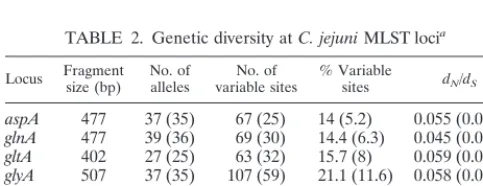
Diversity of housekeeping genes.The alleles defined for the MLST scheme were between 402 bp (gltA) and 507 bp (glyA) in length, and between 27 (gltA and unc) and 46 (pgm) alleles were present per locus. The proportion of variable sites present in the MLST alleles ranged from 9.2% (pgm) to 21.2% (tkt). In part, this was due to the polymorphisms present in a minority of alleles which were divergent (11 to 15% nucleotide sequence difference) from all other allele sequences. Such al-leles were observed at least once for each of the MLST loci and were present in a total of 11 isolates, which had divergent alleles at between one and six loci. Searches of the GenBank database established that two of these, at thegltAlocus, were very similar (97% nucleotide sequence identity) to the se-quence of this gene fromC. coli. When the divergent alleles were removed from analysis, the remaining allele sequences had between 5.2% (aspA) and 11.8% (pgm) variable sites (Ta-ble 2).
The proportion of nucleotide changes which changed the amino acid sequence was calculated and indicated bydN
(non-synonymous base substitutions), and the proportion of nucle-otide changes which did not change the amino acid sequence was indicated by dS (synonymous base substitutions). The
dN/dSratios were calculated for all seven loci and were much
less than 1 whether or not the more divergent alleles were included in the analysis (Table 2). The frequency that each allele occurred in the sample population is shown in Fig. 2; in
each case several alleles predominated, with the remainder observed in one or two isolates.
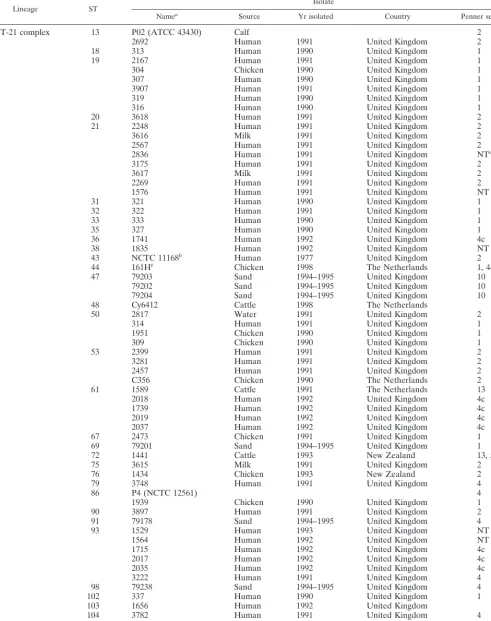
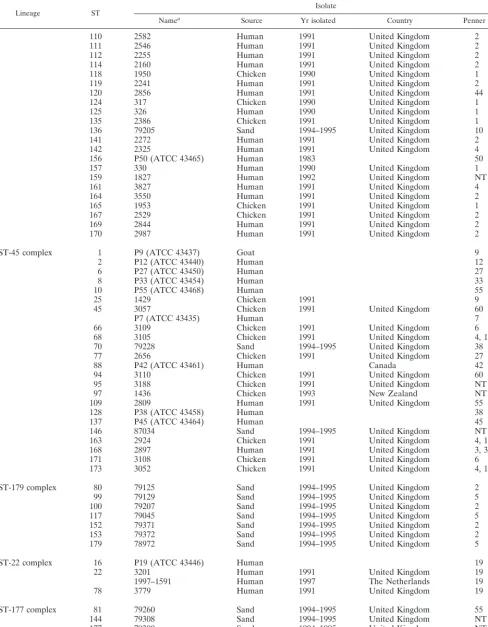
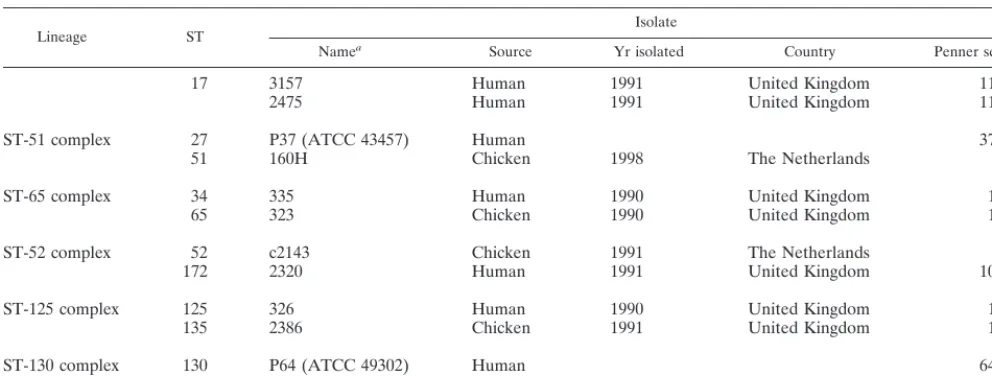
STs and lineages.There were a total of 155 STs among the 194 isolates examined, 140 (90%) of which were present only once, with the most common ST (ST-21) occurring eight times in the dataset. Assignment of the STs to lineages established that 51 STs were both unique and unrelated to any others (data are available at http://mlst.zoo.ox.ac.uk/). The remaining iso-lates were assigned to 11 complexes: the ST-21 complex was the largest, with 56 members; the ST-45 complex had 23 mem-bers; and the ST-179 complex comprised 7 STs. There were two lineages with three member STs (two lineages) and six lineages with two members (Table 3). TheIAfor the complete
data set was 2.016, with a value of 0.5671 obtained when only one representative of each lineage was included.
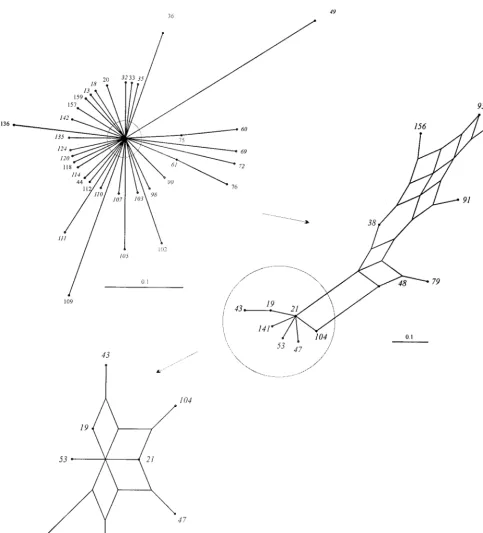
Interrelationships of members of the ST-21 complex. The relationships among members of the ST-21 complex were vi-sualized by an annotated splits graph of a distance matrix generated by pairwise comparisons of the allelic profiles (Fig. 3). The unresolved splits graph including all members of the complex is shown at the top left of Fig. 3. The outer branches were then pruned to show a partially resolved network, which was further pruned to resolve completely the center of the graph. Consistent with the lineage assignment by BURST, this placed the predicted founder ST at a central position of the split graph. The relationships among other members of the group were assessed by examining the number of nodes (rep-resenting the number of changes) between two isolates. For example, in the central region of the graph, ST-21 and ST-19 are separated by one node, representing one allele change between the two. Their STs are 2-1-1-3-2-1-5 and 2-1-5-3-2-1-5, respectively. ST-21 and ST-31 were separated by two nodes and differed by two alleles (ST-31 is 2-20-12-3-2-1-5).
[image:3.612.51.552.83.261.2]Relationships of lineage, source, and serotype.Isolates be-longing to the two largest lineages present in the data set, the ST-21 complex and ST-45 complex, had originated from a diversity of sources (Table 3). The ST-21 complex included 59 of the 79 human isolates studied (75%), 14 of the 34 chicken isolates (41%), 7 of the 33 sand isolates (21%), 3 of the 3 cattle isolates (100%), and 3 of the 3 milk isolates (100%). The ST-45 TABLE 1. Oligonucleotide primers forCampylobacterMLST
Locus
Dideoxyoligonucleotide primer
Amplicon size (bp)
Function Name and sequence
Forward Reverse
asp Amplification asp-A9, 5⬘-AGT ACT AAT GAT GCT TAT CC-3⬘ asp-A10, 5⬘-ATT TCA TCA ATT TGT TCT TTG C-3⬘ 899 Sequencing asp-S3, 5⬘-CCA ACT GCA AGA TGC TGT ACC-3⬘ asp-S6, 5⬘-TTA ATT TGC GGT AAT ACC ATC-3⬘
gln Amplification gln-A1, 5⬘-TAG GAA CTT GGC ATC ATA TTA CC-3⬘ gln-A2, 5⬘-TTG GAC GAG CTT CTA CTG GC-3⬘ 1,262 Sequencing gln-S3, 5⬘-CAT GCA ATC AAT GAA GAA AC-3⬘ gln-S6, 5⬘-TTC CAT AAG CTC ATA TGA AC-3⬘
glt Amplification glt-A1, 5⬘-GGG CTT GAC TTC TAC AGC TAC TTG-3⬘ glt-A2, 5⬘-CCA AAT AAA GTT GTC TTG GAC GG-3⬘ 1,012 Sequencing glt-S1, 5⬘-GTG GCT ATC CTA TAG AGT GGC-3⬘ glt-S6, 5⬘-CCA AAG CGC ACC AAT ACC TG-3⬘
gly Amplification gly-A1, 5⬘-GAG TTA GAG CGT CAA TGT GAA GG-3⬘ gly-A2, 5⬘-AAA CCT CTG GCA GTA AGG GC-3⬘ 816 Sequencing gly-S3, 5⬘-AGC TAA TCA AGG TGT TTA TGC GG-3⬘ gly-S4, 5⬘-AGG TGA TTA TCC GTT CCA TCG C-3⬘
pgm Amplification pgm-A7, 5⬘-TAC TAA TAA TAT CTT AGT AGG-3⬘ pgm-A8, 5⬘-CAC AAC ATT TTT CAT TTC TTT TTC-3⬘ 1,150 Sequencing pgm-S5, 5-GGT TTT AGA TGT GGC TCA TG-3⬘ pgm-S2, 3⬘-TCC AGA ATA GCG AAA TAA GG-3⬘
tkt Amplification tkt-A3, 5⬘-GCA AAC TCA GGA CAC CCA GG-3⬘ tkt-A6, 5⬘-AAA GCA TTG TTA ATG GCT GC-3⬘ 1,102 Sequencing tkt-S5, 5⬘-GCT TAG CAG ATA TTT TAA GTG-3⬘ tkt-S4, 5⬘-ACT TCT TCA CCC AAA GGT GCG-3⬘
unc Amplification unc-A7, 5⬘-ATG GAC TTA AGA ATA TTA TGG C-3⬘ unc-A2, 5⬘-GCT AAG CGG AGA ATA AGG TGG-3⬘ 1,120 Sequencing unc-S5, 5⬘-TGT TGC AAT TGG TCA AAA GC-3⬘ unc-S4, 5⬘-TGC CTC ATC TAA ATC ACT AGC-3⬘
TABLE 2. Genetic diversity atC. jejuniMLST locia
Locus Fragmentsize (bp) No. ofalleles variable sitesNo. of % Variablesites dN/dS
aspA 477 37 (35) 67 (25) 14 (5.2) 0.055 (0.049)
glnA 477 39 (36) 69 (30) 14.4 (6.3) 0.045 (0.071)
gltA 402 27 (25) 63 (32) 15.7 (8) 0.059 (0.057)
glyA 507 37 (35) 107 (59) 21.1 (11.6) 0.058 (0.057)
pgm 498 46 (45) 108 (59) 21.7 (11.8) 0.048 (0.038)
tkt 459 37 (32) 98 (48) 21.3 (10.5) 0.033 (0.037)
uncA 489 27 (25) 91 (41) 18.6 (8.4) 0.028 (0.036)
aThe values in parentheses exclude alleles which were likely to have originated
in other species.
on May 15, 2020 by guest
http://jcm.asm.org/
[image:3.612.53.295.617.710.2]FIG. 2. Allele frequencies in the sample population. For each of the seven loci (A to G), the number of times that each allele occurs in the isolate collection is shown. The frequencies are shown in the order of most to least abundant.
on May 15, 2020 by guest
http://jcm.asm.org/
TABLE 3. C. jejunilineages
Lineage ST Isolate
Namea Source Yr isolated Country Penner serotypec
ST-21 complex 13 P02 (ATCC 43430) Calf 2
2692 Human 1991 United Kingdom 2
18 313 Human 1990 United Kingdom 1
19 2167 Human 1991 United Kingdom 1
304 Chicken 1990 United Kingdom 1
307 Human 1990 United Kingdom 1
3907 Human 1991 United Kingdom 1
319 Human 1990 United Kingdom 1
316 Human 1990 United Kingdom 1
20 3618 Human 1991 United Kingdom 2
21 2248 Human 1991 United Kingdom 2
3616 Milk 1991 United Kingdom 2
2567 Human 1991 United Kingdom 2
2836 Human 1991 United Kingdom NTd
3175 Human 1991 United Kingdom 2
3617 Milk 1991 United Kingdom 2
2269 Human 1991 United Kingdom 2
1576 Human 1991 United Kingdom NT
31 321 Human 1990 United Kingdom 1
32 322 Human 1991 United Kingdom 1
33 333 Human 1990 United Kingdom 1
35 327 Human 1990 United Kingdom 1
36 1741 Human 1992 United Kingdom 4c
38 1835 Human 1992 United Kingdom NT
43 NCTC 11168b Human 1977 United Kingdom 2
44 161Hr Chicken 1998 The Netherlands 1, 44
47 79203 Sand 1994–1995 United Kingdom 10
79202 Sand 1994–1995 United Kingdom 10
79204 Sand 1994–1995 United Kingdom 10
48 Cy6412 Cattle 1998 The Netherlands
50 2817 Water 1991 United Kingdom 2
314 Human 1991 United Kingdom 1
1951 Chicken 1990 United Kingdom 1
309 Chicken 1990 United Kingdom 1
53 2399 Human 1991 United Kingdom 2
3281 Human 1991 United Kingdom 2
2457 Human 1991 United Kingdom 2
C356 Chicken 1990 The Netherlands 2
61 1589 Cattle 1991 The Netherlands 13
2018 Human 1992 United Kingdom 4c
1739 Human 1992 United Kingdom 4c
2019 Human 1992 United Kingdom 4c
2037 Human 1992 United Kingdom 4c
67 2473 Chicken 1991 United Kingdom 1
69 79201 Sand 1994–1995 United Kingdom 1
72 1441 Cattle 1993 New Zealand 13, 50
75 3615 Milk 1991 United Kingdom 2
76 1434 Chicken 1993 New Zealand 2
79 3748 Human 1991 United Kingdom 4
86 P4 (NCTC 12561) 4
1939 Chicken 1990 United Kingdom 1
90 3897 Human 1991 United Kingdom 2
91 79178 Sand 1994–1995 United Kingdom 4
93 1529 Human 1993 United Kingdom NT
1564 Human 1992 United Kingdom NT
1715 Human 1992 United Kingdom 4c
2017 Human 1992 United Kingdom 4c
2035 Human 1992 United Kingdom 4c
3222 Human 1991 United Kingdom 4
98 79238 Sand 1994–1995 United Kingdom 4
102 337 Human 1990 United Kingdom 1
103 1656 Human 1992 United Kingdom
104 3782 Human 1991 United Kingdom 4
105 3174 Human 1991 United Kingdom 2
107 2945 Human 1991 United Kingdom 2
108 2879 Human 1991 United Kingdom 2
Continued on following page
on May 15, 2020 by guest
http://jcm.asm.org/
TABLE 3—Continued
Lineage ST Isolate
Namea Source Yr isolated Country Penner serotypec
110 2582 Human 1991 United Kingdom 2
111 2546 Human 1991 United Kingdom 2
112 2255 Human 1991 United Kingdom 2
114 2160 Human 1991 United Kingdom 2
118 1950 Chicken 1990 United Kingdom 1
119 2241 Human 1991 United Kingdom 2
120 2856 Human 1991 United Kingdom 44
124 317 Chicken 1990 United Kingdom 1
125 326 Human 1990 United Kingdom 1
135 2386 Chicken 1991 United Kingdom 1
136 79205 Sand 1994–1995 United Kingdom 10
141 2272 Human 1991 United Kingdom 2
142 2325 Human 1991 United Kingdom 4
156 P50 (ATCC 43465) Human 1983 50
157 330 Human 1990 United Kingdom 1
159 1827 Human 1992 United Kingdom NT
161 3827 Human 1991 United Kingdom 4
164 3550 Human 1991 United Kingdom 2
165 1953 Chicken 1991 United Kingdom 1
167 2529 Chicken 1991 United Kingdom 2
169 2844 Human 1991 United Kingdom 2
170 2987 Human 1991 United Kingdom 2
ST-45 complex 1 P9 (ATCC 43437) Goat 9
2 P12 (ATCC 43440) Human 12
6 P27 (ATCC 43450) Human 27
8 P33 (ATCC 43454) Human 33
10 P55 (ATCC 43468) Human 55
25 1429 Chicken 1991 9
45 3057 Chicken 1991 United Kingdom 60
P7 (ATCC 43435) Human 7
66 3109 Chicken 1991 United Kingdom 6
68 3105 Chicken 1991 United Kingdom 4, 16, 50
70 79228 Sand 1994–1995 United Kingdom 38
77 2656 Chicken 1991 United Kingdom 27
88 P42 (ATCC 43461) Human Canada 42
94 3110 Chicken 1991 United Kingdom 60
95 3188 Chicken 1991 United Kingdom NT
97 1436 Chicken 1993 New Zealand NT
109 2809 Human 1991 United Kingdom 55
128 P38 (ATCC 43458) Human 38
137 P45 (ATCC 43464) Human 45
146 87034 Sand 1994–1995 United Kingdom NT
163 2924 Chicken 1991 United Kingdom 4, 13, 50
168 2897 Human 1991 United Kingdom 3, 37
171 3108 Chicken 1991 United Kingdom 6
173 3052 Chicken 1991 United Kingdom 4, 16, 50
ST-179 complex 80 79125 Sand 1994–1995 United Kingdom 2
99 79129 Sand 1994–1995 United Kingdom 5
100 79207 Sand 1994–1995 United Kingdom 2
117 79045 Sand 1994–1995 United Kingdom 5
152 79371 Sand 1994–1995 United Kingdom 2
153 79372 Sand 1994–1995 United Kingdom 2
179 78972 Sand 1994–1995 United Kingdom 5
ST-22 complex 16 P19 (ATCC 43446) Human 19
22 3201 Human 1991 United Kingdom 19
1997–1591 Human 1997 The Netherlands 19
78 3779 Human 1991 United Kingdom 19
ST-177 complex 81 79260 Sand 1994–1995 United Kingdom 55
144 79308 Sand 1994–1995 United Kingdom NT
177 79309 Sand 1994–1995 United Kingdom NT
ST-17 complex 14 P11 (ATCC 43439) Human Canada 11
Continued on following page
on May 15, 2020 by guest
http://jcm.asm.org/
complex included 10 of the 79 human isolates (13%), 11 of the 34 chicken isolates (32%), and 2 of the 33 sand isolates (6%). Three Penner HS serotypes predominated in the ST-21 com-plex (HS1, 25%; HS2, 33%; and HS4, 8%), and some of the STs forming this lineage were homogenous for serotype (e.g., the six ST-19 isolates were all HS1, while the eight ST-21 isolates were all HS2 or non typeable), although these sero-types were also present in isolates exhibiting different STs. Conversely, the ST-45 complex contained a wide variety of serotypes and a number of cross-reactive isolates, but the two most common serotypes observed in the ST-21 complex, HS1 and HS2, were not present in the ST-45 complex. The remain-ing complexes comprised small numbers in the isolate collec-tion and these were homogenous for serotype, with the excep-tion of the seven ST-179 complex isolates which originated in sand and were HS2 or HS5 and two members of the ST-130 complex (Table 3).
DISCUSSION
Unambiguous, discriminatory isolate characterization schemes are essential for epidemiological, population genetic, and evo-lutionary studies. Ideally, these schemes generate data that are relevant to all of these areas, but before the recent advent of high-throughput nucleotide sequence determination technol-ogy, this goal had proved elusive (19). There is a particular need for appropriate typing schemes forC. jejuni, as this com-mon human pathogen (3) has extensive animal and environ-mental reservoirs and the relationships between disease-asso-ciated and animal or environmental populations remain to be fully elucidated. This study demonstrates that MLST (i) dis-criminates amongC. jejuniisolates effectively and (ii) gener-ates data that can be applied to the investigation of the pop-ulation structure and evolutionary mechanisms in this organism. The advantages of MLST include high
discrimina-tion, reproducibility, simplicity of interpretation by using one technique rather than a combination of techniques, and the generation of data which are directly comparable among lab-oratories via the Internet (20). The ease with which the system can be transferred among laboratories was exploited in this study, with the sequence determinations being performed in two separate locations (Oxford and Bilthoven).
The seven loci chosen were a suitable basis for an MLST typing scheme, as they could be amplified and sequenced from isolates obtained from a wide variety of sources, were unlinked on theC. jejunichromosome (Fig. 1), exhibited sufficient di-versity to provide a high degree of resolution, and were not subject to positive selection, as demonstrated by the dN/dS
ratios calculated for each locus (Table 2). The fact that the dN/dSratios were much less than 1 demonstrates that there is
selection against amino acid change (adN/dSratio of greater
than 1 implies selection for amino acid changes). The nucleo-tide sequence determination for these loci was consistent with the results obtained previously from a number of phenotypic and genotypic studies ofC. jejuni, which suggested that popu-lations of this organism are highly diverse (35, 36). Some of this diversity was likely to have been imported recently from re-lated species, with a potential donor, C. coli, identified for some of the more diverse sequences. When these likely impor-tation events were excluded (Table 2), the C. jejuni sample exhibited nucleotide sequence diversity similar to that ob-served inNeisseria meningitidis(12, 15a, 20) and substantially greater than that seen inStreptococcus pneumoniae(8).
The housekeeping gene sequences provided evidence that horizontal genetic exchange has a major influence on the struc-ture and evolution ofCampylobacter populations, which was itself consistent with previous findings for the antigen genes of C. jejuni(10). The fall in theIAfrom 2, for the whole data set,
to 0.57, when only one example of each lineage was included, was indicative of a weakly clonal population (22) which con-TABLE 3—Continued
Lineage ST Isolate
Namea Source Yr isolated Country Penner serotypec
17 3157 Human 1991 United Kingdom 11
2475 Human 1991 United Kingdom 11
ST-51 complex 27 P37 (ATCC 43457) Human 37
51 160H Chicken 1998 The Netherlands
ST-65 complex 34 335 Human 1990 United Kingdom 1
65 323 Chicken 1990 United Kingdom 1
ST-52 complex 52 c2143 Chicken 1991 The Netherlands
172 2320 Human 1991 United Kingdom 10
ST-125 complex 125 326 Human 1990 United Kingdom 1
135 2386 Chicken 1991 United Kingdom 1
ST-130 complex 130 P64 (ATCC 49302) Human 64
162 P65 (ATCC 49303) Not stated 65
aWhere appropriate the American Type Culture Collection (ATCC) or National Collection of Type Cultures (NCTC) designation is also given. Names beginning
with P indicate reference isolates for the Penner serotyping scheme.
bCampylobacter isolate for which the complete genome sequence is available at http:www.sanger.ac.uk/Projects/C_jejuni/. cFrom reference 28.
dNT, nontypeable.
on May 15, 2020 by guest
http://jcm.asm.org/
[image:7.612.54.550.84.272.2]tained a number of clonal complexes of relatively recent evo-lutionary origin with no tree-like phylogenetic relationship with each other (12). The presence of the same allele in iso-lates of diverse origins and different lineages (for example, aspAallele number 2 in isolates from humans, sand, and poul-try) supported this view, as did the fact that the majority of
changes within the most common lineages were likely to be due to recombinational replacement rather than mutation.
[image:8.612.64.547.67.599.2]The presence of apparent lineages in isolate collections of weakly clonal organisms may be amplified by sampling (23); for example, the presence of many isolates belonging to the ST-21 complex could have been a consequence of members of this
FIG. 3. Splits graphs showing the interrelationships of members of ST-21 complex. Progressive pruning of branches to improve resolution is indicated by the circles and arrows. The completely resolved region (bottom left) derived from the center of the unpruned graph contains the most abundant members of the complex and the predicted founder of the lineage, ST-21.
on May 15, 2020 by guest
http://jcm.asm.org/
complex being more likely to be associated with human infec-tion. Alternatively, certain lineages might be associated with a particular niche, for example, the ST-179 complex, which con-tained environmental isolates (from sand of United Kingdom bathing beaches) (4). Further MLST analyses of appropriate isolate collections are necessary to address these questions more fully. However, the finding that human isolates cluster predominantly in the ST-21 complex, while chicken isolates have a broader distribution, suggests that it may be unlikely that the majority of the human strains come from chickens but that human strains may come from different sources like cattle, although the number of strains studied from cattle were low. A more detailed nucleotide sequence-based investigation of the relationships of organisms classified as differentCampylobacter species is also warranted given the evidence for genetic ex-change among these organisms.
A number of typing techniques have been applied to C. jejuni, with Penner HS typing, which is based on the lipopoly-saccharide component of the outer membrane (28), being fa-vored by many laboratories. The data presented here demon-strated that the Penner HS serotype was consistent and conserved in some lineages, (Table 3); for example, there was a correlation between Penner HS type and ST among some members of the ST-21 complex. However, the members of the ST-45 complex were highly diverse for Penner HS serotype (Table 3). These data are consistent with those reported earlier (25, 31, 35) and suggested the existence of a number of C. jejunistrains which were genetically and antigenically stable over the sampling period.
This data set provides a basis for the exploitation of MLST in the study ofC. jejuni. The MLST approach is in principle applicable to any bacterial species, and while the oligonucleo-tide primers described here were not designed for character-ization of otherCampylobacterspecies, the evidence for inter-species horizontal genetic exchange betweenC. jejuniand at least one otherCampylobacter species strongly suggests that this MLST system will be directly applicable to other Campy-lobacter species. The identification of alleles with gene se-quences that were diverse from the majority ofC. jejuni se-quences may indicate disparity between microbiological and nucleotide sequence-based species classifications of these or-ganisms, but additional data and analyses will be required to address these issues.
The MLST scheme provides a means for the investigation of disease outbreaks in both global and local contexts, permitting confirmation of suspected routes of transmission from the en-vironment and livestock to humans. In addition, MLST data will assist in resolving broader issues such as the relationship of environmental to disease isolates at the population level, the structure ofCampylobacterpopulations, the existence or oth-erwise of widely distributed lineages, and the extent of intra-and interspecies recombination. The Campylobacter MLST website is a freely accessible resource available to the commu-nity as a whole for the investigation of this important and as yet incompletely understood pathogen. Submission of data from other laboratories is welcomed.
ACKNOWLEDGMENTS
This work was funded by the United Kingdom Ministry of Agricul-ture, Fisheries and Food (contract number OZ0604).
We are grateful to Birgitta Duim and Jaap Wagenaar, Department of Bacteriology, Institute for Animal Science and Health, Lelystad, The Netherlands, for providing the chromosomal DNA of the human and animal campylobacter isolates from The Netherlands.
REFERENCES
1.Achtman, M., K. Zurth, G. Morelli, G. Torrea, A. Guiyoule, and E. Carniel. 1999.Yersinia pestis, the cause of plague, is a recently emerged clone of Yersinia pseudotuberculosis. Proc. Natl. Acad. Sci. USA96:14043–14048. 2.Adak, G. K., J. M. Cowden, S. Nicholas, and H. S. Evans.1995. The Public
Health Laboratory Service national case-control study of primary indigenous sporadic cases of campylobacter infection. Epidemiol. Infect.115:15–22. 3.Altekruse, S. F., N. J. Stern, P. I. Fields, and D. L. Swerdlow.1999.
Campy-lobacter jejuni—an emerging foodborne pathogen. Emerg. Infect. Dis.5:28–35. 4.Bolton, F. J., S. B. Surman, K. Martin, D. R. A. Wareing, and T. J. Hum-phrey.1999. Presence ofCampylobacterandSalmonellaein sand from bath-ing beaches. Epidemiol. Infect.122:7–13.
5.Bolton, F. J., D. R. A. Wareing, M. B. Skirrow, and D. N. Hutchinson.1992. Identification and biotyping of campylobacters, p. 151–161.InR. G. Board, D. Jones, and F. A. Skinner (ed.), Identification methods in applied and environmental microbiology. Blackwell Scientific Publications Ltd., London, United Kingdom.
6.Bygraves, J. A., R. Urwin, A. J. Fox, S. J. Gray, J. E. Russell, I. M. Feavers, and M. C. J. Maiden.1999. Population genetic and evolutionary approaches to the analysis ofNeisseria meningitidisisolates belonging to the ET-5 com-plex. J. Bacteriol.181:5551–5556.
7.Embley, T. M.1991. The linear PCR reaction: a simple and robust method for sequencing amplified rRNA genes. Lett. Appl. Microbiol.13:171–174. 8.Enright, M., and B. G. Spratt.1998. A multilocus sequence typing scheme
forStreptococcus pneumoniae: identification of clones associated with serious invasive disease. Microbiology144:3049–3060.
9.Feavers, I. M., S. J. Gray, R. Urwin, J. E. Russell, J. A. Bygraves, E. B. Kaczmarski, and M. C. J. Maiden.1999. Multilocus sequence typing and antigen gene sequencing in the investigation of a meningococcal disease outbreak. J. Clin. Microbiol.37:3883–3887.
10. Harrington, C. S., F. M. Thomson Carter, and P. E. Carter.1997. Evidence for recombination in the flagellin locus ofCampylobacter jejuni: implications for the flagellin gene typing scheme. J. Clin. Microbiol.35:2386–2392. 11. Heuvelink, A. E., J. J. H. C. Tilburg, N. Voogt, W. van Pelt, W. J. van
Leeuwen, J. M. J. Sturm, and A. W. van de Giesen.1999. Surveilance of zoonotic bacteria among farm animals (Dutch). RIVM-report 285859–009. RIVM, Bilthoven, The Netherlands.
12. Holmes, E. C., R. Urwin, and M. C. J. Maiden.1999. The influence of recombination on the population structure and evolution of the human pathogenNeisseria meningitidis. Mol. Biol. Evol.16:741–749.
13. Hudson, J. A., C. Nicol, J. Wright, R. Whyte, and S. K. Hasell.1999. Seasonal variation ofCampylobactertypes from human cases, veterinary cases, raw chicken, milk and water. J. Appl. Microbiol.87:115–124.
14. Huson, D. H.1998. SplitsTree: a program for analysing and visualising evolutionary data. Bioinformatics14:68–73.
15. Jackson, C. J., A. J. Fox, D. M. Jones, D. R. Wareing, and D. N. Hutchinson. 1998. Associations between heat-stable (O) and heat-labile (HL) serogroup antigens ofCampylobacter jejuni: evidence for interstrain relationships within three O/HL serovars. J. Clin. Microbiol.36:2223–2228.
15a.Jolley, K. A., J. Kalmusova, E. J. Feil, S. Gupta, M. Musilek, P. Kriz, and M. C. J. Maiden.2000. Carried meningococci in the Czech Republic: a diverse recombining population. J. Clin. Microbiol.38:4492–4498. 16. Ketley, J. M.1997. Pathogenesis of enteric infection by Campylobacter.
Microbiology143:5–21.
17. Konkel, M. E., S. A. Gray, B. J. Kim, S. G. Garvis, and J. Yoon.1999. Identification of the enteropathogens Campylobacter jejuni and Campy-lobacter colibased on the cadFvirulence gene and its product. J. Clin. Microbiol.37:510–517.
18. Kumar, S., K. Tamura, and M. Nei.1994. MEGA: molecular evolutionary genetics analysis software for microcomputers. Comput. Appl. Biosci.10: 189–191.
19. Maiden, M. C. J.2000. High-throughput sequencing in the population anal-ysis of bacterial pathogens of humans. Int. J. Med. Microbiol.290:183–190. 20. Maiden, M. C. J., J. A. Bygraves, E. Feil, G. Morelli, J. E. Russell, R. Urwin, Q. Zhang, J. Zhou, K. Zurth, D. A. Caugant, I. M. Feavers, M. Achtman, and B. G. Spratt.1998. Multilocus sequence typing: a portable approach to the identification of clones within populations of pathogenic microorganisms. Proc. Natl. Acad. Sci. USA95:3140–3145.
21. Maynard Smith, J.1991. The population genetics of bacteria. Proc. R. Soc. London B245:37–41.
22. Maynard Smith, J., C. G. Dowson, and B. G. Spratt.1991. Localized sex in bacteria. Nature349:29–31.
23. Maynard Smith, J., N. H. Smith, M. O’Rourke, and B. G. Spratt.1993. How clonal are bacteria? Proc. Natl. Acad. Sci. USA90:4384–4388.
24. Nachamkin, I., B. M. Allos, and T. Ho.1998.Campylobacterspecies and Guillain-Barre syndrome. Clin. Microbiol. Rev.11:555–567.
on May 15, 2020 by guest
http://jcm.asm.org/
25.Nachamkin, I., H. Ung, and C. M. Patton.1996. Analysis of HL and O serotypes ofCampylobacterstrains by the flagellin gene typing system. J. Clin. Microbiol.34:277–281.
26.Parkhill, J., B. W. Wren, K. Mungall, J. M. Ketley, C. Churcher, D. Basham, T. Chillingworth, R. M. Davies, T. Feltwell, S. Holroyd, K. Jagels, A. V. Karlyshev, S. Moule, M. J. Pallen, C. W. Penn, M. A. Quail, M. A. Rajan-dream, K. M. Rutherford, A. H. van Vliet, S. Whitehead, and B. G. Barrell. 2000. The genome sequence of the food-borne pathogenCampylobacter jejunireveals hypervariable sequences. Nature403:665–668.
27.Peabody, R., M. J. Ryan, and P. G. Wall.1997. Outbreaks ofCampylobacter infection: rare events for a common pathogen. Communicable Dis. Rep. 7:R33–R37.
28.Penner, J. L., J. N. Hennessy, and R. V. Congi.1983. Serotyping of Campy-lobacter jejuniandCampylobacter colion the basis of thermostable antigens. Eur. J. Clin. Microbiol.2:378–383.
29.Selander, R. K., D. A. Caugant, H. Ochman, J. M. Musser, M. N. Gilmour, and T. S. Whittam.1986. Methods of multilocus enzyme electrophoresis for bacterial population genetics and systematics. Appl. Environ. Microbiol. 51:837–884.
30.Skirrow, M. B.1994. Diseases due toCampylobacter,Helicobacterand re-lated bacteria. J. Comp. Pathol.111:113–149.
31.Slater, E., and R. J. Owen.1998. Subtyping of Campylobacter jejuni Penner heat-stable (HS) serotype 11 isolates from human infections. J. Med. Micro-biol.47:353–357.
32.Staden, R.1996. The Staden sequence analysis package. Mol. Biotechnol. 5:233–241.
33.Suerbaum, S., J. Maynard Smith, K. Bapumia, G. Morelli, N. H. Smith, E. Kunstmann, I. Dyrek, and M. Achtman.1998. Free recombination within Helicobacter pylori. Proc. Natl. Acad. Sci. USA95:12619–12624.
34. Walker, R. I., M. B. Caldwee, E. Lee, P. Guerry, T. J. Trust, and G. M. Ruiz-Palacios.1986. Pathophysiology ofCampylobacterenteritis. Microbiol. Rev.50:81–94.
35. Wareing, D.1999. The significance of strain diversity in the epidemiology of Campylobacter jejuni gastrointestinal infections. Ph.D. thesis. University of Central Lancashire, Preston, United Kingdom.
36. Wassenaar, T. M., and D. G. Newell.2000. Genotyping ofCampylobacter species. Appl. Environ. Microbiol.66:1–9.