CONGRATULATIONS, YOU’VE FAILED:
EVALUATING COLLABORATIVE PROJECTS
THROUGH LOGICAL FRAMEWORKS AND
STORIES
T
h o m a s
M . V
i n s o n
T
h e s i s
S
u p p o r t
D
o c u m e n t
: R
e t r o s p e c t i v e
L
o g i c a l
F
r a m e w o r k
A
n a l y s i s
(R L F A )
D e p a r t m e n t o f S o c i a l P s y c h o l o g y
L o n d o n S c h o o l o f E c o n o m i c s a n d P o l i t i c a l S c i e n c e
U n i v e r s i t y o f L o n d o n
UMI Number: U506961
All rights reserved
INFORMATION TO ALL USERS
The quality of this reproduction is dependent upon the quality of the copy submitted.
In the unlikely event that the author did not send a complete manuscript
and there are missing pages, these will be noted. Also, if material had to be removed,
a note will indicate the deletion.
Dissertation Publishing
UMI U506961
Published by ProQuest LLC 2014. Copyright in the Dissertation held by the Author.
Microform Edition © ProQuest LLC.
All rights reserved. This work is protected against
unauthorized copying under Title 17, United States Code.
ProQuest LLC
789 East Eisenhower Parkway
P.O. Box 1346
F
^ 2
.
RETROSPECTIVE LOGICAL FRAMEWORK ANALYSIS (RLFA)
This document supports the full thesis,
Congratulations, You’ve Failed: Evaluating
Collaborative Projects Through Logframes and Stories.
To follow are 31 different
retrospective logframes representing coded data from the NC-Exchange Community
NETworker Demonstration.
In my approach, I have taken interview data from project participants in three categories -
NC-Exchange staff, NETworkers, and host organization directors - in addition to the
original NETworker project proposal, and coded the information using the structure of the
logical framework. In all, I have coded 26 separate items from different project sources.
More specifically, I have placed each statement (or portion of a statement) made by the
participants (or sentences, in the case of the proposal) into the box in the logframe matrix
that I feel best represents the statement’s meaning relative to its position within the overall
system o f the NETworker project. In this way, each statement becomes a disaggregated
Wider Objective, Immediate Objective, Output, Activity, Indicator of Achievement, Means
of Verification, or Assumption o f the project. Because the individual retrospective
logframes based on statements from the full interview transcripts are quite long (in some
cases, more than 40 pages), I have also produced synthesized versions of several
retrospective logframes in which I capture the main points in bullet-point format.
In the long versions of the retrospective logframes, statements have been left intact; in the
short versions, individual statements have been shortened or summarized into their key
themes. In summarizing them, I have sought to leave the phrases in the same language
used by the respondents in order to preserve the intended meanings. Statements that have
not fit within the logframe categories have not been captured, though they remain
accessible via the transcripts.
TABLE OF CONTENTS
NC-Exchange Interview Retrospective Logframes
RLF 1: NC-Exchange proposal to TIIAP... 5
RLF 2: NC-Exchange proposal to TIIAP (Short Version)... 16
RLF 3: NC-Exchange Executive Director and NETworker Project Coordinator #1... 23
RLF 4: NC-Exchange Executive Director and NETworker Project Coordinator #1 (short
version)... 39
RLF 5: NC-Exchange Executive Director and NETworker Project Coordinator #1 (second
interview)... 42
RLF 6: NC-Exchange Executive Director and NETworker Project Coordinator #1 (second
interview - short version)... 56
RLF 7: NC-Exchange Executive Director (final interview)... 59
RLF 8: NC-Exchange Executive Director (final interview - short version)... 91
RLF 9: NC-Exchange Project Coordinators #1 and #2 and NETworker Pilot
Evaluator... 102
RLF 10: NC-Exchange Project Coordinators #1 and #2 and NETworker Pilot Evaluator
(short version)... 170
N ETw orker Interview Retrospective Logframes
RLF 11: Greensboro NETworker (first interview)... 180
RLF 12: Greensboro NETworker (second interview)...185
RLF 13: Swain County NETworker (first interview)
... 188
RLF 14: Swain County NETworker (second interview)... 190
RLF 15: Rocky Mount NETworker (first interview)... 193
RLF 16: Rocky Mount NETworker (second interview)... 199
RLF 17: BMWCDC NETworker (first interview)...205
RLF 18: BMWCDC NETworker (second interview)...209
N E T w o rk er P r o je c t Site D ir e cto r In ter v ie w R e tr o sp ec tiv e L o g fra m es
RLF 20: Greensboro Self-Help Credit Union Branch Office Director (first
interview)...222
RLF 21: Greensboro Self-Help Credit Union Branch Office Director and Greensboro
NETworker... 224
RLF 22: Greensboro Self-Help Credit Union Branch Office Director (second
interview)...226
RLF 23: Self-Help Central Office Executive Director... 229
RLF 24: Swain County Extension Branch Office Executive Director... 232
RLF 25: Swain County Extension Branch Office Interim Director...234
RLF 26: DEPC Executive Director (first interview)...235
RLF 27: DEPC NETworker Project Supervisor...238
RLF 28: DEPC Executive Director (second interview)...241
RLF 29: BMWCDC Founder and Chair o f Board of Directors... 243
RLF 30: BMWCDC Executive Director... 246
RLF 1: Source: NC-Exchange Proposal for Community NETworker project, submitted to US Department of Commerce, March 1996.
Project Structure / Narrative
Summary
Indicators of achievement
and value
How indicators can be
quantified or assessed
Assumptions, risks, and
conditions
W ider
Objectives
■ Locally-based NETworkers will help nonprofits, local government, and small businesses apply information and communication technologies strategically to solve real world problems in their communities and achieve their organizational goals.
■ In this demonstration, Community NETworkers (locally based networking "helpers") will assist designated end users (CBOs, locally-based government agencies, and small businesses) employ the resources o f the National Information Infrastructure to achieve clearly defined mission statements, goals and objectives, or business plans that support community revitalization.
The evaluation will measure the model’s effects on the capacity o f the end users, local support organizations, and statewide resource organizations to use
telecommunications effectively to achieve well-defined goals. The NETworker will work with each end user to formulate specific goals for the demonstration, based on its mission statement or business plan. Such goals may include access to new information on community development resources and management tools, better internal and external communication, increased collaboration, improved service delivery, more effective community problem-solving, or increased visibility of end user and the community.
■ All participants including end users, local support and statewide resource organizations will measure and document the usefulness o f the N il to their work and the value added by the NETworker towards achievement of their defined objectives.
■ Surveys will be administered at the beginning, midpoint, and conclusion o f the demonstration. End users will be surveyed to determine (1) current telecommunications usage and perceived barriers, (2) awareness of online information and resources, (3) perceived ability to access, assess, and effectively use online tools for community development, either directly or indirectly, (4) knowledge o f and willingness to engage in online communication and collaboration for community development, and (5) willingness to pay for the services o f a NETworker. Local support organizations will be surveyed to assess their capacity to assume NETworker functions within the community. Statewide resource organizations will be surveyed to assess the importance of
telecommunications in disseminating information and providing technical assistance to constituents statewide. The effects o f variations in
geographic setting, host organization, and issue focus will be analyzed.
■ Practical applications o f the National Information Infrastructure are elusive.
■
Orgs. find it hard to grasp telecom technology's relevance to their work, and they find the technology confusing — often overwhelming.■
CBOs and local government agencies are wary o f the added burden telecommunications might impose on their already overworked staff.■
They are reluctant to trade-off valuable time to master unfamiliar technology for which they don’t see a direct benefit.■ Few have local access to training and technical support.
■ When they do go online, it is difficult for them to find information that matches their real needs.
Project Structure / Narrative
Summary
Indicators of achievement
and value
How indicators can be
quantified or assessed
Assumptions, risks, and
conditions
NETworkers, in cooperation with statewide resource organizations, will demonstrate the value o f information infrastructure, build local capacity, promote collaboration, and create a self-sustaining support system. The effectiveness o f NETworkers operating in different geographic settings, issue groups, and organizational structures will be evaluated, and the findings disseminated.
A major barrier to online participation by CBOs is inadequate consultation, training, and technical support. People who work in and serve those communities must experience first-hand the power of telecommunications to help them discover new resources and ideas, communicate interactively with colleagues, form new collaborations, participate more actively in the development o f public policy, and achieve visibility for their efforts.
W ider
Objectives
We will implement the Community NETworker model in four low-wealth communities in North Carolina, incorporating the knowledge and materials developed in our 1994 TIIAP planning project.
cont'd.
The Community NETworker project (previously called the Community Information Broker project) has been one o f the first initiatives to address the issue o f the relevance o f information technology to real-world problems in human services and community development. The proposed demonstration is designed to assess the effectiveness o f the NETworker model across a range o f community variables, including geographic setting, type o f host organization, and issue area. The demonstration will also explore sustainability o f the model through local community support o f the NETworker, by building the capacity of local support organizations to assume NETworker functions and by assessing the willingness o f the end users to engage the NETworker on a fee-for-service basis. The information gained through evaluation o f this comprehensive application o f the model
■ Periodic interviews with end users will provide insight into how the NETworker is affecting their awareness and goals. Feedback from surveys and interviews will be provided to the statewide resource organizations. NETworkers also will be interviewed to measure the responses o f the statewide resource organizations to changing information usage. Interviews and contextual data will provide a rich and detailed understanding o f how implementation o f the model is proceeding and will indicate adjustments that could be made during the demonstration. ■ NETworkers will compile case
studies documenting their achievements and difficulties
Project Structure / Narrative
Summary
Indicators o f achievement
and value
How indicators can be
quantified or assessed
Assum ptions, risks, and
conditions
W ider
Objectives
cont'd.
C ont'd.
will facilitate its replication in communities across the U.S.
C ont'd.
experienced. These case studies will provide insight into the extent to which technology can be used to solve community problems and will aid in identification o f possible refinements in the model. NC-Exchange will compile, publish, and disseminate the case studies.
Customized support for end users (CBOs, locally based government agencies, and minority- and women-owned small businesses in
disadvantaged communities) is the primary purpose o f this demonstration project
End user needs have been identified in NC- Exchange’s 1993 survey o f networked nonprofits and in a series o f focus groups conducted during the planning project.
■ The core goal o f this demonstration is to reduce disparities in access to the N il in disadvantaged communities by providing support for the key organizations involved in human services and community development. All four demonstration sites are in underserved areas with significant rural, minority, and/or low-income populations, where the services o f a NETworker will be valuable in extending the benefits o f the NIL
Project S tru c tu re / N arrative
Sum m ary
Indicators of achievem ent
and value
How indicators can be
quantified or assessed
Assum ptions, risks, and
conditions
Im m ediate
Objectives
At each demonstration site, an individual with networking experience and sensitivity to the needs o f communities will be hired as a Community NETworker and trained to do the following:
■ Identify the goals and objectives o f each end user and design a communication and information strategy to meet those goals. ■ Serve as a networking expert, matching
information available on-line with strategic information needs.
■ Promote, through demonstrations and site visits, the active use o f telecom services to address community problems, and help groups integrate networking functions into their ongoing operations.
■ Provide training, technical support, and follow-up, directly or through screened volunteers.
■ Create and promote opportunities for cross-sector cooperation and collaboration, self-sufficiency, and empowerment within the community. ■ Document successes and failures in case-
study format and participate in project evaluations.
The NETworker will make every effort to deliver tangible benefits of
telecommunications to the end user: demonstrations, training, technical assistance, handholding, cheerleading, etc.
As part o f the planning project, a community networking guide containing a self-assessment and guidelines for developing a strategic networking plan is being created to be used in conjunction with the model. It will provide a customized, problem-driven approach to meeting each end user’s human services, community development or business goals.
P roject S tru c tu re / N arrativ e
Sum m ary
Indicators of achievem ent and
value
How indicators can be
quantified or assessed
Assum ptions, risks, and
conditions
Im m ediate
Objectives
cont’d.
Throughout the demonstration, NETworkers will work to develop a community networking support system by identifying and building the capacity o f local support organizations willing to assume networking functions for their
constituencies. At each site, these will include the public library, the cooperative extension office, and the regional field office of the state Division o f Community Assistance. Other potential support organizations include community development corporations, community action centers, councils of government, family resource centers, and one- stop career centers. End users also may start as or evolve into local support organizations.
O utputs
Activities
A key feature o f this model is that the NETworker’s specific activities will be determined locally, in response to community needs identified through a structured process and a local advisory committee.
Inputs and Indicators
P roject S tru ctu re / N arrative
Sum m ary
Indicators of achievement and
value
How indicators can be
quantified or assessed
Assum ptions, risks, and
conditions
The NETworker will work first with each end user to define organizational information and communication goals and then with the committee to define community information and communication goals. This profile will be used to create a customized work plan for the NETworker’s activities.
::
:
/"..
Activities
cont'd.
If the NETworker is unable to respond directly to technical questions, they may identify, screen, and assign local volunteers to work with the end user. Although based at one host site, the NETworker may make his or her services available at a variety o f locations in the community on a pre-arranged schedule.
The NETworkers will be in place three months after the start of the project, the initial training will be completed by the end of the fourth month and work plans for the NETworkers will be established in the eighth month.
NCx
General Administration
1. Prepare written operating procedures, reporting and case study formats, hiring guidelines.
2. Purchase equipment.
3. Prepare and sign contracts with host, resource orgs., and consultants. 4. Monitor the activities of Community
NETworkers and statewide resource orgs. on an ongoing basis.
5. Make regular visits to the demo sites. 6. Facilitate ongoing online discussions
Project S tru ctu re
/N arrative
Sum m ary
Indicators of achievement and
value
How indicators can be
quantified or assessed
Assum ptions, risks, and
conditions
...
Demonstration Sites Pre-hiring o f NETworker
1. Review NETworker model and procedures with host.
2. Work with host to identify and solicit the participation o f key target group members and support orgs. in each site (15-20 local nonprofits and agencies; 8-12 small businesses).
3. Convene (with host) potential members of advisory group.
4. Establish local advisory committee at each site.
5. Set up equipment and NETworker workspace in preparation for NETworker. Hiring
1. Begin recruitment o f NETworker in 3 sites: Advertising and word o f mouth.
2. Host and advisory committee screen applicants for NETworker position and select finalists.
3. NCx makes final selection at Sites #2 and #3. Host org. makes final selection at Site #1.
4. All NETworkers hired.
5. NETworkers meet with NCx for initial orientation.
Post-hirine of NETworker The NETworker will:
1. Meet with host to establish work guidelines for the host org.
2. Meet with advisory committee to determine project priorities.
Project S tru c tu re
/N arrative
Sum m ary
Indicators of achievem ent and
value
How indicators can be
quantified or assessed
A ssum ptions, risks, and
conditions
Activities
cont'd.
C ont'd.
4. Provide a local orientation and network demonstration for a broader group of interested target group members. 5. Designate (with consultation) project
participants (end users) based on interest, diversity, the presence o f well-defined goals and understanding o f the NETworker role.
6. Use NCx's Community Networking Guide (Making the Net Work) to help each end user identify information and
communications needs which networking can address.
7. Formulate specific goals for the demo based on the end user's mission statement or business plan.
8. Identify common issues and opportunities for collaboration among the end users. 9. Produce community-wide workplan which
includes end user goals and proposed rotation schedule for review by host, NCx and advisory committee.
10. Advisory committee approves work plan and rotation schedule for NETworker. 11. Work on an ongoing basis with each end
user to achieve the identified strategies. 12. Assign end users ISP accounts as needed. 13. Locate and screen volunteers to assign as
mentors to end users if needed. 14. Help build a community networking
support system.
15. Promote the use o f networking throughout the community.
Project S tru ctu re
/N arrative
Sum m ary
Indicators of achievem ent and
value
How indicators can be
quantified or assessed
Assum ptions, risks, and
conditions
Activities
cont'd.
...
NETworker T raining
1. NCx / trainers review training curriculum developed during the planning phase and finalize roles and responsibilities. 2. Schedule training: location, date,
equipment, identify training materials. 3. Finalize training curriculum with lead trainer and other training consultants. 4. Assemble training materials.
5. Conduct initial 3-day training session for NETworkers: Basics o f Networking, Introduction to Community Economic Development, Intro to Online Search Techniques.
6. NETworkers return after 2 weeks for 2-day advanced training: Advanced Networking and Search Techniques; GIS.
7. NETworkers participate in quarterly 1 -day in-service training sessions (6 in all) to share experiences and develop case studies.
Evaluation
1. Finalize evaluation design.
2. Conduct pre-demonstration study o f end users, local support orgs., and statewide resource orgs.
3. NETworkers document experiences for case studies.
4. Conduct periodic face-to-face interviews with participants.
5. Conduct mid-point surveys and suggest revisions as needed for the second phase of the demonstration.
Project S tru ctu re / N arrative
Sum m ary
Indicators of achievem ent and
value
How indicators can be
quantified or assessed
Assum ptions, risks, and
conditions
Activities
cont'd.
Publicizing the Model
1. Establish and maintain a web site and listserv.
2. Present the model at state and national conferences as appropriate.
3. Keep national groups who are interested in publicizing and replicating the model informed about the progress o f the demonstration.
4. Respond to ongoing inquiries about the project.
RLF 2: Source: NC-Exchange Proposal for Community NETworker project, submitted to US Department o f Commerce, M arch 1996.
StLUKl
VERSION
Project Structure / Narrative
Summary
Indicators of achievement
and value
How indicators can be
quantified or assessed
Assumptions, risks, and
conditions
W ider
Objectives
■ Locally-based NETworkers will help nonprofits, local government, and small businesses apply information and communication technologies strategically to solve real world problems in their communities and achieve their organizational goals.
■ NETworkers will assist designated end users (CBOs, locally-based government agencies, and small businesses) employ the resources o f the National Information Infrastructure to achieve clearly defined mission statements, goals and objectives, or business plans that support community revitalization.
Access to new information on community development resources and management tools, better internal and external communication, increased collaboration, improved service delivery, more effective community problem-solving, or increased visibility of end user and the community.
Surveys will be administered at the beginning, midpoint, and conclusion o f the demonstration. End users will be surveyed to determine (1) current telecom usage and perceived barriers, (2) awareness o f online information and resources, (3) perceived ability to access, assess, and effectively use online tools for community development, either directly or indirectly, (4) knowledge o f and willingness to engage in online communication and collaboration for community development, and (5) willingness to pay for the services o f a NETworker. Local support organizations will be surveyed to assess their capacity to assume NETworker functions within the community. Statewide resource
organizations will be surveyed to assess the importance o f telecommunications in disseminating information and providing technical assistance to constituents statewide.
■ Practical applications of the National Information Infrastructure are elusive. ■ Orgs. find it hard to grasp telecom
technology's relevance to their work, and they find the technology confusing — often overwhelming. ■ CBOs and local government agencies
are wary o f the added burden telecommunications might impose on their already overworked staff.
■
They are reluctant to trade-off valuable time to master unfamiliar technology for which they don’t see a direct benefit.■ Few have local access to training and technical support.
■ When they do go online, it is difficult for them to find information that matches their real needs.
■ Perceived cost is also a major barrier; orgs need help in identifying the most cost effective networking strategies.
NETworkers, in cooperation with statewide resource organizations, will demonstrate the value o f information infrastructure, build local capacity, promote collaboration, and create a self-sustaining support system. The effectiveness o f NETworkers operating in different geographic settings, issue groups, and organizational structures will be evaluated, and the findings disseminated.
Project Structure / Narrative
Summary
Indicators o f achievement
and value
How indicators can be
quantified or assessed
Assumptions, risks, and
conditions
Model will be implemented in four low-wealth communities in North Carolina, incorporating the knowledge and materials developed in 1994 planning project.
W ider
Objectives
cont'd.
■ To address the issue o f the relevance of information technology to real-world problems in human services and community development. ■ To the test the effectiveness o f the
NETworker model across a range of community variables, including geographic setting, type o f host organization, and issue area. ■ To explore sustainability o f the model
through local community support o f the NETworker, by building the capacity o f local support organizations to assume NETworker functions and by assessing the willingness o f the end users to engage the NETworker on a fee-for-service basis. ■ To facilitate replication o f the model in
communities across the U.S.
■ Periodic interviews with end users. ■ Feedback from surveys and
interviews with participants. ■ NETworkers will compile case
studies documenting their achievements and difficulties
A premise o f the model is that improved use o f online resources can cause a conceptual leap, resulting in recognition o f new needs for information and communication.
Customized support for end users (CBOs, locally based government agencies, and minority- and women-owned small businesses in
disadvantaged communities) is the primary purpose o f this demonstration project
End user needs have been identified in NC- Exchange’s 1993 survey o f networked nonprofits and in a series o f focus groups conducted during the planning project.
■ To reduce disparities in access to the National Info Infrastructure in
Project S tru c tu re / N arrativ e
Sum m ary
Indicators of achievem ent
and value
How indicators can be
quantified or assessed
A ssum ptions, risks, and
conditions
W ider
Objectives
cont'd.
C ont'd.
■ To provide options for orgs. that are not yet "ready to network" — those who do not have the hardware, skills, or interest to directly access information and
communications opportunities available through electronic networks.
■ To extend the reach o f electronic information sources to "non-linked" entities in their communities.
Im m ediate
Objectives
NETworkers will be hired and trained to: ■ Identify the goals and objectives o f each
end user and design a communication and information strategy to meet those goals. * Serve as a networking expert, matching
information available on-line with strategic information needs.
■ Promote, through demonstrations and site visits, the active use of telecom services to address community problems, and help groups integrate networking functions into their ongoing operations.
■ Provide training, technical support, and follow-up, directly or through screened volunteers.
■ Create and promote opportunities for cross-sector cooperation and collaboration, self-sufficiency, and empowerment within the community. ■ Document successes and failures in case-
study format and participate in project evaluations.
The NETworker will make every effort to deliver tangible benefits of
telecommunications to the end user: demonstrations, training, technical assistance, handholding, cheerleading, etc.
Project S tru c tu re / N arrative
Sum m ary
Indicators of achievement and
value
How indicators can be
quantified or assessed
A ssum ptions, risks, and
conditions
Im m ediate
Objectives
cont’d.
To develop a community networking support system by identifying and building the capacity of local support organizations willing to assume networking functions for their constituencies.
O utputs
A key feature o f this model is that the NETworker’s specific activities will be determined locally, in response to community needs identified through a structured process and a local advisory committee.
Inputs and Indicators
NC-Exchange will hire and supervise the NETworkers at two o f the demonstration sites; the NETworkers at the other two sites will be hired by the host organizations. NC-Exchange will train, coordinate activities for, monitor, and evaluate all NETworkers.
Activities
The NETworker will work first with each end user to define organizational information and communication goals and then with the advisory committee to define community information and communication goals. This profile will be used to create a customized work plan for the NETworker’s activities.
Project S tru ctu re
/N arrative
Sum m ary
Indicators of achievement and
value
How indicators can be
quantified o r assessed
Assum ptions, risks, and
conditions
Activities
cont’d.
The NETworkers will be in place three months after the start o f the project, the initial training will be completed by the end of the fourth month and work plans for the NETworkers will be established in the eighth month.
NCx
General Administration
7. Prepare written operating procedures, reporting and case study formats, hiring guidelines.
8. Purchase equipment.
9. Prepare and sign contracts with host, resource orgs., and consultants. 10. Monitor the activities of Community
NETworkers and statewide resource orgs. on an ongoing basis.
11. Make regular visits to the demo sites. 12. Facilitate ongoing online discussions
among Community NETworkers.
Demonstration Sites Pre-hirine o f NETworker
6. Review NETworker model and procedures with host.
7. Work with host to identify and recruit key target group members and support orgs. in each site (15-20 local nonprofits and agencies; 8-12 small businesses). 8. Convene (with host) potential members of
advisory group.
9. Establish local advisory committee at each site.
Project S tru c tu re
/N arrative
Sum m ary
Indicators of achievement and
value
How indicators can be
quantified o r assessed
A ssum ptions, risks, and
conditions
Activities
cont'd.
C ont'd. Hiring
6. Begin recruitment o f NETworker in 3 sites: Advertising and word of mouth.
7. Host and advisory committee screen applicants for NETworker position and select finalists.
8. NCx makes final selection at Sites #2 and #3. Host org. makes selection at Site #1. 9. All NETworkers hired.
10. NETworkers meet with NCx for initial orientation.
Post-hiring of NETworker The NETworker will:
17. Meet with host to establish work guidelines for the host org.
18. Meet with advisory committee to determine project priorities.
19. Publicize the project throughout the community and schedule orientation meeting.
20. Provide a local orientation and network demonstration for a broader group of interested target group members. 21. Designate (with consultation) project
participants based on interest, diversity, the presence o f well-defined goals and understanding of the NETworker role. 22. Use NCx's Community Networking Guide
(Making the Net Work) to help each end user identify information and
communications needs which networking can address.
23. Formulate specific goals for the demo based on the end user's mission statement or business plan.
24. Identify common issues and opportunities for collaboration among the end users.
Project S tru ctu re
/N arrative
Sum m ary
Indicators of achievement and
value
How indicators can be
quantified or assessed
Assum ptions, risks, and
conditions
Activities
cont’d.
C ont'd.
25. Produce community-wide workplan which includes end user goals and proposed rotation schedule for review by host, NCx and advisory committee.
26. Advisory committee approves work plan and rotation schedule for NETworker. 27. Work on an ongoing basis with each end
user to achieve the identified strategies. 28. Assign end users ISP accounts as needed. 29. Locate and screen volunteers to assign as
mentors to end users if needed. 30. Help build a community networking
support system.
31. Promote the use of networking throughout the community.
32. Provide feedback to resource orgs. on the value of info provided online.
N ETworker T raining
8. NCx / trainers review training curriculum developed during the planning phase and finalize roles and responsibilities. 9. Schedule training: location, date,
equipment, identify training materials. 10. Finalize training curriculum with lead trainer and other training consultants. 11. Assemble training materials.
12. Conduct initial 3-day training session for NETworkers: Basics o f Networking, Introduction to Community Economic Development, Intro to Online Search Techniques.
13. NETworkers return after 2 weeks for 2-day advanced training: Advanced Networking and Search Techniques; GIS.
Project S tru ctu re
/N arrativ e
Sum m ary
Indicators of achievement and
value
How indicators can be
quantified or assessed
A ssum ptions, risks, and
conditions
Activities
cont’d.
C ont’d.
Evaluation
8. Finalize evaluation design.
9. Conduct pre-demonstration study o f end users, local support orgs., and statewide resource orgs.
10. NETworkers document experiences for case studies.
11. Conduct periodic face-to-face interviews with participants.
12. Conduct mid-point surveys and suggest revisions as needed for the second phase of the demonstration.
13. Conduct post-demonstration surveys. 14. Analyze findings.
Publicizing the Model
6. Establish and maintain a web site and listserv.
7. Present the model at state and national conferences as appropriate.
8. Keep national groups who are interested in publicizing and replicating the model informed about the progress o f the demonstration.
9. Respond to ongoing inquiries about the project.
10. Compile, publish, and disseminate the evaluation findings and case studies.
RLF
3: NC-Exchange Executive Director (Project Creator), Debby Stebark and Project Coordinator #1 Glenda Robinson. Source: Interview, 7/7/97.
Project Structure / Narrative
Summary
Indicators of achievement
and value
How indicators can be
quantified or assessed
Assumptions, risks, and
conditions
W ider
Objectives
Each of the host sites participated in this project because they liked the idea o f the project, but I think they all also had some o f their own agendas that they were hoping that the NETworker would help them achieve. And that's a strength, that the people have real things they wanted the NETworker to do. There are also some challenges with that because they think that the NETworker, some o f the NETworker's time and energy can be focused on some activities that are not directly a part o f the NETworker demonstration, although very often you can define it.
■ [Differentiating between support for host organizations as a target group and extraneous work is] not easy, and that is one of the problems that we have been having. It's that [the host orgs.] have gone, 'Well this is, you know, we are a target group and they are supporting us.' And we are saying that they need to be starting the assessments with the target groups, and identifying targets, having advisory committee meetings.. ..So, I have taken a pretty tough position and I think they have not been happy. In some cases we've even said, you know, maybe if this isn't happening, you are not especially committed to this, and that, you know, are you really committed to this, because if you aren't we need to talk about it.
■ There's been a fair amount o f energy spent on things that are, that wouldn't be directly related to ... But we knew there would be a certain amount of that, but I think there's a bit more than we wanted. There is progress being made, and I think they are all moving and making some progress. It's been a little bit better lately. I think in the last couple o f weeks Fve been feeling better.
I think we always understood that the host o f the organization was gonna be a primary target group and I think that what has really worked well is that they are really using the NETworkers in new ways that are pretty exciting actually.
They are really thinking about technology for die organization in a way that is not in a techie, not from a techie perspective but from an implementation perspective.
t o
Project Structure
/Narrative
Summary
Indicators o f achievement
and value
How indicators can be
quantified or assessed
Assumptions, risks, and
conditions
W ider
Objectives
cont'd.
■ I felt that this was a demonstration and we needed to take it through this process. ■ From your point o f view the demonstration,
because it's a demonstration, needs to show at least certain things. Those goals come from the project design?
■ Can you distinguish between the process, or have you begun making the distinction between the process and the goals now. You talked about those separately and do you see the process becoming an important focus o f the project or are the results still
the most important thing?
■ I think that is what we are looking at is the organization's mission and then seeing the difference that technology makes and helping them achieve that mission by adding this component, the NETworker. ■ So the goal then is, o f the project with
respect to the organizational mission statement, is that there should be some value added with a NETworker in place,
(Exactly) with the strategic use o f telecommunications (Right). And that it would carry them someway toward you doing better or more efficiently, or whatever? And branching out and connecting them with the community. ■ We really have learned a lot that we've done
wrone. This is an incredible learning process, that is the neat thing, we really have learned a lot.
■ We've asked the NETworker to take the time to work on this and we are trying to get these people to talk about their mission statement and do all this formal stuff up front so that we can measure them over time.
■ We needed to be able to evaluate what happened with... The whole idea o f having these target groups that we have spent so much energy on, with these few groups, and it looks like it's going to be like, ten groups in each area. Because, they think, mainly because they are doing other things and that's about all they feel they can handle. I am just thinking out loud about this and wondering, and thinking that would be a useful question to ask the
NETworkers, about whether they think this process in someway constrains them. I don't know if this is anything that is possible to ask them about. ■ Right, they come from the project
design and so the need to feel that there is some way to evaluate the impact of the project and I think to some extent, that evaluation is driving that piece of it a I think that the results are the most
important thing. One of the things that we've talked about is sitting down with the organizations and looking at how we might be able to reach those goals, and whether this process really supports that I mean, that's a question that I have for you, is what will it do to an evaluation if we said, 'Well, maybe this process isn't working in this way and
■ I guess what Tm saying is that we don't know if the NETworker is, at this point, really getting the information that we need or asking the right questions because w e ....
■ We talked to them about that. We thought to some extent, that the assessment process gets at what are those compelling reasons that they have for being on-line. That is one reason for using that as a ...
■ But see, we haven't had any reports back on the actual relationship between the NETworker and the target group yet to really see if that kind o f dialogue is going on.
Project Structure / Narrative
Summary
Indicators of achievement
and value
How indicators can be
quantified or assessed
Assumptions, risks, and
conditions
W ider
Objectives
cont'd.
C ont'd.
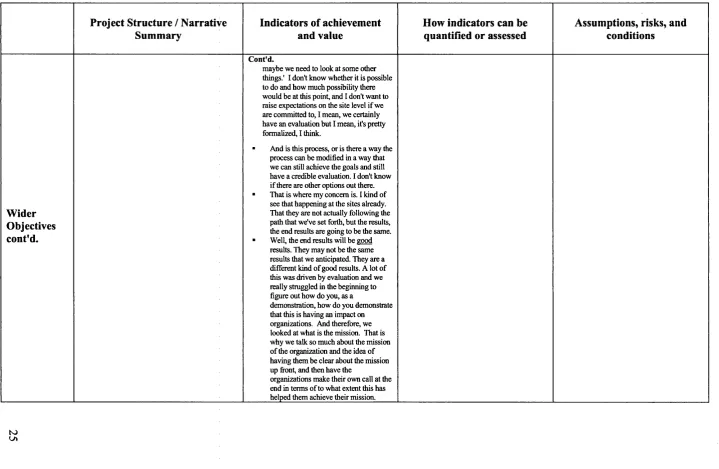
maybe we need to look at some other things.' I don't know whether it is possible to do and how much possibility there would be at this point, and I don't want to raise expectations on the site level if we are committed to, I mean, we certainly have an evaluation but I mean, it's pretty formalized, I think.
■ And is this process, or is there a way the process can be modified in a way that we can still achieve the goals and still have a credible evaluation. I don't know if there are other options out there. ■ That is where my concern is. I kind of
see that happening at the sites already. That they are not actually following the path that we've set forth, but the results, the end results are going to be the same. ■ Well, file end results will be good
[image:27.842.51.771.20.489.2]results. They may not be the same results that we anticipated. They are a different kind o f good results. A lot of this was driven by evaluation and we really struggled in the beginning to figure out how do you, as a
demonstration, how do you demonstrate that this is having an impact on organizations. And therefore, we looked at what is the mission. That is why we talk so much about the mission o f the organization and the idea of having them be clear about the mission up front, and then have the
organizations make their own call at the end in terms o f to what extent this has helped them achieve their mission.
NJ
Project Structure
/Narrative
Summary
Indicators of achievement
and value
How indicators can be
quantified or assessed
Assumptions, risks, and
conditions
W ider
Objectives
A basic goal o f the project is what I hadjust said, about the difference, the value added o f the NETworker and utilization o f telecommunications technology in accomplishing the organizational mission. That is one thing. There is also the community development aspect o f this. How do those two things relate to each other, which is the more important o f the two? Does the second one resultfrom the first one?
■ I think the second one is less explicit than the first one. But it's certainly what we have talked about, and die proposal talks about collaboration as an important goal.. .among local groups and helping them become more collaborative with colleagues within the state and elsewhere. I'm saying all levels of collaboration.
■ There are some external forces overlapping with us. It's all creating synergies and I think the fact that these are all positives... I cant figure out what are the causes, and I think this will be difficult. I think that one of die roles o f the NETworker is really to integrate all [those community-based networking activities] together in some way.
■ I think there are two assumptions under-riding this project: One, that information helps organizations and two, that networks or collaborations among organizations helps
organizations. And so, you are trying to increase each o f those things to the point that they are still beneficial and
they do not become a drag, so you are spending too much time networking and not enough time working on what it is that you do.
■ And trying to deliver the service that you need to deliver.... Also, how do you determine, as they are all going to require a fair amount o f investment up front, what the benefits are going to be down the line.
cont'd.
Do you fee l like the need to be able to evaluate the project is what’s driving part o f the focus on
organizational mission statements or is that something that you would want in the project anyway? Is it a useful management tool or is it a.. ?
■ I think that it is more theoretically than in practice, maybe. I think I probably would not put as much emphasis on it if I wasn't as aware of the need for the evaluation. How do you feel? ■ I don't know, to me you kind of need
both pieces. You need the evaluation piece and I think it's important or else you don't really see or can't really measure the results without it. So I think it's key in that it happens in these stages so that we can see that we have advanced from here to there. Or else, we won't have any way of saying 'it's not going in the right direction.' I don't see any other way to really measure what's happening without having it.
K>
Project Structure / Narrative
Summary
Indicators o f achievement
and value
How indicators can be
quantified or assessed
Assumptions, risks, and
conditions
W ider
Objectives
cont'd.
C ont'd.
where we have to have results, and if we didn't have this mechanism in place, I don't think we would be able to. ■ But I think there is some sort of balance
between having the formal process and having kind of an organic process, where you observe needs and try to meet those needs, whether or not they fit into the category neatly or no t ■ But it's almost like a Phase II in my
mind. Like we need to do this Phase I kind of structure in order for people to really understand the process. And then, if there is like a Phase II it's is kind of, you know, now you know what you are doing and how do you go about helping the community without having, you know, to follow this step by step? ■ In practice, I think what they are finding
in the site is there are issues coming up that are not formally part of the process that they are feeling they need to address. I mean, certainly I think in Caroline's case.
■ So far, I see them fitting into the process though. I don't see them so far out in left field (No, no, no) that they don't fit into the process.
Do you have a clear picture o f specific activities that would be going on at a local level, at a regional or state level, that would indicate to you that things are being successful? And this is not in a broad sense, but very specific things, I mean, what would be indicative o f success?
■
Well, one o f the things that is part o f the monthly report is success stories, anecdotes, o f how they have made a difference.... It's anecdotal.■
I think that what the community NETworker does is offer a different avenue o f getting information., because [the hosts] don't have anyone else thereInterviewer: To me, it is much more process-focused and when you are talking about two
sort o f vague things - information and how it helps you and how you work with other organizations - it is not an easy thing to measure. You have to rely on some o f the anecdotal success stories. It goes back to some o f the things we talked about in January,
■ The target groups, particularly in the case o f BMW. That has been a real issue and they are working with small, emerging CDCs, some o f whom don't even have any full-time staff. They only have volunteers, and so a lot o f them just do not have a computer at all.
Project Structure / Narrative
Summary
Indicators of achievement
and value
How indicators can be
quantified or assessed
Assumptions, risks, and
conditions
W ider
Objectives
cont'd.
C ont'd.
that does the kind o f online searches that [the NETworker] knows how to do. So I think that is where you see where the NETworker has the influence on the organization, because I don't think it would have been brought to the table, that, 'let’s go online and search for this information' had she not been there.
■ Another possibility that may present itself where you get some information, give it to someone and it is not useful; I mean that particular information is not useful. But, on the other hand, they may have thought, well this wasn't useful, but maybe the next time we need information, that time they might think, or they might go back to the
NETworker and think about going online themselves and that time, they might find some information that's useful. One of the things I have observed a lot is just going in and finding something, doing the search, and finding something that is maybe not quite what they want but kind of close - that it still gets people kind of excited about the possibilities and makes those connections.
■ I think its also the ability to get the information out to others and to be able to share the information more broadly as well, and find information that is useful to one organization. And then you can send it out to a number of other organizations that might also have an interest and be able to benefit as well.
about perception shifts or things that are internal to people working in organizations. Do they feel that they are in a different place after the process (yeah) has come through their organization and is it a better place. Do they feel like they have a different orientation at that point. A different conception about their own abilities and the abilities o f their organization because they now know that yes, there is information out there that I can have, and there are other organizations like mine that could help me in this particular project. So, I think what you are doing is creating an entire sort o f funny network structure that I hopefully will be able to map some parts of, at least. That is what I see my jo b is, to come in at different points and shed some light on what that structure is beginning to look like
C ont'd.
■ If I'm not mistaken, though, the target groups that they have identified have computers so that particular organization that represents that area, you know, where resources are limited. But the ones that they have identified to work with as a target group have access or expect to have access.
K>
Project Structure / Narrative
Summary
Indicators of achievement
and value
How indicators can be
quantified or assessed
Assumptions, risks, and
conditions
W ider
Objectives
cont'd.
C ont'd.
■ But I think the outcome is that when we have completed this project and this is what I think it is, and you take the NETworker out, that these organizations are connected and they will continue to collaborate and work without having to have Caroline there to implement i t So I think the outcome is that you build coalitions and people continue to use the network to collaborate and not depend on having a NETworker having to make those things happen.... Initially the NETworker is to assist in searching and getting information, but the ultimate outcome is that the organization can do it themselves, that it would not be the responsibility of the NETworker. ■ I think that another scenario could be
that they realize they really do need someone and then try to figure out how they keep somebody doing that. I think either scenario is a success. Either they continue to do it What isn't successful is that if nothing happens and there is no long collaboration, or anything like that But whether they have somebody there or whether they don't have somebody there and that collaboration is happening: I think that both of them are successful, they are just different ways and different scenarios o f success. ■ Because to me it's difficult, or I would
feel bad if you set up this fantastic picture o f how this works, and at the end o f the process, say, for example, Greensboro says they can no longer
N>
Project S tru ctu re / N arrative
Sum m ary
Indicators of achievement
and value
How indicators can be
quantified o r assessed
Assum ptions, risks, and
conditions
W ider
Objectives
cont'd.
Cont'd.
afford to maintain the NETworker. You don't want to have all this work that has been done, and then everything just falls apart because the NETworker is taken out. See what I'm saying? I think that is where your success comes in, that, you know, you built these relationships and there is this understanding of resources and that they are working together, and continue to work together, even if you pull the person out. Then you have successfully built these collaborations that have really worked, you know, that people continue to do it ongoing. Now, how you measure that after, you won't be able to really, unless somehow we are still in there, you know, kind of monitoring things.
I think that is been one of the real positives about the project is that, kind of like you develop a new role that no one really thought about or thought was necessary but now that they have somebody available to do it, they are finding all kinds of ways that can be implemented.
■ I don't think that the concept o f being in an environment, just like working in any organization, just how much time it is going to take for that person to do after get acclimated into that office first, and I think we didn't allow that kind of time frame and so, we wanted the NETworker to come in and start working, but at the same time, they have their own span in the environment in which they worked in. They had to attend meetings and staff meetings, and work with the staff there first and that took a lot o f time. In doing that you get, people hear 'technology' and someone that can do
u>
Project S tru ctu re / N arrative
Sum m ary
Indicators of achievement
and value
How indicators can be
quantified or assessed
A ssum ptions, risks, and
conditions
Im m ediate
Objectives
cont’d.
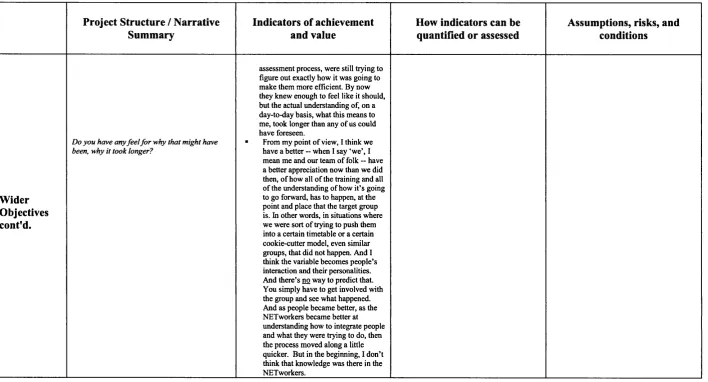
computers or knows how to put things on line or fix things. This person gets pulled into different directions in helping an organization. We realize, 1 think, that most of the organizations weren't on line and up to speed, so it also took a lot of time for the NETworker to just get the organization together. I mean, getting them on line and getting them working before they can even look outside of their organization.
• And again, I want to emphasize that we needed more time in developing the NETworkers themselves. You know, I think the timetable, like now, we are ready to really implement but it took all this time to get them to where we needed them to be and that time was not put into the grant time. I would think we needed three months just to get there... understanding the concept of the NETworker Project.
One reason Rocky Mount wanted a NETworker is to help them implement their networking strategy, which is pretty ambitious. They are getting a direct connection in that building and have set up a Parent Information Center that has a computer.
■ Yes, that is the other thing that has been kind of interesting. In each case the project has helped fund public access and helps support other access points within the organization in each of the three areas.
Project S tru c tu re / N arrative
Sum m ary
Indicators of achievement
and value
How indicators can be
quantified or assessed
Assum ptions, risks, and
conditions
Im m ediate
Objectives
cont’d.
Cont'd.
we've said this isn't, you know, she's not spending her time on demonstration activities and we are not seeing that progress. You know, we can push them. [The host org. work was] helping them get their technology stuff, doing computer support for their staff, developing this parent center, which has one public access computer but is also a library and since Rocky Mount NW Caroline was a librarian, they asked her to set up the library for the Parent Information Center which is not part of the demonstration. There were a number of things. If you look at her work plan.. .have you seen the work plans they have done? They have each done work plans, and you can say that there are other activities there that are, in some way support for the host organization as a target group, but also have taken a fair amount of time. You have to go to a lot of meetings. They are often seen as sort of the technology person, and so, anything that's kinda remotely or at all about technology they've been assigned to deal with it.
■ Particularly with [Rocky Mount], it's been pretty rocky (laughs). You know, I have even talked about... At one point I was really frustrated because, you know stuff wasn't happening, they weren't handing in their reports on time, and at one time, I even thought about pulling this project. But I said I'm not going to do that, but she didn't hear me say I am not going to do that (laughs). So
Project S tru ctu re / N arrative
Sum m ary
Indicators of achievem ent
and value
How indicators can be
quantified or assessed
Assum ptions, risks, and
conditions
Im m ediate
Objectives
cont'd.
.
C ont'd.
they've been, they've been, you know...You know, it's been.. .We've had a couple of meetings and I had one meeting. We sat down with the head of the organization and it's a little strange, because in two of the cases, both in [Rocky Mount and BMW] the host organizations around are on our board... It's a little hairy (laughs) to do it, but I mean, I've pushed pretty hard, and in some ways, it has been a little bit of good-guy, bad-guy stuff. I've been the bad guy and [the project director] has maintained I think, a good relationship with those folks. I mean I've really, I've really pushed and made it clear that I was not happy with what I was the progress being made.
■ The advisory committee is a local support, a support organization for the NETworker and their host organization in this project, to do a variety of different things.
■ We have certain kind of organizations that needed to be invited to participate, including our partner organizations, like the Division Community Assistance, Cooperative Extension, the library, CDC. We had certain ones that we asked them to invite to participate because we knew in every community not everyone would do that. And they had their own folks that they wanted to participate, and it's certainly different for each area.
Project S tru c tu re / N arrative
Sum m ary
Indicators of achievement
and value
How indicators can be
quantified or assessed
A ssum ptions, risks, and
conditions
Im m ediate
Objectives
cont’d.
Getting on track would mean getting back focused on the work plans?
I don't think they were totally off the work plans. If they were totally off their work plans they couldn't be where they are now, it's just they didn't go in the direction that we wanted them to go.... They didn't go as fast, they didn't go as fast.
I'm constantly talking to them all the time. If something is wrong I will go out to the site and work with them. Or just, you know,
conversations over the phone, a lot of email back forth between us. And I try to make sure that I talk to them every week. Sometimes I talk to them two or three times a week. But there is always some communication so that I can try to keep them on track.
■ Basically it takes them through a process. We've got, basically, four networking functions. Communication, access to information, collaboration and getting visibility. And the book takes them through a process with a whole series o f worksheets of understanding what are their
communication needs, who do they communicate with, are they likely to be online, what kind of information do they need, how important is it for them to have information in a digital format versus hard copy, how important is it for it to be timely. It wasn't meant just for this process, it was meant to be a fairly comprehensive assessment for groups that maybe were fairly sophisticated to help them determine the cost-benefit of networking versus other kinds of activities. I sort of said this is your guide, you know, this is your bible. But I had sort of assumed (laughs) that this is kind of a basis that you work from and that you add your own stuff, and I was little shocked that thev were takine it so literallv. I wasn't expecting it to be that way at all. There is information in here but I never expected them to go and say, 'Okay, you are going to
■ I think that's the lesson we're learning from this: how they're getting from A to B where we may want one of them to go this way.
■ They go in different ways. And that is the other thing, to some extent, I think the framework is too formalized. And I think I would, in some ways, one of the reasons we did it was, to some extent, the evaluation is driving it in a way that may not be as constructive because you need to be able to evaluate outcomes with specific organizations. That's the way, we sort of have this lock step. You know, you do your assessment, you do your piece and then at the end you evaluate how it was different. I think what they are finding is there is lots of different demands and they would prefer to be able to have more flexibility and go out there and see where the problems are that are unique to their community and be able to address them in different ways, and try to get there in a different way. I mean, we formalized the process that I think may not really be...
Project S tru c tu re
/N arrative
Sum m ary
Indicators of achievement
and value
How indicators can be
quantified or assessed
Assum ptions, risks, and
conditions
Im m ediate
O bjectives
cont’d.
C ont'd.
fill out worksheet I and go through it and do worksheet II and go through that. I knew that wouldn't work. But they started doing that so...
■ The purpose of the assessment is to come up with, to boil their needs down to basically one page which says, these are the compelling reasons for our organization to be online and to use networking. So that they can really understand it clearly. And then, you can start looking at the second or the third chapter is really where they are starting to have strategic networking plans. So then you can help the organizations understand how they need to organize their group in order to use the Net; what the technology decisions are or the financial decisions are. It is to answer the why before the how, and, as you know, very often people want to know what computer they should get, and what browser they could use before they kind of understand what they want to do and how they want to go about it. ■ It also allows them to see whether or not
they want to be a part of this process, you know, if they want to be a target group? Some may go for this and realize that this is not for me and our organization does not want to participate. There has to be some kind of way of seeing, you know, do you want to be a part of this process, and understanding this whole process? I think this assessment does that.
■ It also has kind of a readiness: what are the barriers, are you ready to network? Do you have the time to do it? Do you have the staff to do it? Do you have anybody that has
Cont'd.
■ Well a perfect example is like the manual that we gave them to follow to do the assessment, and we said, 'Follow this manual to do your assessment.' Well, in doing that, it didn't always, they needed to be able to modify it, but they didn't know they could initially. ■ Yeah, and had always meant it to be
kind of a general guide but they took it like you need to follow it ABC & D, and it doesn't work that way. ■ And now, it's like this light bulb has
come on, and everybody says, 'Oh, okay we can change this and can do this different.
■ We want them to be as creative as possible.
■ They were given this guideline and sometimes you need to be able to modify, and it doesn't work. You know you can change this. Now that they realize that, I think it's gonna be a lot different in how they approach their assessments.
■ Yeah. And since the NETworkers haven't really had an opportunity to do this long enough to kind of make it their own and understand it, we don't know how well that is going. This is a real learning process. We hope that the first one they will learn from. They will leam what works and what doesn't work and then at the end, they will come out with something... ■ Well, the questions are so detailed. I
actually, in doing this, I worked with an editor, and we had some real arguments
Project S tru ctu re / N arrative
Sum m ary
Indicators of achievement
and value
How indicators can be
quantified o r assessed
Assum ptions, risks, and
conditions
Im m ediate
Objectives
cont'd.
Cont'd.
technical savvy, do you have access to technical support?
■ I think [not having computers is] just the need, and they are saying these folks have these needs and they are dealing with the needs as they present themselves. And people are not saying, 'please come and do an assessment of my,' you know, but they are saying, Tielp us get on line or help us get computers, or help us get some information.' ■ I think that's why we needed to re-evaluate
how the assessment process was being done. I think that was too structured, the assessment process. (Yeah) So, if you understand the organization that you are working with, modify the assessment procedure to fit the organization, then I think the assessment would be okay, because it would be helpful to the organization that you are working with.
Cont'd.
about this process. I wanted to boil it down and she kind of argued me into a position where you make it very extensive and sort of provide every kind of laundry list of possible issues. And so, it's really, it could really be used for a group that’s really sophisticated, that really wants to do very sophisticated cost-benefit analysis. But most of these are grassroots organizations, and they are not, I mean basically, I think it's just very simple. "Who do you want to talk to, what information do you need, what you are doing now? Do you understand the value added by having information available electronically? Do you understand those benefits. And now that you understand, how do you think? What kind of ideas does this generate in you as to how you might want to use it and apply it? But when you look through it, it is very detailed and you have people go through all this lengthy process. It's not for a beginning group. The issues, I think, it's important for them to understand underlying issues, but certainly to sorta pick and choose, the worksheets are not, don't use the whole worksheets.
Are the NETworkers more loyal to NC-Exchange or to their organizations?
■ fin unison, stronelv) To their organizations.
■ Because they're hired...See it would be different if they were hired by us. See, then we could have more say, but they are hired by the organization and are
U>
Project S tru ctu re / N arrative
Sum m ary
Indicators of a