Face-specific Capacity Limits under
Perceptual Load Do not Depend on Holistic Processing
Volker Thoma
School of Psychology, University of East London
Word count: 3885
Address correspondence to: Volker Thoma
School of Psychology, University of East London Water Lane, London, E15 4LZ
Abstract
Can we recognize a face when we are not paying attention to it? Faces are highly relevant social stimuli, and there is evidence that they may be processed almost
‘automatically’, that is faster than other non-face objects and presumably without conscious awareness (Young, Ellis, Flude, McWeeny, & Hay, 1986). Importantly, ‘automatic’
processes are deemed to be mandatory, meaning that face recognition cannot be prevented intentionally (Wojciulik, Kanwisher, & Driver, 1998), and capacity-free, in the sense that they require only minimal attentional resources (Schneider & Chien, 2003). The current study is concerned with the conditions that determine boundaries for automatic face processing.
Initial research on the role of attention in face recognition seemed to suggest that face recognition does not proceed in the absence of attention. In visual search studies unexpressive faces do not ‘pop out’ among scrambled or inverted faces (Kuehn & Jolicoeur, 1994) which appears to indicate that detecting a face requires attentional capacity (Adlington & Rhodes, 2002). Recently, however, there is a growing literature suggesting that in many situations face processing is not drawing on substantial amounts of attentional resources (see Palermo & Rhodes, 2007, for a review). For example, Lavie and colleagues (Lavie, Ro, & Russell, 2003) asked participants to search for the name of a famous pop-star or politician among a low or a high number of name-like strings, and make speeded category classifications while ignoring a peripheral distracter face. The distracter face was either congruent (e.g. depicting the same person as the current target name) or incongruent with the name (a face from the opposite category). Interference effects from peripheral faces were unaffected by any
objects were eliminated under conditions of high load in the name search task (e.g. with a search set-size of six strings).
The fact that perceptual load reduced flanker recognition for objects but not faces as found by Lavie et al. (2003) was surprising as it seems to contradict previous findings using perceptual load manipulations. According to perceptual load theory (Lavie, 1995) processing of irrelevant stimuli depends on the limited attentional capacity of the visual system and on the processing demands of the main task. Target stimuli will always be processed as a priority, but in conditions of low perceptual load spare attentional capacity will be available for the involuntary processing of task-irrelevant distracter stimuli. However, under conditions of high load - in which the central task is demanding on perceptual capacity - no spare
resources are available for distracter processing, and consequently distracter interference will diminish and possibly be eliminated. But the results from Lavie et al. (2003) seem to indicate that faces are special in the sense that they are not susceptible to the same capacity limits as usually obtained in perceptual load paradigms such as letters (Lavie, 1995; Lavie et al., 2003) or objects (Lavie et al., 2009). Recently, Neumann, Mohamed, and Schweinberger (2011) observed similar effects from an event-related potentials (ERP) repetition paradigm in which a letter search task was superimposed over unfamiliar faces, hands, and houses as distracters. ERP correlates of repetition priming for non-face objects were modulated by load, but this modulation was not observed for face stimuli.
Taken together, these reports could either mean that faces do not require any
attentional resources to be processed, or alternatively, that only face-specific resources may be needed for face processing. This latter interpretation would fit with evidence that
mandatory fashion in the presence of face input (Farah, Wilson, Drain, & Tanaka, 1998; Kanwisher, McDermott, & Chun, 1997).
Recently, Thoma and Lavie (2013) systematically tested the hypothesis of face-specific attentional resources by comparing the perceptual load effects in visual search tasks with faces and non-faces. Participants searched a central array of either faces or letter-strings for a famous pop star versus a politician’s face or name and made speeded classification responses. Perceptual load was varied through the relevant search set size. In the face search task response competition effects from a category-congruent or incongruent peripheral distractor face were found for set size one but these distractor effects were eliminated with more than two faces. In contrast, in the name search task the response competition effects were unaffected by perceptual load, replicating the Lavie et al. (2003) results. In a further experiment Thoma and Lavie showed that these face-specific perceptual load effects were not due to possible differences in the effectiveness of the the load manipulations between face and name search tasks, because perceptual load effects manifested themselves when the distracter was a name instead of a face.
integration of information from the whole face region rather than a decomposition into component parts (eyes, nose, etc., Tanaka & Farah, 1993). Facial features are arranged in prototypical spatial relations (e.g., nose above the mouth, so-called first-order relational information) that allow rapid classification of a stimulus as a face, while discriminating between individual faces relies on second-order relational information (i.e., the metric distance between facial features). In contrast, processing of non-face objects seems to be primarily ‘part-based’ (e.g., Thoma, Hummel, and Davidoff, 2004), relying on local
information or features (Maurer, Grand, & Mondloch, 2002). Studies have shown that holistic processing of faces occurs only in the upright orientation (Farah et al., 1998), whereas
inverted faces are processed in a part-based manner, with the processing of local feature information itself being largely unaffected by orientation (Searcy & Bartlett, 1996).
The current study seeks to investigate whether face congruency effects depend on perceptual load in situations in which both target and distracters are faces and in which perceptual load is systematically manipulated by adding non-target faces to a central visual search task. The first experiment in this study aims to replicate whether interference from distracter faces is modulated by a manipulation of load specifically on face processing (as found by Thoma and Lavie, 2013). To investigate the locus of capacity limiting processes for face perception the second experiment will test whether face-specific capacity limits are restricted to holistic face processing by substituting upright non-target faces (as used in Experiment 1) with inverted non-target faces.
Experiment 1
the set size of the visual seach task: In set size 1 (low load) only the single famous face was displayed in one of the three positions, in set size 2 (medium load) one of the other two positions was occupied by a non-famous face (non-target), and in set size 3 (high load) both other positions contained each an additional anonymous nontarget face. In all conditions a famous face was shown in the periphery (counterbalanced on the left or right of fixation). Participants were asked to attend to the centre of the display and classify via a button press the famous face according to whether it was a pop star or a politician, while ignoring the peripheral distracter face which was either the same (congruent conditions) as the target face or a face from the opposite category (incongruent conditions). Congruency effects – faster response times in congruent compared to incongruent conditions - should be independent of set size if face processing is genuinely capacity-free as found previously (Lavie et al., 2003). However, if there are capacity limitations to face processing, then according to perceptual load theory congruency effects should be observed under low load, but should be diminished by the increase in search load by additional non-target faces.
Experiment 1 Method
Stimuli and Procedure. Participants were placed in front of a 15” CRT monitor at a distance of approximately 60 cm. Each display comprised of the target face at fixation or with its center 3 cm above or below fixation. The target face could be presented alone or among one or two other unfamiliar faces. Participants had to indicate by a speeded key press whether the famous face was a politician or a pop star (faces depicted people of an apparent age between ca. 40 and 55 years, see Lavie et al., 2003). The peripheral distracter face was presented 4 cm either to the left or right of fixation. This face was either the same (congruent) as the target face, or from the opposite category (incongruent). Thus, twenty-four male faces were presented which comprised of six famous politicians, six famous pop stars1, and twelve unfamiliar faces which served as non-targets in conditions with set size 2 or set size 3. The target and non-target faces were a vertical size of 3cm and the distracter faces 3.4 cm. E-prime 1.1 was used to run the experiment. Target identity and positions were
counterbalanced, as were distracter identity and position (left vs right). Each subject ran through a practice block of 72 trials followed by 8 experimental blocks of 72 trials each. All conditions were randomly intermixed in each block. Displays remained visible for 3 seconds unless the participant responded earlier.
Results
Only correct response times greater than 150 ms were analysed, response times below that were counted as an error (0.1% of all trials). Figure 1 presents the mean RTs as a
function of the experimental conditions. A within-subject ANOVA with the factors
congruency and set size was performed on response times (degrees of freedom Greenhouse-Geisser corrected for the factor set size). The results revealed a significant main effect for set size, F (1.14, 13.61) = 41.00, p < .001, partial eta2 = .77, indicating that response latencies
1
were significantly higher following an increase in the search set size (p < .001 in all comparisons) with an average search slope of 106 ms. This finding shows that processing demands rose following an increase in the face search set size, indicating that the
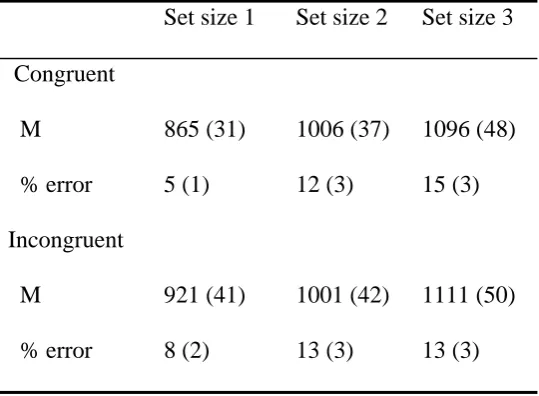
manipulation of perceptual load was successful. There was also a main effect of congruency, F (1, 12) = 6.80, p < .05, partial eta2 = .36, with congruent trials being responded to faster than incongruent ones (see Table 1). This effect was qualified by an interaction with set size, F(1.32, 15.97) = 7.10, p < .05, partial eta2 = .37. The interaction clearly shows that whereas the irrelevant distracter face produced significant congruency effects at set size one, F(1, 12) = 15.74, p < .005, partial eta2 = .57, there was no such effect at set size two, F(1, 12) < 1, partial eta2 = .02, or at set size three, F(1, 12) = 1.47, p = .25, partial eta2 = .11. Error rates were analysed in an equivalent ANOVA, revealing only a significant effect of load, F(1.19, 14.32) = 5.19, p = .013, partial eta2 = .30 (see Table 1). In summary, the results of
Figure 1.
[image:10.595.68.338.293.491.2]Mean response times and standard errors of the mean for congruent and incongruent conditions as a function of set size in Experiment 1.
Table 1
Experiment 1: Mean Response Time and Standard Errors (ms) and Percentage Errors (and their Mean Standard Error) for Performance in the Probe Displays as a Function of Set size in Experiment 1
Set size 1 Set size 2 Set size 3 Congruent
M 865 (31) 1006 (37) 1096 (48) % error 5 (1) 12 (3) 15 (3) Incongruent
M 921 (41) 1001 (42) 1111 (50) % error 8 (2) 13 (3) 13 (3)
Experiment 2
whether distracter interference effects modulated by load are due to demands on face
recognition or whether interference is due to face-specific low-level properties. Experiment 2 is therefore designed to test more directly whether load effects for face distracters are limited to search tasks with upright faces as non-targets. One interpretation of the results of both Experiment 1 and those of Lavie et al. is that perceptual load does not affect face recognition of distracters as long as the central task is not loaded with upright (non-target) faces. If this interpretation of a face-specific load effect is correct, then we would expect that perceptual load effects should disappear when non-target faces are inverted. In this case, distracter interference in set size conditions 2 and 3 would now be expected, because inverted faces are typically not processed holistically but encoded in a more part-based fashion similar to non-face objects (Yin, 1969), which in turn have been shown not to affect interference effects for flanker faces under high load (Lavie et al., 2003). If, however face-specific perceptual load effects are not determined by upright faces (implying processing at the face recognition stage) but extend to situations in which the non-targets are inverted faces then we can conclude that load effects for face distracters are determined by non-holistic stimulus information (potentially based on face parts) in face images.
Method
Participants. Thirteen unpaid students from the University of East London (2 male, mean age 29 years, SD = 8.4) participated after reading an information leaflet and giving their written consent before the experiment. All reported normal or corrected-to-normal vision. Before the experiment participants were asked to name photographs of the famous faces used in the experiment. All participants could name the faces correctly.
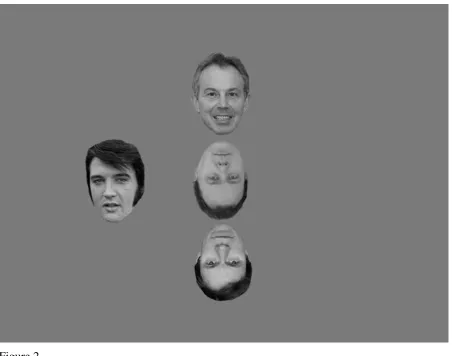
non-target faces in set sizes 2 and 3 appeared in an upside-down orientation. The non-target face and the distracter were always shown in the familiar upright orientation.
Figure 2.
Example of a stimulus display with two (inverted) non-target faces (set size 3) and the distracter (appearing to either the left or right side of fixation) in Experiment 2. Note: The versions of the faces shown here differ from the images used in the actual experiments due to copyright limitations (see Appendix for lists of famous faces used in this study)2.
Results
2
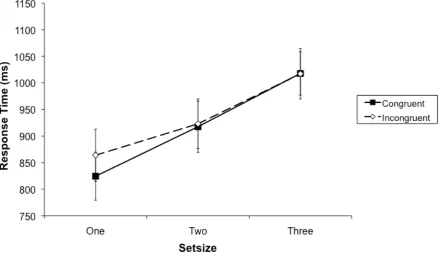
Latencies below 150 ms were counted as errors (0.2% of all trials) and omitted from further analysis. Figure 3 presents the mean RTs as a function of the experimental conditions (see also Table 2). A within participants ANOVA (set size by congruency) was run on latencies of correct trials. A significant main effect of set size, F(1, 12) = 110.06, p < .001, partial eta2 = .90, showed significant increases in latencies between increments in the search set size (p < .001 in all comparisons) with an average search slope of 87 ms. There was a trend for an effect of congruency, F(1, 12) = 3.52, p = .08, partial eta2 = .28, but more
crucially there was a significant interaction between congruency and set size, F(2, 12) = 4.33, p < .05, partial eta2 = .26. As in the previous experiment, distracter interference was
significant in set size 1, F(1, 12) = 9.71, p < .01, partial eta2 = .45, but not in set size 2, F(1, 12) < 1, or set size 3, F(1, 12) < 1. Error rates were small (between 5% and 6%) in all
conditions, and an ANOVA revealed no significant differences for the main effects (all F < 1) or the interaction, F(2, 24) = 2.34, p = .12 partial eta2 = .16 (see Table 2).
Figure 3:
Table 2.
Experiment 2: Mean Response Time (ms) and Percentage Errors (and their Mean Standard Errors) for Performance in the Probe Displays as a Function of Set size in Experiment 2
Set size 1 Set size 2 Set size 3 Congruent
M 824 (47) 917 (49) 1017 (42)
% error 5 (1) 6 (1) 6 (2)
Incongruent
M 863 (51) 923 (48) 1017 (49)
% error 6 (1) 5 (1) 6 (2)
Experiment 2 showed an almost identical pattern of results as Experiment 1:
search task in a similar way as upright non-target faces, but also had the same effect of eliminating distracter interference.
General Discussion
The investigation reported here demonstrates that processing of distracter faces depends on perceptual load: In two experiments interference from distracter faces was observed when the search task included one face, but was eliminated when the face search task included two or three faces as non-targets. Importantly, Experiment 2 showed for the first time that face-specific perceptual load effects did not depend on whether the central search task contained non-target faces in an upright orientation, as adding inverted faces to the search set had almost identical effects on distracter processing as did adding upright faces. Thus, these capacity limits do not depend on the properties of “holistic” (or first-order configural) face processing.
The present data partially contradict and extend previous work that has suggested that processing of faces has no general capacity limits (Lavie et al., 2003; Neumann et al., 2011), and Thoma and Lavie (2013), who only used upright faces to show face-specific capacity limits. The notion of face-specific capacity limits is broadly in line with the suggestion of a ‘face module’ (Fodor, 1983; Kanwisher, 2000) that operates automatically and is unaffected by processing of other stimuli3. This notion appears to be supported by developmental studies (e.g., Morton & Johnson, 1991), functional imaging and single cell studies (Kanwisher et al., 1997; Puce, Allison, Gore, & McCarthy, 1995) and neuropsychological reports of
prosopagnosia (Farah, Wilson, Drain, & Tanaka, 1995), although some authors cite evidence for a more widely distributed face-specific network (e.g., Gobbini & Haxby, 2006).
3
What is the nature of the capacity limitations, if both upright and upside-down non-target faces affect distracter processing? Theoretical accounts stressing holistic face processing suggest that faces are primarily recognized as undifferentiated wholes or
templates, contrary to non-face objects which are mainly recognized in a part-based manner (Farah et al., 1998; Tanaka & Farah, 1993). Configural accounts of face processing (Diamond & Carey, 1986; Searcy & Bartlett, 1996) propose that face processing is based on computing the spatial relations between facial features. The current results therefore indicate that the capacity bottleneck for face images is located before any potential holistic or first-order relational processing occurs. But if these hallmarks of face-recognition cannot account for the face-specific capacity limitations observed here, how can the present data be reconciled with the special status of faces (FIE; Yin 1969) in terms of capacity limitations (Thoma & Lavie, 2013)4?
A potential explanation for the face-specific processing resources that underlie the orientation-invariant load effects is that faces have a unique pattern of spatial frequencies compared to other objects (Costen, Parker, & Craw, 1996; De Valois & De Valois, 1980). Recently, Rothstein and colleagues (Rotshtein, Vuilleumier, Winston, Driver, & Dolan, 2007) found that faces selectively activate different areas in the occipito-temporal areas, depending on the spatial frequency manipulation of the face stimuli (spatially filtered for high or low frequency), but that the right fusiform area (associated with face recognition) responded to both frequency ranges. Therefore spatial frequencies of faces – present in both upright and inverted faces – may determine their capacity limits under perceptual load. Yet in the Jenkins et al. (2003) study an additional flanker consisting of scrambled version of a face retaining the same spatial frequency bands did not result in a flanker dilution effect, compared to
4
scrambled (neutral) faces which did dilute the flanker effect. This result seems to indicate that spatial frequency alone may not explain the unique capacity demand for faces (see also Cheung, Richler, Palmeri, & Gauthier, 2008).
More direct evidence that the broad range of spatial frequencies contained in face images cannot fully explain the observed face-specific capacity limitation comes from Thoma and Lavie (2013, Experiment 4). Using an almost identical paradigm to the one reported here, non-target faces in the search set were replaced with scrambled faces. Scrambling was achieved by a 2-D Fast Fourier transformation of the faces, which randomizes the phase spectrum, while keeping the amplitude (power spectrum) intact (see McCarthy, Puce, Gore, & Allison, 1997; Jenkins et al., 2003). Adding scrambled faces to the search did not reduce the congruency effect5, unlike the original non-target faces.
A different potential explanation of our current results is therefore that face-processing limits are determined by the face-processing of specific face parts or local features. There is evidence that face perception can work without holistic or first-order relational processes and that observers can rely on local facial characteristics. For example, Schwaninger and colleagues (Schwaninger, Lobmaier, Wallraven, & Collishaw, 2009) compared faces with faces that had their features spatially scrambled. They found that the part-scrambled versions were not more difficult to recognise than the faces in which features were placed in their correct categorical relational position but with distorted metrical
distances, which indicates a featural route to face recognition.
Furthermore, results from studies using response classification, reverse correlation, or ideal observer techniques suggest that face recognition relies mostly on eye regions, followed
5
by mouth and nose regions (Gaspar, Bennett, & Sekuler, 2008; Gold, Mundy, & Tjan, 2012) and indicate that the well-known face inversion effect for face recognition and discrimination tasks may be a result of more efficient processing of parts in the upright orientation rather than a qualitatively different use of visual information. The nature of the processing of face parts and their contribution to the face inversion effect is currently debated (e.g., Riesenhuber & Wolff, 2009; Rossion, 2008). Whatever the cause of the FIE, the current data strongly suggest that face-specific capacity limits are affected by perceptual attributes after spatial frequency components have been extracted and before holistic face representations have been established.
In conclusion, faces are perceived in an automatic manner as long as there is sufficient capacity for their perception, but not when task relevant processing exhausts that capacity. Although face recognition seems to be limited by the amount of face-specific resources (Thoma & Lavie, 2013), this study shows for the first time that these capacity limits are not bounded by upright faces alone, indicating that the capacity limits are
References
Adlington, R. L., & Rhodes, G. (2002). The influence of divided attention on holistic face perception. Cognition, 82(3), 225–257.
Cheung, O. S., Richler, J. J., Palmeri, T. J., & Gauthier, I. (2008). Revisiting the role of spatial frequencies in the holistic processing of faces. Journal of Experimental Psychology: Human Perception and Performance, 34, 1327–1336.
doi:10.1037/a0011752
Coren, C. G., Sarty, M., & Wu, P. Y. K. (1975). Visual following and pattern discrimination of face-like stimuli by newborn infant. Pediatrics, 56, 544–549.
Costen, N. P., Parker, D. M., & Craw, I. (1996). Effects of high-pass and low-pass spatial filtering on face identification. Perception & Psychophysics, 58(4), 602–612. De Valois, R. L., & De Valois, K. K. (1980). Spatial Vision. Annual Review of Psychology,
31(1), 309–341. doi:10.1146/annurev.ps.31.020180.001521
Diamond, R., & Carey, S. (1986). Why Faces, Are and Are Not Special: An Effect of Expertise. Journal of Experimental Psychology: General, 115(2), 107–117.
Farah, M J, Wilson, K. D., Drain, H. M., & Tanaka, J. R. (1995). The inverted face inversion effect in prosopagnosia: evidence for mandatory, face-specific perceptual
mechanisms. Vision Research, 35(14), 2089–2093.
Farah, Martha J., Wilson, K. D., Drain, M., & Tanaka, J. N. (1998). What is “special” about face perception? Psychological Review, 105(3), 482–498.
doi:10.1037/0033-295X.105.3.482
Gaspar, C. M., Bennett, P. J., & Sekuler, A. B. (2008). The effects of face inversion and contrast-reversal on efficiency and internal noise. Vision Research, 48(8), 1084–1095. doi:10.1016/j.visres.2007.12.014
Gauthier, I., Behrmann, M., & Tarr, M. J. (1999). Can face recognition really be dissociated from object recognition? Journal of Cognitive Neuroscience, 11(4), 349–370. Gobbini, M. I., & Haxby, J. V. (2006). Neural response to the visual familiarity of faces.
Brain Research Bulletin, 71(1-3), 76–82. doi:10.1016/j.brainresbull.2006.08.003 Gold, J. M., Mundy, P. J., & Tjan, B. S. (2012). The Perception of a Face Is No More Than
the Sum of Its Parts. Psychological Science, 23(4), 427–434. doi:10.1177/0956797611427407
Jenkins, R., Lavie, N., & Driver, J. (2003). Ignoring famous faces: category-specific dilution of distractor interference. Perception & Psychophysics, 65(2), 298–309.
Kanwisher, N. (2000). Domain specificity in face perception. Nature neuroscience, 3(8), 759–763. doi:10.1038/77664
Kanwisher, N., McDermott, J., & Chun, M. M. (1997). The fusiform face area: a module in human extrastriate cortex specialized for face perception. The Journal of
Neuroscience: The Official Journal of the Society for Neuroscience, 17(11), 4302– 4311.
Kuehn, S. M., & Jolicoeur, P. (1994). Impact of quality of the image, orientation, and similarity of the stimuli on visual search for faces. Perception, 23, 95–122. doi:10.1068/p230095
Lavie, N. (1995). Perceptual load as a necessary condition for selective attention. Journal of Experimental Psychology: Human Perception and Performance, 21(3), 451–468. doi:10.1037/0096-1523.21.3.451
Lavie, N., Lin, Z., Zokaei, N., & Thoma, V. (2009). The role of perceptual load in object recognition. Journal of Experimental Psychology. Human Perception and
Performance, 35(5), 1346–1358. doi:10.1037/a0016454
Maurer, D., Grand, R. L., & Mondloch, C. J. (2002). The many faces of configural processing. Trends in Cognitive Sciences, 6(6), 255–260.
Morton, J., & Johnson, M. H. (1991). CONSPEC and CONLERN: a two-process theory of infant face recognition. Psychological Review, 98(2), 164–181.
Neumann, M. F., Mohamed, T. N., & Schweinberger, S. R. (2011). Face and object encoding under perceptual load: ERP evidence. NeuroImage, 54(4), 3021–3027.
doi:10.1016/j.neuroimage.2010.10.075
Palermo, R., & Rhodes, G. (2007). Are you always on my mind? A review of how face perception and attention interact. Neuropsychologia, 45(1), 75–92.
doi:10.1016/j.neuropsychologia.2006.04.025
Perrett, D. I., Hietanen, J. K., Oram, M. W., & Benson, P. J. (1992). Organization and functions of cells responsive to faces in the temporal cortex. Philosophical Transactions of the Royal Society of London. Series B, Biological Sciences, 335(1273), 23–30. doi:10.1098/rstb.1992.0003
Riesenhuber, M., & Wolff, B. S. (2009). Task effects, performance levels, features,
configurations, and holistic face processing: A reply to Rossion. Acta Psychologica, 132(3), 286–292. doi:10.1016/j.actpsy.2009.07.004
Rossion, B. (2008). Picture-plane inversion leads to qualitative changes of face perception. Acta Psychologica, 128(2), 274–289. doi:10.1016/j.actpsy.2008.02.003
Rotshtein, P., Vuilleumier, P., Winston, J., Driver, J., & Dolan, R. (2007). Distinct and Convergent Visual Processing of High and Low Spatial Frequency Information in Faces. Cerebral Cortex, 17, 2713–2724. doi:10.1093/cercor/bhl180
Schneider, W., & Chien, J. M. (2003). Controlled & automatic processing: behavior, theory, and biological mechanisms. Cognitive Science, 27, 525–559. doi:10.1016/S0364-0213(03)00011-9
Schwaninger, A., Lobmaier, J. S., Wallraven, C., & Collishaw, S. (2009). Two Routes to Face Perception: Evidence From Psychophysics and Computational Modeling. Cognitive Science, 33(8), 1413–1440. doi:10.1111/j.1551-6709.2009.01059.x Searcy, J. H., & Bartlett, J. C. (1996). Inversion and processing of component and spatial–
relational information in faces. Journal of Experimental Psychology. Human Perception and Performance, 22, 904–915.
Tanaka, J. W., & Farah, M. J. (1993). Parts and wholes in face recognition. The Quarterly Journal of Experimental Psychology. A, Human Experimental Psychology, 46(2), 225–245.
Thoma, V., & Lavie, N. (2013). Perceptual load effects on processing distractor faces indicate face-specific capacity limits. Visual Cognition, 1–24.
Tsal, Y., & Benoni, H. (2010). Diluting the burden of load: perceptual load effects are simply dilution effects. Journal of experimental psychology. Human perception and
performance, 36(6), 1645–1656. doi:10.1037/a0018172
Wilson, D. E., Muroi, M., & MacLeod, C. M. (2011). Dilution, not load, affects distractor processing. Journal of experimental psychology. Human perception and performance, 37(2), 319–335. doi:10.1037/a0021433
Wojciulik, E., Kanwisher, N., & Driver, J. (1998). Covert visual attention modulates face-specific activity in the human fusiform gyrus: fMRI study. Journal of
Neurophysiology, 79(3), 1574–1578.
Yin, R. K. (1969). Looking at upside-down faces. Journal of Experimental Psychology, 81(1), 141–145. doi:10.1037/h0027474
Appendix A
The following faces were used in both Experiments 1 and 2: Famous politicians:
Tony Blair, Gordon Brown, George W Bush, Bill Clinton, John F Kennedy, John Major Famous pop stars:
Mick Jagger, Elton John, Paul McCartney, Elvis Presley, Rod Stewart, Robbie Williams
Acknowledgements: