Understanding War and Its Continuation:
The Case of Northern Uganda
Christopher Gerald Dolan
Development Studies Institute
London School of Economics & Political Science
University of London
Submitted for the degree of PhD
Abstract
This thesis addresses the question of why, when almost everyone says they wish it would end, suffering such as that in northern Uganda continues. I argue that, contrary to popular presentations, the situation is not primarily one of war between the Lord’s Resistance Army and the Government of Uganda, but instead a form of mass torture, which I call Social Torture.
The principal victims are the population within the ‘war zone’, particularly in
‘protected villages’ for the internally displaced, where tactics and symptoms typical of torture, including violation, dread, disorientation, dependency, debilitation and humiliation, are widespread. The most visible perpetrators are the Government and LRA, but a range of less visible actors are also involved, not least donor governments, multi-lateral organisations, academics, churches and NGOs. In many instances these can be regarded as complicit bystanders; like doctors in a torture situation, they appear to be there to ease the suffering of victims, but in reality they enable the process to be prolonged by keeping the victim alive for further abuse. This serves a number of inter-linked economic, political and psychological functions for perpetrators and bystanders alike, and is underpinned by psychological and discursive processes of justification, most importantly the idea that this situation is first and foremost a ‘war’ between the LRA and the Government.
Acknowledgements
There is no way to adequately acknowledge the multiple ways in which different people at different times have contributed to this work over its long gestation, and not all of them can or would wish to be named. This includes many people in the
‘protected villages’ who welcomed me, a researcher, with the words ‘go and tell people out there what is happening to us here’. With this piece I am trying to discharge the task you gave me.
Among those who can be (and I hope will also wish to be) named, I would include all my colleagues in ACORD Gulu at the time, not least Rosalba Oywa for her moral and practical support, Sunday Abwola for our work with the military, Andrew Olweny for guiding me around Kitgum district, and Christopher Ojera for suggesting that we hold the 1999 conference on research findings in Gulu rather than anywhere else. The Hon. Omwony Ojok I thank both for a number of lengthy conversations and for galvanising numerous people to attend the conference and thereby raise it to another level than that foreseen.
For bringing their personal skills, analyses and suggestions to bear on our data collection and methodologies I am indebted to: Latim William, David Okiya, David Okello, Anna Okwir, Odoch Athii, Stella Atim, Jude Ogik, Ongwech Otim Patrick, Kinyera Fred, Alice Jean Ochola, Oola Timothy, Oola Ben, Okwera Santo, Oringa Robert, Opio James, Obol Alex Okot, Oyera Martin Leko, and the late Odoko Amida Martin of Odek. Most particularly, for helping to put the show on the road and keep it running both when I was there and when I was absent, I have only praise and
admiration for my colleague and friend, Komakech Charles Okot.
For saving my life when malaria was just about to take it in June 1998, I can never say enough thanks to the late Dr Matthew Lukwiya of Lacor Hospital, and similarly to Okello Vincent, who looked after me unstintingly throughout that period.
For spending ten days telling me his experiences in the LRA, I shall always remember and respect the late Yakobo Engena. To Father Carlos who has the courage to speak out my thanks also.
Table of Contents
1Abstract ... 2
Acknowledgements ... 3
Table of Contents ... 4
List of Tables, Charts & Diagrams... 10
List of Illustrations ... 11
List of Acronyms ... 13
Map of ‘Protected Villages’ in which fieldwork was conducted ... 15
Chapter 1 - Introduction ... 16
The Mainstream Discourse of today’s wars... 17
Building Blocks of a Counter-narrative ... 20
Impacts... 26
Actors ... 27
Benefits and Functions... 29
Justifications... 30
Elaborating a model of Social Torture ... 31
Overview of the thesis ... 37
Chapter 2: The Research Process ... 42
Introduction... 42
Institutional setting... 43
Contextual Challenges ... 44
Conceptual challenges ... 46
Horizontal segmentation or vertical linkages? ... 47
Acknowledging Peoples’ Agency ... 48
Ethical Considerations ... 49
Methods adopted... 50
Composition of the research team ... 50
In-depth key informant interviews... 54
Audio-visual data... 56
Research integrated with programming – the use of focus groups ... 58
Dealing with findings ... 59
Discussion and Conclusions ... 62
Subjectivity and Objectivity... 65
Chapter 3 - An overview of the situation in northern Uganda ... 67
Introduction... 67
The build-up to war ... 70
Phase I (1986-1988) ... 72
Phase II (1988-1994)... 75
Phase III (1994-1999) ... 77
Phase IV – Amnesty for ‘Terrorists’ (2000 – 2002) ... 85
Phase V – Operation Iron Fist and its aftermath (2002 - 2004)... 89
The war as people remember it ... 92
Discussion ... 99
Some Concluding Questions... 107
Chapter 4 – Reconsidering the LRA - Government dynamic ... 109
Introduction... 109
The LRA’s ambiguities ... 112
The LRA’s Modus Operandi... 118
LRA motivations and politics... 126
The 1994 Peace Talks... 131
Discussion ... 135
Conclusions ... 156
Chapter 5 - Protection as Violation... 158
Introduction... 158
Part I: Formation and Organisation ... 162
Physical layout and shelter ... 165
Administration ... 167
Mchaka-mchaka ... 171
Part II: Subsistence in the Camps ... 173
Access to land ... 176
Other alternatives to agriculture ... 182
Group Formation... 186
Food Aid ... 187
Demonstration sites ... 192
Calls to allow people to return home ... 193
Block Farming ... 195
Part III: Access to education... 197
Universal Primary Education (UPE)... 200
Drop-outs... 202
Teacher Motivation ... 204
Secondary Schooling... 205
Part IV: Access to health care ... 210
Part V: Access to protection ... 218
When was the LRA the UPDF? ... 223
People’s responses... 227
Discussion and conclusions... 228
Chapter 6 - Protection as Debilitation ... 233
Introduction... 233
Physical Debilitation ... 235
Psychological Debilitation... 242
Suicide... 243
Heavy drinking... 246
Cultural Debilitation ... 248
Burial and Funeral Rites ... 253
Breakdown of Restorative Justice ... 254
Dance and Song ... 257
External Interventions which ‘diluted’ culture ... 260
Changing military-civilian relationships ... 263
Discussion ... 272
Signs of resilience? ... 275
Conclusions ... 276
Introduction... 279
The hegemonic model of masculinity... 280
What women are (supposed to be) like... 280
What youth are (supposed to be) like ... 282
What men are (supposed to be) like ... 285
Masculine Roles... 285
The gap between model and reality: Inability to fulfil external and internalised expectations ... 287
Acquisition of knowledge ... 288
Marriage... 290
Provision... 293
Physical protection ... 294
Further threats to sense of masculinity ... 294
‘Gender’ discourse and practice... 297
Militarisation... 298
The impacts of the emergence of a hegemonic model... 299
Domestic violence ... 307
Increased male vulnerability to violence ... 308
State benefits from the hegemonic model... 311
Discussion ... 312
Conclusions ... 315
Chapter 8 - Social Torture and the Continuation of War ... 317
Introduction... 317
Impacts and Methods... 319
Actors ... 327
Benefits and Functions... 338
Economic ... 338
Psychological ... 341
Political ... 342
Justifications for action and inaction... 346
Discussion ... 351
Geographically extensive and time-indifferent ... 353
Multiple actors ... 353
Multiple functions ... 354
Social Torture acquires its own momentum... 356
Social Torture is justified in public discourses which themselves become instruments of social torture... 358
Conclusions ... 360
Chapter 9 - Conclusions ... 363
Social Torture offers a counter-narrative to the mainstream discourse... 363
Social Torture goes beyond the Convention Against Torture... 371
Social Torture suggests the need for more comprehensive interventions... 376
Annex A: Communique from the Participants at the International Conference on the theme 'Peace Research & the Reconciliation Agenda', held at District Farm Institute, Gulu, Northern Uganda, 27 - 29 September 1999... 379
Annex B: Testimony of an LRA soldier who returned under Amnesty, October 2001. Recorded April 2002, Kampala ... 383
A comment on the integrity of this testimony... 383
An Aye: I am the one ... 385
Section 1 ... 385
1.1: Abduction... 385
1.2. Journey to Sudan (December 1995/January 1996)... 391
1.3 Arrival in Sudan ... 393
Section 2: Integration into the LRA in Sudan ... 393
2.1: Arrival in Aru Camp (18 January 1996) ... 393
2.2: 1st meeting with Joseph Kony, 20 January 1996 ... 395
2.3: Joseph Kony’s Regulations... 396
2.4: Initiation into LRA and military training ... 398
Section 3: Life in the LRA ... 399
3.1: Shortages of food and water (January/February 1996) ... 399
3.2: Food raids in Dinka villages, March 1996... 401
3.3: Arrival of members of WNBF, 17 March 1996 ... 403
3.5: Attack by NRA/SPLA, 9 April 1996... 404
3.6: Jebeleen, April 10th 1996... 408
3.7: Offensives in Uganda ... 408
3.8: Visit of Ugandan Delegation, June 1997... 409
3.9: Revision of standing orders, 1 December 1998 ... 411
3.10: Explosion of ammunition store (November 1999)... 411
3.11: Attack on civilians near LRA camp (December 1999)... 412
3.12: Move to Nisitu (January 2000)... 413
3.13: Lubanga Tek ( February 2000):... 414
3.14: The move to Bin Rwot, April 2000 ... 415
3.15: Breakdown of Relations with Government of Sudan ... 417
3.16: Building links with Equatoria Defence Forces (2000) ... 418
3.17: LRA drawback ... 419
Section 4: Escape ... 421
4.1: Escape to Nisitu ... 421
4.2: Transfer to Juba ... 423
4.3: Transfer to Khartoum ... 424
4.4: Seven months in Khartoum ... 425
4.5: Repatriation... 427
Section 5: Treatment of Stragglers... 429
Section 6: Control exercised over people’s sex lives... 429
Section 7: LRA Sick Bays... 430
Section 8: Herbal Remedies used in the LRA ... 432
Section 9: Organisational chart for the year 1999 - 2000... 434
Section 10: The Four Holy Spirits Guiding Joseph Kony... 435
Section 11: The Yards ... 436
Section 12: The Controllers (Lunyut Twer)... 438
Section 13: List of items kept in the Yard Store (Ot Twer)... 440
Annex C: Two representative accounts of LRA raids... 442
Palaro, 26 November 1998... 442
Pabo, 17 October 1998: ... 443
Meeting of 10th January 1994 (summarised from elder’s account) ... 444
The meeting of 22 January 1994 (summarised from video transcript and elder’s narrative)... 449
Annex E: Notes on the LRM ... 456
Annex F: List of items for sale in Pabbo Camp, 3 March 1999 ... 459
Annex G: Account of World AIDS Day, 1 December 1999, Anaka... 461
Annex H: List of compensation payments drawn up by the Rwot Moo of Atiak Division together with his committee, March 1999: ... 462
Bibliography ... 463
List of Tables, Charts & Diagrams
DIAGRAM 1.1: KEY ELEMENTS IN IDENTIFYING TORTURE... 26TABLE 1.1 KEY DIFFERENCES BETWEEN INDIVIDUAL AND SOCIAL TORTURE... 32
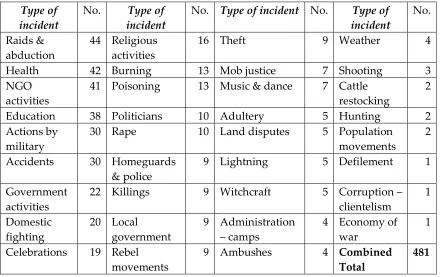
TABLE 2.1: NUMBER OF REPORTS BY SUBJECT MATTER OVER THE SIX MONTHS JULY -DECEMBER 1999, FROM 10 PROTECTED VILLAGES IN GULU DISTRICT... 52
TABLE 3.1: INCIDENTS THAT HAPPENED TO WOMEN AND THEIR IMMEDIATE FAMILIES (EACH LINE REPRESENTS A DIFFERENT PERSON’S MEMORY) ... 93
TABLE 3.2: INCIDENTS WITHIN THE IMMEDIATE COMMUNITY... 94
TABLE 3.3: INCIDENTS AT DISTRICT AND NATIONAL LEVEL... 95
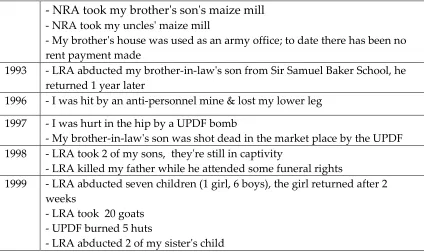
TABLE 3.4: SUMMARY OF EXPERIENCES OF INDIVIDUALS AS DRAWN FROM TIMELINES (1986-1999) DEVELOPED WITH 10 SELF-HELP GROUPS, GULU DISTRICT, FEBRUARY 1999 ... 98
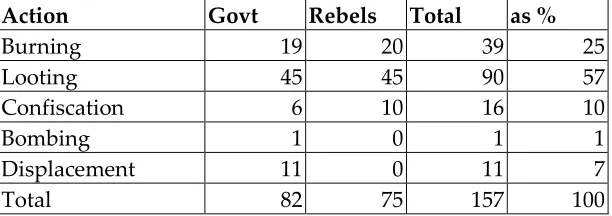
TABLE 3.5: ATTRIBUTION OF RESPONSIBILITY FOR 157 INSTANCES OF DAMAGE TO PERSONAL PROPERTIES BY 170 PARTICIPANTS IN 10 SELF-HELP GROUPS, GULU, FEBRUARY 1999 98 CHART 5.1 SHOWING ESCALATION IN NUMBERS OF INTERNALLY DISPLACED IN GULU/KITGUM/PADER, 1997-2003 ... 159
TABLE 5.2: CROP PRICES DURING FIELDWORK PERIOD, 1999-2000... 175
TABLE 5.3: PRIMARY SCHOOLING IN PABBO CAMP, 1998... 199
TABLE 5.4: PRIMARY SCHOOL ENROLMENTS IN PALARO, ABAKA, AND ODEK P7 SCHOOLS ... 202
TABLE 6.2: RANKING OF ILLNESSES TREATED IN 961 PATIENTS BY 37 TRADITIONAL HEALERS
IN GULU DISTRICT IN THE WEEK 14-20 JUNE 1999 ... 239
TABLE 6.3: LIST OF DEATHS RECORDED BY FIELDWORKERS IN AWER & PAGAK CAMPS, JULY
99 – MARCH 00, SORTED BY AGE OF DECEASED... 241
TABLE 6.4: EXPLANATIONS GIVEN BY SOLDIERS’ WIVES IN GULU BARRACKS IN ANSWER TO
THE QUESTION ‘WHY DO YOU THINK THE HIV INFECTION RATE IN GULU HAS RISEN TO
BE ONE OF THE HIGHEST IN THE COUNTRY?’ ... 264
TABLE 6.5: WOMEN’S STATED REASONS FOR THEIR OWN INFECTION WITH HIV, AS GIVEN BY
116 MEMBERS OF AN ACORD ASSISTED SUPPORT GROUP FOR PEOPLE LIVING WITH
AIDS ... 265
TABLE 6.6: RANKING OF RISKS TO HEALTH AS GIVEN IN TWO FOCUS GROUPS WITH MEMBERS
OF THE UPDF, 3-4 JUNE 1999... 270
TABLE 7.1: ACTORS IDENTIFIED BY 11 MEMBERS OF A YOUTH GROUP IN GULU DISTRICT, 8
FEBRUARY 1999 ... 283
TABLE 7.2: RANKING OF ILLNESSES TREATED IN 416 MALE PATIENTS BY 37 TRADITIONAL
HEALERS IN GULU DISTRICT IN THE WEEK 14-20 JUNE 1999 ... 301
TABLE 7.3: METHODS AND REASONS FOR SUICIDES/SUICIDE ATTEMPTS AMONG MEN... 302
List of Illustrations
MAP SHOWING GULU, KITGUM AND NIMULE TOWNS, AND THE ‘PROTECTED VILLAGES’ IN
WHICH WE CONDUCTED THE MAJORITY OF FIELDWORK: ATIAK BIABIA, ACET, ANAKA,
AWER, AWERE, AWAC, CWERO, ODEK, PABO,PALARO. ... 15 ILLUSTRATION 3.2RE-ROOFING A HUT, WHICH WAS ALLEGEDLY BURNED OUT BY ‘NRA’ IN
1996. BUU-CORO, 20 APRIL 1999... 99 ILLUSTRATION 5.1ZONE F OF PABO CAMP, 7 APRIL 1999... 160 ILLUSTRATION 5.2SKETCH MAP OF PABO ‘PROTECTED VILLAGE’, FEBRUARY 1999. THE
ARMY IS IN THE ‘RESERVED AREA’ ... 165 ILLUSTRATION 5.3PARENTS BUILDING PIT LATRINES AT CWERO (AMALGAMATED) P7
WITH PARENT CONTRIBUTIONS TO THE PARENT-TEACHER-ASSOCIATION (500
SHILLINGS PER CHILD). ... 167
ILLUSTRATION 5.4THE OFFICE OF THE CAMP COMMANDER, PAGAK CAMP, 2 MARCH 1999 ... 168
ILLUSTRATION 5.5MCHAKA-MCHAKA CADRES, GULU TOWN, 12 JULY 1999 ... 172
ILLUSTRATION 5.7HUNTER FROM PALARO DISPLAYING HIS CATCH, 20 APRIL 1999 ... 181
ILLUSTRATION 5.8BODA BODA [BICYCLE TAXI], GULU TOWN, 14 APRIL 1999... 183
ILLUSTRATION 5.9WOMAN MAKING BRICKS, PAGAK CAMP, 7 MARCH 1999... 184
ILLUSTRATION 5.10WOMAN DISTILLING ALCOHOL, AWER CAMP, 13 MARCH 1999... 186
ILLUSTRATION 6.1CHILDREN AT DOOR OF HUT, PABO, AFRICAN CHILD DAY, 3 JULY 1999. NOTE THE DOOR MADE FROM FLATTENED OIL CANS GIVEN AS PART OF RELIEF ASSISTANCE... 237
ILLUSTRATION 6.2‘MALNOURISHED CHILDREN AND THEIR MOTHERS BEING DISPLAYED BEFORE THE VICE PRESIDENT OF WORLD VISION AFRICA DURING HIS VISIT TO PABO CAMP ON 7 JULY 1999. IN FRONT OF THEM ARE SAMPLES OF FOOD FOR CHILDREN’S DIET’ ... 238
ILLUSTRATION 6.3MOTHER OF TEN CHILDREN SITTING AT THE GRAVES OF EIGHT OF THEM, GULU TOWN, 12 JULY 1999 ... 242
ILLUSTRATION 6.4KIDS PRACTISING LARAKARAKA, AWER CAMP, 7 MARCH 1999... 257
ILLUSTRATION 8.1THE BODIES OF TWO ALLEGED THIEVES, KILLED EXTRA-JUDICIALLY AND PUT ON PUBLIC DISPLAY IN GULU MORGUE, WHERE THOUSANDS OF SCHOOL CHILDREN CAME TO LOOK (1999). ... 328
List of Acronyms
ACF – Action Contre la Faim
AAH - Action Against Hunger
ARLPI – Acholi Religious Leaders Peace Initiative
AVSI - Associazione Volontari per il Servizio Internazionale CDC - Center for Disease Control
CO - Commanding Officer
CRS - Catholic Relief Services DEO - District Education Office
EU – European Union
FEWS - Famine Early Warning System
GISO - Gombolola Internal Security Operative
GoS – Government of Sudan
GoU - Government of Uganda
HSM – Holy Spirit Movement
HURIFO - Human Rights Focus
HURIPEC - Human Rights and Peace Centre
ICRC – International Committee of the Red Cross IGAD - Inter-Governmental Authority on Development IRIN - Integrated Regional Information Network INGO - International Non-Governmental Organisation KICWA - Kitgum Concerned Women’s Association
LC - Local Council/Councillor
LRA – Lord’s Resistance Army
MSF – Medecins Sans Frontieres
MUAC - Middle Upper Arm Circumference
NGO – Non-Governmental Organisation
NRA - National Resistance Army
NRM – National Resistance Movement
OPM - Office of the Prime Minister PRO - Public Relations Officer (UPDF)
PRRO - Protracted Relief and Recovery Operation
RPF - Rwandan Patriotic Front
SPLA – Sudanese People’s Liberation Army SPLM – Sudanese People’s Liberation Movement
SCF – Save the Children Fund
UHRC - Ugandan Human Rights Commission
UNDP – United Nations Development Programme
UNDMT - United Nations Disaster Management Team UNHCR – United Nations High Commissioner for Refugees UNHCU - United Nations Humanitarian Co-ordination Unit UNICEF – United Nations Children’s Fund
UNLA – Uganda National Liberation Army (first overthrew Amin 1979, then became national army under Obote II)
UNOCHA - United Nations Office for Co-ordination of Humanitarian Affairs
UPC - Uganda People’s Congress
UPDA - Uganda People’s Democratic Army UPDF – Uganda People’s Defence Force
USAID – United States Agency for International Development
WFP – World Food Program
Map of ‘Protected Villages’ in which fieldwork was
conducted
Chapter 1 - Introduction
Why, when almost every concerned party says they wish it would end, does a situation of suffering such as that in northern Uganda continue? When I first went to Gulu in 1998 it was already a pertinent question; by 2004, with the vast majority of the
population internally displaced or in exile, further thousands raped, killed or forcibly abducted, and the economy in tatters, it was still more so.
Contrary to popular presentations of the situation as being primarily an internal war between the LRA and the Government of Uganda, I shall argue that it is instead a form of mass torture, which I shall call Social Torture, in which the principal victims are the population within the ‘war zone’, and whose ultimate function is the subordinate inclusion of the population in northern Uganda. The so-called ‘protected villages’ for the internally displaced are primary sites of Social Torture, as evidenced in widespread violation, dread, disorientation, dependency, debilitation and humiliation, all of which are tactics and symptoms typical of torture.
In this interpretation visible perpetrators include the Government and LRA, but a range of less visible actors are also involved, not least the donor governments, multi-lateral organisations, churches and NGOs. In many instances these can be regarded as complicit bystanders; like doctors in a torture situation, they appear to be there to ease the suffering of victims, but in reality they enable the process to be prolonged by keeping the victim alive for further abuse. Doing this serves a number of inter-linked economic, political and psychological functions for perpetrators and bystanders alike, and is underpinned by both psychological and discursive processes of justification, the most important of which is the idea that this situation is indeed a ‘war’ between the LRA and the Government. Furthermore, by virtue of the scale at which it operates, Social Torture becomes in several senses self-perpetuating and time-indifferent.
Once this reversal of the relationship between means and end is clear it also becomes much clearer why the situation continues: steps to end the war focused on dealing with the LRA through negotiations or military means are insufficient, what is also needed are interventions which address the multiple dimensions of Social Torture. These include addressing political and economic inequities, governmental impunity and harmful psycho-social dynamics. As those who in principle have the most power to make these changes are implicated in the Social Torture themselves, the focus has to shift from the intentions of visible perpetrators to the responsibilities of a far wider range of actors.
The Mainstream Discourse of today’s wars
Arriving at this thesis was not a linear process. Rather it involved an iterative to- and fro- between review of academic literature, policy positions, media coverage, and field-work findings. In the course of this I came to see the literature in terms of two broad types; that which contributes to what I would characterise as the mainstream discourse of today’s wars (which in turn informs the majority of policy and media coverage), and that which offers the building blocks of a counter-narrative. The mainstream discourse argues that post-Cold War conflicts are internal and bi-partisan in nature, as well as apolitical and at times irrational, and therefore posits them as detached from wider systemic dynamics at the international level.
Ramsbotham & Woodhouse’s concept of ‘International Social Conflict’ (ISC), exemplifies the pre-occupation with the internal. They describe ISCs as situations
which are neither inter-state conflicts… nor contained within the resources of domestic conflict management… There are many other terms for this level of conflict, most commonly ‘internal conflict’ or ‘civil war’, but these do not capture the further twin characteristics of ISCs: a) that they are rooted in relations
between communal groups within state borders (the ‘social’ component) and b) that they have broken out of the domestic arena and become a crisis for the state, thereby automatically involving the wider society of states (the ‘international’ component) (1996: 87).
humanitarian emergencies’ or even ‘complex political emergencies’ (CPEs). These are all terms which entered into humanitarian vocabulary following the creation of a safe haven with military peacekeepers in northern Iraq,1 an event which marked a dramatic
shift in the nature of UN interventions in a range of situations globally (Ramsbotham and Woodhouse 1996: 70).
The same basic model of two-party internal wars, in which third parties are only written into the picture in a responsive capacity, is also deeply embedded in the field of international relations and the related practical fields of mediation and conflict resolution (see, for example, Kelman 1992, Crocker 1999, 2001). Even in interventions based on a social-psychological perspective ‘that sees conflict at least partly and at times predominantly as a subjective social process’ (e.g. Fisher & Keashly, 1996), the assumption prevails that third parties come in solely to help the conflicting parties sort out their internal muddle and play no generative role in creating that muddle.
The internal model of war is underpinned by two alternative explanations of what motivates the people who are visibly involved. Both of these largely exclude the possibility of political explanations. One is the substantial body of literature which regards such ‘internal’ conflicts as based on economic rationales. The perspective that simple ‘greed’ is what motivates people, or more specifically, rebels, has tended to predominate, and is forcefully articulated by Collier (2000). A more nuanced economic perspective is provided by Stewart (2002), who explores the role of horizontal
economic inequalities in creating a sense of grievance. Berdal & Malone (2000) argue that, although ‘the presence of economic motives and commercial agendas in wars is not so much a new phenomenon as a familiar theme’, the economic dimensions of civil conflict have not in fact been given sufficiently systematic attention; they therefore seek to explore how economic motivations, violence and destitution all reinforce one
another and give rise to ‘a particular dynamic of conflict’ (Berdal & Malone, 2000; 1-2).
The other branch of the literature which significantly discounts the existence of any rationale with which to engage, whether political or economic, is clearest in what Paul Richards describes as the ‘New Barbarism thesis’ (1996: xiii), a thesis in which the presumption that today’s conflicts are internal is also central. In his 1994 piece, The Coming Anarchy, Robert Kaplan manages to situate the problem of today’s conflicts
squarely within countries in which he sees a breakdown of the state monopoly of violence, the growth of informal and parallel economies and a thinning down of civil order, but also to suggest what the consequences would be for zones of order if such anarchy were to be allowed to spill over. Keegan, a military historian with a similarly high profile, also tends to present today’s conflicts as internal, arising from ‘tribal’ enmities and irrational primitivism which had been long-suppressed during the Cold War. He argues that ‘many of the newer states, particularly those brought into being by the dissolution of European empires, have been unable to liberate themselves from the grip of internal hostilities that pre-date colonisation…’ (1998, 66). The tactics of such internal wars are said to ‘resemble those of the surviving Stone Age peoples of the world’s remote regions, at their most savage’ (idem, 68).
Although some have argued that such conflicts are best left to burn themselves out (e.g. Luttwak’s provocative article Give War a Chance (1999)), the more usual view has been that solutions are to be found through third party interventions, such as those suggested by Keegan himself, namely ‘progress in aid and development programmes allied to stronger alliances with other nations which strengthen the economic
structures of such states and help to neutralise the political insecurities against which their governments constantly battle’ (Keegan, 1998; 73). As such, fear of the spill-over of ‘anarchy’ is closely linked to a containment agenda.
As a whole, this body of literature presents war as a series of dichotomised
possibilities; it is either externally or internally driven, it is either rational or irrational, and it is driven by either grievance or greed. When this lens is applied to today’s wars it tends to find them as internal, irrational and driven primarily by greed
presentations of the situation in northern Uganda, which is often said to be a war of the LRA against its own people, and thus fundamentally irrational and without a cause beyond enjoying the fruits of its looting and pillaging. LRA depradations receive considerably more attention than Government ones, indeed the Government is nearly always presented as intervening to protect its own citizens in response to these
depredations. The main protagonists are thus said to be the LRA and the Government of Uganda, and the chief victim is the Acholi people. In this picture, NGOs, UN, donors, churches and media are all expressly viewed as external, as responding to, rather than having any generative role in, the situation.
Building Blocks of a Counter-narrative
My view that such interpretations of today’s wars in general, and of the situation in northern Uganda in particular, have a practical and political weight which is
disproportionate to their analytical and descriptive value, was strongly influenced by literature on the constructed nature of war and ethnicity (Jabri 1996, Turton 1997), political economy perspectives linking ‘new wars’ with processes of globalisation (Kaldor, 2001) and global governance (Duffield, 2001), and analysis of discourses on development (Abrahamsen 2000). The latter, in particular, helped to bring into focus the limitations in the literature on internal war outlined above, and to think of it in terms of a discourse.
The heart of Abrahamsen’s argument is that the western discourse on good governance and democracy coincided with the end of the Cold War and the need to find
accurate or useful description of the world’ (Abrahamsen 2000: xi). In short, Abrahamsen identifies both the function (subordination) and mechanism (partial representation and over simplified dichotomies) of public discourses.
When applying this analysis to the literature on internal war outlined above, I could see many possible parallels. In trying to identify one primary motivation for war it seemed to play havoc with the subjectivities of people in war, indeed to silence them. By focusing attention on some actors and diverting it from others simultaneously discounted the importance of historical process and the possibility of ‘external’ involvement in and responsibility for the state of affairs in a given place. Its functions thus seemed exculpatory (in that it cast silence on the sins of the past and present), justificatory (in that it justified particular patterns of intervention), and politically oppressive (in that subjectivities were silenced, knowledge gaps created, and wars depoliticised). In short, the discourse on internal war (and the representations of Northern Uganda which seemed to reflect it) had similar mechanisms and functions to those on good governance, democracy and development. In considering the political functions of silence I was particularly struck by Kapucinski’s observation that silence is
a signal of unhappiness and, often, of crime. It is the same sort of political
instrument as the clatter of weapons or a speech at a rally. Silence is necessary to tyrants and occupiers, who take actions to have their actions accompanied by quiet…(Kapuscinski, 1998: 189)
To create a resilient counter-narrative to such a mainstream discourses requires a firm empirical basis. I was inspired in this by a whole series of fine-grained context based analyses of particular conflict related situations. The importance of external
The importance of understanding the ways in which ordinary people are drawn into and contribute to the dynamics of a conflict situation is also highlighted, notably in Zur’s work on Guatemala (1993, 1998), and Mamdani’s work on the genocide in
Rwanda in which he highlights the importance of understanding the complex interplay between a ‘victim-consciousness’ and a perpetrator role (1997b). Mamdani’s work on the truth and reconciliation processes in South Africa also suggests the imperative of considering not just the visible perpetrators, but also the indirect beneficiaries of their acts (1997a, 1997b).
Gilligan’s writing on the epidemiology of violence, based on twenty-five years of observation in the American penal system, combines a psychoanalytical perspective with a public health agenda and a socio-political analysis. He isolates humiliation and shame – notably in relation to men’s sense of their masculinity - as the ‘pathogens’ causing violence. He argues that perpetrators of violence have themselves generally been the victims of extreme forms of physical and psychological violence which weaken their self-worth and make them vulnerable to processes of shaming and humiliation. He goes on to describe the self-defeating nature of a penal system which punishes the violence born of humiliation by systematically ensuring the perpetrators are subjected to further humiliation and shame – and he argues that this counter-productive mechanism is in fact the result of deliberate choices made by the ruling classes who wish to ensure that the lower classes (both black and white) turn the shame-induced violence of their social position against themselves and each other rather than against the ruling classes (Gilligan, 2000).
A reading of this more empirically based literature highlights the way in which reductivist accounts draw attention away from the systemic dimensions and linkages of today’s conflicts and violence, and the consequent involvement of multiple actors at all levels. In ways which resonated with my previous experiences of working with refugees and ex-combatants from Mozambique (a situation with important parallels to northern Uganda), it reinforced for me the importance of building a picture both of local involvement, and of the true extent of external involvement in supposedly
different ways were able to integrate historical, economic, political and
socio-psychological factors into their analyses. These readings also underlined the value of taking a ‘bottom-up’ starting point which ensures that the subjectivities which are silenced by mainstream discourses are heard and inform the counter-narrative.
It was such ‘bottom-up’ views which ultimately prompted me to explore the
relationships between the situation in northern Uganda and the literature on torture. I was repeatedly struck while working there by how often people referred to what was happening to them as ‘torture’, and as a form of persecution. Many would describe the “protected villages” as “concentration camps”, and even talk of a “genocide”. Equally, it was very common for people to say ‘we are all traumatised’, and this language of ‘trauma’ had become common currency by the time I was in northern Uganda.
UNOCHA, for example, argued that the LRA’s practice of abduction had ‘profoundly traumatized the entire population’ (Weeks, 2002: 28), and a consultancy report for NURP II reported that:
… the districts of Gulu and Kitgum were found to be the most affected… …It was established that there was only a variation of intensity, otherwise in one way or the other, everybody was found to be traumatised (COWI, 1999; 68).
Initially I dismissed such usages, thinking they were due to English being the second language, or to rhetorical exaggeration in the interests of making a political point. After all, there is nothing unusual about the use of protected villages as a counter-insurgency strategy. Similar strategies were used by the Sandinistas in the mountains of northern Nicaragua, by FRELIMO in the fight against RENAMO in Mozambique, and perhaps most uncomfortably as a point of comparison, by Ian Smith in Rhodesia.2 Moreover,
when I asked what people meant by this use of ‘torture’, it turned out to refer to anything from various degrees of beating through being unlawfully detained under gruelling circumstances, to extreme violations such as the mutilations of the LRA. Effectively a whole range of abusive behaviours were being put under the rubric of
2As Lan records:
torture. There seemed little connection between this broad picture of torture, much of which could be seen happening to the population at large in their daily lives, and the more conventional notions of torture as something which sets out to destroy targeted individuals in rooms well-hidden from the public gaze. And, given that there were instances of abuse which clearly did qualify as torture,3 it seemed there was a danger of
diluting the force of the term by seeking to apply it more broadly.
When I turned to the Convention against Torture and Other Cruel, Inhuman or Degrading Treatment or Punishment, I found that Article 1 defines torture as
any act by which severe pain or suffering, whether physical or mental, is intentionally inflicted on a person for such purposes as obtaining from him or a third person information or a confession, punishing him for an act he or a third person has committed or is suspected of having committed, or intimidating or coercing him or a third person, or for any reason based on discrimination of any kind, when such pain or suffering is inflicted by or at the instigation of or with the consent or acquiescence of a public official or other person acting in an official capacity.4
Although this definition puts an explicit emphasis on the intentionality of perpetrators, and appears to narrow the possible range of perpetrators to public officials or other persons acting in official capacity, it is in many other respects a broad and wide-reaching one. The phrase ‘for such purposes as’ suggests that while obtaining information, punishment, intimidation and coercion are major objectives of torture, they are not exclusive. The inclusion of suffering ‘for any reason based on
discrimination of any kind’ makes the possibilities even broader. And while Article 1 talks of pain or suffering inflicted ‘on a person’ by ‘a public official or other person acting in an official capacity’, in other words implies a focus on individuals, Article 3 of the Convention, which prohibits the refoulement of an asylum seeker ‘where there are substantial grounds for believing that he would be in danger of being subjected to
3 In 2002, for example, Amnesty was concerned that 20 prisoners illegally removed to a military detention
facility in northern Uganda were at increased risk of torture or ill-treatment whilst they remain in UPDF custody (Public AI Index: AFR 59/004/2002).
4 Convention against Torture and Other Cruel, Inhuman or Degrading Treatment or Punishment, Adopted
torture’, defines substantial grounds as including ‘flagrant or mass violations of human rights’ (emphasis added).
In the light of this I did increasingly wonder if there were there indeed parallels to be drawn between what happens to individuals in torture chambers and what was happening to the population living in the war zone, especially but not exclusively to those people living in the “protected villages”. There is nothing in the convention definition which excludes the mass violations of human rights entailed in the forcible displacement of populations, or in the failure to provide physical security and access to basic education and health care, as described in chapter 5. If these failings could
potentially be considered a form of torture, this raised questions around who the actors might be, and how they could have organised and legitimised torture on such a grand scale. It also began to suggest that the protected villages, despite failing in the stated objectives of protection of civilians and counter-insurgency, might be serving a function after all.
When I then turned to the literature on torture I found analyses which, rather than privileging individual intention above all else, incorporate and integrate multiple elements, not least the impacts on victims but also the multiple actors and their roles, the benefits and functions of torture, and the mechanisms used to justify it. As such there were direct conceptual links to some of ‘building blocks’ of a counter narrative outlined above, indicating that a non-legal model of torture could and should incorporate elements from the existing literature on today’s wars, not least
Diagram 1.1: Key elements in identifying torture
Impacts
As Melamed et al point out (1990), ‘Torture is defined not only by the acts committed, but also by the individual’s response to these acts’. In other words, it is not always necessary to know who the torturer was, how exactly they did it, or what their precise intentions were, in order to be able to diagnose a victim of torture. Some of the key states to be found in victims of torture, as summarised by Suedfeld (1990: 3), include debilitation, dependency, dread and disorientation.
Debilitation is the result of the captor deliberately inducing physical and mental weakness. The elements identified by Suedfeld as key to debilitating torture victims are ‘Hunger, fatigue, lack of medical attention, lack of shelter from the elements, lack of sleep, beatings’. Linked to debilitation is a strong element of enforced dependency, both material and psychological. The former arises when victims are unable to meet their own needs, and Suedfeld describes how psychological dependency is created when ‘friendships and lines of authority among prisoners are destroyed, and the prisoner is stripped of status and dignity’. Dread is described by Suedfeld as the state of mind induced in a victim who is kept ‘in a constant state of fear and anxiety’, and a key tactic in this is ‘keeping the prisoner in doubt as to when if ever he or she will be released’. Disorientation is induced by removing the victim’s sense of control by making events unpredictable and incomprehensible, a process which seriously hinders the victims’ capacity to develop coping mechanisms (Suedfeld 1990, Melamed et al
Actors
Justificatory mechanisms
Benefits & Functions: - Psychological - Economic - Political - Military Torture
1990: 16). The main tactic to achieve this is to change the treatment of the victim ‘in unpredictable fashion’ (Suedfeld, 1990:3).
While debilitation, dependency, dread and disorientation are the states which torturers seek to induce, evidence of torture can also be found in symptoms which are less visibly linked to the act of torture itself. Thus victims may continue to exhibit symptoms related to their experiences long after the acts of torture are over. These would normally fall under the rubric of Post Traumatic Stress Disorder, defined as the development of ‘characteristic symptoms following a psychologically traumatic event that is generally outside the range of usual human experience’5. Symptoms of PTSD
which are particularly prevalent in torture victims include ‘psychic numbing or emotional anaesthesia. There is loss of ability to feel close; frequently, intimacy and sexuality are
not possible’ (Melamed et al 1990: 15). Studies such as those of Peterson & Seligman (1983) show that the
uncontrollability of the onset and termination of victimization… best explains why some victims become numb and passive. They [Peterson & Seligman] believe that because the onset is unpredictable and the event inescapable, coping attempts are futile. Low self-esteem and self-blame are associated with this state. (Melamed et al, 1990: 15-16)
Along with victims of abuse and oppression more broadly, torture victims often get blamed by others for their own misfortunes, and tend to search for their own responsibility (i.e. blame themselves) for what happened to them.
Actors
Having once identified various states and behaviours as possible impacts of torture, it is necessary to read backwards to find the actors involved. Much of the literature on torture and genocide draws on a model of perpetrators, bystanders and victims. The term perpetrator, as used by Staub, encompasses not only ‘the torturers themselves, but also those who are in charge of a system which perpetrates torture.’ (Staub 1990:106).
The bystander group includes all those who either observe directly or at least are aware that torture is being committed, but take no action to prevent or stop it. This inaction may be because they are intimidated as a result of being aware of the torture of others, or because they share some of the perpetrator group’s values (Staub 1990, 1995, Hilberg 1992). Staub distinguishes ‘internal’ bystanders who are individual ‘members of society who are neither victims nor part of the perpetrator group’, from ‘external’ bystanders whom he considers to be ‘other nations’ who fit into an
international relations model of nations as metaphorical individuals in a community of states.
Closer scrutiny of the relationship between the actions of perpetrators and those of ostensibly passive bystanders suggests that over time the distinction between the two can break down. As Staub himself points out, using the example of the doctors who help to keep torture victims alive, it is disturbingly easy for actors to shift between bystander and perpetrator positions:
although their participation may be seemingly humane, it usually serves the perpetrators not the victims – by helping to revive or keep alive victims for more torture or selecting methods of torture to minimize visible signs. (Staub 1990: 68)
Futhermore, there is reason to suppose that some victims become perpetrators
themselves - possibly against a less powerful third party – as a means of dealing with their situation. Gilligan, for example, describes the violent men he dealt with in maximum security settings as ‘dead souls’, and he argues that ‘The violent criminals I have known have been objects of violence from early childhood’ (Gilligan, 2000: 45). As such, in analysing torture, it is necessary to hold two viewpoints simultaneously; on the one hand the snapshot or cross-sectional view, in which the perpetrator-bystander-victim distinctions are clear, on the other the filmed or longitudinal view over time in which individuals shift between roles or indeed experience several roles
Benefits and Functions
Staub makes a convincing case that, alongside its overt functions of coercing direct victims into particular behaviours (e.g. yielding a confession, handing over information about ‘rebel co-ordinators’), torture serves a psychological function for its perpetrators. He argues that rich and poor alike - when they experience ‘difficult conditions of life’ such as ‘severe economic problems, persistent and intense political conflict, and rapid, substantial social change’ - are liable to develop certain psychological needs. These include the need for a sense of security, a sense of ‘positive identity’ (both individual and group), ‘a meaningful comprehension of reality, a sense of how the world is ordered and of one’s place in it’, and also a ‘connection to others’. Turning against another group is one of a number of processes whereby groups will seek to meet these psychological needs rather than addressing the actual difficulties they face. Within this, scape-goating, victimisation, devaluation and dehumanisation of others all help people to recover a positive sense of self, and adherence to ideologies such as communism or nationalism help to create a sense of how the world is ordered.
Devaluation and dehumanisation can be achieved in many ways. In Kelman’s analysis, torturers label their victims as ‘terrorists, insurgents, or dissidents who endanger the state’ as a part of the dehumanisation process. To move from this kind of
Such processes for devaluing others and creating a sense of order are more easily catalysed where there is already a ‘history of devaluation of a group of people’, a ‘monolithic rather than a pluralistic society’, a cultural concept which has been
frustrated, ‘strong respect for and a tendency to obey authority’, a history of aggression in which violence is normalised and made acceptable, and an ‘ideology of antagonism’ (Staub 1990, 1995: 101-103).
Alongside the military and psychological functions it is possible to identify political and economic ones. The links between the psychological and political ones are likely to be intimate in a situation such as Uganda; it seems probable that with the colonial legacy still within living memory, and with neo-colonial forms of control being exercised through concepts of ‘modernisation’, ‘democracy’, ‘good governance’ and ‘structural adjustment’, the psychological need for a strong sense of ‘positive identity’ will be considerable. Achieving this is likely to entail, through devaluation, the subordination of minority groups, and, through the signals this sends, the control of the wider society as a whole.
The economic benefits arising from torture scenarios, I would suggest, are likely to resemble those emerging in other situations of wide-spread suffering, as identified by Keen in The Benefits of Famine (1994); they could include the establishment of
activities such as humanitarian relief interventions, the establishment of niche activities focused on identifiable ‘victims’, and the exploitation of captive markets by particular individuals and groups. The management of these in turn is liable to be linked to political functions, such as using economic rewards to buy off dissidents and potential critics.
Justifications
In terms of justifying torture to themselves, the psychological processes adopted by perpetrators for immediate legitimation are similar to the mechanisms used to meet their underlying psychological needs discussed above. Staub summarises them as ‘differentiation, devaluation, and moral exclusion’ (1990: 52). Clearly the three are linked. Differentiation into an ‘in’ and an group’ allows devaluation of the ‘out-group’. Devaluation in turn makes the moral exclusion of the outgroup more feasible, thereby enabling their torture. Kelman similarly describes ‘dehumanization’, along with ‘routinization’ and ‘authorization’, as what makes possible ‘the exclusion of torture victims from the torturer’s moral community’ (1995: 31).
The psychological mechanisms employed by ostensible ‘bystanders’ to justify their apparent passivity share some characteristics with those used by the perpetrators. Staub points to their use of what he calls ‘just world thinking’, a process in which, ‘Wanting to believe both in a just world and that they themselves will not become victims of random circumstances, people tend to view those who suffer as being responsible for and deserving of their fate because of their character or prior conduct’ (1990: 56, 1995: 106). In other words, ‘just world thinking’ goes hand in hand with devaluation of the victims.
Elaborating a model of Social Torture
In seeking to apply the above elements of the torture model to my findings from northern Uganda I felt that while some of the impacts I observed closely resembled those commonly attributed to torture, the term torture as it stands within a particular strand of legal practice and the popular imagination, cannot do justice to processes on the scale I had observed. I also felt that the processes behind these wide-spread
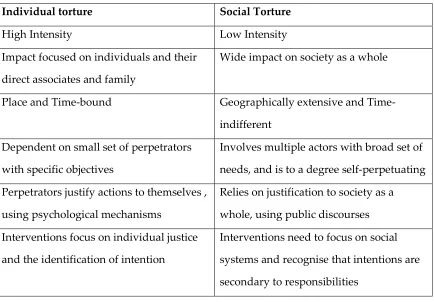
Table 1.1 Key differences between individual and social torture
Individual torture Social Torture
High Intensity Low Intensity
Impact focused on individuals and their direct associates and family
Wide impact on society as a whole
Place and Time-bound Geographically extensive and
Time-indifferent Dependent on small set of perpetrators
with specific objectives
Involves multiple actors with broad set of needs, and is to a degree self-perpetuating Perpetrators justify actions to themselves ,
using psychological mechanisms
Relies on justification to society as a whole, using public discourses
Interventions focus on individual justice and the identification of intention
Interventions need to focus on social systems and recognise that intentions are secondary to responsibilities
Low intensity, wide impact: Whereas individual torture is conventionally thought of in terms of a highly intense and intrusive intervention which impacts primarily on
individual victims and their immediate family, Social Torture can be characterised as ‘low intensity’ in that its methods and impacts are often not immediately visible but should be identifiable across society as a whole. In other words while in individual torture only a minority are directly impacted, in Social Torture only a minority will escape the impacts.
very old (Melamed et al, 1990: 20).6 In short, it may be the cumulative impact of
multiple violations which triggers a visible symptom, such that impact cannot be traced back to any one of those violations in particular. This suggests that it may be necessary to look for impact over the medium rather than the short term, and that it may be more useful to speak of causal contexts rather than of single causal incidents.
And even if visible, impacts cannot always be traced back directly to a particular act, for as studies of the families of Holocaust survivors and of the disappeared in Latin America have shown, even the torture of individuals affects not just the immediate object of the torturer’s attentions, but also impacts on those associated with that person in the form of symptoms such as withdrawal, depression, and intense generalised fear (Melamed et al, 1990: 25). It is thus possible for impacts to be transmitted across and down the generations without the continued need of a physical perpetrator. The gradual impact of Social Torture, and the distance between individual acts and overall impact, contribute to the low visibility of the phenomenon. As one MP commented in northern Uganda, ‘This insecurity is a greater threat than the abductions. It is present every day but nobody sees it’.7
Geographic extension and time-indifference: In the popular imagination torture takes place in very specific sites, generally away from the purview of the general public, at the hands of a very particular set of people, and over a delimited period of time
determined by the limited capacity of the individual body and mind to resist torture. It has a beginning, when the victim is whisked away from their normal daily life, and it has an end, when the person, if still alive, may be returned to the ‘outside’ world, often with visible physical and psychological scars to deal with - in the midst of people the majority of whom have not undergone the same experience.
6 Given what is known about the process of forcible displacement into the “protected villages”, this
immediately makes a large proportion of the northern Uganda population, 90% of which was displaced, increasingly susceptible to PTSD.
Social Torture, by contrast, rather than taking place in very restricted locations in short bursts, it is both geographically extensive and time indifferent. The whole
environment, in this case both the “protected villages” and the war zone as a whole, are the site of torture – all the time. For most people, who have no resources with which to remove themselves from the war zone, there is no ‘outside’. You are not whisked away from your daily life to be tortured; daily life is your torture. This is not helped if the ‘outsiders’, who in the individual model of torture give victims hope by creating political pressure on the victim’s behalf, in this scenario are ‘bystanders’ making their own contributions to social torture.
If your whole world has become the torture chamber, then determining a clear
beginning becomes hard. As I shall suggest in chapter 3, it is never easy to know when a war truly begins. Nor is it easy to know when torture begins. If, as argued in chapter 6, it is necessary to look at debilitation arising not just from discrete incidents but from the accumulation of such, then pin-pointing a particular incident as the torture becomes redundant. Forcible displacement prior to an act of torture does not just render the victim more susceptible to torture-related PTSD symptoms after such an act, it is a part of the torture process itself. Just as the beginning is hard to pinpoint, so is the end. What people experience and the symptoms they exhibit can barely be described as post-traumatic, as for most people there is no end to the circumstances which caused the
trauma. Whereas the aid workers in war zones are sent on R&R (Rest and
Recuperation), there is no such respite for the population at large. From this point of view to use the term post-traumatic stress to describe what is happening inside the war zone can itself be seen as part of a structure of denial, or at least a refusal to
acknowledge that there is no ‘normal’ or pre-traumatic situation to revert to. In short, the process of social torture is time indifferent, measured in years rather than the days to which the individual’s body can be subjected to.
deny, and interests which they will have no wish to see exposed. In drawing in multiple actors, social torture furthers underlying processes of social and political change over which individual actors have little direct control or influence, and, to the extent that their own interests are furthered by keeping quiet, little incentive to challenge. This integration of multiple actors into the dynamics of social torture challenges a key aspect of many existing models of conflict, namely the tendency to view conflict situations as somehow ‘out there’, completely other and detached from the contexts in which those doing the analyses are situated. If, as I shall argue, social torture has to be understood as a systemic process in which what is happening in, for example, Gulu is influenced by and of import to those making decisions in Kampala, London, Brussels and Washington, then an internal vs. external model will only hold insofar as it describes those who are physically inside the war zone and those who are outside it. It will not have any value in identifying causal responsibility for what is happening inside the war zone.
Self-perpetuating: Once under way, social torture elicits states of physical and psychological debilitation, dependency, dread and disorientation and corresponding behavioural responses from its victims which tend to mutually reinforce and deepen each other rather than resolving themselves, and thus contribute to perpetuating or escalating the situation.
For example, although torture is often visited upon the physical body in the first instance, it is at core an invasion of people’s minds which is very difficult to reverse, such that methods and impacts ultimately become one and the same thing. As Primo Levi (1989) puts it, ‘Anyone who has been tortured, remains tortured’. The mental state described as ‘disorientation’ is an outcome of torture, but being in that state is itself an additional form of torture.
independent of the actors who catalysed the discourse and continues long after they have left.
Not only is the invasion of the mind hard to reverse, it also finds expression in further physical debilitation. Both direct and indirect victims are subject to severe
psychological stress, which is known to weaken the immune system.8 This may
increase morbidity, thereby accelerating physical debilitation and economic
dependency, a state in which people are unable to fulfil or learn the roles which under normal circumstances would give them a sense of their adult identity (e.g. provision and protection). This in turn aggravates psychological debility.
Once physical dependency has been induced through lack of food and lack of sleep (which in turn is related to dread), people cannot afford to bite the hand that feeds them, and their time horizons become fore-shortened by the realities of day-to-day survival in the war zone. Coping mechanisms adopted to ameliorate their personal situation often have the opposite effect. To eat today, for example, people resort to selling sex with its concomitant risk of HIV tomorrow (see chapter 6).
In a sense torture becomes involuntarily self-administered, and, insofar as these behaviours are perceived and/or portrayed as self-inflicted, it also becomes possible to ‘blame the victim’ and thereby reinforce discourses of devaluation and
dehumanisation. This diverts attention away from causes and directs it to symptoms, in a manner which is used by those who in principle have the capacity to do
differently, to justify their actions and inactions. It becomes difficult for any of the multiple actors involved to step back and assess their true contribution to - or position in - the various inter-secting cycles of violation and violence. Social Torture thus acquires a degree of momentum independent of the perpetrators’ original actions or intentions.
Public discourses: Because of the scale of social torture, and its potential visibility to the public eye, institutions such as Governments, Churches and NGOs need to convince their constituencies, congregations, and funding bases respectively that the actions and inaction of those they are supporting make sense and are legitimate.
Fundamentally this is likely to be achieved through the manipulation of discourses and their accompanying silences - by focusing on some elements of the situation these discourses serve to divert attention from the bigger picture. In a manner analogous to the individual perpetrator who draws on a language of devaluation shared with other members of society to pre-empt any psychological discomfort with his own actions, so institutions and interest groups pre-empt the threat of exposure outlined above by using discourses to externalise, make public and thereby involve their public in what -in the -individual - would be -internal and private psychological processes of
justification.9
Overview of the thesis
In Chapter 2 I explore set out the institutional framework within which I conducted the research and the key elements of the approach I adopted in order to address the
contextual and conceptual challenges arising from doing research both on and in a ‘war zone’. I argue that, to uncover the hidden rather than focus on the already visible, it was necessary to adopt an extremely open and non-prescriptive approach, in which the subjectivity of people living in that situation was given considerable scope and priority. I suggest that it was through enabling these subjective voices to be heard that the findings emerged which both prompted and supported the development of a model of social torture and a counter-narrative to the accounts shaped by the mainstream discourse.
9The term ‘internalise’, as used in psycho-analysis, ‘means the process whereby inter-subjective relations
Chapter 3 serves a three-fold purpose. It begins with an objective history of major events occurring in northern Uganda over the period 1986 - 2004, including the various Governmental initiatives to deal with the LRA. It is ‘objective’ in the sense that few would dispute these happenings. This is then juxtaposed with peoples’ subjective memories to illuminate the importance of bringing subjective accounts into ‘objective’ history, for when it is done it indicates that although there were undeniably elements of ethnic violence, there were no obvious reasons for giving primacy to an intra-ethnic explanation as there were also inter-intra-ethnic, nationalist, international and trans-national dimensions. Rather than being lead actor, the LRA appears to be one amongst many.
Chapter 4 therefore confronts directly the argument that this is primarily a war
between LRA and Government of Uganda. I do this first through a consideration of the nature of the LRA, second through a review of the gap between the Government’s stated intentions and actions. While I argue that the LRA can be seen as having both a certain coherence and an identifiable cause – not least to confront the Museveni government, as part of a rejection of wider processes of social and political change – and was more of a force to be reckoned with than national and international
propaganda generally allowed, I also argue that the LRA was inherently self-limiting by virtue of its rejection of ‘modernity’. As an organisation it could in principle have been overcome by military means many years ago, and therefore did not offer a sufficient explanation for the continuation of the war. In reviewing the Government’s approach to the 1994 Peace Talks – often cited as the closest they have come to a non-military solution - I suggest that dealing conclusively with the LRA was never the aim of the Government and that its ‘peace talks’ were in fact a form of war talk. I conclude that the main targets of Government policy and strategy were broader than the LRA and also extended to the Acholi population. The self-limiting nature of the LRA and the Government’s lack of commitment to achieving peace allow me to substantially discount the argument that this is primarily a classic internal confrontation between two opposing groups, and to suggest that the confrontation between LRA and
In the following three chapters, in which I focus on the objective and subjective
experiences of the bulk of the population in the war zone in Uganda, particularly in the protected villages where the majority of my own data was collected, I build the
evidence for this argument. I show how, in the name of protection, the population experienced violation (chapter 5), debilitation (chapter 6) and humiliation (chapter 7) on a mass scale.
In chapter 8 I review this evidence, and argue that dread, debilitation, dependency and disorientation, the key impacts of a torture process, are all evident throughout the war zone. In exploring these impacts it also becomes evident that while the LRA and Government were the two most visible parties to the situation, a multiplicity of other actors were also involved with differing levels of visibility and with different ways of making the situation function for them. Perpetrators, complicit bystanders and victims are all in place.
At the most mundane level the functions relate to the petty spoils of war-related corruption and the internal momentum of the ‘aid industry’. At a more important level they relate to the shifting balance of economic and political power within and between states in the post-cold war era of globalisation. In this context Social Torture supports entire processes of social and political change, and here again analogies can be drawn between the functions of individual and social torture. When considering the Ugandan state’s relative vulnerability vis-à-vis its own population and within the wider
international community, the contribution of social torture can be seen as three-fold. While hard won political independence demands that states control their own populations, it offers little in the way of economic power with which to exercise this control. Other means therefore have to be found: demonisation of individuals and sub-groups, and militarisation in the name of pacification, provide important
opportunities. The political need of the Government is for a process of subordinate inclusion (rather than social exclusion) of the population in northern Uganda. Insofar as
(e.g. the Local Council system), it gradually establishes the inclusion of the targeted social group into the national structure but on a subordinate basis. Insofar as these processes are publicised (as chapter 4 suggests they are), they serves as a warning to other social groups in other parts of the country.
The aid and development donors, while talking of good governance, are in fact complicit in this process, as it serves their own need to maintain the Government of Uganda in a subordinate position. By allowing the client state to break with
international conventions, a series of latent conditionalities are created which enable these donor states to exercise leverage and control over the client. Yet insofar as the Government is able to implicate external actors, it limits to a certain extent the powers of intervention of those external actors and thereby increases the Government’s room for manoeuvre.
To support the vested interests which develop, complex mechanisms are in place to legitimise the process, including the use of the mainstream discourse on war. This discourse, and its careful silences about the vested interests of those who promote the discourse, justifies a whole range of interventions (with the stated intention of doing good and the observed impact of doing considerable harm), and obscures the need for alternative interventions. The discourse and its silences are thus shown to be a form of violence.
The low intensity and wide impact of social torture, its geographical extension and time-indifference, its involvement of multiple actors and the functions it has for each of them, and the way the dynamics of violation become to a degree self-perpetuating (particularly in the sense that some victims themselves become perpetrators) all offer explanations for why the situation in northern Uganda continues. I conclude that, taking all these different elements into account, it is possible to see that the
In Chapter 9, I suggest that the analysis of social torture has a number of implications. As a counter-narrative to the mainstream discourse on today’s ‘wars’ it highlights the limitations of models based on binary oppositions such as ‘internal-external’, ‘greed-grievance’ and ‘rational-irrational’. It also highlights the practical limitations of legal approaches when it comes to dealing with multiple perpetrators, with the changing positionality of perpetrators, bystanders and victims, and with the fact that people’s behaviours are not reducible to the intentionality which lies at the heart of the Convention against Torture definition. It suggests that the power of the concept of torture will be strengthened rather than weakened by broadening the lens from a primarily legal one to a more socio-economic, psychological and political one,
Chapter 2: The Research Process
Introduction
The majority of fieldwork on which this thesis draws took place in Gulu and Kitgum districts from May 1998 – March 2000 as part of a wider DFID funded research
Consortium on Political Emergencies (referred to in this text as COPE). At the time, as well as being registered as a part-time PhD student at LSE, I was employed full-time by ACORD, an international Non-Governmental Organisation (NGO) with a long history of working in northern Uganda and other conflict affected areas. As the NGO member of COPE, ACORD (in particular myself) had been given thematic responsibility for investigating the local impacts of complex emergencies and of interventions into them. Although it was initially proposed to do this in Rwanda, staff there expressed
reservations about having a large research project being carried out in their name, and Northern Uganda was suggested as an alternative. During my main period of
fieldwork I was therefore based in Gulu town, with occasional trips to Kampala for administrative purposes. During this main period I had a number of co-researchers, including ten fieldworkers, four part-time documentation assistants, and a full-time research assistant.
After my main period of fieldwork I made three further visits. The first was in March 2000 when I returned to Gulu to co-facilitate a workshop on the implications of the research for ACORD’s programming in northern Uganda. The second was from February – April 2002, just as Operation Iron Fist was getting underway. My last visit, during which I went to Soroti as well as Gulu and Kitgum, was in January 2004. At this point I was conducting a Conflict Assessment for Christian Aid, in collaboration with the Refugee Law Project at Makerere University, and found that the humanitarian and military situation had escalated substantially.