
A recent progress in thin
fi
lm composite membrane: A review
W.J. Lau
⁎
, A.F. Ismail, N. Misdan, M.A. Kassim
Advanced Membrane Technology Research Centre (AMTEC), Universiti Teknologi Malaysia, 81310 Skudai, Johor, Malaysia Faculty of Petroleum and Renewable Energy Engineering, Universiti Teknologi Malaysia, 81310 Skudai, Johor, Malaysia
a b s t r a c t
a r t i c l e i n f o
Article history:
Received 13 December 2010
Received in revised form 30 March 2011 Accepted 1 April 2011
Available online 22 April 2011
Keywords:
Thinfilm composite membrane Interfacial polymerization Polyamide
Substrate Water treatment
The major breakthrough in the preparation of thin film composite (TFC) membrane via interfacial polymerization technique has resulted in tremendous achievements in producing a membrane with a right combination offlux and salt rejection, and generating huge interest in industrial sectors. Over the past decade, there have been intensive and continuous efforts in the development of TFC membrane, both from the industry and academia with the interests to further improve the membrane productivity and selectivity as well as its tolerance against chlorine, solvent, fouling, etc. On basis of a brief introduction of the development history of TFC membranes, this paper reviews the recent research progress of the TFC membrane science and technology, particularly in thefields of water-related separation processes. Reviewing the research progress is imperative and necessary in order to provide an insight for the future development and perhaps open a door to extend the applications to other more challenging areas.
Crown Copyright © 2011 Published by Elsevier B.V. All rights reserved.
1. Introduction
Thinfilm composite (TFC) membranes have experienced tremen-dous development since the concept of interfacial polymerization (IP) wasfirst introduced by Mogan in 1965[1]. It is generally acknowl-edged that the scientific breakthrough in developing ultrathinfilm onto microporous substrate is equivalent to the historic announce-ment of Loeb–Sourirajan asymmetric membrane in nineteen sixty.
Owing to ultrathin selective layer, reverse osmosis (RO) and nanofiltration (NF) membranes prepared using this coating technique have emerged as excellent candidates in a wide variety of separation applications, particularly in the water and wastewater treatment processes[2–5]. Despite TFC membranes have been well received in industry, there is still an interest among membrane scientists in making asymmetric membranes via single-step fabrication process
[6–10]. It is generally agreed that asymmetric membranes can tolerate fairly high level of feed water chlorine in comparison to composite membranes prepared from polyamide (PA) [11]. Several key advantages of TFC membranes however have kept them much competitive in the commercial market. It must be mentioned that each layer (i.e. top selective layer and bottom porous substrate) of TFC membrane can be independently controlled and optimized to achieve desired selectivity and permeability while offering excellent mechan-ical strength and compression resistance.
Apart from IP technique, coating techniques such as photo-grafting, dip-coating, electron beam irradiations and plasma-initiated polymer-ization are also introduced to apply an ultrathin barrier layer upon a support membrane. Of these, IP is of particular interest in composite membrane preparation by taking into account a considerable amount of research work that has been conducted so far. These include several relevant review papers[12–15]and a book of NF published in 2003[11]. A wide variety of research and general information on TFC membrane preparation and characterization is available; however, a recent review on TFC membrane technology and science is necessary to highlight the trend and progress in the development of TFC membranes. This review paper aims to give an overview of the development of TFC membrane technology over the past 10 years, from the top active layer improvement to the application of various polymeric substrates and eventually the state-of-the art approach on IP process. This updated information is of great importance to provide good insights to composite membrane research and development, particularly in the preparation of new types of TFC RO and NF membranes with improved performance.
2. Chronicles of thinfilm composite membrane development
In the early development of composite membrane, Mogan was the veryfirst researcher to propose the use of interfacial polycondensa-tion approach to form a thin polymeric layer onto a substrate[1]. The approach however did not succeed in industrial fabrication until Cadotte and his co-workers discovered that through the optimization of formation conditions, a series of composite membranes with surprisingly highflux could be made by interfacial crosslinking of piperazine with trimesoyl chloride/isophthaloyl chloride mixture
[16,17]. Besides highflux production, these membranes also exhibited ⁎ Corresponding author at: Advanced Membrane Technology Research Centre
(AMTEC), Universiti Teknologi Malaysia, 81310 Skudai, Johor, Malaysia. Tel.: +60 7 5535926; fax: +60 7 5535624.
E-mail address:[email protected](W.J. Lau).
0011-9164/$–see front matter. Crown Copyright © 2011 Published by Elsevier B.V. All rights reserved. doi:10.1016/j.desal.2011.04.004
Contents lists available atScienceDirect
Desalination
high rejection to aqueous sulfate ions but low selectivity of aqueous chloride ions. The contribution of this approach, which is widely known as Interfacial Polymerization is so significant to membrane science and technology and marks a quantum leap towards production of high flux/low pressure membrane with a good combination of salt removal.
Using the method invented by Cadotte et al. [16,17], many companies succeeded in developing a variety of TFC membranes, allowing the application of membranes for many industrial separation processes. It is well acknowledged that by employing IP technique, the properties of both bottom substrate and top barrier film can be individually tailored and optimized to achieve desired water permeation and solute separation rate. Nevertheless, we must point out that this aspect is not fully investigated yet because based on the literature, efforts have been devoted more to top thin active layer development, whether in the present or past. Properties of substrate are paid less attention during TFC membrane preparation, possibly because substrate plays no role in solute separation and fouling reduction as top selective layer does. The effect of sub-layer properties is therefore generally ignored or rarely reported by researchers during composite membrane preparation. Until lately, several research groups have started to address this issue with the purpose of gaining better understanding on the formation mechanisms between top active layer and supporting substrate made of different structural properties. The research outcomes from their investigations will be reviewed in the following sections.
3. Recent progress in thinfilm composite membrane development
This section does not intend to provide an exhaustive review of all the composite membranes developed to date because a comprehen-sive review on composite NF and RO membranes was published by Petersen in 1993, covering the structure and composition of composite membranes which have found commercial use up to 1992 [12]. The following section will instead focus on the recent research activities on the improvements of TFC membrane properties with respect to permeability/selectivity, chlorine tolerance, solvent stability, fouling resistance, etc.
3.1. Effects of aqueous and hydrocarbon solution properties on TFC membrane performances
3.1.1. Monomer
As membrane performances are mainly determined by film structure (i.e. pore dimension, thickness, roughness and hydrophilicity) and its chemical properties (i.e. crosslinking, functional groups and bonds), fundamental understanding on the effects of different monomers on composite membrane properties is necessary in order to tailor desired membrane structure and separation performance.
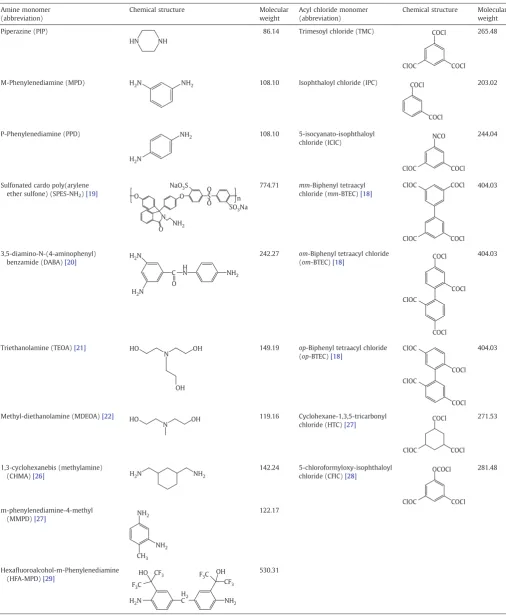
Table 1shows the organic structures of commonly used and newly reported monomers in the thinfilm formation together with their mo-lecular weights. The commonly used reactive monomers are aliphatic/ aromatic diamine such as piperazine (PIP), m-phenylenediamine (MPD) and p-phenylenediamine (PPD) and acid chloride monomers such as trimesoyl chloride (TMC), isophthaloyl chloride (IPC) and 5-isocyanato-isophthaloyl chloride (ICIC). Among these materials, the cross-linked aromatic polyamide composite membrane produced by interfacial polymerization of MPD and TMC is the most successful commercial products in the past and present.Fig. 1shows a synthetic pathway used to prepare standard commercial MPD/TMC polyamide membrane with good desalination properties.
Despite the high performance of composite membrane compared to the asymmetric membrane in water separation processes, the research on how to further improve the properties of top active skin layer still remains as high-priority domain over the years. Newly synthesized monomer used to become the topic of study among the
community of membrane scientists. In the recent past, Li et al.[18]
synthesized a series of isomeric biphenyl tetraacyl chloride (BTEC) for the preparation of TFC membrane with MPD as amine monomer in aqueous solution. According to the authors, the organic phase reactant is likely to have greater impact on membrane performance compared to aqueous phase reactant because IP process is generally diffusion-controlled in the organic layer. The experimental results showed that the membrane prepared from op-BTEC demonstrated the highest permeability (54.2 l/m2·h) followed by membranes prepared from om-BTEC (50.0 l/m2·h) and mm-BTEC (31.7 l/m2·h) when tested
using 2000 ppm NaCl solution at 2 MPa. The reason for the flux enhancement might be due to the rougher and larger surface area of op-BTEC membrane produced which led to greater contact with water molecules. Very interestingly, the membrane ofop-BTEC did not suffer from a drawback of the “trade-off” between permeability and selectivity as NaCl rejection remained almost the same (N97%). Similar results were also reported in the work of Chen et al.[19]in which the incorporation of water soluble amine reactants — sulfonated cardo poly(arylene ether sulfone) (SPES-NH2) into
aqueous solution containing MPD could overcome the trade-off effect between membrane permeability and selectivity. Under the optimum preparation conditions, the TFC membranes prepared from SPES-NH2
showed remarkable increase in water permeability (51.2 l/m2·h)
with slightly decrease in salt rejection (97.5% at 2000 ppm NaCl, 2 MPa) compared to membranes prepared without SPES-NH2(37.4 l/
m2·h and 99%). The improved results are attributed to the
incorporation of hydrophilic SPES-NH2to polyamides and/or higher
degree of cross-linking formed in the thin selective layer.
In view of the importance of hydrophilicity on the TFC mem-brane performance, a novel amine monomer— 3,5-diamino-N-(4-aminophenyl) benzamide (DABA) with three amino groups was synthesized and used together with diamines (MPD) in TFC membrane preparation[20]. With increasing the DABA content in aqueous phase from 0 to 0.25% (w/v), the membranes showed increase in waterflux from 37.5 to 55.4 l/m2·h and maintained a high salt rejection (~ 98%) infiltering salt solution containing 2000 ppm NaCl at 2 MPa. Membrane characterizations revealed that the top membrane surface became more hydrophilic, smoother and thinner as DABA concentration was increased in amine solution. On the other hand, an environmentally friendly yet economical monomer — triethanolamine (TEOA) was utilized by Tang et al.[21]to enhance membrane performance of TFC–NF membrane. It is of great interest to use TEOA as active monomer because the tertiary amino group in its molecule can beflexibly transferred into quaternary ammonium group through variation of feed pH. Moreover, this polyester composite membrane prepared from TEOA and TMC is found to be particularly suitable for treating acidic solution because water flux increased with lowering pH feed due to the fact that amino group on membrane surface can change into R3HN+, resulting in increased hydrophilicity
at lower pH feed. As an extension of this study, they prepared aromatic PA composite membranes with the use of another alcohol amine, i.e. methyl-diethanolamine (MDEOA)[22]. With the presence of LiBr in aqueous phase solution, it is found that the membranes so prepared exhibited different separation properties compared to the membranes prepared from TEOA monomer. The change in separation performance was explained by the different mechanisms involved between these two monomers and the additive LiBr added.
conditions. The composite membranes with aromatic–cycloaliphatic PA top layer were then exposed to NaOCl-NaCl mixed solution of various NaOCl concentrations to ascertain the impact of chlorine on
[image:3.595.39.546.74.690.2]membrane properties. The composite membranes however failed to retain performances as both waterflux and salt rejection decreased considerably upon chlorine exposure of 24 h and 1 ppm. It is elucidated Table 1
The commonly used monomers and newly reported monomers for thinfilm composite membrane preparation.
Amine monomer (abbreviation)
Chemical structure Molecular
weight
Acyl chloride monomer (abbreviation)
Chemical structure Molecular weight
Piperazine (PIP)
HN NH
86.14 Trimesoyl chloride (TMC) COCl
COCl ClOC
265.48
M-Phenylenediamine (MPD) H2N NH2 108.10 Isophthaloyl chloride (IPC) COCl
COCl
203.02
P-Phenylenediamine (PPD) NH2
H2N
108.10 5-isocyanato-isophthaloyl
chloride (ICIC) NCO
COCl ClOC
244.04
Sulfonated cardo poly(arylene ether sulfone) (SPES-NH2)[19]
N O NH2
O O
NaO3S
S O O SO
3Na
n
774.71 mm-Biphenyl tetraacyl chloride (mm-BTEC)[18]
ClOC COCl
ClOC COCl 404.03
3,5-diamino-N-(4-aminophenyl) benzamide (DABA)[20]
C HN O
NH2
H2N
H2N 242.27 om-Biphenyl tetraacyl chloride
(om-BTEC)[18] COCl
COCl ClOC
COCl
404.03
Triethanolamine (TEOA)[21] HO
N OH
OH
149.19 op-Biphenyl tetraacyl chloride (op-BTEC)[18]
COCl ClOC
COCl ClOC
404.03
Methyl-diethanolamine (MDEOA)[22] HO
N OH
119.16 Cyclohexane-1,3,5-tricarbonyl
chloride (HTC)[27] COCl
COCl ClOC
271.53
1,3-cyclohexanebis (methylamine)
(CHMA)[26] H2N NH2
142.24 5-chloroformyloxy-isophthaloyl
chloride (CFIC)[28] OCOCl
COCl ClOC
281.48
m-phenylenediamine-4-methyl
(MMPD)[27] NH2
NH2 CH3
122.17
Hexafluoroalcohol-m-Phenylenediamine (HFA-MPD)[29]
H2
C NH2
H2N
F3C CF3 OH F3C
CF3
that the conversion of amide N-H group to N-Cl group upon chlorine exposure is the main factor causing the hydrophobic character of PA layer to increase, leading to remarkableflux deterioration. Compared to the membrane CHMA-TMC, aromatic–cycloaliphatic PA membranes developed from m-phenylenediamine-4-methyl (MMPD) and cyclo-hexane-1,3,5-tricarbonyl chloride (HTC) showed attractive chlorine resistance of more than 3000 ppm-h Cl [27]. The very significant improvement on the stability of the membrane MMPD-HTC is attributed to the use of aromatic diamine compound with a mono CH3substituent
at theorthoposition which is believed can minimize the attack by chlorine present in the water (seeTable 1). Apart from the high chlorine resistance, the membrane MMPD-HTC also exhibited greater water permeation following a higher degree of pendant group COOH formed on PA skin layer, as shown in XPS results.
In the recent past, Liu et al.[28]fabricated TFC RO membranes through the interfacial polymerization of MPD with TMC, ICIC and CFIC, separately in an effort to assessing the influence of polyacyl chloride structure on the chlorine stability of composite membranes prepared. The results indicated that membrane MPD-CFIC possessed the highest degree of resistant to chlorine attack, followed by membrane MPD-TMC and MPD-ICIC after hypochlorite exposure (up to 2500 ppm-h Cl) at pH 8.5. It is reported that N-chlorination reaction is much easier to be taken place in membrane MPD-ICIC due to the existence of urea (―NHCONH―) bond and pendant group of―NHCOOH. More recently in 2010, novel polyamide TFC membranes with highly tolerant to chlorine were prepared via interfacial polymerization of high MW of hexafluoroalcohol (HFA)-substituted aromatic diamines and TMC[29]. As HFA is an electron withdrawing group and sterically bulky, both electronic and steric factors could play key role in protecting amide linkages and benzene rings against chlorine attack. Results obtained from NMR spectroscopic showed that HFA-PA composite membrane suffered only minor changes in the spectrum after 17 h exposure of 500 ppm hypochlorous acid at pH 5.5. In comparison, the reference PA membrane was severely attacked by chlorine with more than 50% chlorination recorded after the chlorine treatment process, causing irreversible damage to the membrane structure. In this case, protons on benzene ring of reference PA membrane are substituted by Cl via Orton rearrangement upon chlorine exposure.
Polyamide membranes in general also found suitable for the treatment of non-aqueous solutions, though little data on their performance in organic solvents have been published[11]. A general solvent stable composite membrane (including the support) is one that is non-swelling in many solvent categories. In 2006, a solvent stable composite hollowfiber membrane which is found stable in 70% ethanol solution over the 10 weeks studied period has been successfully prepared from the monomer system of poly(ethylenei-mine) (PEI) and IPC[30]. In order to improve adhesion between the selective layer and the support (lumen side of hollow fibers), the authors kept the organic monomer solution within thefiber (up to 10 min) instead of passing the solution through thefiber, creating a condition similar to that of the coating onflatfilms. Prior to this work on PEI/IPC monomer system, reaction of PEI and a diisocyanate was also found useful in the production of stable composite membranes for polar aprotic solvents. Further description on this work can be found in the U.S. patentfiled by Black[31].
With respect to fouling resistance, Hilal and his co-workers[32,33]
reported that the TFC membranes with improved antifouling
properties could be developed by means of interfacial polymerization between bisphenol A (BPA) and TMC. Though PA composite membrane has been continuously explored since 1970s, a polyester composite membrane with a highly charged surface seems to be necessary to overcome the limitations of composite membrane, i.e. fouling propensity. The highly negative charge of composite mem-brane coupled with uniform top polyester layer is reported demon-strating lower fouling factor against negative charge of humic acid molecules. In addition to BPA, the use of polyvinyl alcohol (PVA) as co-additive in aqueous PIP solution during interfacial polymerization was also recently conducted by An et al. [34] to improve antifouling performance of composite membranes produced. The introduction of hydrophilic PVA chain into PA active layer has shown positive effects on producing smoother surface and increasing membrane hydrophi-licity which were found very effective to resist the fouling of protein, leading to higher productivity over a long run. Asflux degradation due to fouling problem is unavoidable in composite membranes of water separation processes, control of membrane fouling will undoubtedly remain as high-priority research domain in the years to come. The state-of-the art approaches to tackle the fouling phenomena of TFC membrane with the addition of various antifouling materials such as silver salts and nanoparticles will be further discussed in the following section (see further inSection 3.1.3).
3.1.2. Surfactant
Studies on the use of surfactants as additives in asymmetric membrane preparation have been previously conducted for gas separation and pervaporation processes[35–37]. However, only few articles reporting the impacts of the surfactants on TFC membrane performance are available[39,40]. As surfactant is capable of altering polymerization efficiency of PA layer formation by helping monomer in the water phase move into the organic layer, improved property of composite membrane is thus able to be produced. In certain cases, surfactant is added to improve wettability of the top surface of the supporting layer so that a greater efficiency of polymerization can take place[41].
In the 2002 study of Jegal et al. [38], three different types of surfactants were used for synthesizing PA layer. Among the surfactants used, it is found that only triethyl benzyl ammonium bromide (TEBAB) could enhance the properties of resultant composite membrane, achieving 40% increase in the waterflux upon 0.2 wt.% TEBAB added. The use of other surfactants such as trimethyl benzyl ammonium bromide (TMBAB) and triethyl benzyl ammonium chloride (TEBAC) played no role in modifying interfacial properties, revealing that not all surfactants displayed positive influence on membrane performance. Recently in 2009, Mansourpanah et al.[39]
made an attempt to modify thin layer characteristics by adding different charge properties of surfactants in organic phase. The results showed that the presence of anionic sodium dodecyl sulfate (SDS) in organic solution could form defects and cracks on the thin layer surface while cationic cetyl trimethyl ammonium bromide (CTAB) and non-ionic Triton X-100 produced denser skin layer, owing to increase in amine monomer diffusion across the interface toward organic phase. It is interesting to note that the overall performance of composite membranes containing surfactant was still superior compared with the membranes prepared without surfactant addition. NH2
NH2
COCl
COCl ClOC
N H
* NHCO CO NH NH CO CO *
COOH O
n m
+
m-phenylenediamine in water
Trimesoyl chloride in
[image:4.595.131.477.54.120.2]hydrocarbon Polyamide thin film
Saha and Joshi[40]on the other hand experienced a variation in the characteristics of resultant membranes by increasing the surfactant concentration of sodium lauryl sulfate (SLS) from 0.1 to 0.5 wt.%. At low concentration of SLS added, the performance of membrane remained unchanged. Further increasing the concentra-tion from 0.125 to 0.5 wt.% caused the NaCl rejecconcentra-tion to decrease from 48 to 10% when the experiments were conducted at 1.03 MPa using 2000 ppm salt solution. No detailed explanation was given by the authors on the changes, but it is believed that the presence of surfactant plays a role in decreasing interfacial tension which facilitates the mass transfer of amine molecules to the organic phase to react with hydrochloride.
In the earlier literature, the addition of surfactants used to be recommended as necessary component for preparation of good PA membranes. However, it is lack of comprehensive studies—to what extent the presence of different properties of surfactant during IP process might really improve the properties of PA thin layer and what underlying mechanisms involved in the changes. It is difficult to draw a general conclusion based on the limited resources. Extensive work on this subject is certainly needed to provide a better level of understanding on how the surfactant governs the efficiency of interfacial polymerization process.
3.1.3. Additive
Most of research studies have focused on improving properties of interfacially polymerized film and subsequently the membrane separation properties by optimizing preparation parameters such as monomer concentration in aqueous/organic solution, monomer ratios, reaction time and post-treatment[11–14]. The presence of additives in aqueous/organic solution in fact is also as important as aforementioned parameters in altering the structure offilm.
Recently, attention was devoted by Tang et al. [22] to the preparation of polyester composite NF membrane by adding inorganic salt–LiBr into aqueous phase solution during IP process. Surface of composite membrane became smoother as the LiBr content increased from zero to 3% (w/v). Rougher surface however was observed at greater amount of LiBr (i.e. 5 and 7%). With respect to membrane performance, asynchronous change in pure water flux and salt rejection was experienced with increasing LiBr content. This is mainly due to the unique interaction of LiBr with both alcohol amine and carbonyl of TMC. Li+ion is generally known to be able to interact with
the hydroxyl oxygen atom of alcohol amine, increasing the density and reactivity of OH groups in aqueous solution; as a result, a dense layer of composite membrane is formed. Formation of loose surface layer is also possible to occur following the interaction between Li+ ion and carbonyl of TMC because acid chloride group of TMC is preferable to hydrolyze in the existence of Li+ion in aqueous solution.
Fig. 2shows the chemical structure of synthesized hydrophilic surface modifying macromolecules (LSMMs). Attempt has been made by Matsuura and his co-workers to render the TFC membrane surface more hydrophilic by incorporating additive LSMMs onto the active PA layer [42]. It is observed that LSSMs synthesized during in situ polymerization could migrate toward the top air-polymer interface rendering membrane hydrophilic and produce best performing composite membrane with improvedflux stability in comparison to LSMMs-free composite membrane. The improved stability is ascribed to the well-dispersed LSMMs in PA layer which increases the mechanical strength of thinfilm layer formed. With respect to salt rejection behavior, this newly fabricated membrane always showed
higher separation efficiency (~ 96% vs ~ 91% of LSMMs-free membrane at 35,000 ppm NaCl, 5.5 MPa) and performed stably throughout the studied period. As an extension of this study, Matsuura et al.[43]
incorporated silver salts simultaneously with LSMM into PA layer to mitigate biofouling effects due to various foulants. The results obtained confirmed the antibiofouling effect of silver salts in which silver nitrate demonstrated the highest antimicrobial fouling intensity in desalination of salty solution, followed by silver lactate and silver citrate hydrate.
Kong et al.[44]recently introduced a new concept for synthesis of TFC-NF membranes with controllable active layer thickness and effective“nanopores”through the addition of co-solvent (acetone) into organic phase.Fig. 3illustrates that the presence of acetone could eliminate the great immiscibility gap between water and hexane, causing the IP reaction zone controllable. This as a consequence led to the production of composite membranes with extremely highflux (8.0 × 10⁻¹²m3/m2·Pa·s) and no considerable salt rejection loss as
compared with the membranes prepared from conventional IP procedure (2.1 × 10⁻¹²m3/m2·Pa·s). It is also noted that with
appropriate addition of co-solvent content, a composite membrane with thinner denser layer and smoother top surface could be produced, reducing the permeation water resistance which in turn enhancing water permeability. Significant flux enhancement on composite RO membrane was also reported elsewhere with the use of solvent dimethyl sulfoxide (DMSO) in the IP process[45]. Similar to acetone, DMSO also plays an influential role in reducing the solubility difference of two immiscible solutions. It increases penetration of diamine molecules into the organic phase, leading to formation of higher degree of cross-linking PA layer.
Most recently in 2010, hexamethyl phosphoramide (HMPA) was first reported that could be utilized as an additive in aqueous solution for PA thinfilm formation[41]. As HMPA is capable of facilitating diffusion rate of amine monomer into organic phase, it might create a thicker zone of reaction. In comparison to non-additive membrane, composite membrane prepared from 3 wt.% HMPA showed dramatic increase in water flux (N70%) while maintaining a good NaCl rejection. The considerableflux enhancement is resulted from the combination effects of enhanced hydrophilicity of membrane surface coupled with increased cross-linking extent of PA skin layer upon HMPA addition.
[image:5.595.304.550.53.198.2]Another important development in TFC membrane technology is the incorporation of nanoscale particles into composite membrane
Fig. 2.Chemical structure of hydrophilic surface modifying macromolecules[42].
[image:5.595.128.453.684.730.2]structure. This sort of nanotechnology is currently being used for a wide variety of applications to make complete, highly advanced products. In membrane-based separation technology, Lee et al.[46]
considered adding titanium oxide (TiO2) nanoparticles into PA thin
film composite membrane for water treatment process. The top thin layer of PA-TiO2was prepared by interfacial reaction between MPD
and TMC in the presence of TiO2nanoparticles in the organic phase
solution. Results revealed that membrane waterflux enhanced with increasing TiO2 concentration as a result of increasing surface
hydrophilicity. The rejection of MgSO4 however was reported to
decrease sharply upon TiO2addition. The significant changes in salt
rejection can be explained by the significant reaction interference of TiO2 in the polymerization process, leading to a lower degree of
polymerization. Self-assembly of TiO2 nanoparticles on the TFC
membrane was also investigated to reduce membrane biofouling
[47]. It is little probable that TiO2might wash away from membrane
surface during operation, owing to the bidendate coordination of carboxylate to Ti4+ and H-bonding interaction between COOH
functional group and TiO2nanoparticles, as shown inFig. 4. As TiO2
could be hybridized with membrane top structure by simply dipping the neat composite membrane in the TiO2colloidal solution, a new
type of TFC membrane demonstrating great potential on microbial fouling prevention could be easily produced.
Apart from TiO2 addition, there have been other attempts to
modify transport properties of RO membranes by employing different types of molecular sieve nanoparticles in PAfilm[48,49].Fig. 5depicts the new concept of embedding molecular sieve nanoparticles in the top selective layer in the preparation of thin film nanocomposite (TFN) membrane. The new concept wasfirst started by Hoek et al.
[48]in early 2007. In their pioneering work, it is experienced that the super-hydrophilic and negatively charged zeolite-A embedded throughout PA thin film was able to dramatically improve the permeability of the TFN membrane and remained equivalent salt rejection when compared with the pure PA composite membrane. Since the size of the zeolite particles is designed to match the PAfilm thickness, it thus provides a favorableflow path through each particle incorporated into membrane, leading to high water permeation[49]. This improved membrane water process is just as effective as current technology but more energy efficient and potentially less expensive. In order to further enhance water molecules transport rate, Fathizadeh et al.[50]in year 2011 impregnated bigger pore size of zeolite NaX (7.4 Å) in the thinfilm layer with the aims of creating larger molecular tunnels for water to flow. It is found that this particular pore size of zeolite offers preferentialflow paths for water molecules of 2.7 Å in diameter but restricts the permeation of hydrated sodium and chloride ions (8–9 Å). Instead of differences in particles' size, controllable design in interfacial chemistry of mem-brane is also possible using other type of molecular sieves, owing to their tunable functionality with respect to hydrophilicity, charge density and antimicrobial capability. It was recently reported by Kim and Deng[51]that hydrophilized ordered mesoporous carbons (H-OMCs) modified from pristine OMCs were possible to be used as nano-filler in making thin-film polymer matrix of improved proper-ties. According to them, the plasma treated H-OCMs could be well dispersed in the aqueous solution which were likely to minimize large
aggregate particles which appeared on the substrate surface during IP process, leading to high quality of thin film layer formed and considerably improved membrane performances with respect to water permeability and bovine serum albumin adsorption. Attempt was also made by Jadav and Singh[52]by incorporating very small size of silica particles (b20 nm) into PAfilm in an effort to develop TFN membrane with improved separation performance and enhanced thermal stability. Both water permeability and solute selectivity were reported to increase upon the addition of 1–2 wt.% silica. As experienced by the authors, proper control of particle loading is necessary because membranes prepared at high silica loading tend to display thicker topfilm, accompanied with larger pore size and higher pore number density.
The incorporation of multiwall carbon nanotubes (MWNTs) throughout the superselective thinfilm layer was also explored as a facile approach to produce superior hydrophilic membrane with fast water molecules transport[53]. As MWNTs were not well-dispersed in the nonpolar solvent of organic phase, a modified IP process was proposed by immersing support membrane into organic phasefirst prior to the conventional IP process. The TFN membranes have shown to increase both permeability and selectivity (~4.5 l/m2·h at 0.6 MPa, ~78% at 5 mmol/l Na2SO4) when compared with TFC membrane
without MWNTs (~ 1.6 l/m2·h, ~70%) and TFN membrane prepared by
the conventional IP (~2.6 l/m2·h, ~ 74%). The authors explained that
the promising separation is not only caused by the low degree of cross-linking thin layer produced but also the presence of high amount of hydrophilic and negatively charged carboxyl groups on top surface, as evidenced from XPS results.
3.2. Applications of different substrates on TFC membranes
A vast variety of polymers has been successfully used as porous supports for TFC membrane fabrication over the years. Among all the polymers used polysulfone (PSF) still remains a mainstay in commercial composite membrane until the present. PSF in general is well accepted as the supportfilm, but it is not without drawbacks being composite membrane support. Its hydrophobic properties and solvent sensitivity are the main concerns to many particularly when the composite membranes are used in separation process of solvent-based solution[12]. Furthermore, these PSF membranes could hardly be used at temperature higher than 50 °C[54]. In light of this, studies have been made on substrate membrane to modify its properties with the objectives of developing chemically and thermally stable polymeric substrates which can withstand harsh environments without compromising water permeability and rejection efficiency.
[image:6.595.314.559.55.193.2]Generally, thermally stable polymeric substrate is highly desired for many industrial processes. For instance, in pulp and paper industry, a temperature of around 70–90 °C is required in an integrated mill process which most commercial membranes cannot withstand such Fig. 5.Conceptual illustration of zeolite-A nanoparticles embedded in the thinfilm structure of composite membrane[48].
Fig. 4.Mechanisms of self-assembly of TiO2nanoparticles onto thinfilm layer, (a) by a bidendate coordination of carboxylate to Ti4+
[image:6.595.69.267.650.713.2]high temperature[11]. In year 2010, Ba and Economy[55]developed a poly(pyromellitic dianhydride-co-4,4′-oxydianiline) (PMDA/ODA PI)-based substrate from precursor polyamic acid (PAA) in the presence of zinc chloride (ZnCl2) in the casting solution. Interaction between zinc
ions and carboxylic groups of PAA is found to be able to creating ionic cross-linking structure, facilitating the formation of supporting layer with improved surface properties. In comparison to commercial PSF-based composite membranes, this thermally stable composite mem-brane provided feasible way to improve significantly water permeability without any drop in salt rejection at elevated operating temperature up to 95 °C. The promising results can be explained by the fact that the high mechanical strength of substrate produced, which resists pore expansion as temperature increases. Kim et al.[56]on the other hand proposed to use superior modified polyvinylidenefluoride (PVDF) as replacement for support layer becausefluorinated polymers demon-strated relatively high mechanical strength and good resistance to chemical compared to PSF-based support substrate. Prior to IP process, plasma treatment on the PVDF membrane surface was conducted to improve its hydrophilicity so as it was suitable for fabrication of a PA-PVDF TFC membrane. It is found that under 180 s plasma exposure using oxygen/methane gas mixture, a TFC membrane with outstanding performance was able to be produced, resulting in approximately 37% enhancement in pure waterflux and slightly increase in salt rejection compared to the membrane prepared using PSF-based support layer (0.19 l/m2·h·psi and 96% at 2000 ppm NaCl, 2.1 MPa).
Using a novel synthesized poly(phthalazinone ether amide) (PPEA) as substrate material, a thermally stable composite membrane was successfully fabricated by Wu et al.[57]. The resultant composite membrane has shown superior performance in removing dyes from a dye–salt mixed solution at 1.0 MPa, 80 °C. The relative stability of the flux and dye rejection during 5 h of experiment at 80 °C testified the thermal stability of the PPEA-based composite membrane. In addition to this, a supporting membrane made from a novel copolymer—poly (phthalazinone ether sulfone ketone) (PPESK) was also reported exhibiting higher upper temperature limit and better thermal stability than those of typical PSF substrates [58]. Even the PPESK-based substrate was operated at temperatureN80 °C, there was no significant sign on pore expansion, proving its extraordinary resistance against thermal attack.
It is also very attractive to apply polypropylene (PP) as support for TFC membrane preparation, owing to its high durability and resistance to chemical, pH variation and a wide range of solvents. As PP is relatively hydrophobic, hydrophilization of substrate is highly recommended prior to IP process. Korikov et al.[30]modified the wettability of PP surface through a chemical surface oxidation method in an effort to improve the adhesion between PA selective layer and supporting layer. Kosaraju and Sirkar[59]on the other hand also utilized PP membrane as supporting substrate in making composite membranes offlatfilm and hollowfiber. The composite membranes prepared were proved to be stable in methanol permeation and brilliant blue rejection even after 10 weeks of exposure to toluene solution, showing the great potential of PP-based composite membranes in handling a solution consisting of solvent. Other than the polymers mentioned here, alternative polymeric substrates reported with outstanding properties for TFC membrane fabrication include polyacrylonitrate (PAN) [60,61], sulfonated poly (phthalazinone ether sulfone ketone) (SPPESK)[62]and poly(tetra-fluoroethlene) (PTFE)[63]. As substrate membranes can be prepared from various polymer materials, the selection of a stable substrate for TFC membrane preparation is therefore subject to the area of industrial applications as well as the cost of polymer material itself. Nevertheless, it must be pointed out that advances in development of stable substrates will offer opportunities to expand application area of membranes particularly to chemical industry of harsh conditions, e.g. petrochemical industry and vegetable oil industry.
Apart from developing substrate membranes with high resistance properties, fundamental studies on the interaction between the ultra
thin selective barrier layer and non-selective microporous substrate should also be focused on. It is true that applications of TFC mem-branes are well established in industrial activity, but PA-substrate interactions are generally not well documented and understood. In view of this, development of idealized surface properties of support layer for TFC membrane fabrication is an interesting subject to explore. It is worthy to describe how the idealized substrate properties such as pore dimension, porosity, roughness, charge, etc. would match perfectly an idealized PA active layer and form a strong adhesion between layers.
In the literature, only several research works have been reported on the interaction between ultrathin barrier layer and the surface of the underlying microporous support with respect to characteristics of support layer [60,64–66]. In 2001, Oh et al. [60] modified the polyacrylonitrate substrate with NaOH to create a covalent or ionic bond with the PA layer and because of this; higher stability of performance was resulted due to the improved adhesion extent. Similar observation was experienced by Liu et al.[63]where formation of covalent linkages between PTFE substratefilm and PA layer led to good layer compatibility and thus greater membrane stability. Singh et al.[64]
on the other hand related the changes in PA layer properties to the different pore size distribution of PSF substrate. Smaller pore size distributions of substrate (0.07μm) is found to have superior salt rejection efficiency compared to bigger pore size distribution (0.15μm), mainly due to significant increase in skin layer thickness following a reduced penetration of PA into pore of substrate. More recently in 2009, Gosh and Hoek[66]performed a comprehensive investigation on the impacts of PSF support properties on the PA-PSF interfacial composite membranes by producing a wide range of support properties. In order to give clear understanding on the interaction between these layers, conceptual models, as illustrated inFig. 6were proposed to explain four different scenarios based on the observations from support membranes with pore size in the range 30–70 nm, water contact angles between 60° and 80° and RMS roughness of 5–10 nm. As can be seen from thefigure, it is noticed that thinfilm layers with different water permeability and structure were possibly produced through a variation in structure and chemistry of PSF-based membrane.
[image:7.595.303.554.480.694.2]The properties of microporous non-selective layer indeed play an influential role in modifying the characteristics of PA thinfilm. It could
be very attractive to designing commercial TFC membranes with easy-controllable properties using this method but more investigation is needed tofind out what is the upper limit of supporting substrate properties for optimized TFC membrane preparation.
3.3. Novel/modified IP approach on composite membranes preparation
Concerted efforts have been continuously devoted to modify the procedure of interfacial polymerization process since it was first introduced in the 1960s. It is realized that the modified IP procedure developed to date is mainly focused on improving the interfacial properties of TFCflat sheet membranes and/or forming a defect-free PA skin on a hollowfiber substrate.
Recently, concern was raised on the excessive unreacted poly-functional acid chlorine monomers on the surface of active skin layer following the growing PAfilm which acts as barrier, restricting the diffusion of amine monomers on the organic phase side. To tackle this problem, Zou et al.[67]used amino monomer to react again with the unreacted acyl chloride groups by placing the membrane in aqueous solution for second time. The membranes prepared using this modified approach yielded a larger amount of amino groups (−NH2) on skin surface and demonstrated better antifouling
properties than that of membranes prepared by typical IP approach. According to the authors, multifunctional TFC membranes are possible to be fabricated via this approach by using different polyfunctional amine monomers in the third phase.
Unlike composite membrane in plate and frame or spiral wound configurations, fabrication of composite hollowfiber membrane via IP technique is experiencing a very slow growth, primarily due to the differences in geometry and handling of solutionflow. One of the earliest mentions of the TFC hollowfiber membrane was disclosed by Tadros and Trehu in a U.S. patent in 1990[68]. It is realized that a defect-free PAfilm is almost impossible to form onto the surface of hollowfiber substrate without modification on IP technique. Due to this difficulty, very little work has been published in this regard; though hollowfiber membrane always offer unique benefit of much higher packing densities than any other membrane configurations.
It is well understood that forming a perfect PAfilm onto hollow fiber outer surface is much more challenging than forming a thinfilm onto its lumen surface as coating on outer diameter of hollowfibers could make the neighboringfibers stick to each other, leading to non-reproducibility of TFC hollowfiber membranes. Due to this reason, research work on preparation of interfacially-synthesized PA layer onto the lumen surface of hollowfiber is rather easy to carry out and has therefore gained some attention from several research groups
[30,69–71]. Verissimo et al.[69]previously applied an intermediate organic solvent between the aqueous amine solution and the organic acid chloride solution so as to reduce not only the pin-holes on PA layer but also create a stronger adhesion between PA layer and hollow fiber support. In 2007, Yang et al.[71]adopted an easier method to remove the excess PIP solution and droplets byflushing nitrogen gas slowly through the lumen side of thefibers. Results showed that this modified IP procedure is able to produce composite hollow fiber membrane with better stability for long term running, most likely due to the good compatibility between PA active layer and substrate membrane. Korikov et al.[30]on the other hand pointed out that only the appropriate combination of all controlling factors (i.e. hydro-philization of fiber, concentration of monomer and reaction time, degree of removal of excess monomer from lumen side and heat treatment of PA layer formed) during IP process could lead to intact coating in the lumen side of hydrophobic PP hollow fibers. They recommended to use acetone as pre-wetting solution followed by continuous circulation of hot chromic acid solution to hydrophilize pores of PPfibers prior to conventional IP coating process in order to ensure a prefect interfaciallyfilm formed[30].
From the standpoint of commercial large-scale production, the current technology of composite hollowfiber membrane preparation is still far from maturity to compete with commercially available composite membranes offlatfilm and spiral wound format, owing to low reproducibility of the resultant composite hollowfiber. However, from the angle of membrane development, this area is one of the subjects deserving a focused research attention in order to make full use of hollowfiber membrane prepared via IP approach.
4. Concluding remarks
The concept of interfacial polymerization has been known for more than 45 years since it wasfirst introduced by Mogan in 1965. Through this concept, an ultrathin selective layer formed by interfacial cross-linking between reactive monomers could be easily established upon a porous supporting membrane, leading to excellent selectivity to divalent ion without sacrificing water productivity. Currently, the use of TFC membranes is found dominating the applications of NF and RO and has showed huge potential to be further used in applications involving gas separation, pervaporation, hydrocarbon fractionations, etc. It is too early to conclude that this technology has already reached the maturity while many opportunities still exist. Efforts should continue on the development of highflux/low pressure composite membrane with enhanced salt rejection as well as improved resistances of fouling, chlorine, solvent, etc. More attention should be paid on the interaction between PA top active layer and underlying supporting membrane. This area deserves intensive studies as no one has conducted comprehensive investigation to describe what kind of idealized substrate surface properties (e.g. pore dimension, surface roughness, hydrophilicity, porosity, etc.) could match perfectly with interfacially synthesized PA layer. Also, development of a strong adhesion between active layer and support is of practical importance to overcome the swelling problem which might limit the operations of composite membranes to certain applications. Continuous improve-ments in TFC membrane performances with respect to permeability, selectivity and stability perhaps in the future will widen the applications of membranes to new areas.
Acknowledgments
The authors would like to thank the Ministry of Higher Education for funding support under Fundamental Research Grant Scheme (no. 78699) and Universiti Teknologi Malaysia for providing the office facilities during the preparation of this manuscript.
References
[1] P.W. Morgan, Condensation polymers: by interfacial and solution methods, Polymer Reviews, Vol. 10, Wiley, New York, 1965, pp. 19–64.
[2] S.K. Nataraj, K.M. Hosamani, T.M. Aminabhavi, Nanofiltration and reverse osmosis thinfilm composite membrane module for the removal of dye and salts from the simulated mixtures, Desalination 249 (2009) 12–17.
[3] M. Liu, D. Wu, S. Yu, C. Gao, Influence of the polyacyl chloride structure on the reverse osmosis performance, surface properties and chlorine stability of the thin-film composite polyamide membranes, J. Membr. Sci. 326 (2009) 205–214. [4] A. Rahimpour, M. Jahanshahi, N. Mortazavian, S.S. Madaeni, Y. Mansourpanah,
Preparation and characterization of asymmetric polyethersulfone and thin-film composite polyamide nanofiltration membranes for water softening, Appl. Surf. Sci. 256 (6) (2010) 1657–1663.
[5] R.S. Harisha, K.M. Hosamani, R.S. Keri, S.K. Nataraj, T.M. Aminabhavi, Arsenic removal from drinking water using thin-film composite nanofiltration membrane, Desalination 252 (2010) 75–80.
[6] K.Y. Wang, T.S. Chung, Fabrication of polybenzimidazole (PBI) nanofiltration hollowfiber membranes for removal of chromate, J. Membr. Sci. 281 (2006) 307–315.
[7] W.J. Lau, A.F. Ismail, Theoretical studies on the morphological and electrical properties of blended PES/SPEEK nanofiltration membranes using different sulfonation degree of SPEEK, J. Membr. Sci. 334 (2009) 30–42.
[9] W.R. Bowen, T.A. Doneva, H.B. Yin, Separation of humic acid from a model surface water with PSU/SPEEK blend UF/NF membranes, J. Membr. Sci. 206 (2002) 417–429.
[10] I.C. Kim, K.H. Lee, T.M. Tak, Preparation and characterization of integrally skinned uncharged polyetherimide asymmetric nanofiltration membrane, J. Membr. Sci. 183 (2001) 235–247.
[11] A.I. Schafer, A.G. Fane, T.D. Waite, Nanofiltration: Principles and Applications, Elsevier, Britain, 2003.
[12] R.J. Petersen, Composite reverse osmosis and nanofiltration membranes, J. Membr. Sci. 83 (1993) 81–150.
[13] N. Hilal, N. Al-Zoubi, N.A. Darwish, A.W. Mohammad, M.A. Arabi, A comprehensive review of nanofiltration membranes: treatment, pretreatment, modeling, and atomic force microscopy, Desalination 170 (2004) 281–308.
[14] W.J. Lau, A.F. Ismail, Polymeric nanofiltration membrane for textile dyeing wastewater treatment: preparation, performance evaluation, transport model-ling, and fouling control—a review, Desalination 245 (2009) 321–348. [15] D. Li, H. Wang, Recent development in reverse osmosis desalination membranes,
J. Mater. Chem. 20 (2010) 4551–4566.
[16] J.E. Cadotte, K.E. Cobian, R.H. Forester, R.J. Petersen, Continued evaluation of in-situ-formed condensation polymers for reverse osmosis membranes, NTIS Report No. PB-253193, loc. cit, 1976 (Apr).
[17] J.E. Cadotte, M.J. Steuck, R.J. Petersen, Research on in-situ-formed condensation polymers for reverse osmosis membranes, NTIS Report No. PB- 288387, loc. cit, 1978 (Mar).
[18] L. Li, S. Zhang, X. Zhang, G. Zheng, Polyamide thinfilm composite membranes prepared from isomeric biphenyl tetraacyl chloride and m-phenylenediamine, J. Membr. Sci. 315 (2008) 20–27.
[19] G. Chen, S. Li, X. Zhang, S. Zhang, Novel thin-film composite membranes with improved waterflux from sulfonated cardo poly(arylene ether sulfone) bearing pendant amino groups, J. Membr. Sci. 310 (2008) 102–109.
[20] H. Wang, L. Li, X. Zhang, S. Zhang, Polyamide thin-film composite membranes prepared from a novel triamine 3,5-diamino-N-(4-aminophenyl)-benzamide monomer and m-phenylenediamine, J. Membr. Sci. 353 (2010) 78–84. [21] B. Tang, X. Huo, P. Wu, Study on a novel polyester composite nanofiltration
membrane by interfacial polymerization of triethanolamine (TEOA) and trimesoyl chloride (TMC) I. Preparation, characterization and nanofiltration properties test of membrane, J. Membr. Sci. 320 (2008) 198–205.
[22] B. Tang, C. Zou, P. Wu, Study on a novel polyester composite nanofiltration membrane by interfacial polymerization. II. The role of lithium bromide in the performance and formation of composite membrane, J. Membr. Sci. 365 (2010) 276–285.
[23] J.-Y. Koo, R.J. Petersen, J.E. Cadotte, ESCA characterization of chlorine-damaged polyamide reverse osmosis membrane, Polym. Prepr. 27 (1986) 391–392. [24] S. Konagaya, H. Kuzumoto, O. Watanabe, New reverse osmosis membrane
materials with higher resistance to chlorine, J. Appl. Polym. Sci. 75 (2000) 1357–1364.
[25] I.C. Tessaro, J.B.A. da Silva, K. Wada, Investigation of some aspects related to the degradation of polyamide membranes: aqueous chlorine oxidation catalyzed by aluminum and sodium lauryl sulfate oxidation during cleaning, Desalination 181 (2005) 275–282.
[26] P.R. Buch, D. Jagan Mohan, A.V.R. Reddy, Preparation, characterization and chlorine stability of aromatic–cycloaliphatic polyamide thin film composite membranes, J. Membr. Sci. 309 (2008) 36–44.
[27] S. Yu, M. Liu, Z. Lu, Y. Zhou, C. Gao, Aromatic–cycloaliphatic polyamide thin-film composite membrane with improved chlorine resistance prepared from m-phenylenediamine-4-methyl and cyclohexane-1,3,5-tricarbonyl chloride, J. Membr. Sci. 344 (2009) 155–164.
[28] M. Liu, D. Wu, S. Yu, C. Gao, Influence of the polyacyl chloride structure on the reverse osmosis performance, surface properties and chlorine stability of the thin-film composite polyamide membranes, J. Membr. Sci. 326 (2009) 205–214. [29] Y.-H. La, R. Sooriyakumaran, D.C. Miller, M. Fujiwara, Y. Terui, K. Yamanaka, B.D.
McCloskey, B.D. Freeman, R.D. Allen, Novel thin film composite membrane containing ionizable hydrophobes: pH-dependent reverse osmosis behavior and improved chlorine resistance, J. Mater. Chem. 20 (2010) 4615–4620.
[30] A.P. Korikov, P.B. Kosaraju, K.K. Sirkar, Interfacially polymerized hydrophilic microporous thinfilm composite membranes on porous polypropylene hollow fibres andflatfilms, J. Membr. Sci. 279 (2006) 588–600.
[31] L.E. Black, Interfacially polymerized membranes for reverse osmosis separation of organic solvent solutions, U.S. Pat. No 5173191, 1991.
[32] M.N. Abu Seman, M. Khayet, N. Hilal, Nanofiltration thin-film composite polyester polyethersulfone-based membranes prepared by interfacial polymerization, J. Membr. Sci. 348 (2010) 109–116.
[33] M.N. Abu Seman, M. Khayet, N. Hilal, Development of antifouling properties and performance of nanofiltration membranes modified by interfacial polymerization, Desalination 273 (2011) 36–47.
[34] Q. An, F. Li, Y. Ji, H. Chen, Influence of polyvinyl alcohol on the surface morphology, separation and anti-fouling performance of the composite polyamide nanofiltra-tion membranes, J. Membr. Sci. 367 (2011) 158–165.
[35] D.M. Wang, F.C. Lin, T.T. Wu, J.Y. Lai, Formation mechanism of the macrovoids induced by surfactant additives, J. Membr. Sci. 142 (1998) 191–204.
[36] H.A. Tsai, L.D. Li, K.R. Lee, Y.C. Wang, C.L. Li, J. Huang, J.Y. Lai, Effect of surfactant addition on the morphology and pervaporation performance of asymmetric polysulfone membranes, J. Membr. Sci. 176 (2000) 97–103.
[37] A.M. Alsari, K.C. Khulbe, T. Matsuura, The effect of sodium dodecyl sulfate solutions as gelation media on the formation of PES membranes, J. Membr. Sci. 188 (2001) 279–293.
[38] J. Jegal, S.G. Min, K.H. Lee, Factors affecting the interfacial polymerization of polyamide active layers for formation of polyamide composite membranes, J. Appl. Polym. Sci. 86 (2002) 2781–2787.
[39] Y. Mansourpanah, S.S. Madaeni, A. Rahimpour, Fabrication and development of interfacial polymerized thin-film composite nanofiltration membrane using different surfactants in organic phase; study of morphology and performance, J. Membr. Sci. 343 (2009) 219–228.
[40] N.K. Saha, S.V. Joshi, Performance evaluation of thinfilm composite polyamide nanofiltration membrane with variation in monomer type, J. Membr. Sci. 342 (2009) 60–69.
[41] M. Duan, Z. Wang, J. Xu, J. Wang, S. Wang, Influence of hexamethyl phosphoramide on polyamide composite reverse osmosis membrane performance, Sep. Purif. Technol. 75 (2010) 145–155.
[42] B.J. Abu Tarboush, D. Rana, T. Matsuura, H.A. Arafat, R.M. Narbaitz, Preparation of thin film composite polyamide membranes for desalination using novel hydrophilic surface modifying marcromolecules, J. Membr. Sci. 325 (2008) 166–175. [43] D. Rana, Y. Kim, T. Matsuura, H.A. Arafat, Development of antifouling
thin-film-composite membranes for seawater desalination, J. Membr. Sci. 367 (2011) 110–118.
[44] C. Kong, M. Kanezashi, T. Yamomoto, T. Shintani, T. Tsuru, Controlled synthesis of high performance polyamide membrane with thin dense layer for water desalination, J. Membr. Sci. 362 (2010) 76–80.
[45] S.H. Kim, E.Y. Kwak, T. Suzuki, Positron annihilation spectroscopic evidence to demonstrate theflux-enhancement mechanism in morphology-controlled thin-film composite (TFC) membrane, Environ. Sci. Technol. 39 (2005) 1764–1770. [46] H.S. Lee, S.J. Im, J.H. Kim, J.P. Kim, B.R. Min, Polyamide thinfilm nanofiltration
membranes containing TiO2nanoparticles, Desalination 219 (2008) 48–56. [47] S.H. Kim, S.-Y. Kwak, B.-H. Sohn, T.H. Park, Design of TiO2nanoparticles
self-assembled aromatic poylamide thin-film composite (TFC) membrane as an approach to solve biofouling problem, J. Membr. Sci. 211 (2003) 157–165. [48] B.-H. Jeong, E.M.V. Hoek, Y. Yan, A. Subramani, X. Huang, G. Hurwitz, A.K. Ghosh, A.
Jawor, Interfacial polymerization of thinfilm nanocomposites: a new concept for reverse osmosis membranes, J. Membr. Sci. 294 (2007) 1–7.
[49] M.L. Lind, A.K. Ghosh, A. Jawor, X.F. Huang, W. Hou, Y. Yang, E.M.V. Hoek, Influence of zeolite crystal size on zeolite–polyamide thinfilm nanocomposite membranes, Langmuir 25 (2009) 10139–10145.
[50] M. Fathizadeh, A. Aroujalian, A. Raisi, Effect of added NaX nano-zeolite into polyamide as a top thin layer of membrane on waterflux and salt rejection in a reverse osmosis process,doi:10.1016/j.memsci.2011.03.017.
[51] E.-S. Kim, B. Deng, Fabrication of polyamide thin-film nano-composite (PA-TFN) membrane with hydrophilized ordered mesoporous carbon (H-OMC) for water purifications,doi:10.1016/j.memsci.2011.01.041.
[52] G.L. Jadav, P.S. Singh, Synthesis of novel silica–polyamide nanocomposite membrane with enhanced properties, J. Membr. Sci. 328 (2009) 257–267. [53] H. Wu, B. Tang, P. Wu, MWNTs/Polyester thinfilm nanocomposite membrane: an
approach to overcome the trade-off effect between permeability and selectivity, J. Phys. Chem. C 114 (2010) 16395–16400.
[54] M.J.H. Snow, D. de Winter, R. Buckingham, J. Campbell, J. Wagner, New techniques for extreme conditions: high temperature reverse osmosis and nanofiltration, Desalination 105 (1996) 81–86.
[55] C. Ba, J. Economy, Preparation of PMDA/ODA polyimide membrane for use as substrate in a thermally stable composite reverse osmosis membrane, J. Membr. Sci. 363 (2010) 140–148.
[56] E.-S. Kim, Y.J. Kim, Q. Yu, B. Deng, Preparation and characterization of polyamide thin-film composite (TFC) membranes on plasma-modified polyvinylidene fluoride (PVDF), J. Membr. Sci. 344 (2009) 71–81.
[57] C. Wu, S. Zhang, D. Yang, X. Jian, Preparation, characterization and application of a novel thermal stable composite nanofiltration membrane, J. Membr. Sci. 326 (2009) 429–434.
[58] J. Wei, X. Jian, C. Wu, S. Zhang, C. Yan, Influence of polymer structure on thermal stability of composite membranes, J. Membr. Sci. 256 (2005) 116–121. [59] P.B. Kosaraju, K.K. Sirkar, Interfacially polymerized thinfilm composite
mem-branes on microporous polypropylene supports for solvent-resistant nanofiltra-tion, J. Membr. Sci. 321 (2008) 155–161.
[60] N.W. Oh, J. Jegal, K.H. Lee, Preparation and characterization of nanofiltration composite membranes using polyacrylonitrate (PAN). II. Preparation and characterization of polyamide composite membranes, J. Appl. Polym. Sci. 80 (2001) 2729–2736.
[61] M. Dalwani, N.E. Benes, G. Bargeman, D. Stamatialis, M. Wessling, Effect of pH on the performance of polyamide/polyacrylonitrile based thin film composite membranes, J. Membr. Sci. 372 (2011) 228–238.
[62] Y. Dai, X. Jian, S. Zhang, M.D. Guiver, Thinfilm composite (TFC) membranes with improved thermal stability from sulfonated poly(phthalazinone ether sulfone ketone) (SPPESK), J. Membr. Sci. 207 (2002) 189–197.
[63] Y.-L. Liu, C.-H. Yu, J.-Y. Lai, Poly(tetrafluoroethylene)/polyamide thin-film composite membranes via interfacial polymerization for pervaporation dehydra-tion on an isopropanaol aqueous soludehydra-tion, J. Membr. Sci. 315 (2008) 106–115. [64] P.S. Singh, S.V. Joshi, J.J. Trivedi, C.V. Devmurari, A.P. Rao, P.K. Ghosh, Probing the
structural variations of thinfilm composite RO membranes obtained by coating polyamide over polysulfone membranes of different pore dimensions, J. Membr. Sci. 278 (2006) 19–25.
[67] H. Zou, Y. Jin, J. Yang, H. Dai, X. Yu, J. Xu, Synthesis and characterization of thinfilm composite reverse osmosis membranes via novel interfacial polymerization approach, Sep. Purif. Technol. 72 (2010) 256–262.
[68] S.E. Tadros, Y.M. Trehu, Coating process for composite reverse osmosis membranes, U.S. Pat. No 4980061, 1990.
[69] S. Verssimo, K.V. Peinemann, J. Bordado, New composite hollowfiber membrane for nanofiltration, Desalination 184 (2005) 1–11.
[70] F. Yang, S. Zhang, D. Yang, X. Jian, Preparation and characterization of polypiperazine amide/PPESK hollowfiber composite nanofiltration membrane, J. Membr. Sci. 301 (2007) 85–92.

![Fig. 3. Schematic diagram of (a) conventional IP technique and (b) novel co-solventassisted IP (CAIP) technique [44].](https://thumb-us.123doks.com/thumbv2/123dok_us/8776887.901951/5.595.304.550.53.198/schematic-diagram-conventional-technique-novel-solventassisted-caip-technique.webp)
![Fig. 5. Conceptual illustration of zeolite-A nanoparticles embedded in the thinstructure of composite membrane film [48].](https://thumb-us.123doks.com/thumbv2/123dok_us/8776887.901951/6.595.69.267.650.713/conceptual-illustration-zeolite-nanoparticles-embedded-thinstructure-composite-membrane.webp)
![Fig. 6. The impacts of PSF support membrane structure and chemistry in producingMPD-TMC thin film composite membrane with (a) greater permeability and roughersurface, (b) relatively impermeability and intermediate surface roughness, (c) the mostpermeability and the highest roughness, and (d) the least permeability andintermediate surface roughness [66].](https://thumb-us.123doks.com/thumbv2/123dok_us/8776887.901951/7.595.303.554.480.694/producingmpd-permeability-roughersurface-impermeability-intermediate-mostpermeability-permeability-andintermediate.webp)
