Mohd Salleh, Berhannudin and Esa, Ahmad and Mohamed, Rosli and Kamsun, Yazid and Jono, Jayati (2000). Proceeding
International Conference on Technical And Vocational
Education. Parit Raja: ITTHO. PP 1-11. ISBN 983-99486-1-X
A SMART PARTNERSHIP PROGRAMME : THE COMPUTERIZATION OF A TECHNICAL SECONDARY SCHOOL
Berhannudin bin Mohd Salleh Ahmad Esa
Institut Teknologi Tun Hussein Onn Batu Pahat, Johor, Malaysia
Rosli Mohamed
Equipment Repair Center ( Southern Zone ) Technical Education Department
Ministry of Education, Malaysia
Yazid Kamsun Jayati Jono
Sekolah Menengah Teknik Batu Pahat, Johor, Malaysia
ABSTRACT
Introduction
Computer-Aided Learning (CAL) seems to be the "in-thing" in today's learning
environment. Ever since the last decade or so, education authorities all over the world are
beginning to realize the importance and benefits of towards enhancing and improving the
educational development of the population. Already countries like United States,
Sweden, and Canada have and are fully gearing up to "computerize" their schools.
According to a recent survey, Canada has become the first country in the world to
connect all of its public schools, including first nation schools, to the internet. This is
followed by US where more than 95 % of all its public schools having access to the
internet for students to use (The New Straits Times, 18 Sept 2000).
In fact, among educationists, they strongly believe that CAL should be part-and-parcel of
the whole learning process itself as evident through their research findings. In a study
conducted upon first semester students of Institute Teknologi Tun Hussein Onn, the
researcher discovered that Malay students who were normally reluctant and shy to use the
target language felt that they could improve on their face-to-face speaking sessions in
class after having gone through CMC interaction processes. They were actually
“speaking with their fingers” (Berhannudin, 2000). Based on the analysis of a
Computer-Mediated Communication forum, MOOtalk, and on the interviews with participants in
her PennMoo class, Wan Fara (1998) in her study on the use of MOO, concluded that the
virtual platform presented an opportunity for the participants to practice "speaking" in the
target language. It has also been found that there were greater improvements in the level
of active participation, discussion quality and group dynamics compared to the traditional
classroom setting. It has also been found that there were greater improvements in the
level of active participation, discussion quality and group dynamics compared to the
traditional classroom setting. In another studies, findings indicated improvement in
self-reported mastery of material, critical thinking and analysis skills (Alavi, 1994; Cerratto &
The A-Team
In Malaysia, the "formal" process of computerizing institutions of learning especially at
school level has only been recently launched under the "Sekolah Bestari" programme or
Smart School programme (Ministry of Education, 1999). Initially, only 85 secondary
schools and 5 primary schools have been selected for a pilot project and nine new smart
schools are due to be completed by the year 2000. However, this current figure is not
even 5 % of the total number of about 8000 schools in the country. Although the
remaining schools will, sooner or later, be "computerized" but the question is:
"Do we have to wait that long and let our children be denied the immediate benefits that CAL has to offer before our schools can be fully wired-up?"
or
"Can we not do something to complement the existing programmes to take advantage of the numerous unlimited lifelong benefits of CAL that would have otherwise been lost or deemed outdated as a result of delay and procrastination?
This dire need to be proactive as regards providing lifelong education opportunities for
our younger generation was recently highlighted by one prominent Malaysian
educationist in his speech on conjunction with the recent World Teacher’s Day:
“More than any other group in society, teachers are expected to understand the importance of lifelong education. They must therefore, become the champions of lifelong education … While knowledge is universal, the access to knowledge is not universal and is differential. Teachers are among the leaders in society who are entrusted to create opportunities for access in any way possible”
I would conclude that the term "teachers" as referred to by Ibrahim above includes the
school Principal as well. Specifically, the principal, being the head administrator of a
school is responsible towards providing the right conducive learning environment and
services that enhance quality learning. This can of course be achieved through excellent
planning, implementation and coordination of various school development related
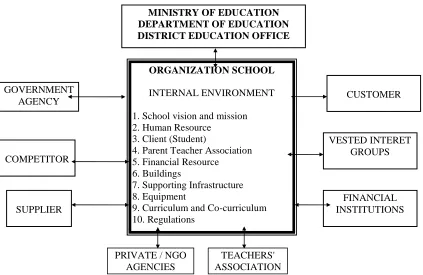
programmes through smart partnership and cooperation among and between teachers,
non-academic staff, PTA as well as the other internal and external learning-related
Figure 1: School Organization Environment (Adapted from Stoner & Winkel, 1989)
The Parent Teacher Association (PTA) is one of the most influential body outside the
school organization that can and should contribute towards meeting the needs of
educational benefits of the students. Other than providing a forum and service to both the
teachers and the parents the association is also to contribute towards meeting the material
needs of the students for their academic and co-curricular activities. In this regard, PTAs
can help by complementing the "Sekolah Bestari" project to provide sufficient computer
facilities and training for the students through fund raising campaigns, donations or smart
partnerships with the general public or the relevant agencies.
Another leading member of the smart partnership team is the Southern Zone Equipment
Repair Center (ERC). In Malaysia, it is one of the four ERCs under the purview of the
Technical Education Department of the Ministry of Education. Among others, the role of
the ERC is to assist the department in its mission to realize a world class technical
education system towards meeting the dynamic needs of the country. More specifically,
the center provides technical service and assistance in aspects of training, repair and
MINISTRY OF EDUCATION DEPARTMENT OF EDUCATION DISTRICT EDUCATION OFFICE
GOVERNMENT AGENCY CUSTOMER COMPETITOR VESTED INTERET GROUPS ORGANIZATION SCHOOL INTERNAL ENVIRONMENT
1. School vision and mission 2. Human Resource
3. Client (Student)
4. Parent Teacher Association 5. Financial Resource 6. Buildings
7. Supporting Infrastructure 8. Equipment
9. Curriculum and Co-curriculum 10. Regulations
SUPPLIER
FINANCIAL INSTITUTIONS
PRIVATE / NGO AGENCIES
maintenance of equipment and buildings of technical and vocational secondary schools in
Malaysia (Ministry of Education, 2000).
The DIY Project
Thus, realizing the prominent roles that every member of the school fraternity can play
and of the great benefits that computers can contribute towards promoting educational
development, the idea of a Do-It-Yourself (DIY) computerization project through a smart
partnership programme came into being. The main objective of the programme was to
provide better and maximum opportunity for ALL students and staff of the school to
receive a more planned and intensive computer training. It also aims to provide students
and staff with enough computer facility for academic and co-curricular purposes. This is
actually complementing and in line with the Ministry's aim of equipping students with IT
competence towards bringing about a systematic change in education from an
exam-dominated culture to a thinking and creative knowledge culture (Ministry of Education,
1999)
"Win-Win Situation"
Among the rationales justified for the project was that being a prominent secondary
school that offers technical, vocational and skills training it was felt that providing the
students with good and sufficient basic computer training should be part and parcel or the
"hidden curriculum" of the school. Furthermore, the real cost of basic computer training
incurred would have been relatively expensive by as much as 85 % more for the students
if they were to undergo training with private IT companies.
With the implementation of the proposed programme, it was hoped that the school could
overcome the persistent difficulties and irregularities of fee collection from students.
From previous experiences, private IT companies providing computer education classes
to students of the school had a hard time and faced loses in terms of fee collection and
bound to be instances where students would fail to fully pay for the computer lessons
either deliberately or otherwise.
With the availability of the school's own computer facility and teaching manpower, ALL
the students, regardless of socioeconomic background, would have equal opportunity to
learn computer skills throughout their 7-days-7-nights length of study in the particular
school without having to make any further payment. Furthermore, those students who
would have not bothered to become computer literate or whose homes are too far away
from nearby computer training centers would have the opportunity to learn computing
right at their very doorstep.
On the part of the team, because it was a Do-It-Yourself (DIY) project, the teachers and
PTA committee members would have learned invaluable computer assembling skills for
"free" which otherwise would have been very costly if learned from private IT
companies. A sense of pride, commitment, belonging, ownership and care for the public
capacity of the school would have also been instilled among staff and students of the
school because they themselves paid for the computer facility and that it was out of their
own collective effort that has made the whole project possible.
As for the school administration, it would have the chance to acquire, maintain and repair
as many computer sets as it likes and at the cheapest cost possible since it has the full
financial support of the PTA and the already available trained manpower in its
possession. And of course, its inventory of computers and all its peripherals could be
easily added with the annual intakes of students.
Implementation of the Project
Prior to launching of the programme, a working paper was prepared and presented in the
PTA's Annual General Meeting for approval and endorsement. A working committee was
then formed comprising of the school administrators, teachers, Parent Teacher
Education. The team headed by the writer himself, started forming sub-committees,
outlining and delegating tasks for implementation (Appendix 1).
The financial aspect of the project was looked into by the PTA. It was decided that
members of the PTA contribute a minimum of RM30 each towards funding the project of
which was spent on computer components, workshop, training, maintenance and one year
teaching allowances for computer teachers. The technical aspects of the project as regards
purchase of computer components, training, certificates and workshop was handled by
ERC. Meanwhile, selection of participants for the training and workshop was left to the
school administrator. The respond among the staff of the school was so encouraging that
many were quite disappointed for not having been selected to participate in the 3-day
computer training and assembly workshop. Only a nominal fee of about RM20 per
participant was charged mostly for handouts and refreshments which the 30 participants
paid themselves. Space for training and workshop as well as the room for conversion into
a furnished computer laboratory was provided for by the school administrator.
CONCLUSIONS
From the day of its inception in October 1998, the project was finally materialized in
early 1999 The project worked out well as planned. Beginning with only 10 computer
sets, two dot matrix printers and several other peripherals the figure now has increased to
about 40 sets. ALL 1200 or so technical, vocational and skills students of the school are
now reaping the benefits of the project whereby computer lessons are conducted every
day including weekends by their very own teachers. - for free! Not only can they learn
about computers and computer applications, the students can also polish up on their
computer skills through preparing society reports, publishing newsletters or building web
pages. In terms of cost, the whole DIY project cost only between RM40,000-RM50,000
and resulted in a saving of about RM240,000 in terms of training of staff, computer parts,
Future plans for upgrading of the computer facility includes purchase of LCD projector,
and link to the internet. With the availability of the fully-equipped computer center,
systematic training programme and an A-team of committed staff the school is now more
reflective of being identified as a complete technical and vocational learning institution
-thanks to the smart partnership programme of Sekolah Menengah Teknik Batu Pahat!
BIBLIOGRAPHY
Al. Ramaiah (1992). Kepimpinan Pendidikan. Petaling Jaya: IBS Buku Sdn. Bhd.
Berhannudin Mohd Salleh (2000) Speaking With Your Fingers. (Unpublished). Research Report.
Graus, J. (1999) An Evaluation of the Usefulness of the Internet in the EFL Classroom. (Unpublished). Thesis submitted for a Master's degree at the University of Nijmegen.
Ibrahim Ahmad Bajunid (2000) Broadening Teaching Horizons. Speech on conjunction with World Teacher’s Day inNew Straits Times, 10 October 2000.
James A. F. Stoner dan Charles Wankel (1989).Pengurusan. (3rd Edn.) (Translated). Petaling Jaya. Amiza Publishing Sdn. Bhd.
Marjonic, O. (1999) "Learning and Teaching in a Synchronous Collaborative
Environment" in Journal of Computer Assisted Learning. Volume 15 Number 2.
June 1999. P. 129-138.
Ministry of Education (1999) Smart Schools. Retrieved on 1 Oct 2000 at http://202.190.218.3/smartschool/technology.html
Ministry of Education (2000) Smart Schools. Retrieved on 1 Oct 2000 at http://202.190.218.3/smartschool/index.html
Rosli Mohamed (1998) An interview with the Head of the Southern Zone Equipment Repair Center on Roles of ERC. Batu Pahat. 1 Dec.
The New Straits Times. (2000) Swedish Students Most Net-Savvy. 18 September 2000.
Wan Fara Adlina Mansor (1998) Interaction on the Network: A Case of PENMOO
ABOUT US
Berhannudin Mohd Salleh is a lecturer of English at Institut Teknologi Tun Hussein Onn, Malaysia. Prior to his posting at ITTHO, he was attached to Sekolah Menengah Teknik Batu Pahat and the former Project Manager of the Smart Partnership Programme. A keen user of IT and currently pursuing his doctoral degree with specialisation in web-based learning at Universiti Teknologi Malaysia.
Ahmad Esa is also a lecturer atInstitut Teknologi Tun Hussein Onn, Malaysia. Specializing in Economics and Management and received his education at Universiti Malaya and Universiti Teknologi Malaysia. Currently, attached to the Social Science Unit of the Department of Education and Humanities.
Rosly Mohamed is the Head of the Equipment Repair Center (Southern Region) of the Technical Education Department, Ministry of Education. Received his training in Canada and specializes in the field of electronics.
Yazid Kamsun is a teacher at Sekolah Menengah Teknik Batu Pahat, Johor. Received his training at Universiti Teknologi Malaysia and currently the new Project Manager of the Smart Partnership programme.
Jayati Jono is a teacher at Sekolah Menengah Teknik Batu Pahat, Johor. Received his training at Universiti Teknologi Malaysia. Being the Honorary Secretary of the school's PTA he looks into the financial aspect of the computerization project.
A big