THE INFLUENCE OF WHAT AM I? GAME TOWARDS STUDENTS’ SPEAKING ACHIEVEMENT AT THE SECOND GRADE OF
SMP AL-HUDA JATI AGUNG LAMPUNG SELATAN IN 2015/2016 ACADEMIC YEAR
(A Script)
By
Yulina Suhardiyati
FACULTY OF TEACHER TRAINING AND EDUCATION UNIVERSITY OF LAMPUNG
ABSTRACT
THE INFLUENCE OF WHAT AM I? GAME TOWARDS STUDENTS’ SPEAKING ACHIEVEMENT AT THE SECOND GRADE OF
SMP AL-HUDA JATI AGUNG LAMPUNG SELATAN IN 2015/2016 ACADEMIC YEAR
By
YULINA SUHARDIYATI
Speaking is the productive skill of a language to express the idea or to send message to the listener. When the students speak in English they do not explore their ability to speak up because they have lack of practicing their speaking. Therefore, in order to give a chance for the students to practice more, the researcher applied What Am I? game to improve the students’ speaking achievement.
This research was intended to find out whether or not there is a significant improvement of students’ speaking achievement after being taught through What Am I? game. This research was conducted at SMP Al-Huda Jati Agung Lampung Selatan. The sample of this research was students of second grade, class VIII D. The research employed one group pretest-posttest design and treatment. In order to collect the data, the researcher used speaking test. There were two raters to score students’ speaking achievement.
THE INFLUENCE OF WHAT AM I? GAME TOWARDS STUDENTS’ SPEAKING ACHIEVEMENT AT THE SECOND GRADE OF
SMP AL-HUDA JATI AGUNG LAMPUNG SELATAN IN 2015/2016 ACADEMIC YEAR
By
Yulina Suhardiyati
A Script
Submitted in a Partial Fulfillment of The Requirements For S-1 Degree
In
The Language and Arts Department of Teacher Training and Education Faculty
FACULTY OF TEACHER TRAINING AND EDUCATION UNIVERSITY OF LAMPUNG
CURRICULUM VITAE
The name of the writer is Yulina Suhardiyati. She was born in Bandar Lampung, on July 29th, 1992. She is the last child of a harmonious and wonderful couple Hi. Sumedi and Hj. Sunarti.
She started her study at TK Pratama Bandar Lampung in 1998. Then, she entered SDN 1 Rawa Laut Bandar Lampung and graduated in 2004. In the same year, she continued studyingat SMPN 1 Bandar Lampung and completed the three-year study program in 2007. She then decided to continue her study at SMA N 12 Bandar Lampung and finished in 2010.
DEDICATION
This script is sincerely dedicated to:
My beloved parents, Hi. Sumedi and Hj. Sunarti
(For their endless love, pray, and support)
My beloved siblings
My beloved brother and sister-in-law
My beloved nieces and nephew
My beloved friends of English Department 2011
MOTTO
ACKNOWLEDGEMENT
Alhamdulillahirobbil’alamiin, Praise is merely to the Mightiest Allah SWT for the gracious mercy and tremendous blessing that enables me to accomplish this script entitled “The Influence of What Am I? game Towards Students’ Speaking Achievement at the Second Grade of SMP Al-Huda Jati Agung Lampung Selatan
in 2015/2016 Academic Year”. Shalawat and Salaam is for Prophet Muhammad
SAW, his family, his followers, and all Moslems. This script is submitted as a compulsary partial fulfillment of the requirements for S-1 degree of English Education Study Program at Teacher Training and Education Faculty, Lampung University.
It is important to be known that this script would never have come into existence without any supports, encouragements, and assistance by several gorgeous people. Here are the writer would like to address her gratitude and respect to:
1. Dr. Muhammad Sukirlan, M.A., as the writer’s first advisor, for his willingness to give assistance, ideas, and encouragements within his time during the script writing process.
2. Dr. Ari Nurweni, M.A., as the writer’s second advisor, for her kindness, invaluable evaluations, comments, and suggestions in guiding the writer finishing the script.
3. Dr. Flora, M.Pd., as the writer’s examiner, for her encouragements, contributions, and suggestions during the seminar until the script examination.
4. Drs. Mahpul, M.A., Ph.D., as the writer’s academic advisor along the writer’s college years.
5. Dr. Mulyanto Widodo, M.Pd., as the Chairperson of Language and Art Education Department.
6. Prof. Dr. Patuan Raja, M.Pd., as the Dean of Teacher Training and Education Faculty.
8. My beloved parents, Hi. Sumedi, S.Sos., M.M., and Hj. Sunarti, S.Sos. Thank you for your love, support, and pray. May Allah give you His never ending blessings.
9. My beloved siblings, Ary Suhardiyanto, S.E., and Martina Suhardiyani, S.P., who have supported the writer all the time.
10. My beloved brother and sister in law, Shelvya Novietha, S.E., and Tito Hendarto, S.E.
11. My beloved nieces and nephew, Caca, Balqis, Zaky, Chila, and Alya. 12. My teachers and lecturers for sharing knowledge, experience, and spirit. 13. My beloved Anisah Karlina, Elvina Fridya N, Indri Febrianti, Lia Annisa
M, and Khairun Nisa for always accompanying me.
14. My beloved KKN family, Indri Julianti, Henitya, Lita, Desi, Nisa, Murniati, Marina, Ibnu, and Lingga.
15. My beloved friends of English Department 2011. Thank you for
assistances, supports, and suggestions.
16. Anyone who cannot be mentioned directly and has contributed in completing this script.
Hopefully, this script would give a positive contribution for educational development and for those who want to carry out further research.
Bandar Lampung, November 2018 The writer
TABLE OF CONTENTS Page ABSTRACT... CURRICULUM VITAE... DEDICATION... MOTTO... ACKNOWLEDGEMENTS... TABLE OF CONTENTS... LIST OF TABLES... LIST OF GRAPHS... LIST OF APPENDICES...
I ii iii iv v vii ix xi xii I. INTRODUCTION
1.1. Background ... 1
1.2. Research Question ... 4
1.3. Objectives of the Research ... 4
1.4. Uses of the Research ... 5
1.5. Scope of the Research ... 5
1.6. Definition of Terms ... 5
II. LITERATURE REVIEW 2.1. Speaking ... 6
2.2. Aspect of Speaking ... 8
2.3. Types of Speaking Performance ... 8
2.4. Teaching Speaking ... 10
2.5. Techniques in Teaching Speaking ... 13
2.6. What Am I? game ... 17
2.7. Procedure of Teaching What Am I? game ... 18
2.8. Advantages and Disadvantages of What Am I? game... 19
2.9. Theoretical Assumption ... 20
III. METHODS
3.1.Design ... 22
3.2.Population and Sample ... 23
3.3.Variable ... 23
3.4.Research Instrument... 24
3.5.Validity and Reliability ... 26
3.1.1. Validity of Test ... . 26
3.1.2. Reliability of Test ... 27
3.6. Research Procedure ... 28
3.7. Data Analysis ... 30
3.8. Hypothesis Testing ... 32
IV. RESULT AND DISCUSSION 4.1. Result ... 34
4.2. The Implementation of What Am I? game ... 34
4.3. Students’ Speaking Achievement... 39
4.3.1. Students’ Speaking Achievement before Treatment... 39
4.3.2. Students’ Speaking Achievement after Treatment ... 43
4.3.3. Students’ Speaking Achievement before and after Treatment 46
4.4.Discussion ... 51
V. CONCLUSION AND SUGGESTION 5.1. Conclusions ... 55
5.2. Suggestions ... 56
REFERENCES... 58
LIST OF TABLES
Table Page
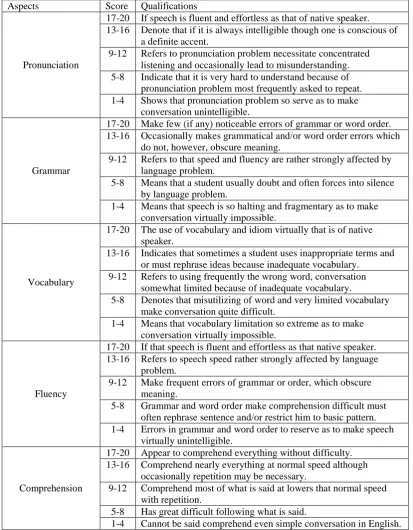
3.1.Aspects of Speaking which are Scored ... 25
3.2.English Speaking Test Sheet ... 26
3.3.Rubric of Speaking Aspect ... 31
3.4.Rubric of the Raters ... 31
4.1.The Statistic Table of Speaking Pretest Scores ... 40
4.2.Distribution Frequency of Students’ Speaking Pretest Score ... 40
4.3.The Statistic Table of Speaking Posttest Scores... 43
4.4.Distribution Frequency of Students’ Speaking Posttest Score... 44
4.5.The Improvement in Each Aspect after the Treatment... 49
LIST OF GRAPHS
Graph Page 4.1.The Average of Students’ Speaking Scores before the Treatment ... ... 42 4.2.The Average of Students’ Speaking Scores after the Treatment ... …. 45 4.3.The Improvement of Students’ Speaking in Five Aspects after
LIST OF APPENDICES
Appendix Page
1. Pre-Test ... 61
2. Post Test ... 62
3. Lesson Plan I ... 63
4. Lesson Plan II ... 66
5. Lesson Plan III ... 69
6. Research Schedule ... 72
7. Table of Result Score Pre-test among Two Raters ... 73
8. Table of Result Score Posttest among Two Raters ... 74
9. Table of Result Score Pre-test for Each Aspect among Two Raters ... 75
10.Table of Result Score Posttest for Each Aspect among Two Raters ... 77
11.T-test Computation ... 79
12.Inter-rater Reliability of Pretest Score ... 80
13.Reliability of Pretest ... 81
14.Inter-rater Reliability of Posttest Score ... 82
15.Reliability of Posttest ... 83
16.Frequency Table of Pretest ... 84
17.Frequency Table of Posttest ... 85
18.Transcription of Pretest ... 86
19.Transcription of Posttest ... 92
20.Surat Keterangan Penelitian ... 98
I. INTRODUCTION
This chapter discusses introduction of the research used in this study, that is,
background of the problem, formulation of the research question, objectives of the
research, uses of the research, scope of the research, and definitions of terms.
1.1. Background
In the national curriculum of school-based curriculum (KTSP) 2006 it is stated
clearly that the goal of learning and teaching English is to make the students have
competency in four language skills namely, listening, speaking, reading, and
writing. According to Kayi (2006: 1) speaking is an essential tool for
communicating, thinking and learning. Oral language is a powerful learning tool
which shapes, modifies, extends, and organizes thought. Oral language is a
foundation of all languages development and, therefore, the foundation of all
learning. Through speaking, students learn the concepts of learning develop
vocabulary, and perceive the structure of the English language in which it is the
essential components of learning.
Speaking is basically a process of building and sharing meaning through the use
of verbal and non-verbal symbols, in a variety of context (Chaney, 1998).
2
speaking is very important. It is as a measurement of language learners whether
someone is successful in learning language or not. Speaking is an interactive
process of constructing meaning that involves producing and receiving and
processing information (Brown, 1994; Burns & Joyce, 1997). Its form and
meaning are dependent on the context in which it occurs, including the
participants themselves, their collective experiences, the physical environment,
and the purposes for speaking. It is often spontaneous, open-ended, and evolving.
Speaking requires that learners not only know how to produce specific points of
language such a grammar, pronounciation or vocabulary, but also understand
when, why and in what ways to produce language. In speaking skill, the learners
have to decide what they want to say to select words that is appropriate to pattern
to use the correct arrangement of sounds, pitch, and forms. The content should
also be suitable to the situation.
Speaking involves several aspects, such as accuracy, appropriateness, fluency, and
vocabulary building. The students need to master all of the elements. In teaching
and learning process, the teachers give less attention to speaking. Therefore, if
students do not learn how to speak or do not get any opportunities to speak in the
language classroom, they may soon lose their interest in learning. Students, who
do not develop strong oral skills during this time, will find itdifficult to keep pace
3
However, today’s world requires that the goal of English Language Teaching
(ELT) is to help students develop what they know about the language into an
ability to use the language. Beside that, it can improve students’ communicative
skills because only in that way can students express themselves and learn how to
follow the social and cultural rules appropriate in each communicative
circumstance (Edge, 1993).
When the researcher conducted pre-observation in SMP Al-Huda Jati Agung in
the second grade, it was found that the students still faced some problems in
speaking such as: (1) students found difficulties to express their ideas in spoken
English,(2) students felt nervous when the teacher asked them because they could
not answer in English well, (3) students did not want to practice and communicate
in English to their friends because they were afraid of making mistakes and their
friends would laugh them, (4) students also lacked of the vocabulary and grammar
in English, (5) students had a little spirit that could motivate them in learning
English especially in speaking.
Based on the conditions stated above, the researcher tried to solve the problem by
offering one teaching technique for teaching speaking namely games. Many kinds
of English games that can be used in learning and teaching process, there are
Hang Man, Bingo, Who Am I?, What Am I?, and many others. In this research, the
researcher chose What Am I? game because it was a very useful teaching
technique for the effective and joyful learning. In addition, this game can arise
4
their speaking ability and that is one of the reason for the students to talk with
each other without wondering how to start the conversation.
Based on the background above, the researcher was interested to solve the
problem by implementing a game in teaching speaking. The name of game is
What Am I? game. What Am I? game is a game using flashcards and for playing
this game, the students can guess about the card.
1.2. Formulation of the Research Questions
Based on the background, the researcher tried to formulate the research question
as follows:
Is there any significant improvement of students’ speaking achievement after
being taught through What Am I? game?
1.3. Objectives of the Research
Based on the formulation of the research questions, the researcher tried to
formulate the objective as follows:
To find outwhether or not there is a significant improvement of students’
5
1.4. Uses of the Research
The uses of this research were as follows:
1. Theoretically, this research is proposed to correlate whether the findings of
this research is relevant or not with the theory of What Am I? game and its
influences.
2. Practically, this research will be usefulfor the teachers to improve their
students’ speaking achievement by teaching through What Am I? game.
1.5. Scope of the Research
This research was focused on whether What Am I? game could influence students’
speaking achievement. The researcher chose What Am I? game to be used in this
research. This research was conducted to the students inVIII D class of SMP
Al-Huda Jati Agung Lampung Selatan. This class consisted of 32 students. The
researcher conducted this research in 5 meetings for three weeks.
1.6. Definition of Terms
There are some terms used by the researcher and to make them clear and to avoid
misunderstanding, they were clarified as follows:
1. What Am I? game is a game using flashcards and for playing this game students can guess about the card. This game is very popular and by using the
flashcards the teachers can adapt the game to the classroom.
II. LITERATURE REVIEW
This chapter discusses several points related to the theories used in this study,
such as concept of speaking, concept of teching speaking, techniques of teaching
speaking, concept of What Am I? game, procedures of teaching What Am I? game,
advantages and disadvantages of What Am I? game, theoretical assumption and
hypothesis.
2.1. Speaking
Speaking is one of the four skills of language that must be learnt by the students to
study their English as a foreign language. Speaking is also one of the language
skills that is essential to be learnt even though the students have some problems in
their speaking. Speaking is the way for people to express their ideas, feelings, and
thoughts and convey message orally with the other people to show through our
action. Without speaking, it will be impossible for human being to socialize with
other people to understand what the other say. There are many kinds of speaking
test, such as responsive speaking, interactive speaking, intensive speaking, and the
others. In this research, the researcher used responsive speaking in giving
7
Cameron (2001: 40) stated that speaking is the active use of language to express
meaning so that other people can make sense of them. Through speaking, people
will feel and understand what others express in language. Speaking will not be
effective if no one listens to what people say. In other words, there must be
interaction between the speaker and the listener. Based on the theories above, the
researcher assumes that speaking is very important in our life to make good
communication in order the people can understand to each other.
According to Brown (2001: 267) “From a communicative, pragmatic view of
language classroom, listening and speaking skills are closely intertwined. More
often than not, ESL curricula that oral communication skill will simply be labeled
as listening speaking courses. The interaction between these two modes or
performance applies especially strongly to conversation, the most popular
discourse category in the profession. In the classroom even relatively
unidirectional types of spoken language input (speeches, lectures, etc) are often
followed or preceded by various from of oral production on the part of students”.
From the statement above, it means that we can use English in the classroom
when we teach.
Speaking is one of the four basic skills of language and it has an important role in
daily life because it is the main skill in communication. When people need
something, they interact with others through language as a medium. In short,
when people speak, they have an interactive process of constructing meaning that
8
2.2. Aspects of Speaking
According to Haris (1974: 75), there are five aspects of speaking as follows:
1. Pronunciation refers to be the person’s way of pronouncing words. Brown
(2004: 157) also states that pronunciation is the language learner has to know
how to pronounce and understand the words that are produced by the speaker.
2. Grammar is the study of rules of language inflection. It is a system of units and
patterns of language (Lado, 1969: 221).
3. Vocabulary refers to the words used in language. Phrases, clauses, and
sentences are built up by vocabulary. In short, vocabulary is very important
because without words we cannot speak at all (Wilkins, 1983: 111).
4. Fluency refers to the one whose express quickly and easily. This is also stated
by Ekbatani (2011: 34) that fluent speaker is someone who is able to express
oneself readily and effortlessly.
5. Comprehension denotes the ability of understanding the speakers’ intention and
general meaning (Heaton, 1991: 35). It means that if person can answer or
express well and correctly, it shows that he comprehends or understands well.
2.3. Types of Speaking Performance
Brown (2004: 271) describes six categories of speaking performance based on
9
a. Imitative
This category includes the ability to practice an intonation and focus on some
particular elements of language form. That is just imitating a word, phrase or
sentence. The important thing here is focusing on pronunciation. The teacher uses
drilling in the teaching learning process. The reason is by using drilling, students
get opportunity to listen and to orally repeat some words.
b. Intensive
This is the students’ speaking performance that is practicing some phonological
and grammatical aspects of language. It usually places students doing the task in
pairs (group work), for example, reading aloud that includes reading paragraph,
reading dialogue with partner in turn, reading information from chart, etc.
c. Responsive
Responsive performance includes interaction and test comprehension but at the
somewhat limited level of very short conversation, standard greeting and small
talk, simple request and comments. This is a kind of short replies to teacher or
student-initiated questions or comments, giving instructions, and directions. Those
replies are usually sufficient and meaningful.
d. Transactional (dialogue)
It is carried out for the purpose of conveying or exchanging specific information.
This kind of speaking performance more focus on transaction activity such as
10
e. Interpersonal (dialogue)
Interpersonal dialogue refers to the dialogue which more for the purpose of
maintaining social relationships than for the transmission of facts and
informations. The forms of interpersonal speaking performance are interviews,
role plays, discussions, conversations, and games.
f. Extensive (monologue)
Teacher gives students extended monologues in the form of oral reports,
summaries, storytelling, and short speeches.
In this research, the researcher focused on interpersonal dialogue. Based on the
explanation before, game includes in interpersonal dialogue. In this research, the
researcher gave the treatment by using game and made descriptive text to improve
students’ speaking achievement through What Am I? game.
2.4. Teaching Speaking
Speaking is one of the four skills of language that students must master. Speaking
can transfer someone’s idea or thought to other people. Teaching speaking is a
part of teaching English as a foreign language. To make the students have good
speaking ability, the teacher should concern with all factors involved in it. The
factors are; classroom management, teaching method, good media, and the
speaking materials that must be considered as the factors which influence in
11
At this point some suggestions for English language teachers while teaching oral
language are:
Provide maximum opportunity to students to speak the target language
by providing a rich environment that contains collaborative work,
authentic materials, and tasks, and shared knowledge.
Try to involve each student in every speaking activity; for this aim,
practice different ways of student is participation.
Reduce the teacher speaking time in class while increasing student
speaking time step back and observe students.
Indicate positive signs when commenting on a student’s response.
Ask eliciting questions, such as “What do you mean? How did you
reach that conclusion? “I order to prompt student to speak more.
Provide written feedback like “Your presentation was really great. It
was a good job. I really appreciated your effort in preparing the
materials and efficient use of your voice...”
It means that as an English teachers, they should be able to teach English well in
order to target language can be reached easily by the students. Therefore,they also
need teaching motivation to create cozy situation in the classroom that can help
the students feel interested in teaching learning English as natural as possible.
Beside that,they should give the students an occasion to explore themselves to
learn English more intense so the students can feel familiar and interested to learn
12
Wallace (1982: 105) puts forward two reasons of using language games in
language instructions as follows: Language games have become more widely used
recently, probably for two main reasons; first, an increasing emphasis on the
importance of motivation and of the appropriate kind of positive efective
atmosphere in the classroom, second, an increasing emphasis on the importance of
real communication. If a game is working properly, it very often supplies a
genuine desire to communicate in the target language, even within the artificial
confines of the classroom.
Teaching speaking is the way for students to express their emotions,
communicative needs, interact to other person in any situation, and influence the
others. For this reason, in teaching speaking skill it is necessary to have clear
understanding involved in speech. The goal of teaching speaking is to
communicate effectively.
Teaching speaking is the activity of transfering knowledge and skills which is
focused on improving communication skill in order to make the students able to
communicate each other especially in sharing their ideas or delivering their
speech. It is very difficult to teach because the students get difficulty to share their
ideas. They are afraid of making mistakes when they speak in English. However,
speaking is not correct and wrong because speaking is the listener understands
what the speaker meaning. It will be supported by Setiyadi (2006: 57), “one can
learn to speak and understand a language only being exposed to the spoken
13
According to Nunan (2003), teaching speaking is to teach learners to:
1. Produce the English speech sounds and sound patterns.
2. Use word and sentence stress, intonation patterns and the rhythm second
language.
3. Select appropriate words and sentences according to the proper social
setting, audience, situation, and subject matter.
4. Organize their thoughts in a meaningful and logical sequence.
5. Use language as a means of expressing values and judgements.
6. Use the language quickly and confidently with few unnatural pauses which
is called fluency.
Based on the statement above, the researcher assumes that teaching and learning
English is important. By speaking people can exchange opinion, ideas, thought,
and feeling and they can also exchange experience by using the language. In this
case, teacher can apply an appropriate technique in teaching speaking by using
What Am I? game to increase the students’ speaking ability.
2.5. Techniques in Teaching Speaking
Harmer (2001: 271-273) suggested in his book that there are some techniques or
classroom speaking activities that are currently used in communicative class:
1. Giving information
In this stage, the teachers explain the material that they want to teach in the
class. When the students are given the information, they are able to imagine
14
2. Role play
In this step, the teacher explains the activity rules that will be used in teaching
learning process in the classroom. As a result, the teacher can decide the
suitable activities to improve the students’ ability, especially in speaking skill.
For example, the teachers use pair work activities. They ask their students to
make a conversation with their friend in one table. It includes asking question
and giving information. They will be able to practice their speaking skill there.
3. Discussion
Generally, discussion is the effective activity or strategy in improving the
students’ ability because all components in the classroom (the teacher and
students) can play the role in teaching learning process. They will practice their
speaking skill with their relation regularly.
4. Communication Games
Games which are designed to provoke communication between students
frequently depend on an information gap, so that one student has to talk to a
partner in order to solve a puzzle, put things in the right order (describe and
arrange), or find similarities and differences between pictures.
5. Answer and question
Answer and question are the activities that will influence the development of
the students’ ability because they will respond what the teacher asks to them
and they also can ask the teacher when they get difficulty on the material.
6. Information Gap
In this activity, students are supposed to be working in pairs. One student will
15
share their information. Information gap activities serve many purposes, such
as solving a problem or collecting information. Also, each partner plays an
important role because the task cannot be completed if the partners do not
provide the information the others need. These activities are effective because
everybody has the opportunity to talk extensively in the target language.
7. Story Telling
Students summarize a tale or story. It helps students express ideas in the format
of beginning, development, and ending, including thecharacters and setting a
story has to have. Students can tell riddles or jokes.
8. Interviews
Students can conduct interviews on selected topics with various people. It is a
good idea that theteacher provides a rubric to students so that they know what
type of questions they can ask orwhat path to follow, but students should
prepare their own interview questions. Conductinginterviews with people gives
students a chance to practice their speaking ability not only in classbut also
outside and helps them becoming socialized. After interviews, each student can
present it.
9. Story completion
This is a very enjoyable, whole-class, free-speaking activity for which students
sit in a circle. Forthis activity, a teacher starts to tell a story, but after a few
sentences he or she stops narrating.Then, each student starts to narrate from the
point where the previous one stopped. Each studentis supposed to add from
16
10. Reporting
Before coming to class, students are asked to read a newspaper or magazine
and, in class, theyreport to their friends what they find as the most interesting
news. Students can also talk aboutwhether they have experienced anything
worth telling their friends in their daily lives before class.
11.Picture describing
One way to make use of pictures in a speaking activity is to give students just
one picture andhaving them describe what it is in the picture. For this activity
students can form groups and eachgroup is given a different picture. Students
discuss the picture with their groups, then aspokesperson for each group
describes the picture to the whole class. This activity fosters thecreativity and
imagination of the learners as well as their public speaking skills.
12. Find the difference
For this activity students can work in pairs and each couple is given two
different pictures, for example, picture of boys playing football and another
picture of girls playing tennis. Students in pairs discuss the similarities and/or
differences in the pictures.
In this research, the researcher only used three among sometechniques or
classroom speaking activities mentioned previouslythat are appropriate to the
material will be delivered. The techniques are as follows:
1. Giving information
Teachers explain the material that they want to teach in the class. When the
students are given the information, they are able to imagine and guess the
17
2. Communication Games
Teacher uses communication games in teaching speaking to make the students
interested in learning English. For this activity the students working in pair.
The student gives some questions to their partner and their partner only answer
yes/ no.
3. Picture describing
One way to make use of pictures in a speaking activity is to give students just
one picture and having them describe what it is in the picture. For this activity
students given a different picture and their must describe it in front of the class
individually. This activity fosters the creativity and imagination of the students
as well as their public speaking skills.
2.6. What Am I? Game
Agoestyowati (2007: 237) states that What Am I? game is a game using flashcards
and for playing this game the students can guess about the card. This game gives
the students a reason to talk each other without wondering how to start the
conversation. This game is very popular and by using the flashcards the teachers
can adapt this game to the classroom.
In this game the teacher uses flashcards consisting of some topics, such as
professions, transportations, things, animals, fruits, flowers or others. After that,
the teacher asks two students to come in front of the class. Then, one of two
students chooses the cards. The student who chooses the card is not allowed to see
18
partner and their partner only answers yes/ no. He or she tries to guess about the
card. The students play this game until they can guess who he or she is.
The students often find difficulties in learning English to express their ideas in
speaking. To change this bad thing, the researcher tried to use What Am I? game
to make the students have motivation in learning English. Besides, they will not
get bored when they are learning English.
2.7. The Procedure of Teaching What Am I? Game
The procedure of teaching speaking by using What Am I? game in the class is
divided into three terms. They are pre-activity, whilst-activity, and post-activity.
Here are the procedures of teaching speaking by using What Am I? game:
1. Pre Activities
Teacher greets the students.
Teacher gives the questions or brainstorming to the students related to
the topic that they are going to learn.
2. Whilst Activities
Teacher explains the vocabularies associated with professions, animals,
fruits, transportations, things, flowers or the others.
Teacher explains the material and introduces about What am I? game
and how to play it.
Teacher asks three students to stand in front of the class. Then, each
student chooses one of some cards/ papers about professions, animals,
19
Teacher asks students to show the card to their partner. Students are not
allowed to see their own card. She or he tries to guess about their own
card by giving maximal 10 questions to their partner in correct
grammatical sentences for describing and their partner only answers
yes/no.
3. Post Activities
Teacher and students review the activities that they have done.
Teacher closes learning activity.
2.8. The Advantages and the Disadvantages of What Am I? Game
In using What Am I? game, there must be the strengths and the weakness that will
be elaborated in the following section.
A. The Advantages of What Am I? Game
Using What am I? game, the students will gain three advantages. The first is
that What Am I? game can motivate students to speak English. Second, the
students can enjoy in learning speaking. The last, What Am I? game can
increase students’ speaking ability.
The process of implementing What Am I? game guides the student to be more
20
B. The Disadvantages of What Am I? Game
Even though What Am I? game looks as an effective technique or method for
students’ speaking, it has several weaknesses. There are two weaknesses
when performing What Am I? game in the class, that is; first, by using What
Am I? game the students have difficulty to memorize English words, and;
second, the students feel shy to speak.
2.9. Theoretical Assumption
The literature reviews above have made the researcher predict that What Am I?
game will have an impact to increase the students’ speaking ability. In learning
and teaching English, the teachers must teach the students by using appropriate
technique and method, in order to the students can easy to understand and
memorize the material given. Beside that, they must make the students interested
in learning and teaching process.
Based on the theories used, the researcher assumed that by using What Am I?
game as one technique in teaching speaking, it can make the students easy to
understand and memorize the words. This technique has positive influence
towards students’ speaking ability.
It is assumed that the problems which are usually faced in teacing speaking can be
reduced or even solved by using What Am I? game. As a result, logically, the
21
2.10. Hypothesis
Based on the theoretical assumption, the reseacher formulated the hypothesis as
follows:
H1: There is a significant improvement of students’ speaking achievement after
being taught through What Am I? game.
H0: There is no significant improvement of students’ speaking achievement after
III. METHOD
This chapter describes the method that is used in conducting the data of the
research, such as design, data research, data source, research instruments, research
procedure, data analysis, and hypothesis testing.
3.1. Design
In this research, the researcher used a quantitative method. Setiyadi (2006: 5) said
that quantitative design aims to investigate a theory that has been existed and the
data in order to support or reject it.
The objective of this research was to find out whether or not there was an
improvement of students’ speaking achievement after being taught through What I
Am? game.In conducting the research, the researcher used one class as the
experimental class which got treatments from the researcher and also got the
pretest and the posttest. The research design could be presented as follows:
T1 X T2
Where:
T1: Pretest (Speaking test)
X: Treatment (using What Am I? game)
23
3.2. Population and Sample
The population of this research was the second grade students of SMP Al-Huda
Jati Agung in 2015/ 2016 academic year. There were 5 classes of the second grade
in this school and each class consisted of 30-32 students.
From the population above, there was one class as an experimental class that got
the treatments (teaching speaking by using What Am I? game) that was VIII D
class. This class consisted of 32 students. In determining sample, the reseacher
used Random Sampling Technique by using a lottery so that all the second grade
classes got the same chance to be the sample in order to avoid subjectivity and to
guarantee that every class has the same opportunity.
3.3. Variables
In order to assess the influence of the treatment in research, variables can be
defined as dependent and independent variables. Hatch and Farhady (1982:15)
state that the independent variable is the major variable that a researcher hopes to
investigate and the dependent variable is the variable that the researcher observed
and measured to determine the improvement of the independent variable.
The research consists of two variables as follows:
1. Independent variable of the research is using What Am I? game that
symbolized by (X)
2. Dependent variable of this research is students’ speaking achievement that
24
3.4. Research Instrument
In getting the data, the researcher used oral speaking test. It consisted of the
pretest and the posttest.
1. Pretest
The researcher administered the pretest before the treatments. It was aimed at
knowing the students’ speaking achievement before being given the treatment
using What Am I? game. In that test, the students described one example of some
topics given by the researcher consisted of professions, animals, and fruits. They
had 3 minutes to describe it orally in front of the class. The researcher recorded
the oral test by using tape recording.
2. Posttest
The researcher administered the posttest after the treatments. It was aimed at
seeing the significant difference of the students’ speaking achievement after they
have taught through What Am I? game. In that test, the students described one
example of some topics given by the researcher consisted of professions, animals,
and fruits. They had 3 minutes to describe it orally in front of the class. During the
test, the researcher recorded by using tape recording.
In this research, the researcher used oral test to find out the students’ speaking
ability. This oral test was in terms of Descriptive text. Since it was a subjective
test, there were two raters in judging. The two raters were the researcher and
English teacher at SMP Al-Huda. Based on the oral rating sheet, there were five
25
vocabulary, fluency, and comprehension. In scoring system students speaking
[image:41.595.106.520.176.707.2]ability, the researcher used the score system proposed by Harris (1974: 84).
Table 3.1. Aspects of Speaking which are Scored
Aspects Score Qualifications
Pronunciation
17-20 If speech is fluent and effortless as that of native speaker. 13-16 Denote that if it is always intelligible though one is conscious of
a definite accent.
9-12 Refers to pronunciation problem necessitate concentrated
listening and occasionally lead to misunderstanding. 5-8 Indicate that it is very hard to understand because of
pronunciation problem most frequently asked to repeat.
1-4 Shows that pronunciation problem so serve as to make
conversation unintelligible.
Grammar
17-20 Make few (if any) noticeable errors of grammar or word order.
13-16 Occasionally makes grammatical and/or word order errors which
do not, however, obscure meaning.
9-12 Refers to that speed and fluency are rather strongly affected by language problem.
5-8 Means that a student usually doubt and often forces into silence by language problem.
1-4 Means that speech is so halting and fragmentary as to make
conversation virtually impossible.
Vocabulary
17-20 The use of vocabulary and idiom virtually that is of native speaker.
13-16 Indicates that sometimes a student uses inappropriate terms and or must rephrase ideas because inadequate vocabulary.
9-12 Refers to using frequently the wrong word, conversation
somewhat limited because of inadequate vocabulary.
5-8 Denotes that misutilizing of word and very limited vocabulary
make conversation quite difficult.
1-4 Means that vocabulary limitation so extreme as to make
conversation virtually impossible.
Fluency
17-20 If that speech is fluent and effortless as that native speaker. 13-16 Refers to speech speed rather strongly affected by language
problem.
9-12 Make frequent errors of grammar or order, which obscure
meaning.
5-8 Grammar and word order make comprehension difficult must
often rephrase sentence and/or restrict him to basic pattern.
1-4 Errors in grammar and word order to reserve as to make speech
virtually unintelligible.
Comprehension
17-20 Appear to comprehend everything without difficulty.
13-16 Comprehend nearly everything at normal speed although
occasionally repetition may be necessary.
9-12 Comprehend most of what is said at lowers that normal speed
with repetition.
5-8 Has great difficult following what is said.
26
The score of speaking ability based on the five elements can be divided in
percentage as follows:
a. Pronunciation ... 20%
b. Fluency ... 20%
c. Grammar ... 20%
d. Vocabulary ... 20%
e. Comprehension ... 20%
Total Percentage ... 100%
The researcher used this percentage because the researcher tried to find out the
most improvement of speaking aspects.
Table 3.2. The Table of English Speaking Test Sheet
Students’ Code
Pronounciation Fluency Grammar Vocabulary Comprehension Total
Number
(1-20) (1-20) (1-20) (1-20) (1-20)
1 2 3
3.5. Validity and Reliability 3.5.1. Validity of Test
Validity refers to the extent to which the test measure and to what is intended to
measure. A test can be considered to be valid if it can precisely measure the
27
There are four kinds of validity, that are: (1) Face validity, concerns with the
layout of the test; (2) Content validity, depends on a careful analysis of the
language being stated; (3) Construct validity, measures certain specific
characteristic in accordance with a theory of language learning; (4)
Criterion-related validity, concerns with measuring the success in the future as in
replacement test.
Based on the types of validity above, the researcher used content and construct
validity to measure the validity of the test. In the content validity, the material and
the test are composed based on the indicators and objective on syllabus and
curriculum for this school. The material of this research was expressing the
meaning in functional oral text and simple short monologue in form of descriptive
to interact with closer surrounding. While,construct validity focuses on the kinds
of the test used to measure the students’ ability. In this research, the researcher
administered a speaking test and the technique for scoring students’ speaking test
was based on five aspects; pronunciation, grammar, vocabulary, fluency, and
comprehension.
3.5.2. Reliability of Test
In achieving the reliability of scoring the pretest and the posttest in this research,
the researcher usedinter-rater reliability. There were two raters to reduce the
subjectivity in judging students’ speaking ability. The raters were the researcher
and English teacher at SMP Al-Huda Jati Agung, Ms. Marita Susanti, S.S.. The
28
classroom when the students performed the test, while the second judgement was
done by listening the students’ performances record. The final score was
combination of the final test based on the both raters. After gaining the score from
the second judgement, the two raters compared the scores given for the students’
performances. The students’ scores gained from the two raters were analyzed by
using formulaproposed by Shohamy (1985: 213) in order to see the reliability.
3.6. Research Procedure
The procedures of the research were as follows:
1. Selecting and Determining the Population and Sample
The population of the research was the second grade students of SMP Al-Huda
Jati Agung in 2015/ 2016 academic year. There were 5 classes of the second grade
in this school and each class consisted of 30-32 students.
From the population above, there was one classas experimental class that got the
treatments (teaching speaking by using What Am I? game) that was VIII D class.
This class consisted of 32 students. In determining sample, the reseacher used
Random Sampling Technique by using a lottery so that all the second grade
classes got the same chance to be the sample in order to avoid subjectivity and to
guarantee that every class has the same opportunity.
2. Administering the Pretest
The researcher administered the pretest before the treatments. It was aimed at
knowing the students’ speaking achievement before being given the treatment
29
topics given by the researcher consisted of professions, animals, and fruits. They
had 3 minutes to describe it orally in front of the class. The researcher recorded
the oral test by using tape recording.
3. Conducting the Treatments
This was done after the pretest to teach the students through What Am I? game.
There were three times of treatments. In each treatment, it lasted for 80 minutes.
The researcher treated the students until they could reach the objectives.
4. Administering the Posttest
The researcher administered the posttest after the treatments. It was aimed at
seeing the significant difference of the students’ speaking achievement after they
have taught by using What Am I? game. In that test, the students described one
example of some topics given by the researcher consisted of professions, animals,
and fruits. They had 3 minutes to describe it orally in front of the class. During the
test, researcher recorded by using tape recording.
5. Analyzing the Test Result (Pretest and Posttest)
After scoring the students’ performance, the researcher compared the result of the
pretest and the posttest to see whether the score of the posttest was higher than the
30
3.7. Data Analysis
To analyze data, the researcher computed students’ score in the pretest and the
posttest by using formula from Arikunto (1997: 68) as follows:
Where:
M = Mean (the average score)
x = Students’ score
N = Total number of students
After that mean of the pretest was compared to mean of the posttest to see
whether What Am I? game gave an improvement on students’ speaking ability or
not. In order to determine whether the students got an improvement, the
researcher used following formula.
Where:
I = the improvement of students’ speaking ability
M1 = the average score of the pretest
M2 = the average score of the posttest
After the data had been collected, the researcher treated the data by using the
following procedures:
1. Put students’ score in the pretest (T1) and the posttest (T2) on the table
31
Table 3.3. Rubric of Speaking Aspect
Ss’
Code
Pronun. Vocab. Fluency Comprehen. Grammar Total
R1 R2 R1 R2 R1 R2 R1 R2 R1 R2 R1 R2
A
B
…
Mean X1= X2=
Where:
R1 : Rater 1
R2 : Rater 2
XI : ∑ R1
X2 : ∑ R2
[image:47.595.117.517.439.745.2]2. Found the reliability of the pretest and the posttest.
Table 3.4. Rubric of the Raters
No. Students' Code Pretest Rank 1 Rank 2 D D²
R1 R2
1
2
3
Note:
R 1 : rater 1
R2 : rater 2
Rank 1 : Rank rater 1
Rank 2 : Rank rater 2
D : the difference rank correlation between R1 and R2
32
In order to find the reliability of the pretest the researcher used the following
formula:
Shohamy (1985; 213).
Notes:
R : Reliability
N : Number of the students
d : The difference of the rank collection
1- 6 : Constant number
The standard of reliability (Arikunto, 1998: 260):
A. Reliability ranges from : 0.00 to 0.19 = very low
B. Reliability ranges from : 0.20 to 0.39 = low
C. Reliability ranges from : 0.40 to 0.49 = medium
D. Reliability ranges from : 0.60 to 0.79 = high
E. Reliability ranges from : 0.80 to 0.100 = very high
3.8. Hypothesis Testing
The hypothesis testing was used to prove whether the hypothesis proposes in this
research was accepted or not. The hypothesis was analyzed by using Repeated
Measures T-test of Statistical Package for Social Sciences (SPSS) windows
version 16. The reseracher used the level of significance 0.05 in which the
hypothesis was approved if sign < p. It meant that the probability of error in the
33
The hypotheses were drawn as follows:
H0: There is no significant improvement of students’ speaking achievement
after being taught through What Am I? game.
H1 : There isa significant improvement of students’ speaking achievement after
being taught through What Am I? game.
(Hatch and Farhadi, 1982: 111)
The criteria for accepting the hypothesis is as follows:
If Tvalue> Ttable H1 is accepted at significant level 0.05
If Tvalue< Ttable H0 is accepted at significant level 0.05
The researcher used SPSS to calculate the result whether it was significant or not
V. CONCLUSION AND SUGGESTION
This chapter deals with some conclusions and also suggestions.
5.1. Conclusions
Having conducted the research at the second grade of SMP Al-Huda Jati Agung
and analyzed the data, the researcher would like to give the conclusions as
follows:
1. What Am I? game turns to be an appropriate technique to improve
students’ speaking achievement. This can be seen from the result of this
research. There is a significant improvement of students’ speaking
achievement after being taught through What Am I? game. It means that
What Am I? game can improve students’ speaking achievement. From the
result, it can be seen that the posttest is higher than the pretest. There is an
improvement from average score of the pretest 60.77 to the posttest 73.80.
The result of hypothesis test shows also that t-value (20.462) was > t-table
(2.039). It means that the hypothesis which has been mentioned previously
that there is a significant improvement of students’ speaking achievement
56
2. What Am I? game can improve vocabulary because the researcher
explained some examples of vocabulary that could be used to describe
something. Besides, the students heard many new vocabularies that they
never heard before from their friends in treatment. As a result, they could
describe something by using their own idea. This can be seen from the
result of this research.
5.2. Suggestions
Some suggestions that the researcher would like to propose based on the
conclusions are as follows:
1. Suggestions for the teacher
a. The English teachers are suggested to use What Am I? game in
teaching speaking because the researcher found in the field that most
of students was interested to study speaking through What Am I?
game. This is proved by the result of students’ speaking test score.
This technique can be used by the English teachers when teach
Description Text. It can make the students enjoy the learning process
in Description Text and stimulate the students’ speaking ability.
b. For the English teachers who want to use What Am I? game are
suggested to be able to make some variations of topic in teaching
which are interesting for the students. This is to make the students do
not feel bored and hard to follow the learning process.
c. In implementing this technique, the teacher should give more attention
to students’ awareness in grammar since the result of the lowest
57
2. Suggestions for further researcher
a. Further researchers should pay attention more to the lowest aspect,
grammar, by developing the technique to make a significant
improvement of that lowest aspect. This is because the researcher has
found out that the lowest improvement aspect of speaking is grammar.
b. Further researchers should try to use this technique to improve the
other skills. Because in this research, the researcher has used What Am
I? game to improve speaking skill.
c. Further researchers should conduct this technique at different levels of
students. Because in this research, the researcher has used this
technique to improve students’ speaking achievement on the second
REFERENCES
Agoestyowati, R. 2007. 102 English Games. Jakarta: Gramedia Pustaka Utama.
Allen, David and Vallette Rebecca M. 1997. Classroom Foreign Language and English as a Second Language. New York: Harcourt Brave Javanovich.
Arikunto, S. 1998. Prosedur Penelitian Suatu Pendekatan Praktek. Jakarta: Rineka Cipta.
Bimantara, Muhammad. 2012. The Implementation of “Who Am I” Game to Teach Speaking Descriptive Text to the 7th Grades of SMPN 3 Krian. Unpublished Thesis: University of Surabaya.
Brown, H.D. 1994. Teaching by Principles: An Interactive Approach to Language Pedagogy. New Jersey: Prentice Hall.
Brown, H.D. 2001. Teaching by Principles: An Interactive Approach to Language Pedagogy. San Francisco: Longman.
Brown, H. Douglas. 2004. Language Assessment Principles and Classroom Practices. San Francisco: Longman.
Bryne, Donn. 1984. Teaching Oral English. Singapore: The British Council. Longman.
Burns, A, & Joyce, H. 1997. Focus on Speaking. Sydney: National Center for English Language Teaching and Research.
Cameron, Lynne. 2001. Teaching Languages to Young Learners. USA:
Cambridge University Press.
Chaney, A.L, and Burk, T.L. 1998. Teaching Oral Communication in Grades K-8. Boston: Allyn & Bacon.
Edge, Julian. 1993. Essentials of English Language Teaching. New York: Longman.
59
Fung, Yong Mei. 2016. Effects of Board Games on Speaking Ability of Low-Proficiency ESL Learners. International Journal of Applied Linguistic and English Literature, 5(3): 261-271.
Gray, Dave. 2010. Game Storming. Sebastopol: O’reiey Media. Inc
Harris, David. 1974. Testing English as Second Language. New York: Mc Graw Hill Book Company.
Harmer, Jeremy. 2001. How To Teach English. Malaysia. Stenton Associates.
Hatch, E & Farhady. 1982. Research Design and Statistics for Applied Linguistic. University of California: Los Angeles Pers: Roeley. London. Tokyo.
Heaton, J B. 1991. Writing English Language Testing. New York: Longman Inc.
Jacobs, Holly S. 1981. Testing ESL Composition: A Practical Approach. Massachusetts: Newbury House Publisher, Inc.
Kayi, H. 2006. Teaching Speaking: Activities to Promote Speaking in a Second Language. The Internet TESL Journal, 11. Retrieved from:
http://iteslj.org/Techniques/Kayi-TeachingSpeaking.html
Lado, Robert and Charles C. Fries. 1969. English Pattern Practice: Establishing Patterns as Habits. New Delhi: Hill Publishing Co. Itd.
Nunan, D. 2003. Practical English Language Teaching. New York: MC Graw Hill.
Setiyadi, Ag. Bambang. 2006. Teaching English as A Foreign Language. Yogyakarta: Graha Ilmu.
Setiyadi, Ag. Bambang. 2006. Metode Penelitian Untuk Pengajaran Bahasa Asing: Pendekatan Kuantitatif dan Kualitatif. Yogyakarta: Graha Ilmu.
Shohamy, E. 1985. A Practical Handbook in Language Testing for the Second Language Teacher. Tel.Aviv: Tel Aviv University.
Sorayaie Azar, A. 2012. The Effect of Games on EFL Learners’ Vocabulary Learning Strategies. International Journal of Applied and Basic Sciences, 1(2): 252-256.
Wallace, M. 1982. The Study of Language. Australia: Cambridge University Press.