Algorithm for congestion control network in vehicular
ADHOC network
Ankit Kumar
M.Tech. Scholar, Oriental University, Indore
DOI: 10.29322/IJSRP.8.9.2018.p8124 http://dx.doi.org/10.29322/IJSRP.8.9.2018.p8124
ABSTRACT
I propose a scattered, supportive message activity blockage control and spread figuring 'CCMDA' utilizing ITS that effects fruitful utilization of correspondence to channel, keeps up zone protection, more secure voyaging and air condition and gives drivers unfaltering data on improvement deters over long segments. Advancement articles ought to encourage with each other by utilizing vehicle-to-Infrastructure (V2I) and Vehicle-to-vehicle (V2V) correspondence approaches, as the correspondence data is the best unutilized thoroughly factor in ITS for diminishing message activity blockages in correspondence channel (CCH), sparing travel time, decreasing heap up, lessening air contaminations, lowing centrality utilize and in addition giving requesting data amidst improvements. What's more, we demonstrate an adaptable reenactment and acknowledgment structure we masterminded and made to support our framework by showing its achievability in different conditions and to help in the imaginative work of this and future VANET applications.
The vital motivation driving this check diminish the car crashes and street trafficking by the stop up control assuming that can guarantee high steadiness and ideal transport of disseminating occasion driven security messages to one focus point to different focus focuses.
In this suggestion we proposed a thought L-Routes, message transmissions obey remarkable structures and they are required to help for execution of stop up control updates. L-Route is a predefined course to dissipate data autos and furthermore transports fustily. Thusly, L-Routes ought to have a capacity to join more adaptable focuses with the target that procedure can be best utilized. This course satisfying grant messages quick one focus point to different focus focuses.
KEYWORDS
VANET, Networking, CCMDA, Congestion, L-Route, Broadcasting.
INTRODUCTION
The postulation modifies the present obstruct control to the remote condition that is a tiny bit at a time transforming into an essential portion of the vehicular uncommonly designated framework. Today transportation prosperity is a champion among the most basic employments of vehicular frameworks. Vehicles can pass on information on action, road accidents, road trafficking and road conditions with each other, and moreover with settled framework center points (RSU). The dispersal of emergency messages to all vehicles is a basic issue in surge hour gridlock circumstances, for instance, for events if there ought to emerge an event of accident the spread of security messages may foresee assistant mishaps and expect an essential part in the ensure of people. It is in this way essential to ensure a strong telecom of alert and ready messages, with low movement delay. This prosperity message is called event driven message.
We have taken a based paper in this paper proposed a TMDA calculation and in this paper, novel Vehicle Ad-hoc Network (VANET) working for city activity correspondences is shown. This structure will make an open gateway for examination of the upsides of auto based procurement and spread of improvement data and in addition age and hovered execution of development control. For planning purposes, the structure applies another Traffic Message Delivery Algorithm (TMDA).[1] But in this paper there is no portray the degree of vehicles for correspondence we have enhanced the blockage control issue and proposed the CCMDA calculation, given the favored outcome over TMDA.
figuring meeting the necessities yet, a couple of researchers have proposed computations with the thought of particular development information, for example, the fuse of the assertions into the intermittent signs for high reliability [2] and the thought of vehicles' status and enveloping information in [3], et cetera. This work bases on the change of a system for obstruct control issues: Congestion Control Message Delivery Algorithm (CCMDA) is a novel development controlling computation expected for improving correspondence execution of a particular VANET orchestrate. The qualification when appeared differently in relation to another controlling tradition is that CCMDA does not simply complete single telecom approach, for instance, the essential flooding, probability based procedure, area based system and neighborhoods-based start [4], yet furthermore gets astute coordinating techniques by utilizing the past movement information for message transport at any given moment and describe the locale of the vehicles for pass on messages one vehicle to another.
In this proposition we use L-Route for scattering messages one concentration point to another center. It recommends that the figuring with the blend of headway course information will be introduced in each correspondence flexibility center point with current actuated information change contraptions and give advance courses to messages between the source and the objective.
Fig: 1 Vehicle to Infrastructure and Vehicle-to-Vehicle Communication
TRAFFIC CONGESTION CONTROL
Stop up control counts are planned to find zones of high action thickness and low speeds. Each vehicle spreads the information it has gotten from its own particular gear and from various sources and process the information got from various centers in the framework.
Blockage control is only a solitary of various employments of ITS and it isn't proposed to be used as means for automated driving yet rather as a mechanical assembly to pass on information to the driver that will support him/her settle on decisions to avoid the growing development issues, for instance, auto deluge and snappy mishap notification et cetera. Fast and reliable consistent action information is vital device to collect ensured and capable development condition. To achieve this goal, action things should organize with each other by using Car-to-Infrastructure (C2I) and Car-to-Car (C2C) correspondence approaches, as the correspondence of information is the best unutilized totally factor in ITS for reducing development blockages, saving travel time, decreasing car crash, improving air defilements, lowing imperativeness usage and moreover giving asking for information in the midst of developments.
PROPOSED SOLUTION
Fig: 2 Show the traffic in High-Way in L-Route.
PROPOSED ALGORITHM
PSEUDO CODE OF CCMDA IN BROADCASTING MESSAGES
STEP 1: Event: Define the range between Ps and Pd
STEP 2: Finding the position of Pd, we calculate the T(avg.)
STEP 3: T(avg.) = (Td1+Td2 +Td3 +.+ Tdn ) / n
STEP 4: If (Tack <Tavg) then
STEP 5: Add the node in the node list;
STEP 6: else
STEP 7: discard the node;
STEP 8: Event: the message received by the Pd
STEP 9: on the off chance that msg_id isn't in check_list at that point
STEP 10: gets the message; STEP 11: else
STEP 12: dispose of the message;
STEP 13: Occasion: the message got from Neighbouror Ps STEP 14: if R = srcthen
STEP 15: discard the msg; STEP 16: else
STEP 17: if Pd= dstthen
STEP 18: inform others to stop broadcasting; STEP 19: else
STEP 20: if Ps is on L-Routes then STEP 21: if Pd is on L-Routes then
STEP 22: when Tc= Td1, farthest neighbor forward message; STEP 23: Inform others between < Ps to Pd> to stop broadcast; STEP 24: Message is put away longer in this hub Pd;
STEP 25: else
STEP 26: if Direction of Pd= Direction of S then
STEP 27: when Tc= Td2, farthest neighbor forward message; STEP 28: else
STEP 29: when Tc= Td3, farthest neighbor forward message; STEP 30: else
STEP 31: if Pdis on L-Routes then
STEP 32: when Tc= Td1, farthest neighborforward message; STEP 33: inform others between<Ps to Pd>to stop broadcast; STEP 34: message is stored longer in this node Pd;
STEP 35: else
STEP 36: when Tc= Td1, farthest neighbor forward message;
CCMDA OVERVIEW
approach, for instance, the fundamental flooding, probability based framework, and neighborhood-based begin, yet close to gets portray the level of vehicles, precarious sorting out procedures by utilizing the earlier change information for message transport at any given moment. In this figuring proposed the segment to keep up a key detachment from blockage issue in VANET. The computation with the possibility of action course information will be embedded in each correspondence .
Flexibility focus point with current pushed data change contraptions and give streamlining courses to messages between the source and the target fixation centers.CCMDA uses highlights of every sort of focus focuses for fit and solid development correspondences. For instance, it doesn't just manhandle articulation of auto focus focuses, yet additionally mishandle the advantages of controllable, booked, and predicted transport focuses; it doesn't just permit clear telecom practices of vehicles, yet besides make occupations of higher limit of transport focus focuses for really anchoring and sending the messages. Regardless, these messages will be send predefine L-Routes and depict the degree of vehicles.
ALGORITHM DETAILS
CCMDA could be confined into two segments: (a) depict the degree of vehicles, and (b) getting of messages. In first locale portray the degree of vehicles for finding the situation of focus of target. We take in the Tavg by the run of the mill of timing to take the time achieved messages of various focus focuses eg. There are (1, 2,… .n) focuses and the time of achieved messages for various focuses are (Td1, Td2,… … Tdn). To discover Tavg to take the aggregate of time of messages came to various focus focuses and restricted by the aggregate no. of focus focuses 'n' Tavg = (Td1+Td2+Td3+...+Tdn)/n.
Calculation displaying the pseudo-code of CCMDA for message enduring part. `Actually, above advances understand a specific sending instrument by using extra roadway improvement related data. The general point is to address grant storm issues. Two basic parts are connected with the structure. One is the probability of L-Route. This is a basic course, e.g., transport routes, used to pick next activities of focuses. On the off chance that messages achieve L-Routes, they will be speedier sent after the pre-laid out heading of the L-Routes; else, they depend upon made telecom structures as they say. The inside focuses on L-Route, notwithstanding the true blue kind, are overseen as transports. In perspective of L-Route, another contemplation is about 'most evacuated focus point at first sends' (FNFS). Once a sender passes on a message to all neighbors, the most remote one inside the transmission range will manage the message following
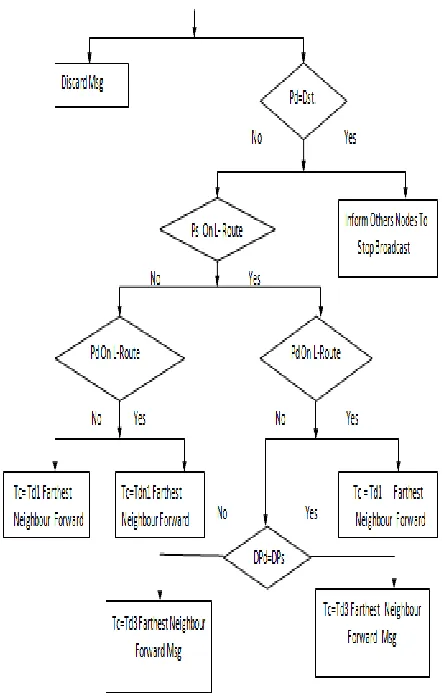
the need over others. The need level is set by delays presented in the running with pseudo-code of CCMDA. The thought is gainful to control information impacts to a specific degree. Message enduring point of confinement is separated into two occasions. From line 8 to 13, when a beneficiary Pd gets a message with the id msg_id, Pdshould promptly check whether it gets an excess message. Each VANET focus has a check_listto store got msg_id. Along these lines if the msg_idis found in the quick overview, Pd disposes of the message; generally, proceeds with the strategies for another occasion (line 14 to 36).WhenPd gets the message from its neighbors or source Ps, it needs to ensure that the message does not float back. By at that point if Pd is the target focus point, it fundamentally gives back to all neighbors with a stop run the show. Obviously, if Pd is a broadly engaging focus just, strides from line 13 to line 29 depend on. To judge when to forward the message to neighbors, Pd has to know neighbor's or Ps' position (x, y) and its own particular position. This checks whether they are on L-Routes or not. On the off chance that both of Ps and Pd are on L-Routes, by then Pd moves the message at Td1which includes current time(Tc) and a holding up delay d1. Inside the transmission go, the delayd1 will be decreased running with the augmentation of separation between <Ps, Pd>. That is, the most remote Pd will forward message at first. Additionally, if Ps is on the L-Route in any case Pd isn't, the moving headings of Pd and Ps end up fundamental. Same course of Pd and Ps (Dr= Ds) impacts the forward to happen at Td2 while the message is bestowed at Td3 for various introduction of Pd and Ps. The estimation of Td2 or Td3 is uncommon yet both contain a present time Tc, a deferral as shown by the separation d1and a pre-coordinated postponement d2 setup by the figuring. The respect arrange is Td1 <Td2 <Td3.
THE FLOW-CHART OF PROPOSED CCMDA ALGORITHM
Flow-Chart of Proposed CCMDA Algorithm
RESULTS EVALUATION AND ANALYSIS
System correspondence execution examinations in perspective of two parameters one is end-to-end put off time (EDT) and another is message development rate (MDR).
- >End-to-End Delay Time (EDT)
It proposes the term of a message sent from source to objective over the system.
- >Message Delivery Rate (MDR)
It tends to a degree of great message transports source focus point to target focus.
THE COMPARISON OF ROUTING PROTOCOLSAODV Remote Ad hoc On-Demand Distance Vector (AODV) organizing custom weights on versatile remarkably named
structures (e.g., MANETs) these days. It is a responsive controlling convention which influences a course for focuses precisely when they to request it, being one of standard telecom organizing customs utilized beginning at now for both unicast and multicast planning. The basic issue is the telecom storm, which attempts to be maintained a strategic distance from and lessened in the proposed coordinating custom CCMDA.
TMDA
Movement Message Delivery Algorithm passes on messages depending upon the possibility of pre-organized courses (I-Routes) in the city circumstances.
CCMDA
Traffic Control Message Delivery Algorithm passes on messages depending upon the possibility of pre-planned courses (L-Routes) in the high - way circumstances. In light of general telecom methodologies, CCMDA diminishes convey whirlwinds and stop up issue in orchestrate by methods for particular sending framework, joined with geographic information.
RESULT IN VARIOUS DENSE NETWORK
Following figure examine EDT and MDR results by applying Congestion Control Message Delivery Algorithm (CCMDA), executing Ad hoc On-Demand Distance Vector (AODV) and Traffic Message Delivery Algorithm (TMDA) coordinating tradition in low, medium and high thickness of frameworks autonomously. There is a supposition in the examinations that the proliferation length 40 seconds and unpredictable source-to-objective sets are allowed to exchange distinctive measure of messages (from 1 to 10) in low ,(from 1 to 50) in medium and (from 1 to 100) in high thickness orchestrate. The general point is to investigate whether CCMDA prompts less EDT and higher MDR in various circumstances rather than an another present controlling tradition; how degree the measure of messages influence on correspondence execution; and how the example of EDT and MDR changes in different framework conditions eg. low thickness orchestrate, medium thickness framework and high thickness compose.
[image:6.612.58.279.64.412.2]LOW DENSITY NETWORK
Figure consider typical deferral of messages and ordinary rate of messages, results by applying Congestion Control Message Delivery Algorithm (CCMDA), Traffic Message Delivery Algorithm (TMDA) and On-Demand Distance Vector (AODV) coordinating tradition in low thickness organize. According to the diagrams CCMDA shows humblest deferral from 1 message to 10 messages for each testing time.
Fig: 1 Delays in the low density of networks
Fig: 2 Rates in the low density networks MEDIUM DENSITY NETWORK
Following figure consider typical delay of messages and ordinary rate of messages, results by applying Congestion Control Message Delivery Algorithm (CCMDA), Traffic Message Delivery Algorithm (TMDA) and On-Demand Distance Vector (AODV) coordinating tradition in medium thickness mastermind. According to the charts CCMDA shows humblest deferral from 1 message to 50 messages for each testing time.
So it is clearly show up in graphs low ordinary deferment and high typical rate of CCMDA better than AODV and TMDA in medium thickness medium.
Fig: 1 Average delays in medium density network
Fig: 2 Average Rates in medium density networks
HIGH DENSITY NETWORK
Following figure take a gander at ordinary deferral of messages and typical rate of messages, results by applying Congestion Control Message Delivery Algorithm (CCMDA), Traffic Message Delivery Algorithm (TMDA) and On-Demand Distance Vector (AODV) controlling tradition in medium thickness organize. As shown by the outlines CCMDA indicates humblest 0 2 4 6 8 10 12 14
1 2 3 4 5 6 7 8 9 10
A ve rag e Delay (s)
Number of Messages
AODV TMDA Proposed System 0 20 40 60 80 100 120
1 2 3 4 5 6 7 8 9 10
A ve rag e R ate (% )
Number of Messages
AODV TMDA Proposed System
0 5 10 15 20 25 30
5 10 15 20 25 30 35 40 45 50
A ve rag e Delay (s)
Number of Messages
AODV TMDA Proposed System 0 10 20 30 40 50 60 70 80 90
5 10 15 20 25 30 35 40 45 50
A ve rag e R ate ( % )
Number of Messages
AODV
TMDA
delay from 1 message to 100 messages for each testing time, contemplating the thunders lines typical deferral and most lifted ordinary rate from the above lines than got from TMDA and AODV traditions.
So it is evidently show up in outlines low typical deferment and high ordinary rate of CCMDA better than AODV and TMDA in high thickness medium.
Fig: 1 Average delays in the high density medium
Fig: 2 Average Rates in the high density network
CONCLUSION
This report tended to the relationship of correspondence execution of normal deferral and run of the mill rate of messages by utilizing proposed figuring and indisputable organizing customs (AODV and TMDA) in a novel VANET layout. AODV and TMDA are coursed convention utilized typically in without any preparation system, while, CCMDA is a starting late proposed and enhanced of TMDA calculation. It not just gets measures in context of existing telecom figuring yet additionally high-way activity course data into the tally, using the likelihood of 'L-Route' open in vehicles and high-way. The motivation behind these new controlling techniques is to help the effect of the issues caused by past planning conventions and in addition best association for the specific utilizes foundation. We plan a VANET diagram, which contains two sorts of interestingly assigned correspondence objects – flexible (autos), and static (street side units) ones.
REFERENCES
[1] Panda, B. S., Bhatta, B. K., & Mishra, S. K. (2017, July). Improved Energy-Efficient Target Coverage in Wireless Sensor Networks. In International Conference on Computational Science and Its Applications (pp. 350-362). Springer, Cham.
[2] Swain, R. R., Mishra, S., Samal, T. K., & Kabat, M. R. (2017). An energy efficient advertisement based multichannel distributed MAC protocol for wireless sensor networks (Adv-MMAC). Wireless Personal Communications, 95(2), 655-682. 0
10 20 30 40 50 60
10 20 30 40 50 60 70 80 90 100
A
ve
rag
e
Delay
(S)
Number of Messages
AODV TMDA Proposed System
0 5 10 15 20 25 30 35 40 45 50
10 20 30 40 50 60 70 80 90 100
A
ver
ag
e
Rate
(%
)
Number of Messages
[3] Mishra, S., Swain, R. R., Samal, T. K., & Kabat, M. R. (2015). CS-ATMA: A hybrid single channel MAC layer protocol for wireless sensor networks. In Computational Intelligence in Data Mining-Volume 3 (pp. 271-279). Springer, New Delhi.
[4] Yueyue Li and EvtimPeytchev,” New traffic message delivery algorithm for a novel VANET architecture”,ICWMC 2012 The Eighth International Conference on Wireless and Mobile Communications,25-28June2012, Venice, Italy, 395-401, ISBN: 978-1-61208-203-5
[5] F.J. Ros, P.M. Ruiz, and I. Stojmenovic, Based Broadcast Protocol for Reliable and Efficient Data Dissemination in Vehicular Ad Hoc Networks, "Mobile Computing, IEEE Transactions on , vol.11, no.1, pp.33-46, Jan. 2012.
[6] J. Fukumoto, Sirokane, Y. Ishikawa, Wada, N. Tomotaka, K. Ohtsuki, H. Okada, “Analytic method for real-time traffic problems in VANET by using Contents Oriented Communications”, 7th International Conference on ITS, 6-8 June 2007.
[7] N. Karthikeyan, V. Palanisamy, and K. Duraiswamy, “ Performance Comparison of Broadcasting methods in Mobile Ad Hoc Network”,International Journal of Future Generation Communication andNetworking , Vol. 2, No. 2, June, 2009.
[8] F.J. Ros, P.M. Ruiz, and I. Stojmenovic, "Acknowledgment-Based Broadcast Protocol for Reliable and Efficient Data Dissemination in Vehicular Ad Hoc Networks," Mobile Computing, IEEE Transactions on , vol.11, no.1, pp.33-46, Jan. 2012.
[9] J. Fukumoto, Sirokane, Y. Ishikawa, AWada, N. Tomotaka, K. Ohtsuki,H. Okada, “Analytic method for real-time traffic problems in VANET by using Contents Oriented Communications”, 7th International Conference on ITS, 6-8 June 2007.
[10] Wedde,Horst, Lehnhoff, Sebastian and Van Bonn, Bernhard.“Highly Dynamic and Scalable VANET Routing for Avoiding Traffic Congestions”.International Conference on MobileComputing and Networking.2007.