1
Effect of Video and Computer Games on Behavioral Disorder of Adolescent
User: Challenge before Teachers
Hedyeh Nasser Ranjbar , Ph.D Scholar
Department of Education and Extension University of Pune
Dr Megha Uplane Associate Professor
Department of Education and Extension. University of Pune
Abstract
2
mean has found higher between lesser user of video game .additional result have shown out of 92 video games mentioned as favorite games by participant 32 percent were belongs to M type of games means have a content Equivalent TV Ratings Mature (+17) .and 68 percent of participants prefer to playing alone than in accompany with others.
Introduction
Education system continues to face stern challenges due to swiftly technologies changes and consequences of that. Beside growing economical and information technology in world some new pattern of activities in recent decades grown up such as video and computer games that effect of them on children and adolescents users become new educators and parents source of concern. One of the most popular multimedia activities in last three decades is electronics games. Truly for this generation who is growing up in digital era, the interactive media is not entirely new phenomenon. It become as a dominate activity for them in 21st century .in the years ahead, it’s clear that the interactive entertainment media will have extra main role in the social and educational experiences of children and adolescents in the world and as well as in relation between them and educators , parents and society due to changes in them behaviors . Video and computer games are now a common part of leisure activity for children and adolescents. The colorful, magnificent, entertaining and attractive elements of these games make them popular. They are accessible by a variety of devices, the range of handhold machine such as game console and mobile phone and computers and even accessible in social network as facebook that allow people to play in different situation and even during travelling .due to these factors they have users of all ages, genders, ethnic and backgrounds.
3
show high growth of 53% within 2013. Today we are in the middle of a new revolution in both technology and culture, a dramatic change in which our children are pioneers
Effect of video and computer games on young users
4
to grow, and as the industry continues to expand, the need for additional research becomes ever more apparent. Only by overcoming our ignorance and filling in the gaps of our understanding about the impact of video and computer games on users, we will be able to determine how to address the problems which we already face and the ones we foresee. We need more research on the ways interactive entertainment affects on behavioral health and development. Main goal of this study is to identify adolescents’ abnormal behavior due to using computer and video games.
Method
Participants
The selected participants were from a middle high socio –economic English and Marathi school located in Pune city ,maharashtra ,india .five hundred and seventy 9th and 10th grade of student participants in this study .student recruited from three urban private schools and one public school .the mean age of respondent was 15.5 (sd.=0.62).
As this study utilized human participants and investigated on behavioural problems, certain issues were addressed. The respondents were also advised that they could withdraw from the study even during the process. With this, the participants were not forced to participate in the research. The confidentiality of the participants was also ensured by not disclosing their names or personal information in the research. Only relevant details that helped in answering the research questions were included.
Procedure
5 Result
participant were asked the amount of time spend for playing video and computer games weekly on a 5 choice answer scale of nothing to above 18 hours .based on answers categorized in two group as a higher than mean user ( mean of time respondent =6.88 and s =4.77 ) and lesser than mean user .To test significant difference between abnormal behavior among user (high and less than mean time of video and computer ) , independent samples t-test ,in statistical package for social science spss was performed to examine main and potential effects of using video and computer games on behavior of users .therefore in conducting a independent sample t-test for this study ,time amount of gaming consider as a independent variable ;the result of student scl-90 r symptom dimensions scores were dependent variable. An alpha level .05 was set to analyze the significant difference of hypothesis. For interpretive of scl-90-r a profile mean scores of raw data have used on the non patient adolescents male norm. And used descriptive frequency method for parents and additional users question about games’ content.
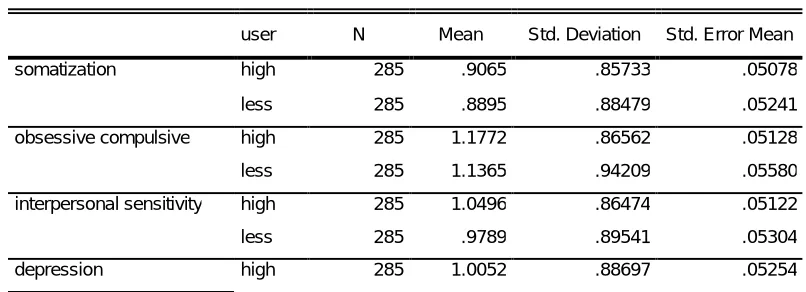
[image:5.612.104.507.562.708.2]Descriptive statistics of behavioral problems including Somatization, ,Obsessive – ,Interpersonal Sensitivity ,Depression , Anxiety ,Hostility , Phobic Anxiety ,Paranoid Ideation ,Psychotictism ,can be seen in table 1. In all aspects the higher than mean time user had a slightly greater amount mean than lesser user else depression. In hostility dimension this difference is statistically significant .the result of t-test have shown in table 2.
Table.1. Means and Standard Deviation of scl-90-r dimensions Group Statistics
user N Mean Std. Deviation Std. Error Mean
somatization high 285 .9065 .85733 .05078
less 285 .8895 .88479 .05241
obsessive compulsive high 285 1.1772 .86562 .05128
less 285 1.1365 .94209 .05580
interpersonal sensitivity high 285 1.0496 .86474 .05122
less 285 .9789 .89541 .05304
6
less 285 1.0532 1.02420 .06067
anxiety high 285 .9596 .86474 .05122
less 285 .9189 .89541 .05304
hostility high 285 1.4472 .97769 .05791
less 285 1.0979 1.02256 .06057
phobic anxiety high 285 .8052 .76031 .04504
less 285 .7807 .72648 .04303
paranoid ideation high 285 1.1863 .88760 .05258
less 285 1.1633 .98892 .05858
psychoticism high 285 .7908 .66067 .03913
less 285 .7812 .72351 .04286
Table.2. t.test of behavioral problem dimensions Independent Samples Test
Levene's
Test for
Equality of
Variances t-test for Equality of Means
F Sig. t df Sig. (2-taile d) M e a n D iff e re n ce S td . E rr o r D iff e re n ce 95% Confidence Interval of the Difference Low er Upp er
som Equal variances assumed .173 .678 .233 568 .816 .017 .072 -.12 .160
o-c Equal variances assumed .772 .380 .537 568 .591 .040 .077 -.10 .189
i-s Equal variances assumed .117 .733 .959 568 .338 .070 .077 -.07 .215
dep Equal variances assumed .750 .387 -.59 568 .550 -.04 .082 -.20 .109
anx Equal variances assumed .117 .733 .552 568 .581 .04 .073 -.10 .185
7
phob Equal variances assumed 2.077 .150 .394 568 .694 .024 .062 -.09 .146
par Equal variances assumed 3.413 .065 .292 568 .770 .022 .078 -.13 .177
psy Equal variances assumed 1.412 .235 .166 568 .868 .009 .058 -.10 .123
add Equal variances assumed 4.012 .046 -1.5 568 .112 -.11 .074 -.26 .022
Interpretation Part A
As the significance for levene’s test is above 0.05 in all dimensions, the equal variances assumed. A t-test failed to reveal a statistically reliable difference between the mean number of higher (M: .90 , SD: .85) and lesser M: .88 , SD : .88 )than mean time Indian user of video and computer game in Somatization Dimension , t ( 570) : 233, p: .816, α :.05 . However due to descriptive statistics and according table 1, the high user on average still had a slightly higher score than less user group in Somatization Dimension.
A t-test failed to reveal a statistically reliable difference between the mean number of higher (M 1.17 ,SD : .86) and lesser (M: 1.13 , SD : .94)than mean time Indian user of video and computer game in obsessive –compulsive Dimension , t ( 570 ) : .537 , p: .591 , α :.05 . However due to descriptive statistics and according table 1, the high user on average still had a slightly higher score than less user group in obsessive –compulsive Dimension.
A t-test failed to reveal a statistically reliable difference between the mean number of higher M: 1.04 , SD : .86) and lesser ( M: .97 , SD : .89 )than mean time Indian user of video and computer game in interpersonal sensitivity Dimension , t ( 570) : .959, p: .338 , α :.05 .
8
A t-test failed to reveal a statistically reliable difference between the mean number of higher (M: 1.00 ,SD: .88) and lesser ( M: 1.05 ,SD : 1.02 )than mean time Indian user of video and computer game in Depression Dimension , t ( 570) : .598 , p: .550 , α :.05 . However due to descriptive statistics and according table 1 , the lesser user on average still had a slightly higher score than higher user group in Depression Dimension.
A t-test failed to reveal a statistically reliable difference between the mean number of higher (M: .95 ,SD : .86 ) and lesser (M: .91 ,SD: .89 ) than mean time Indian user of video and computer game in Anxiety Dimension , t ( 570) : .552, p: .581, α :.05 . However due to descriptive statistics and according table 1, the higher user on average still had a slightly higher score than lesser user group in Anxiety Dimension.
A t-test reveal a statistically reliable difference between the mean number of higher (M: 1.44 ,SD : .97 ) and lesser ( M: 1.09 , SD: 1.02 ) than mean time Indian user of video and computer game in hostility Dimension , t ( 570) : 4.168 , p: .01 , α :.05 . A t-test failed to reveal a statistically reliable difference between the mean number of higher (M: .80 , SD : .76) and lesser (M: .78 , SD : .72 )than mean time Indian user of video and computer game in Phobic Anxiety Dimension , t ( 570) : .394, p: .694, α :.05
A t-test failed to reveal a statistically reliable difference between the mean number of higher (m:1.18 , s : .88) and lesser ( m: 1.16 , s : .98 )than mean time Indian user of video and computer game in paranoid ideation Dimension , t ( 570) : .292 , p: .770 , α :.05 .
A t-test failed to reveal a statistically reliable difference between the mean number of higher (M: .79 , SD : .60) and lesser ( M: .78 , SD: .72)than mean time Indian user of video and computer game in psychoticism Dimension , t ( 570) : .166 , p: .868 , α :.05 .
9 Interpretation of SCL-90-R Profile Part B
The respondent’s scl-90-r symptom profile releaves a pattern of dimensions of
distress as follow: There is some evidence to suggest that the both group respondents
are experiencing difficulties with somatic complains obviously higher than average level.
The respondent’s level of obsessive-compulsive is above normative. There is
evidence suggests that the respondent may be suffering from a thoughts and actions
that are experienced as a continuous, irresistible and unwanted. But not essentially
remarkable. However the higher user has a greater level than lesser one. Level of
interpersonal sensitivity symptom in both group respondents’ profile are at normative
mean levels and are essentially unremarkable.
The respondent’s record reveals level of depression above the normative mean, in
both groups that can be remarkable. There is evidence suggests that the respondent
may be suffering from Symptoms range of dysphormic mood and affect are
represented as signs of withdrawal of life interest, lack of motivation, and loss of
vital energy. The respondents’ anxiety levels are obviously above average due to their
profile, and are clearly indicative of a picture involving enhanced distress associated
with nervousness and tension as anxiety components in both group but can be interpret
10
The hostility level has a obviously difference between higher and lesser user in
respondent’s profile .There is some evidence to suggest that the higher user
respondent is experiencing difficulties with feeling of the negative affect state of anger
that reflects as a aggression and rage or resentment: however, distress is not of a
clinical weight .The respondent’s phobic anxiety levels are obviously above average in
both group, and are clearly indicative of a clinical picture involving enhanced distress
associated with fear responses that is irrational and disproportionate to the stimulus
and avoidance behavior. There is a some evidence of suspiciousness in the respondents’
response, but not clinical in nature about paranoid ideation dimension of both group.
The respondent’s psychoticism score is above mean range .however, it is some more
likely that this reflects an intense experience with social alienation, rather than a
thought disorder.
Part C: regarding the obtained result of preference playing situation 68 percent prefer gaming alone .the 3 top favorite games users have got rating out of 92 games nominated by participants according ESRB (Entertainment Software Rating Board) (Figure 1).the result revealed .22.8 of games were belongs to EVERYONE group that
have content suitable for ages 6 and older. Titles in this category may contain minimal cartoon, fantasy or mild violence and/or infrequent use of mild language. 28.3 of games were belonging to EVERYONE+10 rates that may be suitable for ages 10 and older. With contain more cartoon, fantasy or mild violence, mild language and/or minimal suggestive themes.32.6 percent of games were belong to TEEN rating that suitable for ages 13 and older. Containing violence, suggestive themes, crude humor, minimal blood, simulated gambling, and/or infrequent use of strong language. 8.7 percent were belongs to RATING PENDING that have been submitted to the ESRB and are awaiting final rating. And 32.6 percent that was belongs to the last group MATURE rate that is suitable for persons ages 17 and older. Titles in this category may contain intense violence, blood and gore, sexual content and/or strong language.
11 Discussion
12 References
Anderson, C. A. (2003). The influence of media violence on youth. Malden, MA: Blackwell Pub.
Banks, J. A., & Banks, C. A. M. (1995). Handbook of research on multicultural education. New York:
Macmillan Pub.
Baktaro, B., Tuozzt, G., Codispoti, M., Montebarocci, O., Barbagli, F., Trombini, E., et al. (2004).
Aggressive and non-violent videogames: short-term psychological and cardiovascular effects on
habitual players. STRESS AND HEALTH. 20 (4), 203-208.
Baranov/ski, tom (2004) Psychologist-Designed Game Linked to Improvements in Children's Diets.' APA
Monitor on Psychology.
Barenthin jami and Marieke Van Puymbroeck(2004);Video games have measurable social effects on
adolescents Joystick Generation.
. Bar-On, R., Maree, K., & Elias, M. 3. (2007). Educating people to be emotionally inteH/gent Westport;
Conn: Praeger.
Bariett, C. P., Harris, R. J., & Bruey, C. (2008). The effect of the amount of blood in a violent video game on
13
Beasiey, B., & Collins Stand ley, T. (2002). Shirts vs. Skins: Clothing as an Indicator of Gender Rote
Stereotyping in Video Games. Mass Communication A Society. 5 (3), 279-293.
Best, J. W. (1970/. Research in education. Englewood Cliffs, N.J.: Prentice-Hall.
Buchman. D D.. & Funk. J B. (1996). Video and computer games in the '90s: Children’s time
commitment and game preference. Children Today
Camagey, N L., Anderson, C. A.. & Bushman. 8 J. (2007). The effect of video game violence on
physiological desensitization to real-life violence. JOURNAL OF EXPERIMENTAL SOCIAL
PSYCHOLOGY. 43 (3), 489-496
Chiu, S. I., Lee, J. Z., & Huang. D. H. (2004). Video Game Addiction in Children and Teenagers in
Taiwan. CYBEf^SYCHOLOGY AND BEHAVIOR. 7 (5), 571-581.
Chuang, T.-Y., & Chen, W.-F. (2009). Effect of Computer-Based Video Games on Children: An Experimental Study.Educational Technology & Society, 12 (2), 1–10.
Craig A. Anderson, Douglas A. Gentile and Katherine E.Buckley{2006j;Violent Video Game Effects on
Children and Adolescents Theory, Research, andPublic Policy;Department of Psychology,
Yale University, and Co-Director, Yale University Family Television Research and Consultation Center.
Erasmus, C. P. (2007). The role of emotional intelligence in the adaptation of adolescent boys in a
private school Thesis (M. Ed.JUniversity of South Africa. 2007.
Gentile, D A (2003) Media violence and children: a complete guide for parents and
professionals Westport. CT Praeger
Game Ratings & Descriptor Guide retried ;http://www.esrb.org/ratings/ratings_guide.jsp
Video Game Everts: A Psychophysiotogical Investigation. MEDIA PSYCHOLOGY. 8 (4), 343-367.
Walsh, D. A &Gentile. D. A., Lynch, P. J., Linder, J. R. (2004). The effects of violent video game habits on