An E-commerce Web application Based Chatbot
Gulabsha S. Pathan1, Priyanka M. Bante2, Reena V.Dhole3, Prof. Shailesh Kurzadkar4
BE Students, Department of Computer Technology K.D.K. College of Engineering, Nagpur, Maharashtra, India 2Assistant Professor, Department of Computer Technology K.D.K. College of Engineering, Nagpur, Maharashtra, India
Abstract: This paper describes a web application based chatbot. This chatbot can make it easier to interact with the website. The bot understands and converses with the user in Simple Language. This chatbot is linked to an e-commerce website. This web application has a variety of products with different features. The chatbot helps you to make a decision which product is suitable for you. This is especially helpful when you have not narrowed down the criteria for the product. Its functions basically like an online automated assistant in this system our prime objective is to make user's experience more enjoyable and personalized on the basis of their needs and this can be achieved by using the concept of machine learning. The intent is to convert the attitude of window browsing to buying by making the web application.
Keywords: E-Commerce, Chat-bot, AIML, Artificial Intelligence, Machine Learning, My SQL, PHP
I. INTRODUCTION
A chatter bot or chat-bot is a computer program designed to simulate an intelligent conversation with one or more human users via auditory or textual methods. Chat-bots can be programmed for small talk, or can also serve as a medium of interaction with users, providing them with answers based on regular questions. The chat-bot understands context and delivers a response based on the message given to it. Chat-bot is one of many examples of AI. Chat-bots were initially designed as means of entertainment and some of them have been designed to pass the Turing Test.[1]
The other aspect to be considered is a website. Today most websites rely on menu based navigation and a search bar to provide information to the user. However websites with a large amount of content and poorly structured navigation can make it difficult for user to find the information easily and quickly. For instance if you consider an online shopping portal, it has a large catalogue of products. Browsing through the products can be challenging and time consuming given the variety of features a product can have. In this scenario a chatbot to make it easier for the user to find information. The user has an option to chat with the bot and ask it normal questions to get responses. The chatbot has pre- programmed responses, but it can work with dynamic information from a user message in order to make a relevant conversation and suggest relevant information. This is a promising alternative as compared to using search and sort based tools. In this sense, chatbot is used to visualize the contents of a corpus (i.e. samples of real world text[2]) and to give answers to a specific domain, which in this context is an ecommerce website. . Hence, the aim of our project is to develop an effective system that would capture and make use of the user’s previous search and purchasing history so that personalized recommendations could be suggested to the user thereby making the system intelligent. The objective of the project is to build a smart ecommerce website using machine learning approaches thereby making the B2C E-commerce system intuitive. The key component of the system is data. This data is accumulated using variety of sources like customer ratings, previous purchases, feedback/reviews from reviewers etc. The project implements the three main machine learning techniques i.e. content based filtering, chat bot and classification.
II. RELATED WORK A. Extraction of text
For extracting facts from text, the Stanford Core NLP libraries are used, which provide a set of natural language analysis tools which can take raw English language text input and perform lemmatization, POS tagging, markup the structure of sentences in terms of phrases and word dependencies, and many other facilities [7].
B. Designing the Conversation
C. A.L.I.C.E:
One of the most famous chatbot which works on Pattern Matching Strategy is the Artificial Linguistic Internet Computer Entity (A.L.I.C.E.) [9]. The AIML files for A.L.I.C.E. are available online which contain categories like music, art, philosophy, etc. So for the basic working of Donna, these AIML files are being used. Also, another original AIML file for the category “Meetings” has been generated, which answers specific meeting related questions. Thus, as the project concentrates more towards the scheduling module, AIML files are being used for the pattern matching framework of E-commerce Website.
III. PROPOSED SYSTEM
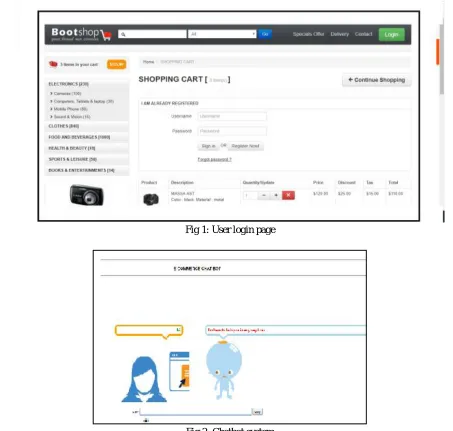
The In order to demonstrate the concept of the project we will design an E-Commerce Website that has a catalogue of products that can be browsed. The website itself is designed so it can be integrated seamlessly with the chatbot. The website has traditional navigation options for the user if he or she desires to browse the website, in a conventional manner. It will also feature conventional search/filter options. This website will have an unobtrusive chatbot that can be accessed from any page. The user can interact with the bot using Natural Language. The bot can make suggestions, give information or ask further questions to elicit further information depending on the user interaction . The bot has a small response time. Firstly the users register themselves with the website using email. In order to register, the active user needs to enter the details like Full name, User name, Password, E-mail ID, Address and contact number. The existing users can directly log in to the system. The registered users will then be suggested products on the basis of user’s purchase history. The login module is for the administrators which grant full access to update, add or delete products. The admin can also view the registered users’ details and their transactions.
A. How Do Chatbots Actually Work?
1) Pattern Matching: Bots use pattern matching to classify text and produce a suitable response for customers. A standard structure of these patterns is the artificial intelligence markup language (AIML).
Here's a simple pattern matching example: <aiml version=” 0.1”encoding=””?>
<category>
<pattern>Hello</pattern>
<template>Hello there. How can I help you?</template>
</category>
</aiml>
The machine then gives an output: Human: Hello
Robot: Hello there. How can I help you?
The chatbot knows the answer only because the name is in the associated pattern. Similarly, chatbots respond to anything related to the associated patterns. But they can not go beyond the associated pattern. To take it to a more advanced level, algorithms can help.
B. Algorithms
For each kind of question, a unique pattern must be available in the database to provide a suitable response. The many possible combinations of patterns that can create a hierarchical structure. We use algorithms to reduce the classifiers and generate a more manageable structure. Computer scientists call it a reductionist approach — in order to provide a simplified solution, reduce the problem. Multinomial Naive Bayes is the classic algorithm for text classification and natural language processing (NLP). For instance, let’s assume a set of sentences that belong to a particular class is provided. Each word in an input sentence is counted for its occurrence and its commonality, and each class is assigned a score. The highest-scored class is the most likely to be associated with the input sentence.
Example sample training set:
Class: Greeting “How are you doing?”
Example sample input sentence classifications:
Input: “Hello, good morning” Term: “Hello” (no matches) Term: “good” (class: greeting) Term: “morning” (class: greeting)
Classification: Greeting (score=2)
With the help of equations, word matches are found using some sample sentences for each class. The classification score identifies the class with the highest term matches — but it also has some limitations. The score signifies the sentence's most likely intent but does not guarantee that it is the perfect match. The highest score only provides the relativity base.
D. Artificial Neural Networks
Neural networks are a way of calculating the output from the input using weighted connections calculated from repeated iterations
while training the data. Each step through the training data amends the weights, resulting in an accurate output.
As discussed earlier, each sentence is broken down into different words and each word is then used as input for the neural networks. The weighted connections are then calculated by different iterations through the training data thousands of times, each time improving the weights to make it more accurate. The trained data of the neural network is a comparable algorithm of code. When there is a comparably small sample, i.e. in which the training sentences have 200 different words and 20 classes, then that would be a matrix of 200×20. But this matrix size increases by n times gradually and can cause a huge number of errors. In this kind of situation, processing speed should be considerably high.There are multiple variations of neural networks, algorithms, and code. Complexity may also increase in some of the variations. But the fundamental idea remains the same: the most important job
is classification.
Lastly, like most applications, chatbots are connected to databases. Chatbot databases are used to feed the chatbot information needed to give a suitable response to the user. Data about user activities and whether your chatbot was able to match their questions is captured in the datastore. NLP translates human language into information with a combination of patterns and text that can be mapped in real-time to find applicable responses.
There are four modules in the systems architecture. i. Presentation layer iii. Data access layer
ii. Service layer iv. Database layer
Presentation layer: It is the interface where the user communicates with E-commerce Website. The output of this layer feeds the input to the service layer. There are two modules in this layer: the interface for E-Commerce Website and a mail server (Gmail). The mail server module access the API module from the service layer.
Service layer: This layer provides services of creating and appending data to the files that are created for storing of data used for sending and receiving Email. The service layer consists of the web based services that E-Commerce Website uses, like the API, Program O, etc.
retrieve the matched patterns. Database layer It consists of three main databases. The first is the AIML database consisting of all the AIML files. The second comprises of the information regarding the user as well as the bot. The user’s data is stored in the third database.
IV. IMPLEMETATION
For the implementation of E-commerce web application, a web server with Internet access, PHP 5+, MySQL, Xampp, Composer, and APIs were used. The algorithm or the approach which has been used to develop this system can work with any other programming language or database manager. The response makes an AJAX request to the PHP page, and on receiving a response, displays it within the chat window. This response contains a hyperlink to the respective product pages of the suggested products.
A. Program–O
Program O is an AIML interpreter written in PHP, and uses a MySQL database to store chat-bot information, including the AIML files used to formulate the chat-bot's responses[8]. Program O supports the creation of multiple
chat-bots. The basic skeleton framework for Donna is constructed using Program O. It lets a user set the bot personality, upload and integrate AIML files with the bot, connect with the database. It also has authorization feature, conversation log storing and a teaching element which can be used to teach the bot. All these features are used in Donna’s web interface. Thus, the Program O library is the integral and most important part of E-commerce web application.
[image:5.612.76.529.294.725.2]Fig 1: User login page
V. CONCLUSION
Thus we have implemented a website based chatbot that attempts to improve User Interaction with the E-Commerce website. The chatbot has a stored set of responses, but also takes dynamic user input into account and thus tends to provide relevant responses and product suggestions. Since the product database is independent of the stored responses, newer products under the respective category can be easily added and removed and require no modification of the stored chatbot responses.
REFERENCES
[1] “ELIZA - Wikipedia,the free encyclopedia.,” [Online]. Available: http://en.wikipedia.org/wiki/ELIZA. [Accessed March 2015]. [2] B. A. Abu Shawar, “A Corpus Based Approach to Generalising a Chatbot System,” School of Computing,University of Leeds, Leeds, 2005. [3] J. Ben Schafer, Joseph A. Konstan, John Riedl. “E-Commerce Recommendation Applications”, In the GroupLens Reaserch project,2014. [4] R. Carpenter, “jabberwacky - live chat bot,” [Online]. Available: http://www.jabberwacky.com/. [Accessed March 2015].
[5] Chevelyn De Mello, Siddharth Gupta, Deep Borkar and Saurabh Patil “An E-commerce website based Chatbot” Reaserch project,2015. [6] Dr. John Woods, Sameera A. Abdul-Kader” Survey on Chatbot Design Techniques in Speech Conversation Systems” Vol. 6, No. 7, 2015
[7] Namita Mhatre, Karan Motani, Maitri Shah,” Donna Interactive Chat-bot acting as a Personal Assistant” Reaserch project Volume 140 – No.10, April 2016 [8] GitHub-Program-O, “https://github.com/Program-O/Program-O”, last retrieved on 07-03-2016.