A new species and two new records of
Quercus
(Fagaceae) from northern Vietnam
Hoang Thi Binh1,2, Nguyen Van Ngoc1,2, Trinh Ngoc Bon3, Shuichiro Tagane4, Yoshihisa Suyama5, Tetsukazu Yahara1,4
1 Graduate School of Systems Life Sciences, Kyushu University, 744 Motooka, Fukuoka, 819-0395, Japan 2 Department of Biology, Dalat University, 01 – Phu Dong Thien Vuong, Dalat, Vietnam 3 Department of Forest Phytodiversity, Silviculture Research Institute, Vietnamese Academy of Forest Sciences, Hanoi, Vietnam 4 Centre for Asian Conservation Ecology, Kyushu University, 744 Motooka, Fukuoka, 819-0395, Japan 5 Kawatabi Field Science Center, Graduate School of Agricultural Science, Tohoku University, 232-3 Yomo-gida, Naruko-onsen, Osaki, Miyagi 989-6711, Japan
Corresponding author:Hoang Thi Binh ([email protected])
Academic editor:H. Schaefer | Received 24 October 2017 | Accepted 20 December 2017 | Published 9 January 2018
Citation: Binh HT, Ngoc NV, Bon TN, Tagane S, Suyama Y, Yahara T (2018) A new species and two new records of Quercus (Fagaceae) from northern Vietnam. PhytoKeys 92: 1–15. https://doi.org/10.3897/phytokeys.92.21831
Abstract
A new species, Quercus xuanlienensis Binh, Ngoc & Bon, is described from Xuan Lien Nature Reserve, Vietnam. The new species is morphologically similar to Q. edithiae Skan, in having 8–11 pairs of second-ary veins, bowl-shaped cupules and ellipsoid to cylindrical-ellipsoid and basally convex nuts. It differs in having serrulate leaf margins only at apical 1/5–1/7, almost entire margins of bracts on cupule and much longer nuts. The species is also similar to Q. fleuryi Hickel & A. Camus in having leaves glabrous on both surfaces with only an apically serrulate margin but differs in having shorter petioles, cupules enclosing 1/5 of the nut and much longer nuts. In addition, Q. disciformis Chun & Tsiang. and Q. bella Chun & Tsiang., previously known from China, are newly recorded from Ba Vi National Park, Vietnam.
Keywords
Ba Vi National Park, DNA barcoding, Fagaceae, Quercus, Taxonomy, Vietnam, Xuan Lien Nature Reserve
Introduction
Quercus L. comprises ca. 400–500 species (Nixon 1993, Valencia-A et al. 2016) and has been divided into two subgenera, Quercus subgenus Cyclobalanopsis (Oerst.) Schneider (ring-cup oaks) characterised by stigma capitate to subcapitate or discoid
http://phytokeys.pensoft.net
Copyright Hoang Thi Binh et al. This is an open access article distributed under the terms of the Creative Commons Attribution License (CC BY 4.0), which permits unrestricted use, distribution, and reproduction in any medium, provided the original author and source are credited.
stigma, cupule bracts being connate or forming concentric or spiral rings and Quercus
subgenus Quercus (scale-cup oaks) characterised by usually linear ampliate or broadly ampliated stigma, free and imbricate cupule bracts (Nixon 1993, Manos et al. 1999). In Vietnam, according to Ho (2003) and Ban (2005), a total of 43 Quercus species were recorded, amongst which 37 species belong to subgenus Cyclobalanopsis and six species belong to subgenus Quercus. Recently, the following two species were reported and the species of Quercus in Vietnam rose to 45 species: Q. lineata Blume of subgenus
Cyclobalanopsis (Li et al. 2016) and Q. trungkhanhensis Binh & Ngoc of subgenus
Quercus (Binh et al. in press).
To widen our knowledge on the Fagaceae of Vietnam, field surveys were under-taken by the authors for 13 conservation areas (national parks, nature reserves and con-servation area) in Vietnam and a total of 105 Quercus samples were collected. Amongst them, during the field surveys in Xuan Lien Nature Reserve and Ba Vi National Park (Fig. 1), we discovered three unknown species of the subgenus Cyclobalanopsis which were not identical to any of the 38 species of Cyclobalanopsis previously recorded from Vietnam (Ho 2003, Ban 2005, Li et al. 2016, Binh et al. in press).
Xuan Lien Nature Reserve, Thuong Xuan District, Thanh Hoa Province, North Central Coast of Vietnam, was established in 1999 with a total area of 21,000 ha. Until now, 1,142 species of vascular plants belonging to 620 genera and 180 families have been recorded (Xuan Lien Nature Reserve 2017). In Fagaceae, 31 species includ-ing 17 Lithocarpus species (55%), 10 species of Castanopsis (32%) and four species of
Quercus (13%) have been recorded (Xuan Lien Nature Reserve 2017). Ba Vi National Park, Ha Noi Capital, northern Vietnam was established in 1991 with a total area of 7,377 ha (Fig. 1). In this national park, located in the Ba Vi mountain range, 1,201 vascular plant species of 649 genera and 160 families including 19 species of Fagaceae are recorded (Ba Vi National Park 2008).
In this study, a new species is reported from Xuan Lien Nature Reserve and two species are newly recorded from Ba Vi National Park. A new species is described as
Quercus xuanlienensis Binh, Ngoc & Bon. The two newly recorded species to the coun-try are Q. disciformis Chun & Tsiang. and Q. bella Chun & Tsiang.
Figure 1.Collection sites of Quercus xuanlienensis Binh, Ngoc & Bon, Quercus disciformis Chun & Tsiang. and Quercus bella Chun & Tsiang.
compared the MIG-seq of Q. xuanlienensis, Q. disciformis and Q. bella with those of 18
Quercus species studied by Binh et al. (in review) and two additional species Q. platycalyx
Hickel & A.Camus and Q. quangtriensis Hickel & A.Camus that have cupules similar to
Q. disciformis and Q. bella, to determine their identities and phylogenetic relationships.
Materials and methods
Morphological observations
DNA extraction
DNA was isolated from silica-gel dried leaf materials following the CTAB method (Doyle and Doyle 1987) with minor modifications, as in Toyama et al. (2016). Before the DNA extraction, dry leaf material was milled by QIAGEN TissueLyser to ob-tain fine powder and the powder was washed up to five times by 1 ml buffer (0.1 M HEPES, pH 8.0; 2% Mercaptoethanol; 1% PVP; 0.05 Ascorbic acid).
DNA barcoding
DNA regions of the large subunit of ribulose-1,5-bisphosphate carboxylase oxygenase (rbcL) and maturase K (matK) were amplified and sequenced following the protocols of Kress et al. (2009) and Dunning and Savolainen (2010), respectively.
Next generation DNA sequencing – MIG-seq
DNA products were used from 105 Quercus spp. as templates to amplify thousands of short sequences (loci) from a wide variety of genomes using primers designed for “mul-tiplexed ISSR genotyping by sequencing” (MIG-seq, Suyama and Matsuki 2015). Then presence/absence of each locus in each sample was used for phylogenetic tree recon-struction regardless of whether it has SNP or not. According to the MIG-seq protocol of Suyama and Matsuki (2015) with minor modifications as in Binh et al. (in review), the 1st PCR, multiple non-repetitive regions from various inter-simple-sequence repeat (ISSR) are amplified from genomic DNA by multiplexed PCR with tailed ISSR prim-ers. The 2nd PCR step was performed based on products from the 50 times dilution for each 1st PCR product with deionised water. Then, 3 µl of each 2nd PCR product was pooled as a single mixture library and purified. Subsequently, the Pippin Prep DNA size selection system (Sage Science, Beverly, MA, USA) was used to selected fragments in the size range 350–800 bp. A SYBR green quantitative PCR assay (Library Quanti-fication Kit; Clontech Laboratories, Mountain View, CA, USA) was used to measure the concentration of the size-selected library with approximately 10 pM of libraries. Finally, 10 pM of libraries were used for sequencing on an Illumina MiSeq Sequencer (Illumina, San Diego, CA, USA), using a MiSeq Reagent Kit v3 (150 cycle, Illumina).
Phylogenetic analyses
same population and threshold frequency of haplotype count in a population (r) = 0.001, a threshold one-order higher than 0.01. Presence/absence (1/0) data of loci were used to compute a distance matrix, construct a neighbour-joining (NJ) tree and the reliability of the tree topology was examined by bootstrapping with 1000 replicates using PHYLYP ver. 3.695 (Shimada and Nishida 2017) as follows; 1000 times re-sampling with Seqboot, dis-tance computation with Restdist, tree construction with NJ and consensus tree construc-tion with Censense. In addiconstruc-tion, FigTree v1.4.3 (http://tree.bio.ed.ac.uk/software/figtree/) was used to visualise the resulting tree. A phylogenetic tree for 105 samples including 43
Quercus species amongst 44 species previously recorded in Vietnam (data not shown) was constructed and subsequently reduced to 28 samples by focusing on the clades containing
Q. xuanlienensis, Q. disciformis, Q. bella and the additional 20 Quercus species following Binh et al. (in review). A total of 19,916 loci were used for the final phylogenetic tree.
Results
Morphological comparison of a new species and two newly recorded species with similar species
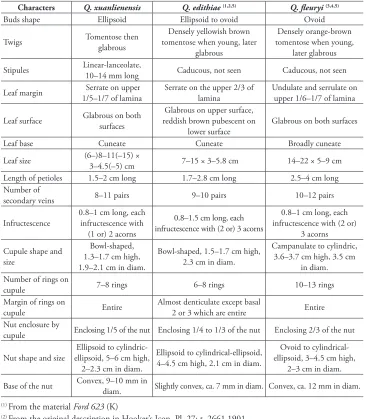
The unknown species (Quercus xuanlienensis) collected from Xuan Lien Nature Reserve was not morphologically assignable to any of the species recognised in Vietnam and its sur-rounding countries. According to Flora of China (Huang et al. 1999) and Illustrated Flora of Vietnam (Ho 2003), Q. xuanlienensis is most similar to Q. edithiae in leaf size (7–15 × 3–5.8 cm), leaf base (cuneate), petiole length (1.5–2.8 cm long), number of secondary veins (8–11 pairs), cupule shape (bowl-shaped) and nut shape (ellipsoid to cylindrical-ellipsoid). However, Q. xuanlienensis is distinct from Q. edithiae in having a leaf margin serrated only along its upper 1/5–1/7 (vs. upper 2/3), entire margin of cupule bracts (vs. denticulate ex-cept basal 2 or 3 rings) and longer nut (5–6 cm long vs. 4–4.5 cm long) (Table 1). Quercus xuanlienensis is also morphologically similar to Q. fleuryi Hickel & A. Camus in leaf shape and texture, leaf margin serrulate only at apical 1/5–1/7, entire margin of cupule bracts, ba-sally convex nuts, but Q. fleuryi (type: Fleury 37831, P [P00753925, P00753926]) showed much larger leaves (14–22 × 5–9 cm) than Q. xuanlienensis ((6–)8–11 × 3–4.5 cm)). In addi-tion, Q. xuanlienensis is distinct from Q. fleuryi in having an ellipsoid bud (vs. ovate), shorter petiole (1.5–2 cm long vs. 2.5–4 cm long), smaller and bowl-shaped cupule, (1.3–1.7 cm high, 1.9–2.1 cm in diam. vs. campanulate to cylindrical, 3.6–3.7 cm high, 3.5 cm in diam.), fewer cupule bracts (7–8 rings vs. 10–13 rings), cupules covering 1/4 to 1/3 of a nut (vs. 2/3) and ellipsoid to cylindrical-ellipsoid (vs. ovoid to cylindrical-ellipsoid) and longer nuts (5–6 cm high, 2–2.3 cm in diam. vs. 3–4.5 cm high, 2–3 cm in diam.) (Table 1).
According to the key and descriptions in the Flora of China (Huang et al. 1999), the other two unknown taxa from Ba Vi National Park were identified as Q. disciformis and
Q. bella. Excluding slightly thinner leaves and lower teeth, one species is identical with
ma-ture; lateral veins 11–13 pairs; petiole ca. 2 cm long; cupule discoid, rim flat when ripe, 3–4 cm in diam., covering base of the nut, scales arranged in 8–10 rings, margin of rings denticulate except apical 2 or 3 entire; nuts oblate 1.5–2 cm high, 2 cm in diam., apex flattened densely appressed hairy. Another species was identified as Q. bella having the following characteristics: leaf blade oblong-elliptic to lanceolate (8–15 cm × 2–3.5 cm), base slightly oblique, margin serrate in the upper 1/2; lateral veins 12 pairs of lateral veins; petiole 1–2 cm long; cupule discoid (ca. 0.5 cm × 2.5–3 cm), covering base of the nut, scales arranged in 6–8 rings, margin of rings irregular denticulate; nut oblate nut 1.5–2 cm high and 2.2–3 cm in diam.
DNA barcoding and MIG-seq
The rbcL and matK sequences of Q. xuanlienensis showed 100% (627/627 bp) and 99% (907/910 bp) homologies with Q. donnaiensis and Q. austrocochinchinensis, re-spectively. The rbcL and matK sequences of Q. disciformis and Q. bella showed that 100% (696/696 bp) and 100% (833/833 bp) homologies with each other, respectively.
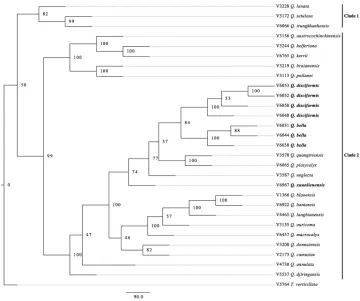
A phylogenetic tree, inferred using MIG-seq, showed that Q. xuanlienensis, Q. dis-ciformis and Q. bella are not identical with any of the 20 species from Vietnam. The neighbour-joining (NJ) tree based on MIG-seq data for 28 sample of Quercus recog-nised two major clades using Trigonobalanus as an outgroup (Fig. 2). Clade 1 with 82% bootstrap value consists of three species of subgenus Quercus (Q. lanata, Q. setulosa and
Q. trungkhanhensis) and Clade 2 with 99% bootstrap value consists of 20 species of sub-genus Cyclobalanopsis including Q. bella, Q. disciformis and Q. xuanlienensis. These three species were clustered with Q. quangtriensis, Q. neglecta and Q. platycalyx and a clade of those six species was strongly supported (74% bootstrap value). Amongst the six species,
Q. xuanlienensis was separated from the other five species forming a clade with a 74% bootstrap value. Four samples of Q. disciformis and three samples of Q. bella formed two distinct clades, each supported by 100% bootstrap value. Quercus disciformis was sister to Q. bella and the clade of those two species had an 84% bootstrap value.
Discussion
The results of the NJ tree, based on MIG-seq data, showed that Q. disciformis is sister to but well differentiated from Q. bella. These two species were collected in Ba Vi Na-tional Park where they co-occur with similar in leaf and nut morphologies, but differ in the coverage of the cupule (Fig. 4, less than 1/8 in Q. disciformis vs. Fig. 5, basal 1/8 to 1/4 in Q. bella). According to the Flora of China (Huang et al. 1999), Q. bella
is recorded from Guangdong, Guangxi and Hainan provinces, whereas Q. disciformis
Table 1.Morphological comparison amongst Quercus xuanlienensis Binh, Ngoc & Bon, sp. nov., Quercus edithiae Skan and Quercus fleuryi Hickel & A. Camus.
Characters Q. xuanlienensis Q. edithiae(1,2,5) Q. fleuryi(3,4,5)
Buds shape Ellipsoid Ellipsoid to ovoid Ovoid
Twigs Tomentose then glabrous tomentose when young, later Densely yellowish brown glabrous
Densely orange-brown tomentose when young,
later glabrous Stipules Linear-lanceolate, 10–14 mm long Caducous, not seen Caducous, not seen
Leaf margin 1/5–1/7 of lamina Serrate on upper Serrate on the upper 2/3 of lamina Undulate and serrulate on upper 1/6–1/7 of lamina
Leaf surface Glabrous on both surfaces reddish brown pubescent on Glabrous on upper surface,
lower surface Glabrous on both surfaces
Leaf base Cuneate Cuneate Broadly cuneate
Leaf size (6–)8–11(–15) × 3–4.5(–5) cm 7–15 × 3–5.8 cm 14–22 × 5–9 cm Length of petioles 1.5–2 cm long 1.7–2.8 cm long 2.5–4 cm long Number of
secondary veins 8–11 pairs 9–10 pairs 10–12 pairs
Infructescence 0.8–1 cm long, each infructescence with (1 or) 2 acorns
0.8–1.5 cm long, each infructescence with (2 or) 3 acorns
0.8–1 cm long, each infructescence with (2 or)
3 acorns Cupule shape and
size
Bowl-shaped, 1.3–1.7 cm high, 1.9–2.1 cm in diam.
Bowl-shaped, 1.5–1.7 cm high, 2.3 cm in diam.
Campanulate to cylindric, 3.6–3.7 cm high, 3.5 cm
in diam. Number of rings on
cupule 7–8 rings 6–8 rings 10–13 rings
Margin of rings on
cupule Entire Almost denticulate except basal 2 or 3 which are entire Entire Nut enclosure by
cupule Enclosing 1/5 of the nut Enclosing 1/4 to 1/3 of the nut Enclosing 2/3 of the nut
Nut shape and size ellipsoid, 5–6 cm high, Ellipsoid to cylindric-2–2.3 cm in diam.
Ellipsoid to cylindrical-ellipsoid, 4–4.5 cm high, 2.1 cm in diam.
Ovoid to cylindrical-ellipsoid, 3–4.5 cm high,
2–3 cm in diam. Base of the nut Convex, 9–10 mm in diam. Slightly convex, ca. 7 mm in diam. Convex, ca. 12 mm in diam.
(1) From the material Ford 623 (K)
(2) From the original description in Hooker’s Icon. Pl. 27: t. 2661 1901
(3) From the material Fleury 37831 (P)
(4) From the original description in Bull. Mus. Natl. Hist. Nat. 29: 600 1923
(5) From the description in flora of China (Huang et al. 1999)
Figure 2. NJ tree of 28 samples of Quercus and one Trigonobalanus (outgroup) based on presence/ab-sence data of 19,916 MIG-seq loci. Branches are labelled with bootstrap support (% of 1000 replicates).
the four species and Q. neglecta was supported by a 77% bootstrap value, although the support for the monophyly of the four species is weaker. The affinity of the four species and Q. neglecta was unexpected because Q. neglecta is an easily distinguished species having linear leaves and small nuts (Huang et al. 1999, Ho 2003).
The MIG-seq tree showed that Q. xuanlienensis is related to the above four species and Q. neglecta that is morphologically distinct from the other Quercus species. From the four species (Q. disciformis, Q. bella, Q. quangtriensis and Q. platycalyx), Q. xuanlienensis is clearly distin-guished by the leaf margin (leaf margin serrulate only at apical 1/5–1/7 in Q. xuanlienensis vs. serrate in upper 1/2 to 2/3 in the four species) and nut shape (ellipsoid to cylindrical-ellipsoid vs. oblate to ovoid). Thus, Q. xuanlienensis is separated as a distinct species from them.
Whereas Q. edithiae is morphologically most similar to Q. xuanlienensis, the type specimens of Q. edithiae collected from Hong Kong (type: Ford 623, K [K000832101, K000832102]) are morphologically distinct from Q. xuanlienensis in having distinct serrations, denticulate cupule bracts and smaller nuts and the description of Q. edithiae
between related species of Quercus in Vietnam and its surrounding countries. Huang et al. (1999) recorded Q. edithiae in Guangdong, Guangxi, Hainan and Vietnam, but no specimen could be found of Q. edithiae collected from Vietnam in any herbarium in Vietnam or on the Chinese Virtual Herbarium website (http://www.cvh.org.cn/). Further studies are needed to confirm the occurrence of Q. edithiae itself in Vietnam.
The MIG-seq tree (Fig. 2) was very helpful in deriving the conclusions contained in this paper. As Q. disciformis and Q. bella are morphologically similar and were collected from the same locality, it was difficult to ascertain whether these are in fact two distinct species and not variants of a single species without the support of the MIG-seq data. Also, the separation of Q. xuanlienensis from the other species in Fig. 2 supported the conclu-sion that it is a new species. The authors also obtained sequences data of rbcL and matK
but the informative content of those sequences was too low to resolve the relationships amongst such closely related species of Quercus. Difficulties were faced in determining the sequences of ITS for Q. disciformis, Q. bella and Q. xuanlienensis, most likely due to the low quality of the authors’ samples. MIG-seq is applicable to low quality samples and provides finer resolution of the relationship amongst closely related species (Suyama and Matsuki 2015, Binh et al. in review). Further studies using MIG-seq would be fruitful to elucidate the diversity of Quercus in Vietnam, a centre of oak species richness in SE Asia.
Taxonomic treatments
Quercus xuanlienensisBinh, Ngoc & Bon, sp. nov. urn:lsid:ipni.org:names:77174819-1
Fig. 3
Diagnosis. Quercus xuanlienensis is morphologically similar to Q. edithiae of China and Vietnam in leaf size (7–15 × 3–5.8 cm), cuneate leaf base, petiole length (1.5– 2.8 cm long), number of secondary veins (8–11 pairs), bowl-shaped cupule, ellipsoid to cylindrical-ellipsoid nut and basally convex nut but differs in leaf margin serrulate only at apical 1/5–1/7 (vs. serrate in the upper 2/3), entire bracts of cupule (vs. almost denticulate except basal 2 or 3 rings which is entire), cupule enclosing 1/5 of the nut (vs. enclosing 1/4–1/3 of the nut) and longer nut (5–6 cm long vs. 4–4.5 cm long).
Type. VIETNAM. Thanh Hoa Province, Thuong Xuan District, Xuan Lien Nature Reserve, in evergreen forest around waterfall, alt. 810 m, 19°52'46.7"N, 105°11'34.4"E, 6 Mar. 2017, Binh HT, Ngoc NV, Bon TN V6967 (holotype KYO!; isotypes DLU!, FU!, P!, VNM!).
cuneate, margin recurved, serrulate in the upper 1/5–1/7, pale brown on the upper sur-face, yellowish brown to reddish brown on the lower surface when dry, glabrous on both surfaces; midribs ±flat on upper surface, prominent and distinct on lower surface, lateral veins 8–11 pairs, prominent on lower surface, at an angle of 40–45 degrees from midrib, straight and running into the margin, tertiary veins scalariform, indistinct on upper sur-face, prominent and distinct on lower surface; petioles 1–2 cm long, glabrous. Male and female inflorescences not seen. Infructescences axillary or terminal, erect, rachis 8–10 mm long, 4–5 mm in diam., glabrous, brownish red when fresh, blackish when dried. Fruits 6–6.5 cm high (including cupule), solitary or twin, sessile; cupules bowl–shaped, 1.3–1.7 cm high, 1.9–2.1 cm in diam., enclosing ca. 1/5 of the nut when mature, outside whitish to yellowish brown tomentose to glabrous, inside densely appressed yellowish brown hairy, wall ca. 1–2 mm thick, comprising of bracts, bracts arranged in 7–8 rings, margin of rings entire; nuts ellipsoid to cylindrical-ellipsoid, 5–6 cm high, 2–2.3 cm in diam., apex acute, densely appressed yellowish brown hairy around stylopodia, with sty-lopodia up to 4 mm long, basal scar 9–10 mm in diam., convex, to 3 mm high, glabrous. Distribution. Vietnam. Thanh Hoa Province, Thuong Xuan District, Xuan Lien Nature Reserve.
Ecology in Vietnam. At present, only one individual was found in evergreen for-est, at 810 m altitude.
Etymology. The specific epithet is derived from the district name of the type local-ity, Xuan Lien Nature Reserve, Thuong Xuan District, Thanh Hoa Province, North Central Coast of Vietnam.
Phenology.Fruiting specimens were collected in March.
GenBank accession no. Binh et al. V6967: LC331257 (rbcL), LC331254 (matK). Preliminary conservation status. Quercus xuanlienensis is known for only one individual inside the protected area of Xuan Lien Nature Reserve. According to the criterion D of the IUCN Red List criteria (IUCN 2012), this species is qualified as Critically Endangered (CR).
Quercus disciformis Chun & Tsiang., J. Arnold Arbor. 28: 324 (1947) Fig. 4
Cyclobalanopsis disciformis (Chun & Tsiang) Y.C. Hsu & H.W. Jen, Acta Bot. Yunnan. 1: 148 (1979).
Type. CHINA. “Hsin-I Hsien, Ling-Tung Pao, Chung-Tung”, 3 Aug. 1931, C. Wang 31087 (holotype-IBK [catalogue no. IBK00081941, image!], isotype-IBSC [catalogue no. 0117316, image!]).
Specimens examined in Vietnam. Ha Noi, Ba Vi District, Ba Vi National Park, in evergreen forest: alt. 737 m, 21°04'33.88"N, 105°22'03"E, 12 Sept. 2016, Binh et al. V 6052, V6053, V6058 [fr.] (FU); alt. 1172 m, 21°03'34.1"N, 105°21'54.1"E, 11 Sep. 2016, Binh et al. V6040 [fr.] (FU).
Distribution. China (Guangdong, Guangxi, Guizhou, Hainan, Hunan) and Vi-etnam (Ba Vi National Park).
Ecology in Vietnam. In the field survey, only three individuals were found at an altitude of 737 m and one at 1172 m; in evergreen forest.
Phenology. Flowering from March to April, fruiting from August to September in China (Huang 1999). Fruiting in September in Vietnam.
GenBank accession no. Binh et al. V6058: LC331258 (rbcL), LC331255 (matK). Preliminary conservation status. Quercus disciformis is widely distributed from Guizhou to Guangdong and Hainan in China and not recorded as a threatened species in IUCN (2017). The Vietnamese population in Ba Vi National Park extends its distri-bution range, representing the south western limit. Given the situation, the population in Vietnam is locally important but the category Least Concern (LC) (IUCN 2012, Ban et al. 2007) would be appropriate for this species.
Quercus bella Chun & Tsiang., J. Arnold Arbor. 28: 326 (1947) Fig. 5
Figure 4.Image of Quercus disciformis Chun & Tsiang. from Binh et al.V6058 (FU) ALeafy twig B Abaxial side of mature leaf C–DInfructescence and mature fruit ENut FCupule GBottom of nut H Vertical section of nut.
Type. CHINA. “Fang-Cheng Hsien, Shi-Wan-Ta Shan”, alt. 200–250 m, in sparsely wooded ravine along stream on moist sites, 24 Mar. 1944, S.H. Chun 4772 (IBSC [catalogue no. 0039624, image!]).
Specimens examined in Vietnam. Ha Noi, Ba Vi District, Ba Vi National Park, in evergreen forest: alt. 600 m, 21°04'40.6"N, 105°22'17.2"E, 11 Sep. 2016, Binh et al. V 6044, V6038 [fr.] (FU); alt. 703m, 21°04'59.6"N, 105°22'03.6"E, 21 Sep. 2017,
Yahara et. al. V6981 [fr.] (DLU, FU); alt. 1023 m, 21°03'33.7"N, 105°21'39.4"E, 11 Sep. 2016, Binh et al.V6031 [fr.] (FU).
Distribution. China (Guangdong, Guangxi, Hainan) and Vietnam (Ba Vi Na-tional Park, Fig. 1).
Ecology in Vietnam. Quercus bella was found on the slopes in evergreen forests in Ba Vi National Park: at alt. 600–1172 m.
Phenology. Flowering from February to April, fruiting from October to De-cember (Huang et al. 1999). Flowering and fruiting specimens were collected from Vietnam in September.
Figure 5.Image of Quercus bella Chun & Tsiang. ALeafy twig BAdaxial side of mature leaf CAbaxial side of mature leaf DInfructescense and mature fruit (A–D from Yahara et al. V6981 (DLU, FU)) E Inside of cupule FBottom of nut (E–F from Binh et al. V6038 (FU))
species is not recorded as a threatened species in IUCN (2017). Although only three fruiting individuals of Q. bella were collected in Ba Vi National Park, more individuals are expected to occur there and the habitat in the Ba Vi National Park is currently well-protected from anthropogenic activities under the law. Thus, it is appropriate to place this species under the category Least Concern (LC) following IUCN Red List (IUCN 2012) and Vietnam Red Data book (Ban et al. 2007).
Acknowledgements
References
Ba Vi National Park (2008) Plants of Ba Vi National Park. http://vuonquocgiabavi.com.vn/ he-thuc-vat-vqg-ba-vi [In Vietnamese; Accessed 20 September, 2017]
Ban NT (2005) Vietnam plant checklist, Vol. 2. Agriculture Publishers, Hanoi National Uni-versity. [In Vietnamese]
Ban NT, Ly DT, Tap N, Dung VV, Thin NN, Tien VN, Khoi KN (2007) Vietnam Red Data Book Part II. Plants. Natural Sciences and Technology Publishers, Hanoi. [In Vietnamese] Binh HT, Ngoc NV, Tai VA, Son HT, Tagane S, Yahara T (in press) Quercus trungkhanhensis
(Fagaceae), a new species from Cao Vit Gibbon Conservation Area, Cao Bang Province, north-eastern Vietnam. Acta Phytotaxonomica et Geobotanica.
Binh HT, Ngoc NV, Tagane S, Toyama H, Mase K, Mitsuyuki C, Strijk JS, Suyama Y, Yahara T (in review) A taxonomic study of Quercus langbianensis complex based on morphology, and DNA barcodes of classic and next generation sequences. Phyto Keys.
Camus A (1936–1954) Les Chênes. Monographie du genre Quercus et Monographie du genre Lithocarpus. Paul Lechevalier Edition, Paris.
Cavender‐Bares J, González‐Rodríguez A, Eaton DA, Hipp AA, Beulke A, Manos PS (2015) Phylogeny and biogeography of the American live oaks (Quercus subsection Virentes): a genomic and population genetics approach. Molecular Ecology 24(14): 3668–3687. https://doi.org/10.1111/mec.13269
Dick CW, Webb CO (2012) Plant DNA barcodes, taxonomic management, and species dis-covery in tropical forests. In: Kress WJ, Erickson DL (Eds) DNA Barcodes. Methods and Protocols 858: 379–393. https://doi.org/10.1007/978-1-61779-591-6_18
Doyle JJ, Doyle JL (1987) A rapid DNA isolation procedure for small quantities of fresh leaf tissue. Phytochemical Bulletin 19: 11–15.
Dunning LT, Savolainen V (2010) Broad-scale amplification of matK for DNA barcoding plants, a technical note. Botanical Journal of the Linnean Society 164(1): 1–9. https://doi.org/10.1111/ j.1095-8339.2010.01071.x
Fitz-Gibbon S, Hipp AL, Pham KK, Manos PS, Sork VL (2017) Phylogenomic inferences from reference-mapped and de novo assembled short-read sequence data using RADseq sequencing of California white oaks (Quercus section Quercus). Genome 60(9): 743–755. https://doi.org/10.1139/gen-2016-0202
Hebert PDN, Gregory TR (2005) The promise of DNA barcoding for taxonomy. Systematic Biology 54: 852–859. https://doi.org/10.1080/10635150500354886
Ho PH (2003) An Illustrated Flora of Vietnam, Vol. 2. Young Publishers, Ho Chi Minh City. [In Vietnamese]
Huang CJ, Zhang YT, Bartholomew B (1999) Fagaceae. In: Zhengyi W, Raven PH, Deyuan H (Eds) Flora of China. Volume 4, 333–369. [http://www.e oras.org]
Hubert F, Grimm GW, Jousselin E, Berry V, Franc A, Kremer A (2014) Multiple nuclear genes stabilize the phylogenetic backbone of the genus Quercus. Systematics and Biodiversity 12(4): 405–423. http://dx.doi.org/10.1080/14772000.2014.941037
IUCN (2017) The IUCN Red List of Threatened Species. Version 2017-2. http://www.iucnredlist. org [Downloaded on 10 December 2017]
Kress WJ, Erickson DL, Jones FA, Swenson NG, Perez R, Sanjur O, Bermingham E (2009) Plant DNA barcodes and a community phylogeny of a tropical forest dynamics plot in Panama. Proceedings of the National Academy of Sciences of the United States of America 106(44): 18621–18626. https://doi.org/10.1073/pnas.0909820106
Li Q, Zhang J, Coombes A (2016) Quercus lineata (Fagaceae): new distribution records from China and Vietnam and its leaf anatomical features. Phytotaxa 266(3): 226–230. https://doi.org/10.11646/21580
Linnaeus C (1753) Species Plantarum, 2. Stockholm.
Manos PS, Doyle JJ, Nixon KC (1999) Phylogeny, biogeography, and processes of molecular differentiation in Quercus subgenus Quercus (Fagaceae). Molecular phylogenetics and evo-lution 12(3): 333–349. https://doi.org/10.1006/mpev.1999.0614
Nixon KC (1993) Infrageneric classification of Quercus (Fagaceae) and typification of sec-tional names. Annales des Sciences Forestières 50: 25s–34s. https://doi.org/10.1051/ forest:19930701
Phengklai C (2008) Fagaceae. Flora of Thailand 9(3): 179–410.
Shimada MK, Nishida T (2017) A modification of the PHYLIP program: A solution for the redundant cluster problem, and an implementation of an automatic bootstrapping on trees inferred from original data. Molecular Phylogenetics and Evolution 109: 409–414. https://doi.org/10.1016/j.ympev.2017.02.012
Simeone MC, Grimm GW, Papini A, Vessella F, Cardoni S, Tordoni E, Piredda R, Franc A, Denk T (2016) Plastome data reveal multiple geographic origins of Quercus Group Ilex. PeerJ 4: e1897. https://doi.org/10.7717/peerj.1897 [eCollection 2016]
Soepadmo E (1972) Fagaceae. Flora Malesiana Series I, Volume 7(2). Noordho-Kol N.V., Dja-karta, 265–403.
Suyama Y, Matsuki Y (2015) MIG-seq: an effective PCR-based method for genome-wide sin-gle-nucleotide polymorphism genotyping using the next-generation sequencing platform. Scientific Reports 5: 16963. https://doi.org/10.1038/srep16963
Toyama H, Tagane S, Chhang P, Nagamasu H, Yahara T (2016) Flora of Bokor National Park, Cambodia IV: A New Section and Species of Euphorbia Subgenus Euphorbia. Acta Phyto-taxonomica et Geobotanica 67(2): 83–96.
Valencia-A S, Rosales JLS, Arellano OJS (2016) A new species of Quercus, section Lo-batae (Fagaceae) from the Sierra Madre Oriental, Mexico. Phytotaxa 269(2): 120–126. http://dx.doi.org/10.11646/phytotaxa.269.2.5