Sindora stipitata
(Detarioideae, Leguminosae),
a new species from Thailand
Wilawan Promprom1, Wannachai Chatan1, Peerapol Saisaard2
1 Department of Biology, Faculty of Science, Mahasarakham University, Kantharawichai District, Maha Sarakham Province, 44150, Thailand 2 Number 57, Village No. 3, Thung Kula Subdistrict, Tha Tum district, Surin Province, Thailand
Corresponding author: Wannachai Chatan ([email protected])
Academic editor:C. Morden | Received 16 April 2018 | Accepted 24 May 2018 | Published 21 June 2018
Citation: Promprom W, Chatan W, Saisaard P (2018) Sindora stipitata (Detarioideae, Leguminosae), a new species from Thailand. PhytoKeys 100: 149–156. https://doi.org/10.3897/phytokeys.100.25870
Abstract
Sindora stipitata, a new species in the subfamily Detarioideae (Leguminosae), collected from Nakhon Phanom Province, Thailand, is described and illustrated. The new species is morphologically similar to S. leiocarpa but differs in its smaller stature (3–5 m high), 6-foliolate paripinnate leaves, falcate persistent stipules, presence of a petal auricle, absence of a petal claw, stipitate ovary and capitate stigma. A key to the Thailand and Malesia species of Sindora is provided.
Keywords
Sindora, Fabaceae, Nakhon Phanom Province, plant diversity, Thailand, taxonomy
Introduction
Sindora Miq. is a genus in the tribe Detarieae (Detarioideae: Leguminosae) (McKinder
2005). It consists of 18–20 species distributed in Southeast Asia, one in Africa (Larsen et al. 1984, Lock and Heald 1994, McKinder 2005), two species in the South Asia (Kumar and Sane 2003) and two species in China (Chen et al. 2010). Three species have been identified in Thailand. Of these, S. siamensis Teysmann ex Miq. is a very common species of dry deciduous dipterocarp forests and beach forests, especially the type variety (Larsen et al. 1984).
http://phytokeys.pensoft.net
Copyright Wilawan Promprom et al. This is an open access article distributed under the terms of the Creative Commons Attribution License (CC BY 4.0), which permits unrestricted use, distribution, and reproduction in any medium, provided the original author and source are credited.
Wilawan Promprom et al. / PhytoKeys 100: 149–156 (2018) 150
During floristic surveys in the years 2009 to 2016 in the northeast of Thailand, a specimen of Sindora was collected from the Phulangka National Park in Nakhon Pha-nom Province which, on further investigation, was found to be clearly different from the previously reported species. It closely resembled S. leiocarpa Backer ex de Wit from Malesia. This was confirmed after comparing it against the type and description of S.
leiocarpa and is here described as a new species.
Materials and methods
Morphological characters were studied based on living plants observed during a field trip in the northeast of Thailand in the years 2009 to 2016 and from dried herbarium specimens housed in BKF and K. The studies consulted all relevant taxonomic litera-ture in Thailand and neighbouring countries. Measurements were made using a vernier caliper and were examined under a stereo dissecting microscope. The conservation status of the new species was evaluated based on the guidelines of the International Union for Conservation of Nature (IUCN 2017).
Taxonomy
Sindora stipitata Chatan & Promprom, sp. nov. urn:lsid:ipni.org:names:60476588-2
Figs 1, 2
Diagnosis.Sindora stipitata is very similar to S. leiocarpa from Malesia, but it is easily distinguished by the following characters: a smaller stature (3-5 m high), 6-foliolate paripinnate leaves, falcate persistent stipules, presence of a petal auricle, absence of a petal claw, stipitate ovary and capitate stigma.
Type. THAILAND. Nakhon Phanom Province: Phu Langka National Park, eleva-tion 250–350 m, 17°59'18.7"N 104°07'50.1"E (Fig. 3), 20 April 2012, W. Chatan 1231 (Holotype: BKF!; Isotype: K!).
Figure 1. Sindora stipitata. A habit and habitat B branches and inflorescences C branch with leaves and stipules D branch with fruits. Photographs of the type specimen by W. Chatan.
Wilawan Promprom et al. / PhytoKeys 100: 149–156 (2018) 152
Figure 2. Line drawing of Sindora stipitata Chatan & Promprom, sp. nov. A a branch with leaves and inflorescence B floral bud C floret D posterior sepal (abaxial side) E posterior sepal (adaxial side) F one of the remaining narrower sepal (abaxial side) G one of the remaining narrower sepal (adaxial side) H petal (adaxial side) I free staminode J fused stamen K pistil. Illustration by W. Chatan (based on type specimen).
Other specimen examined. THAILAND. Nakhon Phanom Province: Phu Lang-ka National Park, 29 June 2013, fruiting, P. Saisaard 55 (BKF).
Flowering and fruiting. Flowering in March–May and fruiting April–June. Distribution. The new species is a Thai endemic and is known from only the type locality in the Phulangka National Park, Ban Pheang District, Nakhon Phanom Prov-ince, North-eastern Thailand.
Ecology. This new species grows in open areas of dry deciduous forest at an eleva-tion of 250–350 m.
Vernacular name. Ma Kha Tae Nakhon Phanom, Mak Tae.
Etymology. The specific epithet refers to its distinctly long ovary stipe. This char-acter is one of many morphological charchar-acters that distinguishes the new species from its closely related species.
Preliminary conservation status. Sindora stipitata is known only from the type locality and its estimated extent of occurrence is less than 100 km2. The number of mature individuals was less than 1,000 and the occupied area is continuing to decline slightly. Therefore, it should be considered as “Critically Endangered” according to the IUCN criteria B1 (IUCN 2017).
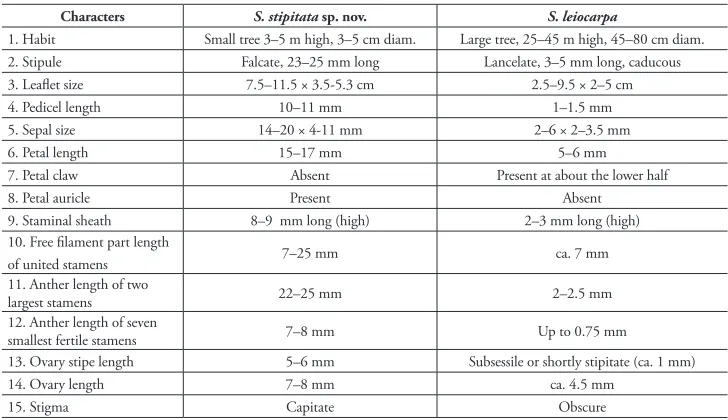
Discussion.Sindora stipitata is closely related to S. leiocarpa, a plant that grows in Sumatra (Jimbi, Palembang and Riau) and Borneo (Sarawak, Brunei, Sabah and Kalimantan) (Hou 2000), but is easily distinguished from the latter by several mor-phological characters. Details of the differences between S. stipitata and S. leiocarpa are presented in Table 1.
Wilawan Promprom et al. / PhytoKeys 100: 149–156 (2018) 154
(vs. shining), the two largest stamen 22–25 mm long (vs. ca. 10 mm long) and anthers 5.5–6 mm long (vs. 2–3 mm long). The new species also clearly differs from S. laotica
Gagnep., a species that is distributed near the border of Thailand (in Vientiane, Phou Khao Khouay National Biodiversity Conservation Area, Lao) and Vietnam (Larsen, Larsen and Vidal 1980); the two species are different in that there is no spiny out-growth on the outer surface of the calyx of the new species (vs. calyx spinescent). The following identification key for Sindora in Thailand and Malesia is constructed by modification of the key from the Flora Malesiana (Hou 2000).
Key to Sindora Species in Thailand and Malesia
1 Leaflets minutely puberulous or pubescent on both surfaces ...S. siamensis – Leaflets glabrous on both surfaces or minutely puberulous or pubescent on
the lower surface or rarely sparsely puberulous above ...2 2 Leaflets glabrous on both surfaces ...3 – Leaflets only minutely puberulous or pubescent on the lower surface or rarely
sparsely puberulous above ...8 3 Apex of leaflet obtuse, rounded, retuse or emarginate ...4 – Apex of leaflets acute to acuminate ...6 4 Calyx lobes densely spinescent ...S. supa – Calyx lobes smooth, unarmed ...5 5 Petal auricle present, petal claw absent, ovary stipe 5-6 mm long ...S. stipitata – Petal auricle absent, petal claw present, ovary subsessile or shortly stipitate ... ...S. leiocarpa
Table 1.Distinguishing features between S. stipitata Chatan & Promprom and S. leiocarpa de Wit.
Characters S. stipitata sp. nov. S. leiocarpa
1. Habit Small tree 3–5 m high, 3–5 cm diam. Large tree, 25–45 m high, 45–80 cm diam. 2. Stipule Falcate, 23–25 mm long Lancelate, 3–5 mm long, caducous
3. Leaflet size 7.5–11.5 × 3.5-5.3 cm 2.5–9.5 × 2–5 cm
4. Pedicel length 10–11 mm 1–1.5 mm
5. Sepal size 14–20 × 4-11 mm 2–6 × 2–3.5 mm
6. Petal length 15–17 mm 5–6 mm
7. Petal claw Absent Present at about the lower half
8. Petal auricle Present Absent
9. Staminal sheath 8–9 mm long (high) 2–3 mm long (high)
10. Free filament part length
of united stamens 7–25 mm ca. 7 mm
11. Anther length of two
largest stamens 22–25 mm 2–2.5 mm
12. Anther length of seven
smallest fertile stamens 7–8 mm Up to 0.75 mm
13. Ovary stipe length 5–6 mm Subsessile or shortly stipitate (ca. 1 mm)
14. Ovary length 7–8 mm ca. 4.5 mm
6 Midrib on the lower surface of the leaflet without a gland near the tip ... ...S. inermis
– Midrib on the lower surface of the leaflet with a gland near the tip ...7
7 Midrib narrow and shallowly grooved on the upper surface ...S. coriacea – Midrib slightly prominent on upper surface ...S. galedupa 8 Fertile stamens 9, the uppermost staminode absent ...S. javanica – Fertile stamens and staminodes 10, the uppermost staminode present ...9
9 Calyx lobes with spinescent outgrowths or warts ...10
– Calyx lobes smooth, unarmed ...13
10 Leaves 3-jugate ...11
– Leaves 4- or 5-jugate ...12
11 Leaflets with apex acute or acuminate ...S. sumatrana – Leaflets with apex obtuse, the tip slightly notched...S. echinocalyx 12 Calyx with spiny outgrowth mostly at the upper half ...S. wallichii – Calyx with loosely, irregularly, minute, spiny outgrowth outside ...S. affinis 13 Leaflets 3- or 4-jugate. Petals hairy on the longitudinal, central part ... ...S. beccariana – Leaflets often 5- or 6-jugate. Petal glabous inside ...14
14 Ovary glabous in the longitudinal, central part ...S. bruggemanii – Ovary all densely woolly ...15 15 Abaxial side of leaflet usually densely hirsute ...S. velutina – Abaxial side of leaflet sparsely and minutely puberulous...S. irpicina
Acknowledgements
The authors are indebted to the curators and officers of L for providing information on the type specimens investigated in this study. We would like to thank Mr. Teerawut Namsawang, Mr. Nopphanun Kanithaisong and the officers in Phulangka National Park while collecting plant specimens during field trips. Thanks for linguistic advice from Dr. Jolyon Dodgson, Faculty of Science, Mahasarakham University. This research was financially supported by Mahasarakham University.
References
Chen D, Zhang D, Hou D (2010) Sindora. In: Wu ZY, Raven PH, Hong DY (Eds) Flora of
China. Vol. 10 (Fabaceae). Science Press, Beijing, and Missouri Botanical Garden Press, St. Louis, 25–26.
Hou D (2000) Leguminosae-Caesalpinioideae. In: Soepadmo F, Saw LG (Eds) Tree Flora of Sabah and Sarawak. Forest research institute Malesia, Kuala Lumpur, 119–180. [Electronic version] IUCN (2017) Standards and Petitions Subcommittee Guidelines for Using the IUCN Red List
Wilawan Promprom et al. / PhytoKeys 100: 149–156 (2018) 156
Kumar S, Sane PV (2003) Legumes of South Asia, A check-List. Royal Botanic Gardens, Kew, 536 pp.
Larsen K, Larsen SS, Vidal JE (1980) Leguminosae-Caesalpinioideae. In: Aubreville A, Leroy J-F (Eds) Flore du Cambodge du Laos et du Viet-Nam 18. Muséum National d’Histoire Naturelle, Paris, 5–221.
Larsen K, Larsen SS, Vidal JE (1984) Leguminosae-Caesalpinioideae. In: Smitinand T, Larsen K (Eds) Flora of Thailand 4(1). Auspices of Danida at the TISTR Press, Bangkok, 1–129.
Hou D (1996) Sindora. In: Kalkman C, Kirkup DW, Nooteboom HP, Stevens PF, de Wilde
WJJO (Eds) Flora Malesiana ser. 1, 12(2). Rijksherbarium/Hortus Botanicus, Leiden, 691–709.
Lock JM, Heald J (1994) Legume of Indo-China, A Check list. Whitstable Litho Ltd., Great Britain, 164 pp.